
LECTURE 3 INNOVATION or TECHNICAL CHANGE FOR DEVELOPMENT
- Slides: 12
LECTURE 3: INNOVATION or TECHNICAL . CHANGE FOR DEVELOPMENT §What is Innovation or Technical Change? §Broad Types of Innovation and their Characteristics; §Importance of Innovation to Development; §Requirements for efficient Innovation; §Innovation as an evolutionary and dynamic process.
BROAD TYPES OF INNOVATION �Major or Radical Innovations – these push outwards the technological frontiers. Examples include: development of motor cars, aeroplanes, micro electronic revolution etc. �They come up with novel processes, methods and ways of doing things which ultimately improve efficiency and productivity.
To effect these types of Innovation requires: § Heavy initial capital outlay and investments; § Highly specialized technical and managerial skills and effort within R&D and related centres; § Involves heavy risks and uncertainty; § Associated with long gestation periods. Major Innovations characteristically take place in technologically advanced countries – where there exists superior technological skills and other forms of capabilities – eg institutions, structures, policies, culture, environment etc.
MINOR OR INCREMENTAL INNOVATION �These are alterations, improvements and modifications performed on existing, tried and proven production systems. They are ‘further ados’ performed on original designs of production systems. �Though minor, but their cumulative impact on productive efficiency and productivity may be as great or even greater than that of major radical changes (See Samuel Hollander (1962; Viv Walsh, 1982; Bell M(1982); etc. �To design and execute these types of Innovations requires:
CONTINUED Less capital outlay and investment; Less specialized skills and expertise; and oftentimes not localized and limited to R&D and Design departments; iii. They involve limited risks and uncertainties; iv. They involve limited gestation period – if at all. i. ii. The majority of innovations that will take place in technologically less advanced countries of the world (like Tanzania) will be of the incremental and minor type – modifications and alterations on original designs of imported technical systems. Examples are abound. For this reason, we are going to focus on this type of innovation – INCREMENTAL or MINOR INNOVATION
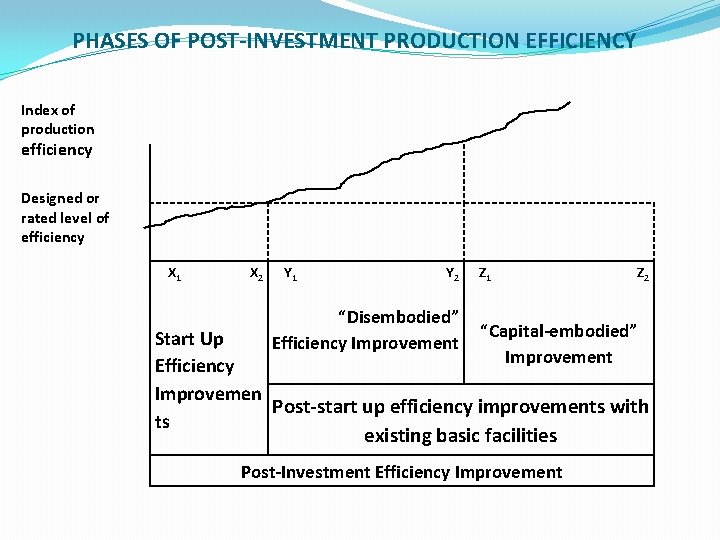
PHASES OF POST-INVESTMENT PRODUCTION EFFICIENCY Index of production efficiency Designed or rated level of efficiency X 1 X 2 Y 1 Y 2 Z 1 “Disembodied” Efficiency Improvement Z 2 “Capital-embodied” Start Up Improvement Efficiency Improvemen Post-start up efficiency improvements with ts existing basic facilities Post-Investment Efficiency Improvement
VALUES OF INNOVATION a) Economic; b) Strategic; c) Social; d) Environmental; e) Personal; f) Political/security
INNOVATION- Continuation 1. Innovation: Is about growth; is a survival imperative 2. Innovation doesn’t just happen-is driven by entrepreneurship 3. Innovation doesn’t happen from our hopes-complex process and needs systematic management 4. Successful innovation managements requires: i. Understanding what we are managing ii. How we are managing iii. Understanding the what, why and how (strategy) iv. Understanding innovation as a moving target-building dynamic capabilities
INNOVATION PROCESS MODEL (Ala Bessant and Tidd)
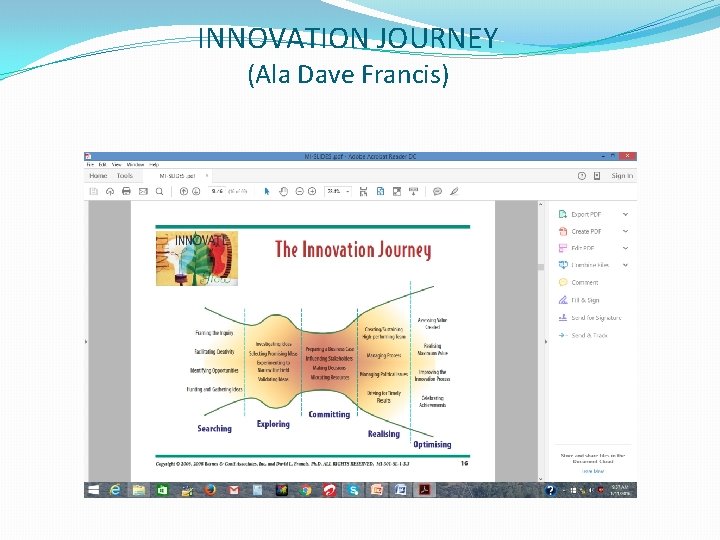
INNOVATION JOURNEY (Ala Dave Francis)
REQUIREMENT FOR EFFICIENT INNOVATION MANAGEMENT CONT… 1. Technological and Managerial Capability 2. Innovation culture and norms i. Team building and working ii. Networking and partner shipping iii. Stay focused iv. Build on other peoples’ ideas v. Timeliness vi. Attentive listening vii. Differing judgment
REASONS FOR DISCUSSING INNOVATION IN DYNAMIC WAY To highlight the technological dimension of development 2. Process being the core of development 3. Away from thinking that R&D being the only source of innovation 1.