
Lecture 3 Human Resource Management MEANING AND DEFINITION
- Slides: 20
Lecture 3 Human Resource Management
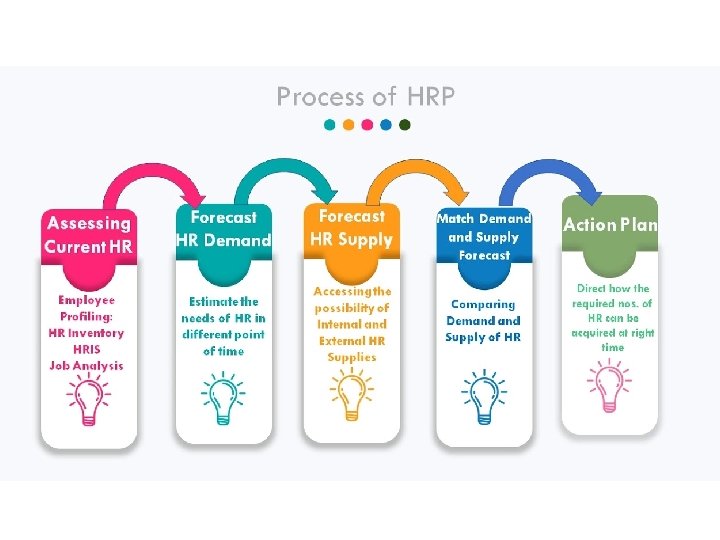
MEANING AND DEFINITION • In simple words, HRP is understood as the process of forecasting an organization's future demand for, and supply of, the right type of people in the right number. • After this only the HRM department can initiate the recruitment and selection process • Its called by manpower planning, personal planning or employment planning
DEFINITION OF HRP • It includes the estimation of how many qualified people are necessary to carry out the assigned activities, how many people will be available, and what, if anything, must be done to ensure that personal supply equals personnel demand at the appropriate point in the future. • Basically it’s the process by which an organization ensures that it has the right number & kind of people, at the right place, at the right time, capable of effectively & efficiently completeing those tasks that will help the organisation achieve its overall objectives.
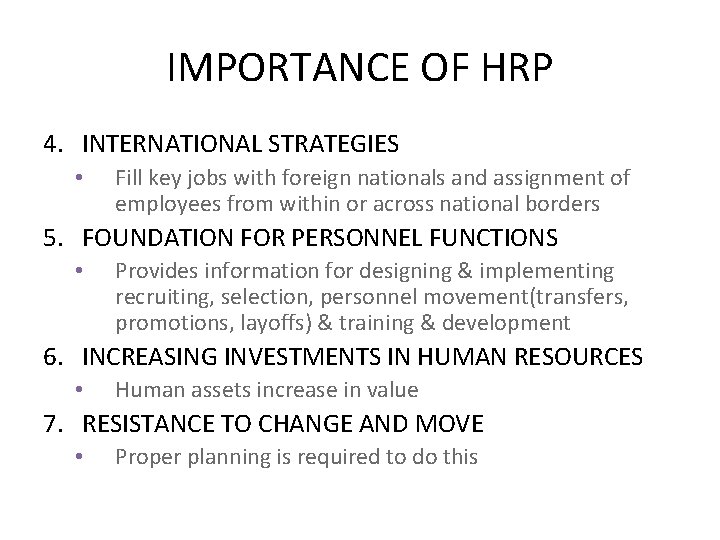
IMPORTANCE OF HRP 1. FUTURE PERSONNEL NEEDS • • Surplus or deficiency in staff strength Results in the anomaly of surplus labour with the lack of top executives 2. COPING WITH CHANGE • Enables an enterprise to cope with changes in competitive forces, markets, technology, products & government regulations 3. CREATING HIGHLY TALENTED PERSONNEL • • HR manager must use his/her ingenuity to attract & retain qualified & skilled personnel Succession planning
IMPORTANCE OF HRP 4. INTERNATIONAL STRATEGIES • Fill key jobs with foreign nationals and assignment of employees from within or across national borders 5. FOUNDATION FOR PERSONNEL FUNCTIONS • Provides information for designing & implementing recruiting, selection, personnel movement(transfers, promotions, layoffs) & training & development 6. INCREASING INVESTMENTS IN HUMAN RESOURCES • Human assets increase in value 7. RESISTANCE TO CHANGE AND MOVE • Proper planning is required to do this
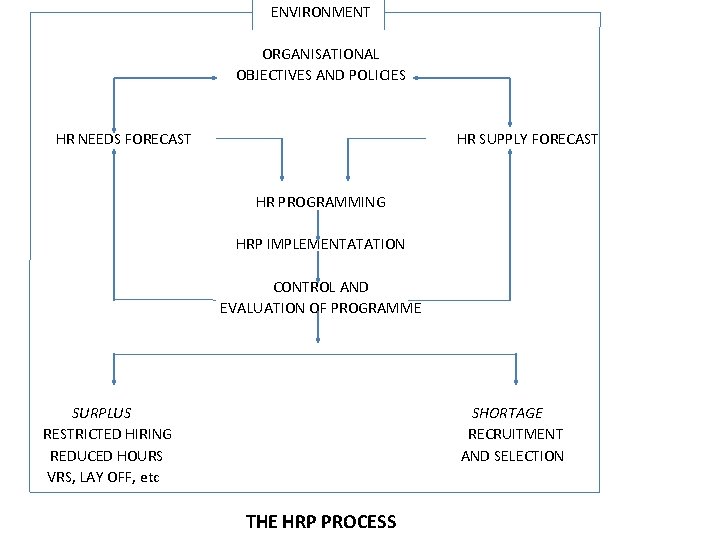
ENVIRONMENT ORGANISATIONAL OBJECTIVES AND POLICIES HR NEEDS FORECAST HR SUPPLY FORECAST HR PROGRAMMING HRP IMPLEMENTATATION CONTROL AND EVALUATION OF PROGRAMME SURPLUS RESTRICTED HIRING REDUCED HOURS VRS, LAY OFF, etc SHORTAGE RECRUITMENT AND SELECTION THE HRP PROCESS
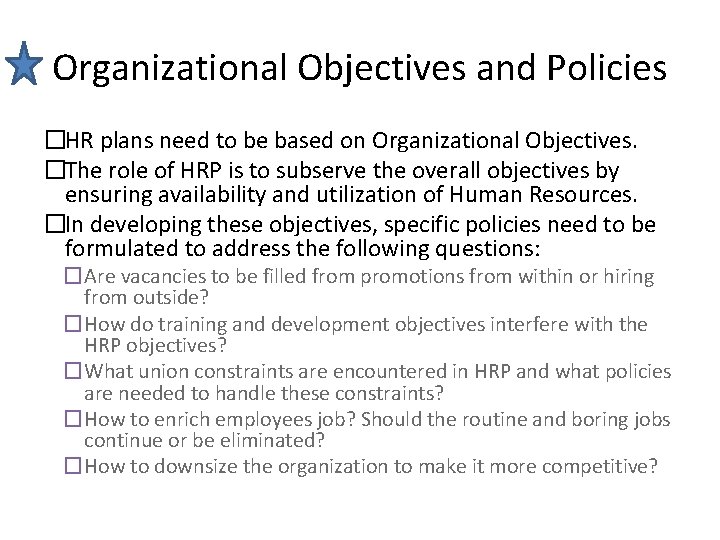
Organizational Objectives and Policies �HR plans need to be based on Organizational Objectives. �The role of HRP is to subserve the overall objectives by ensuring availability and utilization of Human Resources. �In developing these objectives, specific policies need to be formulated to address the following questions: �Are vacancies to be filled from promotions from within or hiring from outside? �How do training and development objectives interfere with the HRP objectives? �What union constraints are encountered in HRP and what policies are needed to handle these constraints? �How to enrich employees job? Should the routine and boring jobs continue or be eliminated? �How to downsize the organization to make it more competitive?
HR Demand Forecast • Demand forecasting is the process of estimating the future quantity and quality of people required. • The basis of the forecast must be the annual budget and long-term corporate plan, translated into activity levels for each function and department
Forecasting Techniques • • • Managerial judgement Ratio-trend analysis Delphi technique Scatter Plot Markov Analysis
Managerial Judgement • In this all managers sit together, discuss and arrive at a figure which would be the future demand for labour. • This technique may involve a ‘bottom-up’ or ‘top-down’ approach. A combination of both could yield positive results.
Ratio-trend analysis • This is the quickest forecasting technique. • This technique involves studying past ratios, say, between the number of workers and sales in an organization and forecasting future ratios, making some allowance for changes in the organization or its method.
Delphi technique • This technique is the method of forecasting personnel needs. • It solicits estimates of personnel needs from a group of experts, usually managers. • The HRP experts act as intermediaries, summarize the various responses and report the findings back to the experts. • Summaries and surveys are repeated until the experts opinion begin to agree.
Scatter plot • shows graphically how two variables such as sales and your firms staffing levels are related. If they are, then if you can forecast the business activity (like sales), you should also be able to estimate your personnel needs. • For example, suppose a 500 -bed hospital expects to expand to 1, 200 beds over the next 5 years. The human resource director wants to forecast how many registered nurses they ll need. The human resource director realizes she must determine the relationship between size of hospital (in terms of number of beds) and number of nurses required.
Markov Analysis • Employers also use a mathematical process known as Markov analysis (or transition analysis) to forecast availability of internal job candidates. Markov analysis involves creating a matrix that shows the probabilities that employees in the chain of feeder positions for a key job (such as from junior engineer, to senior engineer, to engineering supervisor, to director of engineering) will move from position to position and therefore be available to fill the key position
HR SUPPLY FORECAST Supply forecasting measures the no of people likely to be available from within and outside an organisation, after making allowance for absenteeism, internal movements and promotions, wastage and changes in hours and other conditions of work.
HR programming • After personal demand supply are forecast the vacancies should be filled at right time with right employees.
HR Plan implementation • Converting HR plan into action. • Action programmes are. . • • Recruitment Selection & placement Training and development Retraining & redeployment The retention plan The redundancy plan The succession plan
Recruitment Selection & placement If Shortage of employees - Do. Hire new full-time employees Offer incentives for postponing retirement Re-hire retired employees on part-time basis Attempt to reduce turnover Bring in over-time for present employees Subcontract work to another company Hire temporary employees Re-engineer to reduce needs
• If surplus of employees is expected -Do. Do not replace employees who leave Offer incentives for early retirement Transfer or reassign excess employees Use slack time for employees training or equipment maintenance Reduce work hours Pay off employee