
Lecture 3 How Trade Creates Wealth Guest Lecture


- Slides: 25
Lecture 3: How Trade Creates Wealth Guest Lecture 8/31/15 Iva Bozovic
The Big Puzzles • Economists tell us that completely free trade will maximize global wealth. Why do we still see so many barriers to trade? • Why isn’t everyone buying the case for free trade? • Removing (or implementing) trade barriers creates both winners and losers. Who wins, who loses? Lecture 3: Comparative Advantage Iva Bozovic and Benjamin Graham
Taking a Step Back • How does trade create wealth? • Today: • Absolute advantage • The principle of comparative advantage Lecture 3: Comparative Advantage Iva Bozovic and Benjamin Graham
Factors of Production • Inputs • Anything that is used to produce a good (or service) is called a factor of production. • Primary factors: • Land • Farm land, space to set up a factory, etc. (acres) • Labor • Person-hours of work. • Capital • Anything that helps you make more product with less land labor • Money, equipment, tools • “Human capital” = education, knowledge Lecture 3: Comparative Advantage Iva Bozovic and Benjamin Graham
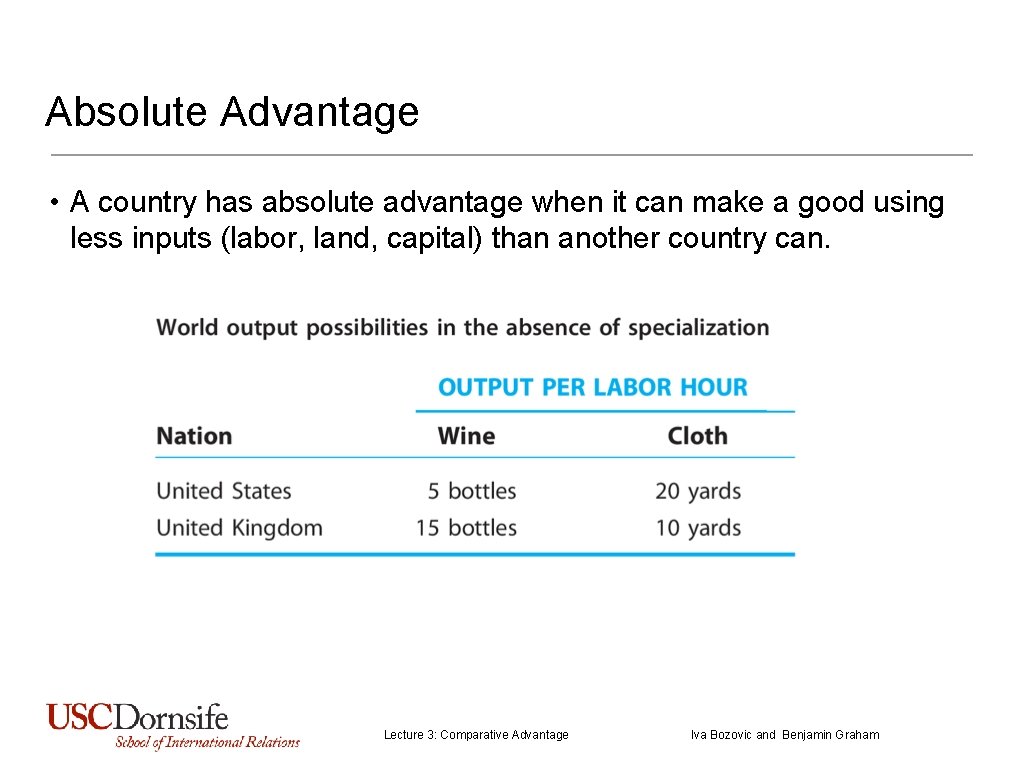
Absolute Advantage • A country has absolute advantage when it can make a good using less inputs (labor, land, capital) than another country can. • Or it can produce more output with the same inputs as another country • Adam Smith says: if two countries each have absolute advantage over the other in at least one thing, they can trade productively. Lecture 3: Comparative Advantage Iva Bozovic and Benjamin Graham
Absolute Advantage • A country has absolute advantage when it can make a good using less inputs (labor, land, capital) than another country can. Lecture 3: Comparative Advantage Iva Bozovic and Benjamin Graham
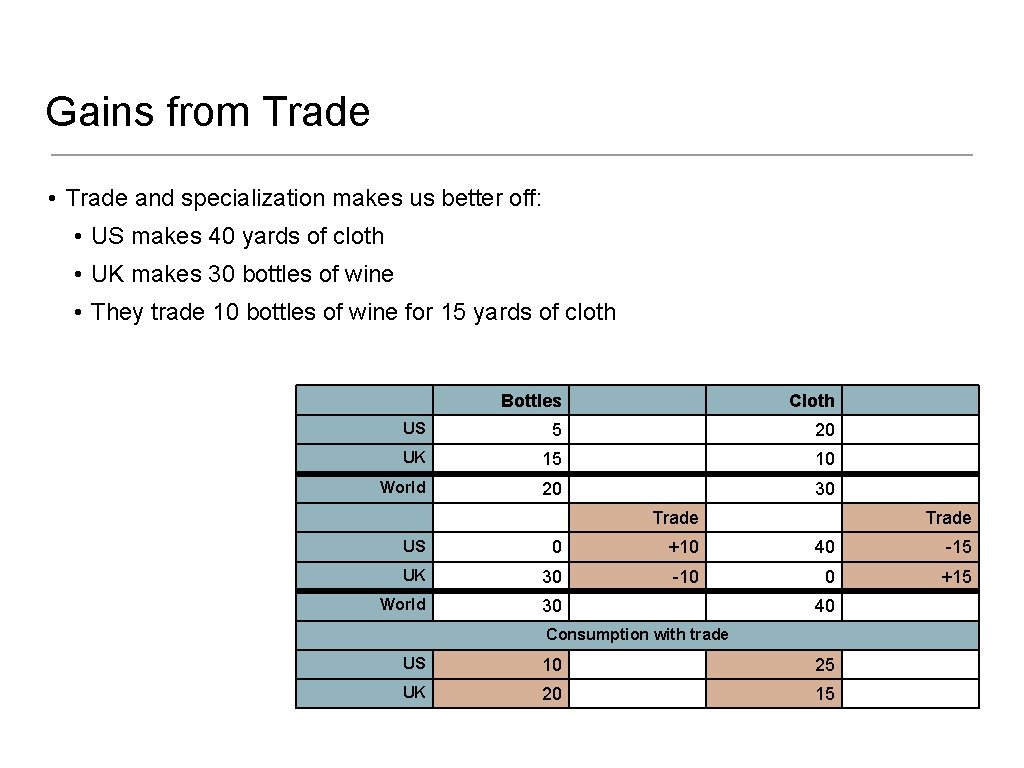
Gains from Trade • Trade and specialization makes us better off: • US makes 40 yards of cloth • UK makes 30 bottles of wine • They trade 10 bottles of wine for 15 yards of cloth Bottles Cloth US 5 20 UK 15 10 World 20 30 Trade US 0 +10 40 -15 UK 30 -10 0 +15 World 30 40 Consumption with trade US 10 25 UK 20 15
Comparative Advantage: The Basis of Exchange 8
A: We can all have more of every good and service if we specialize in the activities at which we are relatively most efficient. 9
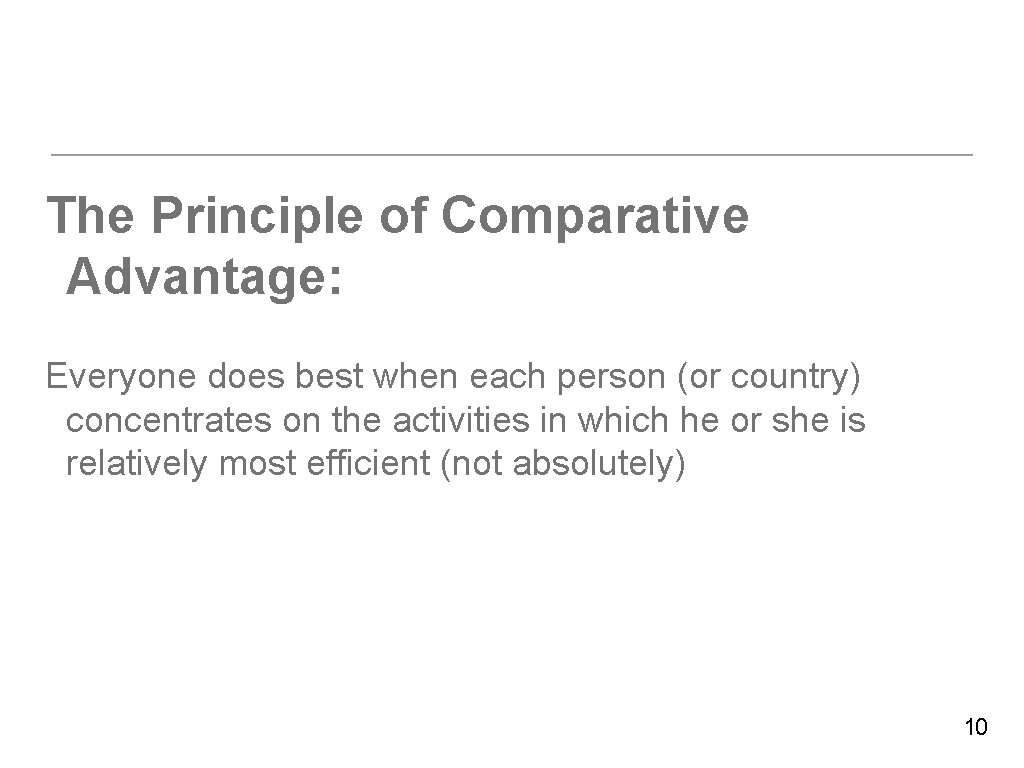
The Principle of Comparative Advantage: Everyone does best when each person (or country) concentrates on the activities in which he or she is relatively most efficient (not absolutely) 10
Principle of Comparative Advantage • Two countries can both benefit from trade EVEN IF one of them has an absolute advantage in everything. • What matters is the opportunity cost Lecture 3: Comparative Advantage Benjamin Graham
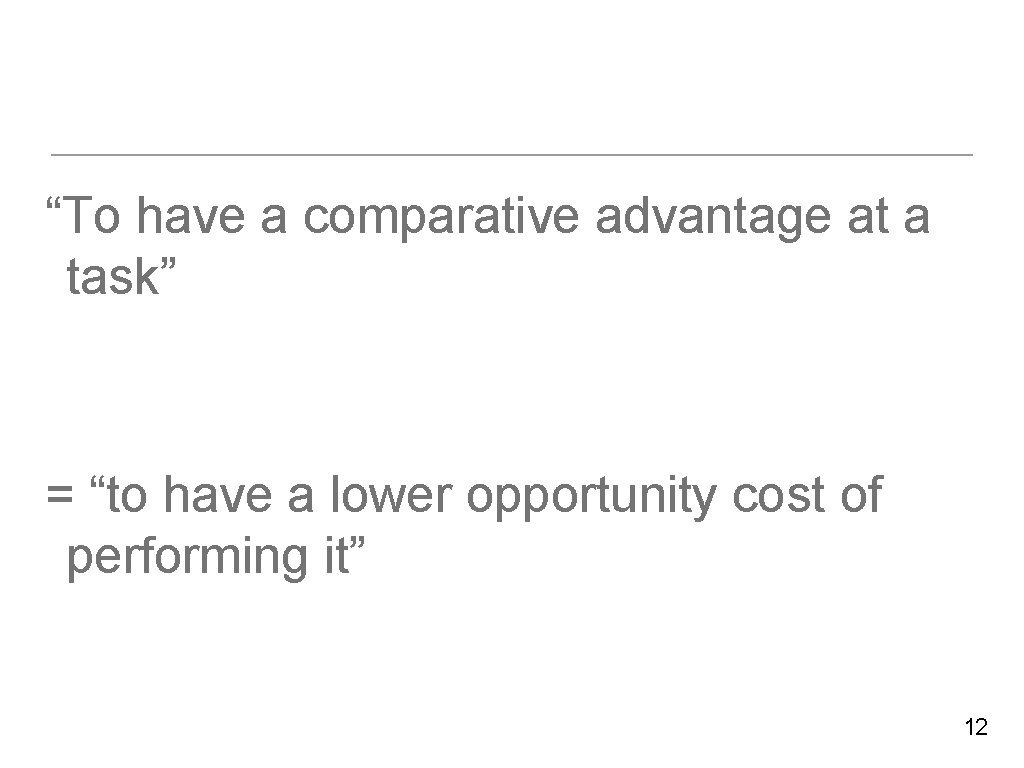
“To have a comparative advantage at a task” = “to have a lower opportunity cost of performing it” 12
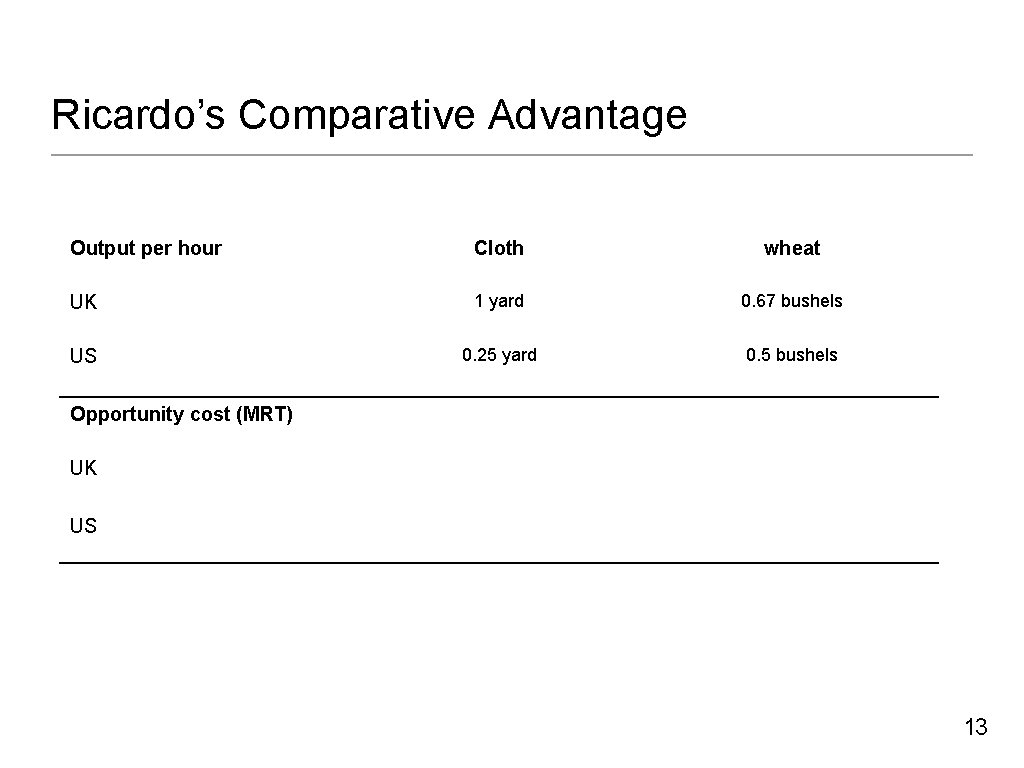
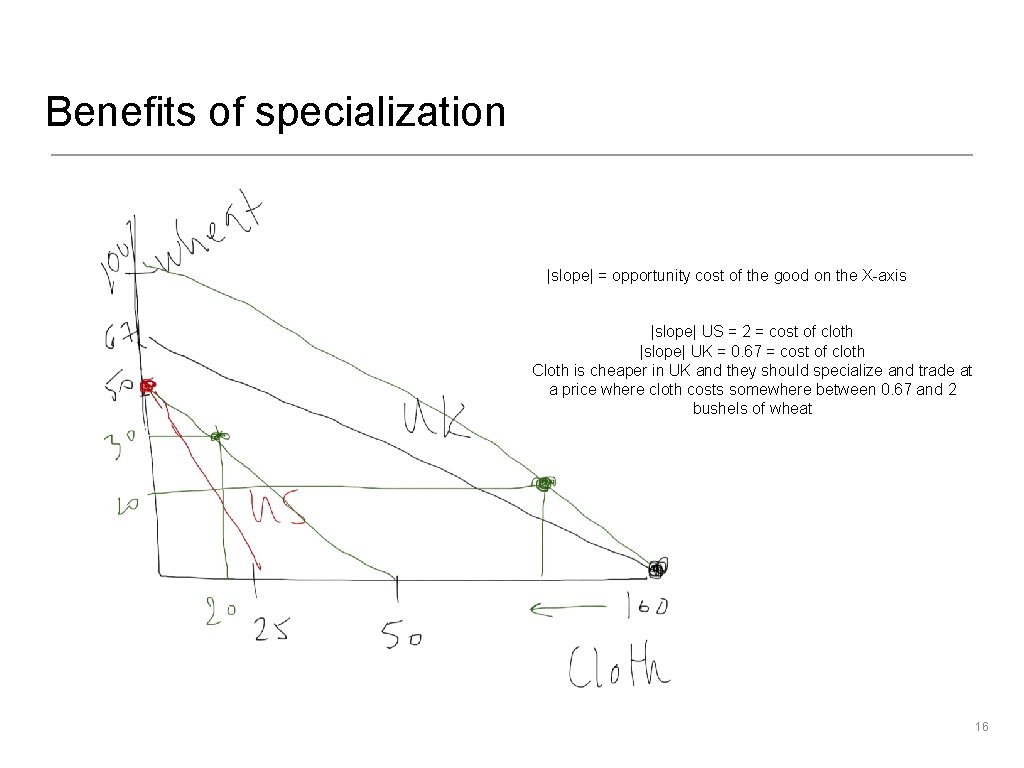
Ricardo’s Comparative Advantage Output per hour Cloth wheat UK 1 yard 0. 67 bushels US 0. 25 yard 0. 5 bushels Opportunity cost (MRT) UK US 13
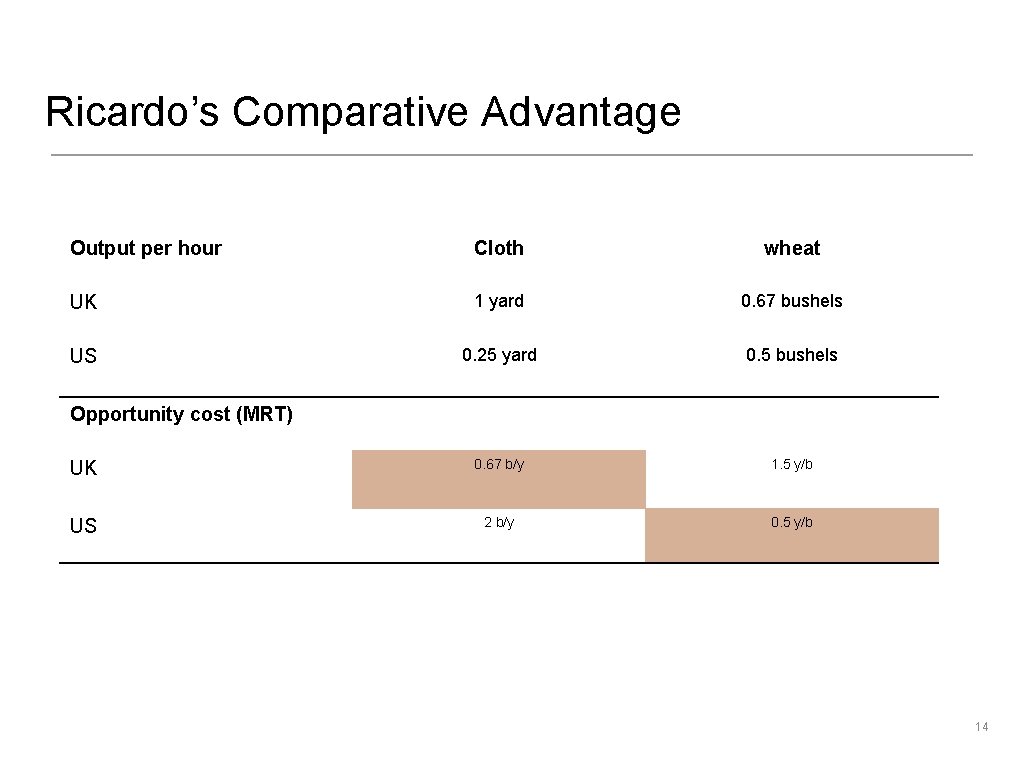
Ricardo’s Comparative Advantage Output per hour Cloth wheat UK 1 yard 0. 67 bushels US 0. 25 yard 0. 5 bushels UK 0. 67 b/y 1. 5 y/b US 2 b/y 0. 5 y/b Opportunity cost (MRT) 14
Benefits of specialization • Let’s say that each country has a 100 million labor hours to use • What could they produce? • Could they rearrange their production to get more benefits • Yes, specialize based on your comparative advantage 15
Benefits of specialization |slope| = opportunity cost of the good on the X-axis |slope| US = 2 = cost of cloth |slope| UK = 0. 67 = cost of cloth Cloth is cheaper in UK and they should specialize and trade at a price where cloth costs somewhere between 0. 67 and 2 bushels of wheat 16
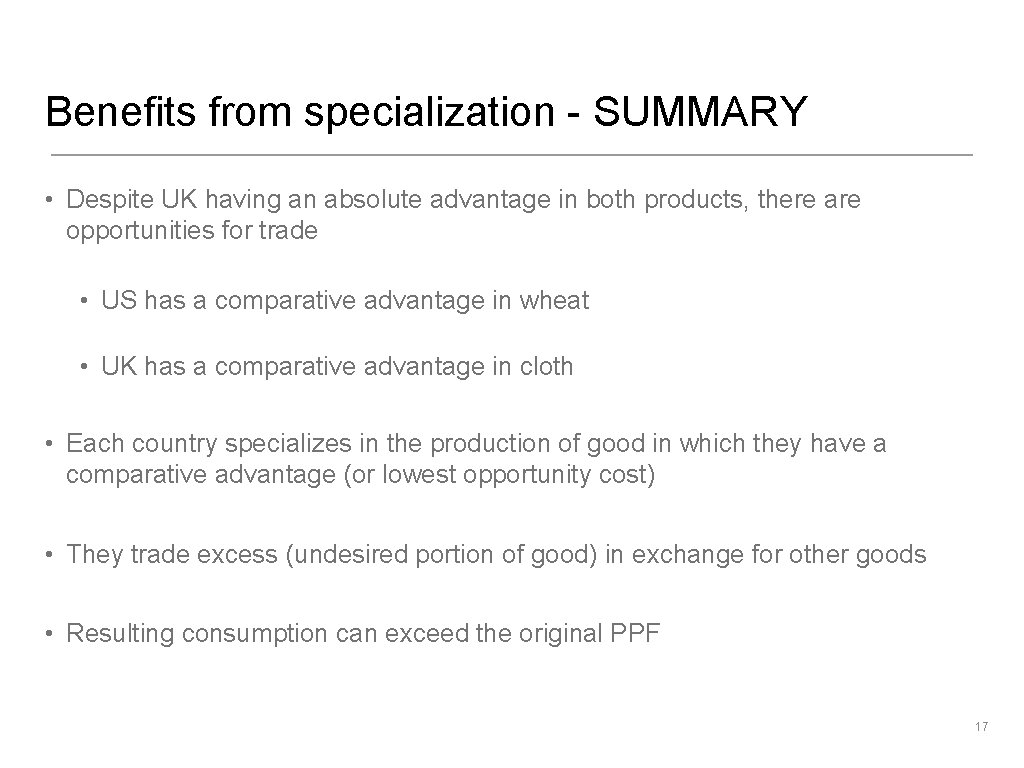
Benefits from specialization - SUMMARY • Despite UK having an absolute advantage in both products, there are opportunities for trade • US has a comparative advantage in wheat • UK has a comparative advantage in cloth • Each country specializes in the production of good in which they have a comparative advantage (or lowest opportunity cost) • They trade excess (undesired portion of good) in exchange for other goods • Resulting consumption can exceed the original PPF 17
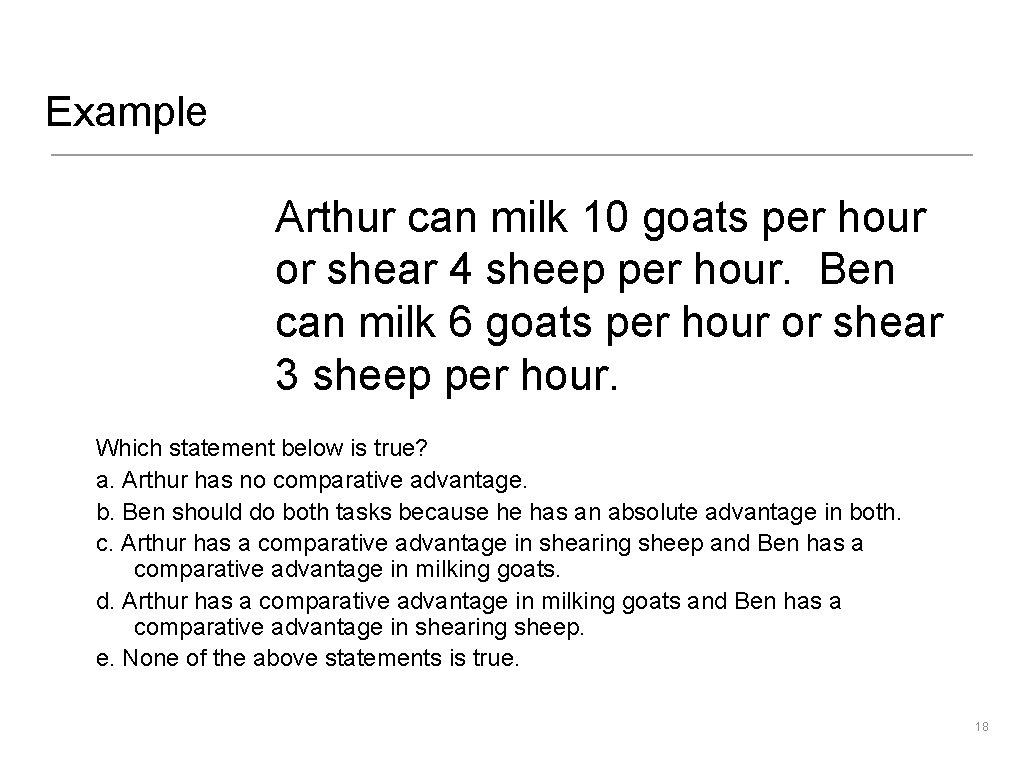
Example Arthur can milk 10 goats per hour or shear 4 sheep per hour. Ben can milk 6 goats per hour or shear 3 sheep per hour. Which statement below is true? a. Arthur has no comparative advantage. b. Ben should do both tasks because he has an absolute advantage in both. c. Arthur has a comparative advantage in shearing sheep and Ben has a comparative advantage in milking goats. d. Arthur has a comparative advantage in milking goats and Ben has a comparative advantage in shearing sheep. e. None of the above statements is true. 18
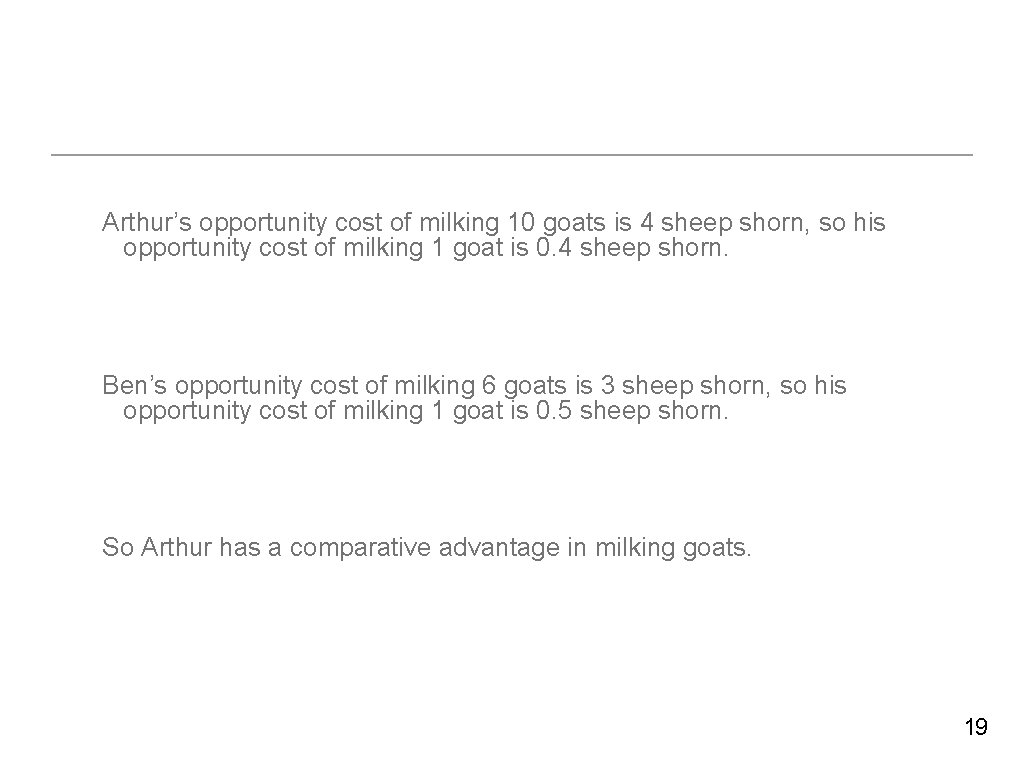
Arthur’s opportunity cost of milking 10 goats is 4 sheep shorn, so his opportunity cost of milking 1 goat is 0. 4 sheep shorn. Ben’s opportunity cost of milking 6 goats is 3 sheep shorn, so his opportunity cost of milking 1 goat is 0. 5 sheep shorn. So Arthur has a comparative advantage in milking goats. 19
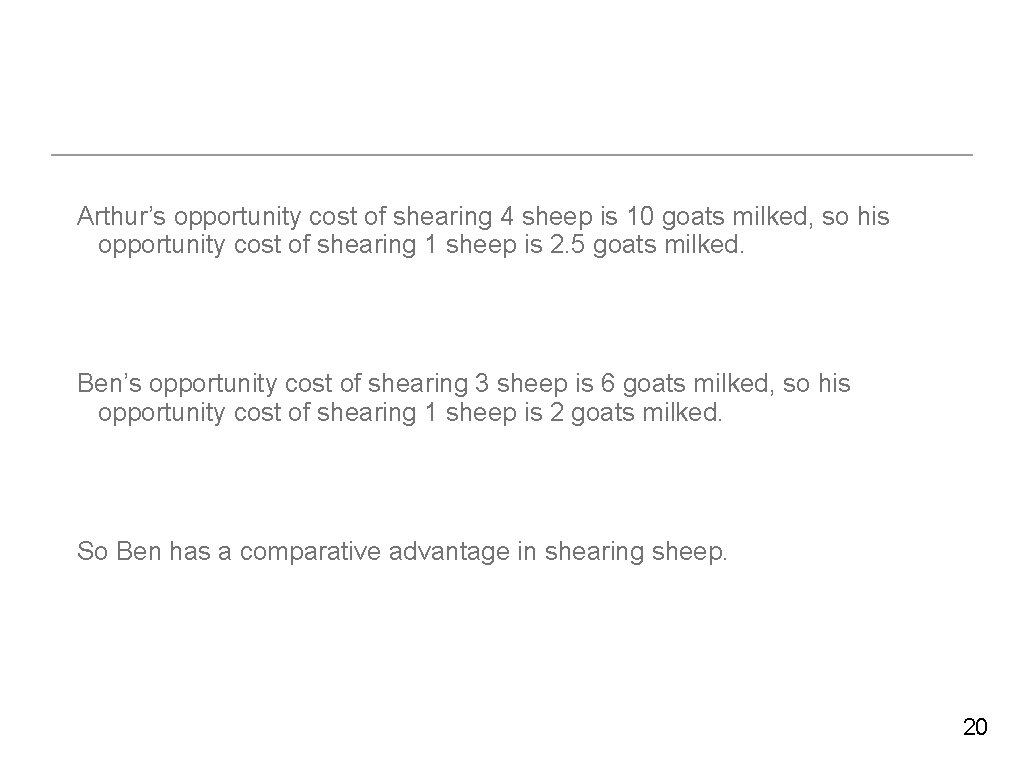
Arthur’s opportunity cost of shearing 4 sheep is 10 goats milked, so his opportunity cost of shearing 1 sheep is 2. 5 goats milked. Ben’s opportunity cost of shearing 3 sheep is 6 goats milked, so his opportunity cost of shearing 1 sheep is 2 goats milked. So Ben has a comparative advantage in shearing sheep. 20
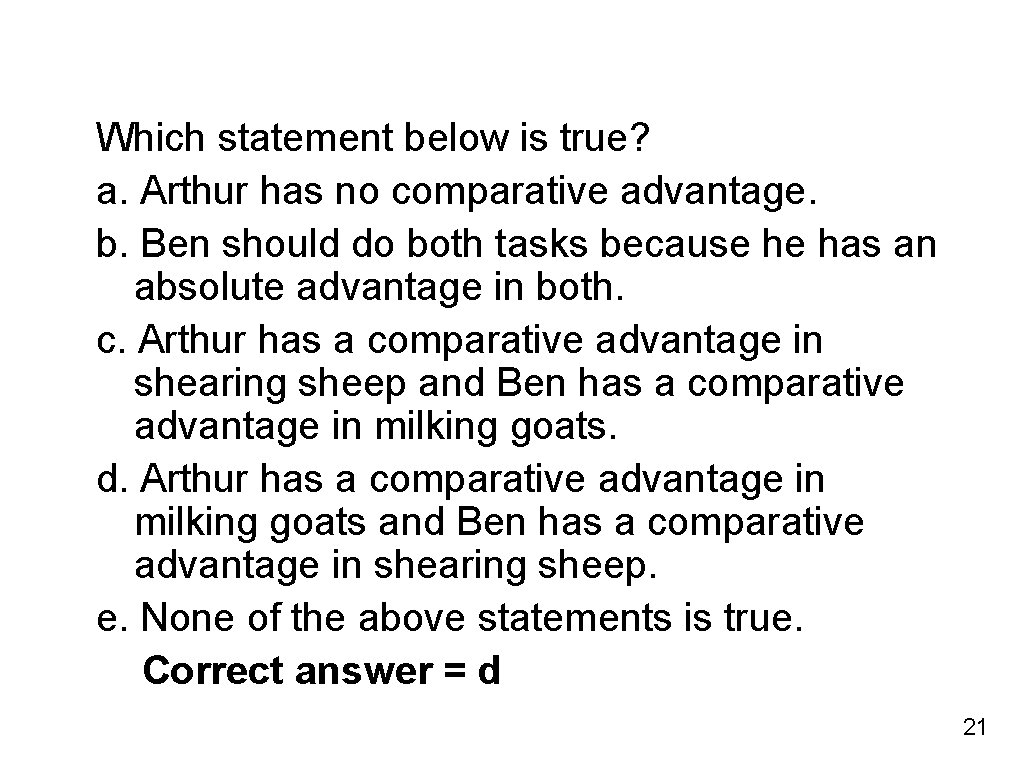
Which statement below is true? a. Arthur has no comparative advantage. b. Ben should do both tasks because he has an absolute advantage in both. c. Arthur has a comparative advantage in shearing sheep and Ben has a comparative advantage in milking goats. d. Arthur has a comparative advantage in milking goats and Ben has a comparative advantage in shearing sheep. e. None of the above statements is true. Correct answer = d 21
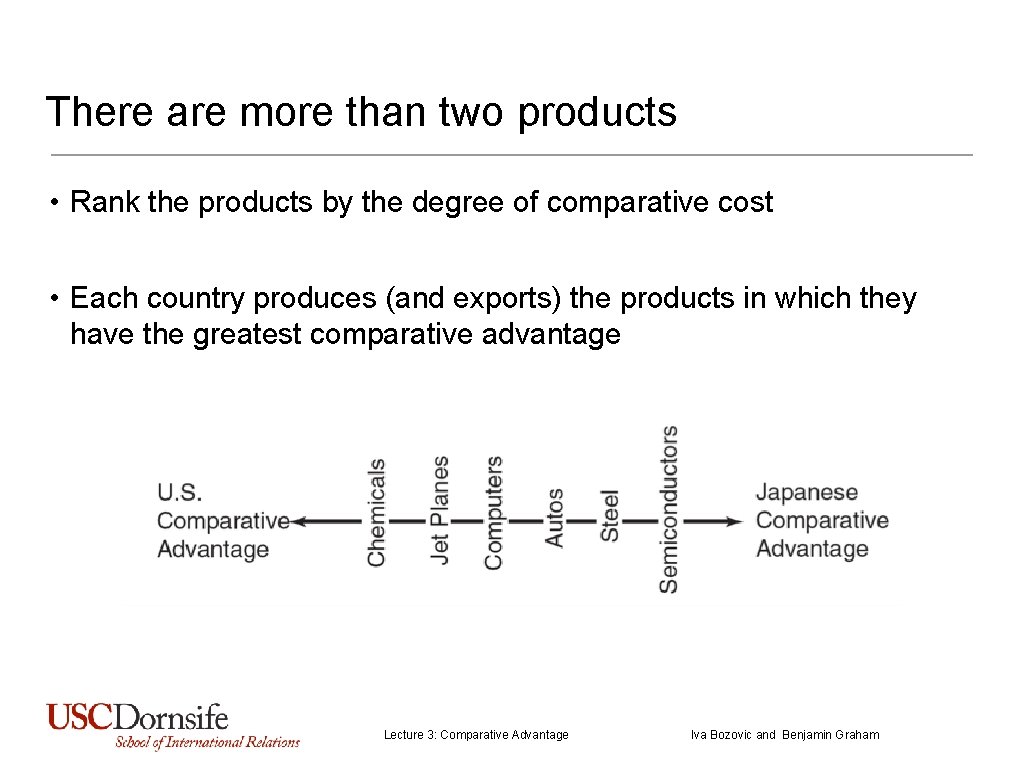
There are more than two products • Rank the products by the degree of comparative cost • Each country produces (and exports) the products in which they have the greatest comparative advantage Lecture 3: Comparative Advantage Iva Bozovic and Benjamin Graham
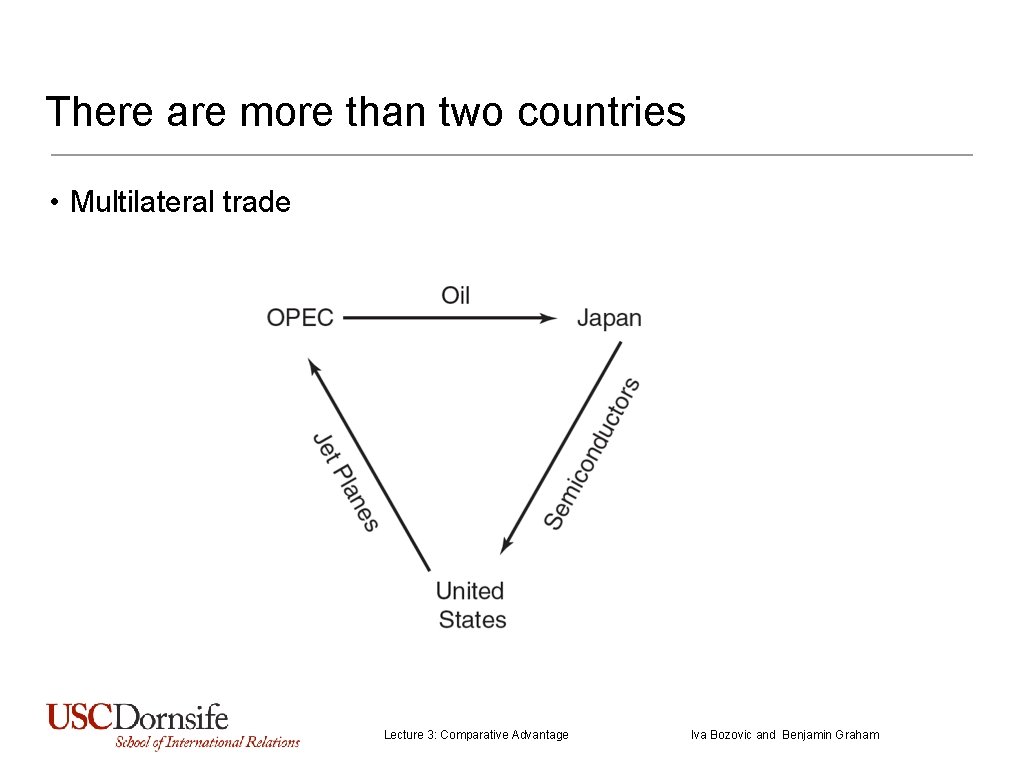
There are more than two countries • Multilateral trade Lecture 3: Comparative Advantage Iva Bozovic and Benjamin Graham
What determines comparative advantage? • Factor endowments -- land, natural resources, weather. . . • Saudi Arabia has a comparative advantage in producing oil • Florida has a comparative advantage producing oranges • Past investments -- how much of what type of capital you have • Education, infrastructure, factories, machinery Lecture 3: Comparative Advantage Iva Bozovic and Benjamin Graham
Who wins, who loses? Lecture 3: Comparative Advantage Iva Bozovic and Benjamin Graham