
Lecture 3 Experimental measurements chpt 5 Feynman Importance

- Slides: 23
Lecture 3: Experimental measurements (chpt 5, Feynman)
Importance of measurements • Physics is an experimental science! Most physicists are experimenters • Measurability is a key part of the sciences • First person who perform quantitative measurement (scientist) is Galileo Galilei (15641642) • Most of the Nobel prizes have awarded to invention of instruments • First US Nobel prize winner: Michelson, invention of interferometer!
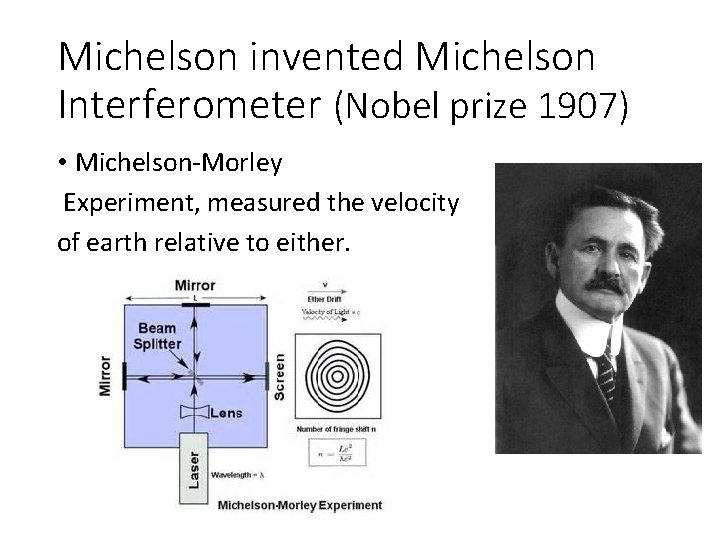
Michelson invented Michelson Interferometer (Nobel prize 1907) • Michelson-Morley Experiment, measured the velocity of earth relative to either.
What do you want to measure? • Distance, Time, Speed • Temperature (thermometer), pressure • Weight, mass • Energy, power, noise • Brightness, telescope, • Concentration, blood analysis, • Electromagnetic fields, electric current, resistors, capacitors, etc. • Radioactivity • ….
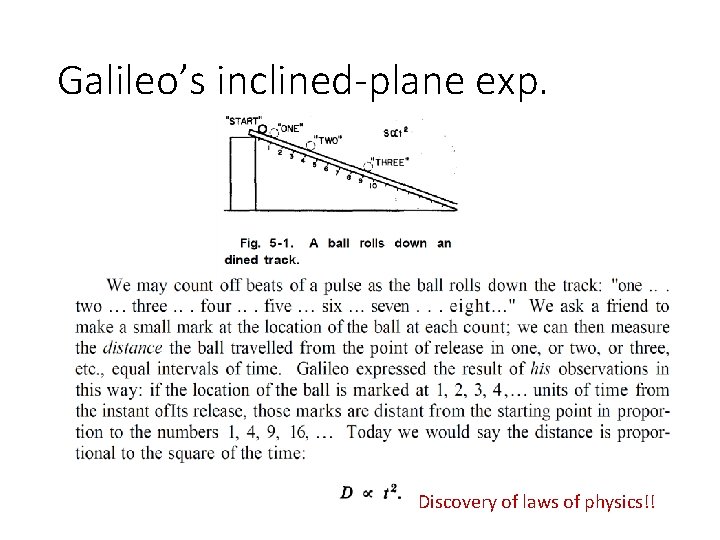
Galileo’s inclined-plane exp. Discovery of laws of physics!!
Time measurement • Something that happens again and again • Counting pulse! • Day, hour glass, noon to noon measurement is nearly the same! • Fraction of a day: other periodic motion! • Galileo: pendulum: grand-father clock • Make a pendulum swing 3600 times x 24 in a day, each swing is a second!
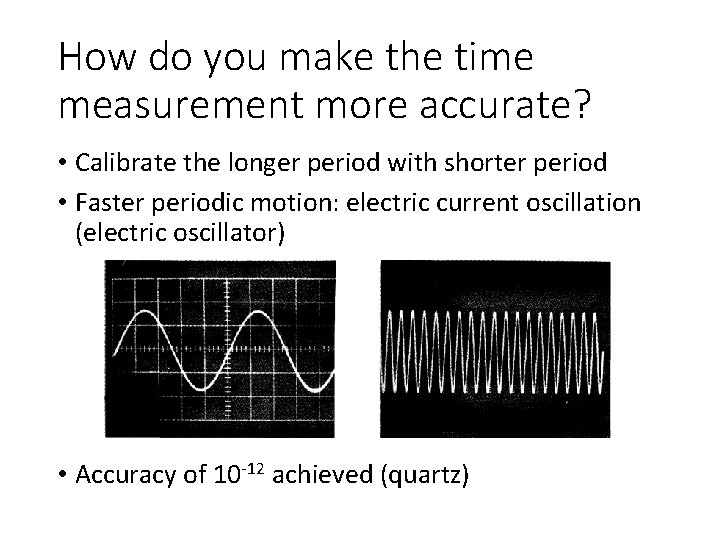
How do you make the time measurement more accurate? • Calibrate the longer period with shorter period • Faster periodic motion: electric current oscillation (electric oscillator) • Accuracy of 10 -12 achieved (quartz)
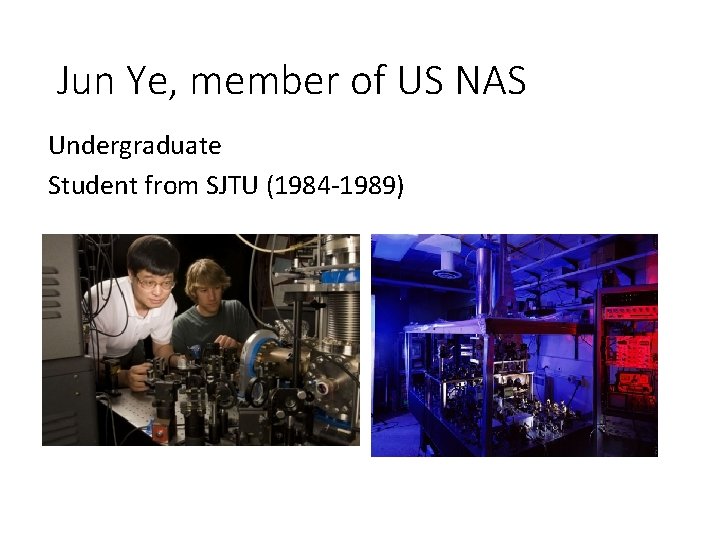
Atomic clock and light clock • Atom moves periodically inside the atom. • Atomic clock has been used as a standard for time measurement since 1960’s and is the most accurate devise now available. • Usually radio-wave and has reached accuracy of 10 -16 • More accurate measurement needs better frequency measurement, light comb, (light clock) • Jun Ye (JILA), the best guy in the world, 10 -18 • Low-temp + relativity
Jun Ye, member of US NAS Undergraduate Student from SJTU (1984 -1989)
Shortest time • Lifetime of the elementary particles • Strong interaction particle 10 -24 sec, time it takes from light travel through the proton, atomic nuclei. • Higgs particles life time is very short. 1. 6 X 10 -22 sec
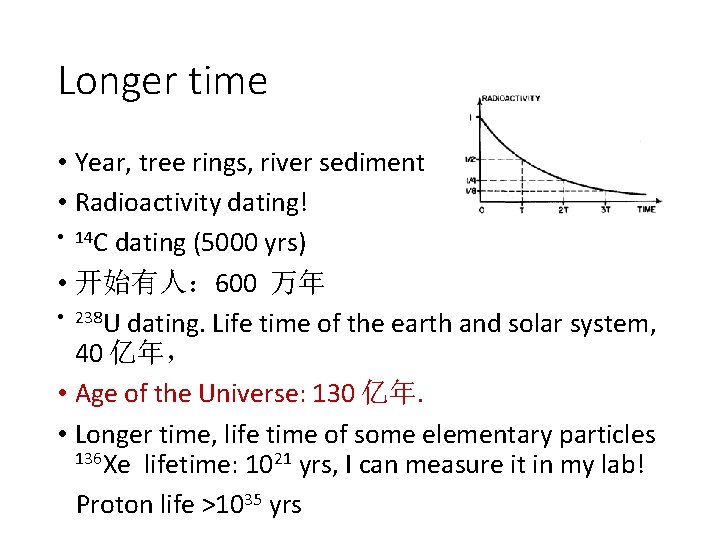
Longer time • Year, tree rings, river sediment • Radioactivity dating! • 14 C dating (5000 yrs) • 开始有人: 600 万年 • 238 U dating. Life time of the earth and solar system, 40 亿年, • Age of the Universe: 130 亿年. • Longer time, life time of some elementary particles 136 Xe lifetime: 1021 yrs, I can measure it in my lab! Proton life >1035 yrs
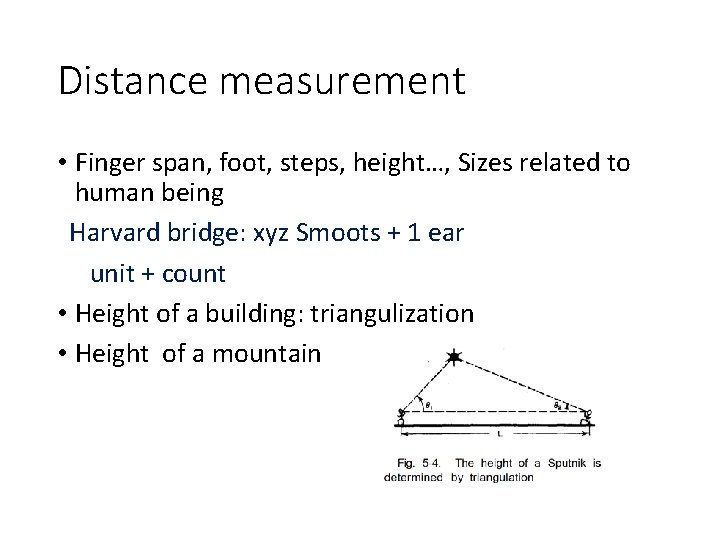
Distance measurement • Finger span, foot, steps, height…, Sizes related to human being Harvard bridge: xyz Smoots + 1 ear unit + count • Height of a building: triangulization • Height of a mountain
Astrophysical measurement • Radius of earth, In the third century B. C. , Eratosthenes was able to mathematically calculate the earth’s diameter by comparing differences in the angle of the sun’s rays at two separate geographic points. He noticed that the difference in the angle of a shadow in his location at Syene, which is present-day Aswan in Egypt, and that of a shadow in Alexandria was about 7. 2 degrees. Since he knew the distance between the locations, he was able to determine the circumference of the earth, and therefore the diameter and radius as well. You can do this, too, by using his method. Read more : http: //www. ehow. com/how_5895686_radiusearth. html how many ways do you know to measure? • Distance to the sun, how many ways? • Distance to moon, laser measurement.
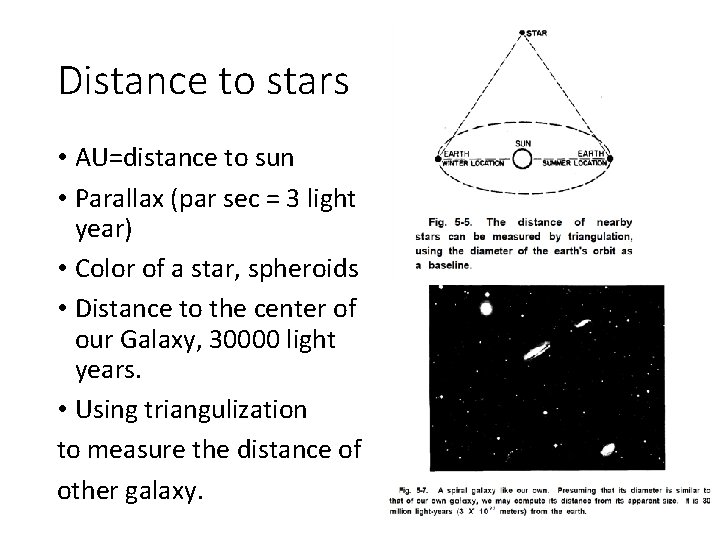
Distance to stars • AU=distance to sun • Parallax (par sec = 3 light year) • Color of a star, spheroids • Distance to the center of our Galaxy, 30000 light years. • Using triangulization to measure the distance of other galaxy.
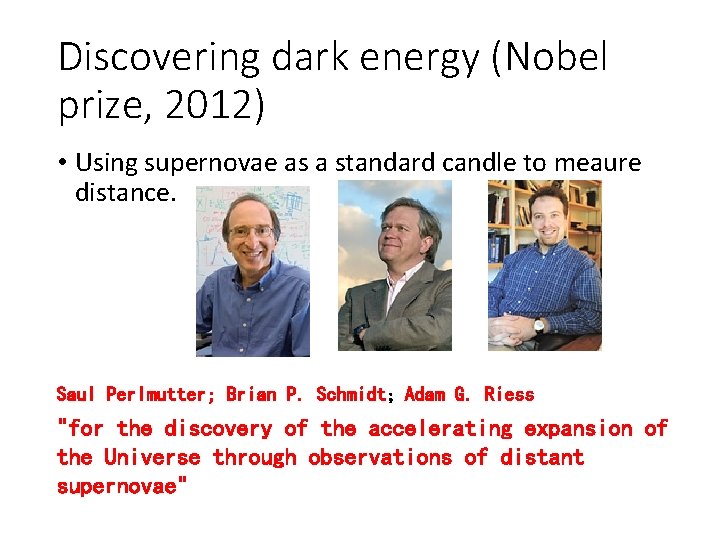
Discovering dark energy (Nobel prize, 2012) • Using supernovae as a standard candle to meaure distance. Saul Perlmutter; Brian P. Schmidt; Adam G. Riess "for the discovery of the accelerating expansion of the Universe through observations of distant supernovae"
Smaller distance • Meter, 4 x 10⁷ m around the equator • Some bar in Paris, now as certain distance that light travels in a certain time. • cm, mm, … • First major improvement: light as a wave! Wavelength is on the order of 500 nm! 1 nm = 10 -9 m • Optics experiment, Newton ring, • Michelson interferometer • X-ray determine the size of atom 0. 1 nm
Even smaller distance • Rutherford experiment found that atoms are quite empty. • He found the size of the nuclei around 10 -15 m = 1 fm • Since then some of the smaller distance measurement done to 10 -18 m, LHC, large hadron collider • Smallest distance measurement: space oscillation under gravitational wave, 10 -22 m. If found this is a Nobel prize work!
More on measurements • Measuring temperature, • Very hot, very cold • Speed measurement, Light speed, speed of an atom • Measuring magnetic field, electric field SQID, Quantum hall effect • Measuring fundamental constants • Sensors, large data, data processing, information science!
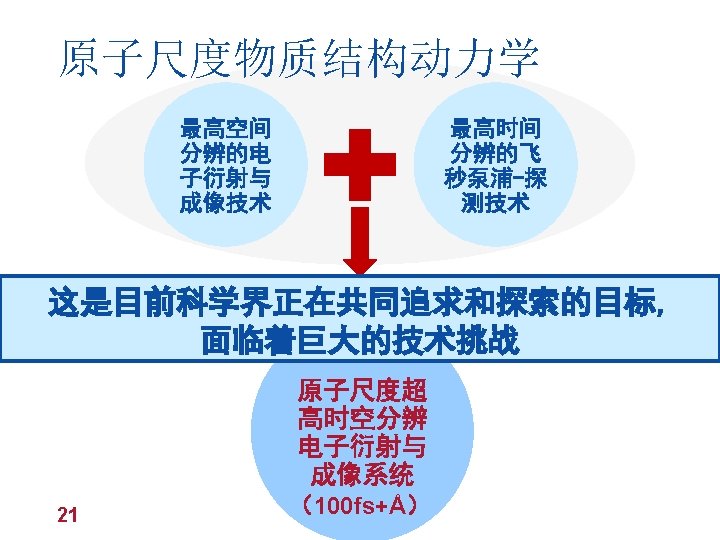
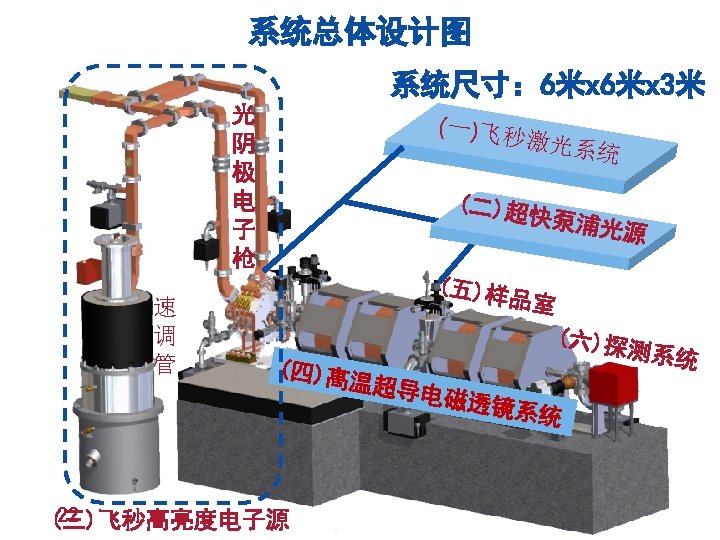
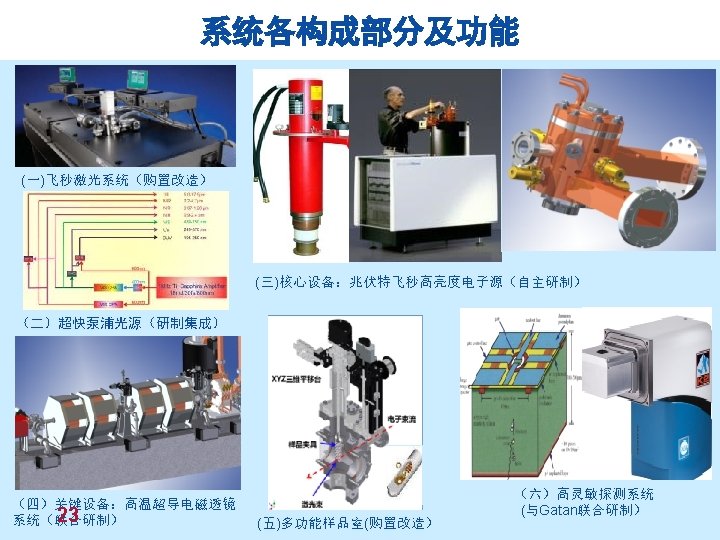
Equipment money • A lot of measuring equipment were invented in western world. • Now China is supporting inventing new apparatus, Ministry of science and technology, National Science Foundation of China • A lot of money • One of these at SJTU, 4 D electron imaging system.