
Lecture 3 Elaboration and System Architecture Copyright W
Lecture 3: Elaboration and System Architecture Copyright W. Howden 1
Topics • System design oriented software architecture concepts – component structures • UML and the representation of architecture – components • Java and architectural components – folders Copyright W. Howden 2
Why Now? • System Architecture is often considered design, not requirements/elaboration • Personal past experience – Have a ready system metaphor we can use • Industry past experience – Study other experiences to get some insight • Examine technology to see what it will support Copyright W. Howden 3

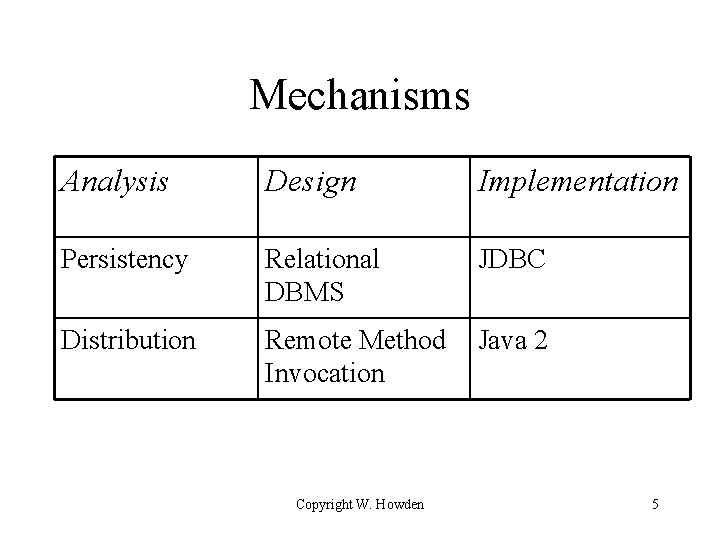
System Architecture • Basic Pieces of the system – Components, Modules, Subsystems • Structure of the System – Relationships between pieces • Solution Strategies for System – Is this Architecture? – E. g. Analysis and Design Mechanisms Copyright W. Howden 4
Mechanisms Analysis Design Implementation Persistency Relational DBMS JDBC Distribution Remote Method Invocation Java 2 Copyright W. Howden 5
Tiers • Physical tiers – Separate machines, e. g. client/server • Logical tiers – Logical components, e. g. GUI, Business Logic, Data. Base • Refinements – E. g. • Thin client: presentation logic only • Fat client: presentation logic plus business logic Copyright W. Howden 6
Layers • From OS – layers of progressively more abstract machines, each of which uses the services of lower levels • Logical Tiers and Layers GUI Business/Application/Domain Logic Data Base Copyright W. Howden 7
Model-View Separation • Layers model for GUI oriented application: View-GUI Model • View layer displays information known from model layer • Why? – Divide and conquer approach to development – Can make changes to GUI without touching the “guts” of the system Copyright W. Howden 8
Model View Controller • View = graphics presentation • Model = Business Logic • Controller = respond to input from View by calling on Model, updating view with information from model • Java, VB, etc. - view classes have associated event responders. Controller merged into View Copyright W. Howden 9
MV Separation and Callbacks • View can call on model to get information to display • How does lower level Model alert View about something that needs to be displayed? • View calls a model method with an identifier for a method to be called when the condition of interest happens. Passed method is called a call back function Copyright W. Howden 10
Observer/Observable -1 • • • Based on a design pattern Java Classes Can be used to support callbacks Observers – register with observable Observable – when instructed, will call the observers’ update() method Copyright W. Howden 11
Observer/Observable -2 • Observer is an interface – Implementer class must implement update(Observable obs, Object arg) • Observable is a class – Includes • add. Observer(Observer obs) • notify. Observers(Object arg) Copyright W. Howden 12
Sample Callback for Dating. System • Requirement: we want the domain/business logic layer of the system to flash a warning on the screen if the logged on member is not paid up, and then continue normally with the logic for logging on • Use of observer/observable – GUI implements Observer => must implement an update() method. Have this method flash the warning – DL extends Observable => it will have an add. Observer(Observer obs) and notify. Observer. Method() Copyright W. Howden 13
Use of the Call. Back • Assume at start up where the constructor for GUI is passed a reference to an instance of the DL • GUI constructor calls DL. add. Observer(this) to register itself as an observer of DL • In the log. On logic in DL: if the special condition is recognized, notify. Observers() is called which causes the registered observers update() methods to be called which causes the warning to flash Copyright W. Howden 14
UML and Components • Components – Pieces of the system architecture – Layers, modules, logical tiers – May be nested subcomponents • UML packages – Collections of classes and packages – May be used for modeling components Copyright W. Howden 15
Subsystems • Package plus one or more interfaces that define the services supported by the subsystem • Layers can be modeled as subsystems • Interfaces: set of method specifications, e. g. Java interfaces Copyright W. Howden 16
Subsystems and Facades • Façade – an interface object that is the single point of entry for the services of a subsystem - a common unified interface for a disparate set of implementations or interfaces • Subsystem interface can be a façade which calls methods in an implemented subsystem • Could also be a proxy which simulates a subsystem or which communicates with a remote implementation • These patterns (façade and proxy) will be discussed later Copyright W. Howden 17
Java Subsystems • Possible units of organization: – Files – Folders – Classes – Packages Copyright W. Howden 18
Files and Subsystems • Files: units of compilation • Compilation produces class files for each class in a file • Too small a unit for organizing subsystems • Class in one file has limited visibility (i. e ability to create an instance of) to classes in other files. Copyright W. Howden 19
Inner Classes and Subsystems • Inner Class – Defined inside another class – Has access to variables of enclosing class • Subsystems consist of a principal class (e. g. subsystem proxy controller), and its inner classes? • Problems e. g. – Cannot have static members in inner classes – Cannot access inner classes from the outside Copyright W. Howden 20
Folders and Subsystems • Associate subsystems with folders • When class file is compiled, compiled class files will go into the same folder Copyright W. Howden 21
Packages • Java Package is a collection of classes • Package is associated with a folder • Can use import statement in a file to identify source of classes used in file • Use package statement to identify a file as belonging to a package • Use import to identify sources of referenced classes Copyright W. Howden 22
Packages and Subsystems • Subsystem is a package • Package has interface classes for the subsystem (e. g. a façade class) • Visibility – Normal: can see the public class in another file – Package: can see non-private (public and “friendly” undesignated) entities in other files Copyright W. Howden 23
Additional Packages • Globals – E. g. Member. Data in DS • Utility routines – E. g. Classes used for tracing and debugging • Subsystem interface definitions? Copyright W. Howden 24
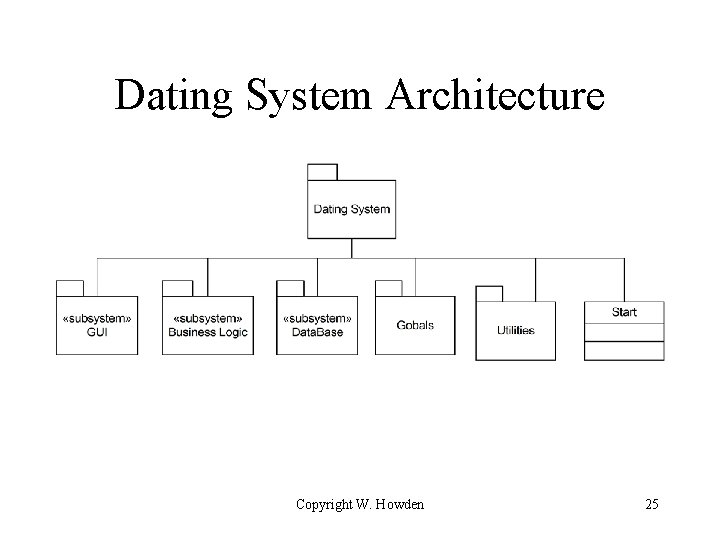
Dating System Architecture Copyright W. Howden 25
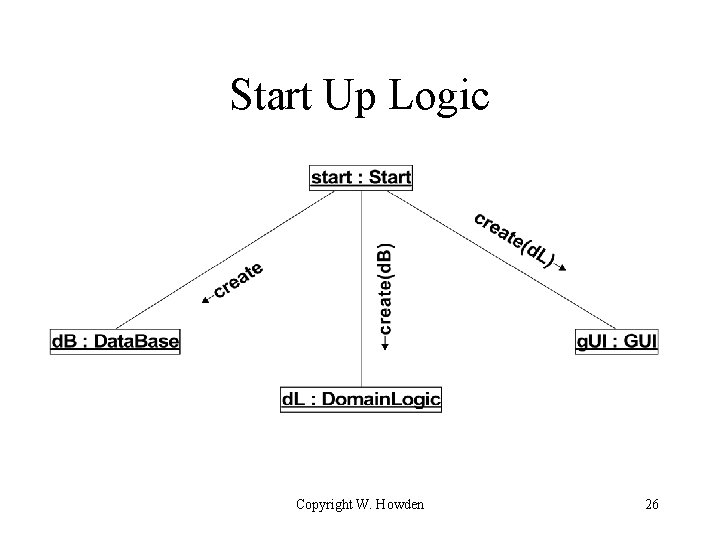
Start Up Logic Copyright W. Howden 26
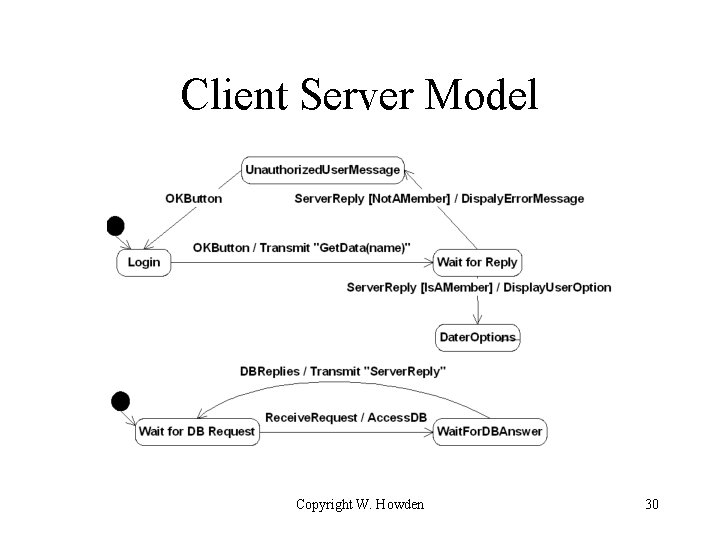
Distributed Systems Architecture • Stand Alone versus Client Server • Basic Model: Communicating State Machines – Components: client(s) and server – Component specification: state machine Copyright W. Howden 27
State Machines • Nodes correspond to states a system/component/object is in • Transitions from one state to another caused by external events that are recognized/recorded by the component • Transitions may also have – conditions that must be satisfied for transition to occur – actions that are carried out when a transition is followed Copyright W. Howden 28
Some state machine notation • Solid black dot shows the starting state(s) • Circular transitions are allowed • “[ cond ]” on a transition indicates a transition condition • “/ action” on a transition indicates a transition action e. g. send or receive message from other component • further discussion will be done in lecture on state charts Copyright W. Howden 29
Client Server Model Copyright W. Howden 30
- Slides: 30