
LECTURE 3 DEDUCTIVE REASONING AGENTS An Introduction to
![Agent Architectures n Kaelbling considers an agent architecture to be: ‘[A] specific collection of](https://slidetodoc.com/presentation_image/3aadf638377908b36bea47dd0167d12c/image-4.jpg "Agent Architectures n Kaelbling considers an agent architecture to be: ‘[A] specific collection of")
- Slides: 47
LECTURE 3: DEDUCTIVE REASONING AGENTS An Introduction to Multi. Agent Systems http: //www. csc. liv. ac. uk/~mjw/pubs/imas 3 -1
Agent Architectures n n n An agent is a computer system capable of flexible autonomous action… Issues one needs to address in order to build agent-based systems… Three types of agent architecture: q q q symbolic/logical reactive hybrid 2
Agent Architectures n n n We want to build agents, that enjoy the properties of autonomy, reactiveness, pro-activeness, and social ability that we talked about earlier This is the area of agent architectures Maes defines an agent architecture as: ‘[A] particular methodology for building [agents]. It specifies how… the agent can be decomposed into the construction of a set of component modules and how these modules should be made to interact. The total set of modules and their interactions has to provide an answer to the question of how the sensor data and the current internal state of the agent determine the actions… and future internal state of the agent. An architecture encompasses techniques and algorithms that support this methodology. ’ 3
Agent Architectures n Kaelbling considers an agent architecture to be: ‘[A] specific collection of software (or hardware) modules, typically designated by boxes with arrows indicating the data and control flow among the modules. A more abstract view of an architecture is as a general methodology for designing particular modular decompositions for particular tasks. ’ 4
Agent Architectures n n Originally (1956 -1985), pretty much all agents designed within AI were symbolic reasoning agents Its purest expression proposes that agents use explicit logical reasoning in order to decide what to do Problems with symbolic reasoning led to a reaction against this — the so-called reactive agents movement, 1985–present From 1990 -present, a number of alternatives proposed: hybrid architectures, which attempt to combine the best of reasoning and reactive architectures 5
Symbolic Reasoning Agents n n n The classical approach to building agents is to view them as a particular type of knowledge-based system, and bring all the associated (discredited? !) methodologies of such systems to bear This paradigm is known as symbolic AI We define a deliberative agent or agent architecture to be one that: q q contains an explicitly represented, symbolic model of the world makes decisions (for example about what actions to perform) via symbolic reasoning 6
Symbolic Reasoning Agents n 1. 2. If we aim to build an agent in this way, there are two key problems to be solved: The transduction problem: that of translating the real world into an accurate, adequate symbolic description, in time for that description to be useful…vision, speech understanding, learning The representation/reasoning problem: that of how to symbolically represent information about complex real-world entities and processes, and how to get agents to reason with this information in time for the results to be useful…knowledge representation, automated reasoning, automatic planning 7
Symbolic Reasoning Agents n n n Most researchers accept that neither problem is anywhere near solved Underlying problem lies with the complexity of symbol manipulation algorithms in general: many (most) search-based symbol manipulation algorithms of interest are highly intractable Because of these problems, some researchers have looked to alternative techniques for building agents; we look at these later 8
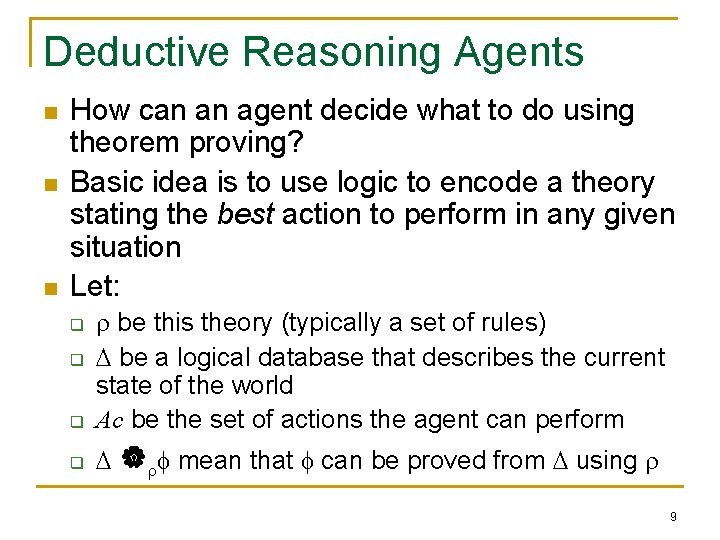
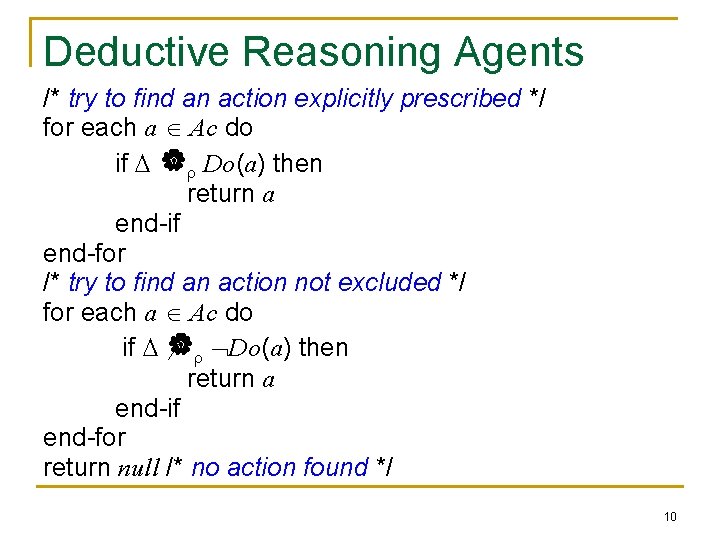
Deductive Reasoning Agents n n n How can an agent decide what to do using theorem proving? Basic idea is to use logic to encode a theory stating the best action to perform in any given situation Let: q be this theory (typically a set of rules) be a logical database that describes the current state of the world Ac be the set of actions the agent can perform q | mean that can be proved from using q q 9
Deductive Reasoning Agents /* try to find an action explicitly prescribed */ for each a Ac do if | Do(a) then return a end-if end-for /* try to find an action not excluded */ for each a Ac do if | Do(a) then return a end-if end-for return null /* no action found */ 10
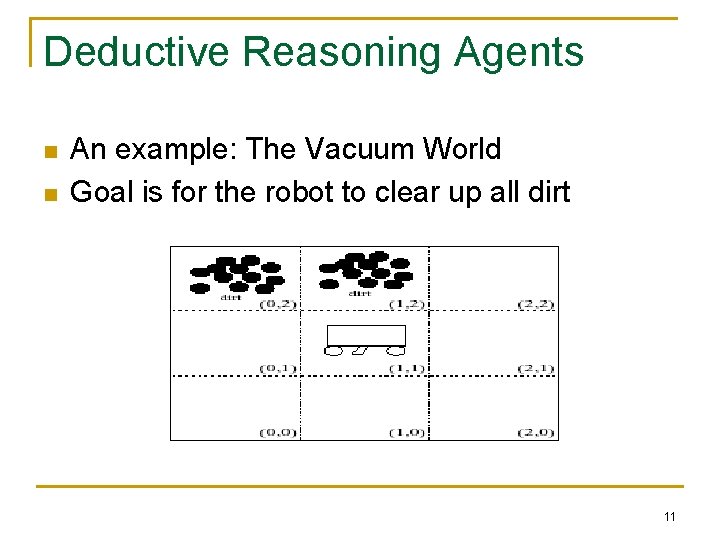
Deductive Reasoning Agents n n An example: The Vacuum World Goal is for the robot to clear up all dirt 11
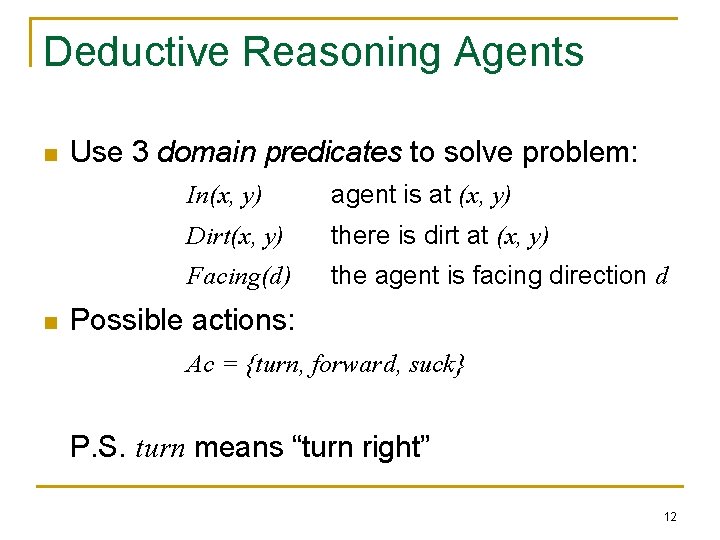
Deductive Reasoning Agents n n Use 3 domain predicates to solve problem: In(x, y) agent is at (x, y) Dirt(x, y) there is dirt at (x, y) Facing(d) the agent is facing direction d Possible actions: Ac = {turn, forward, suck} P. S. turn means “turn right” 12
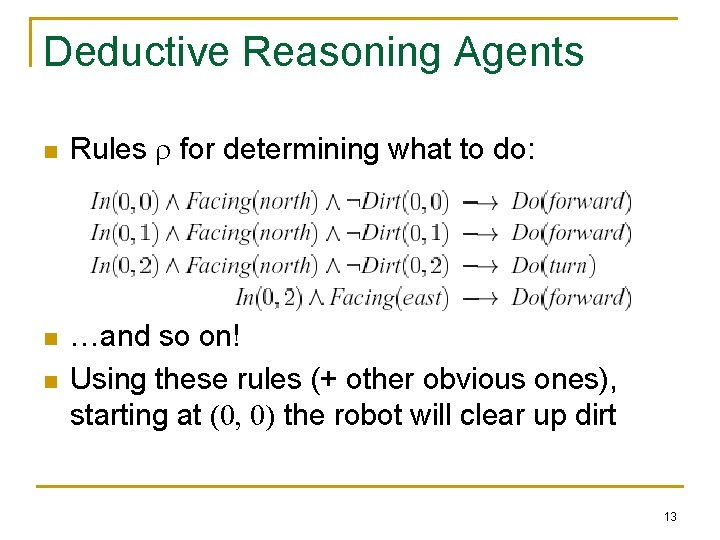
Deductive Reasoning Agents n n n Rules for determining what to do: …and so on! Using these rules (+ other obvious ones), starting at (0, 0) the robot will clear up dirt 13
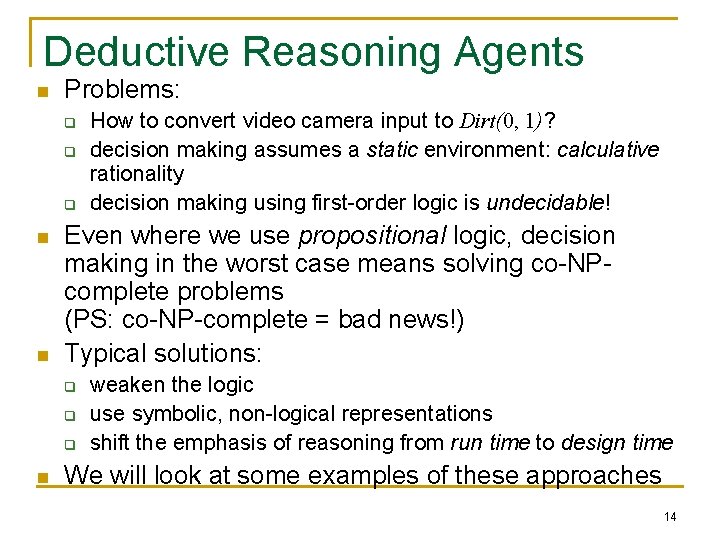
Deductive Reasoning Agents n Problems: q q q n n Even where we use propositional logic, decision making in the worst case means solving co-NPcomplete problems (PS: co-NP-complete = bad news!) Typical solutions: q q q n How to convert video camera input to Dirt(0, 1)? decision making assumes a static environment: calculative rationality decision making using first-order logic is undecidable! weaken the logic use symbolic, non-logical representations shift the emphasis of reasoning from run time to design time We will look at some examples of these approaches 14
More Problems… n n n The “logical approach” that was presented implies adding and removing things from a database That’s not pure logic Early attempts at creating a “planning agent” tried to use true logical deduction to the solve the problem 15
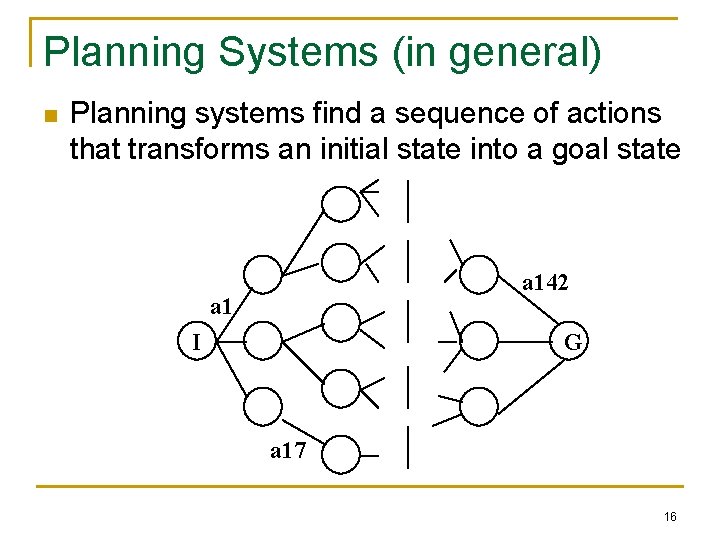
Planning Systems (in general) n Planning systems find a sequence of actions that transforms an initial state into a goal state a 142 a 1 I G a 17 16
Planning n n Planning involves issues of both Search and Knowledge Representation Sample planning systems: q q q n Robot Planning (STRIPS) Planning of biological experiments (MOLGEN) Planning of speech acts For purposes of exposition, we use a simple domain – The Blocks World 17
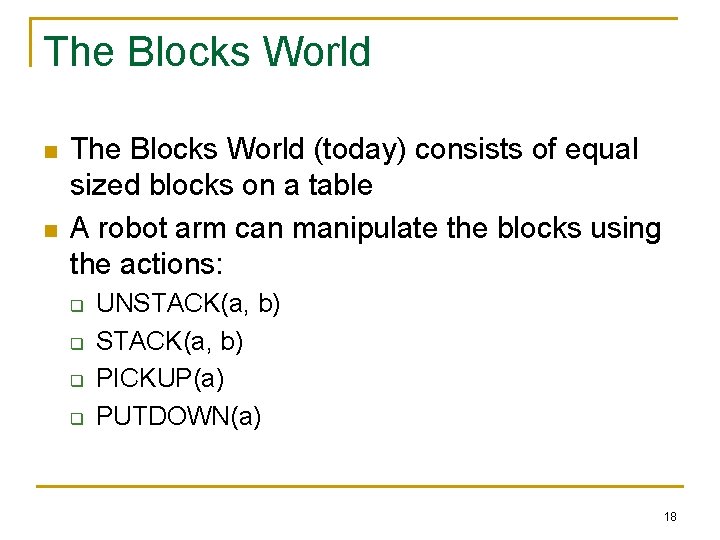
The Blocks World n n The Blocks World (today) consists of equal sized blocks on a table A robot arm can manipulate the blocks using the actions: q q UNSTACK(a, b) PICKUP(a) PUTDOWN(a) 18
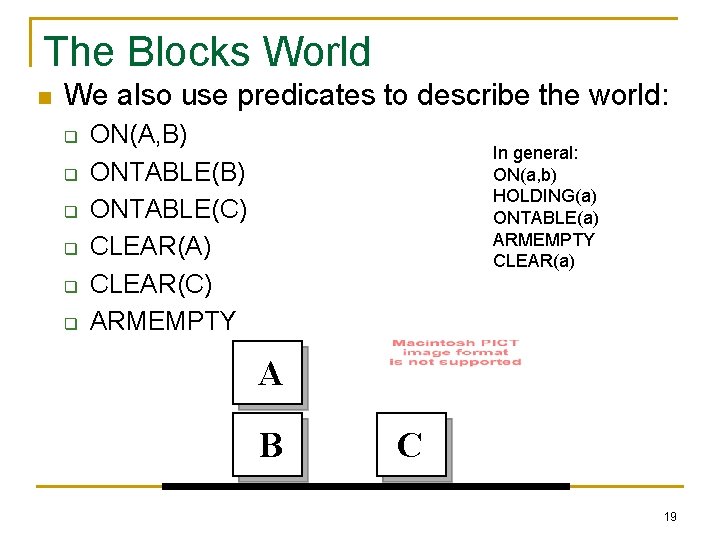
The Blocks World n We also use predicates to describe the world: q q q ON(A, B) ONTABLE(C) CLEAR(A) CLEAR(C) ARMEMPTY In general: ON(a, b) HOLDING(a) ONTABLE(a) ARMEMPTY CLEAR(a) A B C 19
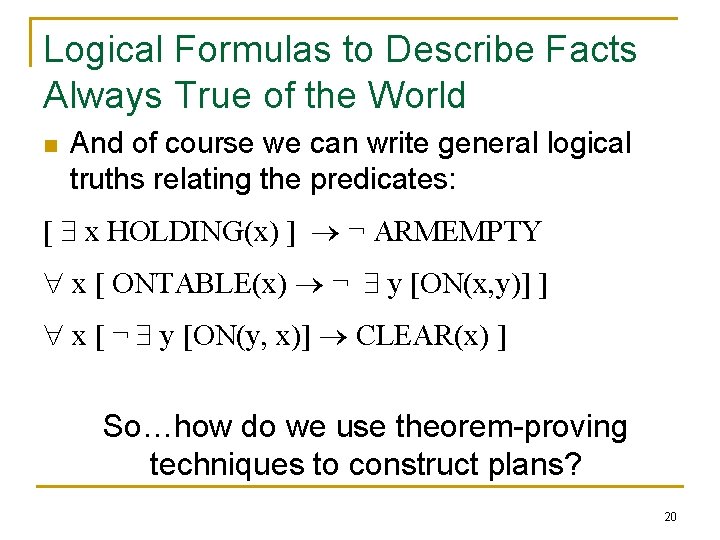
Logical Formulas to Describe Facts Always True of the World n And of course we can write general logical truths relating the predicates: [ $ x HOLDING(x) ] ¬ ARMEMPTY " x [ ONTABLE(x) ¬ $ y [ON(x, y)] ] " x [ ¬ $ y [ON(y, x)] CLEAR(x) ] So…how do we use theorem-proving techniques to construct plans? 20
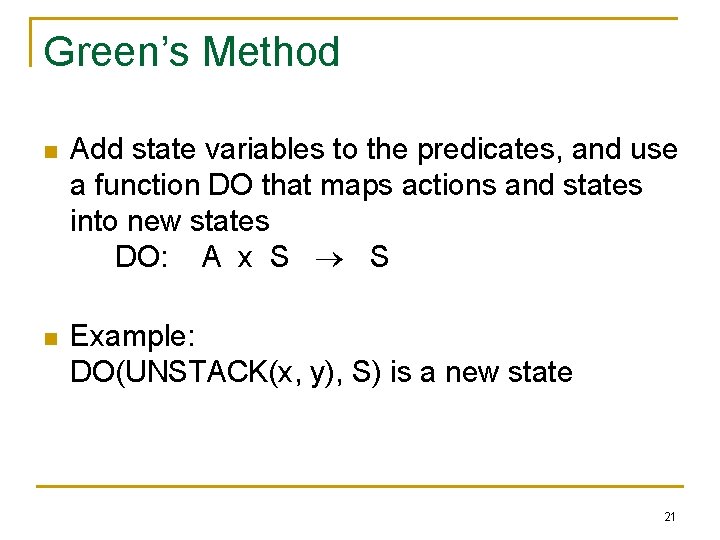
Green’s Method n Add state variables to the predicates, and use a function DO that maps actions and states into new states DO: A x S S n Example: DO(UNSTACK(x, y), S) is a new state 21
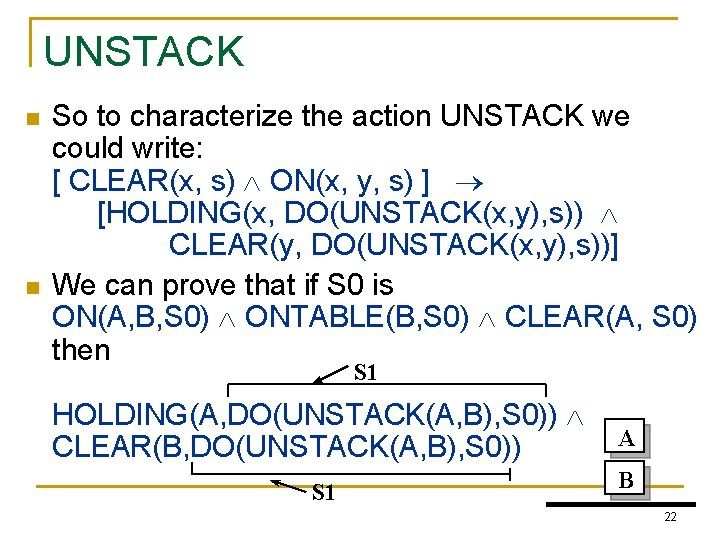
UNSTACK n n So to characterize the action UNSTACK we could write: [ CLEAR(x, s) ON(x, y, s) ] [HOLDING(x, DO(UNSTACK(x, y), s)) CLEAR(y, DO(UNSTACK(x, y), s))] We can prove that if S 0 is ON(A, B, S 0) ONTABLE(B, S 0) CLEAR(A, S 0) then S 1 HOLDING(A, DO(UNSTACK(A, B), S 0)) CLEAR(B, DO(UNSTACK(A, B), S 0)) A S 1 B 22
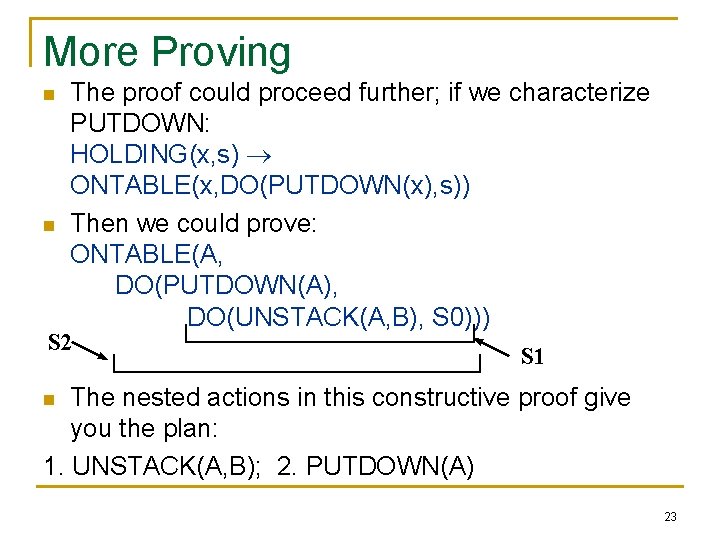
More Proving n n The proof could proceed further; if we characterize PUTDOWN: HOLDING(x, s) ONTABLE(x, DO(PUTDOWN(x), s)) Then we could prove: ONTABLE(A, DO(PUTDOWN(A), DO(UNSTACK(A, B), S 0))) S 2 S 1 The nested actions in this constructive proof give you the plan: 1. UNSTACK(A, B); 2. PUTDOWN(A) n 23
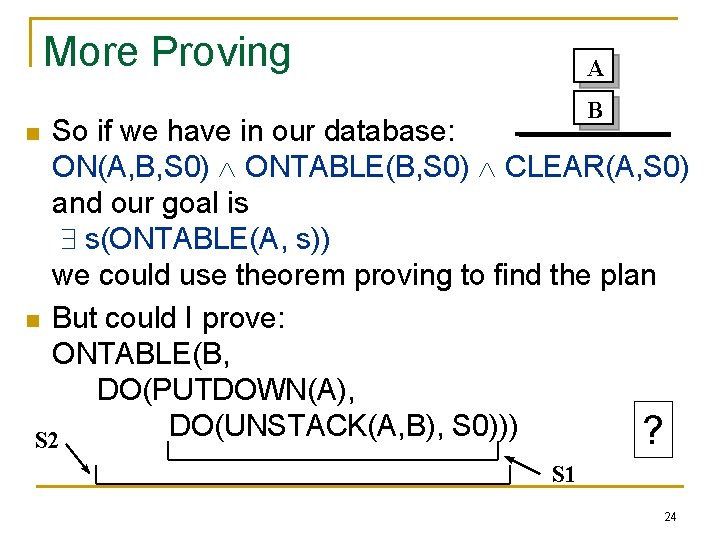
More Proving A B So if we have in our database: ON(A, B, S 0) ONTABLE(B, S 0) CLEAR(A, S 0) and our goal is $ s(ONTABLE(A, s)) we could use theorem proving to find the plan n But could I prove: ONTABLE(B, DO(PUTDOWN(A), DO(UNSTACK(A, B), S 0))) ? S 2 n S 1 24
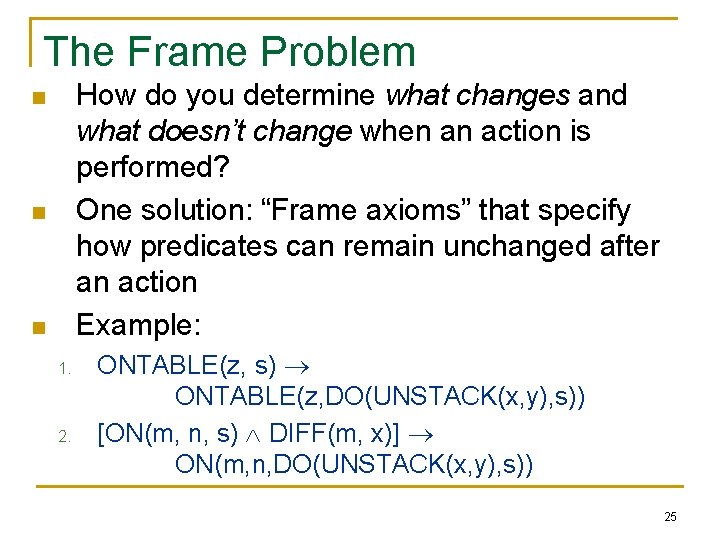
The Frame Problem How do you determine what changes and what doesn’t change when an action is performed? One solution: “Frame axioms” that specify how predicates can remain unchanged after an action Example: n n n 1. 2. ONTABLE(z, s) ONTABLE(z, DO(UNSTACK(x, y), s)) [ON(m, n, s) DIFF(m, x)] ON(m, n, DO(UNSTACK(x, y), s)) 25
Frame Axioms n n n Problem: Unless we go to a higher-order logic, Green’s method forces us to write many frame axioms Example: COLOR(x, c, s) COLOR(x, c, DO(UNSTACK(y, z), s)) We want to avoid this…other approaches are needed… 26
AGENT 0 and PLACA n n Much of the interest in agents from the AI community has arisen from Shoham’s notion of agent oriented programming (AOP) AOP a ‘new programming paradigm, based on a societal view of computation’ The key idea that informs AOP is that of directly programming agents in terms of intentional notions like belief, commitment, and intention The motivation behind such a proposal is that, as we humans use the intentional stance as an abstraction mechanism for representing the properties of complex systems. In the same way that we use the intentional stance to describe humans, it might be useful to use the intentional stance to program machines. 27
AGENT 0 n Shoham suggested that a complete AOP system will have 3 components: q q q n n n a logic for specifying agents and describing their mental states an interpreted programming language for programming agents an ‘agentification’ process, for converting ‘neutral applications’ (e. g. , databases) into agents Results only reported on first two components. Relationship between logic and programming language is semantics We will skip over the logic(!), and consider the first AOP language, AGENT 0 28
AGENT 0 n n AGENT 0 is implemented as an extension to LISP Each agent in AGENT 0 has 4 components: q q n a set of capabilities (things the agent can do) a set of initial beliefs a set of initial commitments (things the agent will do) a set of commitment rules The key component, which determines how the agent acts, is the commitment rule set 29
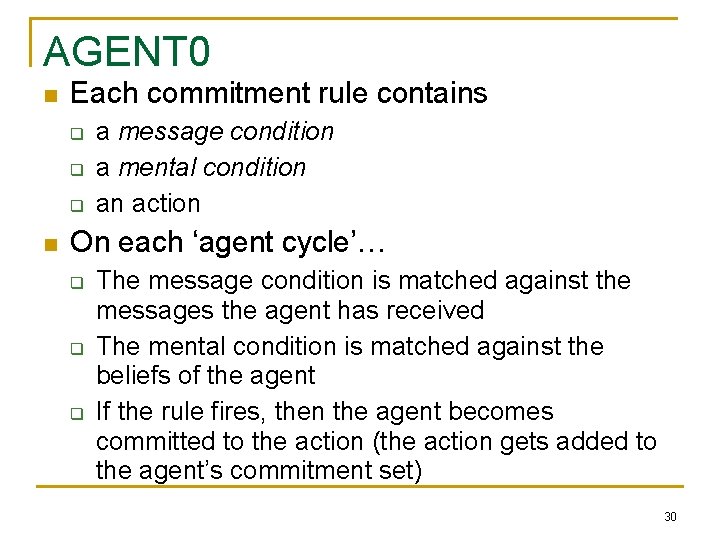
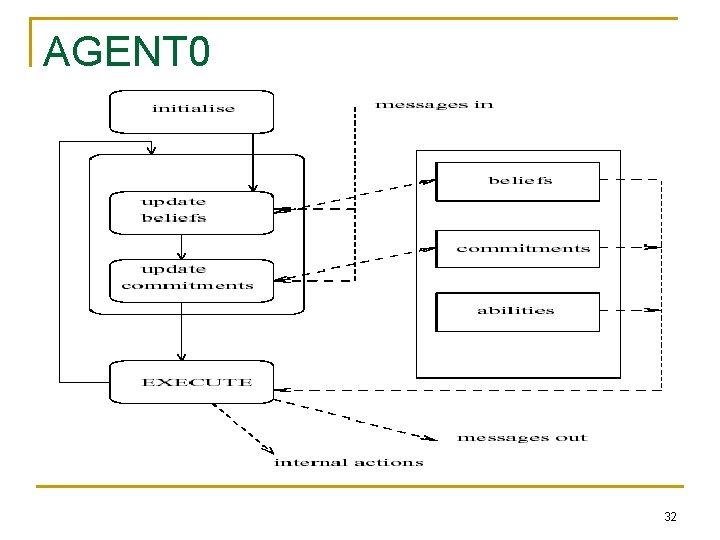
AGENT 0 n Each commitment rule contains q q q n a message condition a mental condition an action On each ‘agent cycle’… q q q The message condition is matched against the messages the agent has received The mental condition is matched against the beliefs of the agent If the rule fires, then the agent becomes committed to the action (the action gets added to the agent’s commitment set) 30
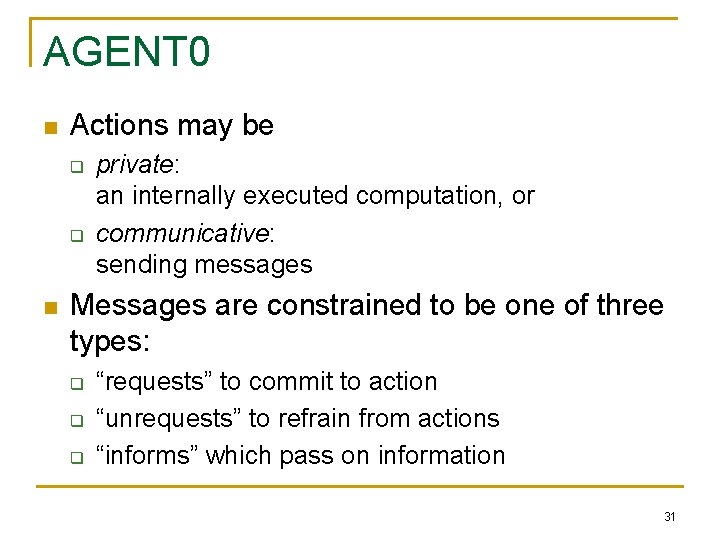
AGENT 0 n Actions may be q q n private: an internally executed computation, or communicative: sending messages Messages are constrained to be one of three types: q q q “requests” to commit to action “unrequests” to refrain from actions “informs” which pass on information 31
AGENT 0 32
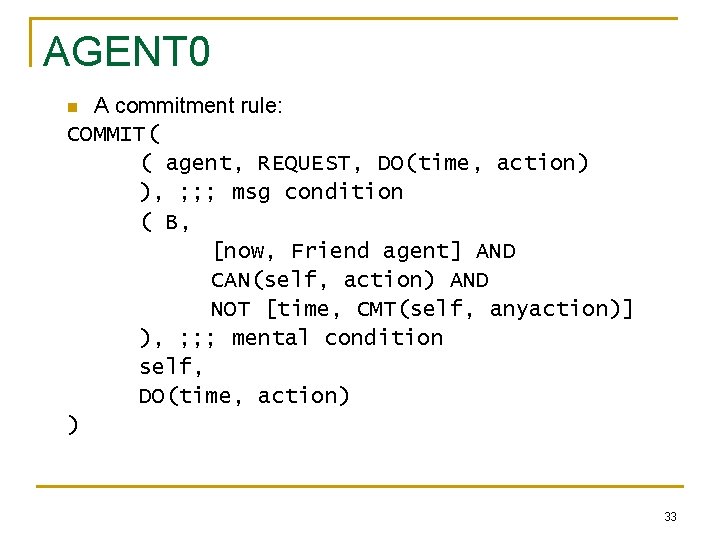
AGENT 0 A commitment rule: COMMIT( ( agent, REQUEST, DO(time, action) ), ; ; ; msg condition ( B, [now, Friend agent] AND CAN(self, action) AND NOT [time, CMT(self, anyaction)] ), ; ; ; mental condition self, DO(time, action) ) n 33
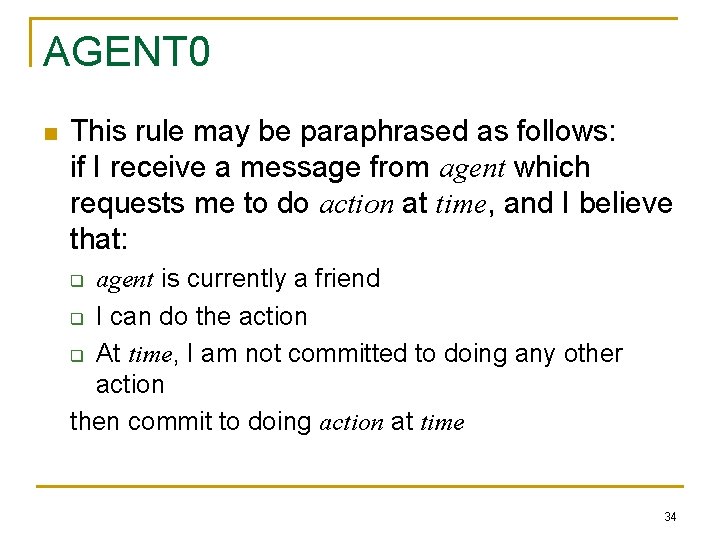
AGENT 0 n This rule may be paraphrased as follows: if I receive a message from agent which requests me to do action at time, and I believe that: agent is currently a friend q I can do the action q At time, I am not committed to doing any other action then commit to doing action at time q 34
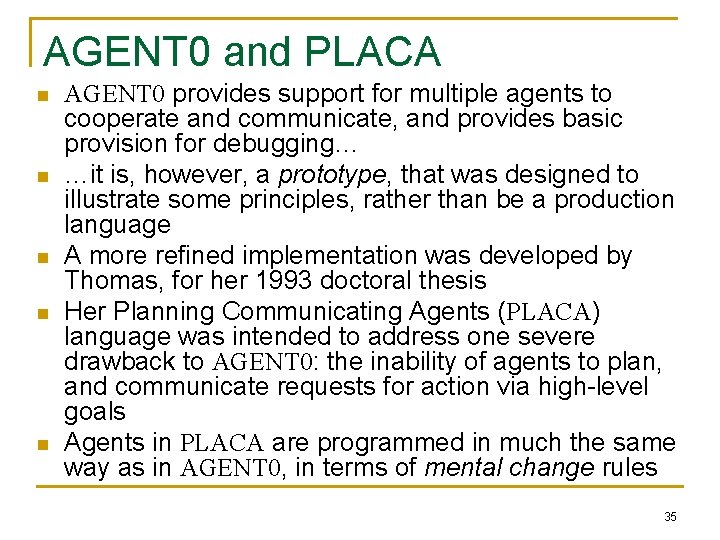
AGENT 0 and PLACA n n n AGENT 0 provides support for multiple agents to cooperate and communicate, and provides basic provision for debugging… …it is, however, a prototype, that was designed to illustrate some principles, rather than be a production language A more refined implementation was developed by Thomas, for her 1993 doctoral thesis Her Planning Communicating Agents (PLACA) language was intended to address one severe drawback to AGENT 0: the inability of agents to plan, and communicate requests for action via high-level goals Agents in PLACA are programmed in much the same way as in AGENT 0, in terms of mental change rules 35
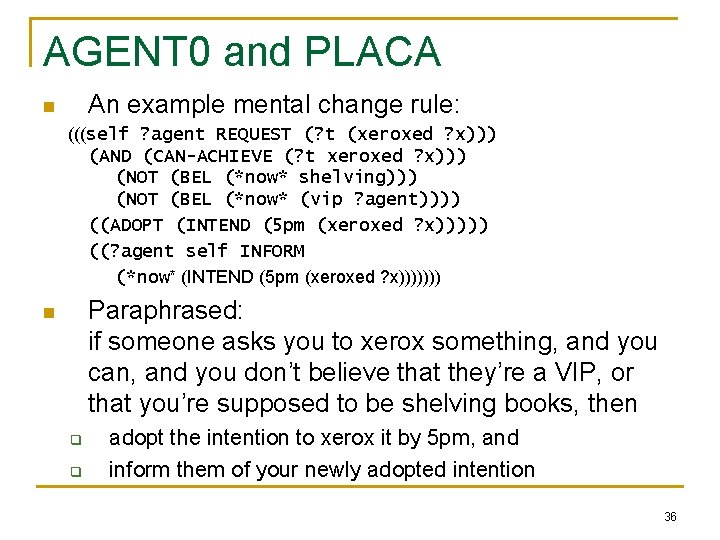
AGENT 0 and PLACA An example mental change rule: n (((self ? agent REQUEST (? t (xeroxed ? x))) (AND (CAN-ACHIEVE (? t xeroxed ? x))) (NOT (BEL (*now* shelving))) (NOT (BEL (*now* (vip ? agent)))) ((ADOPT (INTEND (5 pm (xeroxed ? x))))) ((? agent self INFORM (*now* (INTEND (5 pm (xeroxed ? x))))))) Paraphrased: if someone asks you to xerox something, and you can, and you don’t believe that they’re a VIP, or that you’re supposed to be shelving books, then n q q adopt the intention to xerox it by 5 pm, and inform them of your newly adopted intention 36
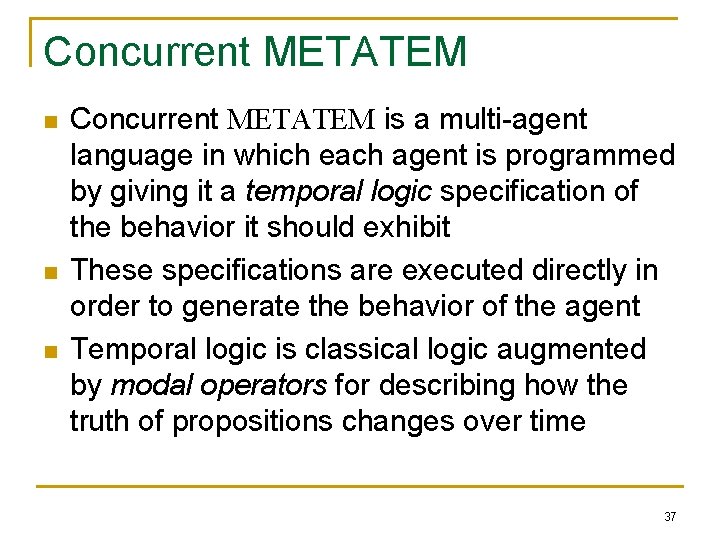
Concurrent METATEM n n n Concurrent METATEM is a multi-agent language in which each agent is programmed by giving it a temporal logic specification of the behavior it should exhibit These specifications are executed directly in order to generate the behavior of the agent Temporal logic is classical logic augmented by modal operators for describing how the truth of propositions changes over time 37
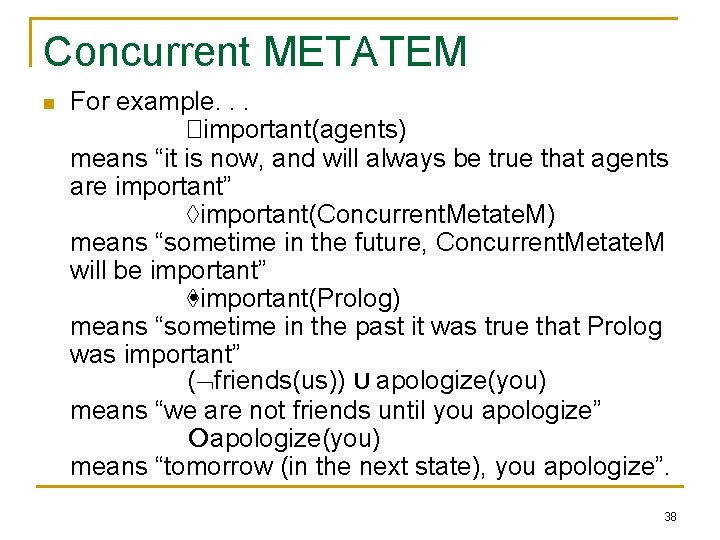
Concurrent METATEM n For example. . . �important(agents) means “it is now, and will always be true that agents are important” important(Concurrent. Metate. M) means “sometime in the future, Concurrent. Metate. M will be important” important(Prolog) means “sometime in the past it was true that Prolog was important” ( friends(us)) U apologize(you) means “we are not friends until you apologize” apologize(you) means “tomorrow (in the next state), you apologize”. 38
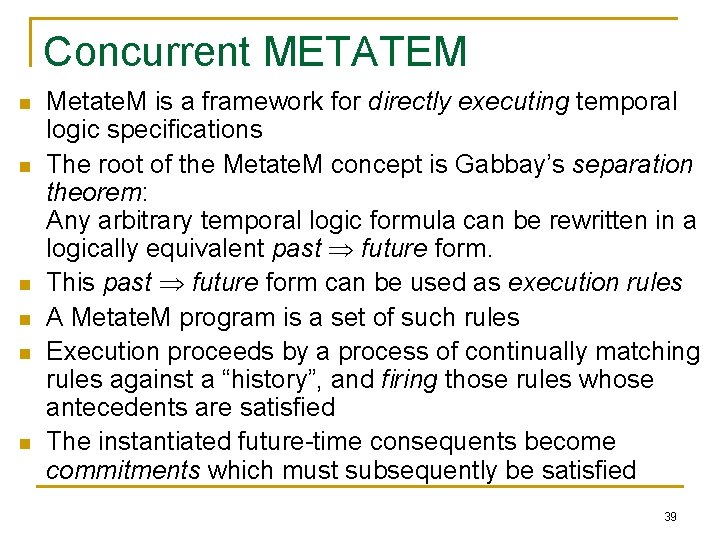
Concurrent METATEM n n n Metate. M is a framework for directly executing temporal logic specifications The root of the Metate. M concept is Gabbay’s separation theorem: Any arbitrary temporal logic formula can be rewritten in a logically equivalent past future form. This past future form can be used as execution rules A Metate. M program is a set of such rules Execution proceeds by a process of continually matching rules against a “history”, and firing those rules whose antecedents are satisfied The instantiated future-time consequents become commitments which must subsequently be satisfied 39
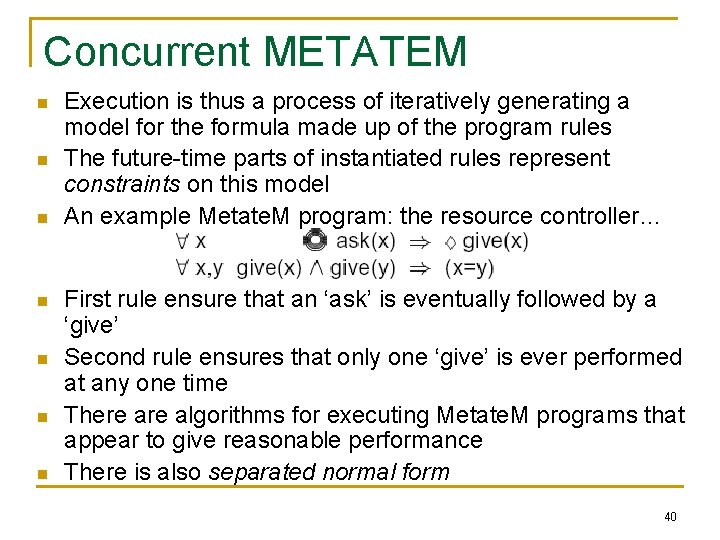
Concurrent METATEM n n n n Execution is thus a process of iteratively generating a model for the formula made up of the program rules The future-time parts of instantiated rules represent constraints on this model An example Metate. M program: the resource controller… First rule ensure that an ‘ask’ is eventually followed by a ‘give’ Second rule ensures that only one ‘give’ is ever performed at any one time There algorithms for executing Metate. M programs that appear to give reasonable performance There is also separated normal form 40
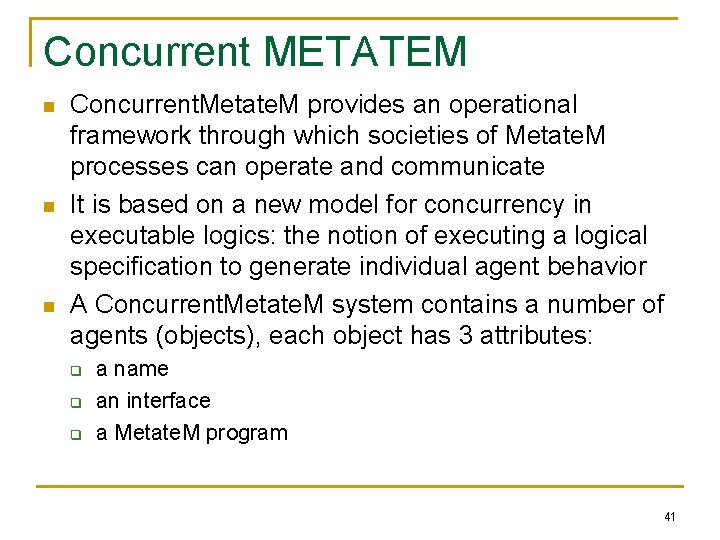
Concurrent METATEM n n n Concurrent. Metate. M provides an operational framework through which societies of Metate. M processes can operate and communicate It is based on a new model for concurrency in executable logics: the notion of executing a logical specification to generate individual agent behavior A Concurrent. Metate. M system contains a number of agents (objects), each object has 3 attributes: q q q a name an interface a Metate. M program 41
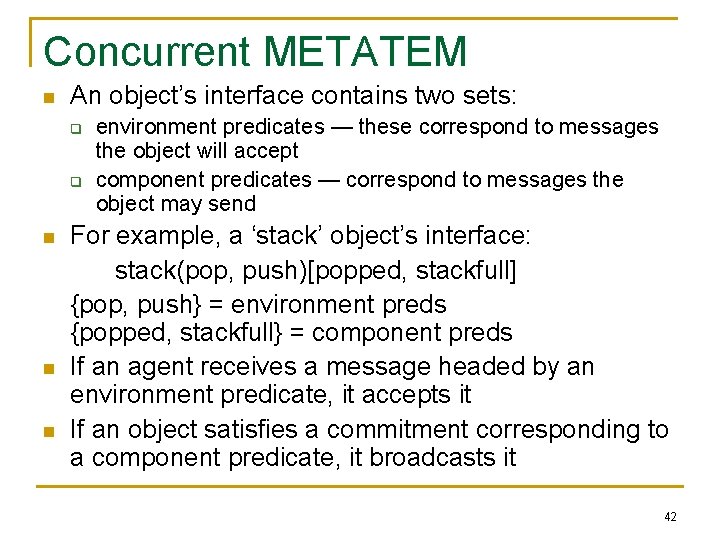
Concurrent METATEM n An object’s interface contains two sets: q q n n n environment predicates — these correspond to messages the object will accept component predicates — correspond to messages the object may send For example, a ‘stack’ object’s interface: stack(pop, push)[popped, stackfull] {pop, push} = environment preds {popped, stackfull} = component preds If an agent receives a message headed by an environment predicate, it accepts it If an object satisfies a commitment corresponding to a component predicate, it broadcasts it 42
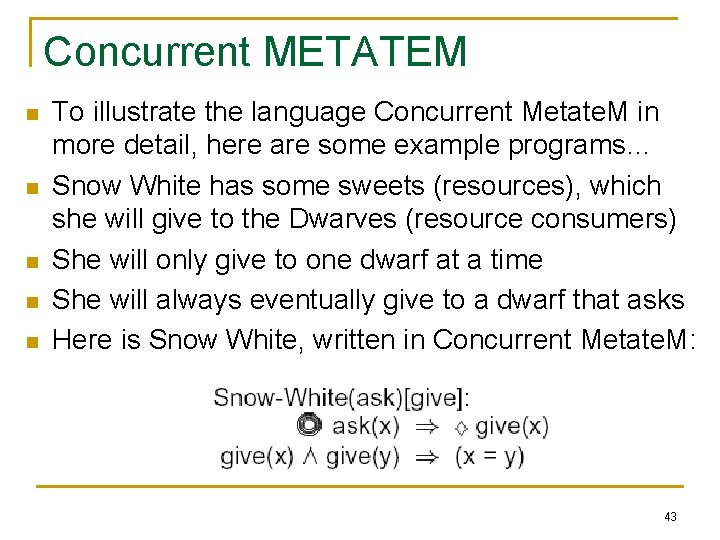
Concurrent METATEM n n n To illustrate the language Concurrent Metate. M in more detail, here are some example programs… Snow White has some sweets (resources), which she will give to the Dwarves (resource consumers) She will only give to one dwarf at a time She will always eventually give to a dwarf that asks Here is Snow White, written in Concurrent Metate. M: 43
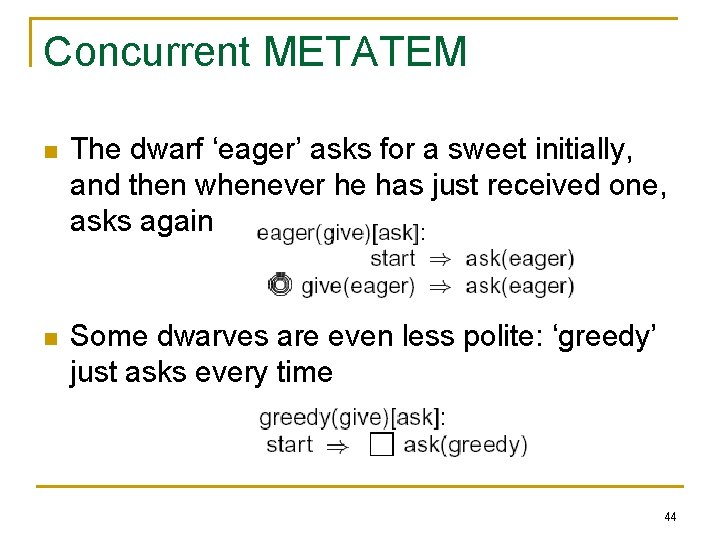
Concurrent METATEM n The dwarf ‘eager’ asks for a sweet initially, and then whenever he has just received one, asks again n Some dwarves are even less polite: ‘greedy’ just asks every time 44
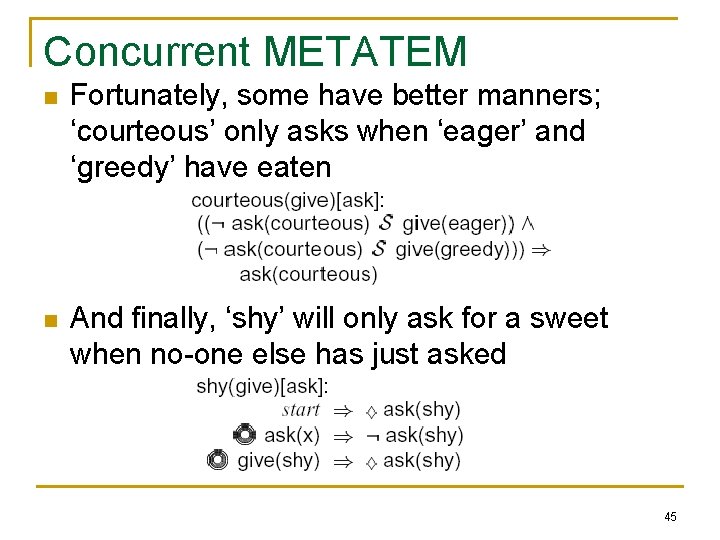
Concurrent METATEM n Fortunately, some have better manners; ‘courteous’ only asks when ‘eager’ and ‘greedy’ have eaten n And finally, ‘shy’ will only ask for a sweet when no-one else has just asked 45
Concurrent METATEM n Summary: q q an(other) experimental language very nice underlying theory… …but unfortunately, lacks many desirable features — could not be used in current state to implement ‘full’ system currently prototype only, full version on the way! 46
Planning Agents n n n Since the early 1970 s, the AI planning community has been closely concerned with the design of artificial agents Planning is essentially automatic programming: the design of a course of action that will achieve some desired goal Within the symbolic AI community, it has long been assumed that some form of AI planning system will be a central component of any artificial agent Building largely on the early work of Fikes & Nilsson, many planning algorithms have been proposed, and theory of planning has been well-developed But in the mid 1980 s, Chapman established some theoretical results which indicate that AI planners will ultimately turn out to be unusable in any time-constrained system 47