
Lecture 3 Concepts of Disease Control BY DR
Lecture 3 Concepts of Disease Control BY DR UMER FAROOQ
Disease Control The term disease control describes operation aimed at reducing • The incidence of disease • The duration of disease , and consequently the risk of transmission • The effects of infection, including both the physical and psychological complications • The financial burden to the community In disease control, the disease agent is permitted to persist in the community at a level where it ceases to be a public health problem
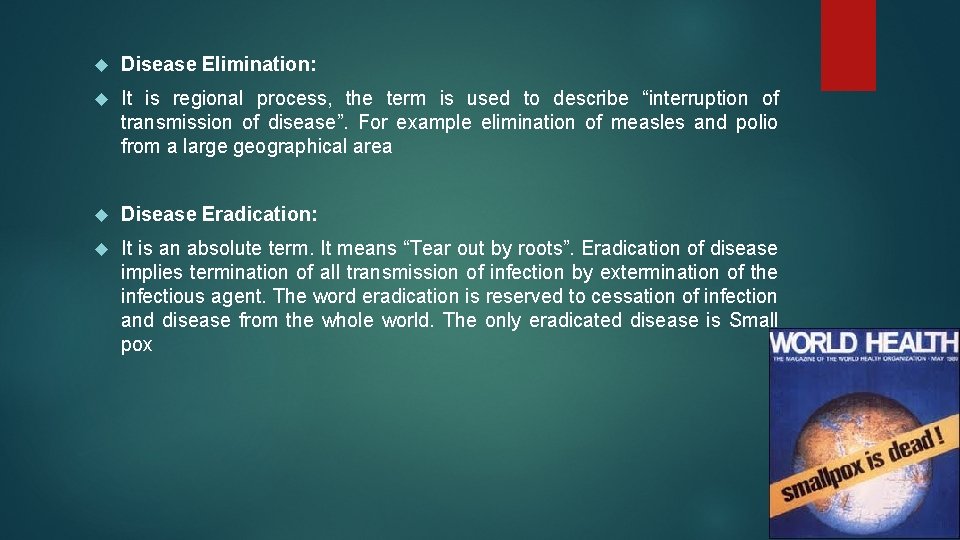
Disease Elimination: It is regional process, the term is used to describe “interruption of transmission of disease”. For example elimination of measles and polio from a large geographical area Disease Eradication: It is an absolute term. It means “Tear out by roots”. Eradication of disease implies termination of all transmission of infection by extermination of the infectious agent. The word eradication is reserved to cessation of infection and disease from the whole world. The only eradicated disease is Small pox
Natural History of Disease results from a complex interaction between man (Host), an agent (or cause of disease) and environment Natural history of disease is “the way disease is going to unfold itself, in the absence of treatment and prevention” Natural history consists of I. Pre-Pathogenesis Phase II. Pathogenesis Phase I. Pre-Pathogenesis Phase: This is the period preliminary to onset of disease

For a disease to occur, three factors are required, agent, host and environment. In the absence of any one of them, disease is not going to occur. This is known as “Epidemiological or Ecological Triad” Environment Agent Host Epidemiological Triad

During pre-pathogenesis phase, man is not involved but he is exposed to risk of disease. We are in pre-pathogenesis phase of many diseases e. g. Typhoid fever, Hepatitis and accidents During this phase, these three factors are present but in isolation forms. When these start interacting with each other man moves into the pathogenesis phase II. Pathogenesis Phase: This phase begins with the entry of disease agent into susceptible host. Incubation period: “Period of time between entry of disease into host and appearance of signs and symptoms is known as incubation period” A patient during incubation period may be apparently healthy but pathological and physiological changes are going on, which are sub clinical. After incubation period, signs and symptoms start to appear
In the beginning, these S/S are slight, as time passes, these become severe and more clear-cut and diagnosis can be made. The end result of disease process may be Complete recovery Death Chronicity Disability In many chronic diseases Agent-Host-Environment interactions are not well understood

Agent, Host and Environmental Factors A) Disease Agent Factors: The disease agent is defined as “A substance living or non-living, or a force, tangible or intangible, the excessive presence or lack of which may initiate a disease process” A disease may have single agent, a number of independent alternative agents or a complex of two or more factors whose combined presence is essential for development of the disease Classification of Agents: 1) Biological Agents: These are living agents of disease e. g. viruses, fungi, bacteria and protozoa
2) Nutrient Agents: These can be proteins, carbohydrates, fats, minerals and water. Any excess or deficiency of intake of nutritive elements may result in nutritional disorders e. g. protein energy malnutrition, anemia, goiter, obesity and night blindness 3) Physical Agents: Exposure to excessive heat, cold, humidity, radiation, electricity sound etc. may result in illness 4) Chemical Agents: Endogenous: These chemicals are produced in the body and cause diseases like Uremia (Urea), Ketosis (Ketone) and Jaundice (Serum bilirubin) etc Exogenous: Agents arising outside human host e. g. allergins, metal fumes, dust, gases, insecticides etc
5) Mechanical Agents: Exposure to chronic friction and other mechanical forces may result in crushing, tearing, sprains, dislocation and even death 6) Social Agents: These are poverty, smoking, abuse of drugs and alcohol, unhealthy life styles, social isolation, maternal deprivation etc B) Host Factors: Human host may be referred as soil and disease agent as seed. In some situations, host factors play a major role in determining the outcome of an individual’s exposure to infection e. g. T. B. Classification: 1) Demographic Characteristics: Such as Age, Sex and Ethnicity
2) Biological Characteristics: Such as genetic factors, blood groups and enzymes 3) Social and Economic Characteristics: Such as socio-economic status, education, occupation, marital status and housing 4) Lifestyle Factors: Such as living habits, nutrition, smoking, physical activity C) Environmental Factors: 1) Physical environment: The term is applied to non-living things and physical factors (e. g. air, water, soil, housing, climate) with which man is in constant interaction. In most developing countries, defective environment is main health problem
2) Biological Environment: It is the universe of living things that surround the man and including man himself. These things are viruses, microbes, rodents, plants and animals. Some of them work as disease producing agents, vectors of disease and reservoirs of infection 3) Psychosocial Environment: This consists of complex of psychosocial factors that affect man These effects may be positive or negative
Modes of Intervention can be defined as “Any attempt to intervene or interrupt the usual sequence in the development of disease in man” 5 modes of Intervention: A. Health promotion B. Specific protection C. Early diagnosis and prompt treatment D. Disability limitation E. Rehabilitation
A. Health Promotion: “It is the process of enabling people to increase control over, and to improve health” It is not directed against any particular disease, but it is intended to strengthen the host by improving the general health and quality of life of an individual and community Health Promotion Involves 1)Health Education: This is the most cost effective intervention. A large number of diseases could be prevented with little or no medical intervention if people are adequately informed about them and if they are encouraged to take necessary precautions in time
2. Environmental modifications: Such as provisions of safe water, installation of sanitary latrines, control of insects and rodents, improvement of housing, etc. 3. Nutritional interventions: Provision of adequate nutrition to vulnerable groups such as during growth, pregnancy and adolescence 4. Periodic medical examination 5. Sex education and marriage counseling 6. Genetic counseling to parents and community 7. Healthy lifestyle: • Encourage physical activity • Discourage smoking • Modifying dietary patterns
B. Speccific Protection: Measures applicable to a disease or a group of diseases, to intercept the cause of disease before it involves man are included in specific protection. It is done by • Immunization against communicable diseases • Use of specific nutrients before the occurrence of disease e. g. In Scurvy ----- Vit. C, In Rickets -------Ca and Vit. D, In Beriberi ----- Vit. B-1 • Protection against occupational hazards • The preventive measures in case of cancer includes avoiding carcinogens • Chemoprophylaxis
Chemo Prophylaxis: It is defined as “administration of chemicals to a person, which also includes administration of antibiotics to prevent the development of infection or progression of infection to active manifest disease” Two types I – Casual Prophylaxis implies the complete prevention of infection by the early elimination of the invading casual agent II – Clinical Prophylaxis implies the prevention of clinical symptoms
Examples of Chemoprophylaxis: Chloroquine in Malaria Penicillin in RHD (Rheumatic Heart Disease) Erythromycin and first dose of vaccine against diphtheria Rifampicin in Meningococcal Meningitis Immunization against TB (INH can also be used) Tetracycline in case of house hold contacts of cholera patients C. Early Diagnosis and Prompt treatment: Early detection of health impairment is defined as “the detection of disturbances of homeostatic and compensatory mechanism while biochemical, morphological and functional changes are still reversible”
Its objectives are: 1. Prevention of spread of communicable diseases to others 2. Prevention of complications is ensured 3. Disease gets arrested and disability is limited Examples: Case finding procedures e. g. sputum examination and miniature radiography are directed towards detection of pulmonary TB when the disease is still dormant Screening examination of school children for detection and correction of defects
D. Disability Limitation: “Any restriction or lack of ability to perform an activity within the range considered normal for his age is called disability” When a patient reports late, objective is to halt the disease process from impairment to handicap by appropriate treatment Concept of disability: Disease ---- Impairment ---- Disability ---- Handicap Impairment: It is defined as “Any loss or abnormality of psychological, physiological or anatomical structure or function” E. g. Loss of foot, defective vision or mental retardation Handicap: It is defined as “A disadvantage for a given individual, resulting from an impairment or a disability, that limits or prevents the fulfillment of a role that is normal for that individual”
Taking example of accidents, the above terms can be explained as Accident ---- disease or disorder Loss of foot ---- impairment Cannot walk ---- disability Unemployed ---- handicap E. Rehabilitation: The combined and coordinated use of medical, social, educational and vocational measures for training and retraining the individual to the highest possible level of functional ability is called rehabilitation Aim: Its aim is to return the affected person to useful place of available capacity 1. Vocational guidance
2. Psychotherapy 3. Speech therapy 4. Physiotherapy E. g. • Establishing school for blind children • Exercise in case of polio • Providing aids (crutches) to disabled or crippled Types: A. Medical Rehabilitation: Means restoration of function. If TB has spread to knee joint, physiotherapy or surgery is done to correct it
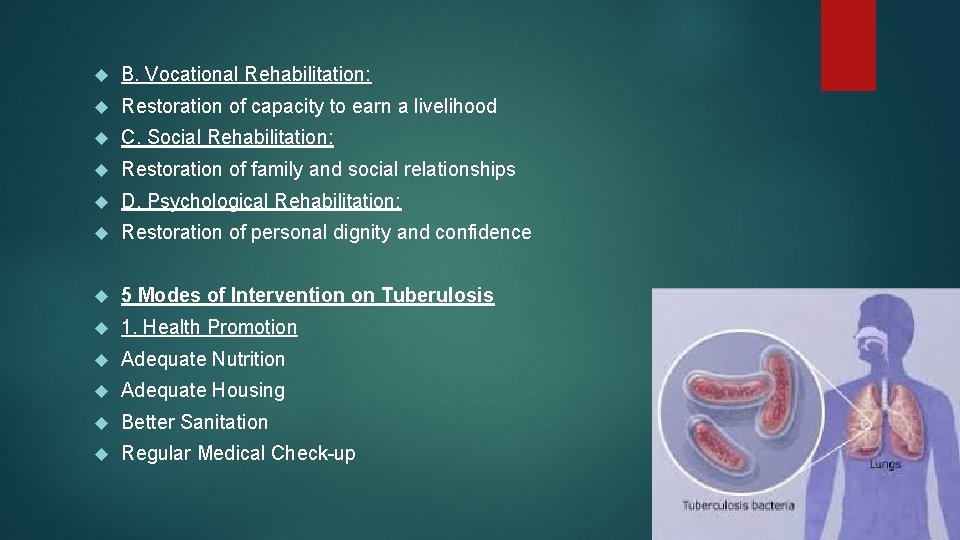
B. Vocational Rehabilitation: Restoration of capacity to earn a livelihood C. Social Rehabilitation: Restoration of family and social relationships D. Psychological Rehabilitation: Restoration of personal dignity and confidence 5 Modes of Intervention on Tuberulosis 1. Health Promotion Adequate Nutrition Adequate Housing Better Sanitation Regular Medical Check-up
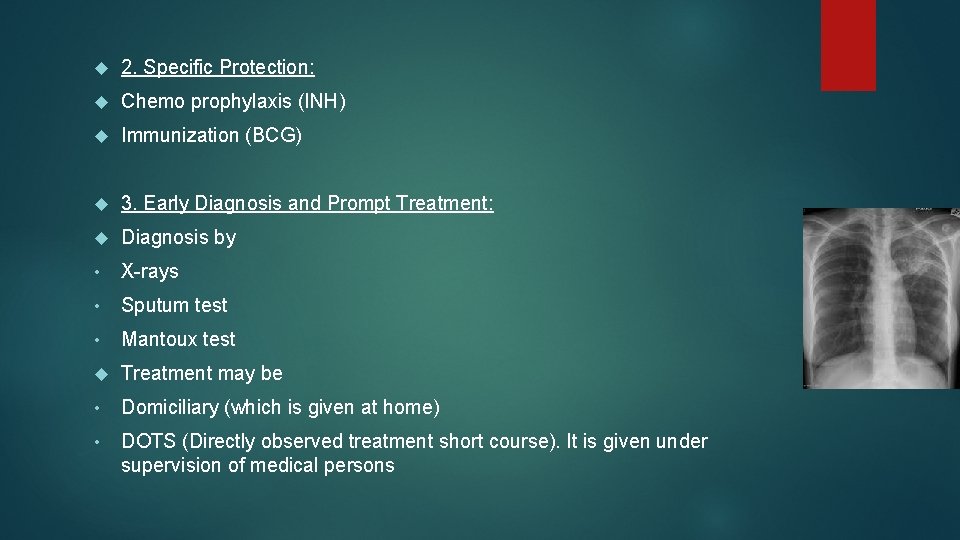
2. Specific Protection: Chemo prophylaxis (INH) Immunization (BCG) 3. Early Diagnosis and Prompt Treatment: Diagnosis by • X-rays • Sputum test • Mantoux test Treatment may be • Domiciliary (which is given at home) • DOTS (Directly observed treatment short course). It is given under supervision of medical persons
Treatment consists of two phases A. Initial Phase: Consists of 4 drugs and is for 2 months: • INH • Rifampicine • Pyrazinamide • Ethambutol B. Continuous Phase: Consists of 2 drugs and is for 7 months • INH • Rfampicin
4. Disability Limitation: If TB has spread to knee joint or involves spine, physiotherapy may be required after surgery to restore motion and development of contractures 5. Rehabilitation: Change of occupation Reducing working hours Selective employment

Thank You
- Slides: 27