
Lecture 3 Closure Properties Regular Expressions Jim Hook
![Regular expressions and Regular Languages • Thm [1. 54] A language is regular iff](https://slidetodoc.com/presentation_image/09ff9d37f1de14c6b2e24ef1ed50277e/image-7.jpg "Regular expressions and Regular Languages • Thm [1. 54] A language is regular iff")
- Slides: 24
Lecture 3: Closure Properties & Regular Expressions Jim Hook Tim Sheard Portland State University
Last Time • Defined DFA, regular languages • Defined NFA, showed equivalent to DFA • Showed closure properties of Regular Languages
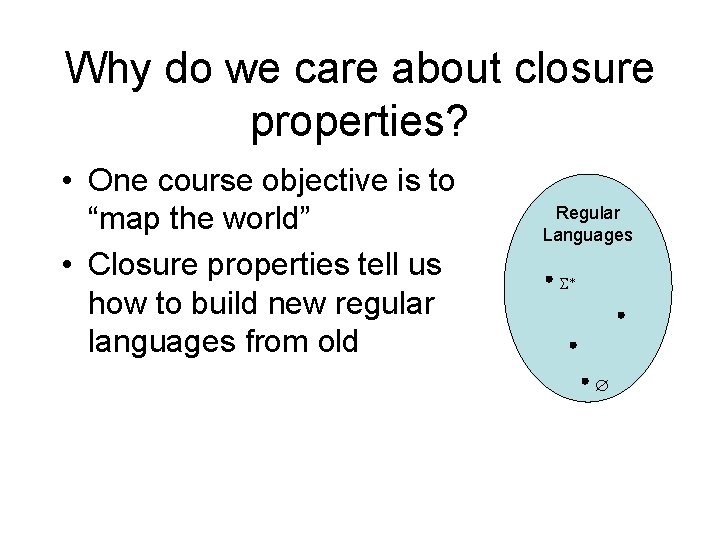
Why do we care about closure properties? • One course objective is to “map the world” • Closure properties tell us how to build new regular languages from old Regular Languages
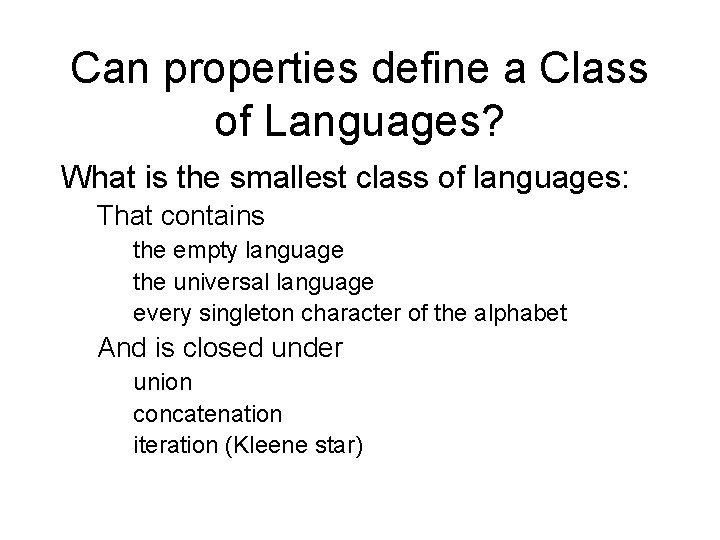
Can properties define a Class of Languages? What is the smallest class of languages: That contains the empty language the universal language every singleton character of the alphabet And is closed under union concatenation iteration (Kleene star)
Regular languages? • Can the regular languages from last lecture be this smallest class? • Since they meet the requirements they must at least contain this smallest class – Discuss • How can we tell if there are regular languages not in this class?
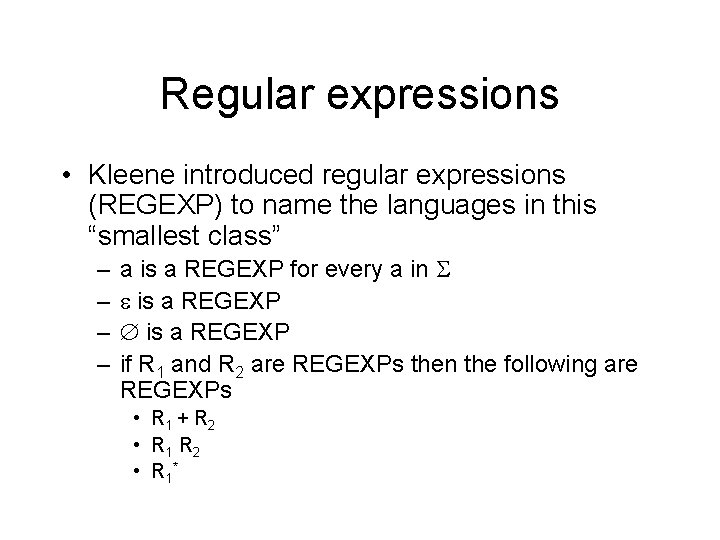
Regular expressions • Kleene introduced regular expressions (REGEXP) to name the languages in this “smallest class” – – a is a REGEXP for every a in is a REGEXP if R 1 and R 2 are REGEXPs then the following are REGEXPs • R 1 + R 2 • R 1 *
Regular expressions and Regular Languages • Thm [1. 54] A language is regular iff it is described by a regular expression • Lemma [1. 55] If a language is descried by a regular expression then it is regular • Proof sketch: – For each REGEXP we must show that a corresponding NFA can be constructed – We’ve done the hard work by proving the closure properties – We just have to complete the base cases for {a}, { }, and .
Regular expressions and Regular Languages • More interesting: can we convert a DFA M into a regular expression? • Lemma [1. 60] If a language is regular then it is described by a regular expression – How do we prove this? – Can we calculate a REGEXP from a DFA?
DFA -> REGEXP • One construction: – Draw a graph labeled essentially like the DFA – Find a way to remove states from the DFA systematically, replacing labels with regular expressions – Set things up so that when we are done the resulting regular expression describes the language accepted by the DFA
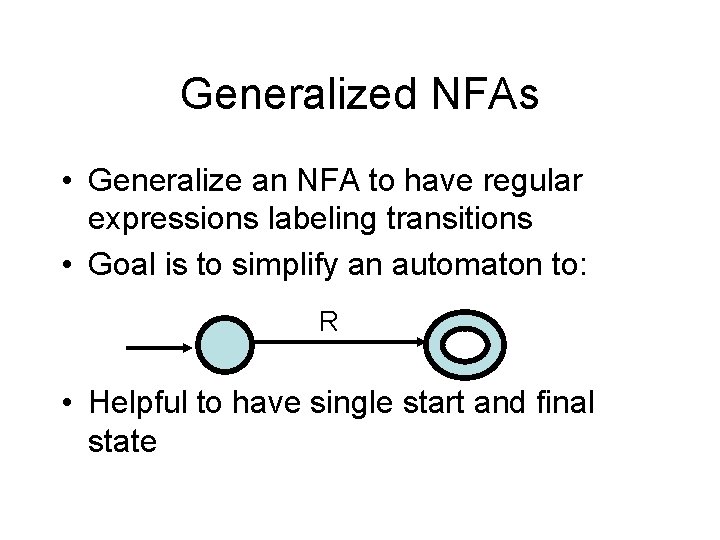
Generalized NFAs • Generalize an NFA to have regular expressions labeling transitions • Goal is to simplify an automaton to: R • Helpful to have single start and final state
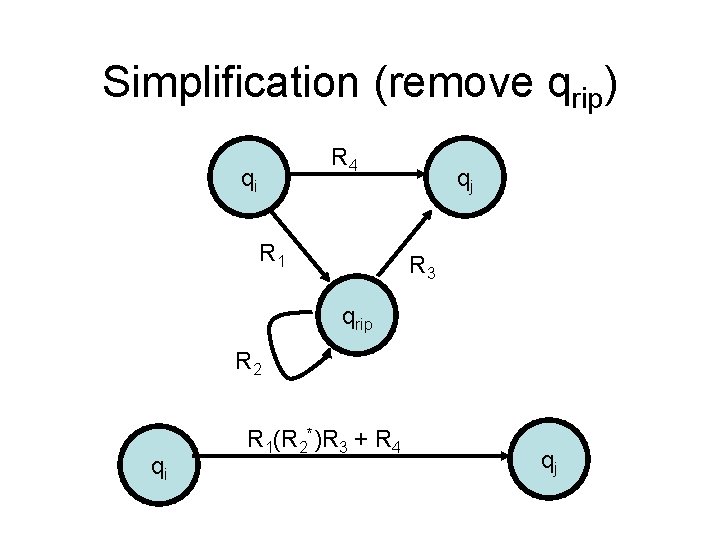
Simplification (remove qrip) R 4 qi R 1 qj R 3 qrip R 2 qi R 1(R 2*)R 3 + R 4 qj
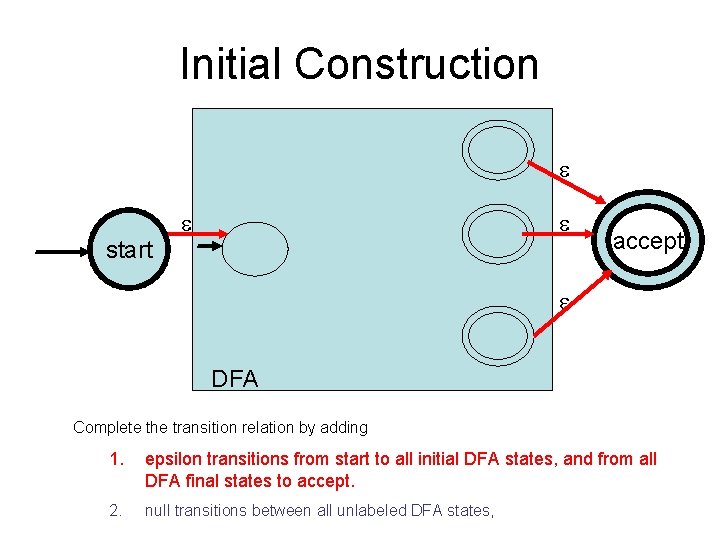
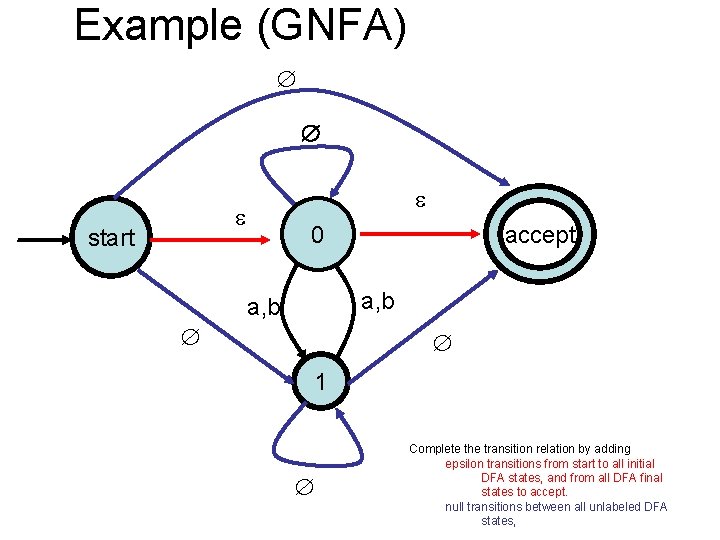
Initial Construction start accept DFA Complete the transition relation by adding 1. epsilon transitions from start to all initial DFA states, and from all DFA final states to accept. 2. null transitions between all unlabeled DFA states,
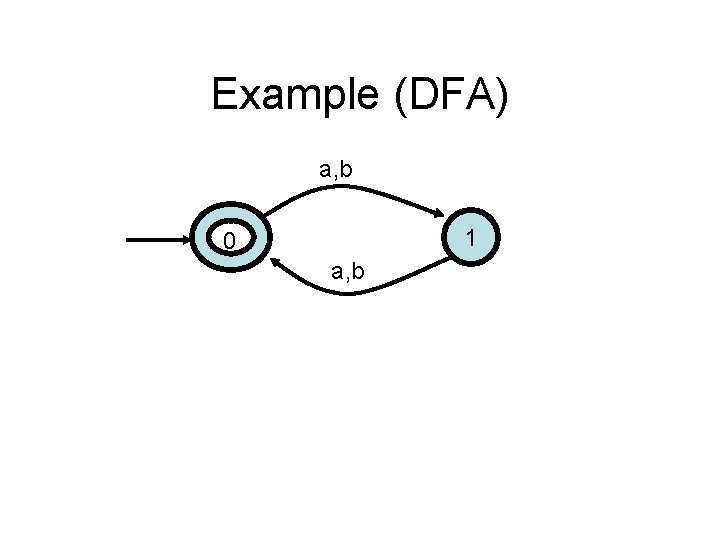
Example (DFA) a, b 1 0 a, b
Example (GNFA) start 00 accept a, b 1 Complete the transition relation by adding epsilon transitions from start to all initial DFA states, and from all DFA final states to accept. null transitions between all unlabeled DFA states,
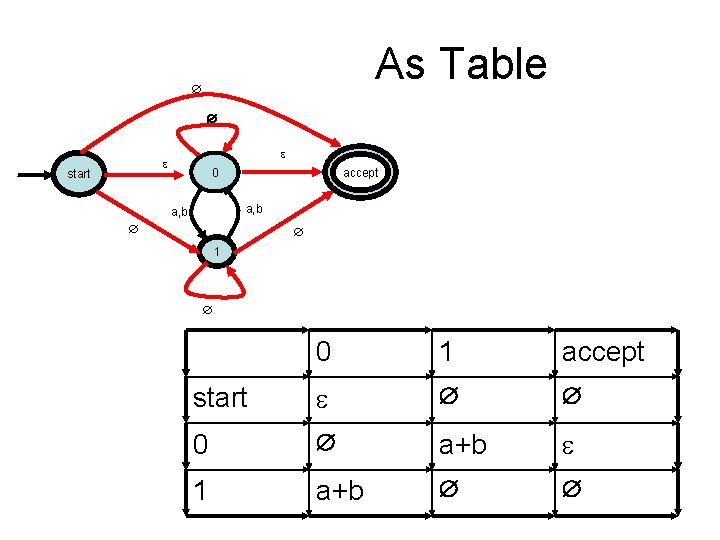
As Table start accept 0 0 a, b 1 0 1 accept start 0 a+b 1 a+b
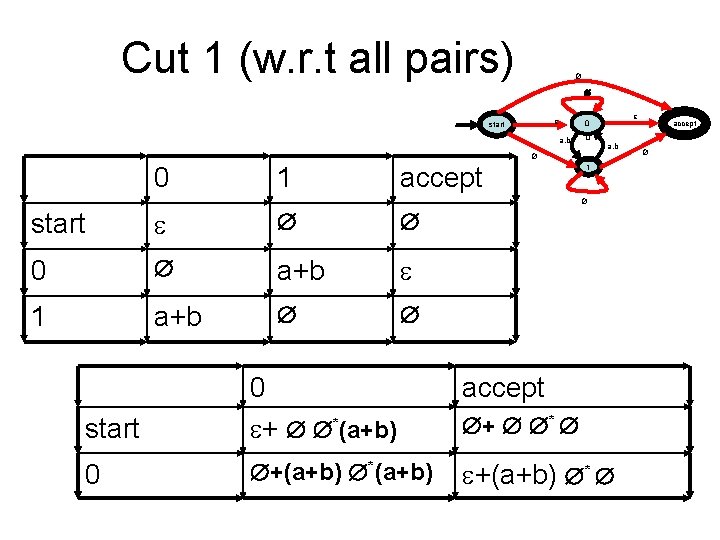
Cut 1 (w. r. t all pairs) start 0 a, b 0 1 accept 1 start 0 a+b 1 a+b accept 0 accept start 0 + *(a+b) 0 +(a+b) *(a+b) +(a+b) * + *
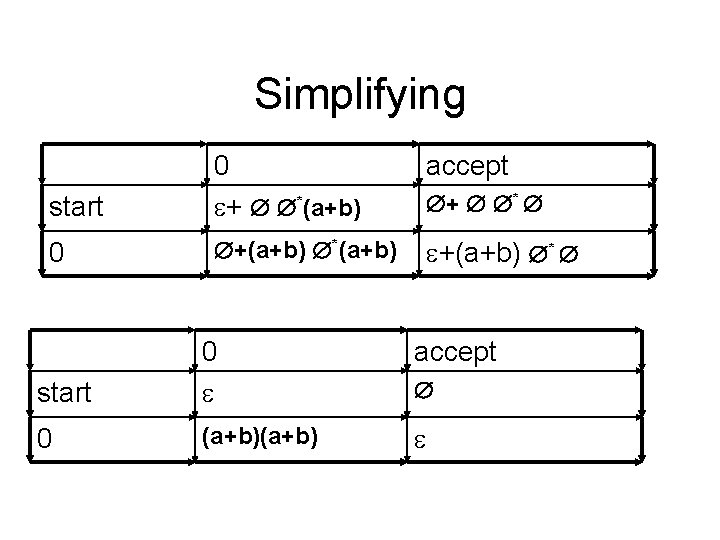
Simplifying accept start 0 + *(a+b) 0 +(a+b) *(a+b) +(a+b) * + * accept start 0 0 (a+b)
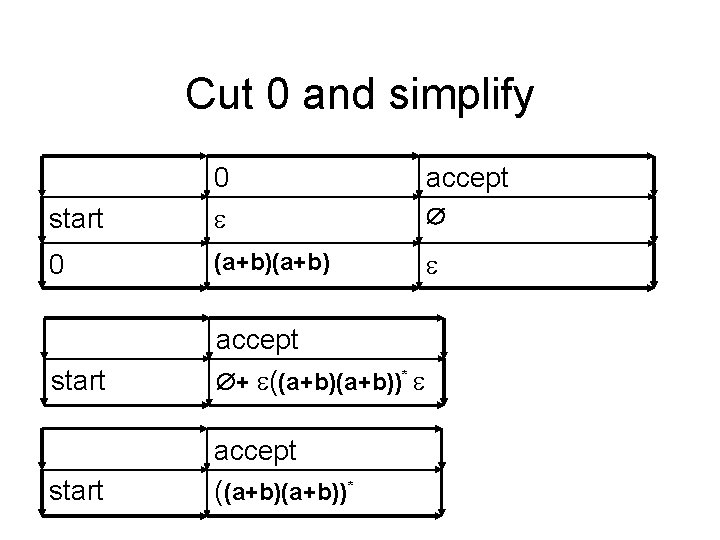
Cut 0 and simplify accept start 0 0 (a+b) start accept + ((a+b))* start accept ((a+b))*
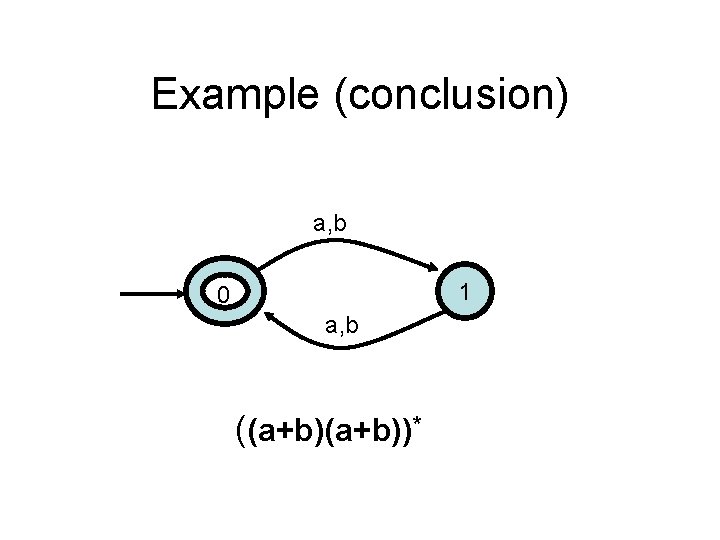
Example (conclusion) a, b 1 0 a, b ((a+b))*
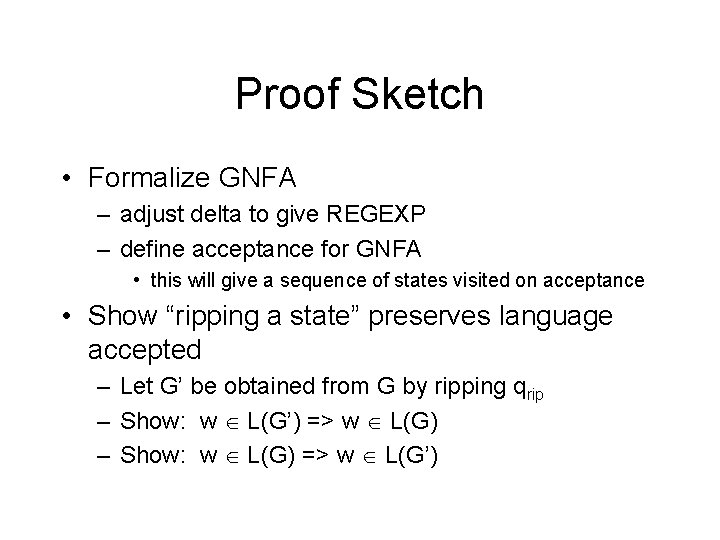
Proof Sketch • Formalize GNFA – adjust delta to give REGEXP – define acceptance for GNFA • this will give a sequence of states visited on acceptance • Show “ripping a state” preserves language accepted – Let G’ be obtained from G by ripping qrip – Show: w L(G’) => w L(G) – Show: w L(G) => w L(G’)
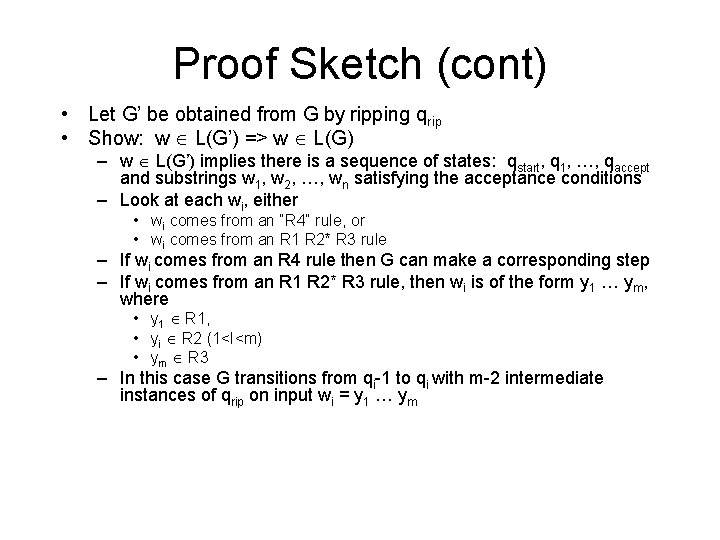
Proof Sketch (cont) • Let G’ be obtained from G by ripping qrip • Show: w L(G’) => w L(G) – w L(G’) implies there is a sequence of states: qstart, q 1, …, qaccept and substrings w 1, w 2, …, wn satisfying the acceptance conditions – Look at each wi, either • wi comes from an “R 4” rule, or • wi comes from an R 1 R 2* R 3 rule – If wi comes from an R 4 rule then G can make a corresponding step – If wi comes from an R 1 R 2* R 3 rule, then wi is of the form y 1 … ym, where • y 1 R 1, • yi R 2 (1<I<m) • ym R 3 – In this case G transitions from qi-1 to qi with m-2 intermediate instances of qrip on input wi = y 1 … ym
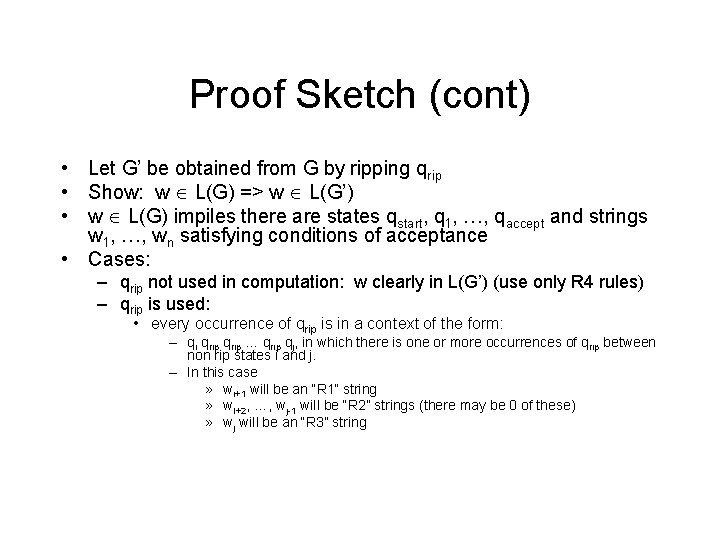
Proof Sketch (cont) • Let G’ be obtained from G by ripping qrip • Show: w L(G) => w L(G’) • w L(G) impiles there are states qstart, q 1, …, qaccept and strings w 1, …, wn satisfying conditions of acceptance • Cases: – qrip not used in computation: w clearly in L(G’) (use only R 4 rules) – qrip is used: • every occurrence of qrip is in a context of the form: – qi qrip … qrip qj, in which there is one or more occurrences of qrip between non rip states i and j. – In this case » wi+1 will be an “R 1” string » w. I+2, …, wj-1 will be “R 2” strings (there may be 0 of these) » wj will be an “R 3” string
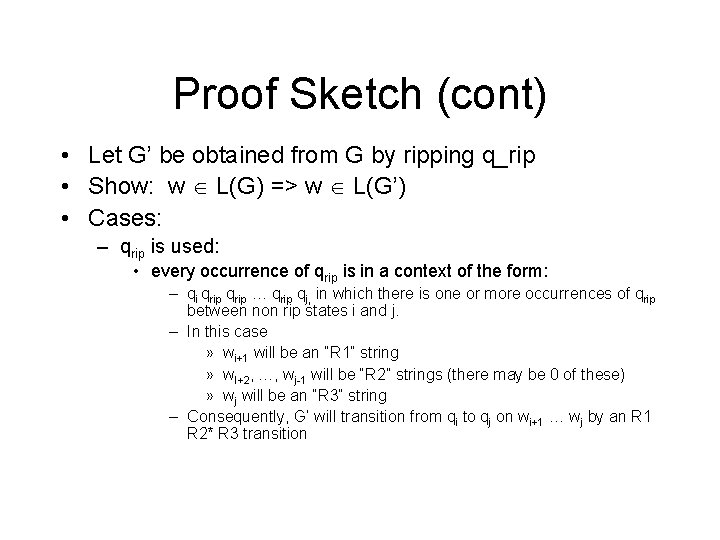
Proof Sketch (cont) • Let G’ be obtained from G by ripping q_rip • Show: w L(G) => w L(G’) • Cases: – qrip is used: • every occurrence of qrip is in a context of the form: – qi qrip … qrip qj, in which there is one or more occurrences of qrip between non rip states i and j. – In this case » wi+1 will be an “R 1” string » w. I+2, …, wj-1 will be “R 2” strings (there may be 0 of these) » wj will be an “R 3” string – Consequently, G’ will transition from qi to qj on wi+1 … wj by an R 1 R 2* R 3 transition
Next time • Non-regular languages (pumping lemma)