
Lecture 3 Ch 2 STRAIGHT LINE MOTION University


- Slides: 35
Lecture 3 Ch 2. STRAIGHT LINE MOTION University Physics: Mechanics Dr. -Ing. Erwin Sitompul http: //zitompul. wordpress. com 2013
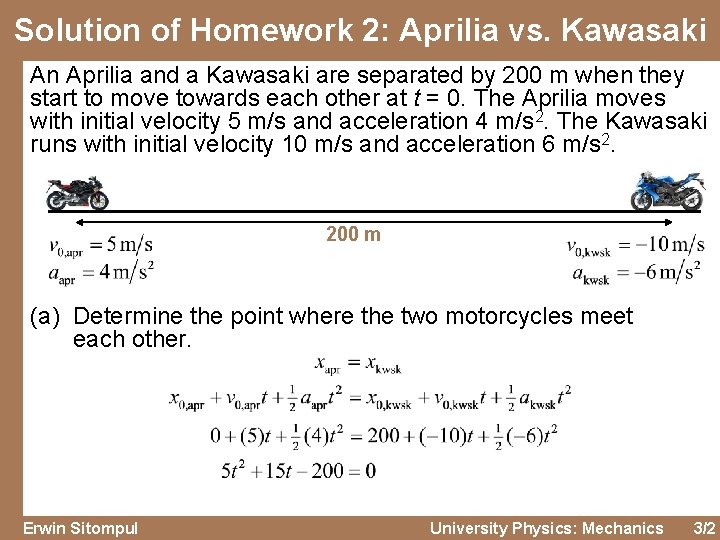
Solution of Homework 2: Aprilia vs. Kawasaki An Aprilia and a Kawasaki are separated by 200 m when they start to move towards each other at t = 0. The Aprilia moves with initial velocity 5 m/s and acceleration 4 m/s 2. The Kawasaki runs with initial velocity 10 m/s and acceleration 6 m/s 2. 200 m (a) Determine the point where the two motorcycles meet each other. Erwin Sitompul University Physics: Mechanics 3/2
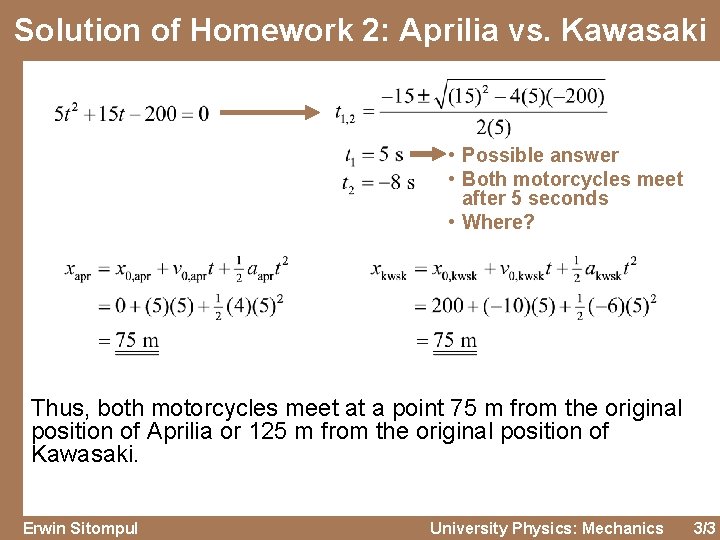
Solution of Homework 2: Aprilia vs. Kawasaki • Possible answer • Both motorcycles meet after 5 seconds • Where? Thus, both motorcycles meet at a point 75 m from the original position of Aprilia or 125 m from the original position of Kawasaki. Erwin Sitompul University Physics: Mechanics 3/3
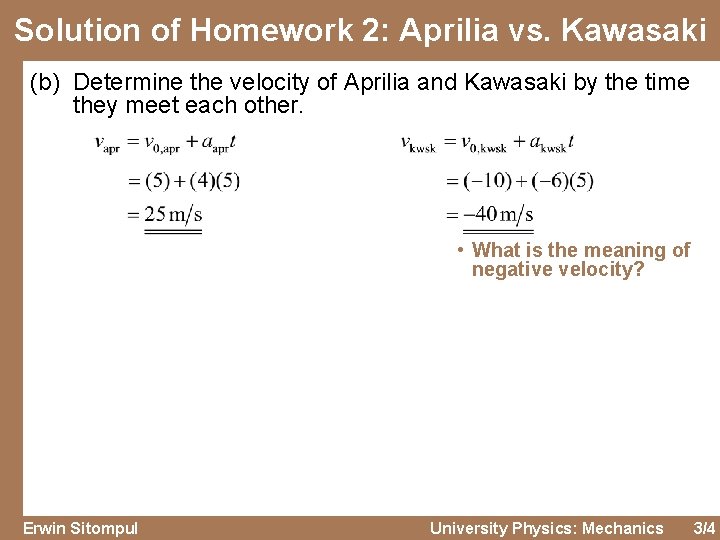
Solution of Homework 2: Aprilia vs. Kawasaki (b) Determine the velocity of Aprilia and Kawasaki by the time they meet each other. • What is the meaning of negative velocity? Erwin Sitompul University Physics: Mechanics 3/4
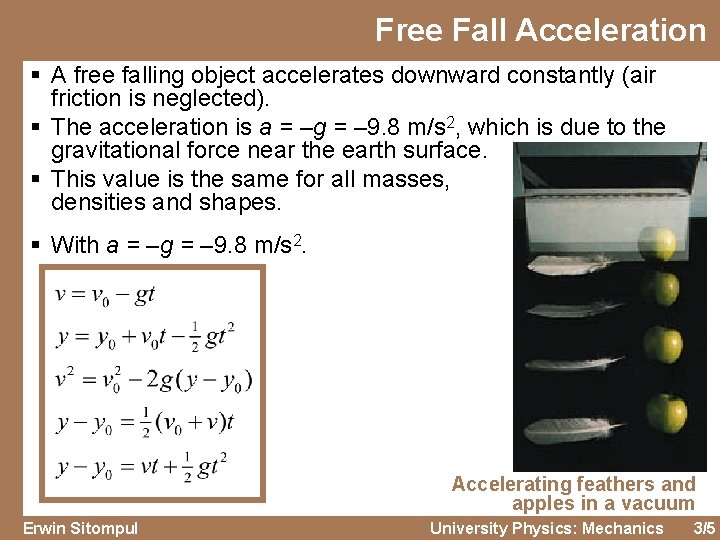
Free Fall Acceleration § A free falling object accelerates downward constantly (air friction is neglected). § The acceleration is a = –g = – 9. 8 m/s 2, which is due to the gravitational force near the earth surface. § This value is the same for all masses, densities and shapes. § With a = –g = – 9. 8 m/s 2. Accelerating feathers and apples in a vacuum Erwin Sitompul University Physics: Mechanics 3/5
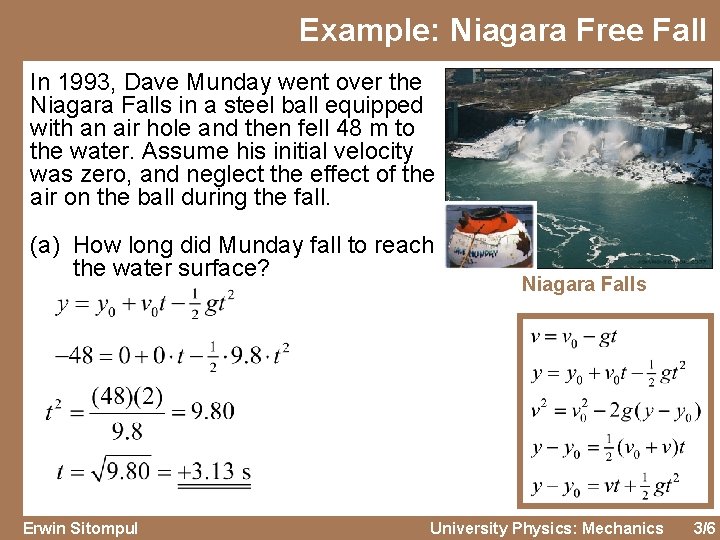
Example: Niagara Free Fall In 1993, Dave Munday went over the Niagara Falls in a steel ball equipped with an air hole and then fell 48 m to the water. Assume his initial velocity was zero, and neglect the effect of the air on the ball during the fall. (a) How long did Munday fall to reach the water surface? Erwin Sitompul Niagara Falls University Physics: Mechanics 3/6
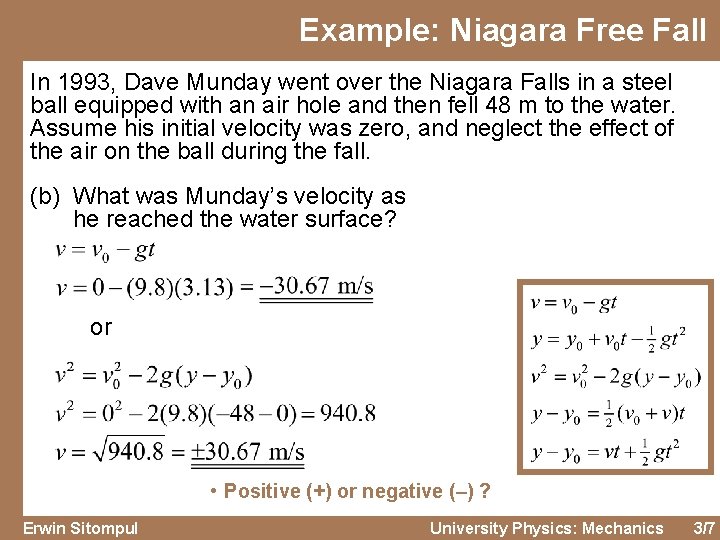
Example: Niagara Free Fall In 1993, Dave Munday went over the Niagara Falls in a steel ball equipped with an air hole and then fell 48 m to the water. Assume his initial velocity was zero, and neglect the effect of the air on the ball during the fall. (b) What was Munday’s velocity as he reached the water surface? or • Positive (+) or negative (–) ? Erwin Sitompul University Physics: Mechanics 3/7
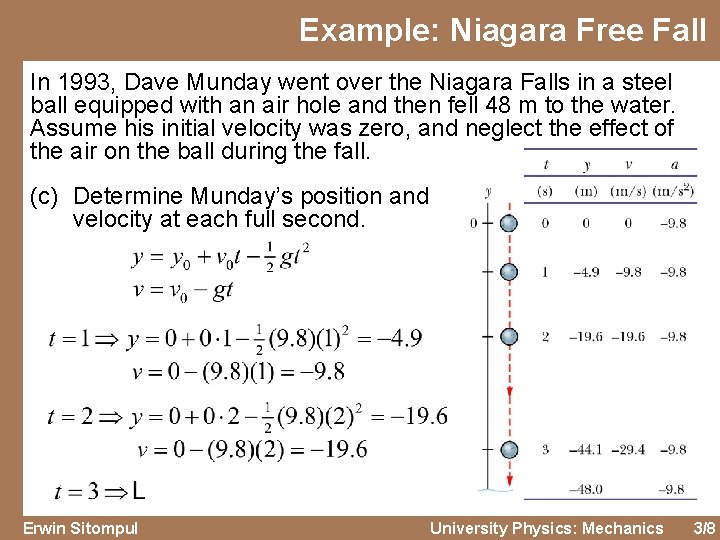
Example: Niagara Free Fall In 1993, Dave Munday went over the Niagara Falls in a steel ball equipped with an air hole and then fell 48 m to the water. Assume his initial velocity was zero, and neglect the effect of the air on the ball during the fall. (c) Determine Munday’s position and velocity at each full second. Erwin Sitompul University Physics: Mechanics 3/8
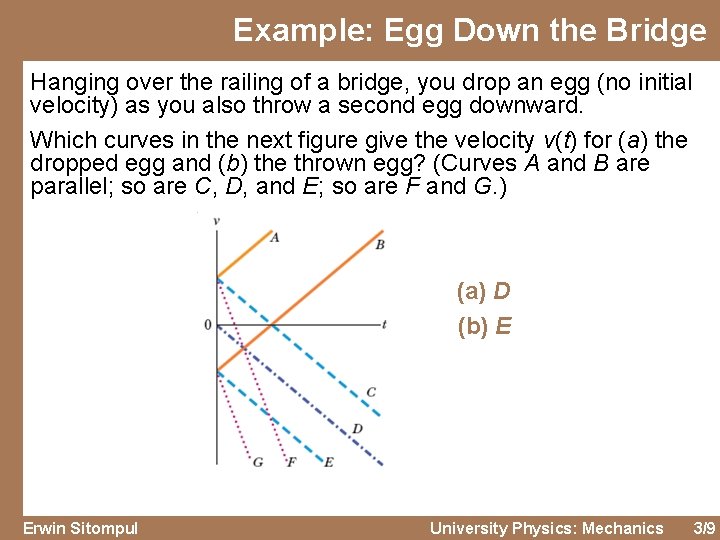
Example: Egg Down the Bridge Hanging over the railing of a bridge, you drop an egg (no initial velocity) as you also throw a second egg downward. Which curves in the next figure give the velocity v(t) for (a) the dropped egg and (b) the thrown egg? (Curves A and B are parallel; so are C, D, and E; so are F and G. ) (a) D (b) E Erwin Sitompul University Physics: Mechanics 3/9
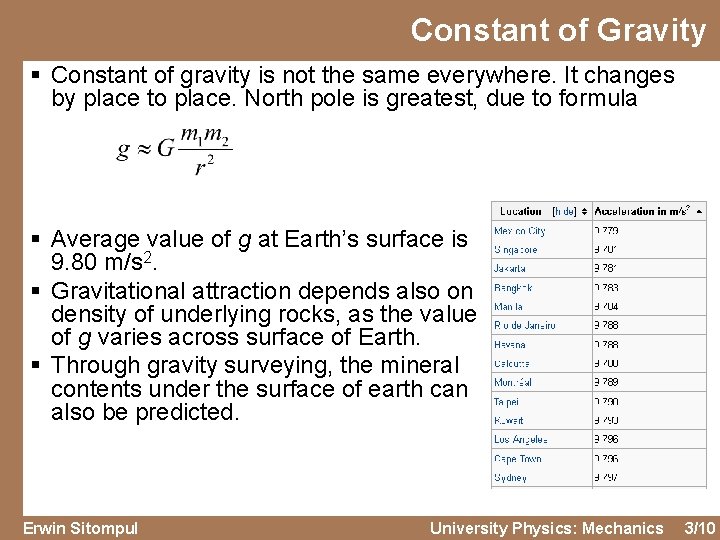
Constant of Gravity § Constant of gravity is not the same everywhere. It changes by place to place. North pole is greatest, due to formula § Average value of g at Earth’s surface is 9. 80 m/s 2. § Gravitational attraction depends also on density of underlying rocks, as the value of g varies across surface of Earth. § Through gravity surveying, the mineral contents under the surface of earth can also be predicted. Erwin Sitompul University Physics: Mechanics 3/10
Short Lab: Determining Constant of Gravity Preparation: 1. Make a group of 3 students. 2. Give name to your group. Materials: 1. An object that you can drop without destroying it 2. A stopwatch (any handphone has it) Procedure: 1. Drop the object from an elevation the same as the height of one of the group member. 2. Measure the time from the release until the object touches the floor. 3. Repeat 5 times, average the result. 4. Use the average fall time to calculate the constant of gravity. 5. Give analysis and submit your group report. Erwin Sitompul University Physics: Mechanics 3/11
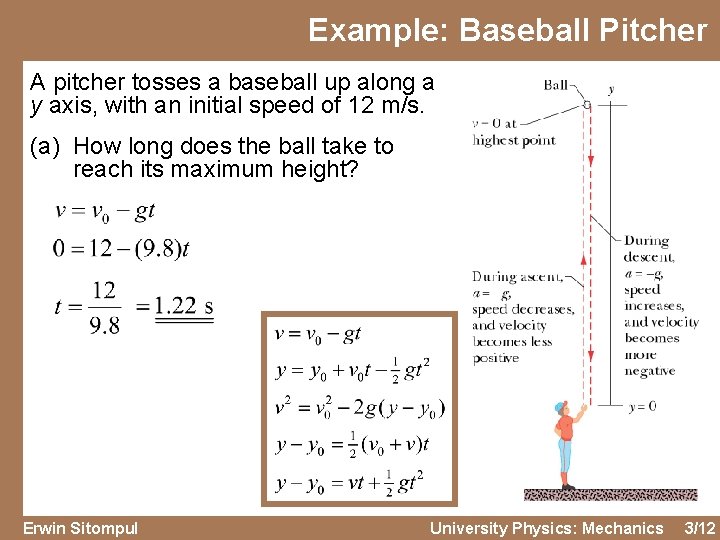
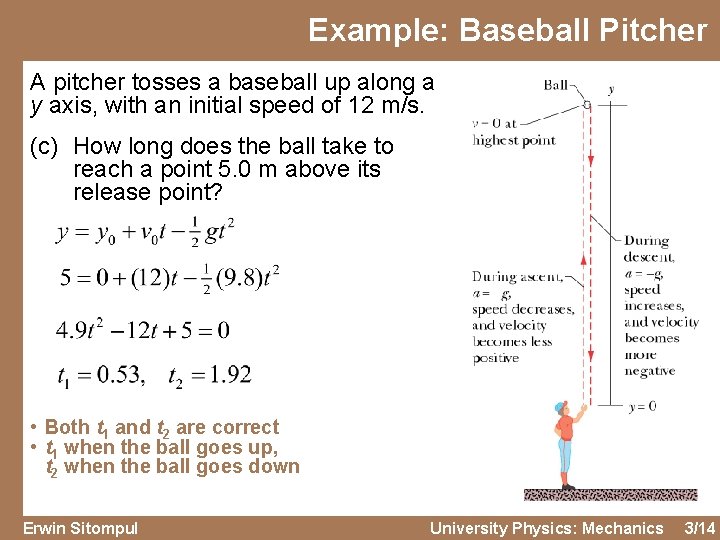
Example: Baseball Pitcher A pitcher tosses a baseball up along a y axis, with an initial speed of 12 m/s. (a) How long does the ball take to reach its maximum height? Erwin Sitompul University Physics: Mechanics 3/12
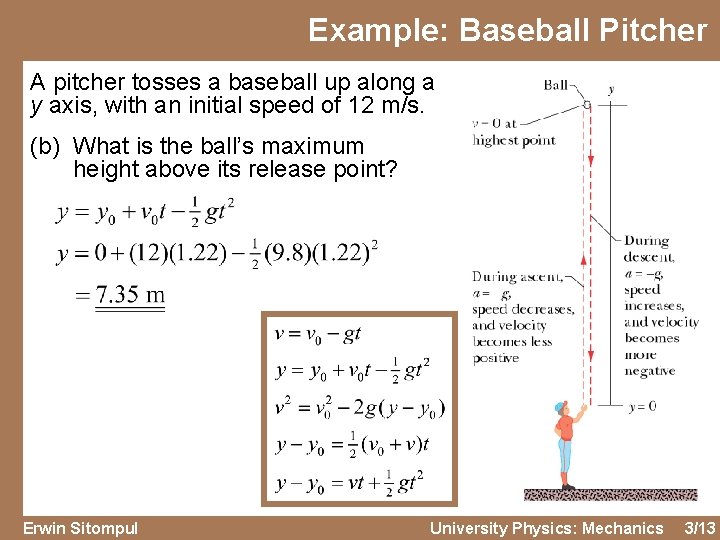
Example: Baseball Pitcher A pitcher tosses a baseball up along a y axis, with an initial speed of 12 m/s. (b) What is the ball’s maximum height above its release point? Erwin Sitompul University Physics: Mechanics 3/13
Example: Baseball Pitcher A pitcher tosses a baseball up along a y axis, with an initial speed of 12 m/s. (c) How long does the ball take to reach a point 5. 0 m above its release point? • Both t 1 and t 2 are correct • t 1 when the ball goes up, t 2 when the ball goes down Erwin Sitompul University Physics: Mechanics 3/14
Lecture 3 Ch 3. VECTOR QUANTITIES University Physics: Mechanics Dr. -Ing. Erwin Sitompul http: //zitompul. wordpress. com
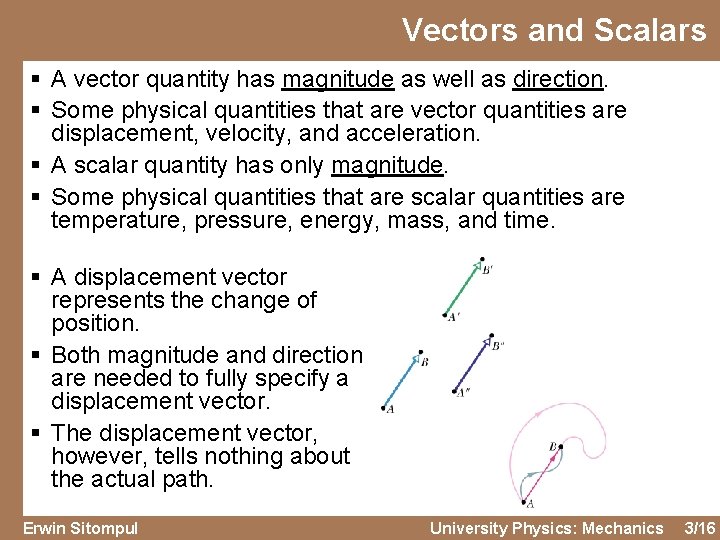
Vectors and Scalars § A vector quantity has magnitude as well as direction. § Some physical quantities that are vector quantities are displacement, velocity, and acceleration. § A scalar quantity has only magnitude. § Some physical quantities that are scalar quantities are temperature, pressure, energy, mass, and time. § A displacement vector represents the change of position. § Both magnitude and direction are needed to fully specify a displacement vector. § The displacement vector, however, tells nothing about the actual path. Erwin Sitompul University Physics: Mechanics 3/16
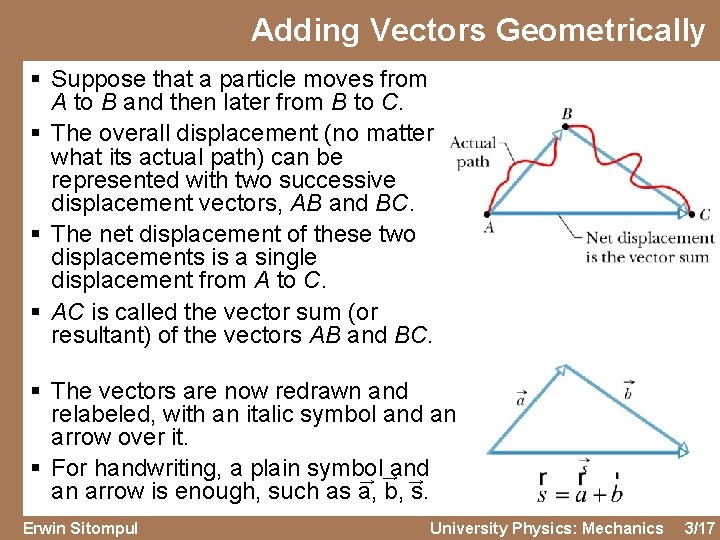
Adding Vectors Geometrically § Suppose that a particle moves from A to B and then later from B to C. § The overall displacement (no matter what its actual path) can be represented with two successive displacement vectors, AB and BC. § The net displacement of these two displacements is a single displacement from A to C. § AC is called the vector sum (or resultant) of the vectors AB and BC. § The vectors are now redrawn and relabeled, with an italic symbol and an arrow over it. § For handwriting, a plain symbol and →→ → an arrow is enough, such as a, b, s. Erwin Sitompul University Physics: Mechanics 3/17
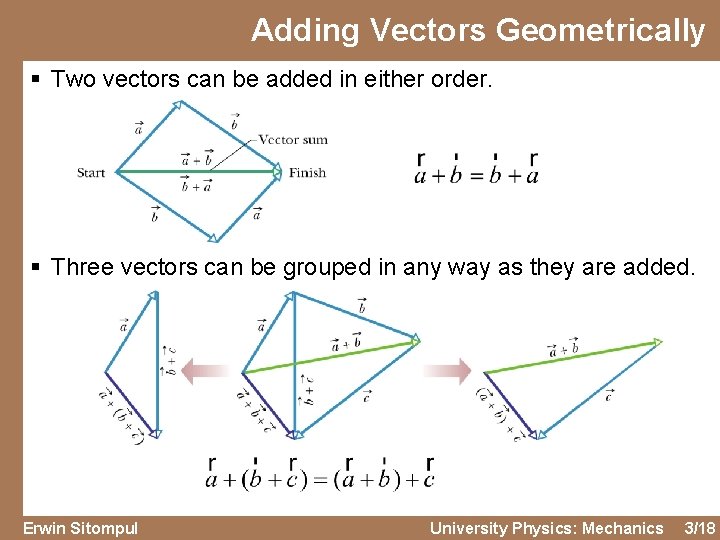
Adding Vectors Geometrically § Two vectors can be added in either order. § Three vectors can be grouped in any way as they are added. Erwin Sitompul University Physics: Mechanics 3/18
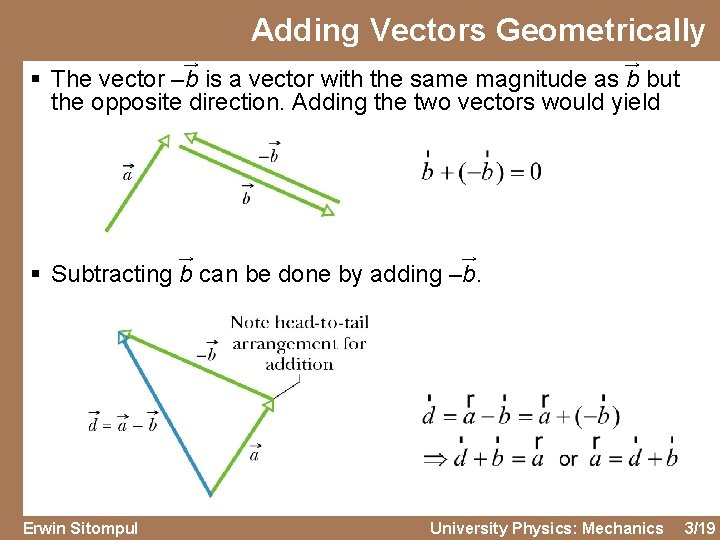
Adding Vectors Geometrically → → § The vector –b is a vector with the same magnitude as b but the opposite direction. Adding the two vectors would yield → → § Subtracting b can be done by adding –b. Erwin Sitompul University Physics: Mechanics 3/19
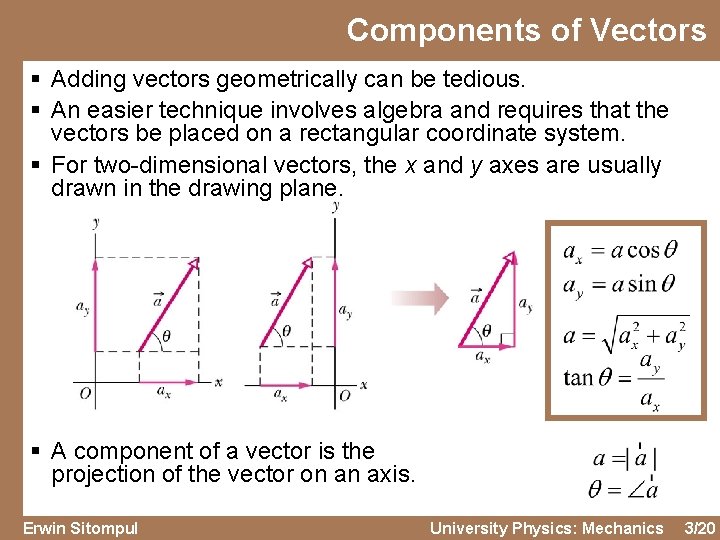
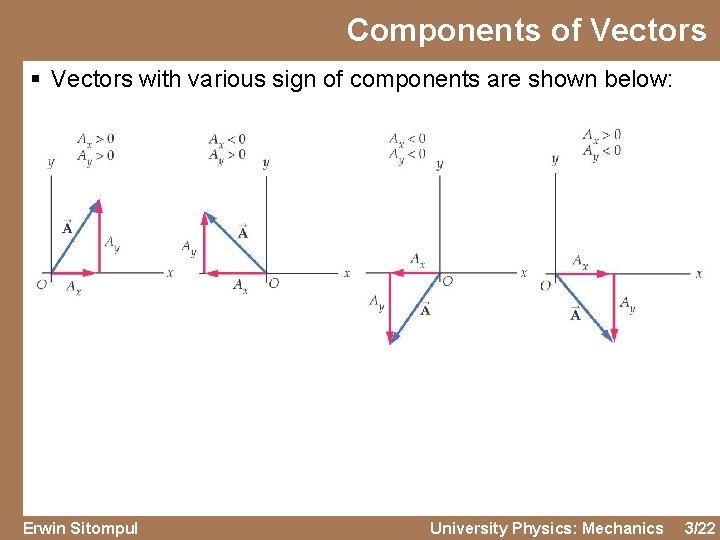
Components of Vectors § Adding vectors geometrically can be tedious. § An easier technique involves algebra and requires that the vectors be placed on a rectangular coordinate system. § For two-dimensional vectors, the x and y axes are usually drawn in the drawing plane. § A component of a vector is the projection of the vector on an axis. Erwin Sitompul University Physics: Mechanics 3/20
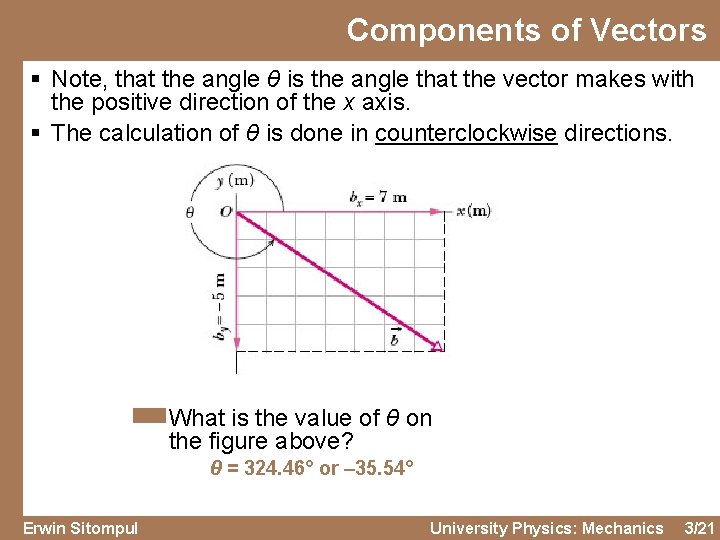
Components of Vectors § Note, that the angle θ is the angle that the vector makes with the positive direction of the x axis. § The calculation of θ is done in counterclockwise directions. What is the value of θ on the figure above? θ = 324. 46° or – 35. 54° Erwin Sitompul University Physics: Mechanics 3/21
Components of Vectors § Vectors with various sign of components are shown below: Erwin Sitompul University Physics: Mechanics 3/22
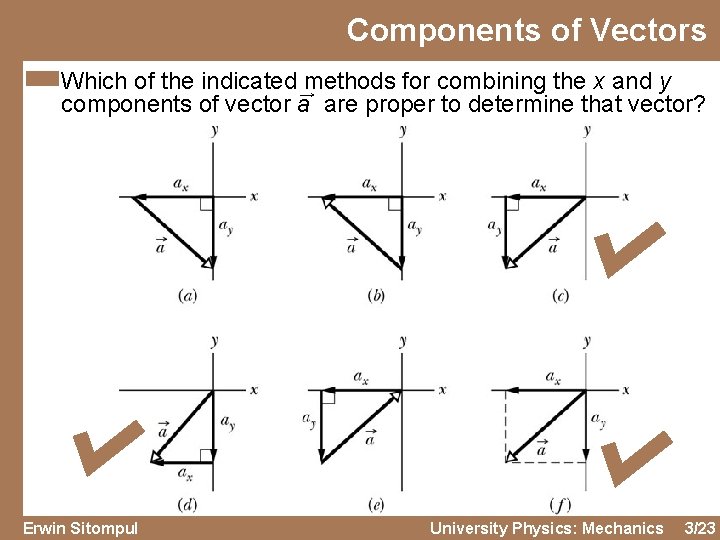
Components of Vectors Which of the indicated →methods for combining the x and y components of vector a are proper to determine that vector? Erwin Sitompul University Physics: Mechanics 3/23
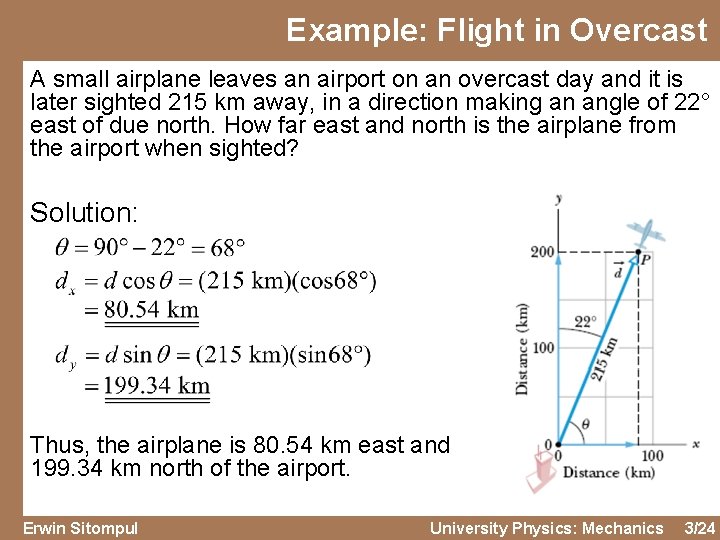
Example: Flight in Overcast A small airplane leaves an airport on an overcast day and it is later sighted 215 km away, in a direction making an angle of 22° east of due north. How far east and north is the airplane from the airport when sighted? Solution: Thus, the airplane is 80. 54 km east and 199. 34 km north of the airport. Erwin Sitompul University Physics: Mechanics 3/24
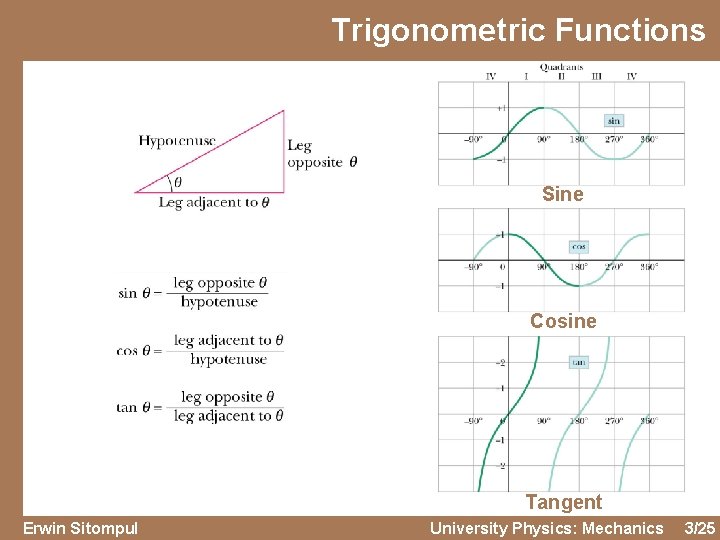
Trigonometric Functions Sine Cosine Tangent Erwin Sitompul University Physics: Mechanics 3/25
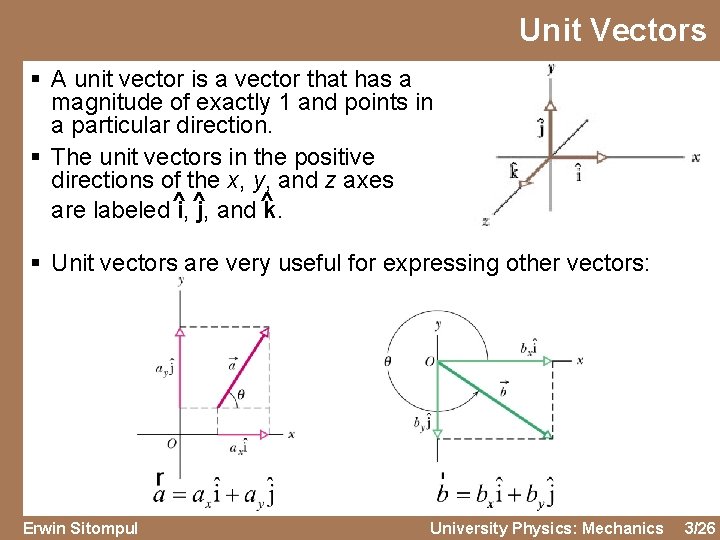
Unit Vectors § A unit vector is a vector that has a magnitude of exactly 1 and points in a particular direction. § The unit vectors in the positive directions of the x, y, and z axes are labeled ^i, ^j, and ^k. § Unit vectors are very useful for expressing other vectors: Erwin Sitompul University Physics: Mechanics 3/26
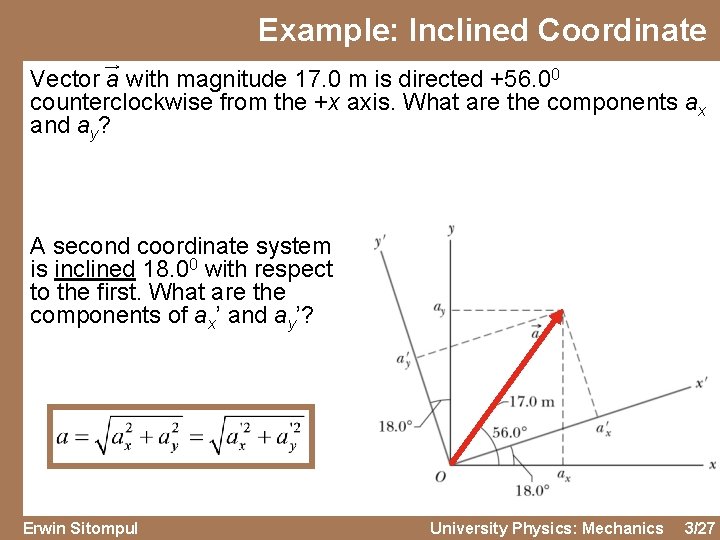
Example: Inclined Coordinate → Vector a with magnitude 17. 0 m is directed +56. 00 counterclockwise from the +x axis. What are the components ax and ay? A second coordinate system is inclined 18. 00 with respect to the first. What are the components of ax’ and ay’? Erwin Sitompul University Physics: Mechanics 3/27
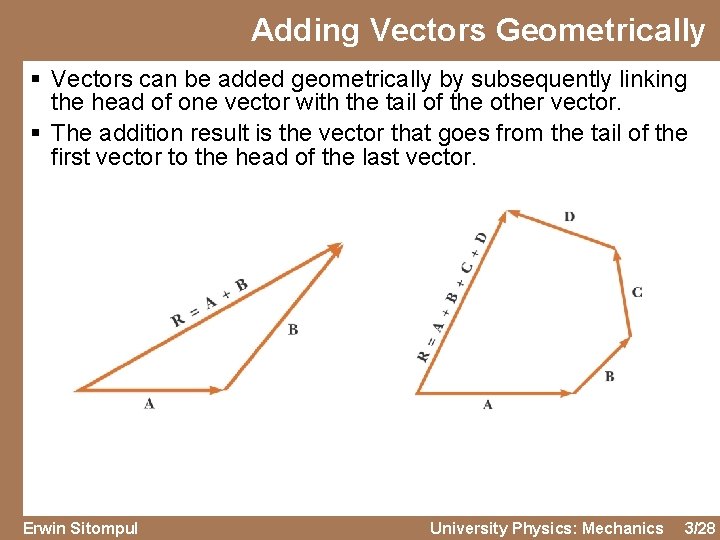
Adding Vectors Geometrically § Vectors can be added geometrically by subsequently linking the head of one vector with the tail of the other vector. § The addition result is the vector that goes from the tail of the first vector to the head of the last vector. Erwin Sitompul University Physics: Mechanics 3/28
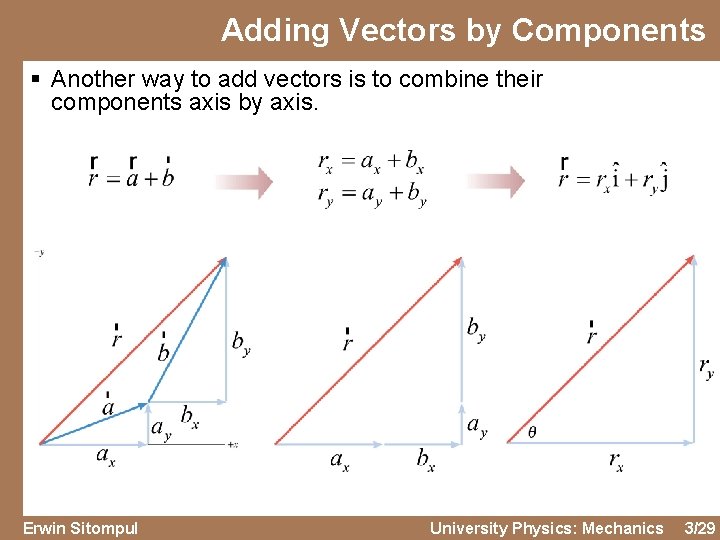
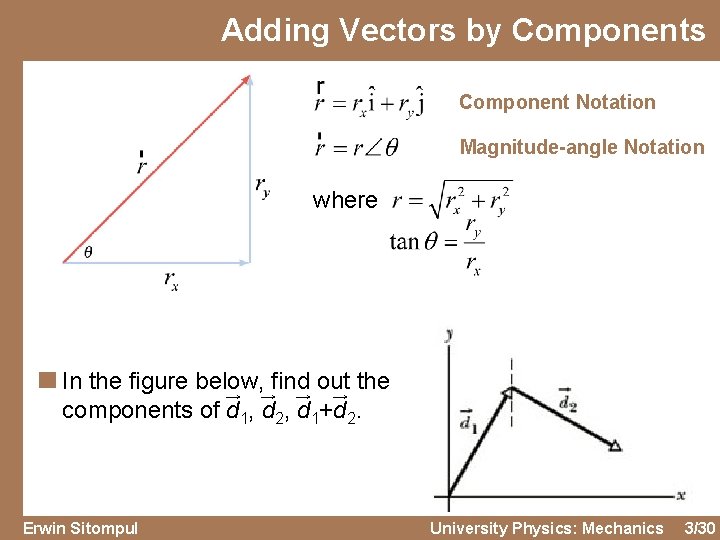
Adding Vectors by Components § Another way to add vectors is to combine their components axis by axis. Erwin Sitompul University Physics: Mechanics 3/29
Adding Vectors by Components Component Notation Magnitude-angle Notation where In the figure below, find out the → → components of d 1, d 2, d 1+d 2. Erwin Sitompul University Physics: Mechanics 3/30
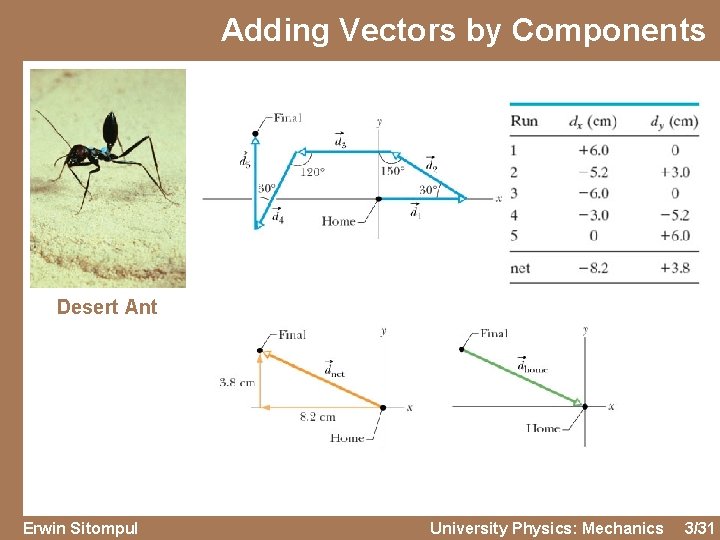
Adding Vectors by Components Desert Ant Erwin Sitompul University Physics: Mechanics 3/31
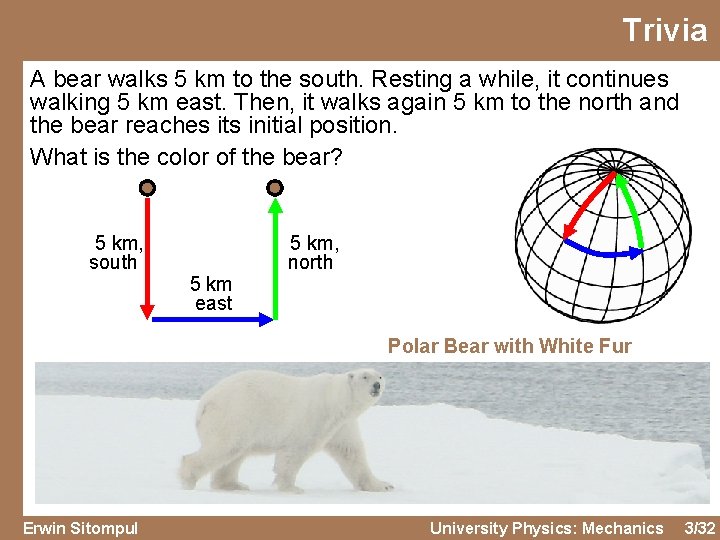
Trivia A bear walks 5 km to the south. Resting a while, it continues walking 5 km east. Then, it walks again 5 km to the north and the bear reaches its initial position. What is the color of the bear? 5 km, south 5 km east 5 km, north Polar Bear with White Fur Erwin Sitompul University Physics: Mechanics 3/32
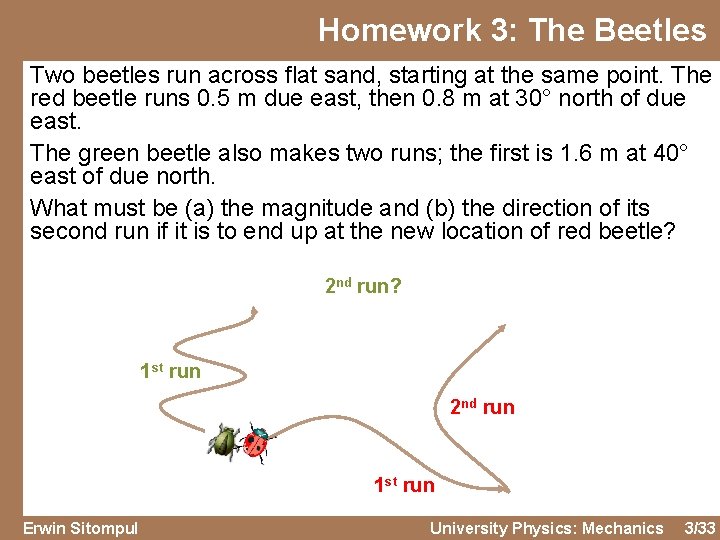
Homework 3: The Beetles Two beetles run across flat sand, starting at the same point. The red beetle runs 0. 5 m due east, then 0. 8 m at 30° north of due east. The green beetle also makes two runs; the first is 1. 6 m at 40° east of due north. What must be (a) the magnitude and (b) the direction of its second run if it is to end up at the new location of red beetle? 2 nd run? 1 st run 2 nd run 1 st run Erwin Sitompul University Physics: Mechanics 3/33
Homework 3 A: Dora’s House Dora, accompanied by Boots, wants to go back to her house, 10 km north east of their current position. To avoid the forest, Dora decides that they should first walk in the direction 20° north of due east, before later keep walking due north until reaching her house. (a) Determine the distance Dora and Boots must travel in their first walk. Erwin Sitompul 10 (c) Determine the total distance they must traveled to reach Dora’s house. km (b) Determine the distance they must travel in their second walk. University Physics: Mechanics 3/34
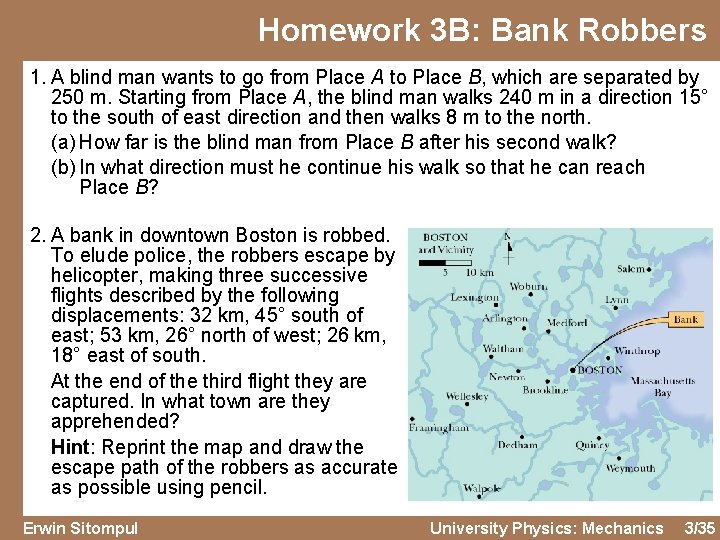
Homework 3 B: Bank Robbers 1. A blind man wants to go from Place A to Place B, which are separated by 250 m. Starting from Place A, the blind man walks 240 m in a direction 15° to the south of east direction and then walks 8 m to the north. (a) How far is the blind man from Place B after his second walk? (b) In what direction must he continue his walk so that he can reach Place B? 2. A bank in downtown Boston is robbed. To elude police, the robbers escape by helicopter, making three successive flights described by the following displacements: 32 km, 45° south of east; 53 km, 26° north of west; 26 km, 18° east of south. At the end of the third flight they are captured. In what town are they apprehended? Hint: Reprint the map and draw the escape path of the robbers as accurate as possible using pencil. Erwin Sitompul University Physics: Mechanics 3/35