
Lecture 3 Camera Rotations and Homographies Recap Normalized


- Slides: 28
Lecture 3: Camera Rotations and Homographies
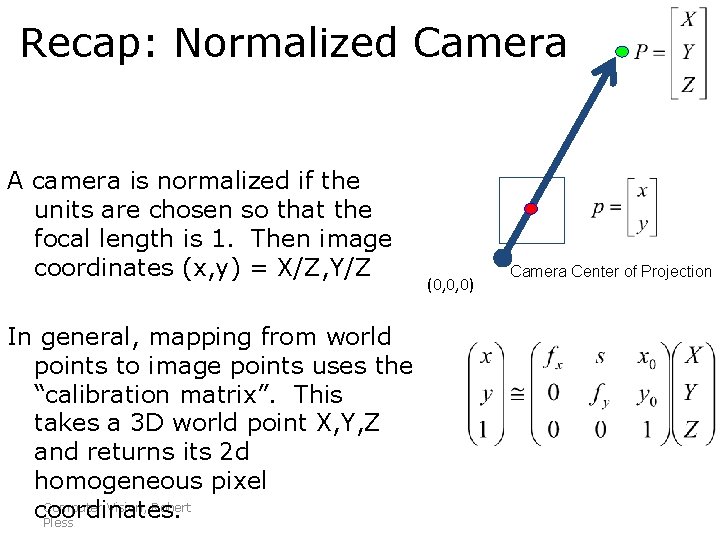
Recap: Normalized Camera A camera is normalized if the units are chosen so that the focal length is 1. Then image coordinates (x, y) = X/Z, Y/Z In general, mapping from world points to image points uses the “calibration matrix”. This takes a 3 D world point X, Y, Z and returns its 2 d homogeneous pixel Computer Vision, Robert coordinates. Pless (0, 0, 0) Camera Center of Projection
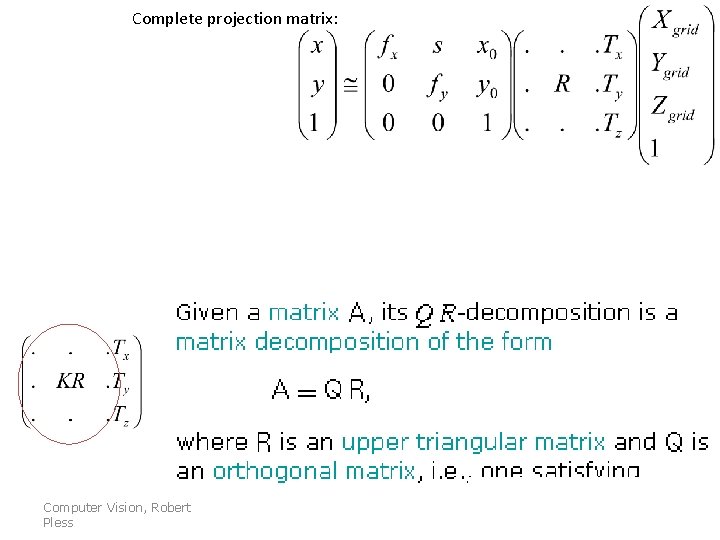
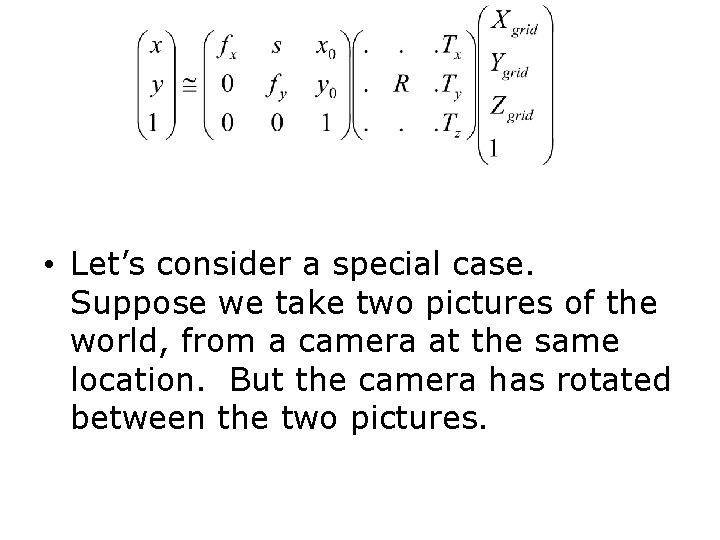
Complete projection matrix: Computer Vision, Robert Pless
• Let’s consider a special case. Suppose we take two pictures of the world, from a camera at the same location. But the camera has rotated between the two pictures.
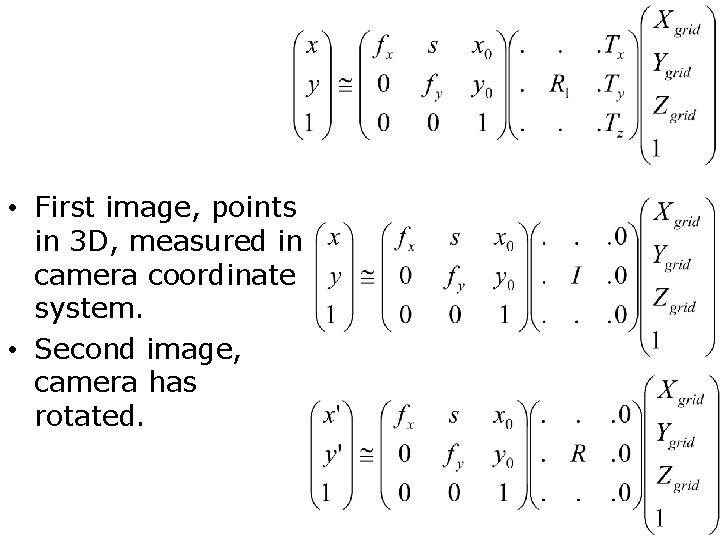
• First image, points in 3 D, measured in camera coordinate system. • Second image, camera has rotated.
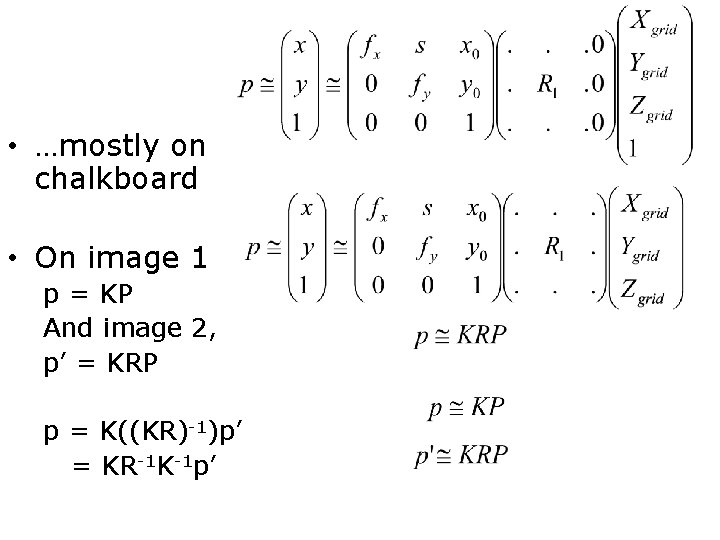
• …mostly on chalkboard • On image 1 p = KP And image 2, p’ = KRP p = K((KR)-1)p’ = KR-1 K-1 p’
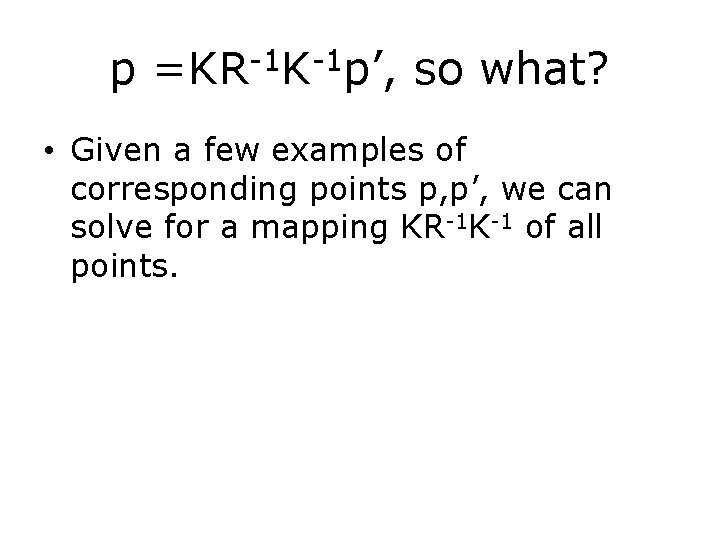
p =KR-1 K-1 p’, so what? • Given a few examples of corresponding points p, p’, we can solve for a mapping KR-1 K-1 of all points.
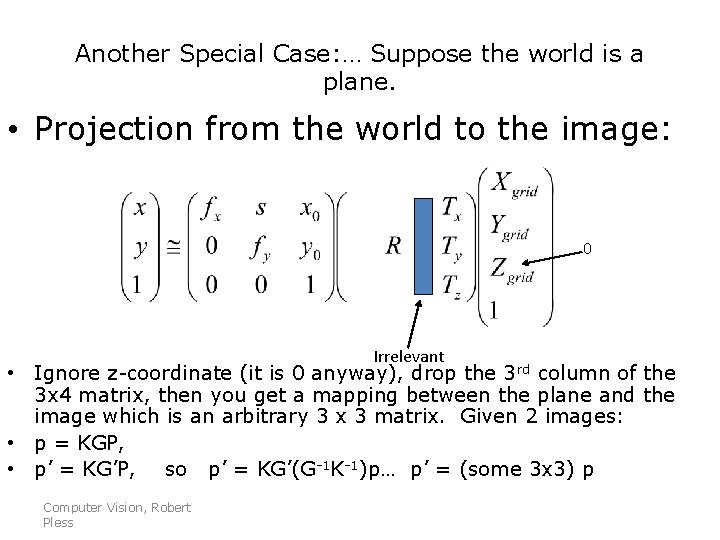
Another Special Case: … Suppose the world is a plane. • Projection from the world to the image: 0 Irrelevant • Ignore z-coordinate (it is 0 anyway), drop the 3 rd column of the 3 x 4 matrix, then you get a mapping between the plane and the image which is an arbitrary 3 x 3 matrix. Given 2 images: • p = KGP, • p’ = KG’P, so p’ = KG’(G-1 K-1)p… p’ = (some 3 x 3) p Computer Vision, Robert Pless
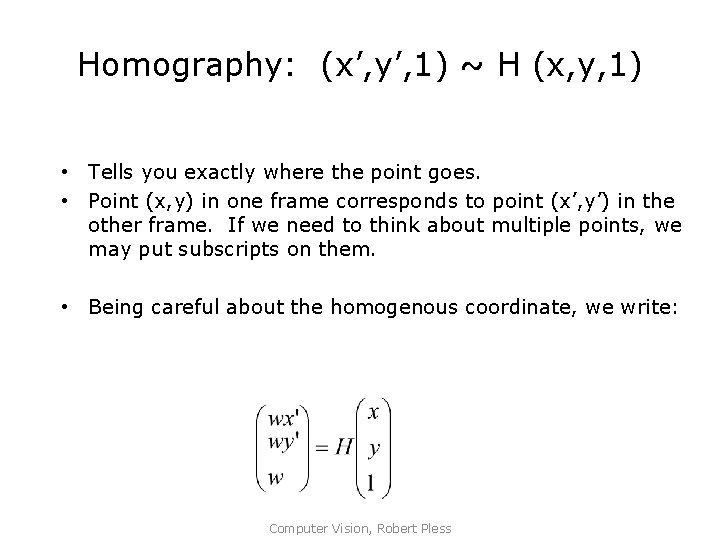
Homography: (x’, y’, 1) ~ H (x, y, 1) • Tells you exactly where the point goes. • Point (x, y) in one frame corresponds to point (x’, y’) in the other frame. If we need to think about multiple points, we may put subscripts on them. • Being careful about the homogenous coordinate, we write: Computer Vision, Robert Pless
Homography is a “simple” example of a 3 D to 2 D transformation It is also the “most complicated” linear 2 D to 2 D transformation. What other 2 D transformations are there? Computer Vision, Robert Pless
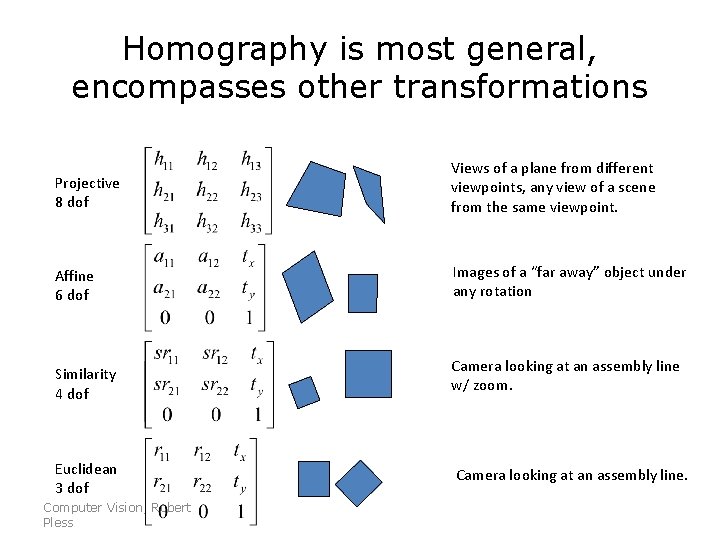
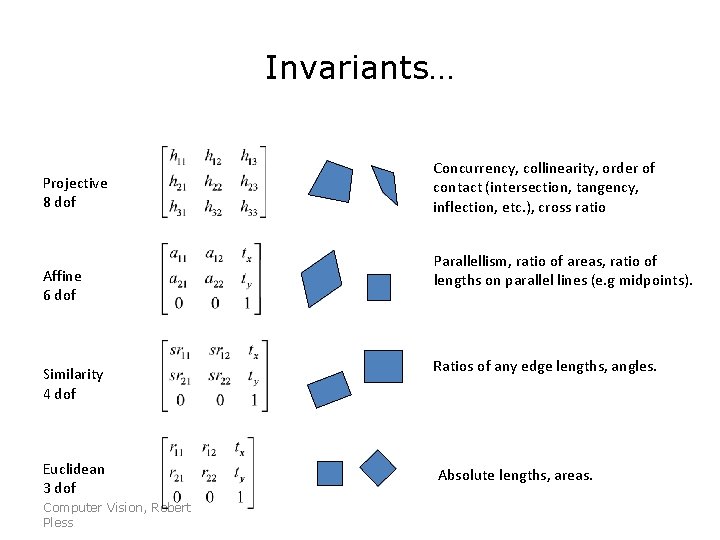
Homography is most general, encompasses other transformations Projective 8 dof Views of a plane from different viewpoints, any view of a scene from the same viewpoint. Affine 6 dof Images of a “far away” object under any rotation Similarity 4 dof Euclidean 3 dof Computer Vision, Robert Pless Camera looking at an assembly line w/ zoom. Camera looking at an assembly line.
Invariants… Projective 8 dof Affine 6 dof Similarity 4 dof Euclidean 3 dof Computer Vision, Robert Pless Concurrency, collinearity, order of contact (intersection, tangency, inflection, etc. ), cross ratio Parallellism, ratio of areas, ratio of lengths on parallel lines (e. g midpoints). Ratios of any edge lengths, angles. Absolute lengths, areas.
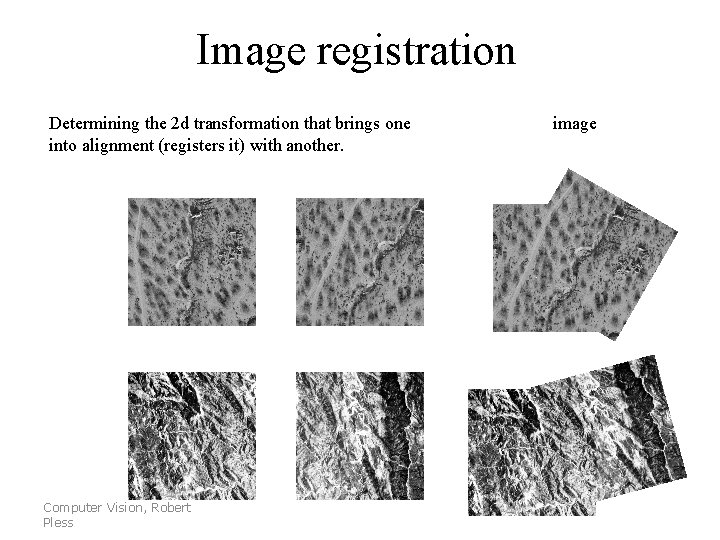
Image registration Determining the 2 d transformation that brings one into alignment (registers it) with another. Computer Vision, Robert Pless image
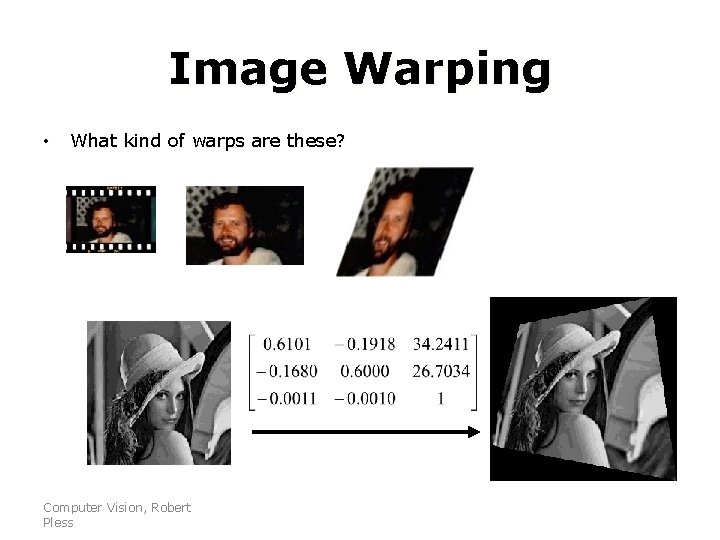
Image Warping • What kind of warps are these? Computer Vision, Robert Pless
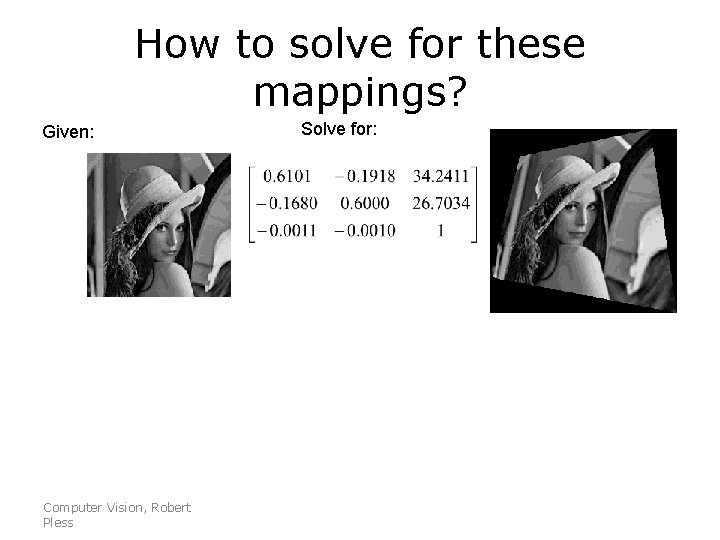
How to solve for these mappings? Given: Computer Vision, Robert Pless Solve for:
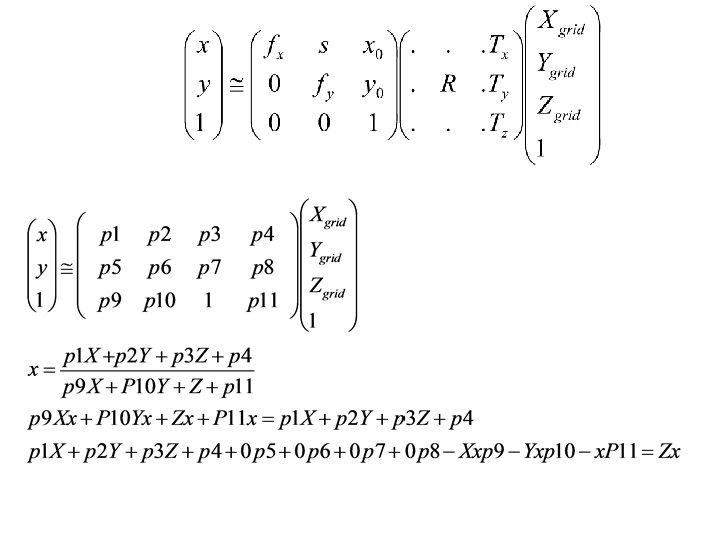
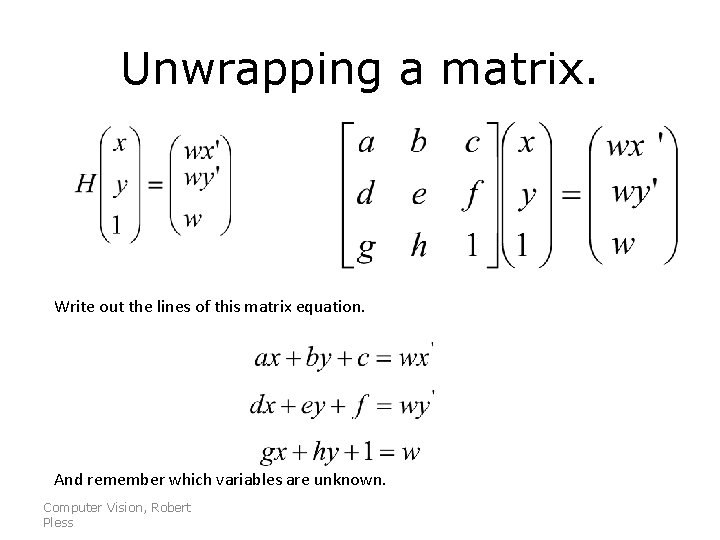
Unwrapping a matrix. Write out the lines of this matrix equation. And remember which variables are unknown. Computer Vision, Robert Pless
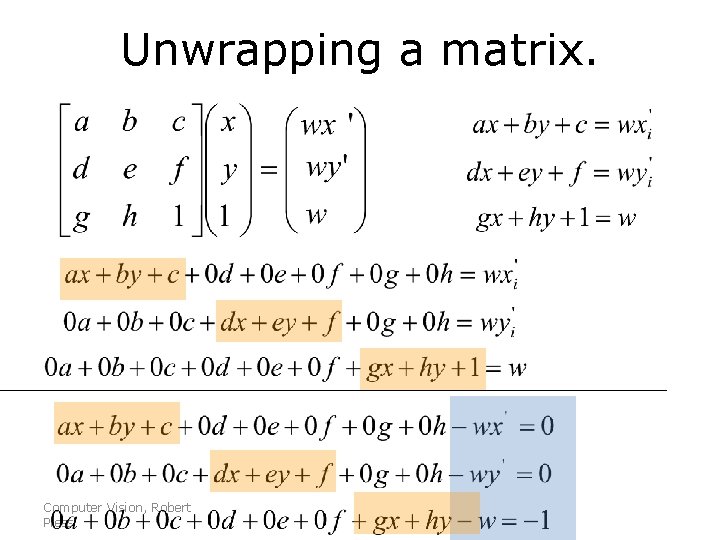
Unwrapping a matrix. Computer Vision, Robert Pless
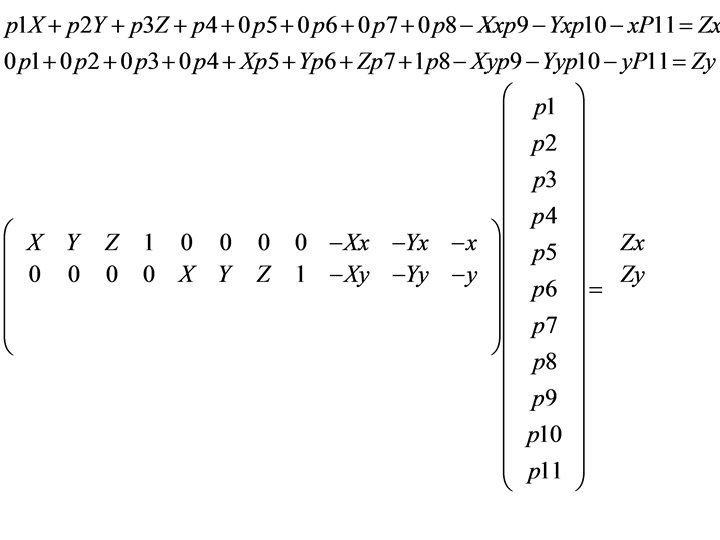
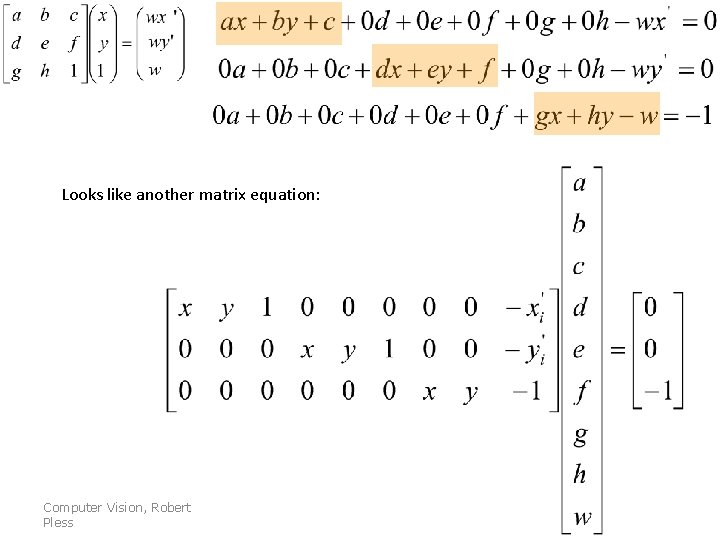
Looks like another matrix equation: Computer Vision, Robert Pless
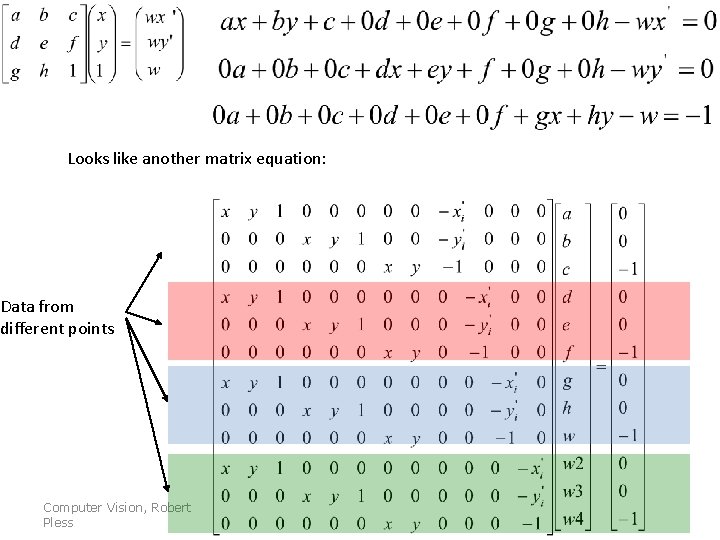
Looks like another matrix equation: Data from different points Computer Vision, Robert Pless
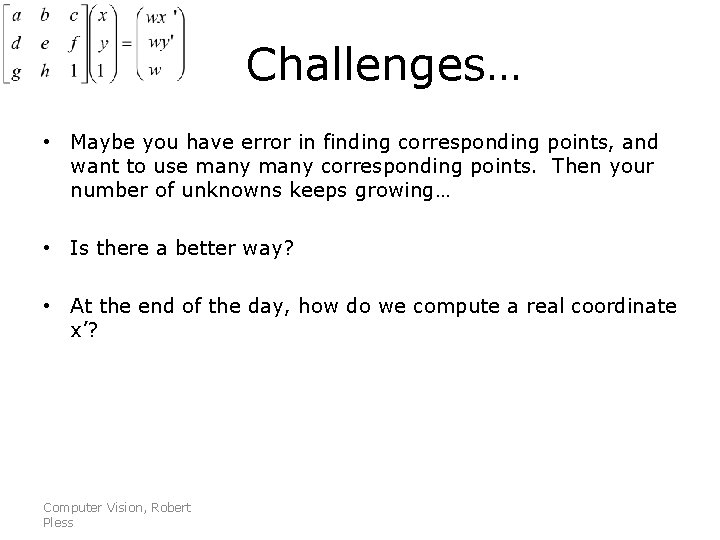
Challenges… • Maybe you have error in finding corresponding points, and want to use many corresponding points. Then your number of unknowns keeps growing… • Is there a better way? • At the end of the day, how do we compute a real coordinate x’? Computer Vision, Robert Pless
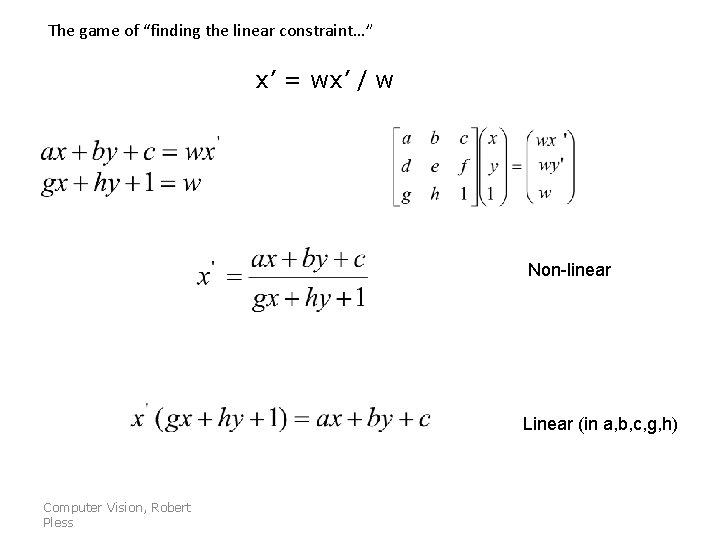
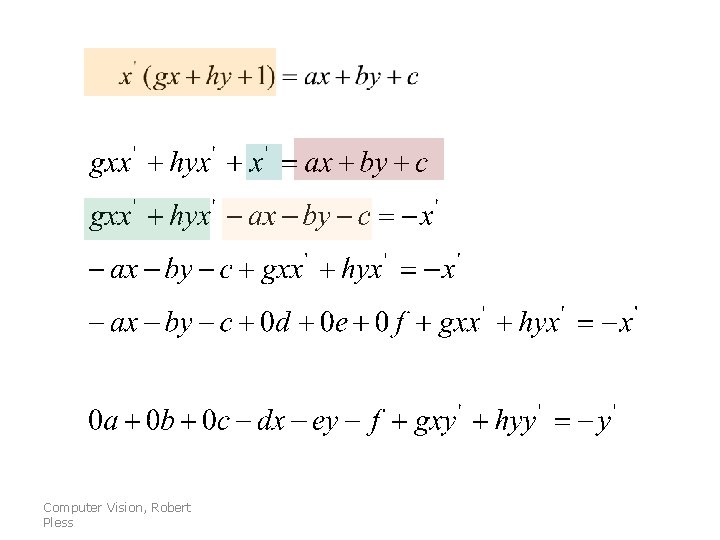
The game of “finding the linear constraint…” x’ = wx’ / w Non-linear Linear (in a, b, c, g, h) Computer Vision, Robert Pless
Computer Vision, Robert Pless
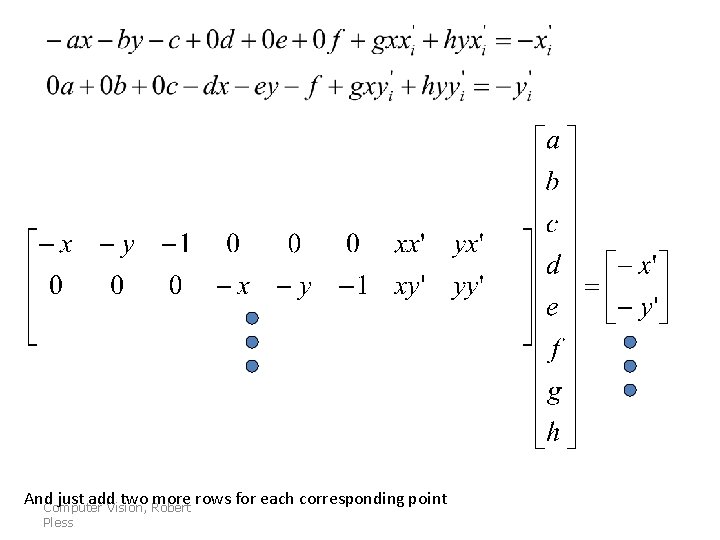
And just add two more rows for each corresponding point Computer Vision, Robert Pless
Ax=b Matlab: x = Ab Then make your homography matrix by rearranging x into a 3 x 3 matrix Size of A? b? Computer Vision, Robert Pless
How to warp images?