
Lecture 3 Building an Argument Evidence Impact Today

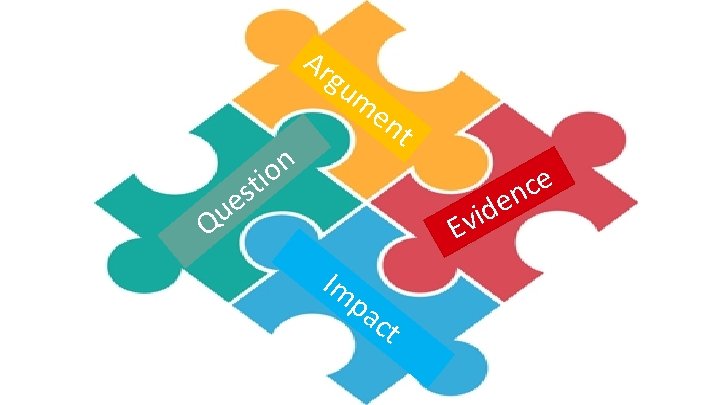
Lecture 3 Building an Argument – Evidence – Impact
Today we will talk about… • Use of Arguments • Claim • Data/evidence • Warrant • Impact

Leading Questions • From Yes Prime Minister – • https: //www. youtube. com/ watch? v=G 0 ZZJXw 4 MTA
Ar gu n o i st m en t e c n e u Q e d i Ev Im pa c t
Argument (or Claim)

Argument (or Claim) • Argument is a broad term, which includes many tactics designed to move people to a position, a belief, or a course of action. • Argument is a specific kind of persuasion based on the principles of logic and reasoning. • One uses arguments to persuade, justify and sometimes to explain
You do NOT need argument if you are: • Describing something • Listing certain items • Explaining how something works (giving instructions) • Identifying key points or factors

For and Against
Two sides: for and against • Affirmative side: Side that supports the proposition –The job of the Affirmative (Aff) is to prove that the topic (resolution) is a good idea. • Negative side: Side that opposes the proposition. –The job of the Negative (Neg) is to prove that the topic (resolution) is a bad idea.
Elements of argument (everyday context) • Structurally, argument should answer certain rules, which also defines argument as a group of statements some of which, the premises, are offered in support of another statement, the conclusion. eg – All humans are mortal (premise) – The Queen is human (premise) – Therefore, the Queen is mortal (conclusion)
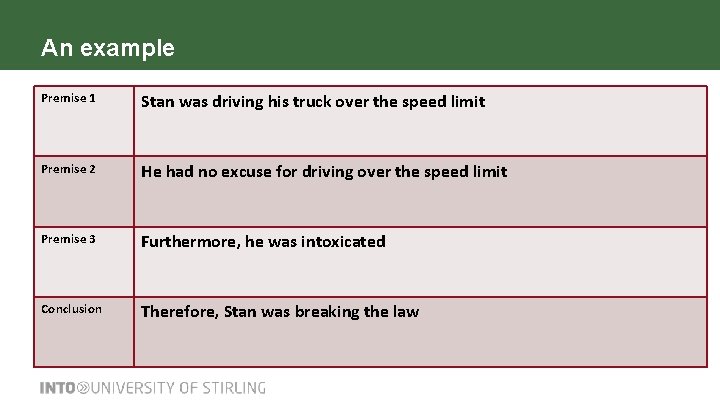
An example Premise 1 Stan was driving his truck over the speed limit Premise 2 He had no excuse for driving over the speed limit Premise 3 Furthermore, he was intoxicated Conclusion Therefore, Stan was breaking the law
Elements of argument (professional and academic context) A more pronounced core elements of an argument (especially in reasoning) include: • Claim • Data/evidence • Warrant • Impact

Claim
What is claim? • An assertion that something is true; • In argument, claim is the key point being made. What one seek to prove true; • A good claim is engaging, not overly vague, logical.

Data/evidence
Data provides evidence in argument • You use it/ cite it to support your claim; • Facts and examples to prove something; • For on demand writing, quotes from the passage/article. • Give credit to author when you’re writing with direct quotes OR…paraphrasing.
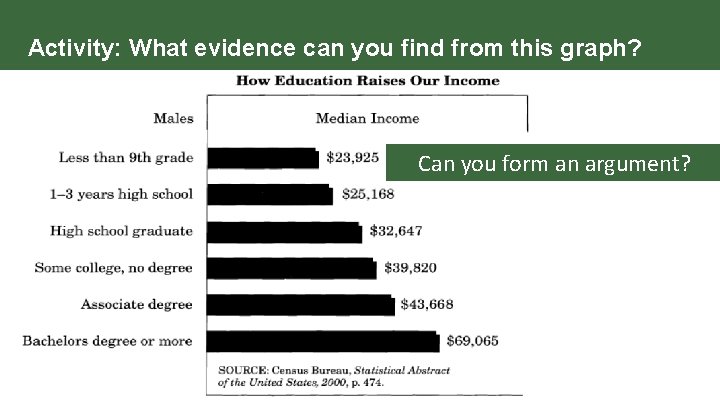
Activity: What evidence can you find from this graph? Can you form an argument?

Warrant
What’s the role of warrant? • Interprets the data and shows how it supports your claim; • Explains why the data proves the claim
Impact (Evaluation; So What? Why does this matter? )
Impact (Evaluation, So What? Why does this matter? ) • A reason why the argument is important to the audience • Impact is why someone should care about your argument. –In other words, why is this point important? • Impact is, for example, something good that will happen if people listen to you or something bad that will happen if they do not. • Examples: • - "If Americans were not allowed to have guns, there would not be as many murders in the United States" or • "If Americans can not own guns, there will be a crime wave in American because people won't be able to protect themselves. "
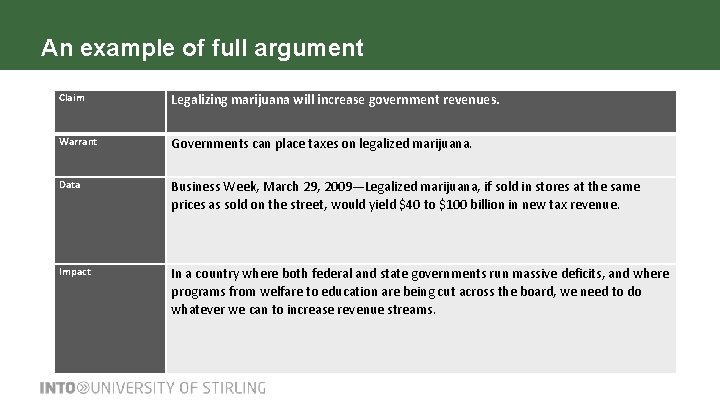
An example of full argument Claim Legalizing marijuana will increase government revenues. Warrant Governments can place taxes on legalized marijuana. Data Business Week, March 29, 2009—Legalized marijuana, if sold in stores at the same prices as sold on the street, would yield $40 to $100 billion in new tax revenue. Impact In a country where both federal and state governments run massive deficits, and where programs from welfare to education are being cut across the board, we need to do whatever we can to increase revenue streams.
Key points/concepts • Each argument has four elements: a claim, a warrant, data, and an impact. • A claim serves as the title for an argument; it conveys the main idea of the argument while also providing a compelling reason to support one side or the other. • A warrant is the logical reason why the claim is true; it is the underpinning of the argument. • Data is the research used to support the argument; it comes from sources found outside the debate round. • An impact is the reason the argument is important; it establishes a compelling reason why the argument matters in a broad context. • While arguments should contain each of these elements, strong arguments also contain illustration and in-depth explanation; arguments should not merely be four sentences long.
What makes argument good? • Acceptability, relevance and grounded conditions of an argument: - the premises are acceptable or reasonable (likely to be true) - the evidence or reasons are relevant to the claim - the reasons provide sufficient grounds to lead us to accept the claim Beware! Much of what we encounter on a daily basis -- from advertising, from politicians -- are designed to convince us without giving good reasons. And most of us at some point(s) believe them and act as suggested!
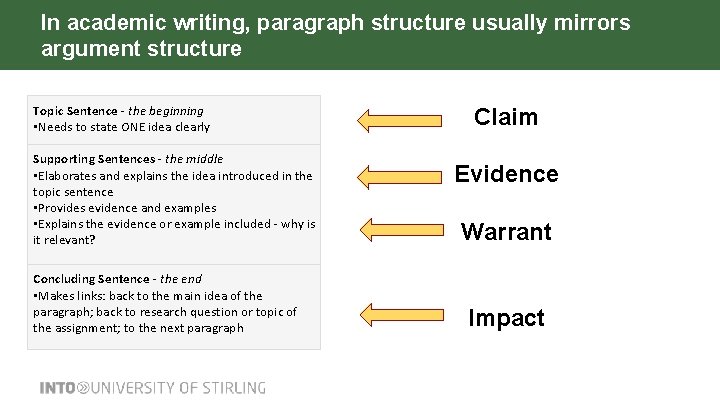
In academic writing, paragraph structure usually mirrors argument structure Topic Sentence - the beginning • Needs to state ONE idea clearly Supporting Sentences - the middle • Elaborates and explains the idea introduced in the topic sentence • Provides evidence and examples • Explains the evidence or example included - why is it relevant? Concluding Sentence - the end • Makes links: back to the main idea of the paragraph; back to research question or topic of the assignment; to the next paragraph Claim Evidence Warrant Impact
Academic argument • Almost everything in academic life is debatable - statistics, ‘facts’, theories, data, etc. • Ideas and theories are progressed by argument - evidence, reasons, authorities, ideas to back up claim • Absolute ‘proof’ is virtually impossible • Many so-called ‘facts’ actually appeal to emotion • Many contentious arguments also arouse emotion - especially moral issues: war, abortion, death penalty, etc. • An effective argument has to address these emotional issues by offering persuasive evidence. An (academic) argument typically has 2 components: 1. Convincing evidence (information, reasons) 2. Persuasive force (emotional steer)

Monty Python’s Argument Clinic

intostudy. com/stirling
- Slides: 29