
Lecture 3 Boolean Algebra n n Boolean algebra
Lecture 3: Boolean Algebra n n Boolean algebra Axioms Useful laws and theorems Examples 1
The big picture n Part of the combinational logic topics (memoryless) ¡ n Different from sequential logic (can store information) Axioms and theorems allow you to… ¡ ¡ ¡ … design logic functions … know how to combine different logic gates … simplify or optimize complex operations 2
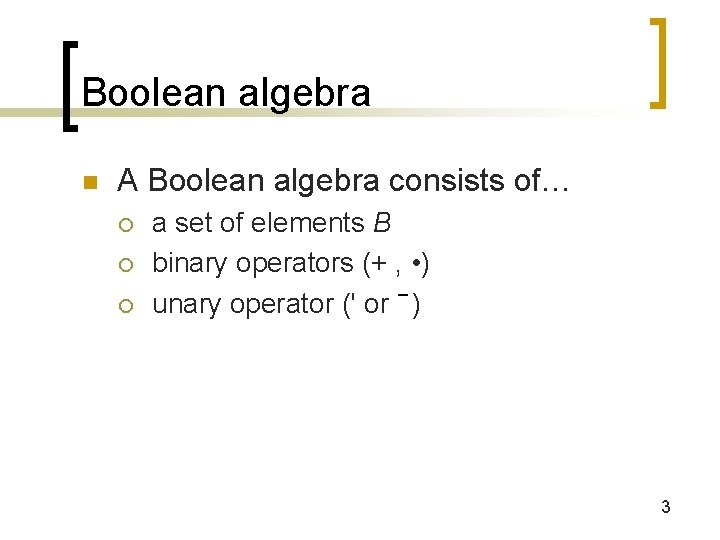
Boolean algebra n A Boolean algebra consists of… ¡ ¡ ¡ a set of elements B binary operators (+ , • ) _ unary operator (' or ) 3
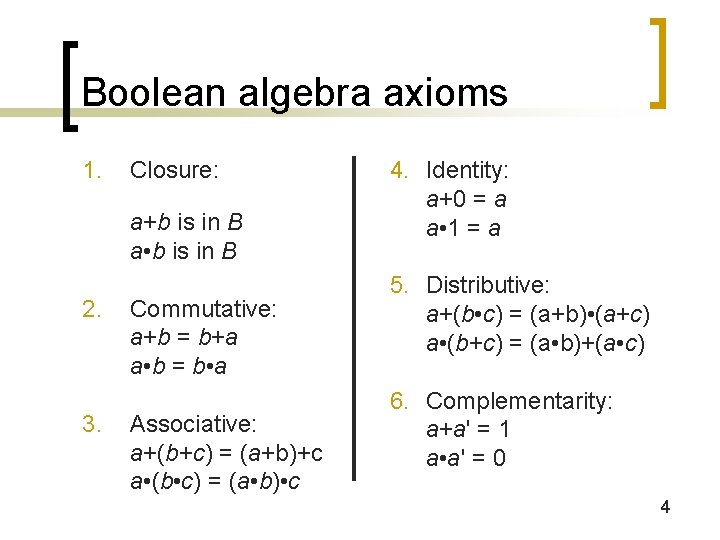
Boolean algebra axioms 1. Closure: a+b is in B a • b is in B 2. 3. Commutative: a+b = b+a a • b = b • a Associative: a+(b+c) = (a+b)+c a • (b • c) = (a • b) • c 4. Identity: a+0 = a a • 1 = a 5. Distributive: a+(b • c) = (a+b) • (a+c) a • (b+c) = (a • b)+(a • c) 6. Complementarity: a+a' = 1 a • a' = 0 4
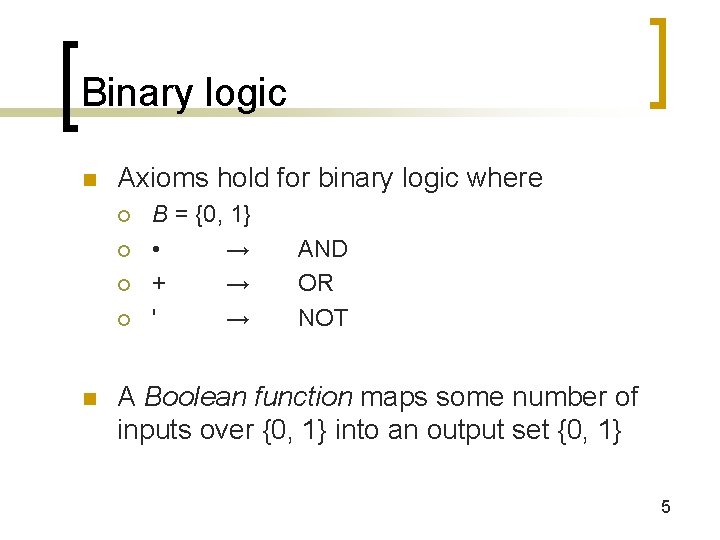
Binary logic n Axioms hold for binary logic where ¡ ¡ n B = {0, 1} • → + → ' → AND OR NOT A Boolean function maps some number of inputs over {0, 1} into an output set {0, 1} 5
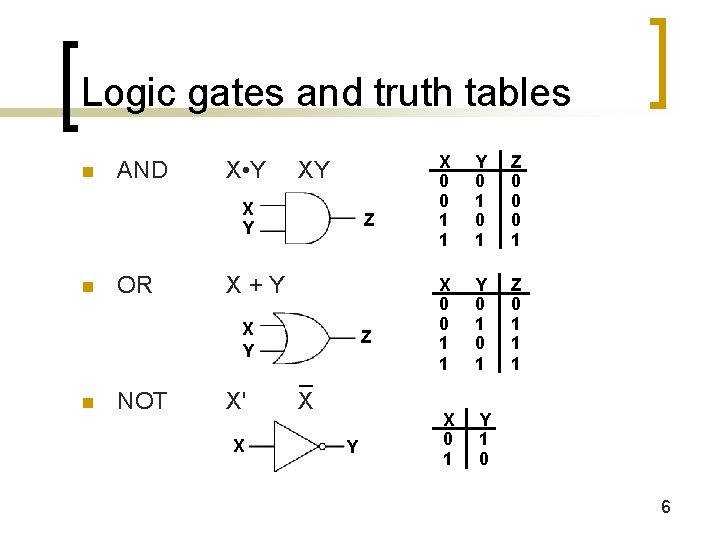
Logic gates and truth tables n AND X • Y XY X Y n OR X+Y X Y n NOT Z X' X Z _ X Y X 0 0 1 1 Y 0 1 Z 0 0 0 1 X 0 0 1 1 Y 0 1 Z 0 1 1 1 X 0 1 Y 1 0 6
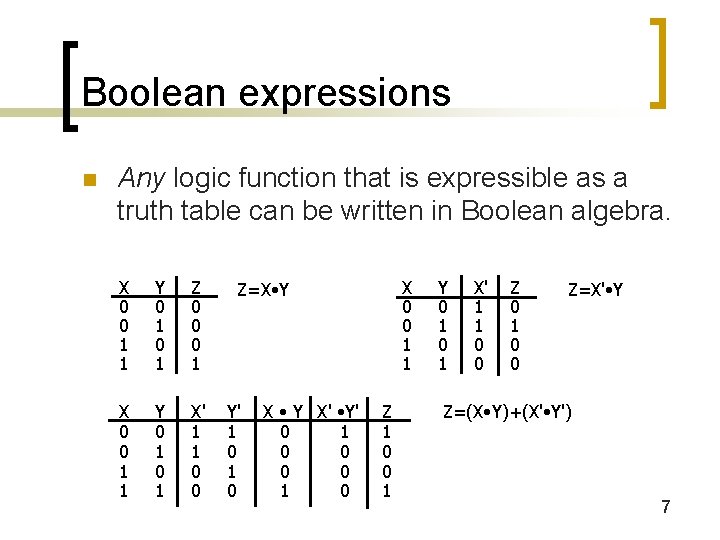
Boolean expressions n Any logic function that is expressible as a truth table can be written in Boolean algebra. X 0 0 1 1 Y 0 1 Z 0 0 0 1 X 0 0 1 1 Y 0 1 X' 1 1 0 0 X 0 0 1 1 Z=X • Y Y' 1 0 X • Y X' • Y' 0 1 0 Z 1 0 0 1 Y 0 1 X' 1 1 0 0 Z 0 1 0 0 Z=X' • Y Z=(X • Y)+(X' • Y') 7
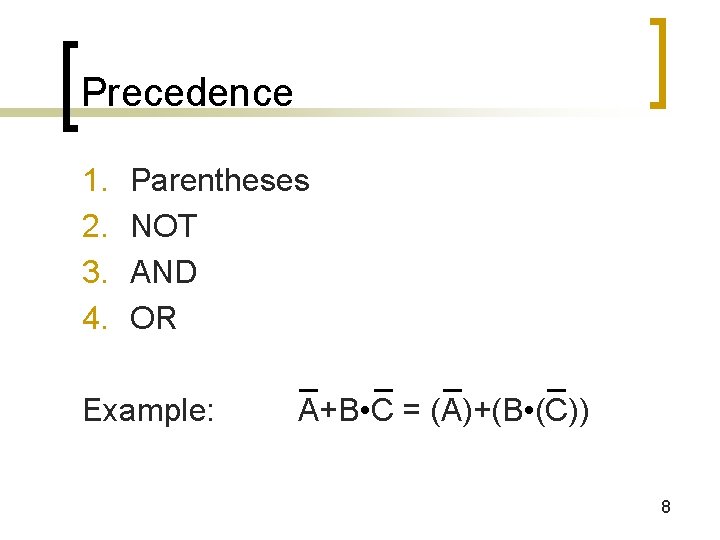
Precedence 1. 2. 3. 4. Parentheses NOT AND OR Example: _ _ A+B • C = (A)+(B • (C)) 8
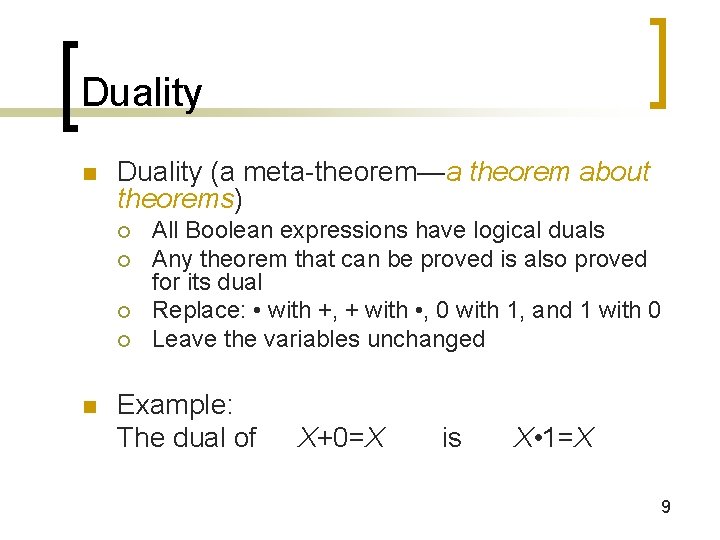
Duality n Duality (a meta-theorem—a theorem about theorems) ¡ ¡ n All Boolean expressions have logical duals Any theorem that can be proved is also proved for its dual Replace: • with +, + with • , 0 with 1, and 1 with 0 Leave the variables unchanged Example: The dual of X+0=X is X • 1=X 9
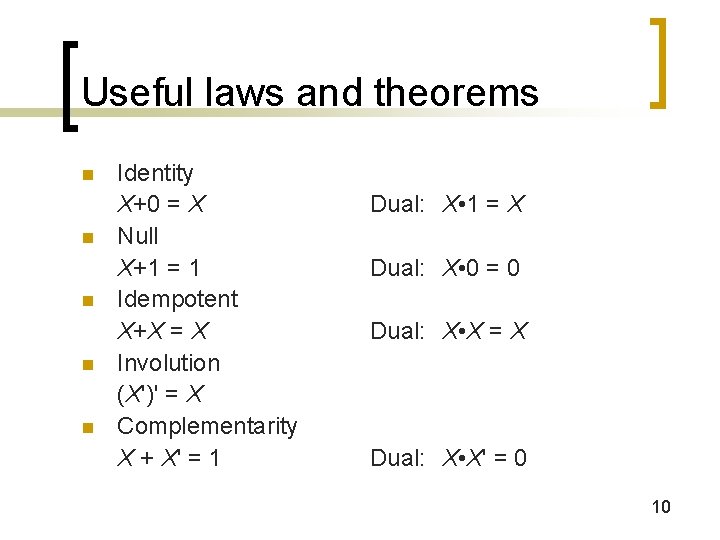
Useful laws and theorems n n n Identity X+0 = X Null X+1 = 1 Idempotent X+X = X Involution (X')' = X Complementarity X + X' = 1 Dual: X • 1 = X Dual: X • 0 = 0 Dual: X • X = X Dual: X • X' = 0 10
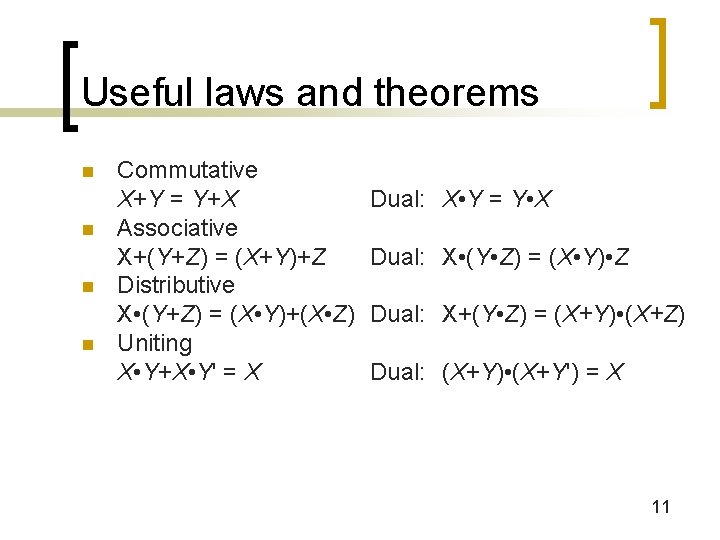
Useful laws and theorems n n Commutative X+Y = Y+X Associative X+(Y+Z) = (X+Y)+Z Distributive X • (Y+Z) = (X • Y)+(X • Z) Uniting X • Y+X • Y' = X Dual: X • Y = Y • X Dual: X • (Y • Z) = (X • Y) • Z Dual: X+(Y • Z) = (X+Y) • (X+Z) Dual: (X+Y) • (X+Y') = X 11
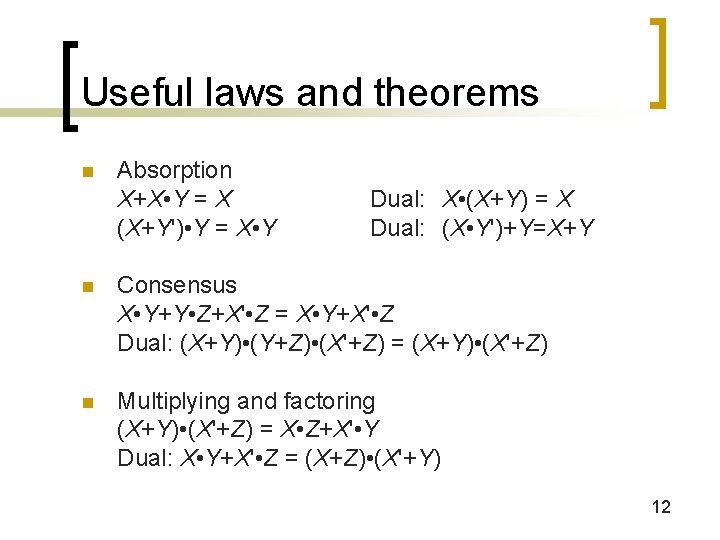
Useful laws and theorems n Absorption X+X • Y = X (X+Y') • Y = X • Y Dual: X • (X+Y) = X Dual: (X • Y')+Y=X+Y n Consensus X • Y+Y • Z+X' • Z = X • Y+X' • Z Dual: (X+Y) • (Y+Z) • (X'+Z) = (X+Y) • (X'+Z) n Multiplying and factoring (X+Y) • (X'+Z) = X • Z+X' • Y Dual: X • Y+X' • Z = (X+Z) • (X'+Y) 12
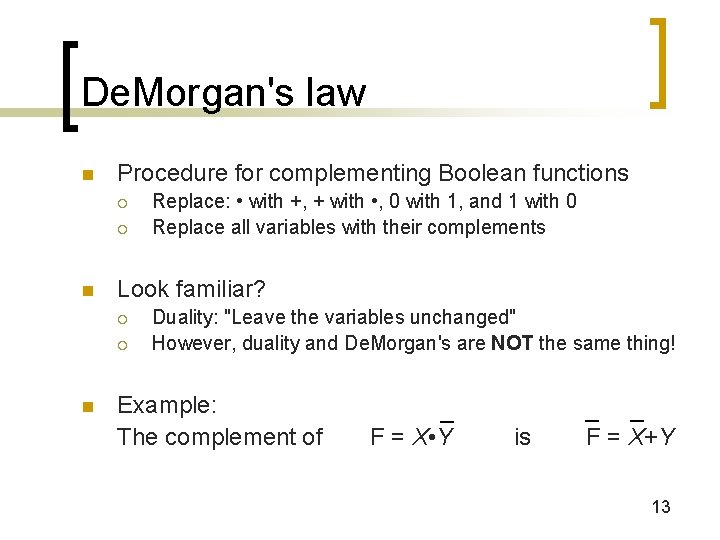
De. Morgan's law n Procedure for complementing Boolean functions ¡ ¡ n Look familiar? ¡ ¡ n Replace: • with +, + with • , 0 with 1, and 1 with 0 Replace all variables with their complements Duality: "Leave the variables unchanged" However, duality and De. Morgan's are NOT the same thing! Example: The complement of _ F = X • Y is _ _ F = X+Y 13
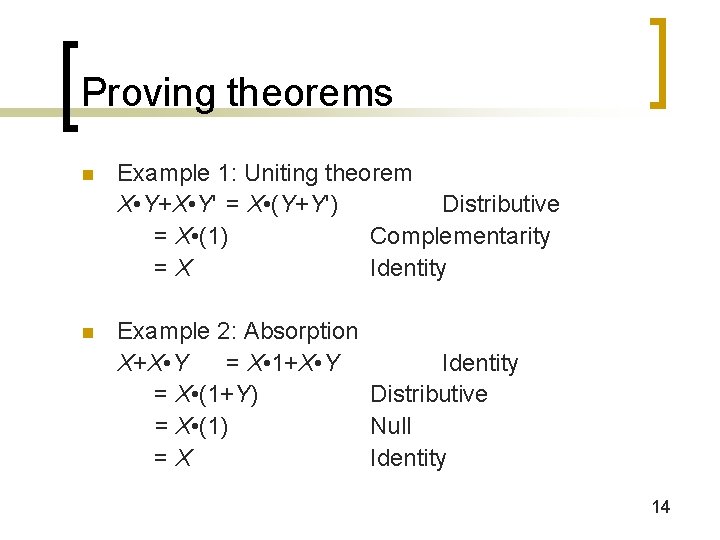
Proving theorems n Example 1: Uniting theorem X • Y+X • Y' = X • (Y+Y') Distributive = X • (1) Complementarity =X Identity n Example 2: Absorption X+X • Y = X • 1+X • Y Identity = X • (1+Y) Distributive = X • (1) Null =X Identity 14
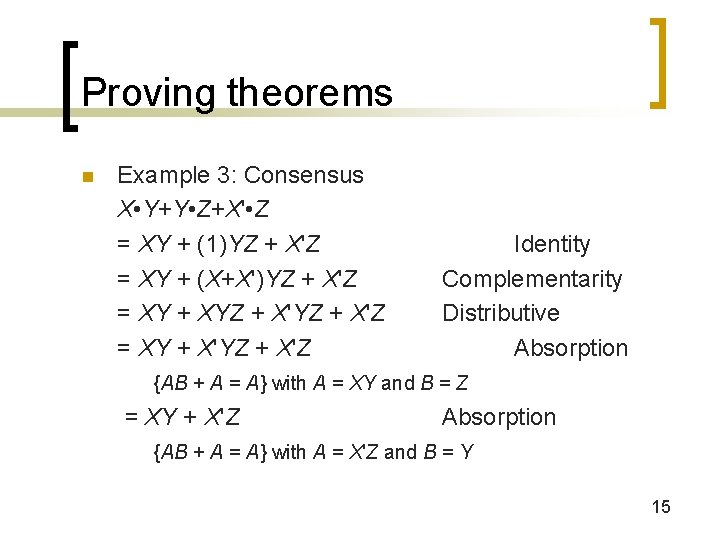
Proving theorems n Example 3: Consensus X • Y+Y • Z+X' • Z = XY + (1)YZ + X'Z = XY + (X+X')YZ + X'Z = XY + XYZ + X'Z = XY + X'YZ + X'Z Identity Complementarity Distributive Absorption {AB + A = A} with A = XY and B = Z = XY + X'Z Absorption {AB + A = A} with A = X'Z and B = Y 15
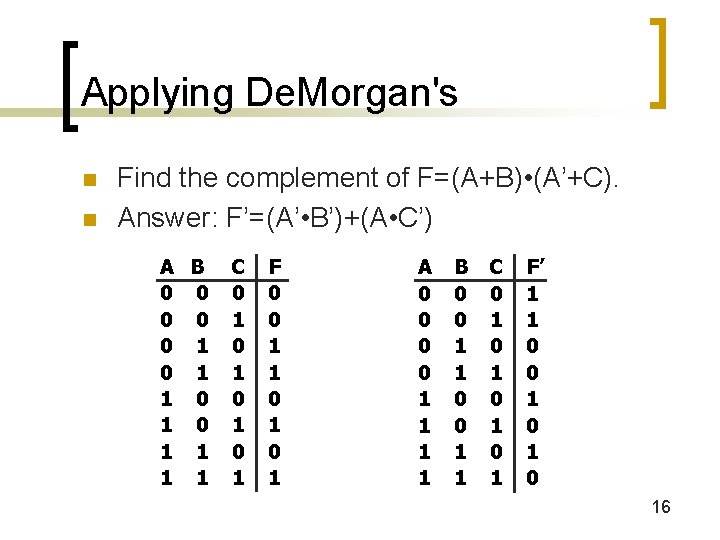
Applying De. Morgan's n n Find the complement of F=(A+B) • (A’+C). Answer: F’=(A’ • B’)+(A • C’) A B 0 0 0 1 0 1 1 1 1 C 0 1 0 1 F 0 0 1 1 0 1 A 0 0 1 1 B 0 0 1 1 C 0 1 0 1 F’ 1 1 0 0 1 0 16
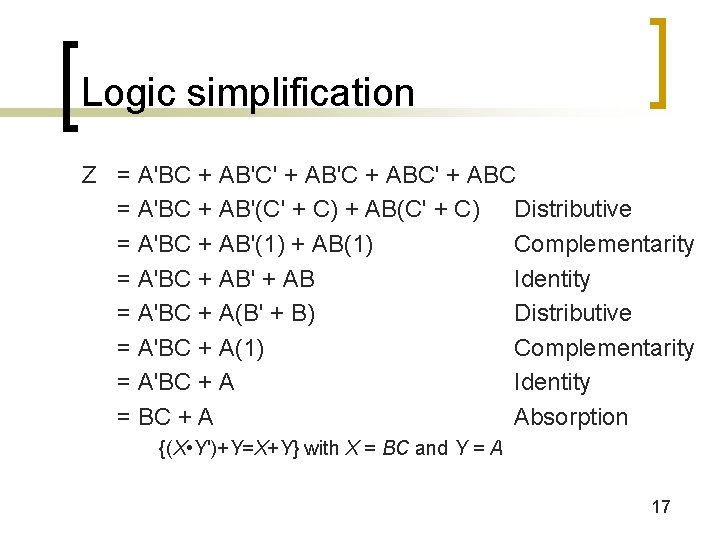
Logic simplification Z = A'BC + AB'C' + AB'C + ABC' + ABC = A'BC + AB'(C' + C) + AB(C' + C) Distributive = A'BC + AB'(1) + AB(1) Complementarity = A'BC + AB' + AB Identity = A'BC + A(B' + B) Distributive = A'BC + A(1) Complementarity = A'BC + A Identity = BC + A Absorption {(X • Y')+Y=X+Y} with X = BC and Y = A 17
- Slides: 17