
Lecture 3 April 10 What is e Exponential
- Slides: 23
Lecture 3, April 10 • What is “e”? • Exponential growth rate and graphing – Exponential growth rate looks linear when you take the log of the numbers – Log axes can handle a wide range of numbers (i. e. 10^1, 10^2, 10^3) • Exponential growth can’t go on forever
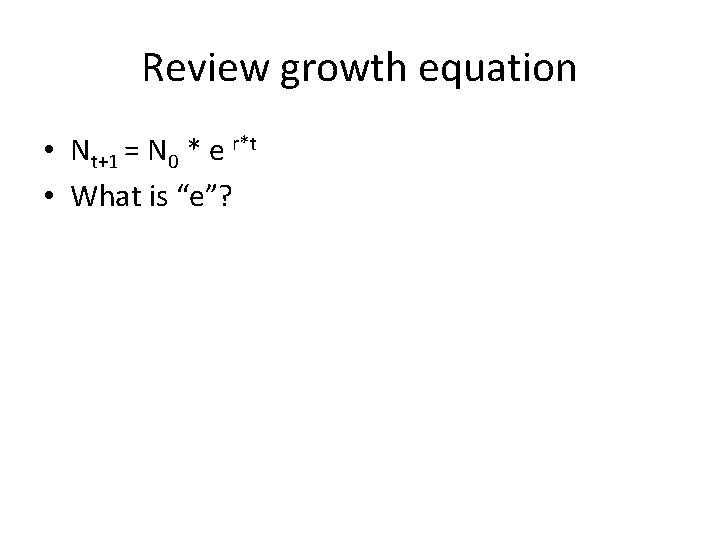
Review growth equation • Nt+1 = N 0 * e r*t • What is “e”?
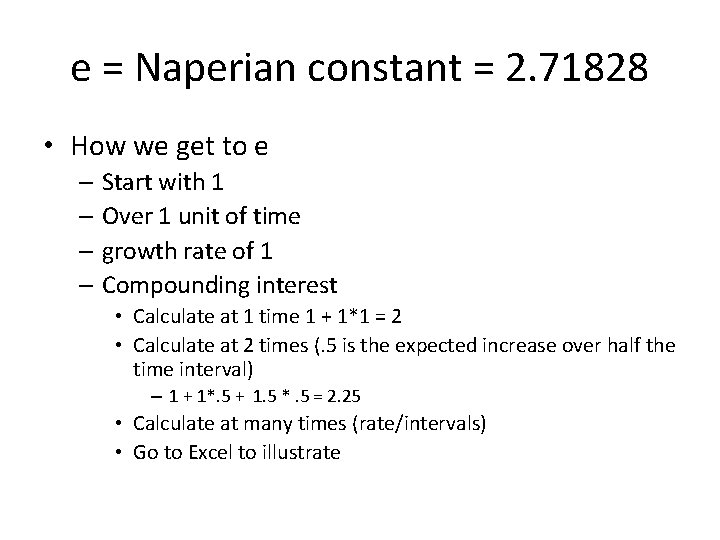
e = Naperian constant = 2. 71828 • How we get to e – Start with 1 – Over 1 unit of time – growth rate of 1 – Compounding interest • Calculate at 1 time 1 + 1*1 = 2 • Calculate at 2 times (. 5 is the expected increase over half the time interval) – 1 + 1*. 5 + 1. 5 *. 5 = 2. 25 • Calculate at many times (rate/intervals) • Go to Excel to illustrate
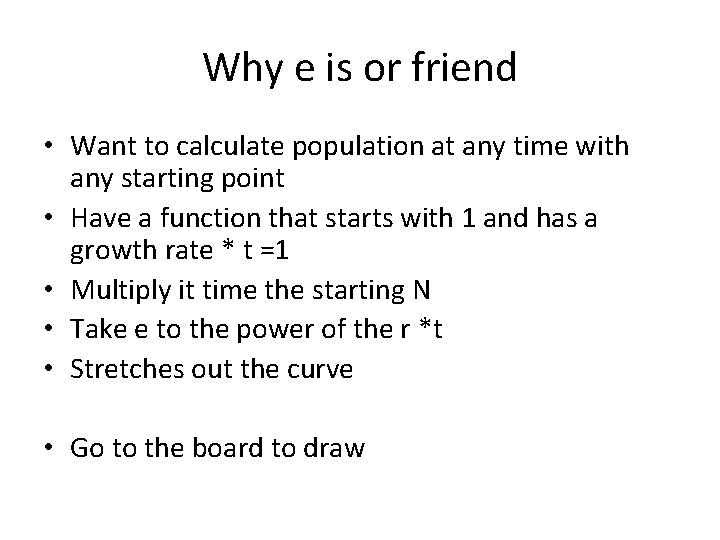
Why e is or friend • Want to calculate population at any time with any starting point • Have a function that starts with 1 and has a growth rate * t =1 • Multiply it time the starting N • Take e to the power of the r *t • Stretches out the curve • Go to the board to draw
3 -1. plot this a. Draw N vs t for r = 0, N 0 = 500, for t = 0, 10, 20 b. Draw N vs t for r = 1, N 0 = 500, for t=0, 2, 5, 10 (put above 2 on the same graph) c. Draw d. N/dt on the Y axis versus N on the X axis. (What equation would you use? ) d. What would the slope be?
Calculations and graphing
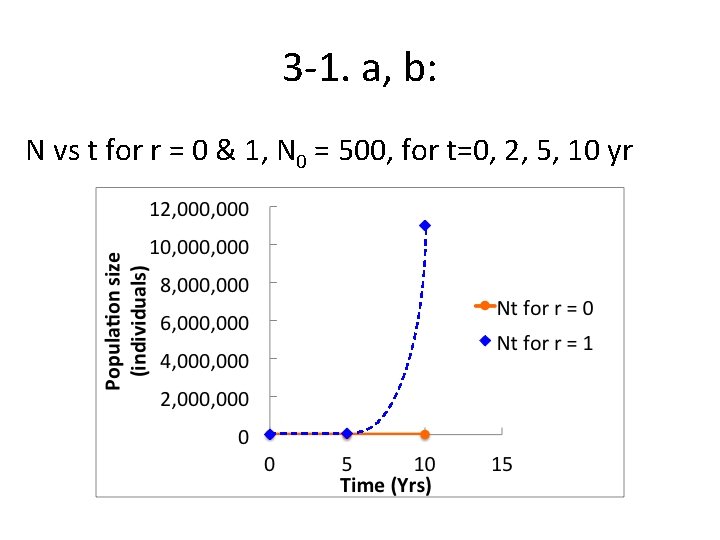
3 -1. a, b: N vs t for r = 0 & 1, N 0 = 500, for t=0, 2, 5, 10 yr
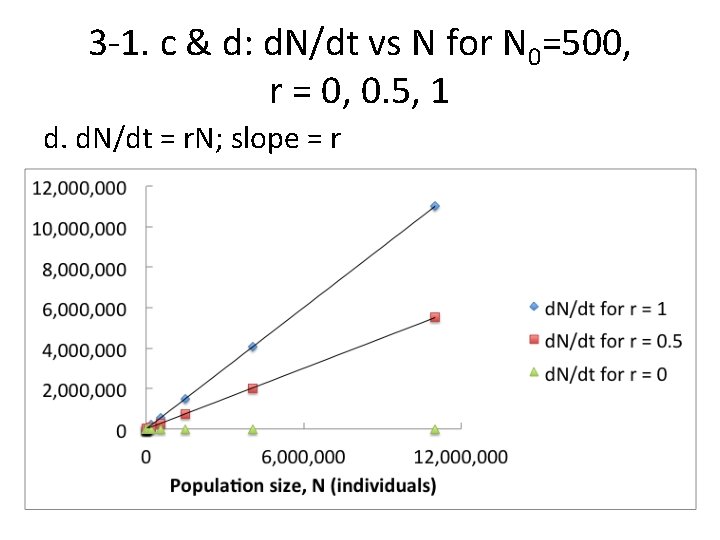
3 -1. c & d: d. N/dt vs N for N 0=500, r = 0, 0. 5, 1 d. d. N/dt = r. N; slope = r
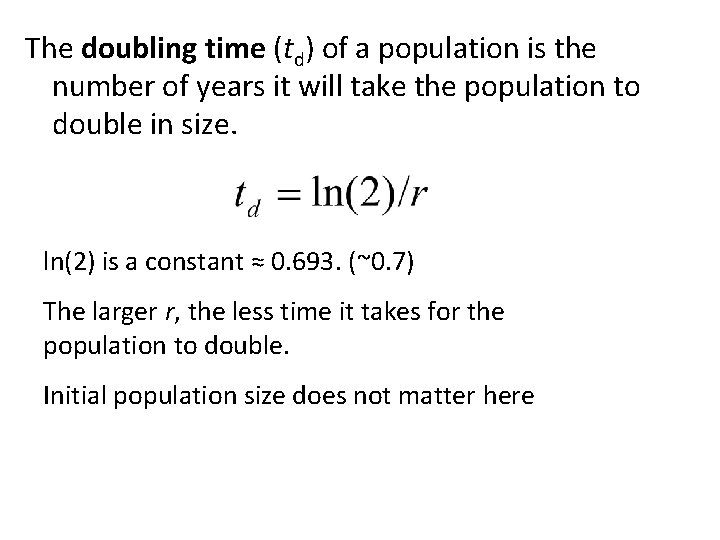
The doubling time (td) of a population is the number of years it will take the population to double in size. ln(2) is a constant ≈ 0. 693. (~0. 7) The larger r, the less time it takes for the population to double. Initial population size does not matter here
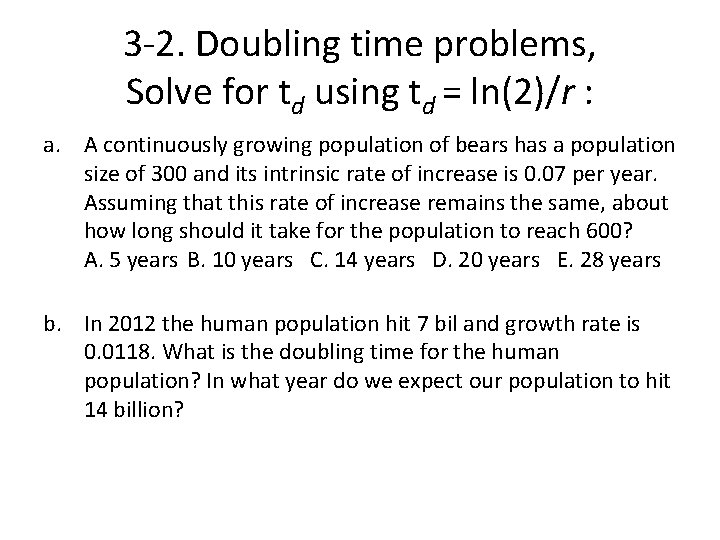
3 -2. Doubling time problems, Solve for td using td = ln(2)/r : a. A continuously growing population of bears has a population size of 300 and its intrinsic rate of increase is 0. 07 per year. Assuming that this rate of increase remains the same, about how long should it take for the population to reach 600? A. 5 years B. 10 years C. 14 years D. 20 years E. 28 years b. In 2012 the human population hit 7 bil and growth rate is 0. 0118. What is the doubling time for the human population? In what year do we expect our population to hit 14 billion?
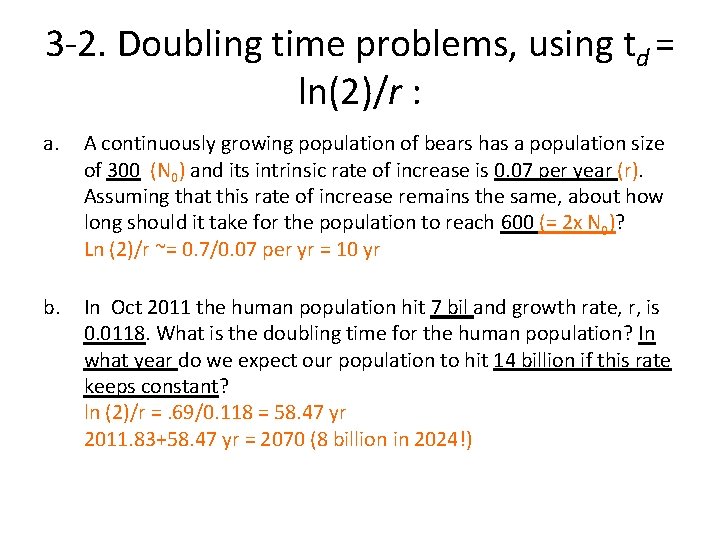
3 -2. Doubling time problems, using td = ln(2)/r : a. A continuously growing population of bears has a population size of 300 (N 0) and its intrinsic rate of increase is 0. 07 per year (r). Assuming that this rate of increase remains the same, about how long should it take for the population to reach 600 (= 2 x N 0)? Ln (2)/r ~= 0. 7/0. 07 per yr = 10 yr b. In Oct 2011 the human population hit 7 bil and growth rate, r, is 0. 0118. What is the doubling time for the human population? In what year do we expect our population to hit 14 billion if this rate keeps constant? ln (2)/r =. 69/0. 118 = 58. 47 yr 2011. 83+58. 47 yr = 2070 (8 billion in 2024!)
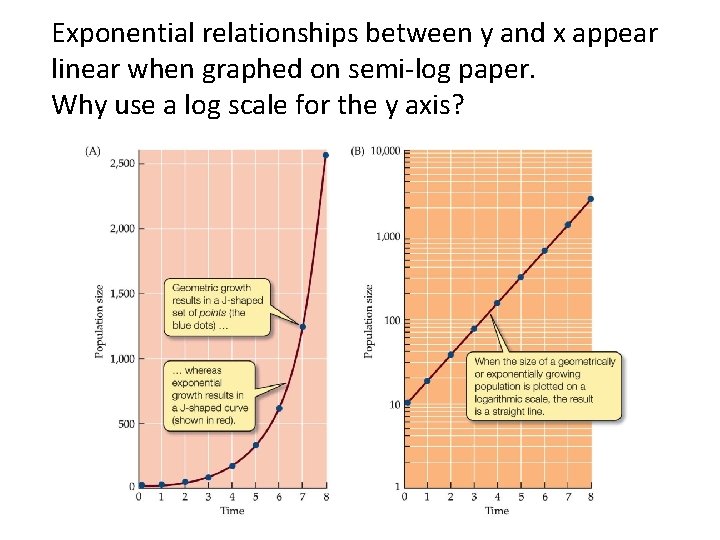
Exponential relationships between y and x appear linear when graphed on semi-log paper. Why use a log scale for the y axis?
Growth rate slows down • Can’t have exponential growth for ever
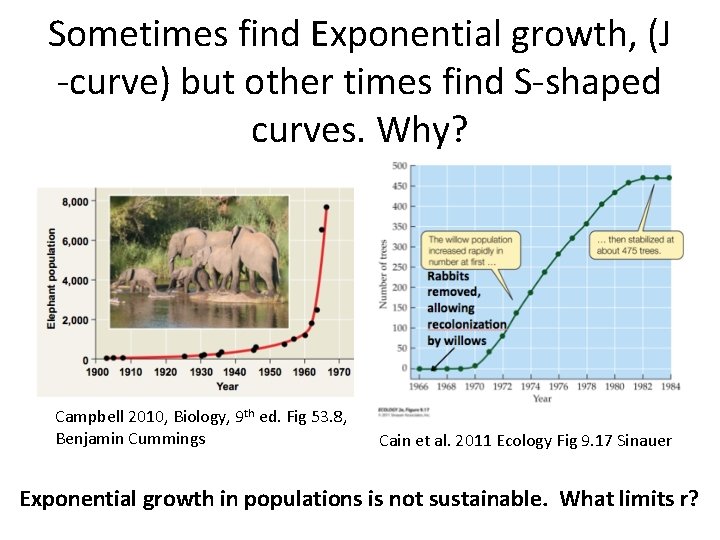
Sometimes find Exponential growth, (J -curve) but other times find S-shaped curves. Why? Campbell 2010, Biology, 9 th ed. Fig 53. 8, Benjamin Cummings Cain et al. 2011 Ecology Fig 9. 17 Sinauer Exponential growth in populations is not sustainable. What limits r?
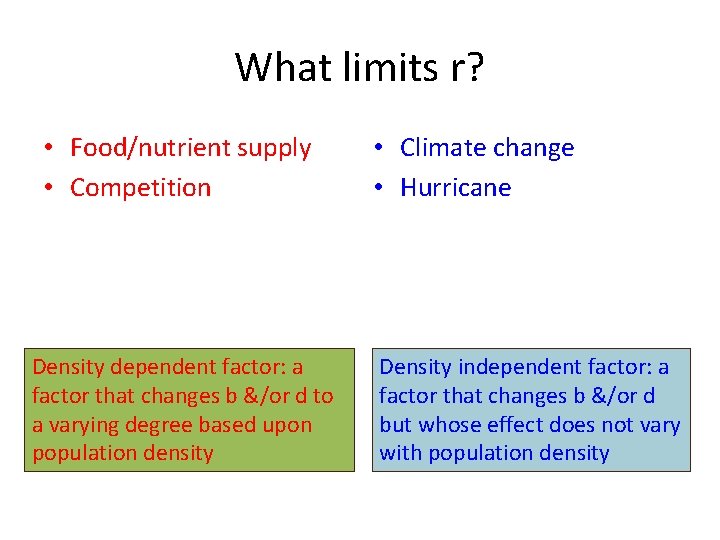
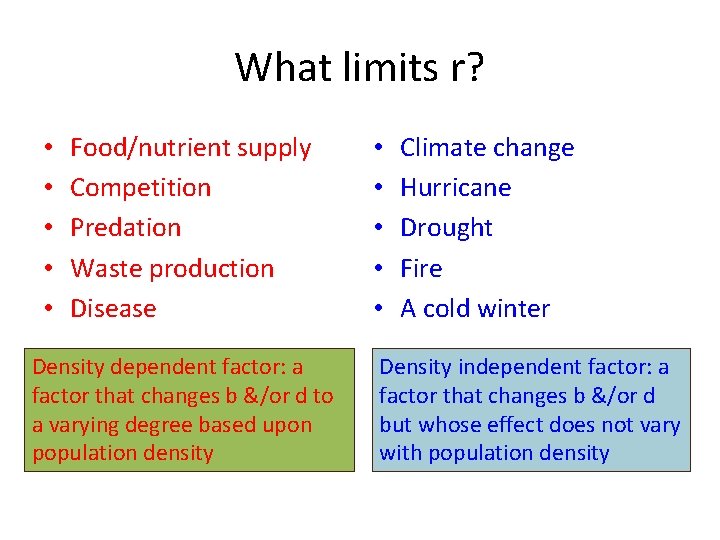
What limits r? • Food/nutrient supply • Competition Density dependent factor: a factor that changes b &/or d to a varying degree based upon population density • Climate change • Hurricane Density independent factor: a factor that changes b &/or d but whose effect does not vary with population density
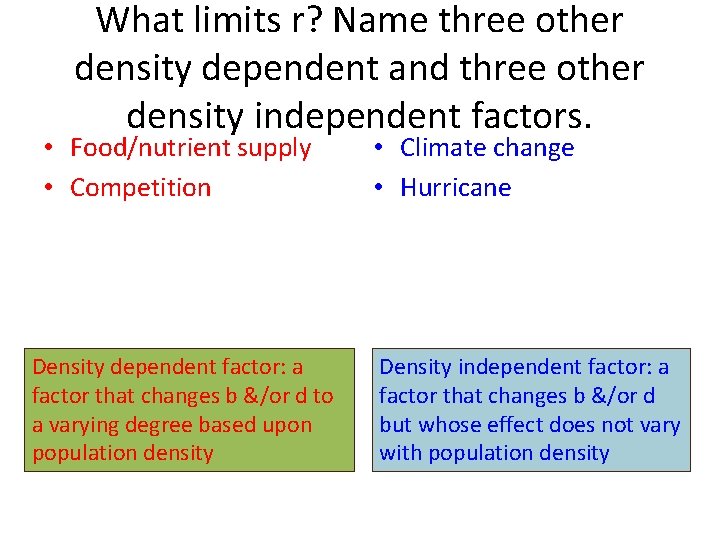
What limits r? Name three other density dependent and three other density independent factors. • Food/nutrient supply • Competition Density dependent factor: a factor that changes b &/or d to a varying degree based upon population density • Climate change • Hurricane Density independent factor: a factor that changes b &/or d but whose effect does not vary with population density
What limits r? • • • Food/nutrient supply Competition Predation Waste production Disease Density dependent factor: a factor that changes b &/or d to a varying degree based upon population density • • • Climate change Hurricane Drought Fire A cold winter Density independent factor: a factor that changes b &/or d but whose effect does not vary with population density
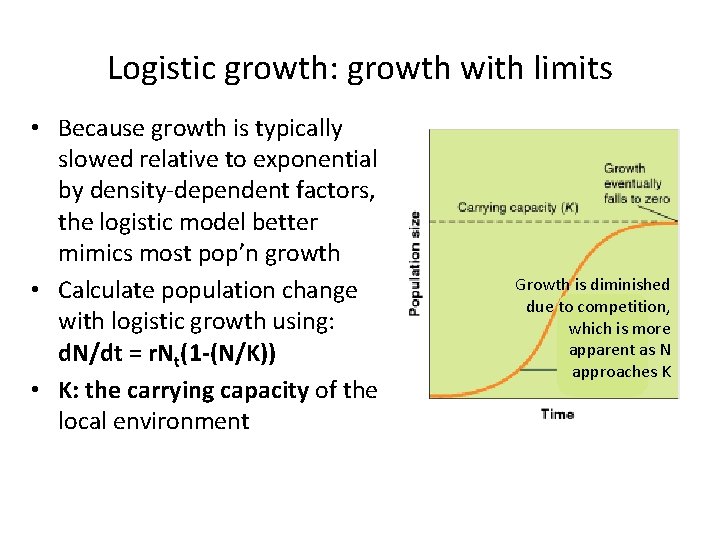
Logistic growth: growth with limits • Because growth is typically slowed relative to exponential by density-dependent factors, the logistic model better mimics most pop’n growth • Calculate population change with logistic growth using: d. N/dt = r. Nt(1 -(N/K)) • K: the carrying capacity of the local environment Growth is diminished due to competition, which is more apparent as N approaches K
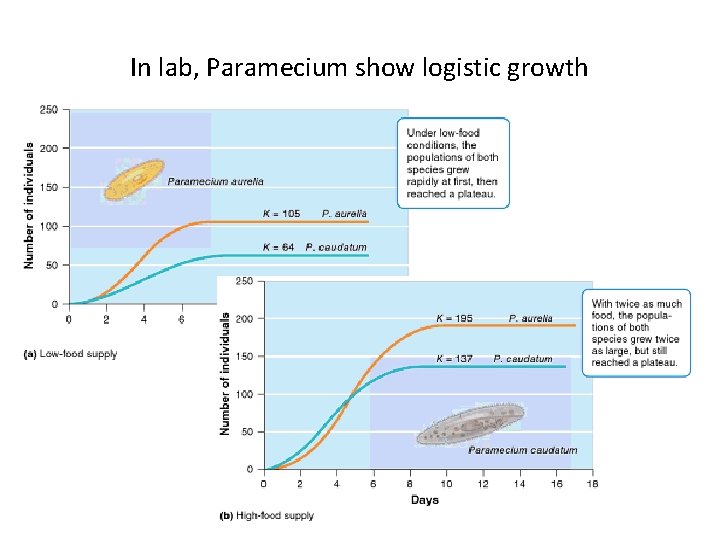
In lab, Paramecium show logistic growth
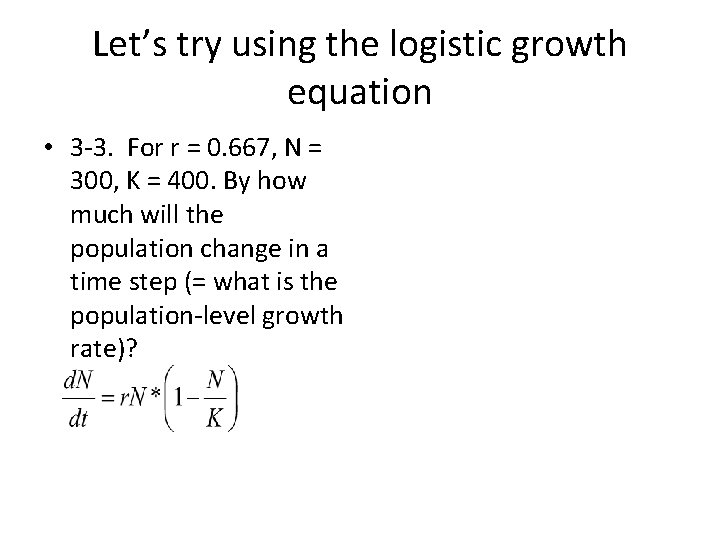
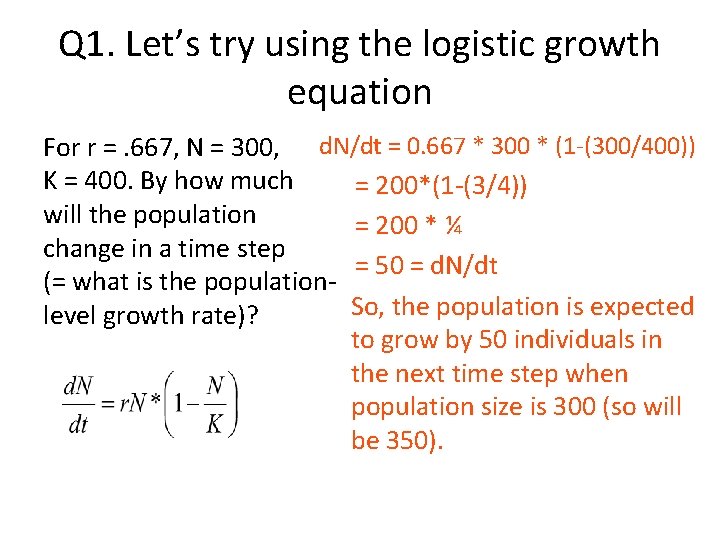
Let’s try using the logistic growth equation • 3 -3. For r = 0. 667, N = 300, K = 400. By how much will the population change in a time step (= what is the population-level growth rate)?
Q 1. Let’s try using the logistic growth equation For r =. 667, N = 300, d. N/dt = 0. 667 * 300 * (1 -(300/400)) K = 400. By how much = 200*(1 -(3/4)) will the population = 200 * ¼ change in a time step = 50 = d. N/dt (= what is the population. So, the population is expected level growth rate)? to grow by 50 individuals in the next time step when population size is 300 (so will be 350).
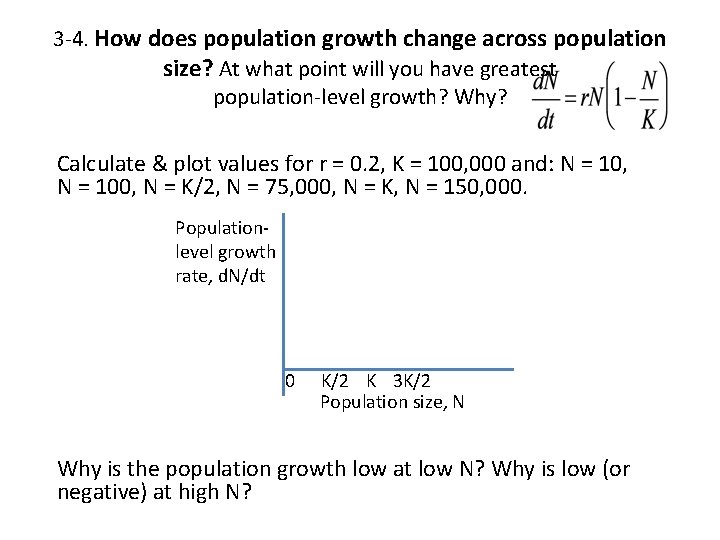
3 -4. How does population growth change across population size? At what point will you have greatest population-level growth? Why? Calculate & plot values for r = 0. 2, K = 100, 000 and: N = 10, N = 100, N = K/2, N = 75, 000, N = K, N = 150, 000. Populationlevel growth rate, d. N/dt 0 K/2 K 3 K/2 Population size, N Why is the population growth low at low N? Why is low (or negative) at high N?
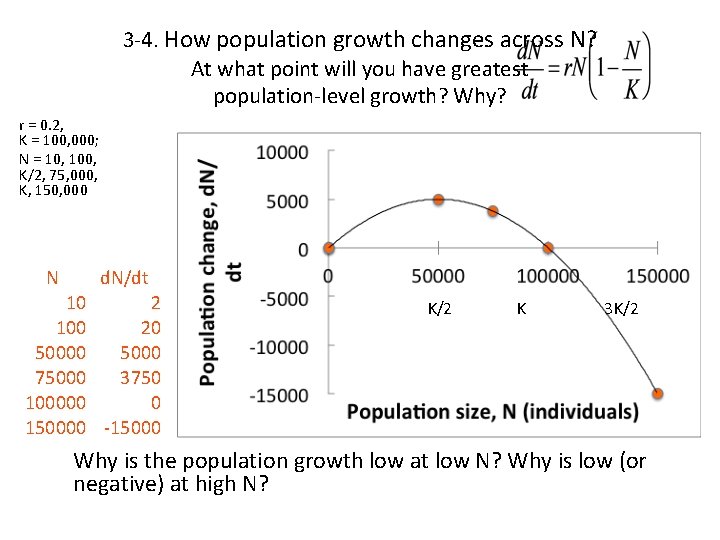
3 -4. How population growth changes across N? At what point will you have greatest population-level growth? Why? r = 0. 2, K = 100, 000; N = 10, 100, K/2, 75, 000, K, 150, 000 N d. N/dt 10 2 100 20 5000 75000 3750 100000 0 150000 -15000 K/2 K 3 K/2 Why is the population growth low at low N? Why is low (or negative) at high N?