
Lecture 3 a Extraction of Caffeine from Tea


- Slides: 17
Lecture 3 a Extraction of Caffeine from Tea Leaves
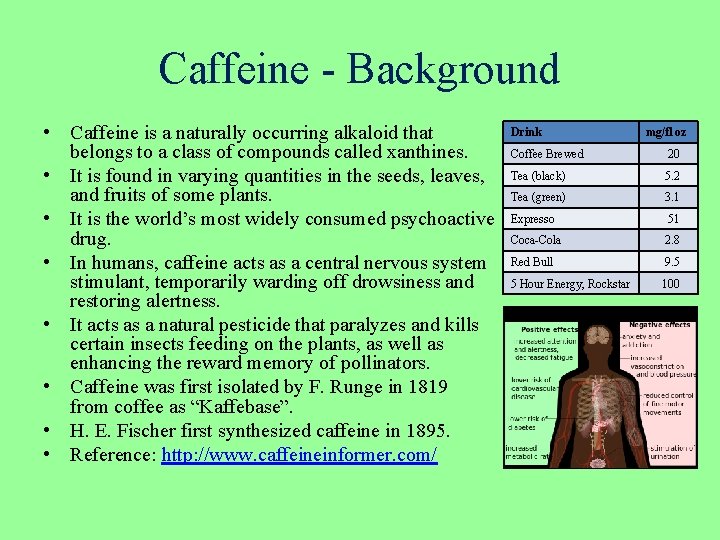
Caffeine - Background • Caffeine is a naturally occurring alkaloid that belongs to a class of compounds called xanthines. • It is found in varying quantities in the seeds, leaves, and fruits of some plants. • It is the world’s most widely consumed psychoactive drug. • In humans, caffeine acts as a central nervous system stimulant, temporarily warding off drowsiness and restoring alertness. • It acts as a natural pesticide that paralyzes and kills certain insects feeding on the plants, as well as enhancing the reward memory of pollinators. • Caffeine was first isolated by F. Runge in 1819 from coffee as “Kaffebase”. • H. E. Fischer first synthesized caffeine in 1895. • Reference: http: //www. caffeineinformer. com/ Drink mg/fl oz Coffee Brewed 20 Tea (black) 5. 2 Tea (green) 3. 1 Expresso 51 Coca-Cola 2. 8 Red Bull 9. 5 5 Hour Energy, Rockstar 100
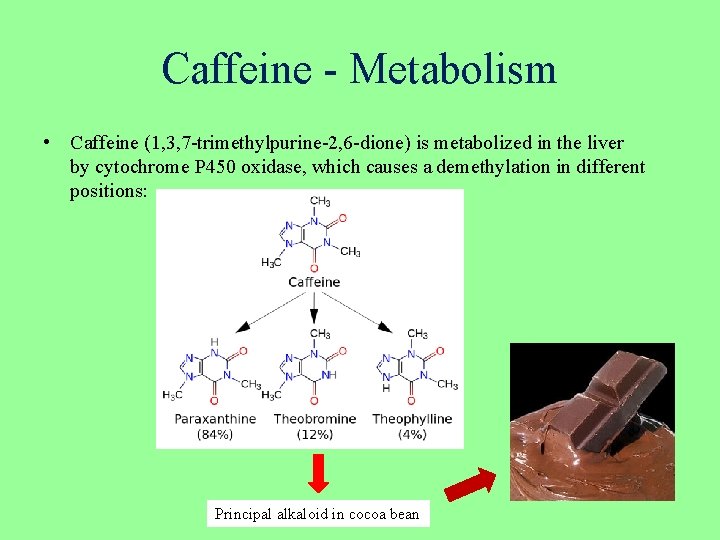
Caffeine - Metabolism • Caffeine (1, 3, 7 -trimethylpurine-2, 6 -dione) is metabolized in the liver by cytochrome P 450 oxidase, which causes a demethylation in different positions: Principal alkaloid in cocoa bean
Extraction I • Extraction is a very commonly used technique in organic chemistry, which involves the selective isolation of products from mixtures of substances. • The most common type of extraction in chemistry is liquid extraction that is often based on acid-base chemistry to change the solubility of the compound. • The solute is extracted from one solvent into the other because the solute is (usually) more soluble in the second solvent than in the first. • It is one way to facilitate the isolation of the target compound: • Extraction: aims at the target compound • Washing: removes impurities from the organic layer
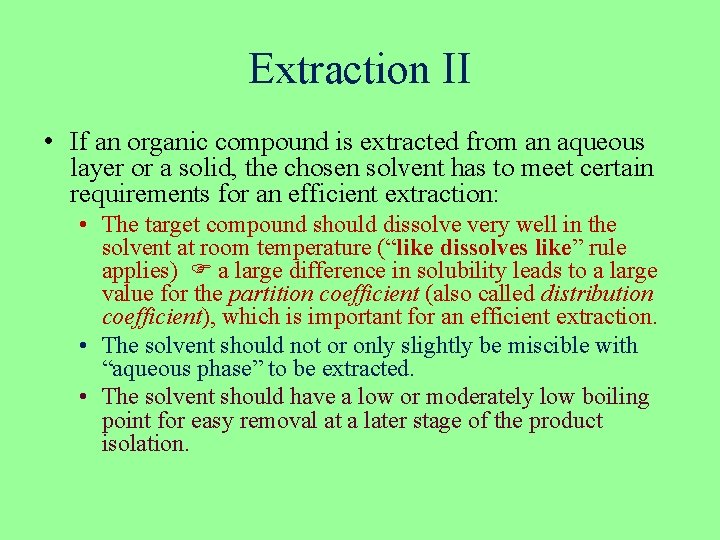
Extraction II • If an organic compound is extracted from an aqueous layer or a solid, the chosen solvent has to meet certain requirements for an efficient extraction: • The target compound should dissolve very well in the solvent at room temperature (“like dissolves like” rule applies) a large difference in solubility leads to a large value for the partition coefficient (also called distribution coefficient), which is important for an efficient extraction. • The solvent should not or only slightly be miscible with “aqueous phase” to be extracted. • The solvent should have a low or moderately low boiling point for easy removal at a later stage of the product isolation.
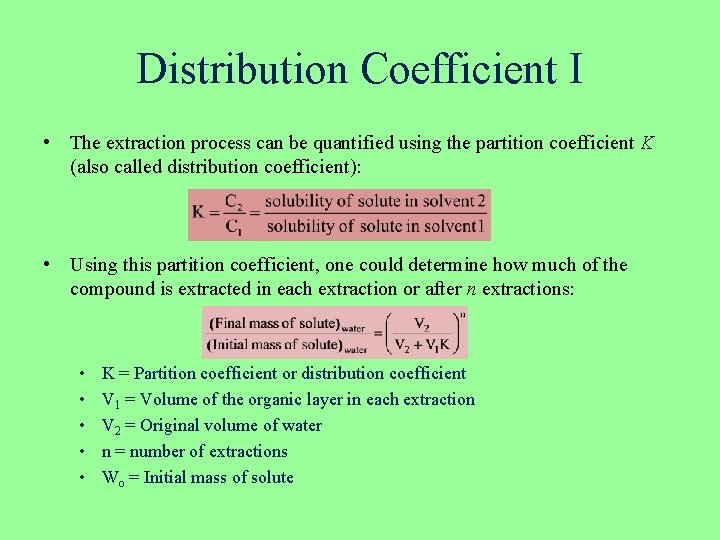
Distribution Coefficient I • The extraction process can be quantified using the partition coefficient K (also called distribution coefficient): • Using this partition coefficient, one could determine how much of the compound is extracted in each extraction or after n extractions: • • • K = Partition coefficient or distribution coefficient V 1 = Volume of the organic layer in each extraction V 2 = Original volume of water n = number of extractions Wo = Initial mass of solute
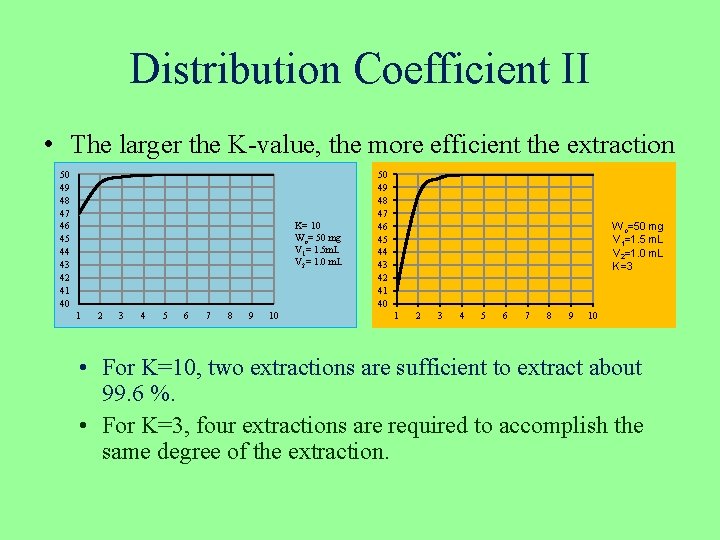
Distribution Coefficient II • The larger the K-value, the more efficient the extraction 50 49 48 47 46 45 44 43 42 41 40 K= 10 Series 1 Wo= 50 mg Series 2 V 1= 1. 5 m. L V 2= 1. 0 m. L Series 3 1 2 3 4 5 6 7 8 9 10 50 49 48 47 46 45 44 43 42 41 40 Wo=50 mg V 1=1. 5 m. L Series 1 V 2=1. 0 m. L K=3 1 2 3 4 5 6 7 8 9 10 • For K=10, two extractions are sufficient to extract about 99. 6 %. • For K=3, four extractions are required to accomplish the same degree of the extraction.
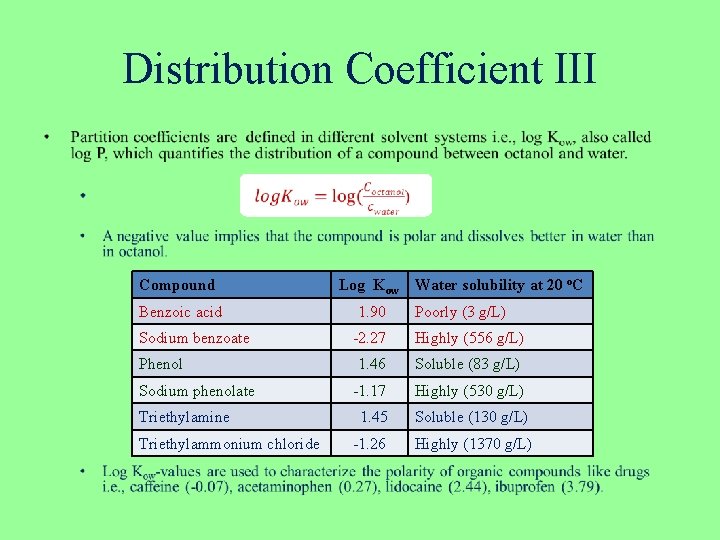
Distribution Coefficient III • Compound Log Kow Water solubility at 20 o. C Benzoic acid 1. 90 Poorly (3 g/L) Sodium benzoate -2. 27 Highly (556 g/L) Phenol 1. 46 Soluble (83 g/L) Sodium phenolate -1. 17 Highly (530 g/L) Triethylamine 1. 45 Soluble (130 g/L) Triethylammonium chloride -1. 26 Highly (1370 g/L)
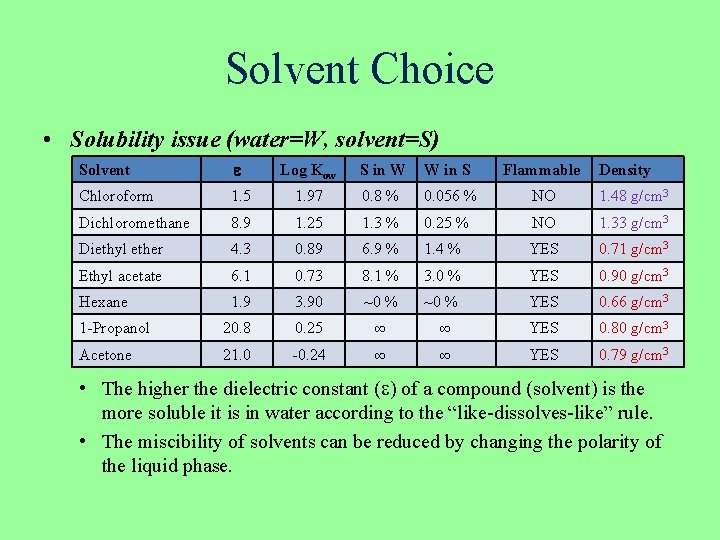
Solvent Choice • Solubility issue (water=W, solvent=S) e Log Kow S in W W in S Flammable Chloroform 1. 5 1. 97 0. 8 % 0. 056 % NO 1. 48 g/cm 3 Dichloromethane 8. 9 1. 25 1. 3 % 0. 25 % NO 1. 33 g/cm 3 Diethyl ether 4. 3 0. 89 6. 9 % 1. 4 % YES 0. 71 g/cm 3 Ethyl acetate 6. 1 0. 73 8. 1 % 3. 0 % YES 0. 90 g/cm 3 Hexane 1. 9 3. 90 ~0 % YES 0. 66 g/cm 3 1 -Propanol 20. 8 0. 25 ∞ ∞ YES 0. 80 g/cm 3 Acetone 21. 0 -0. 24 ∞ ∞ YES 0. 79 g/cm 3 Solvent Density • The higher the dielectric constant (e) of a compound (solvent) is the more soluble it is in water according to the “like-dissolves-like” rule. • The miscibility of solvents can be reduced by changing the polarity of the liquid phase.
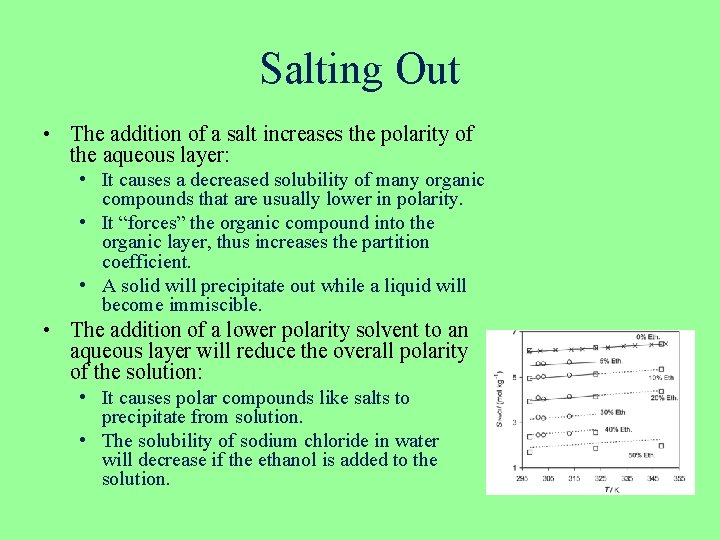
Salting Out • The addition of a salt increases the polarity of the aqueous layer: • It causes a decreased solubility of many organic compounds that are usually lower in polarity. • It “forces” the organic compound into the organic layer, thus increases the partition coefficient. • A solid will precipitate out while a liquid will become immiscible. • The addition of a lower polarity solvent to an aqueous layer will reduce the overall polarity of the solution: • It causes polar compounds like salts to precipitate from solution. • The solubility of sodium chloride in water will decrease if the ethanol is added to the solution.
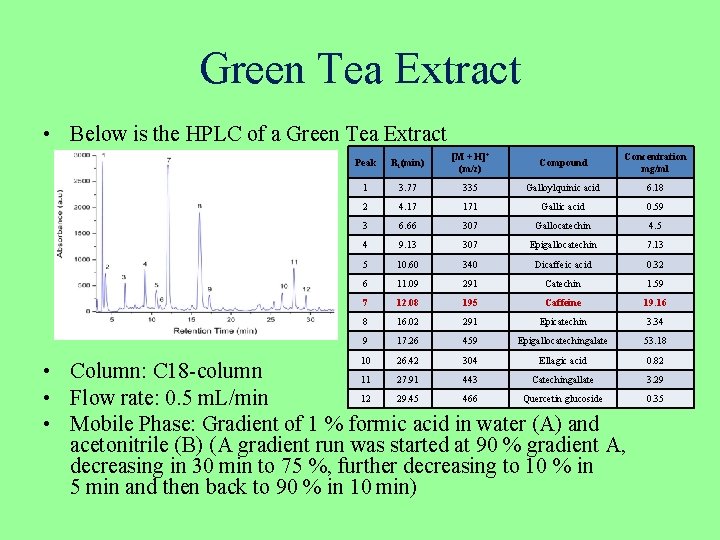
Green Tea Extract • Below is the HPLC of a Green Tea Extract Peak Rt(min) [M + H]+ (m/z) Compound Concentration mg/ml 1 3. 77 335 Galloylquinic acid 6. 18 2 4. 17 171 Gallic acid 0. 59 3 6. 66 307 Gallocatechin 4. 5 4 9. 13 307 Epigallocatechin 7. 13 5 10. 60 340 Dicaffeic acid 0. 32 6 11. 09 291 Catechin 1. 59 7 12. 08 195 Caffeine 19. 16 8 16. 02 291 Epicatechin 3. 34 9 17. 26 459 Epigallocatechingalate 53. 18 10 26. 42 304 Ellagic acid 0. 82 • Column: C 18 -column 11 27. 91 443 Catechingallate 12 29. 45 466 Quercetin glucoside • Flow rate: 0. 5 m. L/min • Mobile Phase: Gradient of 1 % formic acid in water (A) and acetonitrile (B) (A gradient run was started at 90 % gradient A, decreasing in 30 min to 75 %, further decreasing to 10 % in 5 min and then back to 90 % in 10 min) 3. 29 0. 35
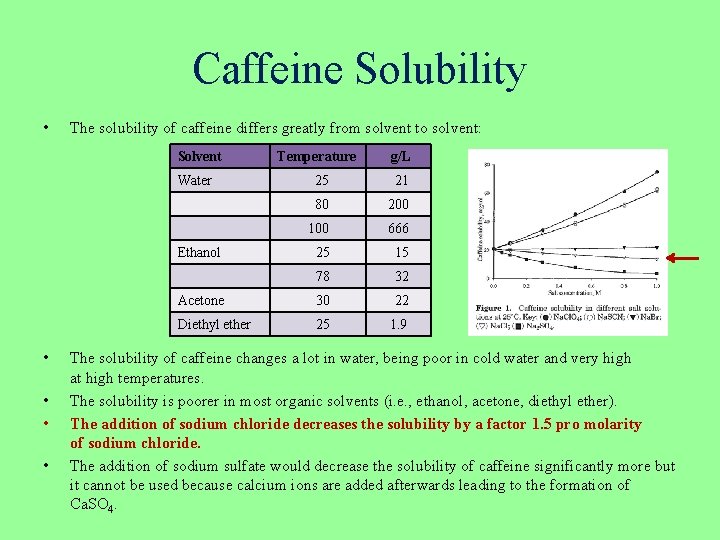
Caffeine Solubility • The solubility of caffeine differs greatly from solvent to solvent: Solvent Temperature g/L 25 21 80 200 100 666 25 15 78 32 Acetone 30 22 Diethyl ether 25 1. 9 Water • • Ethanol The solubility of caffeine changes a lot in water, being poor in cold water and very high at high temperatures. The solubility is poorer in most organic solvents (i. e. , ethanol, acetone, diethyl ether). The addition of sodium chloride decreases the solubility by a factor 1. 5 pro molarity of sodium chloride. The addition of sodium sulfate would decrease the solubility of caffeine significantly more but it cannot be used because calcium ions are added afterwards leading to the formation of Ca. SO 4.
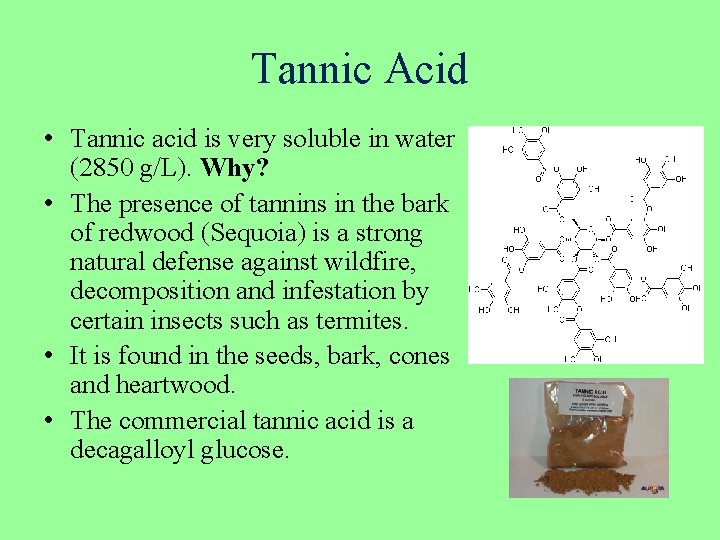
Tannic Acid • Tannic acid is very soluble in water (2850 g/L). Why? • The presence of tannins in the bark of redwood (Sequoia) is a strong natural defense against wildfire, decomposition and infestation by certain insects such as termites. • It is found in the seeds, bark, cones and heartwood. • The commercial tannic acid is a decagalloyl glucose.
Important Points • The caffeine is separated from the rest of the tea ingredients by several extraction steps. • The first step is a solid-liquid extraction using hot water (“brewing”). • In the liquid-liquid extraction, the aqueous layer that has been saturated with sodium chloride is extracted with propanol: • Normally, propanol-water mixtures are completely miscible. • Propanol-salt water mixtures are poorly miscible with the organic layer containing a large amount of water (~20 %). • The addition of the sodium chloride increases the polarity of the aqueous later, which reduces the solubility of the caffeine and 1 -propanol in the aqueous layer. • Caffeine is better soluble in propanol than in the salt water solution resulting is a larger distribution coefficient (K=3. 7).
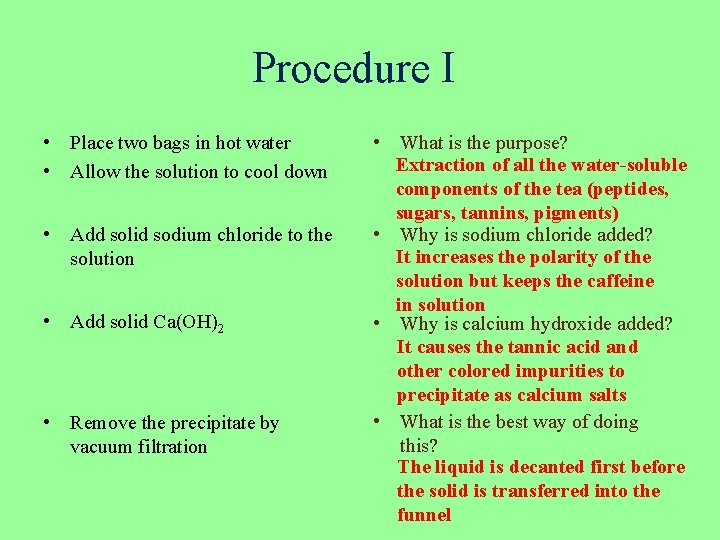
Procedure I • Place two bags in hot water • Allow the solution to cool down • Add solid sodium chloride to the solution • Add solid Ca(OH)2 • Remove the precipitate by vacuum filtration • What is the purpose? Extraction of all the water-soluble components of the tea (peptides, sugars, tannins, pigments) • Why is sodium chloride added? It increases the polarity of the solution but keeps the caffeine in solution • Why is calcium hydroxide added? It causes the tannic acid and other colored impurities to precipitate as calcium salts • What is the best way of doing this? The liquid is decanted first before the solid is transferred into the funnel
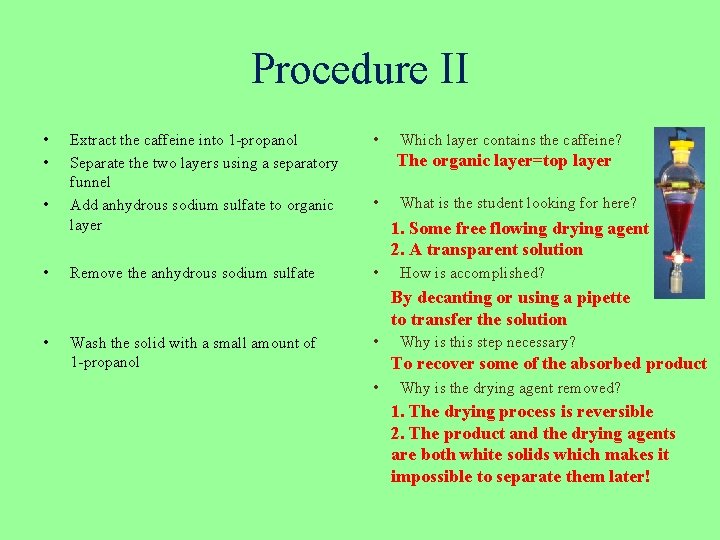
Procedure II • • Extract the caffeine into 1 -propanol Separate the two layers using a separatory funnel Add anhydrous sodium sulfate to organic layer • Remove the anhydrous sodium sulfate • Which layer contains the caffeine? The organic layer=top layer • What is the student looking for here? 1. Some free flowing drying agent 2. A transparent solution How is accomplished? By decanting or using a pipette to transfer the solution • Wash the solid with a small amount of 1 -propanol • Why is this step necessary? To recover some of the absorbed product • Why is the drying agent removed? 1. The drying process is reversible 2. The product and the drying agents are both white solids which makes it impossible to separate them later!
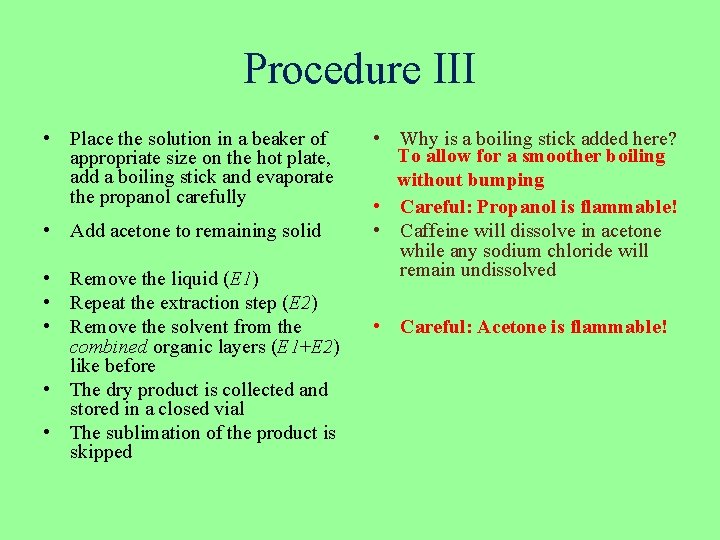
Procedure III • Place the solution in a beaker of appropriate size on the hot plate, add a boiling stick and evaporate the propanol carefully • Add acetone to remaining solid • Remove the liquid (E 1) • Repeat the extraction step (E 2) • Remove the solvent from the combined organic layers (E 1+E 2) like before • The dry product is collected and stored in a closed vial • The sublimation of the product is skipped • Why is a boiling stick added here? To allow for a smoother boiling without bumping • Careful: Propanol is flammable! • Caffeine will dissolve in acetone while any sodium chloride will remain undissolved • Careful: Acetone is flammable!