
Lecture 3 3 1 Accounting and Finance Understanding

- Slides: 30
Lecture 3 3 -1
Accounting and Finance Understanding financial accounting is essential to understanding corporate finance. Key Components of the Financials: The Balance Sheet The Income Statement The Statement of Cash Flows 3 -2
The Balance Sheet is a financial statement that shows the firm’s assets and liabilities at a particular time. Why is it useful? Shareholders’ Equity = Total Assets – Total Liabilities 3 -3
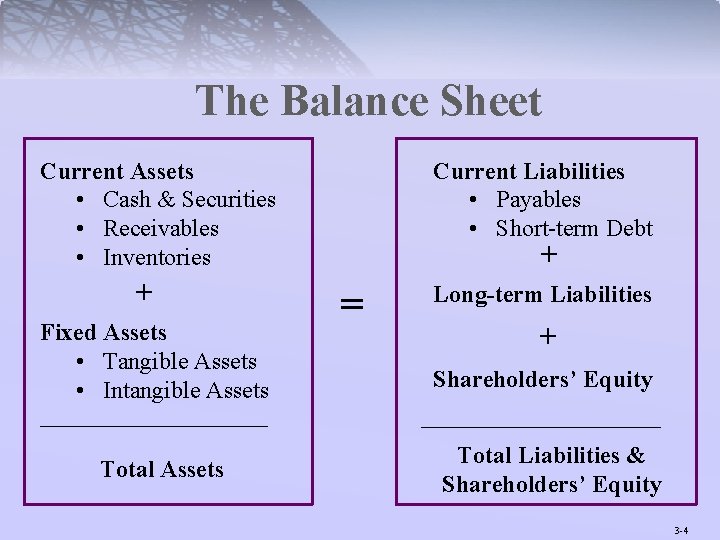
The Balance Sheet Current Assets • Cash & Securities • Receivables • Inventories + Fixed Assets • Tangible Assets • Intangible Assets __________ Total Assets Current Liabilities • Payables • Short-term Debt + = Long-term Liabilities + Shareholders’ Equity __________ Total Liabilities & Shareholders’ Equity 3 -4
Assets represent the uses of a firm’s funds i. e. Assets show what the firm “owns” • Liquid Assets can be converted easily into cash • Current vs. Fixed Assets 3 -5
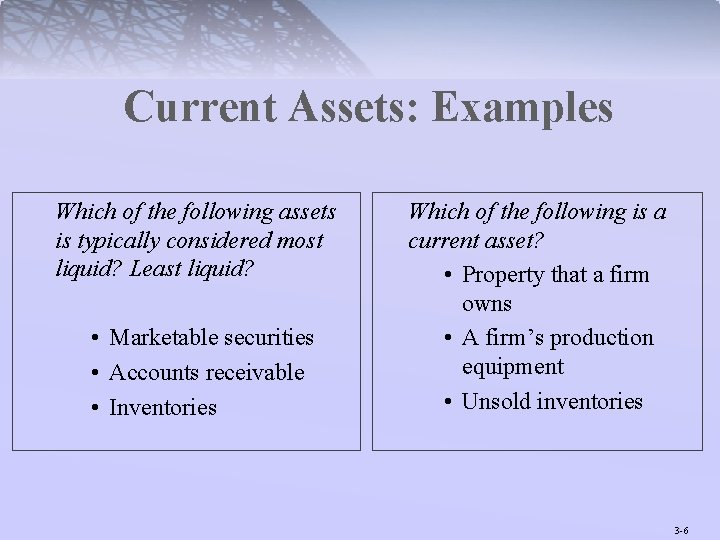
Current Assets: Examples Which of the following assets is typically considered most liquid? Least liquid? • Marketable securities • Accounts receivable • Inventories Which of the following is a current asset? • Property that a firm owns • A firm’s production equipment • Unsold inventories 3 -6
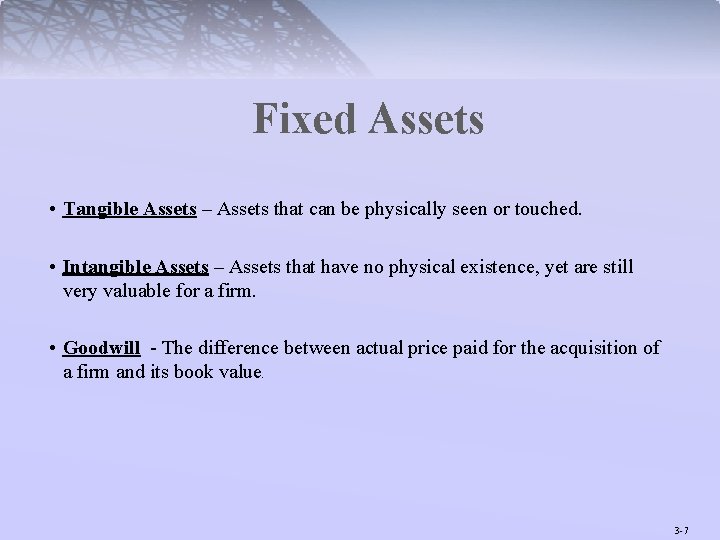
Fixed Assets • Tangible Assets – Assets that can be physically seen or touched. • Intangible Assets – Assets that have no physical existence, yet are still very valuable for a firm. • Goodwill - The difference between actual price paid for the acquisition of a firm and its book value. 3 -7
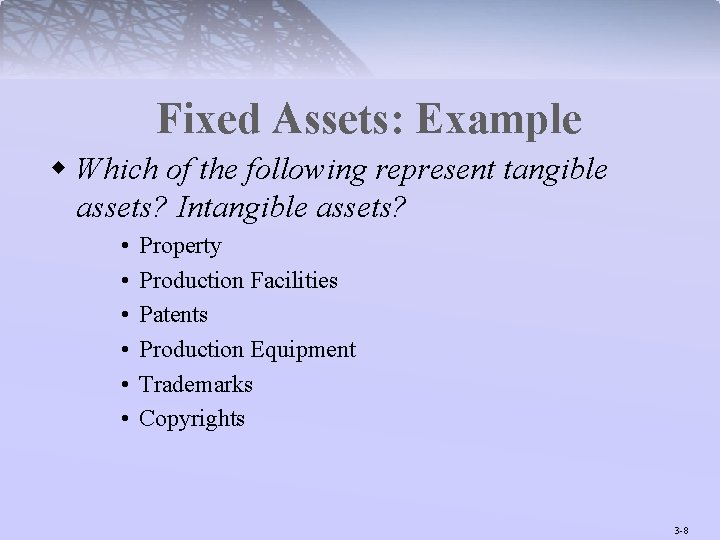
Fixed Assets: Example w Which of the following represent tangible assets? Intangible assets? • • • Property Production Facilities Patents Production Equipment Trademarks Copyrights 3 -8
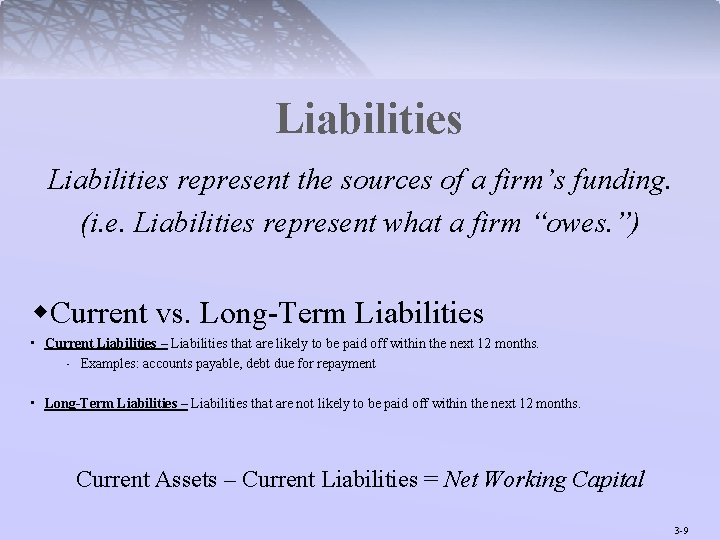
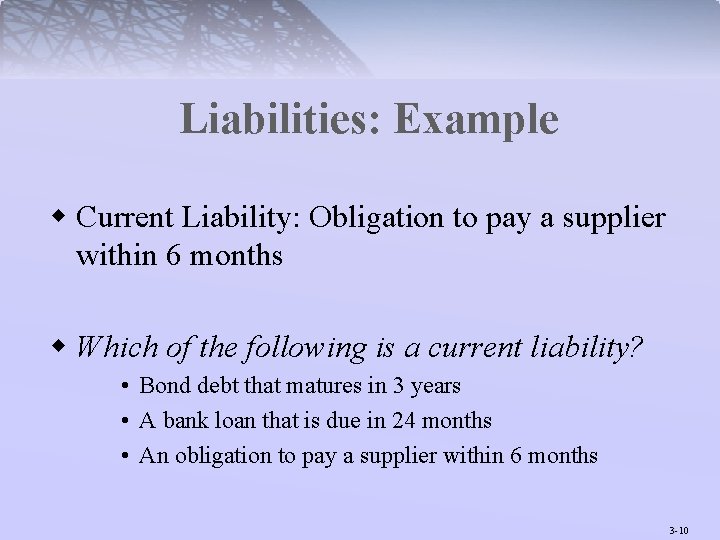
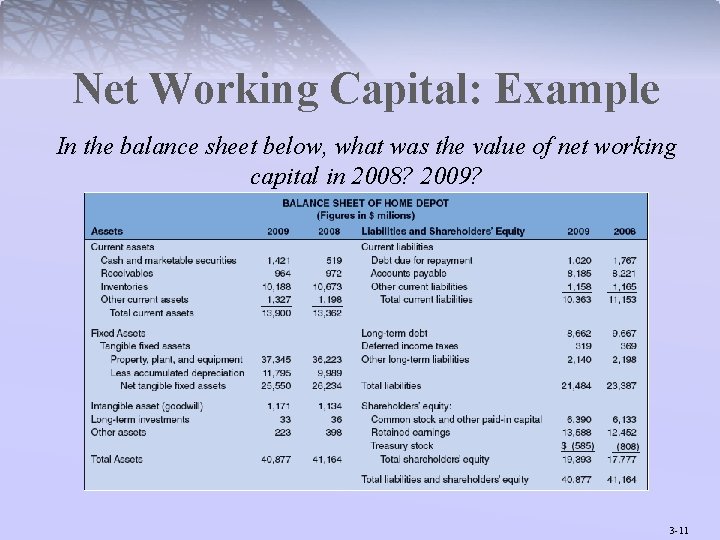
Liabilities represent the sources of a firm’s funding. (i. e. Liabilities represent what a firm “owes. ”) w. Current vs. Long-Term Liabilities • Current Liabilities – Liabilities that are likely to be paid off within the next 12 months. • Examples: accounts payable, debt due for repayment • Long-Term Liabilities – Liabilities that are not likely to be paid off within the next 12 months. Current Assets – Current Liabilities = Net Working Capital 3 -9
Liabilities: Example w Current Liability: Obligation to pay a supplier within 6 months w Which of the following is a current liability? • Bond debt that matures in 3 years • A bank loan that is due in 24 months • An obligation to pay a supplier within 6 months 3 -10
Net Working Capital: Example In the balance sheet below, what was the value of net working capital in 2008? 2009? 3 -11
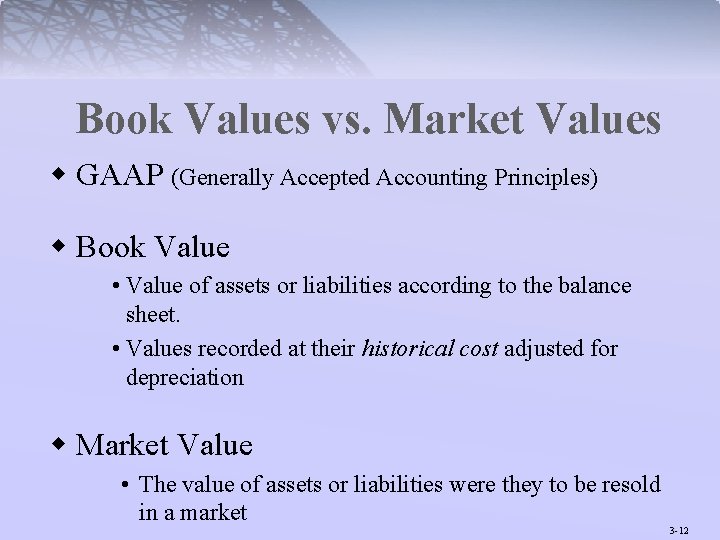
Book Values vs. Market Values w GAAP (Generally Accepted Accounting Principles) w Book Value • Value of assets or liabilities according to the balance sheet. • Values recorded at their historical cost adjusted for depreciation w Market Value • The value of assets or liabilities were they to be resold in a market 3 -12
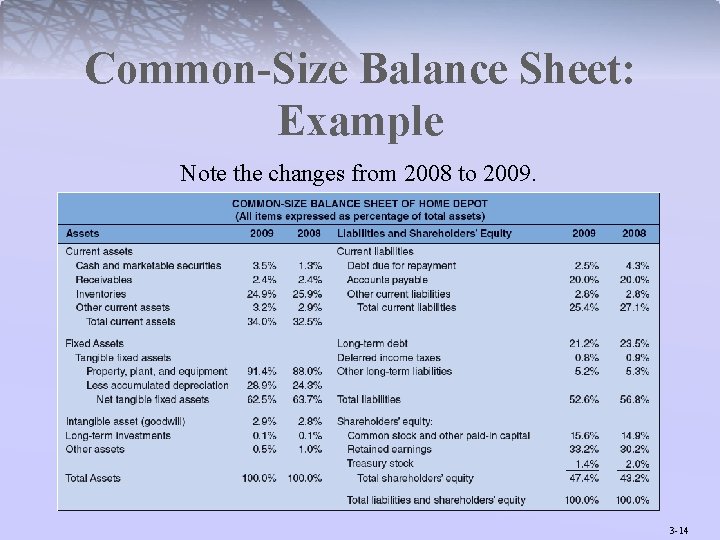
Common-Size Balance Sheet All balance sheet items are expressed as a percentage of total assets. Why is this useful? 3 -13
Common-Size Balance Sheet: Example Note the changes from 2008 to 2009. 3 -14
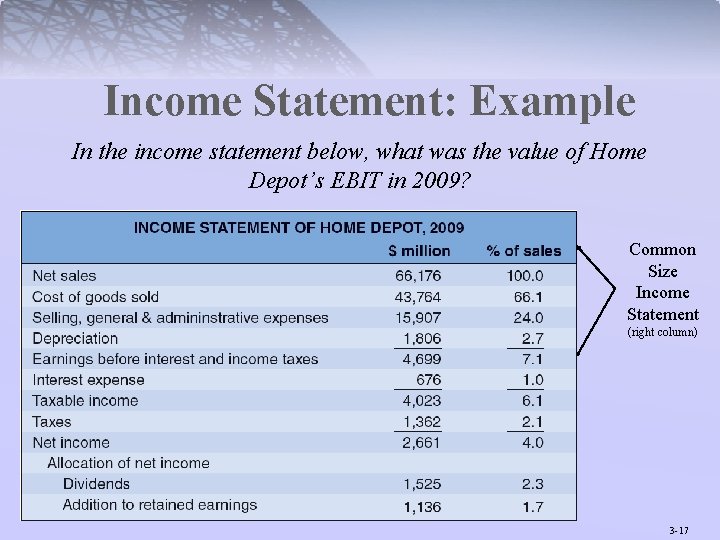
The Income Statement: a financial statement that shows the revenues, expenses, and net income of a firm over a period of time. Why is this useful? • Common-size Income Statement – All items on the income statement are expressed as a percentage of revenues. • EBIT – Earnings Before Income & Taxes • EBIT = total revenues - costs – depreciation 3 -15
Common-size Income Statement All items on a common-size income statement are expressed as a percentage of revenues. Why is this useful? 3 -16
Income Statement: Example In the income statement below, what was the value of Home Depot’s EBIT in 2009? Common Size Income Statement (right column) 3 -17
Profits vs. Cash Flow Differences between profits & cash flow: w Depreciation Rather than deducting the cost of an investment entirely when purchased, the accountant makes an annual charge for depreciation on the firm’s books. w Cash vs. accrual accounting The process of matching revenues and expenses 3 -18
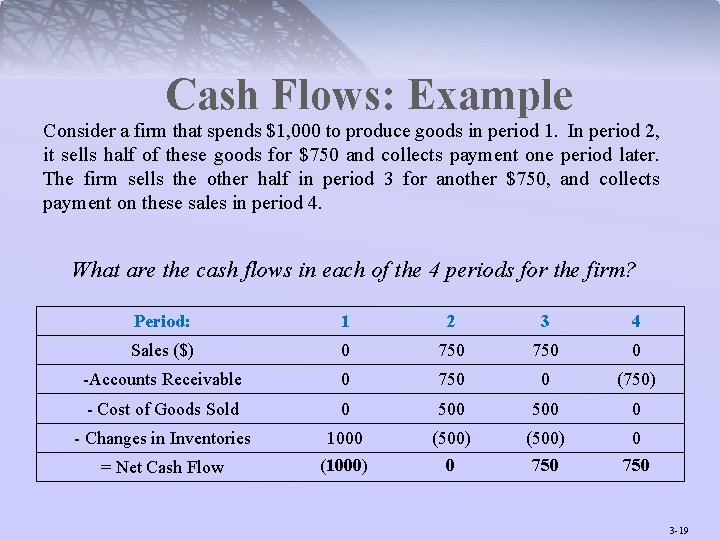
Cash Flows: Example Consider a firm that spends $1, 000 to produce goods in period 1. In period 2, it sells half of these goods for $750 and collects payment one period later. The firm sells the other half in period 3 for another $750, and collects payment on these sales in period 4. What are the cash flows in each of the 4 periods for the firm? Period: 1 2 3 4 Sales ($) 0 750 0 -Accounts Receivable 0 750 0 (750) - Cost of Goods Sold 0 500 0 - Changes in Inventories 1000 (1000) (500) 0 (500) 750 0 750 = Net Cash Flow 3 -19
The Statement of Cash Flows shows the firm’s cash receipts and cash payments over time. Why is it useful? Free Cash Flow is cash available for distribution to investors after the firm pays for new investments or additions to working capital. 3 -20
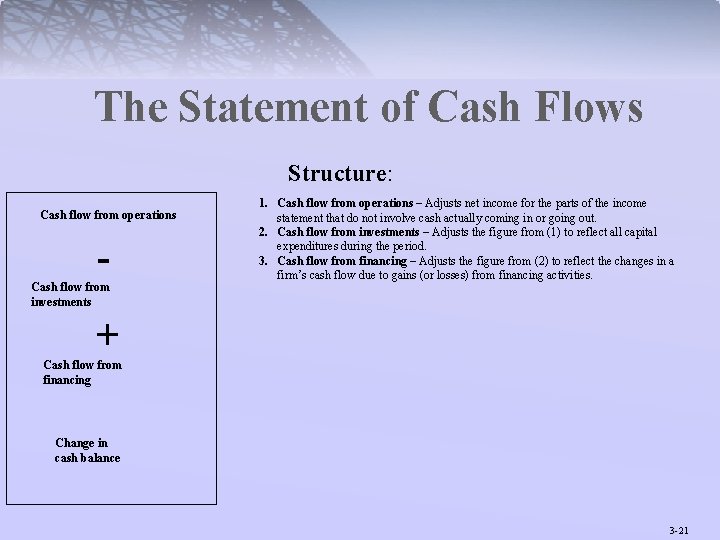
The Statement of Cash Flows Structure: Cash flow from operations Cash flow from investments 1. Cash flow from operations – Adjusts net income for the parts of the income statement that do not involve cash actually coming in or going out. 2. Cash flow from investments – Adjusts the figure from (1) to reflect all capital expenditures during the period. 3. Cash flow from financing – Adjusts the figure from (2) to reflect the changes in a firm’s cash flow due to gains (or losses) from financing activities. + Cash flow from financing Change in cash balance 3 -21
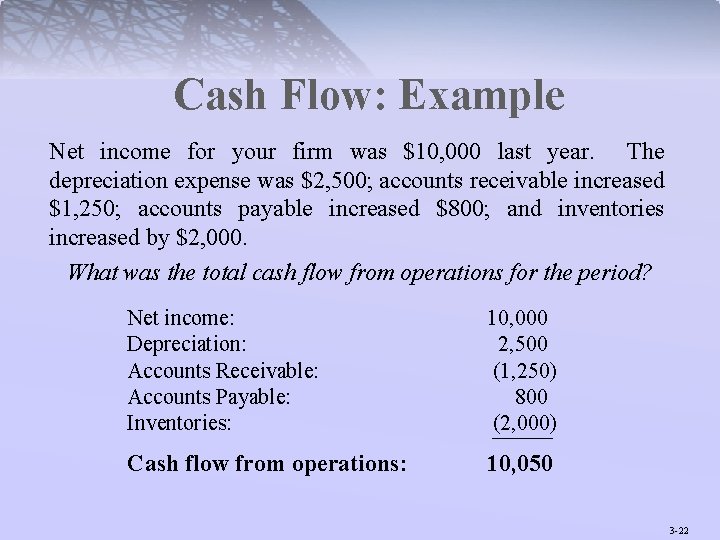
Cash Flow: Example Net income for your firm was $10, 000 last year. The depreciation expense was $2, 500; accounts receivable increased $1, 250; accounts payable increased $800; and inventories increased by $2, 000. What was the total cash flow from operations for the period? Net income: Depreciation: Accounts Receivable: Accounts Payable: Inventories: 10, 000 2, 500 (1, 250) 800 (2, 000) Cash flow from operations: 10, 050 3 -22
Accounting Practice Most managers say that accounting earnings is the single most important number reported to investors. What implications does this have for the investor? 3 -23
Accounting Practice Grey areas for financial managers: Revenue recognition Firms record a sale when it is made, not when the customer actually pays; however the date of sale is not always obvious. Cookie-jar reserves Firms sometimes put cash in separate accounts to be used in times of distress to create the illusion of growth even in bad years. 3 -24
Accounting Practice Additional grey areas for financial managers: Off-balance sheet assets and liabilities Firms may hide large amounts of resources in off balance sheet accounts in order to hide potential liabilities (or assets) from the public. Mark-to-market accounting Many assets and liabilities are valued at their historic cost, not at their current values. This may make it more difficult to accurately value the firm. 3 -25
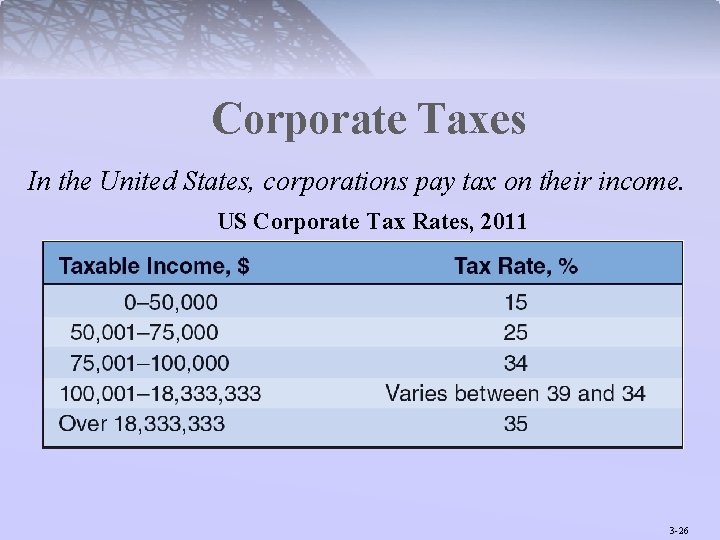
Corporate Taxes In the United States, corporations pay tax on their income. US Corporate Tax Rates, 2011 3 -26
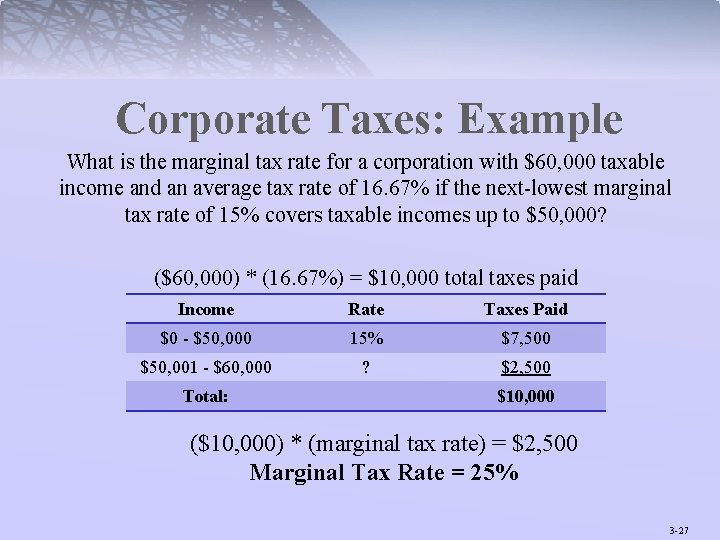
Corporate Taxes: Example What is the marginal tax rate for a corporation with $60, 000 taxable income and an average tax rate of 16. 67% if the next-lowest marginal tax rate of 15% covers taxable incomes up to $50, 000? ($60, 000) * (16. 67%) = $10, 000 total taxes paid Income Rate Taxes Paid $0 - $50, 000 15% $7, 500 $50, 001 - $60, 000 ? $2, 500 Total: $10, 000 ($10, 000) * (marginal tax rate) = $2, 500 Marginal Tax Rate = 25% 3 -27
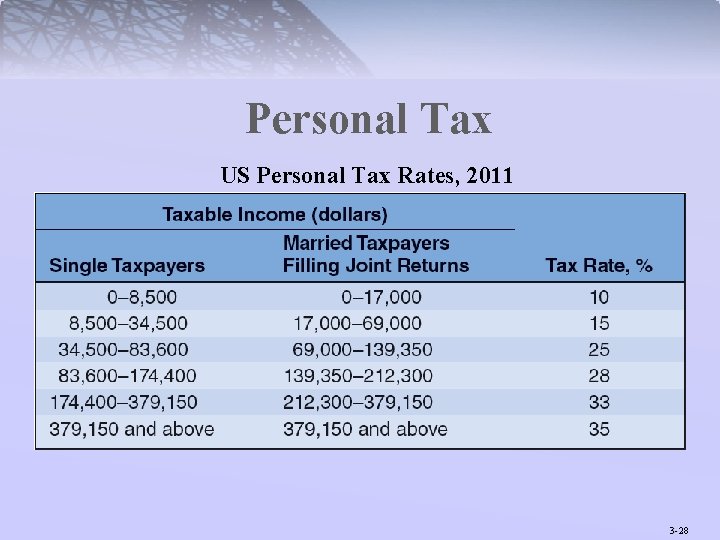
Personal Tax US Personal Tax Rates, 2011 3 -28
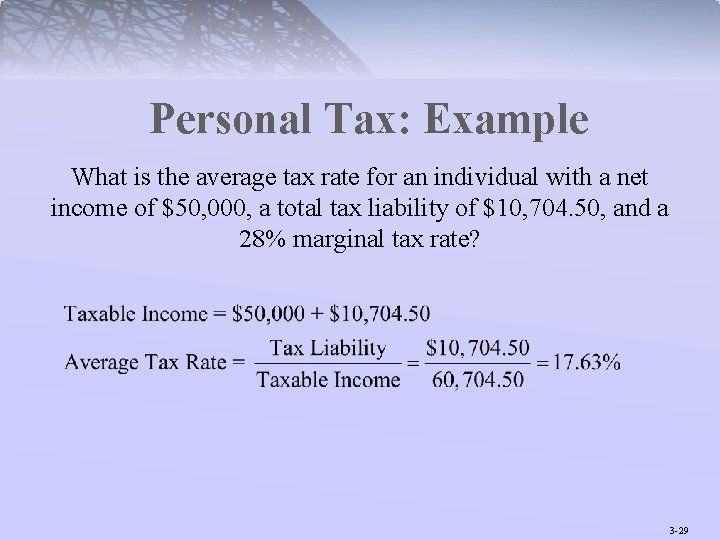
Personal Tax: Example What is the average tax rate for an individual with a net income of $50, 000, a total tax liability of $10, 704. 50, and a 28% marginal tax rate? 3 -29
The Problem of “Double Taxation” When a corporation issues a dividend, each dividend dollar is effectively taxed twice: 1. Each dollar of earnings taxed at corporate. 2. Shareholders pay personal income taxes on all dividends received. 3 -30