
Lecture 3 1 The potential energy surface of

- Slides: 53
Lecture 3 1. The potential energy surface of dinuclear system and formation of mass distribution of reaction products. 2. Partial cross sections. 3. Angular momentum effect on the capture and quasifission cross sections. 4. Analysis of the experimental data obtained in the 40, 48 Ca+144, 154 Sm reactions. My E-mail: aknasirov@gmail. com nasirov@jinr. ru
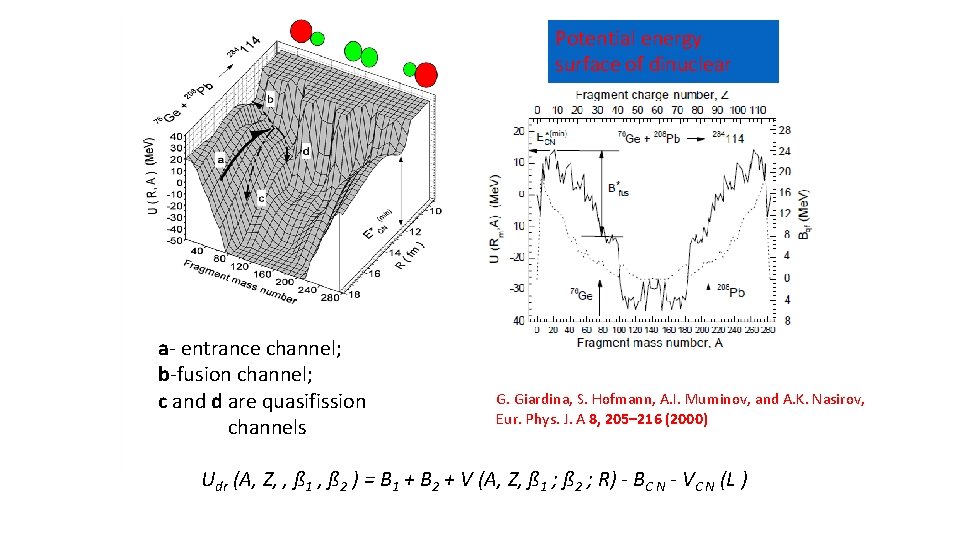
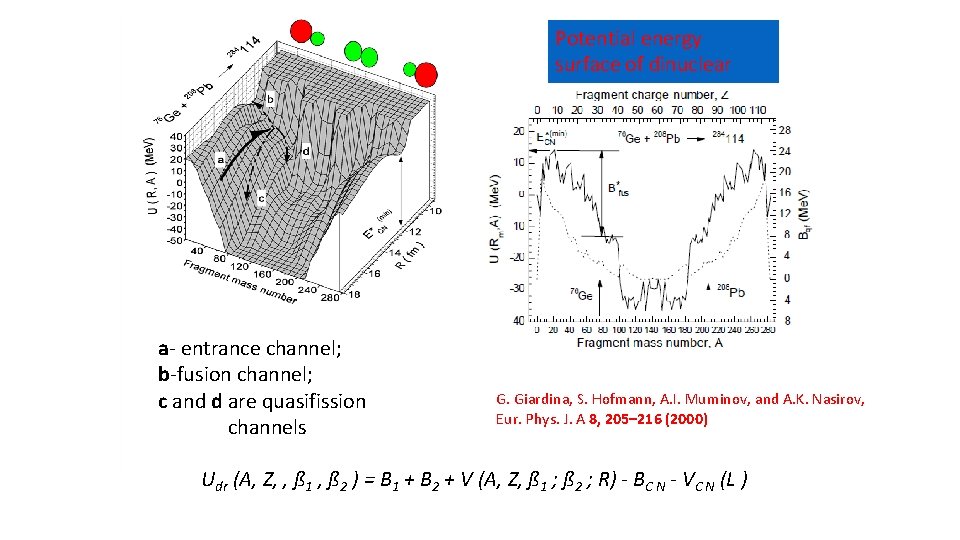
Potential energy surface of dinuclear system a- entrance channel; b-fusion channel; c and d are quasifission channels G. Giardina, S. Hofmann, A. I. Muminov, and A. K. Nasirov, Eur. Phys. J. A 8, 205– 216 (2000) Udr (A, Z, , ß 1 , ß 2 ) = B 1 + B 2 + V (A, Z, ß 1 ; ß 2 ; R) - BC N - VC N (L )
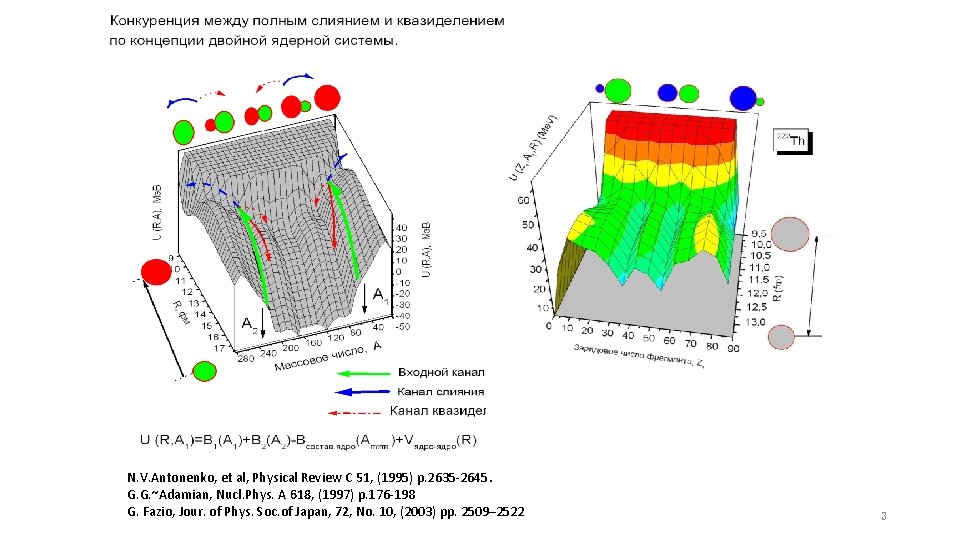
N. V. Antonenko, et al, Physical Review C 51, (1995) p. 2635 -2645. G. G. ~Adamian, Nucl. Phys. A 618, (1997) p. 176 -198 G. Fazio, Jour. of Phys. Soc. of Japan, 72, No. 10, (2003) pp. 2509– 2522 3
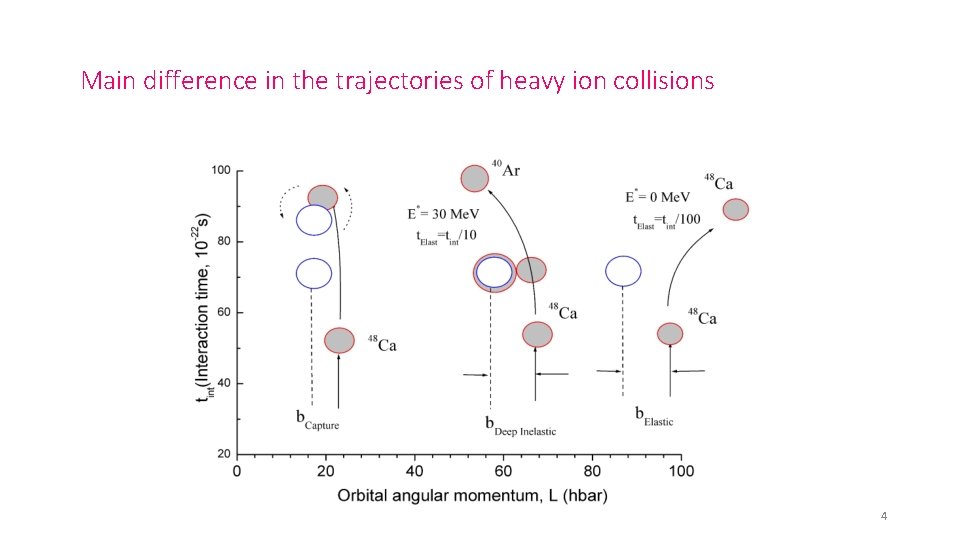
Main difference in the trajectories of heavy ion collisions 4
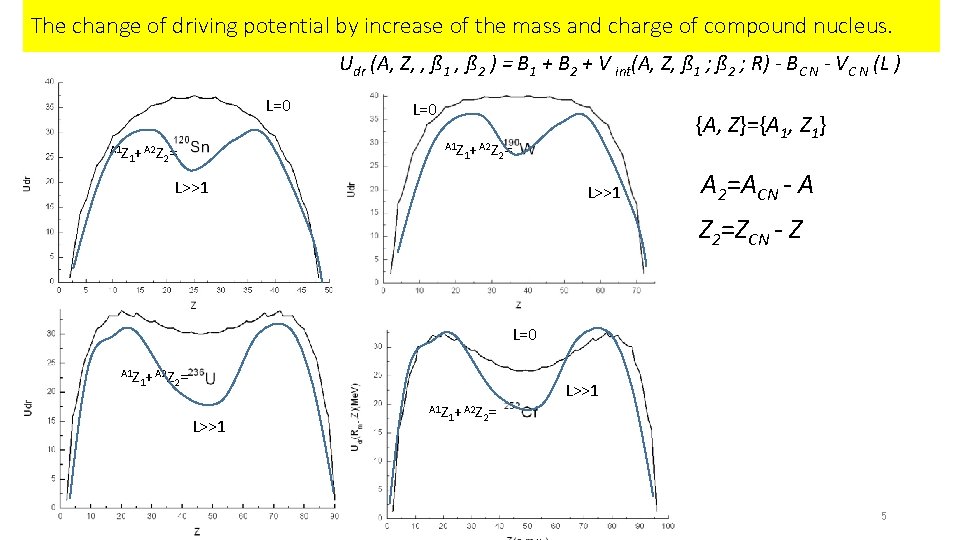
The change of driving potential by increase of the mass and charge of compound nucleus. Udr (A, Z, , ß 1 , ß 2 ) = B 1 + B 2 + V int(A, Z, ß 1 ; ß 2 ; R) - BC N - VC N (L ) L=0 A 1 Z 1+ A 2 Z L=0 A 1 Z 2= 1+ A 2 Z {A, Z}={A 1, Z 1} 2= L>>1 A 2=ACN - A Z 2=ZCN - Z L=0 A 1 Z 1+ A 2 Z 2= L>>1 A 1 Z 1+ A 2 Z 2= 5
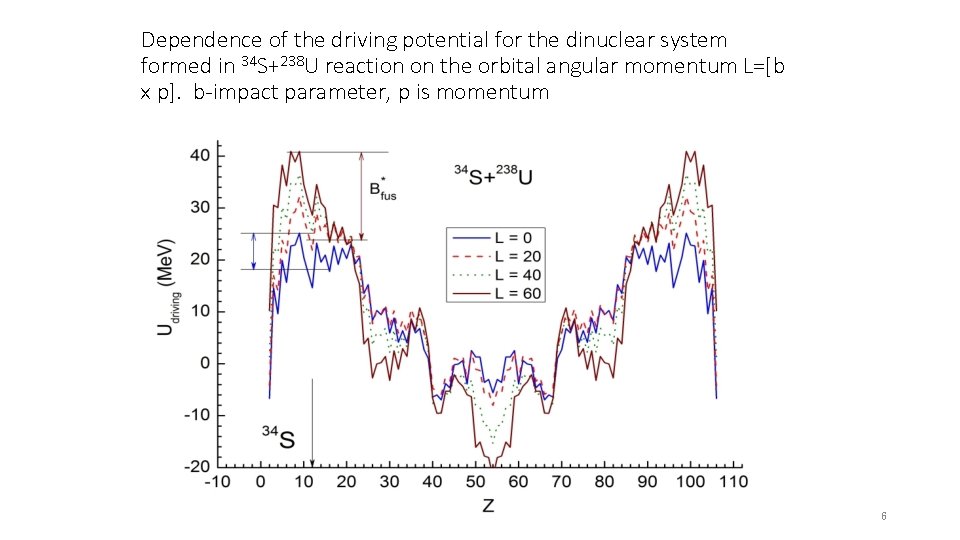
Dependence of the driving potential for the dinuclear system formed in 34 S+238 U reaction on the orbital angular momentum L=[b x p]. b-impact parameter, p is momentum 6
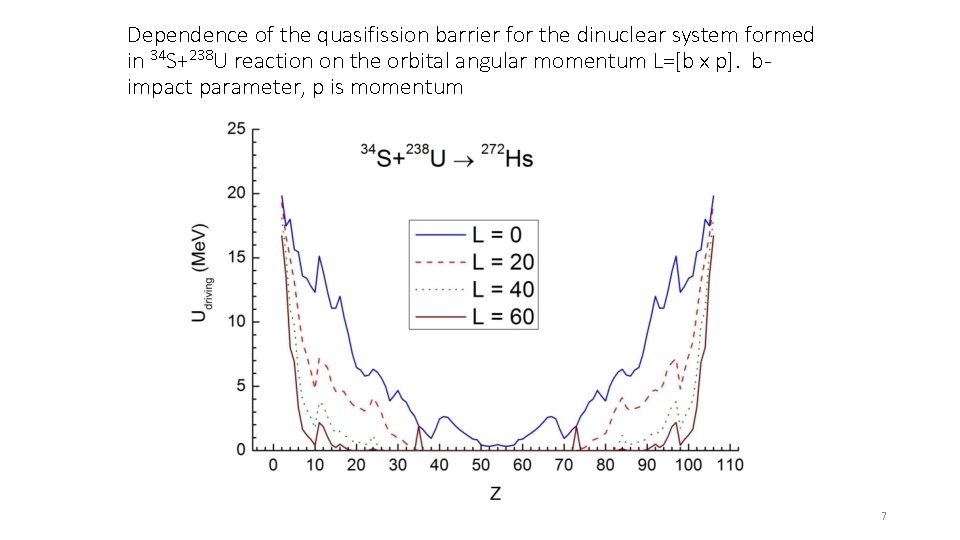
Dependence of the quasifission barrier for the dinuclear system formed in 34 S+238 U reaction on the orbital angular momentum L=[b x p]. bimpact parameter, p is momentum 7
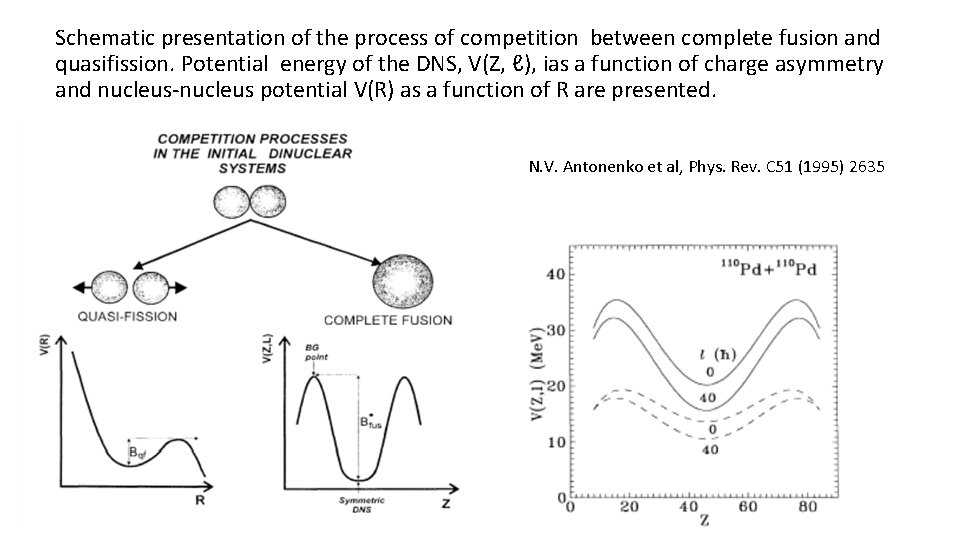
Schematic presentation of the process of competition between complete fusion and quasifission. Potential energy of the DNS, V(Z, ℓ), ias a function of charge asymmetry and nucleus-nucleus potential V(R) as a function of R are presented. N. V. Antonenko et al, Phys. Rev. C 51 (1995) 2635
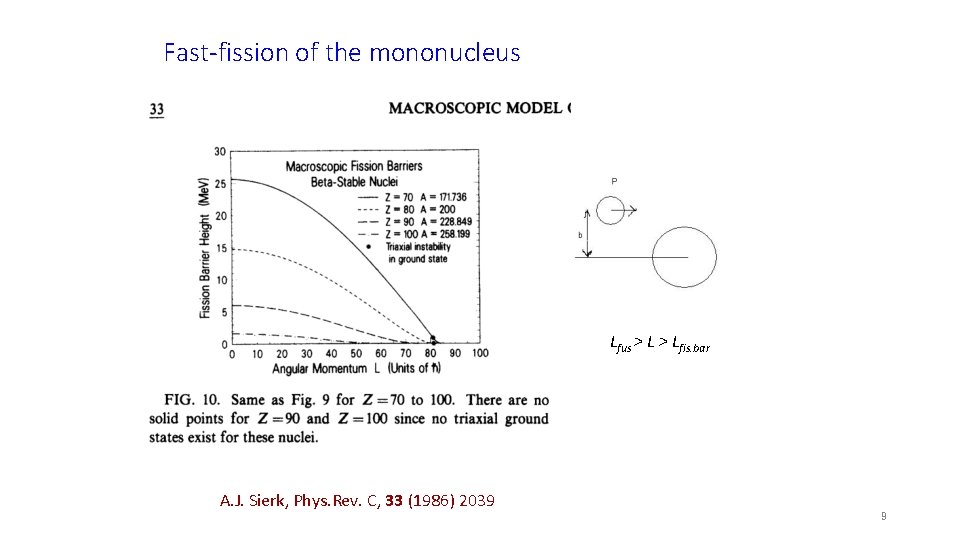
Fast-fission of the mononucleus Lfus > Lfis. bar A. J. Sierk, Phys. Rev. C, 33 (1986) 2039 9
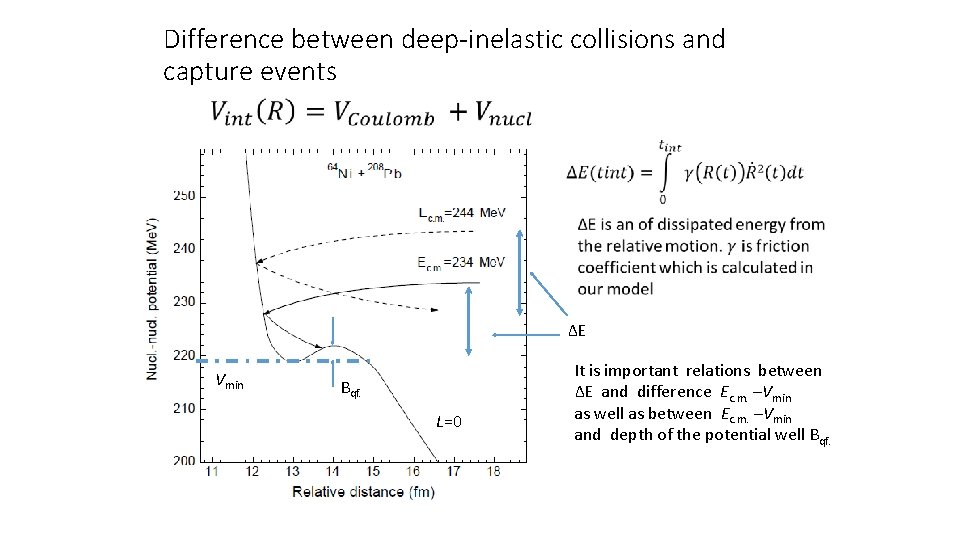
Difference between deep-inelastic collisions and capture events • ΔE Vmin Bqf. L=0 It is important relations between ΔE and difference Ec. m. –Vmin as well as between Ec. m. –Vmin and depth of the potential well Bqf.
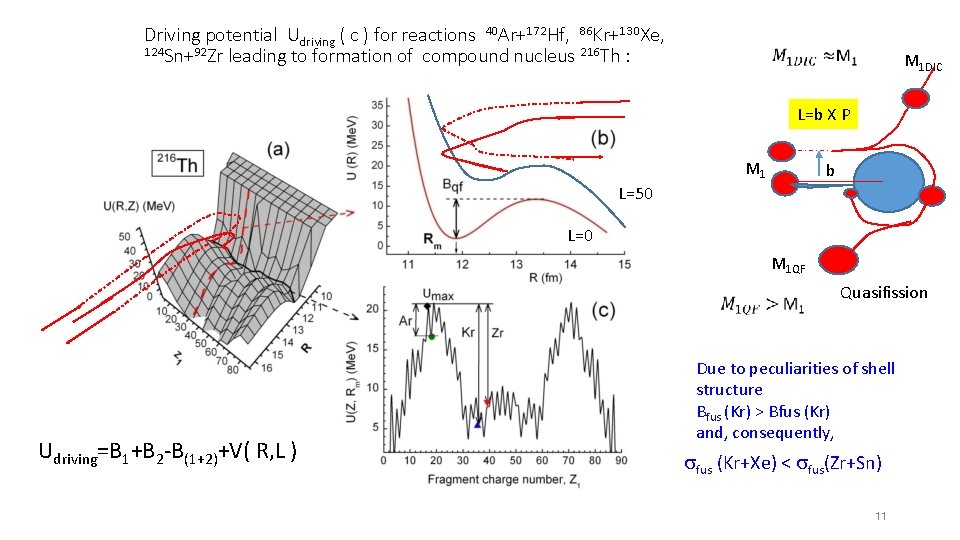
Driving potential Udriving ( c ) for reactions 40 Ar+172 Hf, 86 Kr+130 Xe, 124 Sn+92 Zr leading to formation of compound nucleus 216 Th : M 1 DIC L=b X P L=50 M 1 b L=0 M 1 QF Quasifission Udriving=B 1+B 2 -B(1+2)+V( R, L ) Due to peculiarities of shell structure Bfus (Kr) > Bfus (Kr) and, consequently, fus (Kr+Xe) < fus(Zr+Sn) 11
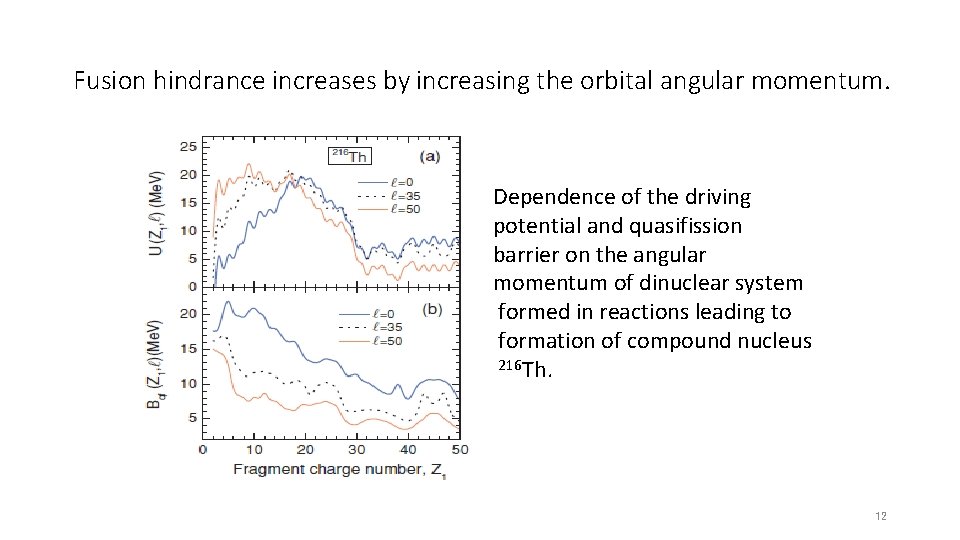
Fusion hindrance increases by increasing the orbital angular momentum. • F Dependence of the driving potential and quasifission barrier on the angular momentum of dinuclear system formed in reactions leading to formation of compound nucleus 216 Th. 12
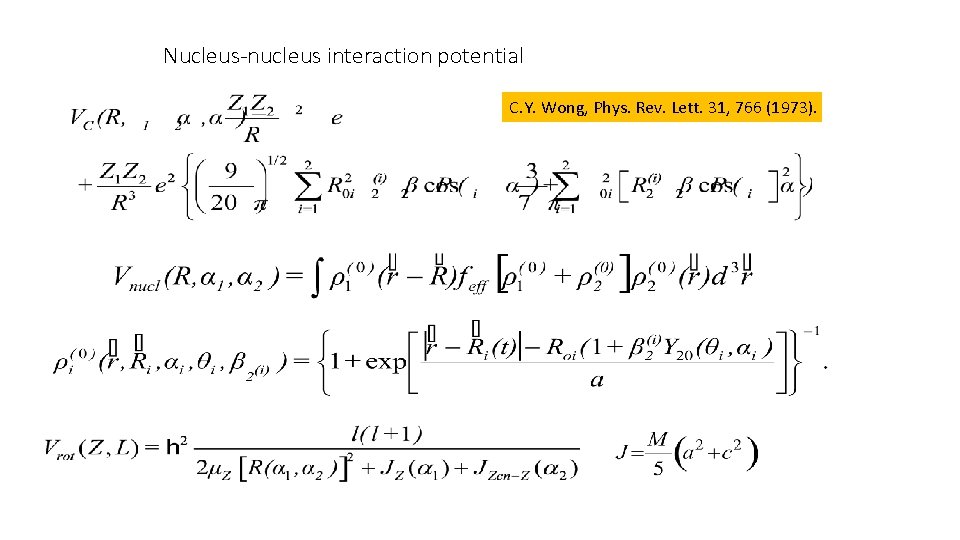
Nucleus-nucleus interaction potential C. Y. Wong, Phys. Rev. Lett. 31, 766 (1973).
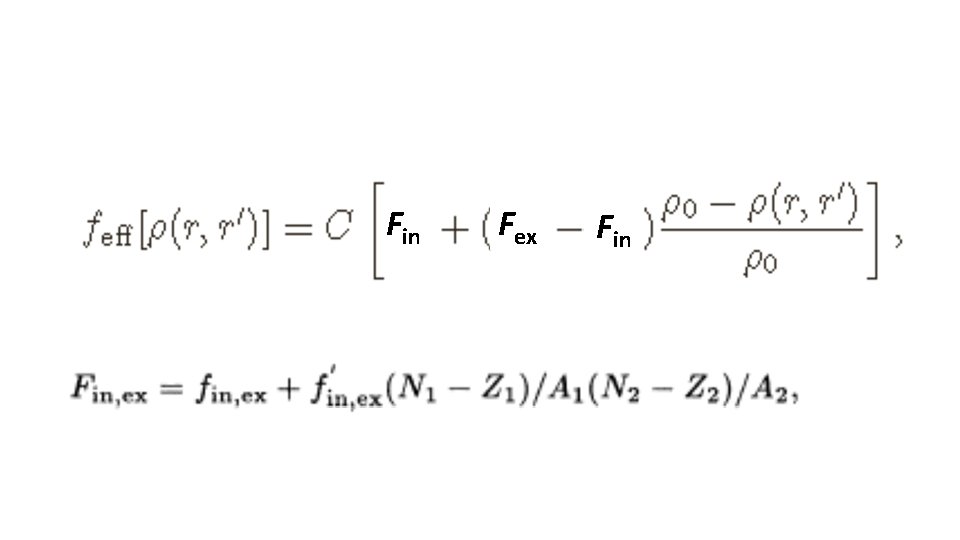
Fin Fex Fin
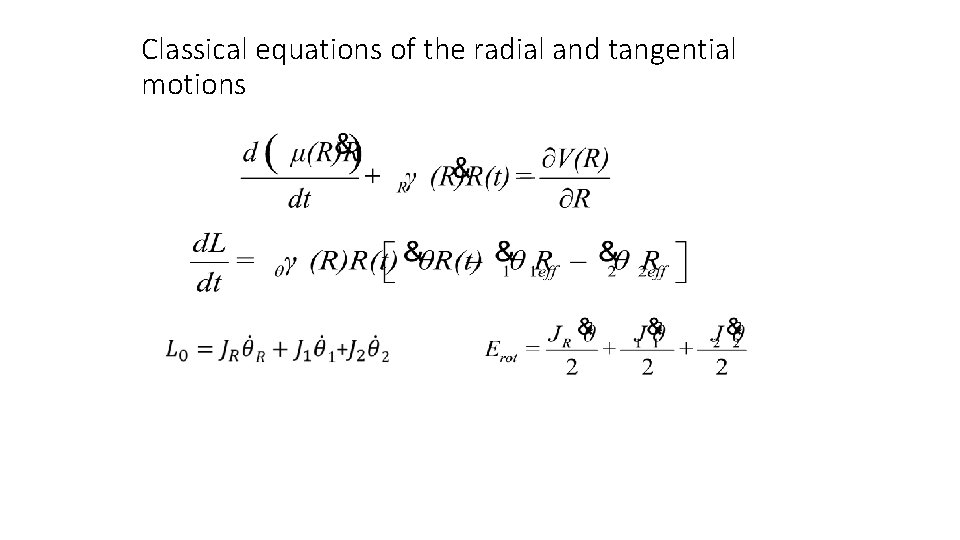
Classical equations of the radial and tangential motions
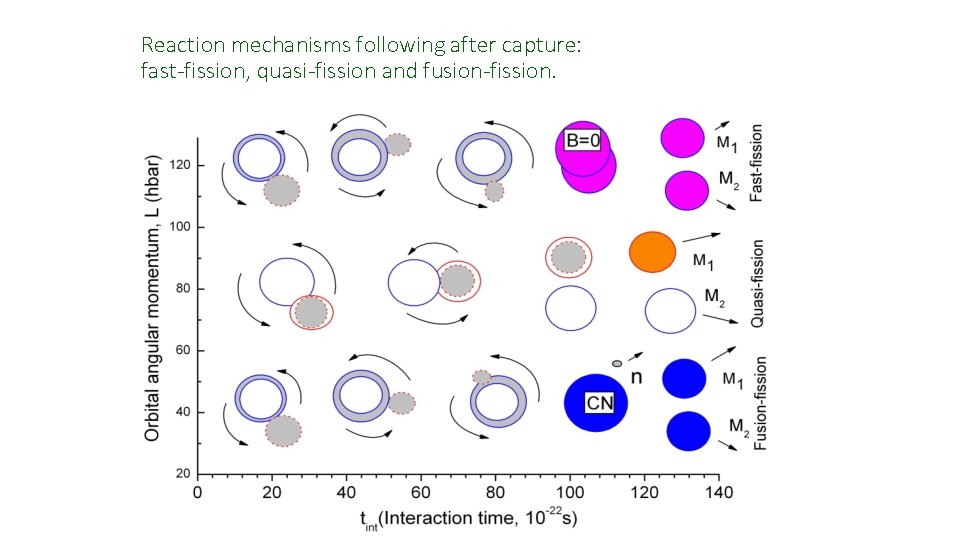
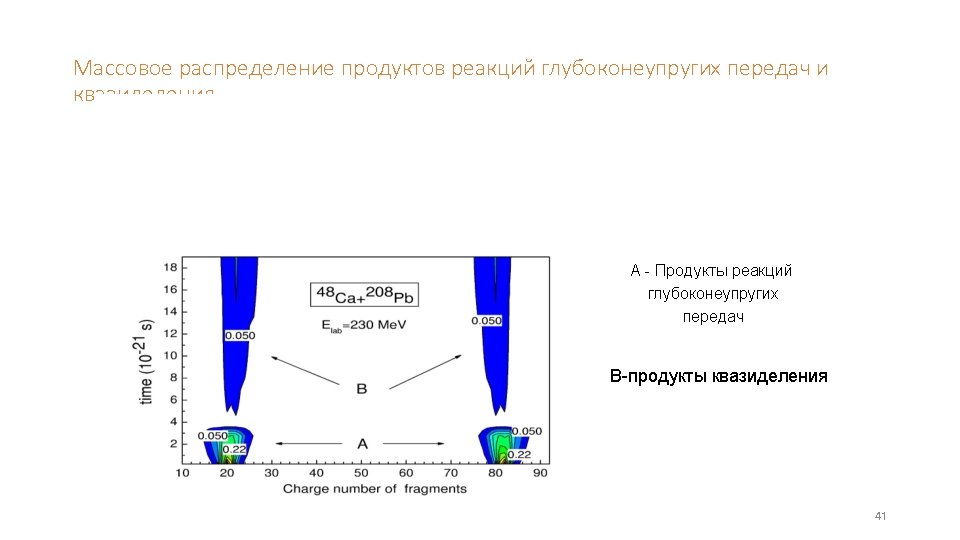
Reaction mechanisms following after capture: fast-fission, quasi-fission and fusion-fission.
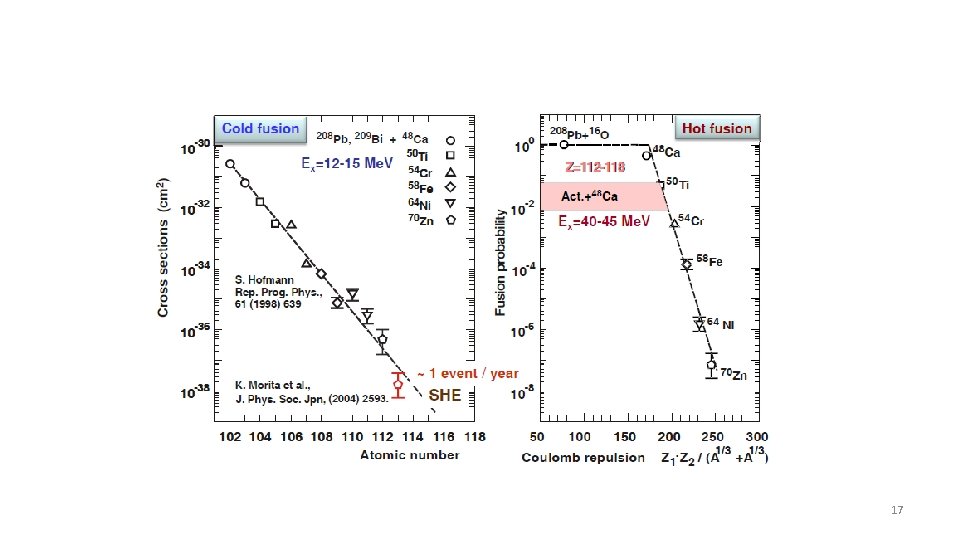
17
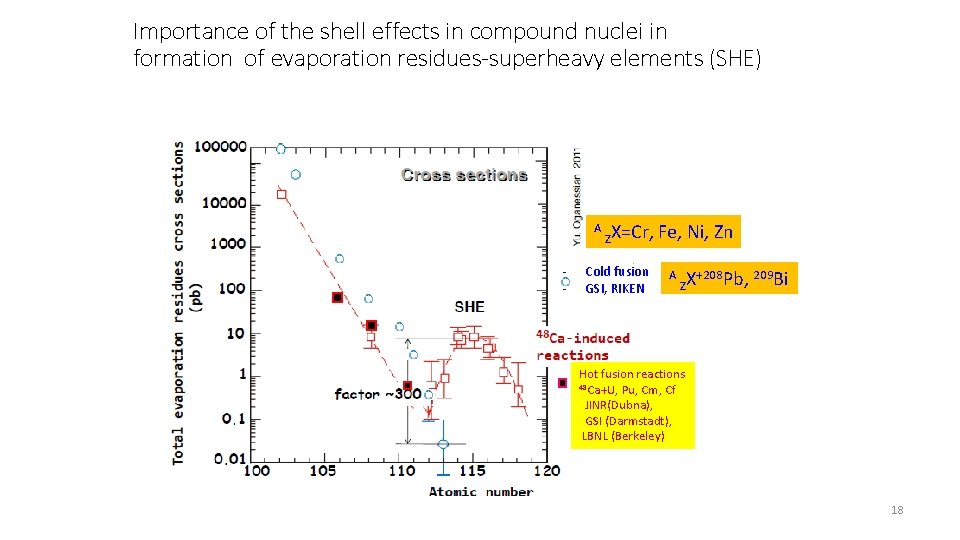
Importance of the shell effects in compound nuclei in formation of evaporation residues-superheavy elements (SHE) A - ZX=Cr, Cold fusion GSI, RIKEN Fe, Ni, Zn A ZX +208 Pb, 209 Bi Hot fusion reactions 48 Ca+U, Pu, Cm, Cf JINR(Dubna), GSI (Darmstadt), LBNL (Berkeley) 18
Potential energy surface of dinuclear system a- entrance channel; b-fusion channel; c and d are quasifission channels G. Giardina, S. Hofmann, A. I. Muminov, and A. K. Nasirov, Eur. Phys. J. A 8, 205– 216 (2000) Udr (A, Z, , ß 1 , ß 2 ) = B 1 + B 2 + V (A, Z, ß 1 ; ß 2 ; R) - BC N - VC N (L )
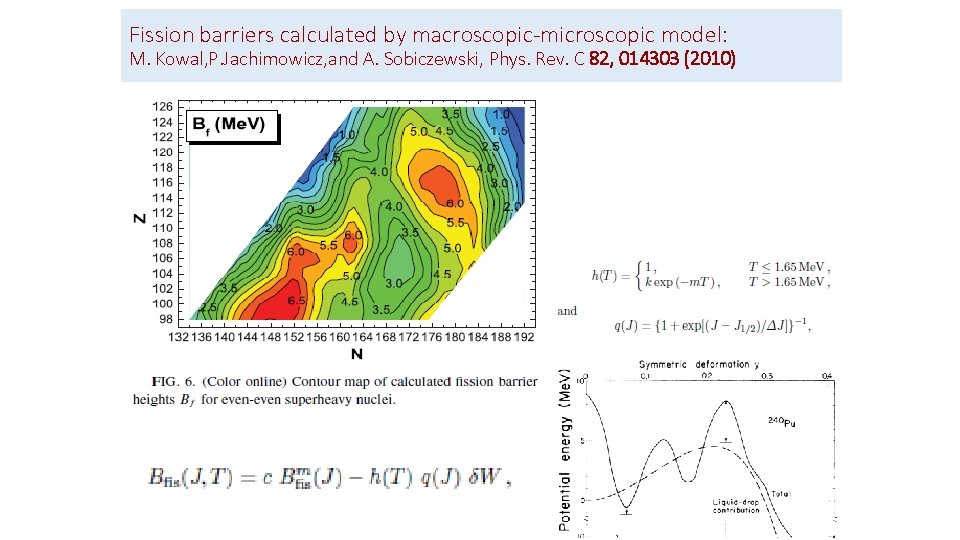
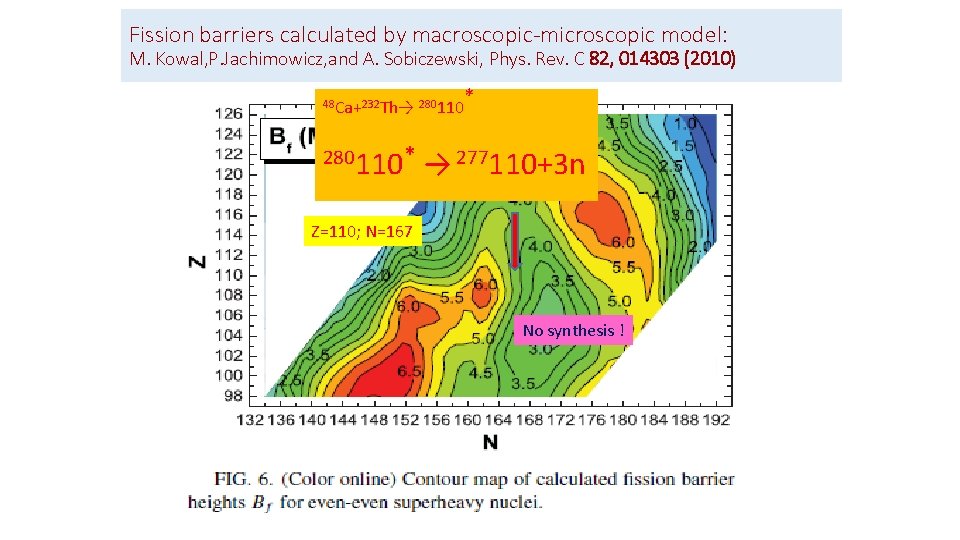
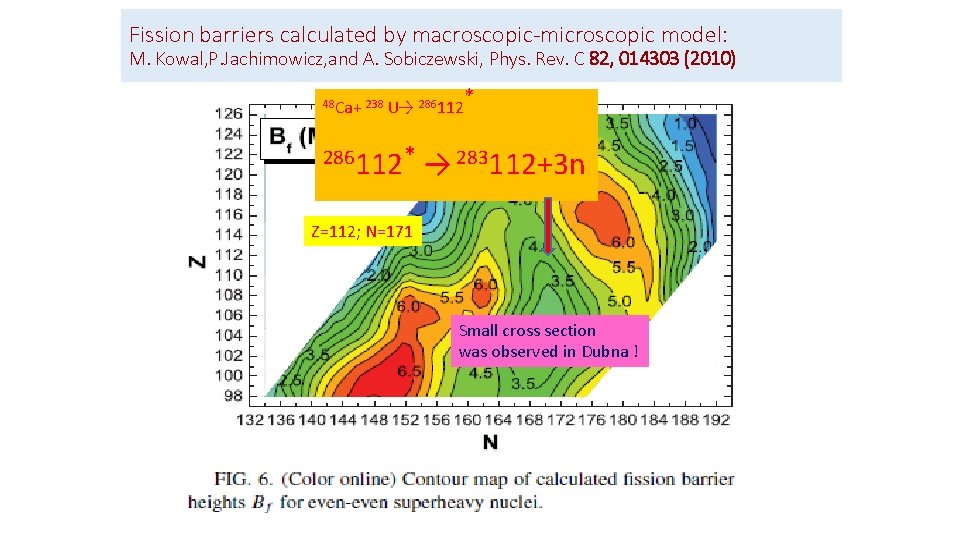
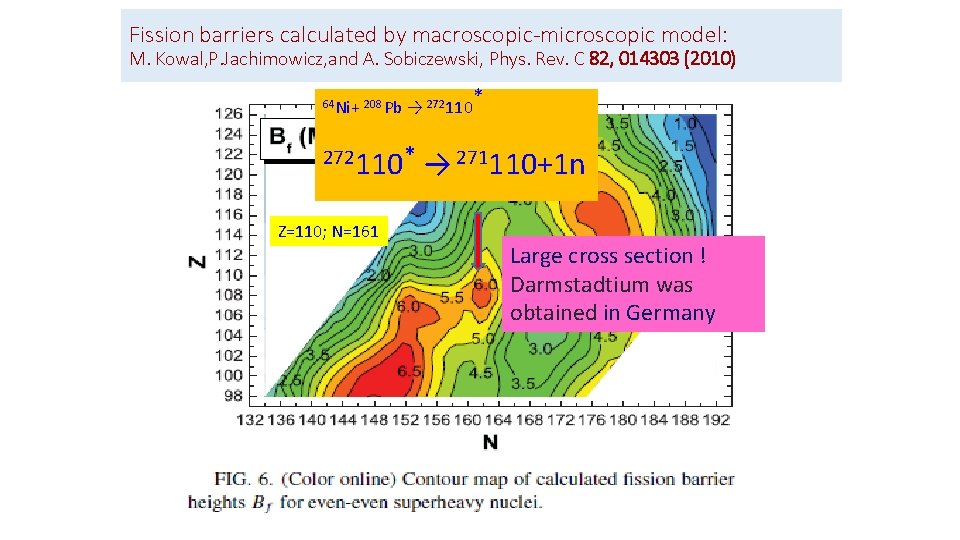
Fission barriers calculated by macroscopic-microscopic model: M. Kowal, P. Jachimowicz, and A. Sobiczewski, Phys. Rev. C 82, 014303 (2010)
Fission barriers calculated by macroscopic-microscopic model: M. Kowal, P. Jachimowicz, and A. Sobiczewski, Phys. Rev. C 82, 014303 (2010) 48 Ca+232 Th→ 280110* * → 277110+3 n Z=120 Z=110; N=167 No synthesis !
Fission barriers calculated by macroscopic-microscopic model: M. Kowal, P. Jachimowicz, and A. Sobiczewski, Phys. Rev. C 82, 014303 (2010) 48 Ca+ 238 U→ 286112* * → 283112+3 n Z=120 Z=112; N=171 Small cross section was observed in Dubna !
Fission barriers calculated by macroscopic-microscopic model: M. Kowal, P. Jachimowicz, and A. Sobiczewski, Phys. Rev. C 82, 014303 (2010) 64 Ni+ 208 Pb → 272110* Z=110; N=161 * → 271110+1 n Z=120 Large cross section ! Darmstadtium was obtained in Germany
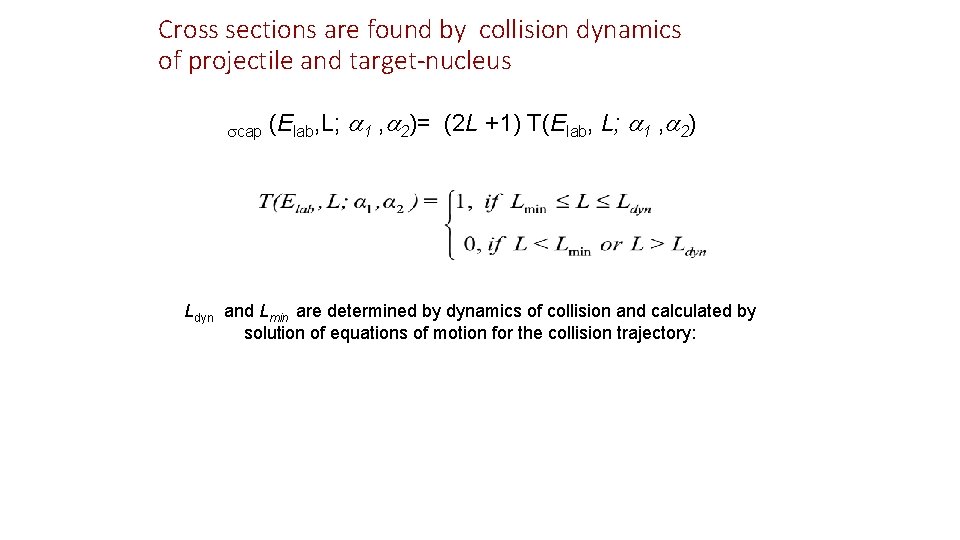
Cross sections are found by collision dynamics of projectile and target-nucleus cap (Elab, L; 1 , 2)= (2 L +1) T(Elab, L; 1 , 2) Ldyn and Lmin are determined by dynamics of collision and calculated by solution of equations of motion for the collision trajectory:
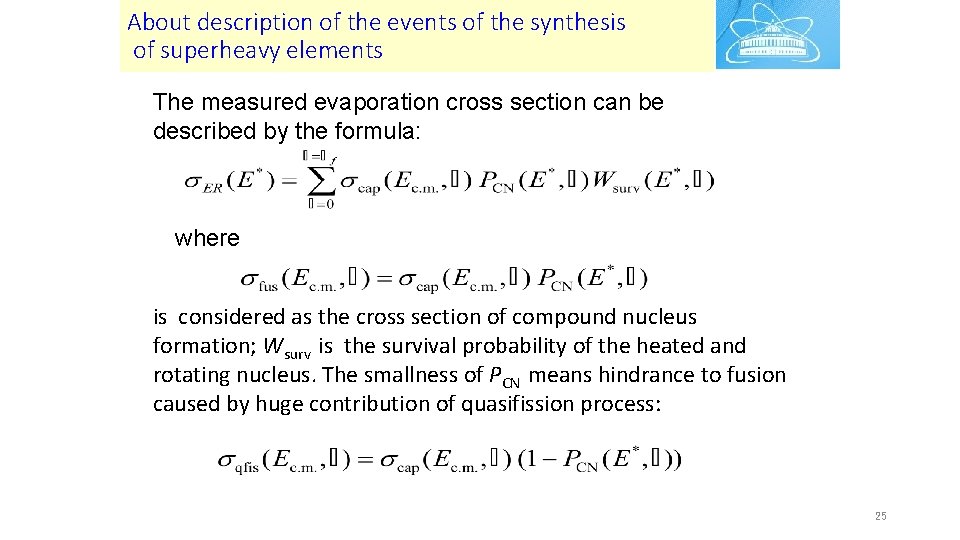
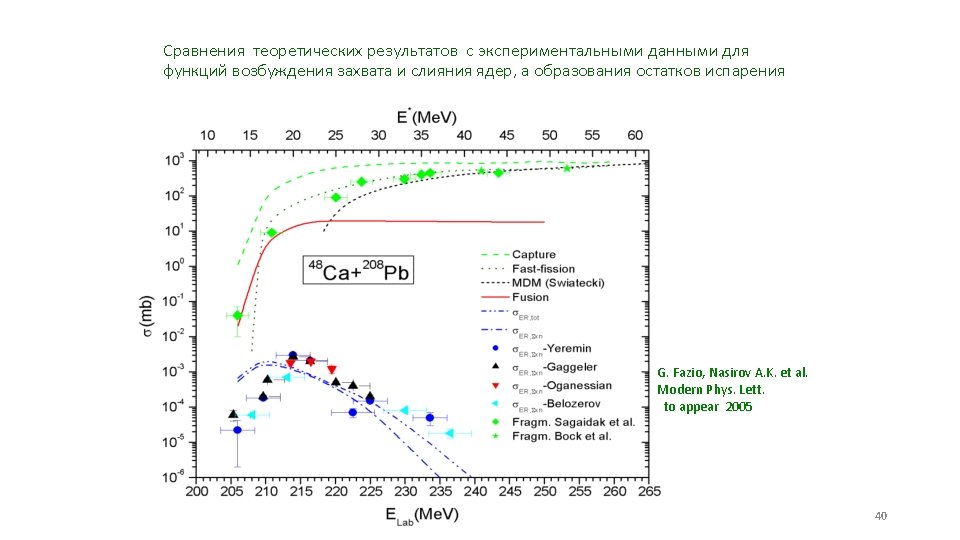
About description of the events of the synthesis of superheavy elements The measured evaporation cross section can be described by the formula: where is considered as the cross section of compound nucleus formation; Wsurv is the survival probability of the heated and rotating nucleus. The smallness of PCN means hindrance to fusion caused by huge contribution of quasifission process: 25
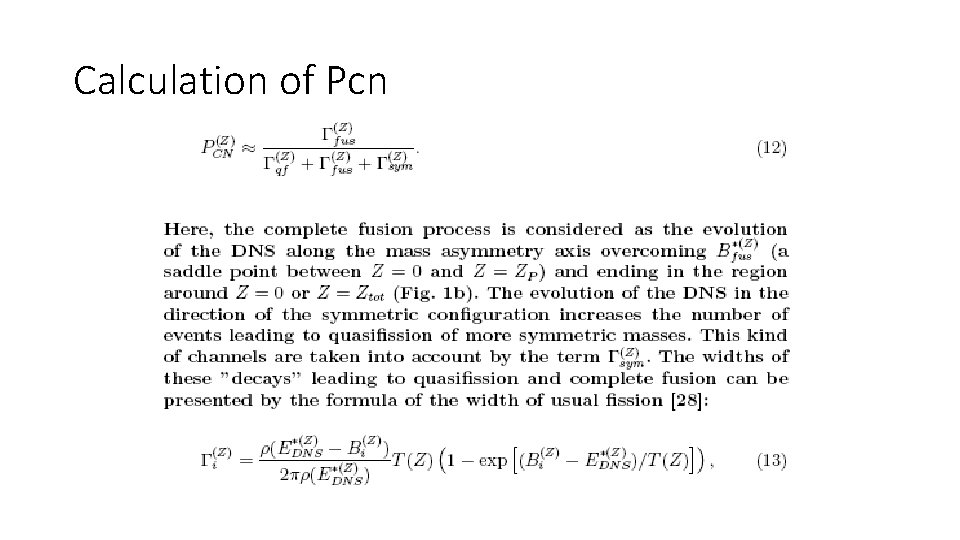
Calculation of Pcn
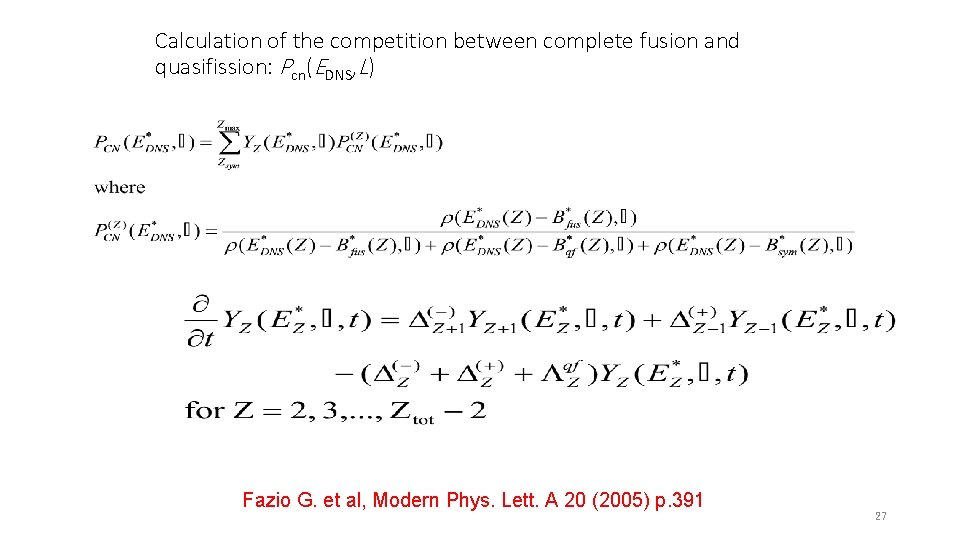
Calculation of the competition between complete fusion and quasifission: Pcn(EDNS, L) Fazio G. et al, Modern Phys. Lett. A 20 (2005) p. 391 27
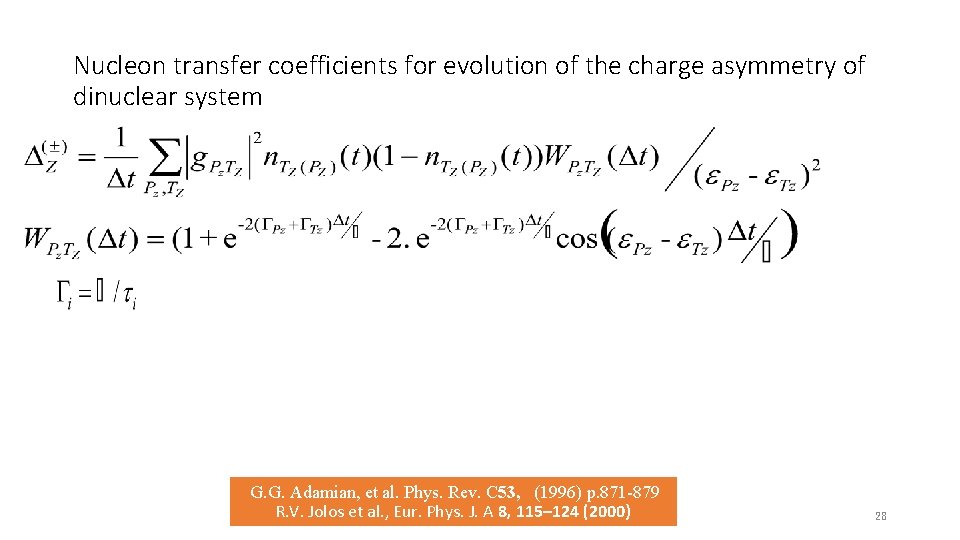
Nucleon transfer coefficients for evolution of the charge asymmetry of dinuclear system G. G. Adamian, et al. Phys. Rev. C 53, (1996) p. 871 -879 R. V. Jolos et al. , Eur. Phys. J. A 8, 115– 124 (2000) 28
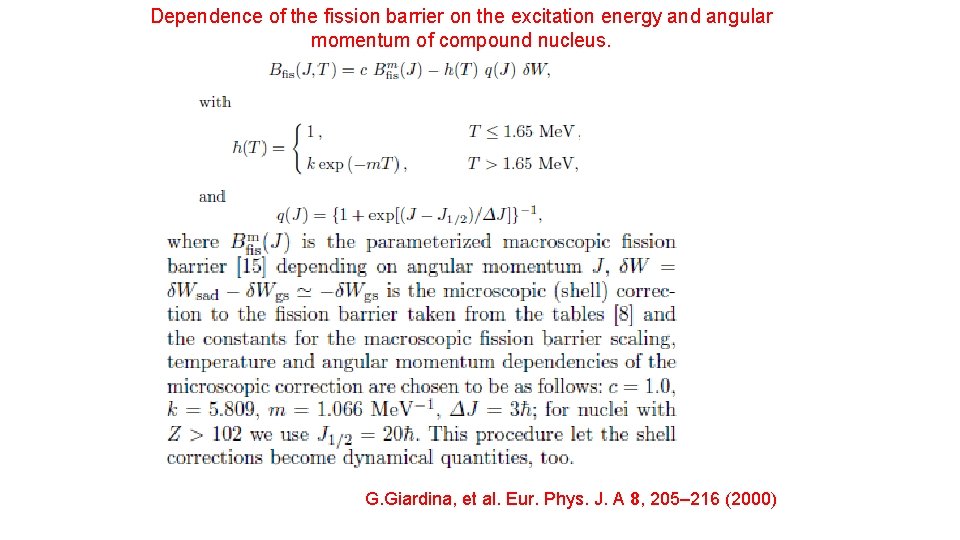
Dependence of the fission barrier on the excitation energy and angular momentum of compound nucleus. G. Giardina, et al. Eur. Phys. J. A 8, 205– 216 (2000)
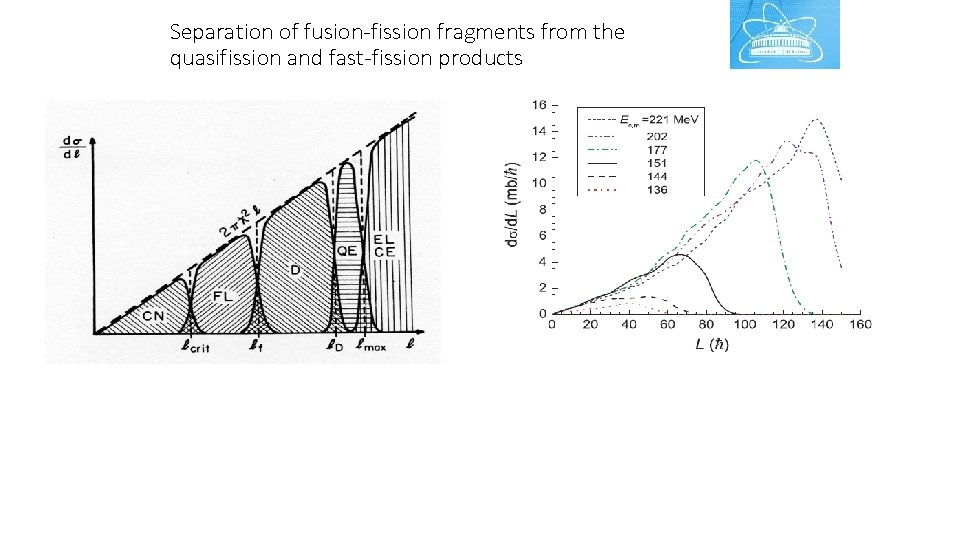
Separation of fusion-fission fragments from the quasifission and fast-fission products
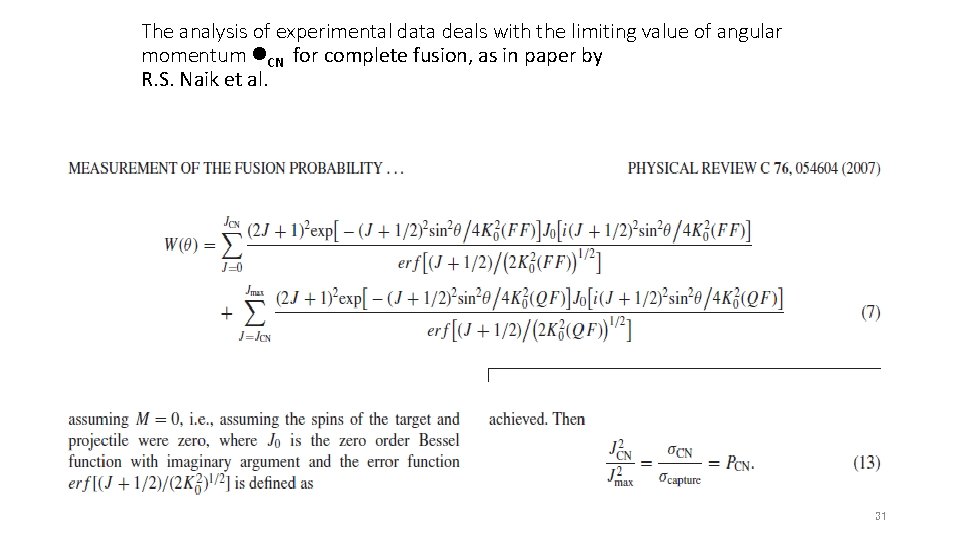
The analysis of experimental data deals with the limiting value of angular momentum l. CN for complete fusion, as in paper by R. S. Naik et al. 31
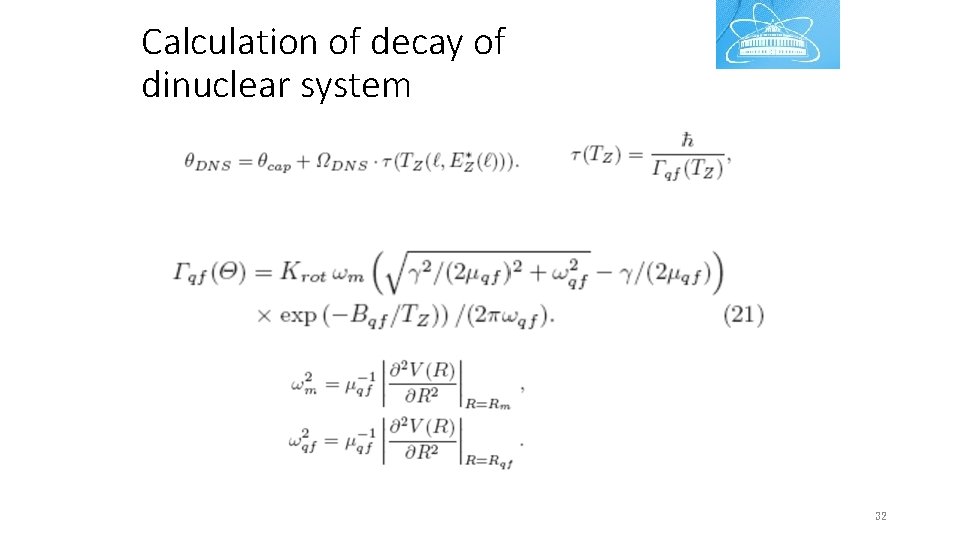
Calculation of decay of dinuclear system 32
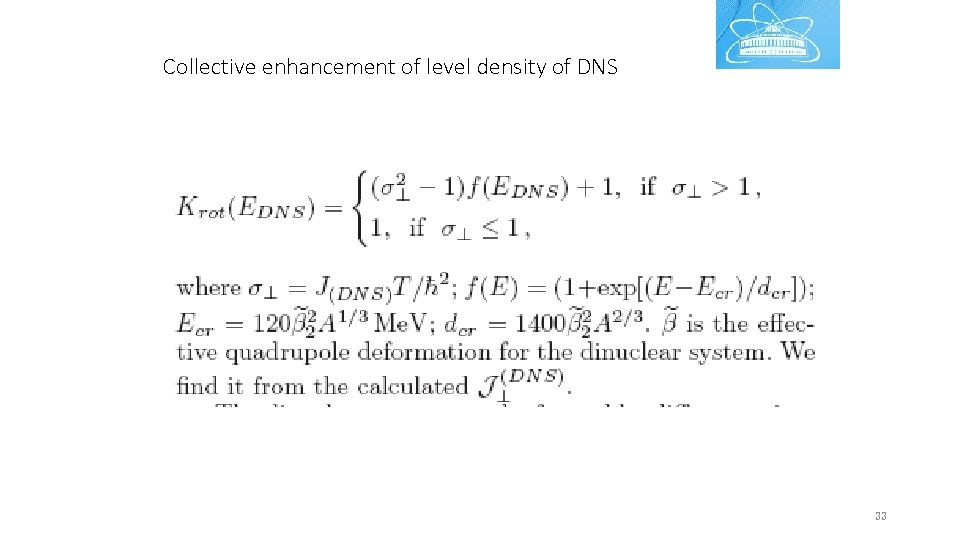
Collective enhancement of level density of DNS 33
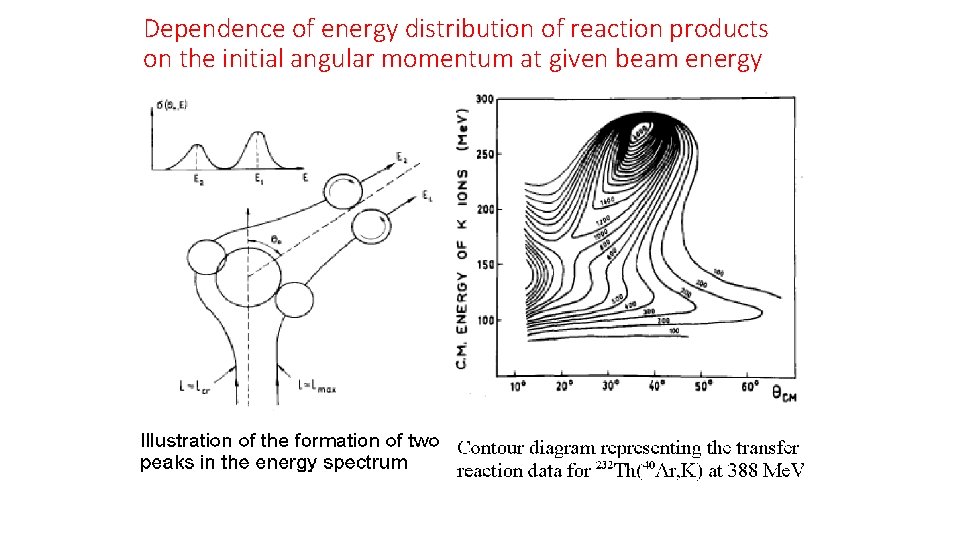
Dependence of energy distribution of reaction products on the initial angular momentum at given beam energy
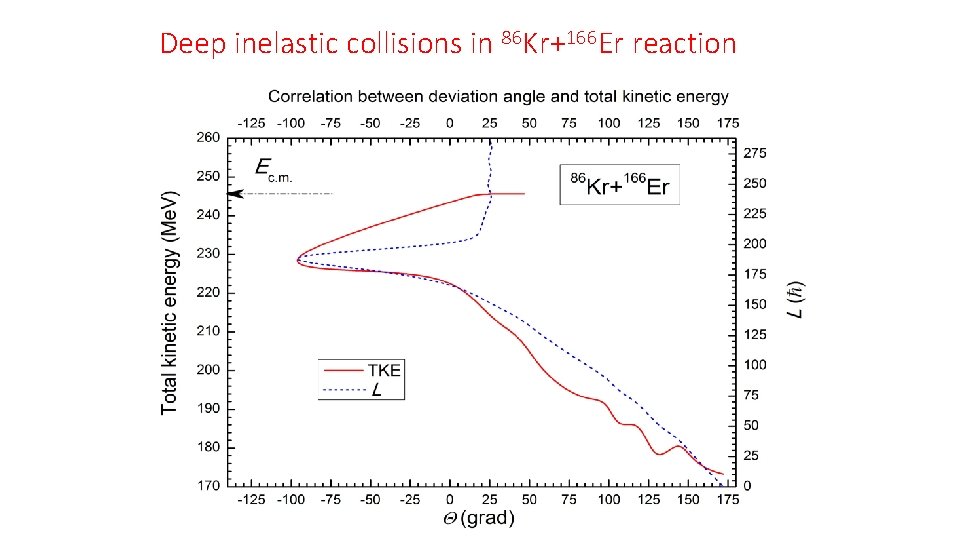
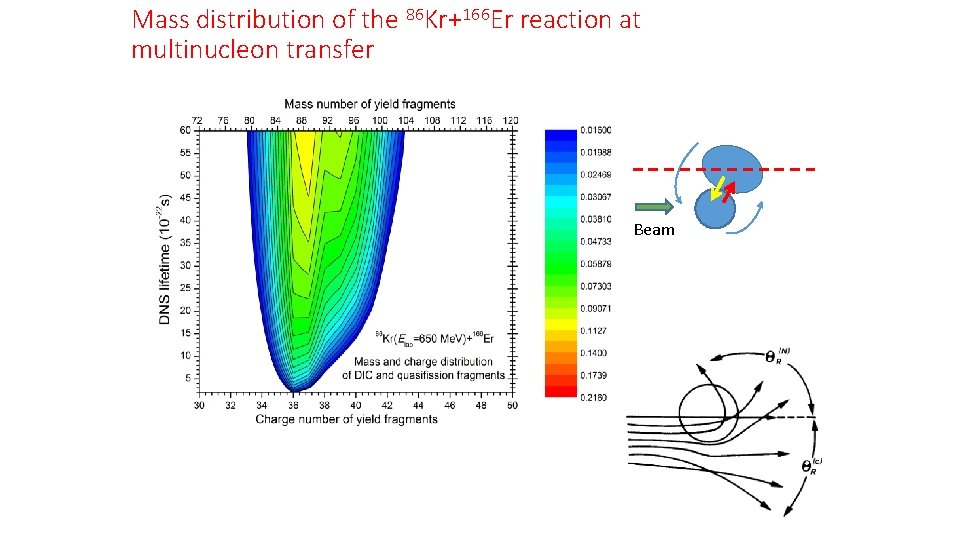
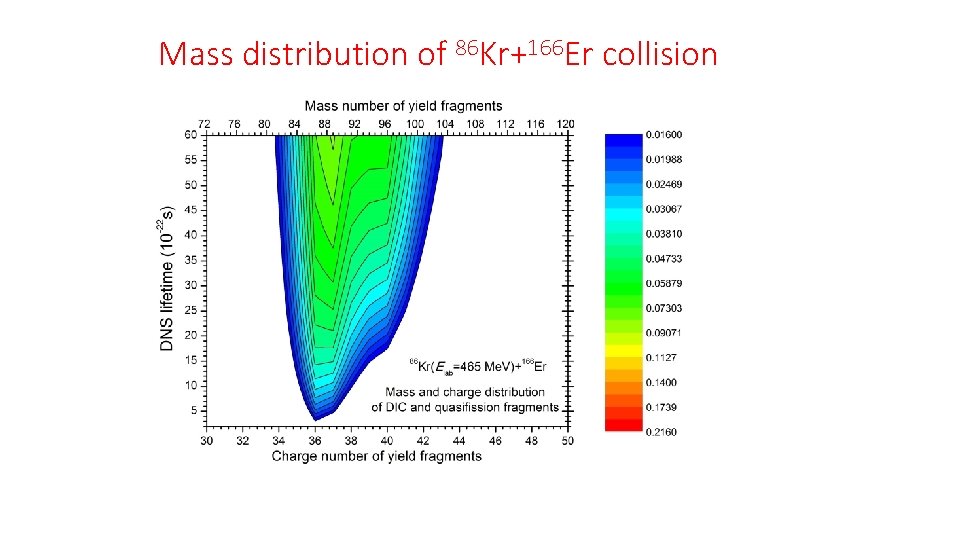
Deep inelastic collisions in 86 Kr+166 Er reaction
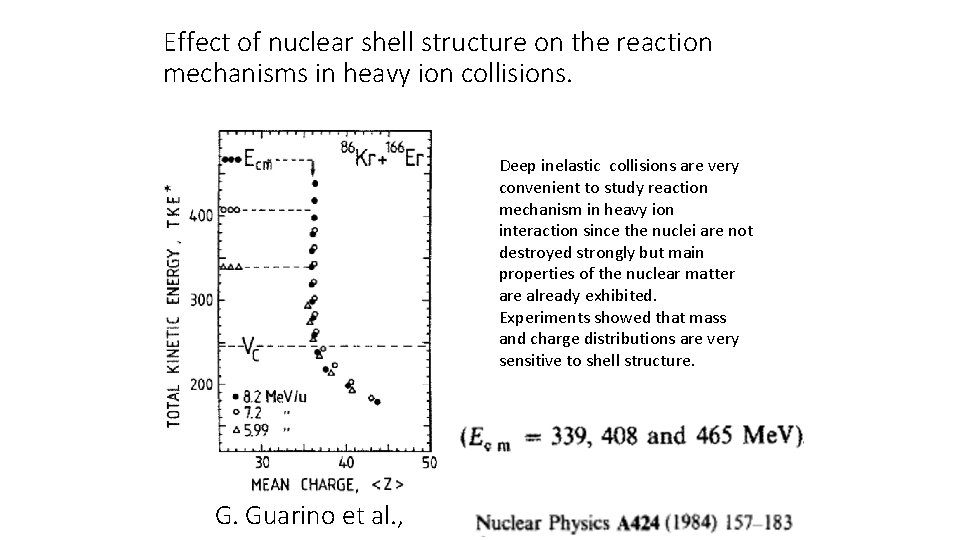
Effect of nuclear shell structure on the reaction mechanisms in heavy ion collisions. Deep inelastic collisions are very convenient to study reaction mechanism in heavy ion interaction since the nuclei are not destroyed strongly but main properties of the nuclear matter are already exhibited. Experiments showed that mass and charge distributions are very sensitive to shell structure. G. Guarino et al. ,
Mass distribution of the 86 Kr+166 Er reaction at multinucleon transfer Beam
Mass distribution of 86 Kr+166 Er collision
Driving potential for the mass transfer between nuclei of dinuclear system formed in 86 Kr+166 Er reaction.
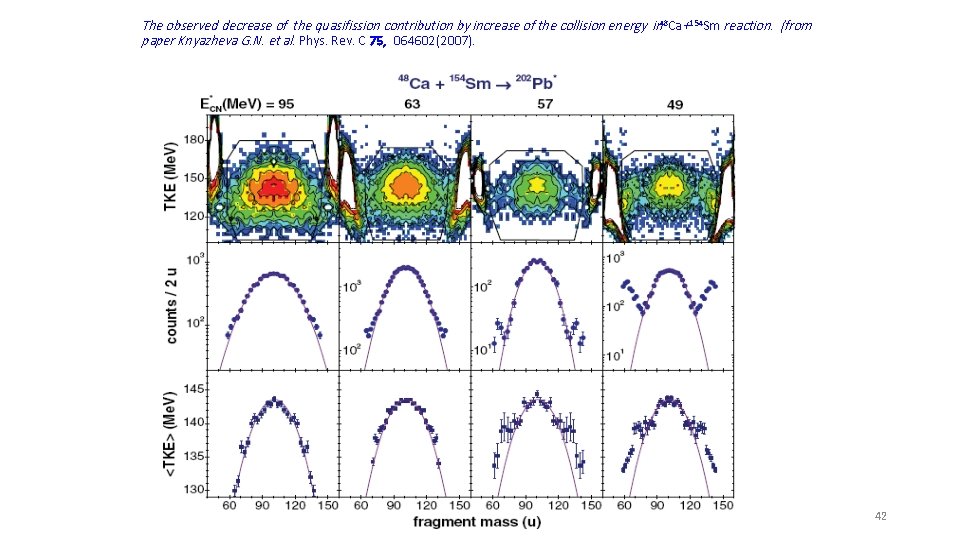
The observed decrease of the quasifission contribution by increase of the collision energy in 48 Ca+154 Sm reaction. (from paper Knyazheva G. N. et al. Phys. Rev. C 75, 064602(2007). 42
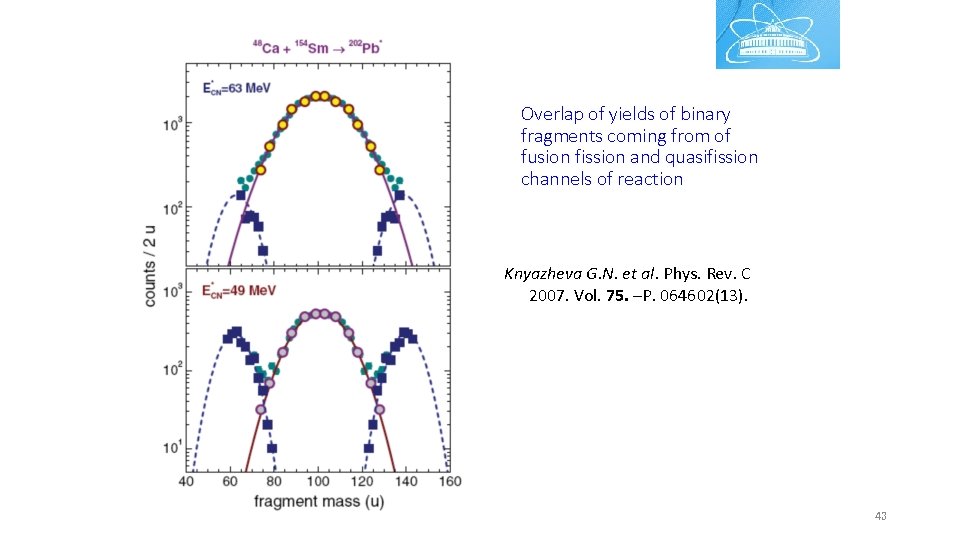
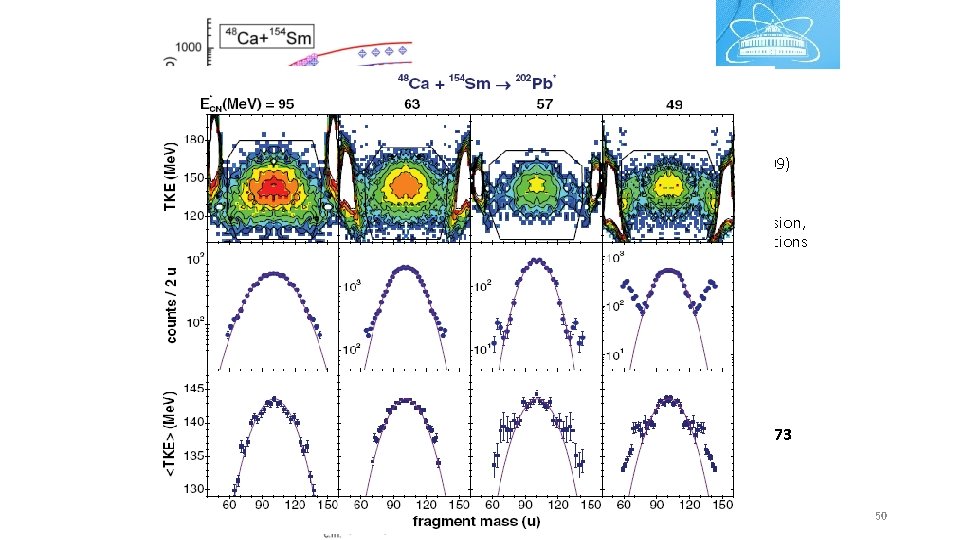
Overlap of yields of binary fragments coming from of fusion fission and quasifission channels of reaction Knyazheva G. N. et al. Phys. Rev. C 2007. Vol. 75. –P. 064602(13). 43
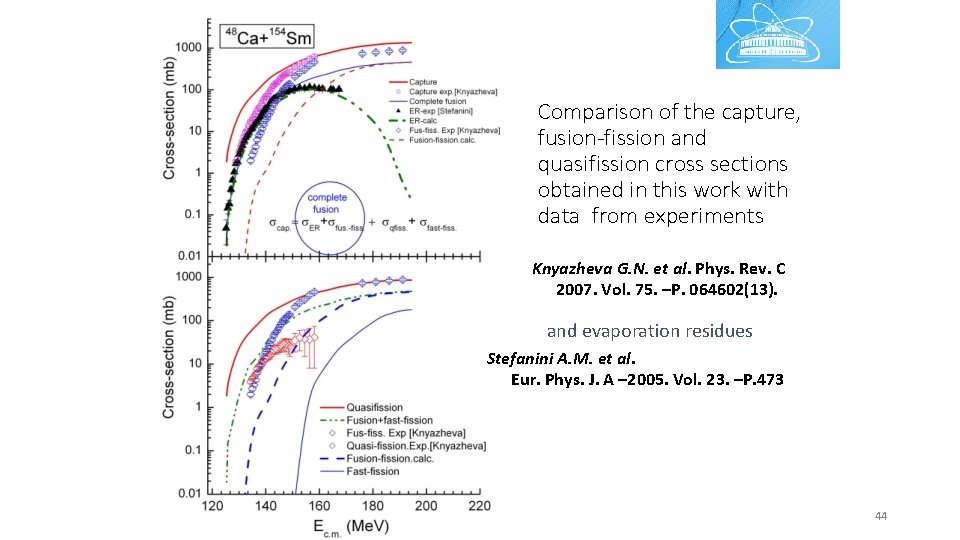
Comparison of the capture, fusion-fission and quasifission cross sections obtained in this work with data from experiments Knyazheva G. N. et al. Phys. Rev. C 2007. Vol. 75. –P. 064602(13). and evaporation residues Stefanini A. M. et al. Eur. Phys. J. A – 2005. Vol. 23. –P. 473 44
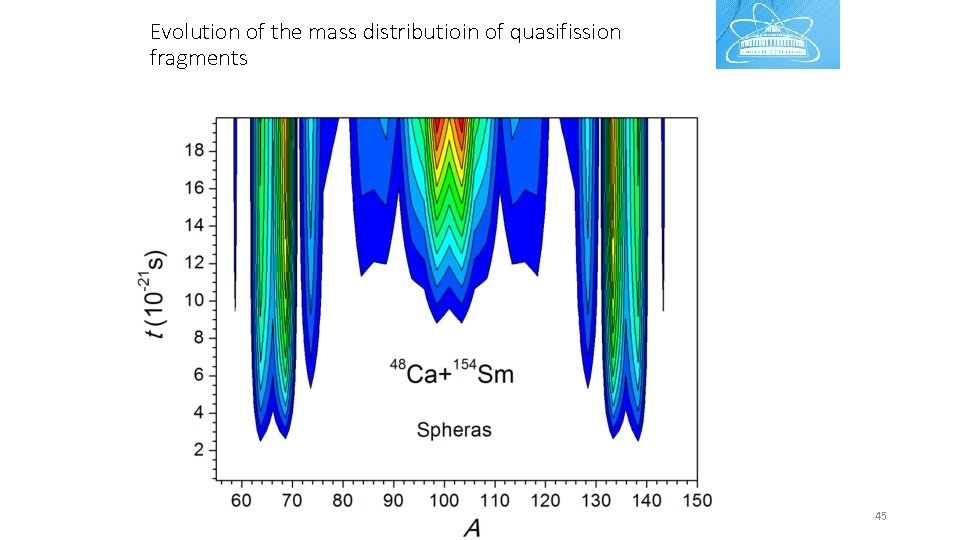
Evolution of the mass distributioin of quasifission fragments 45
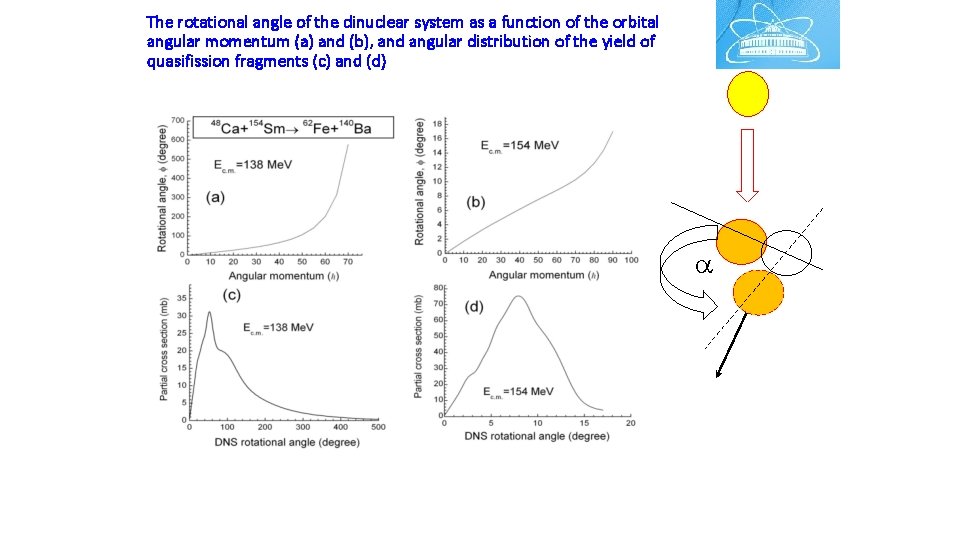
The rotational angle of the dinuclear system as a function of the orbital angular momentum (a) and (b), and angular distribution of the yield of quasifission fragments (c) and (d) a
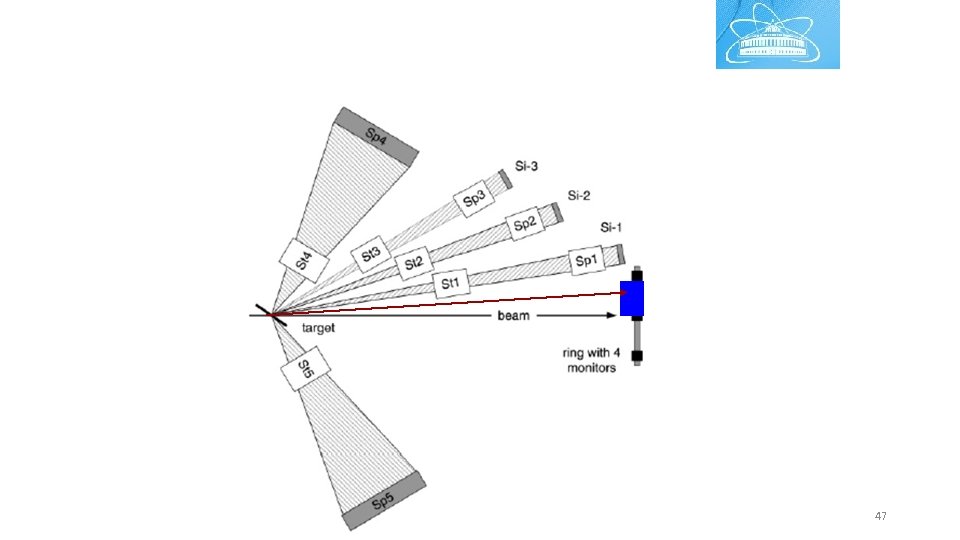
47
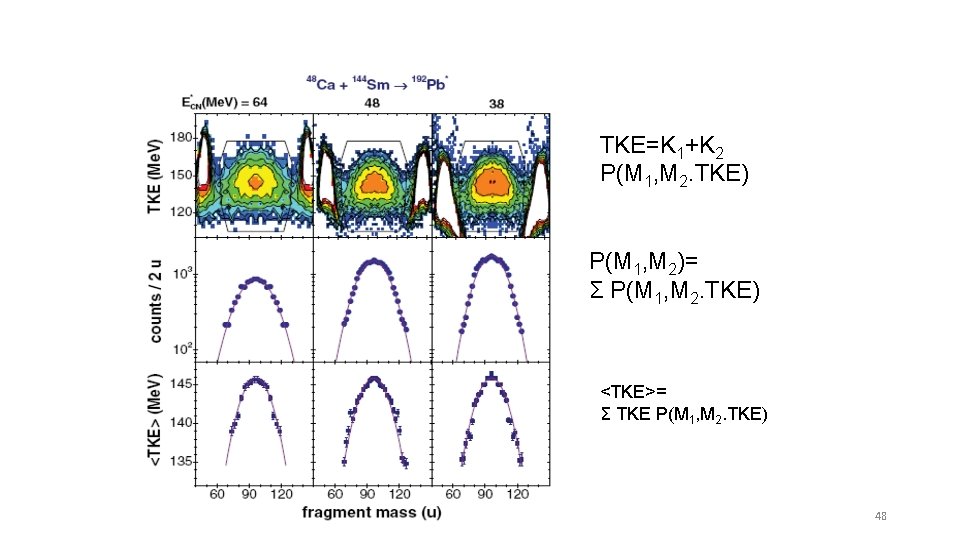
TKE=K 1+K 2 P(M 1, M 2. TKE) P(M 1, M 2)= Σ P(M 1, M 2. TKE) <TKE>= Σ TKE P(M 1, M 2. TKE) 48
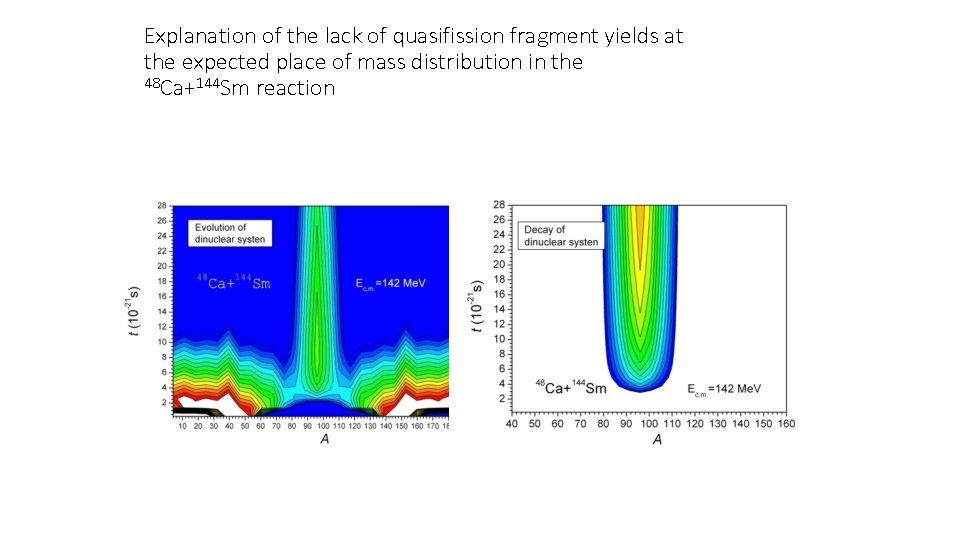
Explanation of the lack of quasifission fragment yields at the expected place of mass distribution in the 48 Ca+144 Sm reaction
A. K. Nasirov et al. Phys. Rev. C 79 (2009) 024606. Comparison of the capture, fusion-fission, quasifission and fast fission cross sections obtained in this work with data from experiments Knyazheva G. N. et al. Phys. Rev. C 2007. Vol. 75. –P. 064602(13). and evaporation residues Stefanini A. M. et al. Eur. Phys. J. A – 2005. Vol. 23. –P. 473 50
We can conclude that the identification of the quasifission fragments among the measured fissionlike products may be difficult due to overlap of their mass and/or angular distributions with ones of the fusion-fission fragments. 51
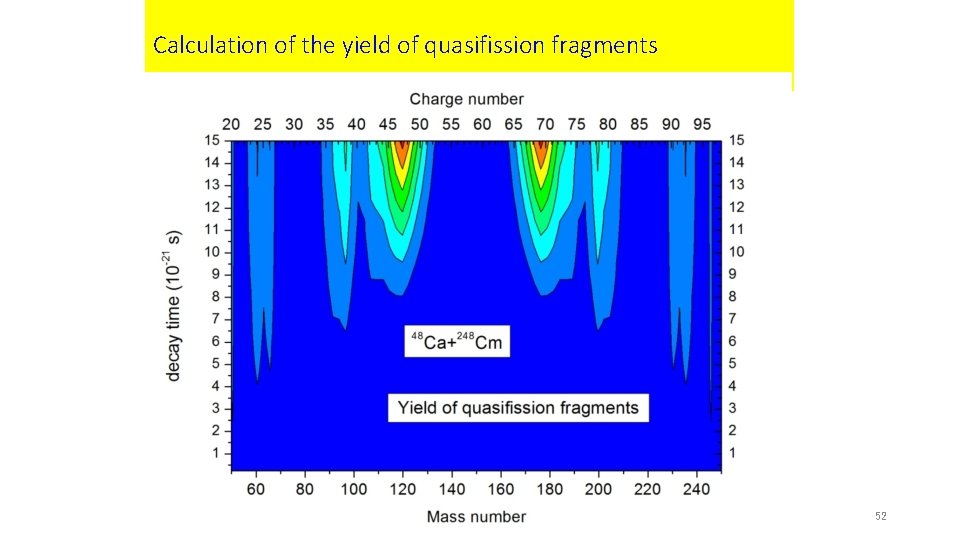
Calculation of the yield of quasifission fragments 52
What is questionable in fusion reactions ? Dynamics of complete fusion and role of the entrance channel in formation of heavy ion collision reactions are questionable or they have different interpretation still now. For example, -- what mechanism is fusion makes the main contribution to formation of compound nucleus: increasing the neck between interacting nucleus or multinucleon transfer at relatively restricted neck size? -- details of angular momentum distribution of dinuclear system and compound nucleus which determines the angular distribution of reaction products, cross sections of evaporation residue, fusion-fission and quasifission products; -- separation of fusion-fission fragments from the quasifission and fast-fission products; -- distribution of the excitation energy between different degrees of freedom, as well as between reaction products. There are exp. results showing evaporation residues at E*>100 Me. V. 53