
Lecture 29 Viruses 0 5 m Lecture outline
- Slides: 23
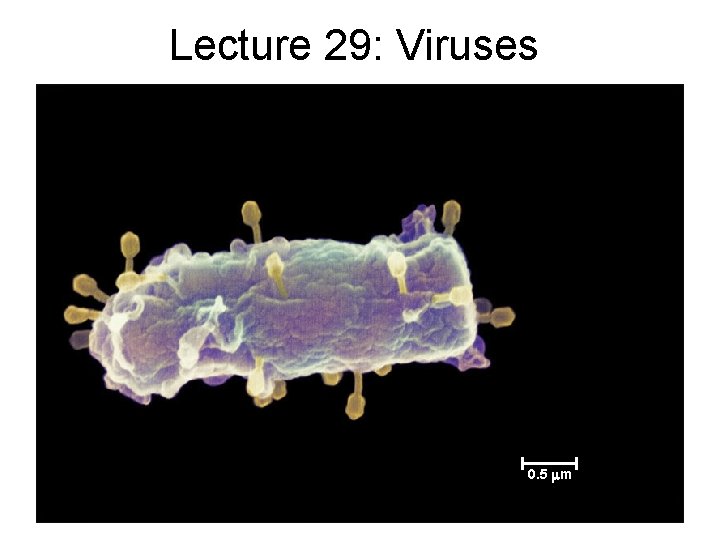
Lecture 29: Viruses 0. 5 m
Lecture outline 11/11/05 • Types of viruses – Bacteriophage • Lytic and lysogenic life cycles – DNA viruses – RNA viruses • Influenza • HIV • Prions – Mad cow disease
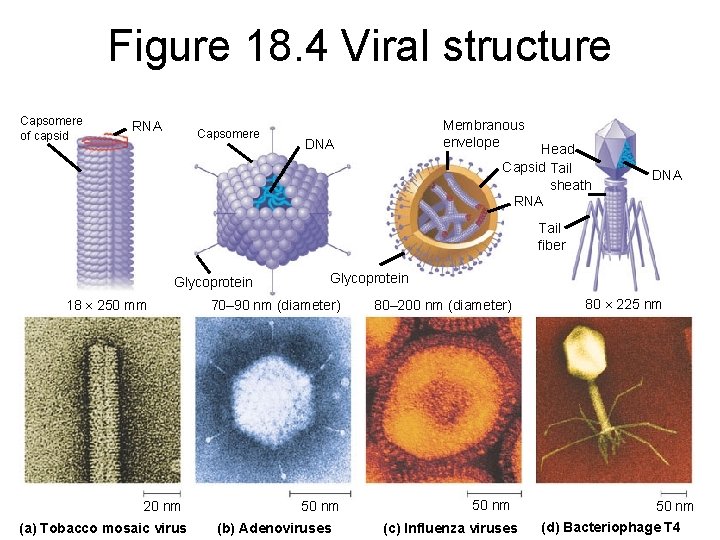
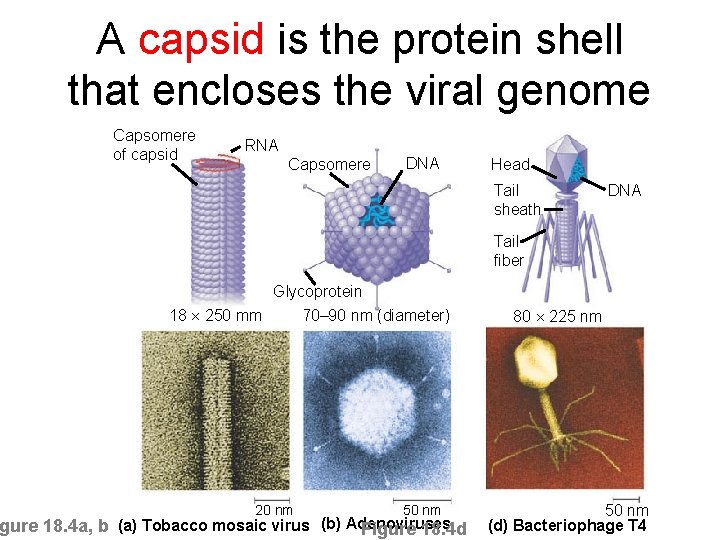
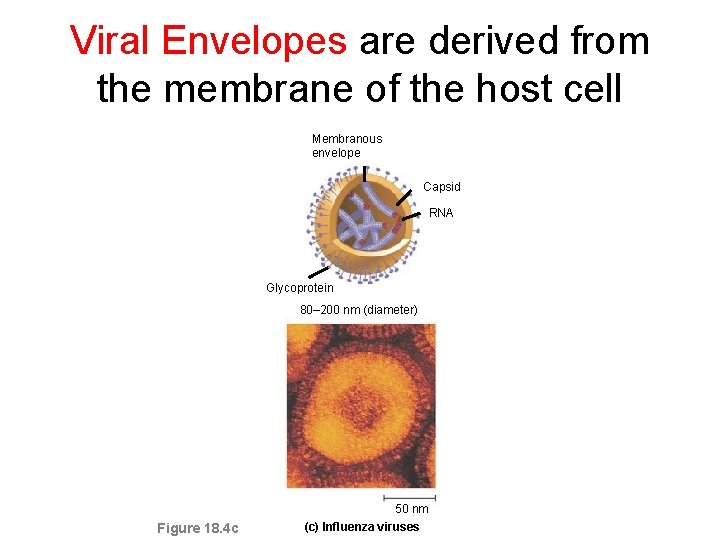
Figure 18. 4 Viral structure Capsomere of capsid RNA Capsomere Membranous envelope DNA Head Capsid Tail sheath RNA DNA Tail fiber Glycoprotein 18 250 mm 20 nm (a) Tobacco mosaic virus Glycoprotein 70– 90 nm (diameter) 80– 200 nm (diameter) 50 nm (b) Adenoviruses (c) Influenza viruses 80 225 nm 50 nm (d) Bacteriophage T 4
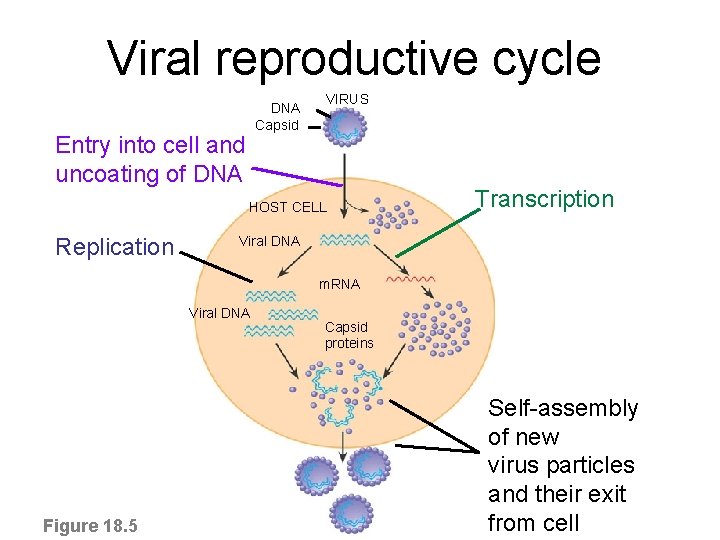
Viral reproductive cycle DNA Capsid Entry into cell and uncoating of DNA VIRUS HOST CELL Replication Transcription Viral DNA m. RNA Viral DNA Figure 18. 5 Capsid proteins Self-assembly of new virus particles and their exit from cell
A capsid is the protein shell that encloses the viral genome Capsomere of capsid RNA Capsomere DNA Head Tail sheath DNA Tail fiber Glycoprotein 70– 90 nm (diameter) 18 250 mm 20 nm 50 nm gure 18. 4 a, b (a) Tobacco mosaic virus (b) Adenoviruses Figure 18. 4 d 80 225 nm 50 nm (d) Bacteriophage T 4
Viral Envelopes are derived from the membrane of the host cell Membranous envelope Capsid RNA Glycoprotein 80– 200 nm (diameter) Figure 18. 4 c 50 nm (c) Influenza viruses
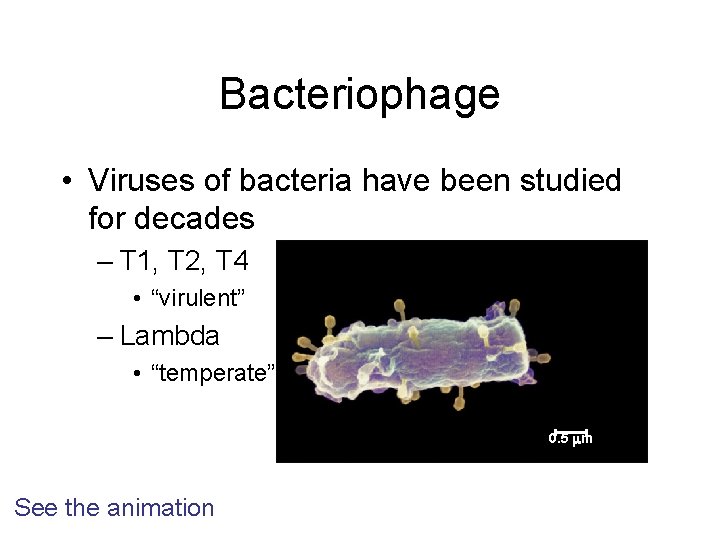
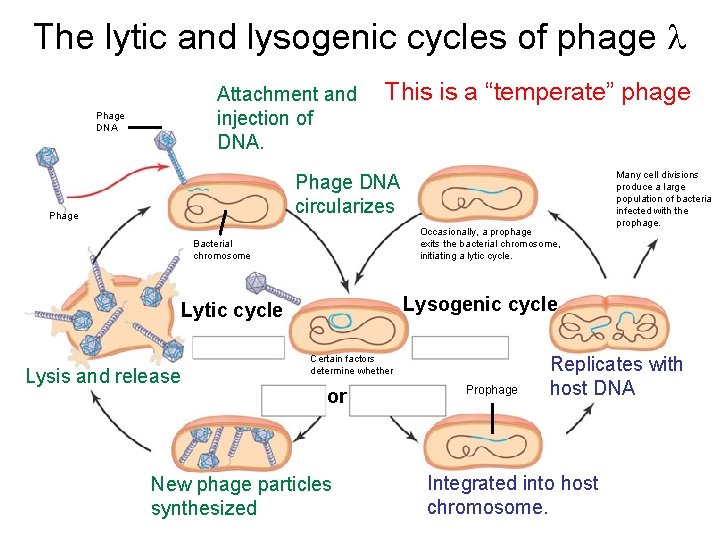
Bacteriophage • Viruses of bacteria have been studied for decades – T 1, T 2, T 4 • “virulent” – Lambda • “temperate” 0. 5 m See the animation
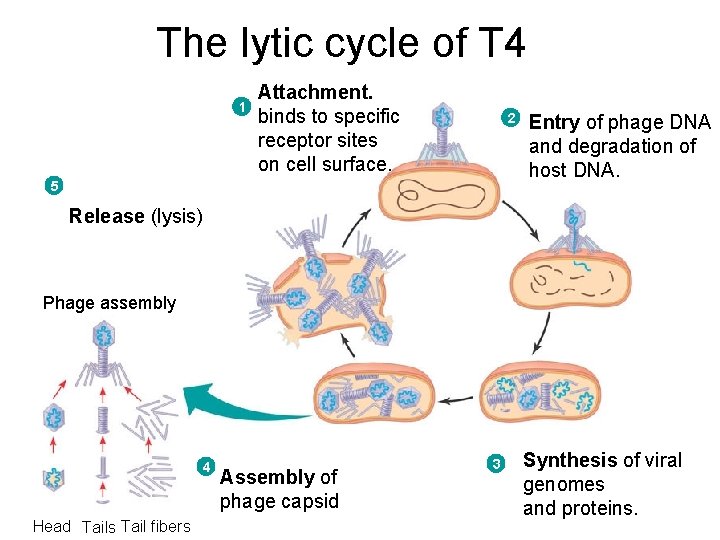
The lytic cycle of T 4 1 Attachment. binds to specific receptor sites on cell surface. 2 5 Entry of phage DNA and degradation of host DNA. Release (lysis) Phage assembly 4 Head Tails Tail fibers Assembly of phage capsid 3 Synthesis of viral genomes and proteins.
The lytic and lysogenic cycles of phage Attachment and injection of DNA. Phage DNA This is a “temperate” phage Phage DNA circularizes Phage Occasionally, a prophage exits the bacterial chromosome, initiating a lytic cycle. Bacterial chromosome Lysogenic cycle Lytic cycle Lysis and release Many cell divisions produce a large population of bacteria infected with the prophage. Certain factors determine whether or New phage particles synthesized Prophage Replicates with host DNA Integrated into host chromosome.
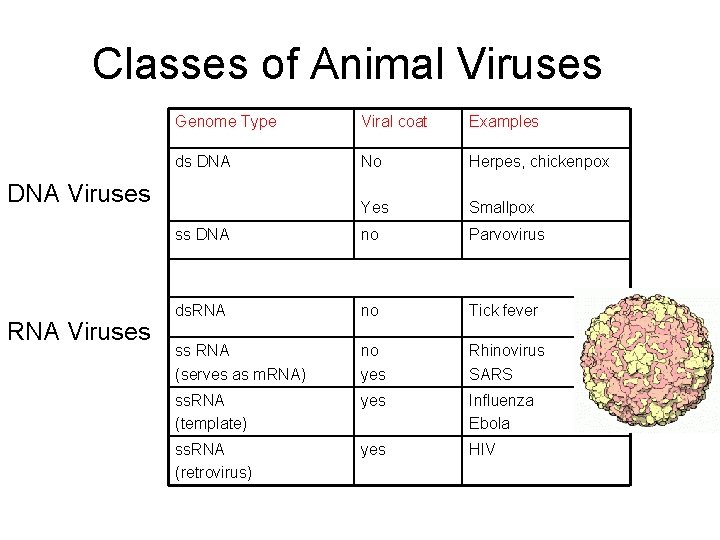
Classes of Animal Viruses Genome Type Viral coat Examples ds DNA No Herpes, chickenpox Yes Smallpox ss DNA no Parvovirus ds. RNA no Tick fever ss RNA (serves as m. RNA) no yes Rhinovirus SARS ss. RNA (template) yes Influenza Ebola ss. RNA (retrovirus) yes HIV DNA Viruses RNA Viruses
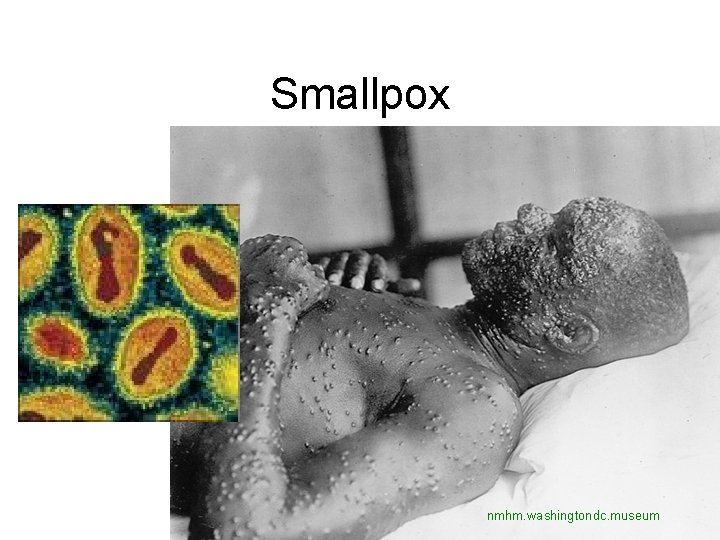
Smallpox nmhm. washingtondc. museum
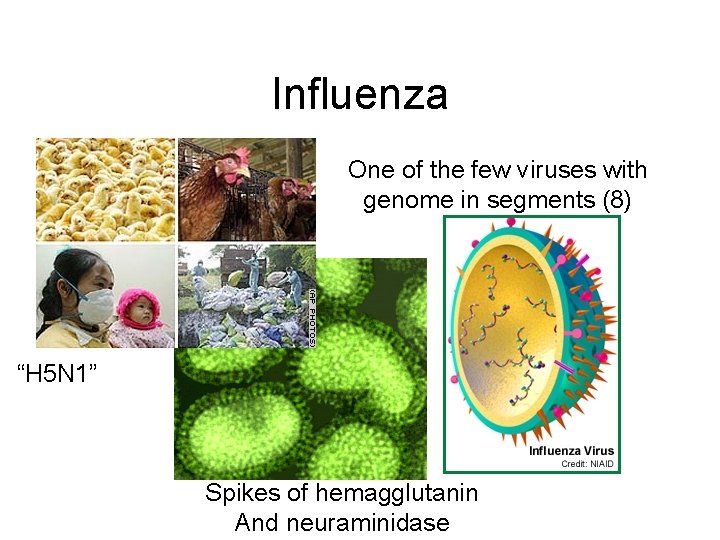
Influenza One of the few viruses with genome in segments (8) “H 5 N 1” Spikes of hemagglutanin And neuraminidase
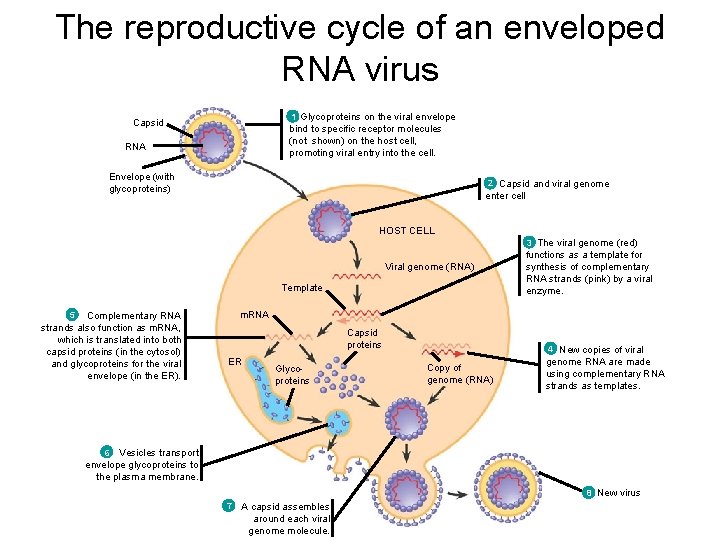
The reproductive cycle of an enveloped RNA virus 1 Glycoproteins on the viral envelope bind to specific receptor molecules (not shown) on the host cell, promoting viral entry into the cell. Capsid RNA Envelope (with glycoproteins) 2 Capsid and viral genome enter cell HOST CELL Viral genome (RNA) Template 5 Complementary RNA strands also function as m. RNA, which is translated into both capsid proteins (in the cytosol) and glycoproteins for the viral envelope (in the ER). 3 The viral genome (red) functions as a template for synthesis of complementary RNA strands (pink) by a viral enzyme. m. RNA Capsid proteins ER Glycoproteins Copy of genome (RNA) 4 New copies of viral genome RNA are made using complementary RNA strands as templates. 6 Vesicles transport envelope glycoproteins to the plasma membrane. 8 New virus 7 A capsid assembles around each viral genome molecule.
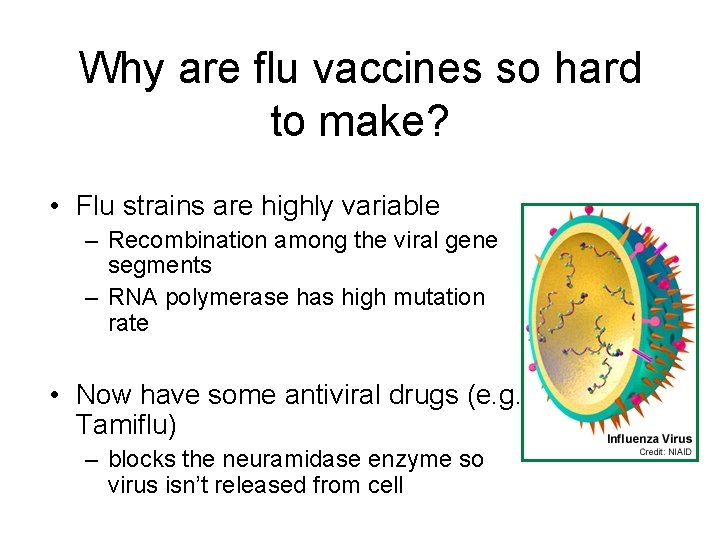
Why are flu vaccines so hard to make? • Flu strains are highly variable – Recombination among the viral gene segments – RNA polymerase has high mutation rate • Now have some antiviral drugs (e. g. Tamiflu) – blocks the neuramidase enzyme so virus isn’t released from cell
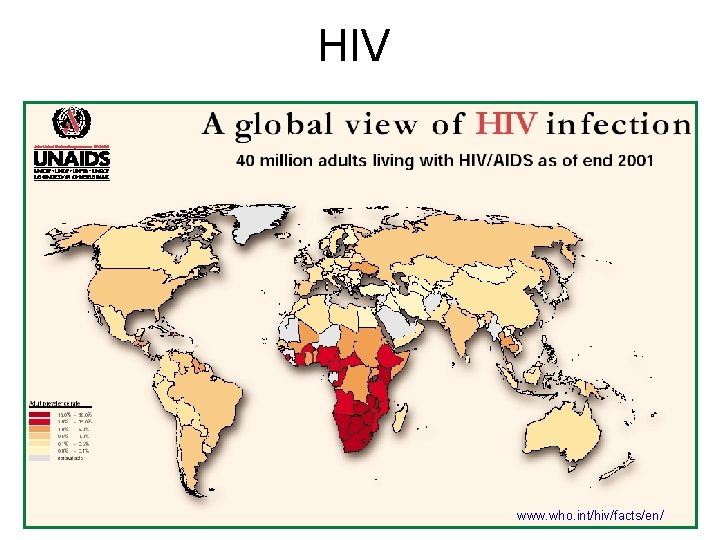
HIV www. who. int/hiv/facts/en/
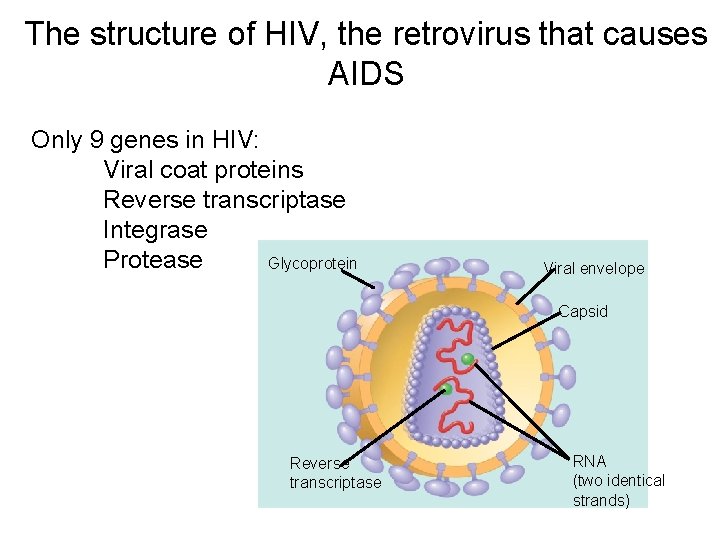
The structure of HIV, the retrovirus that causes AIDS Only 9 genes in HIV: Viral coat proteins Reverse transcriptase Integrase Protease Glycoprotein Viral envelope Capsid Reverse transcriptase RNA (two identical strands)
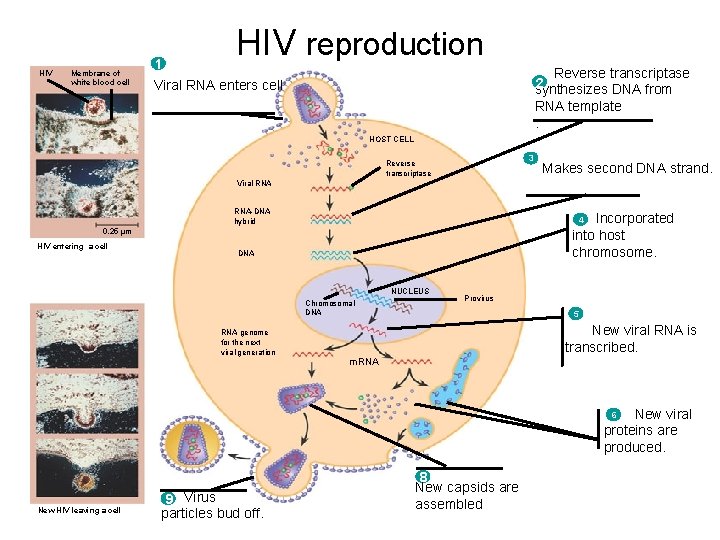
HIV reproduction HIV Membrane of white blood cell 1 Viral RNA enters cell Reverse transcriptase 2 synthesizes DNA from RNA template. HOST CELL 3 Reverse transcriptase Makes second DNA strand. Viral RNA-DNA hybrid Incorporated into host chromosome. 4 0. 25 µm HIV entering a cell DNA NUCLEUS Chromosomal DNA RNA genome for the next viral generation Provirus 5 New viral RNA is transcribed. m. RNA New viral proteins are produced. 6 New HIV leaving a cell 9 Virus particles bud off. 8 New capsids are assembled
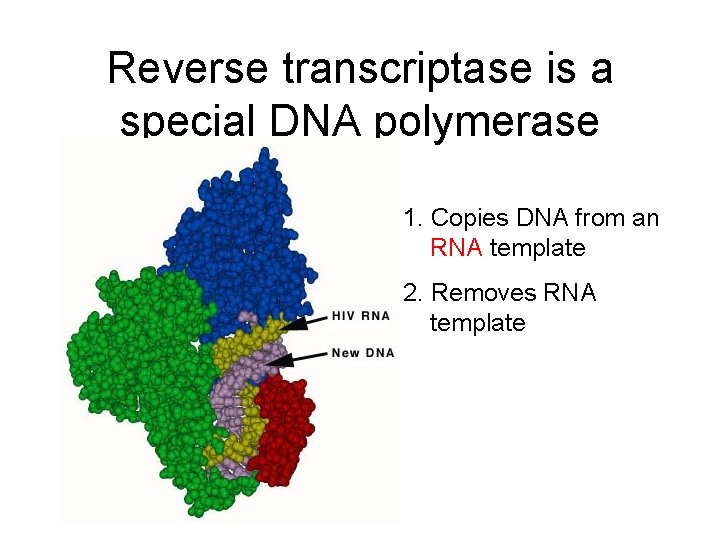
Reverse transcriptase is a special DNA polymerase 1. Copies DNA from an RNA template 2. Removes RNA template
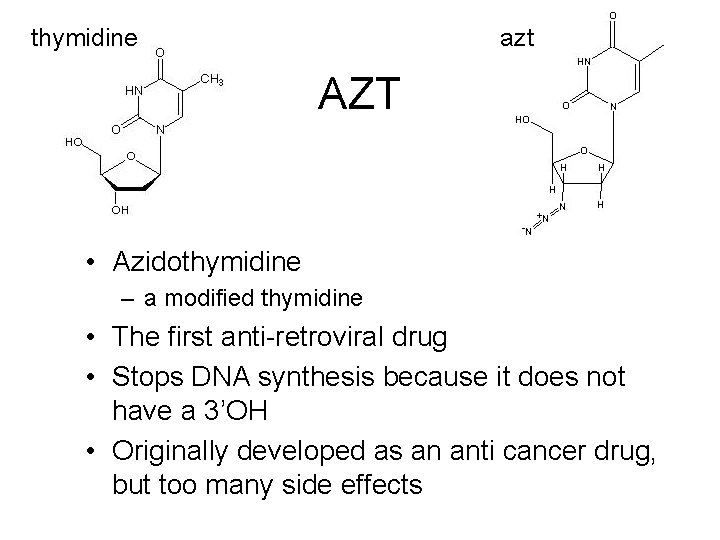
thymidine azt AZT • Azidothymidine – a modified thymidine • The first anti-retroviral drug • Stops DNA synthesis because it does not have a 3’OH • Originally developed as an anti cancer drug, but too many side effects
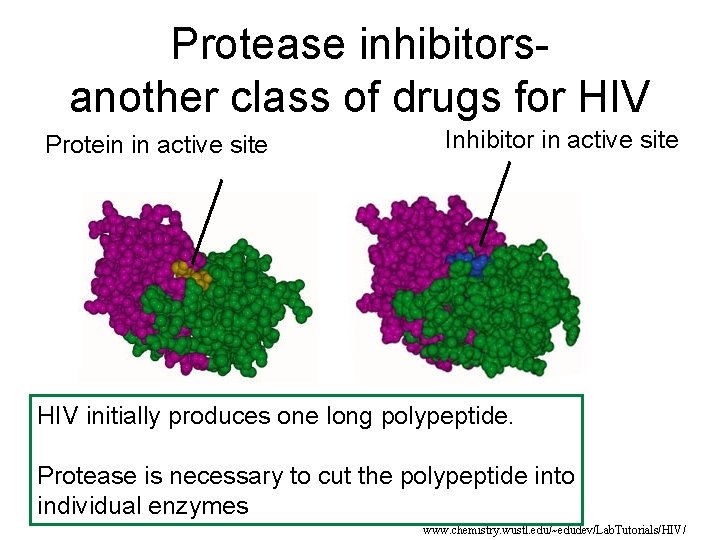
Protease inhibitorsanother class of drugs for HIV Protein in active site Inhibitor in active site HIV initially produces one long polypeptide. Protease is necessary to cut the polypeptide into individual enzymes www. chemistry. wustl. edu/~edudev/Lab. Tutorials/HIV/
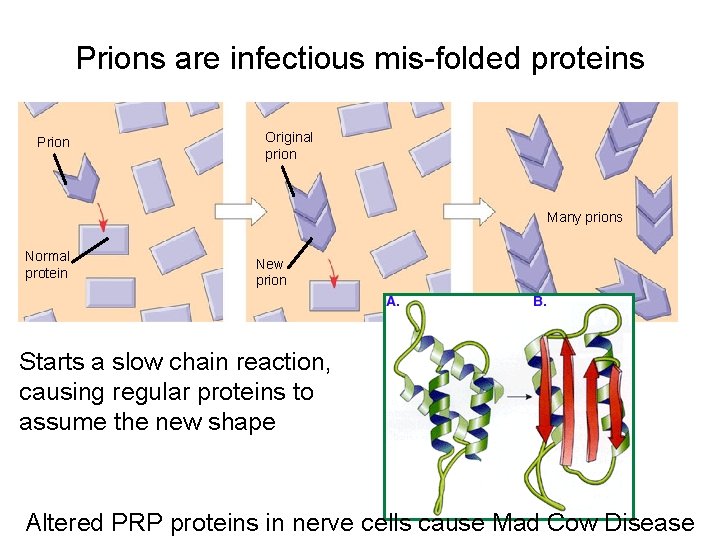
Prions are infectious mis-folded proteins Prion Original prion Many prions Normal protein New prion Starts a slow chain reaction, causing regular proteins to assume the new shape Altered PRP proteins in nerve cells cause Mad Cow Disease