
Lecture 28 Theory Of Automata By Dr MM
Lecture # 28 Theory Of Automata By Dr. MM Alam 1
Lecture 27 recap • Chomsky Normal Form conversion in JFLAP • Push Down Automata Definition • PDA Symbols 2
Adding A Pushdown Stack • A PUSHDOWN STACK is a place where input letters can be stored until we want to refer to them again. • It holds the letters it has been fed in a long line. The operation PUSH adds a new letter to the line. • The new letter is placed on top of the STACK, and all the other letters are pushed back (or down) accordingly. • Before the machine begins to process an input string the STACK is presumed to be empty, which means that every storage location in it initially contains a blank. 3
Adding A Pushdown Stack • If the STACK is then fed the letters a, b, c, d by this sequence of instructions: PUSH a b c d • Then top letter in the STACK is d, the second is c, the third is b, and the fourth is a. • If we now execute the instruction: • PUSH b the letter b will be added to the STACK on the top. The d will be pushed down to position 2, the c to position 3, the other b to position 4, and the bottom a to position 5. 4

Adding A Pushdown Stack • One pictorial representation of a STACK with these letters in it is shown below. • Beneath the bottom a we presume that the rest of the STACK, which, like the INPUT TAPE, has infinitely many storage locations, holds only blanks. b d c b a Δ 5

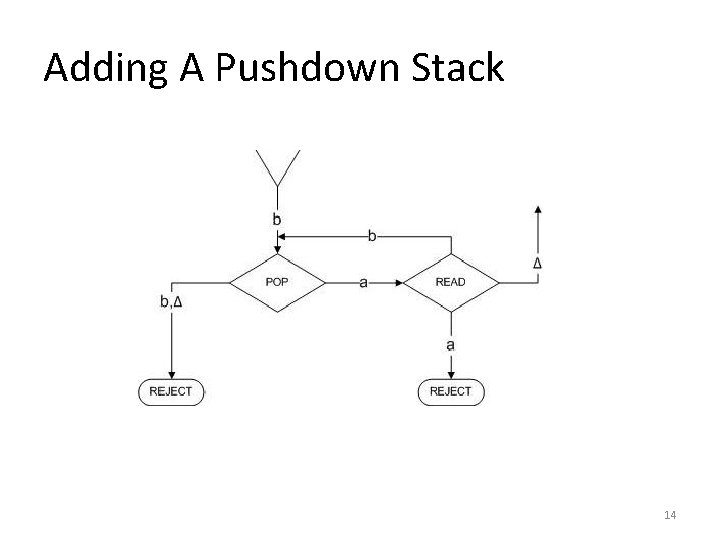
Adding A Pushdown Stack • How the following PDA is working: b a 6
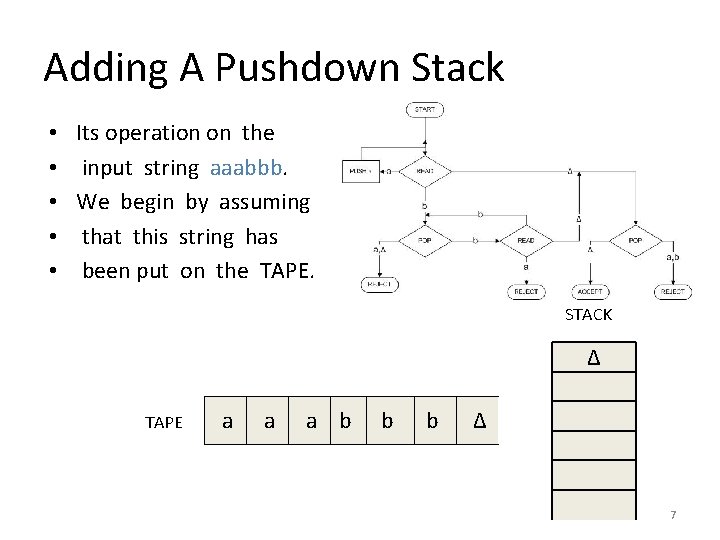
Adding A Pushdown Stack • • • Its operation on the input string aaabbb. We begin by assuming that this string has been put on the TAPE. STACK Δ TAPE a a a b b b Δ 7
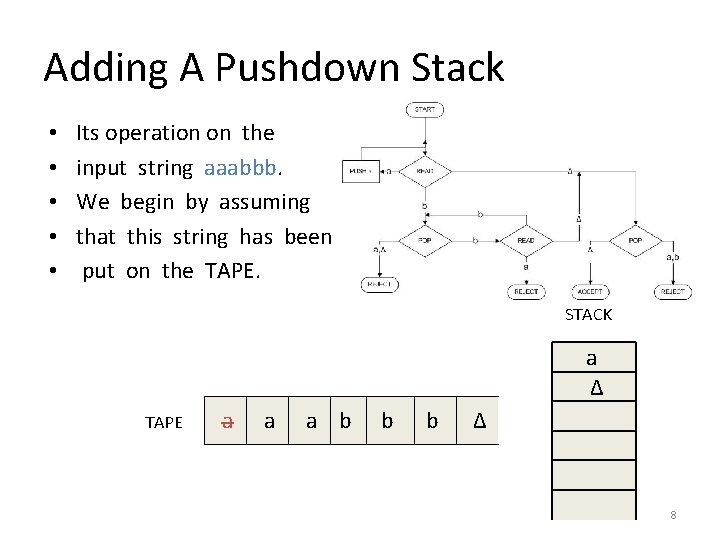
Adding A Pushdown Stack • • • Its operation on the input string aaabbb. We begin by assuming that this string has been put on the TAPE. STACK a Δ TAPE a a a b b b Δ 8
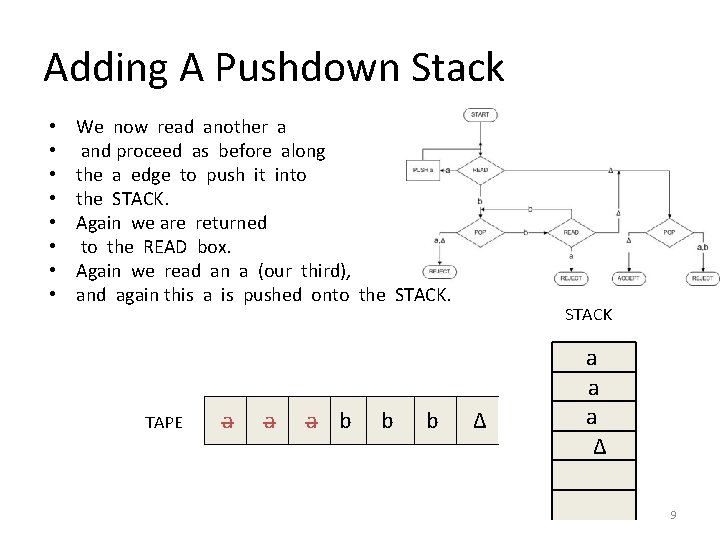
Adding A Pushdown Stack • • We now read another a and proceed as before along the a edge to push it into the STACK. Again we are returned to the READ box. Again we read an a (our third), and again this a is pushed onto the STACK. TAPE a a a b b b STACK Δ a a a Δ 9
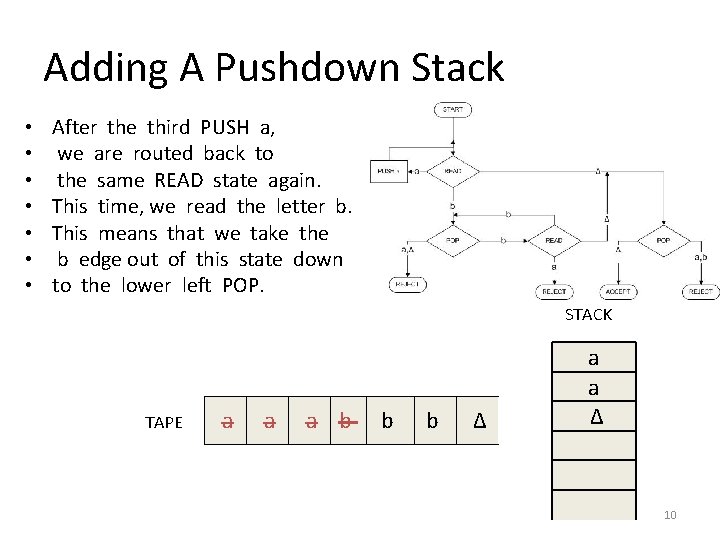
Adding A Pushdown Stack • • After the third PUSH a, we are routed back to the same READ state again. This time, we read the letter b. This means that we take the b edge out of this state down to the lower left POP. STACK TAPE a a a b b b Δ a a Δ 10
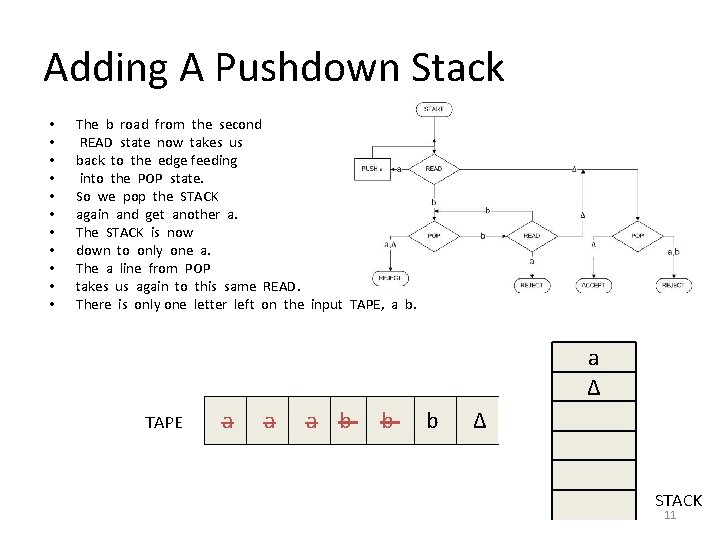
Adding A Pushdown Stack • • • The b road from the second READ state now takes us back to the edge feeding into the POP state. So we pop the STACK again and get another a. The STACK is now down to only one a. The a line from POP takes us again to this same READ. There is only one letter left on the input TAPE, a b. a Δ TAPE a a a b b b Δ STACK 11
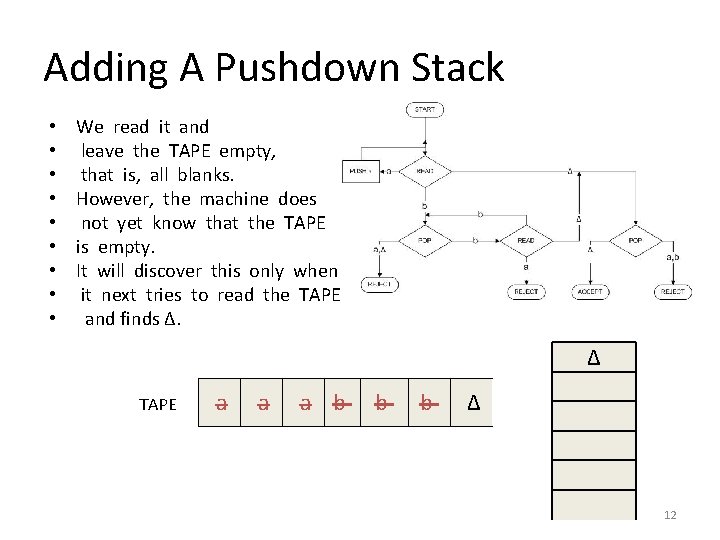
Adding A Pushdown Stack • • • We read it and leave the TAPE empty, that is, all blanks. However, the machine does not yet know that the TAPE is empty. It will discover this only when it next tries to read the TAPE and finds Δ. Δ TAPE a a a b b b Δ 12
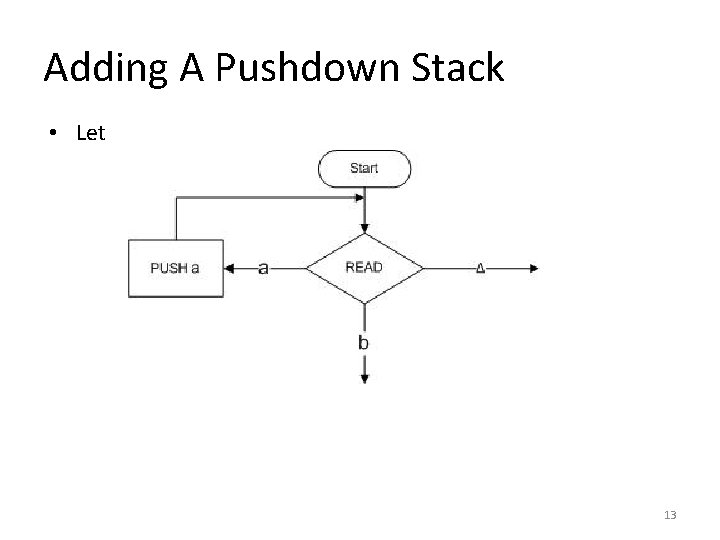
Adding A Pushdown Stack • Let 13
Adding A Pushdown Stack 14
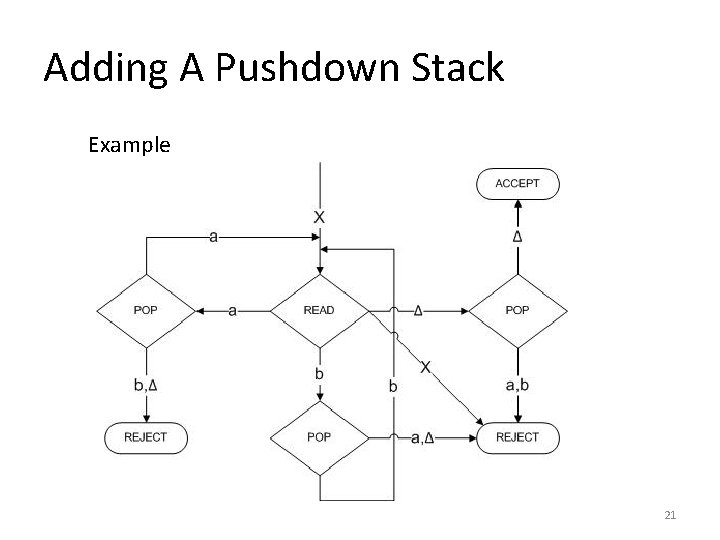
Example • The PALINDROMEX, language of all words of the form s X reverse(s) where s is any string in (a + b)*. • The words in this language are { X a. Xa b. Xb aa. Xaa ab. Xba ba. Xab bb. Xbb aaa. Xaaa aab. Xbaa. . . } • They all contain exactly one X, and this X marks the middle ofthe word. • We can build a deterministic PDA that accepts the language PALINDROMEX. • It has the same basic structure as the PDA we had for the language {anbn}. 15
Adding A Pushdown Stack Example • In the first part of the machine the STACK is loaded with the letters from the input string just as the initial a's from anbn were pushed onto the STACK. • The letters go into the STACK first letter on the bottom, second letter on top of it, and so on till the last letter pushed in ends up on top. • When we read the X we know we have reached the middle of the input. 16
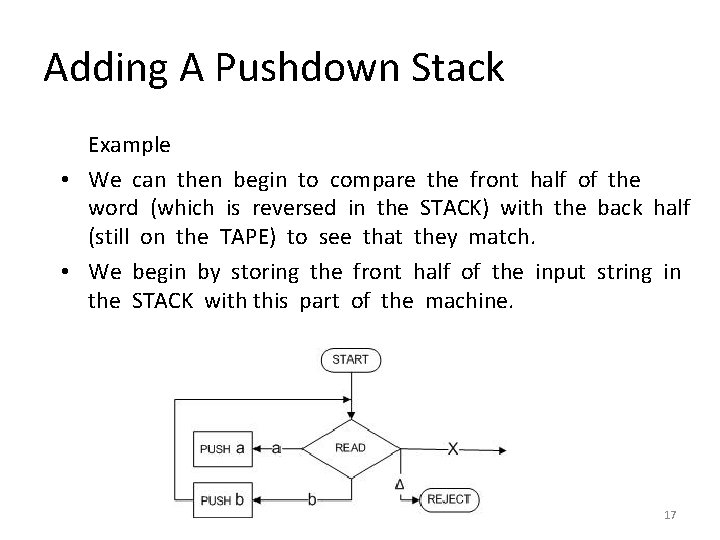
Adding A Pushdown Stack Example • We can then begin to compare the front half of the word (which is reversed in the STACK) with the back half (still on the TAPE) to see that they match. • We begin by storing the front half of the input string in the STACK with this part of the machine. 17
Adding A Pushdown Stack Example • If we READ an a, we PUSH an a. If we READ a b, we PUSH a b, and on until we encounter the X on the TAPE. • After we take the first half of the word and stick it into the STACK, we have reversed the order of the letters and it looks exactly like the second half of the word. • For example, if we begin with the input string abb. Xbba 18
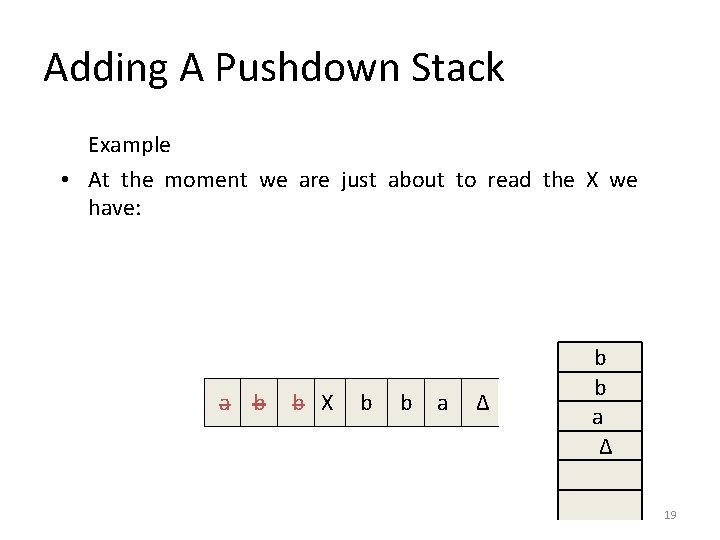
Adding A Pushdown Stack Example • At the moment we are just about to read the X we have: a b b X b b a Δ 19
Adding A Pushdown Stack Example • When we read the X we do not put it into the STACK. It is used up the process of transferring us to phase two. • In order to reach ACCEP these two should be the same letter for letter, down to the blanks. : 20
Adding A Pushdown Stack Example 21
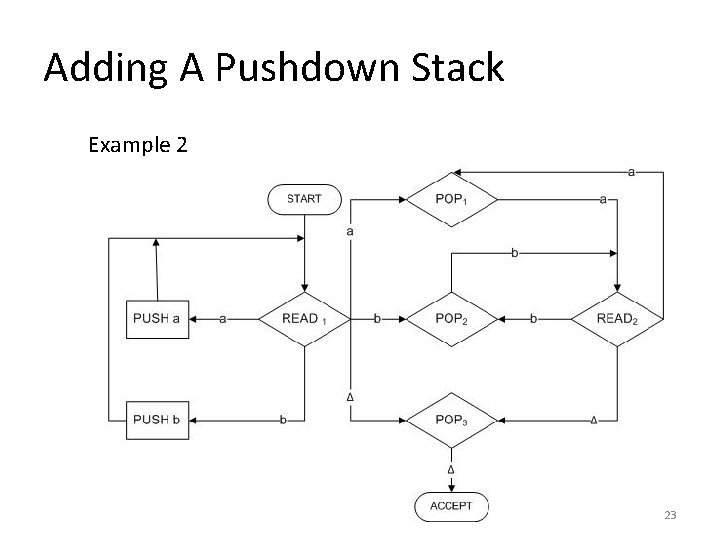
Adding A Pushdown Stack • • Example 2 Consider the language: EVENPALINDROME = {s reverse(s), where s is in (a + b)*} = { A aa bb aaaa abba baab bbbbaaaaaa. . . } This is the language of all palindromes with an even number of letters. One machine to accept this language is shown on next slide: 22
Adding A Pushdown Stack Example 2 23
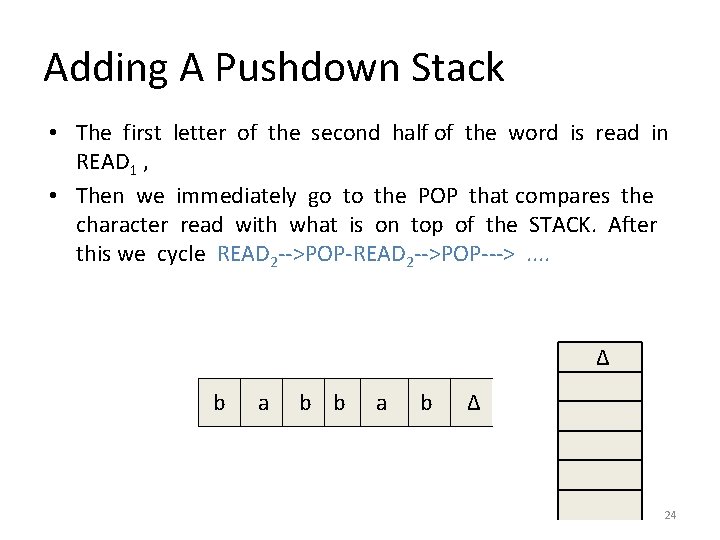
Adding A Pushdown Stack • The first letter of the second half of the word is read in READ 1 , • Then we immediately go to the POP that compares the character read with what is on top of the STACK. After this we cycle READ 2 -->POP--->. . Δ b a b Δ 24
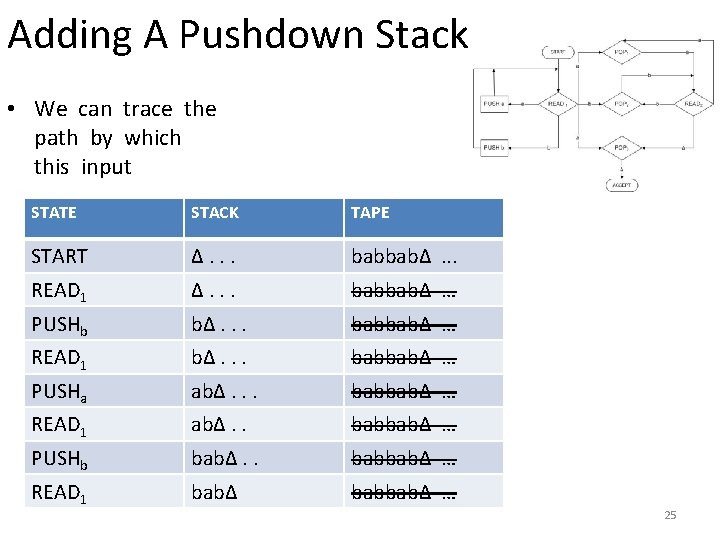
Adding A Pushdown Stack • We can trace the path by which this input STATE STACK TAPE START Δ. . . babbabΔ. . . READ 1 Δ. . . babbabΔ … PUSHb bΔ. . . babbabΔ … READ 1 bΔ. . . babbabΔ … PUSHa abΔ. . . babbabΔ … READ 1 abΔ. . babbabΔ … PUSHb babΔ. . babbabΔ … READ 1 babΔ babbabΔ … 25
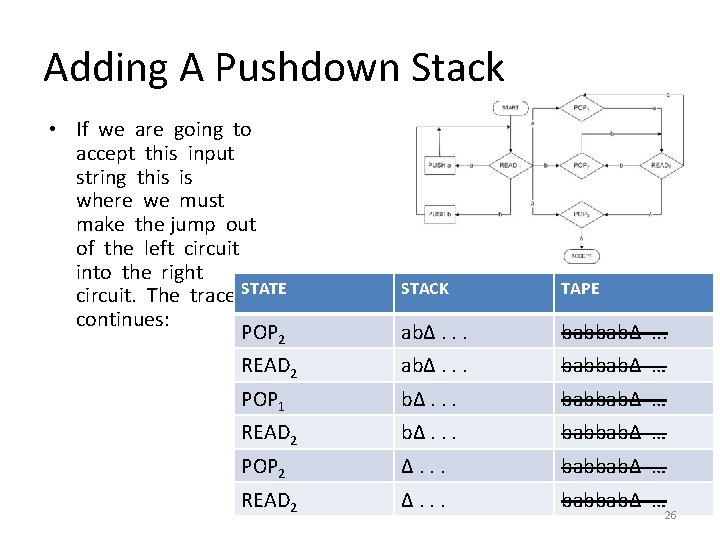
Adding A Pushdown Stack • If we are going to accept this input string this is where we must make the jump out of the left circuit into the right circuit. The trace STATE continues: POP 2 READ 2 POP 1 READ 2 POP 2 READ 2 STACK TAPE abΔ. . . babbabΔ … Δ. . . babbabΔ … 26
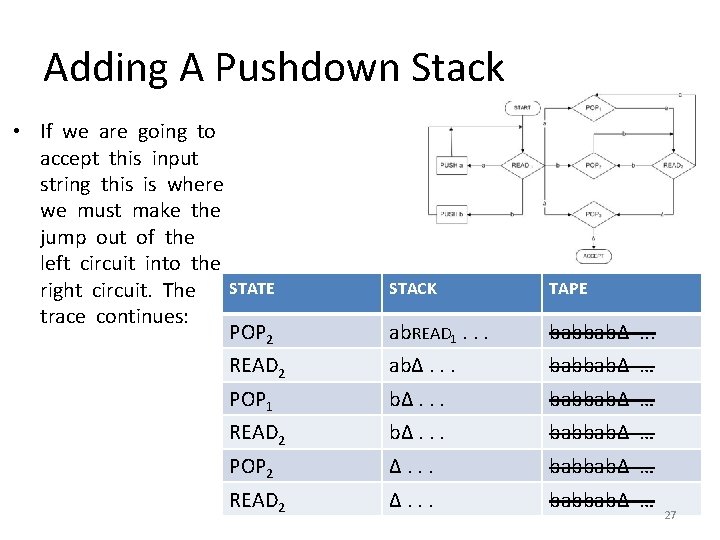
Adding A Pushdown Stack • If we are going to accept this input string this is where we must make the jump out of the left circuit into the STATE right circuit. The trace continues: POP 2 READ 2 POP 1 READ 2 POP 2 READ 2 STACK TAPE ab. READ 1. . . babbabΔ … bΔ. . . babbabΔ … 27
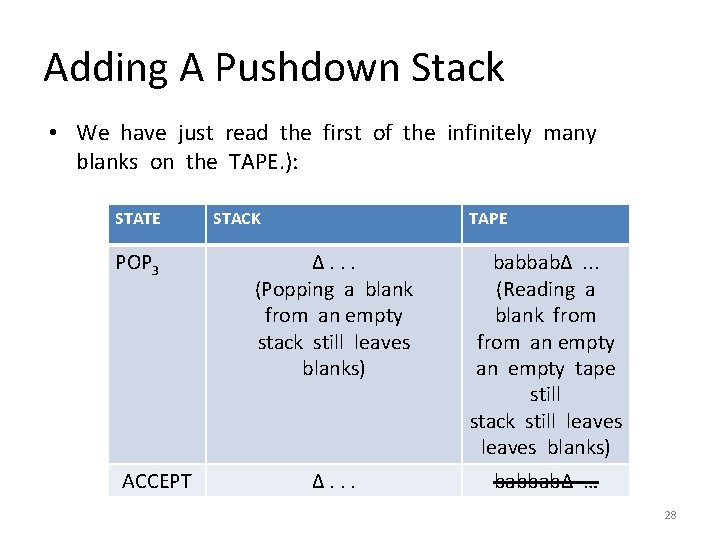
Adding A Pushdown Stack • We have just read the first of the infinitely many blanks on the TAPE. ): STATE POP 3 ACCEPT STACK TAPE Δ. . . (Popping a blank from an empty stack still leaves blanks) babbabΔ. . . (Reading a blank from an empty tape still stack still leaves blanks) Δ. . . babbabΔ … 28

Pushdown Automata A pushdown automaton, PDA, is a collection of eight things 1. An alphabet Σ of input letters. 2. An input TAPE (infinite in one direction). Initially the letters is placed on the TAPE starting in cell i. The rest is blank. 3. An alphabet F of STACK characters. 29
Pushdown Automata • 4. A pushdown STACK (infinite in one direction). Initially empty (contains all blanks). • 5. One START state that has only out-edges, no in-edges. Start 30
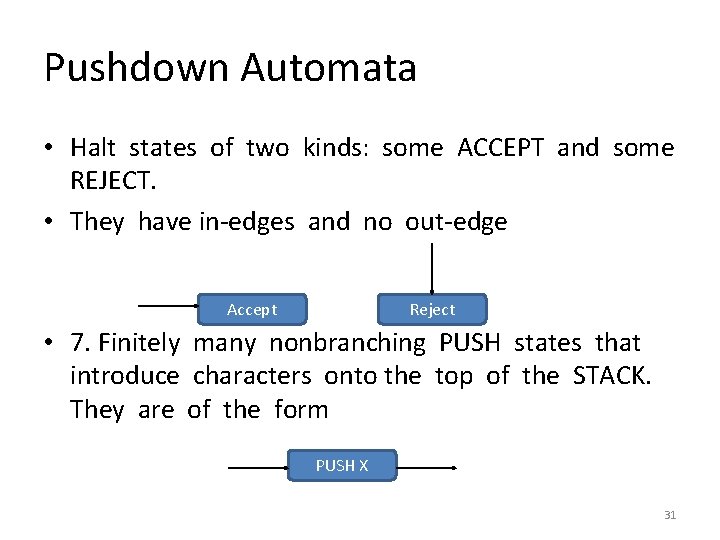
Pushdown Automata • Halt states of two kinds: some ACCEPT and some REJECT. • They have in-edges and no out-edge Accept Reject • 7. Finitely many nonbranching PUSH states that introduce characters onto the top of the STACK. They are of the form PUSH X 31

Pushdown Automata • 8. Finitely many branching states of two kinds: (i) States that read the next unused letter from the TAPE (ii) States that read the top character of the STACK 32

Pushdown Automata • Example • Consider the language generated by the CFG: S→ S+SIS *S|4 • The terminals are +, *, and 4 and the only nonterminal is S. 33
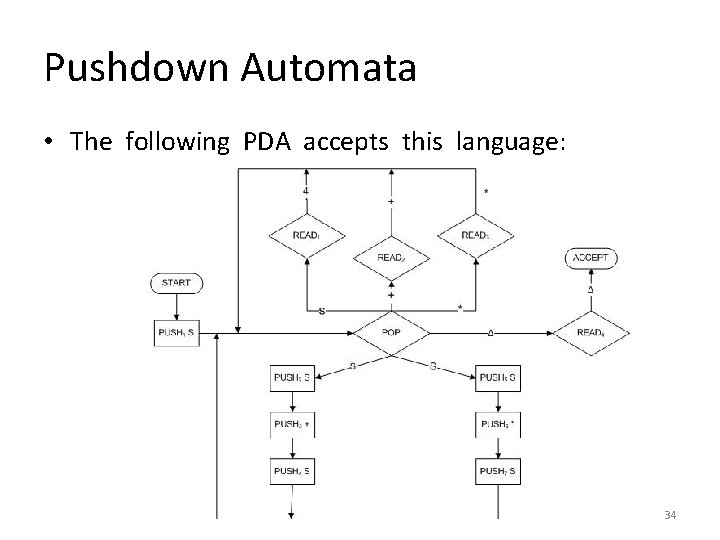
Pushdown Automata • The following PDA accepts this language: 34
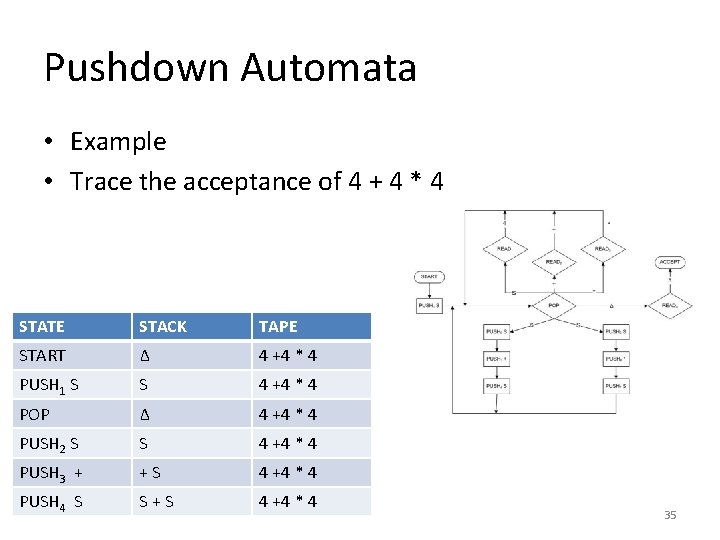
Pushdown Automata • Example • Trace the acceptance of 4 + 4 * 4 STATE STACK TAPE START Δ 4 +4 * 4 PUSH 1 S S 4 +4 * 4 POP Δ 4 +4 * 4 PUSH 2 S S 4 +4 * 4 PUSH 3 + +S 4 +4 * 4 PUSH 4 S S+S 4 +4 * 4 35

Pushdown Automata • Example • Trace the acceptance of 4 + 4 * 4 (continued) STATE STACK TAPE POP +S 4 +4 * 4 READ 1 +S 4*4 POP S 4*4 READ 2 S 4*4 POP Δ 4*4 PUSH 5 S S 4*4 PUSH 6 * *S 4*4 PUSH 7 S S*S 4*4 POP *S 4*4 READ 1 *S *4 36

Pushdown Automata • Example • Trace the acceptance of 4 + 4 * 4 (continued) POP S *4 READ 3 S 4 POP Δ 4 READ 1 Δ Δ POP Δ Δ READ 4 Δ Δ ACCEPT Δ Δ 37
Lecture 28 Summary • Deterministic PDA Examples • Non-Deterministic PDA Examples • Thanks to Daniel I. A. cohen. The material for these slides has been taken from his book Automata Theory 38
- Slides: 38