
Lecture 28 CSE 331 Apr 9 2021 High

![Perhaps a divide & conquer algo? Recur. Weighted. Int([n]) if n = 1 return](https://slidetodoc.com/presentation_image_h2/6b0ee7e9a344bd20b6d57d30ba0862f5/image-18.jpg "Perhaps a divide & conquer algo? Recur. Weighted. Int([n]) if n = 1 return")


- Slides: 28
Lecture 28 CSE 331 Apr, 9 2021
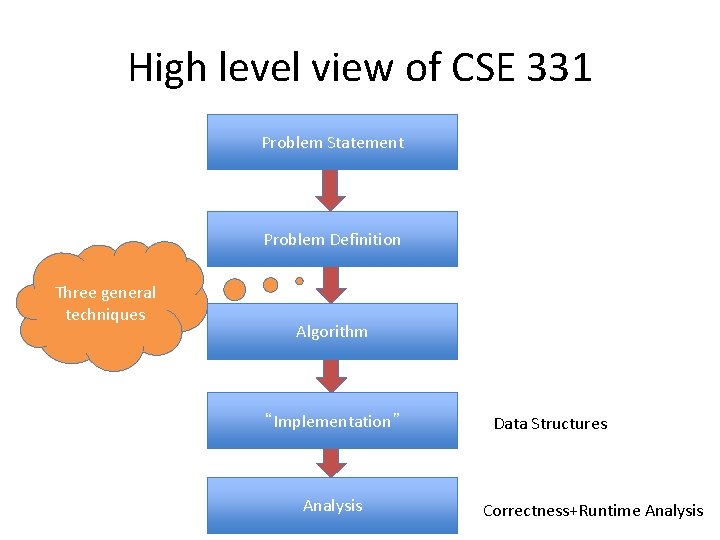
High level view of CSE 331 Problem Statement Problem Definition Three general techniques Algorithm “Implementation” Analysis Data Structures Correctness+Runtime Analysis
Greedy Algorithms Natural algorithms Reduced exponential running time to polynomial
Divide and Conquer Recursive algorithmic paradigm Reduced large polynomial time to smaller polynomial time
A new algorithmic technique Dynamic Programming
Dynamic programming vs. Divide & Conquer
Same same because Both design recursive algorithms
Different because Dynamic programming is smarter about solving recursive sub-problems
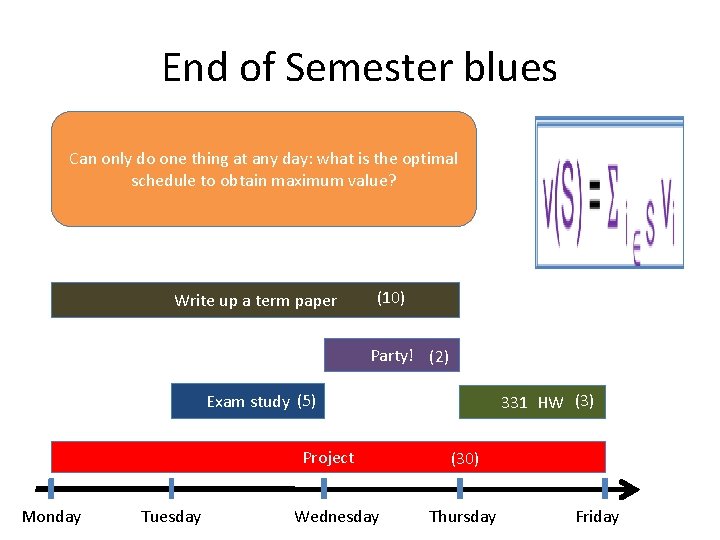
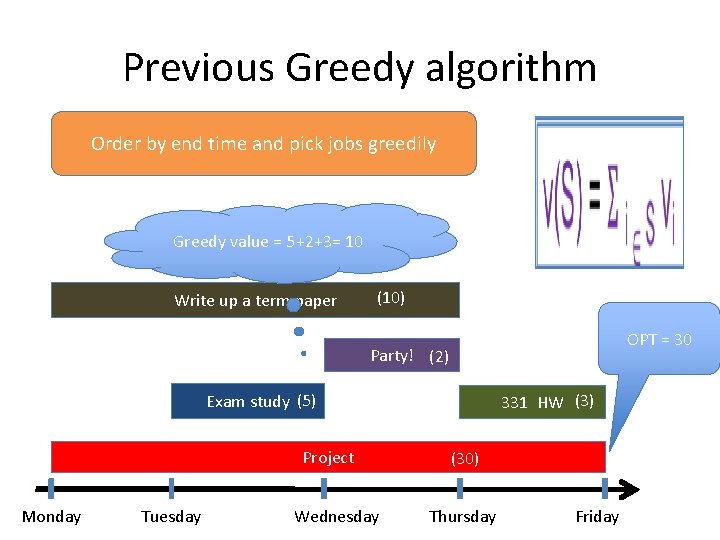
End of Semester blues Can only do one thing at any day: what is the optimal schedule to obtain maximum value? Write up a term paper (10) Party! (2) Exam study (5) Project Monday Tuesday Wednesday 331 HW (3) (30) Thursday Friday
Previous Greedy algorithm Order by end time and pick jobs greedily Greedy value = 5+2+3= 10 Write up a term paper (10) OPT = 30 Party! (2) 331 HW (3) Exam study (5) Project Monday Tuesday Wednesday (30) Thursday Friday
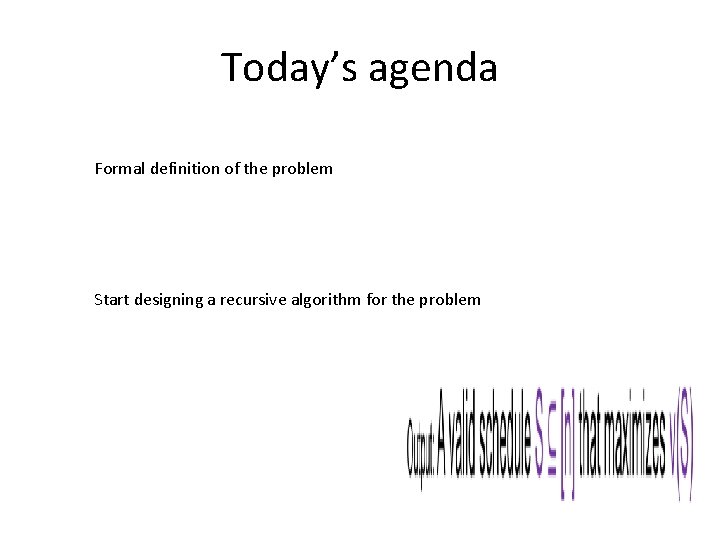
Today’s agenda Formal definition of the problem Start designing a recursive algorithm for the problem
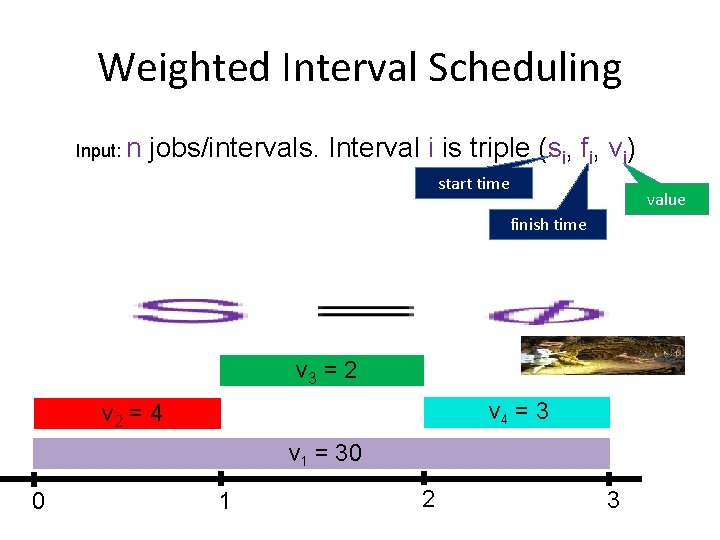
Weighted Interval Scheduling Input: n jobs/intervals. Interval i is triple (si, fi, vi) start time value finish time v 3 = 2 v 4 = 3 v 2 = 4 v 1 = 30 0 1 2 3
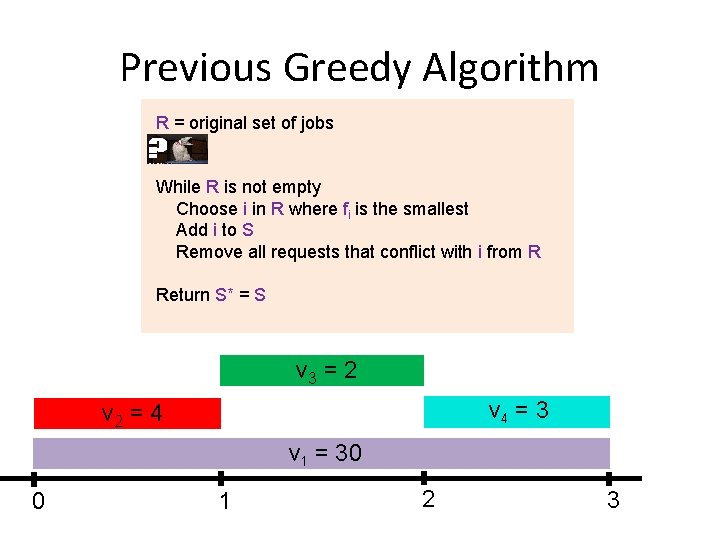
Previous Greedy Algorithm R = original set of jobs While R is not empty Choose i in R where fi is the smallest Add i to S Remove all requests that conflict with i from R Return S* = S v 3 = 2 v 4 = 3 v 2 = 4 v 1 = 30 0 1 2 3
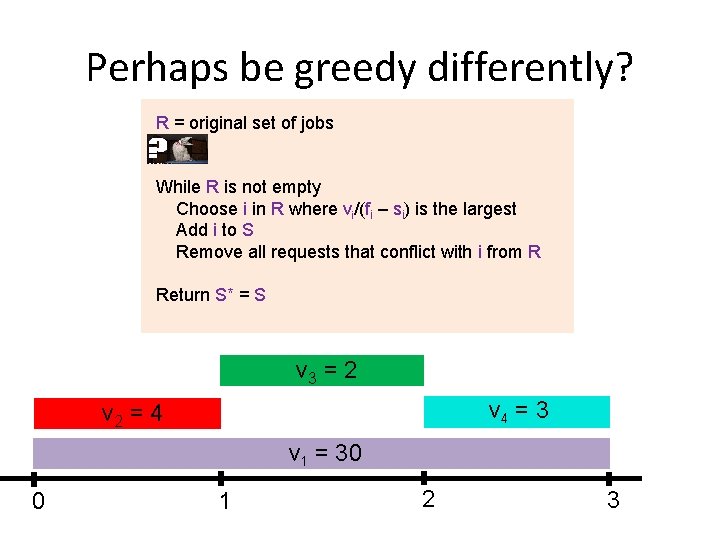
Perhaps be greedy differently? R = original set of jobs While R is not empty Choose i in R where vi/(fi – si) is the largest Add i to S Remove all requests that conflict with i from R Return S* = S v 3 = 2 v 4 = 3 v 2 = 4 v 1 = 30 0 1 2 3
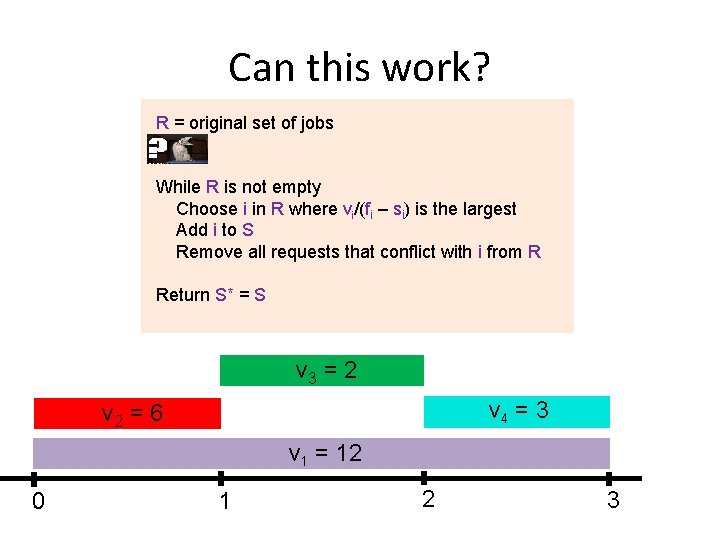
Can this work? R = original set of jobs While R is not empty Choose i in R where vi/(fi – si) is the largest Add i to S Remove all requests that conflict with i from R Return S* = S v 3 = 2 v 4 = 3 v 2 = 6 v 1 = 12 0 1 2 3
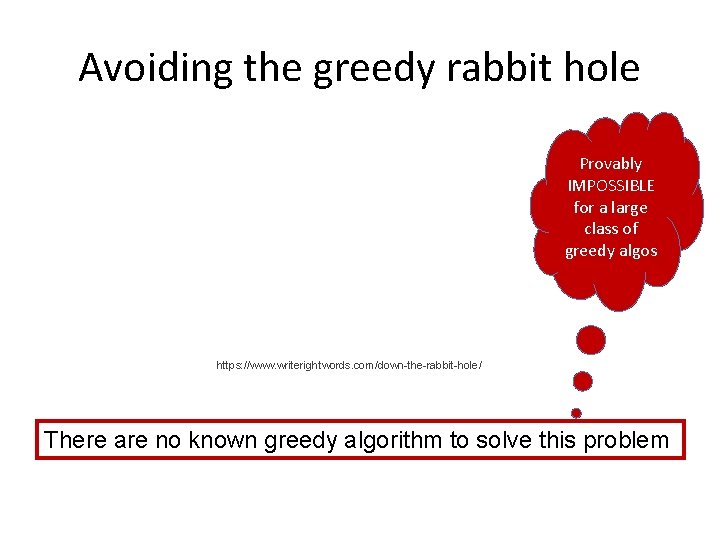
Avoiding the greedy rabbit hole Provably IMPOSSIBLE for a large class of greedy algos https: //www. writerightwords. com/down-the-rabbit-hole/ There are no known greedy algorithm to solve this problem
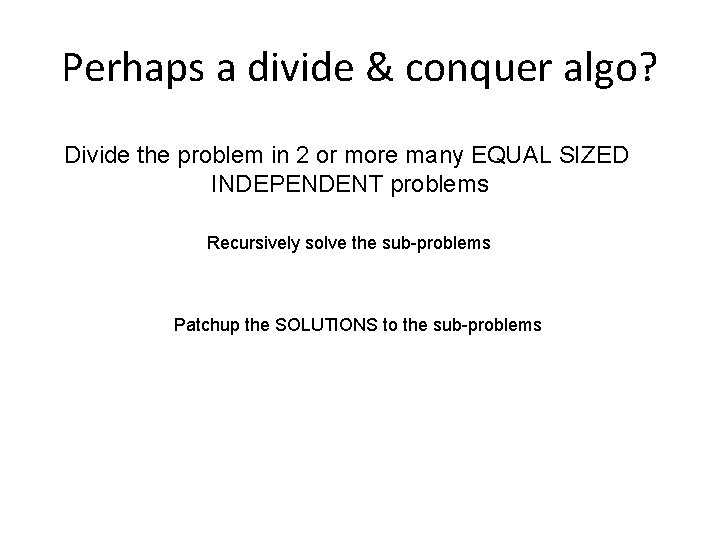
Perhaps a divide & conquer algo? Divide the problem in 2 or more many EQUAL SIZED INDEPENDENT problems Recursively solve the sub-problems Patchup the SOLUTIONS to the sub-problems
Perhaps a divide & conquer algo? Recur. Weighted. Int([n]) if n = 1 return the only interval L = first n/2 intervals R = last n/2 intervals SL = Recur. Weighted. Int(L) SR = Recur. Weighted. Int(R) Would this general scheme work? Patch. Up(SL, SR) Divide the problem in 2 or more many EQUAL SIZED INDEPENDENT problems
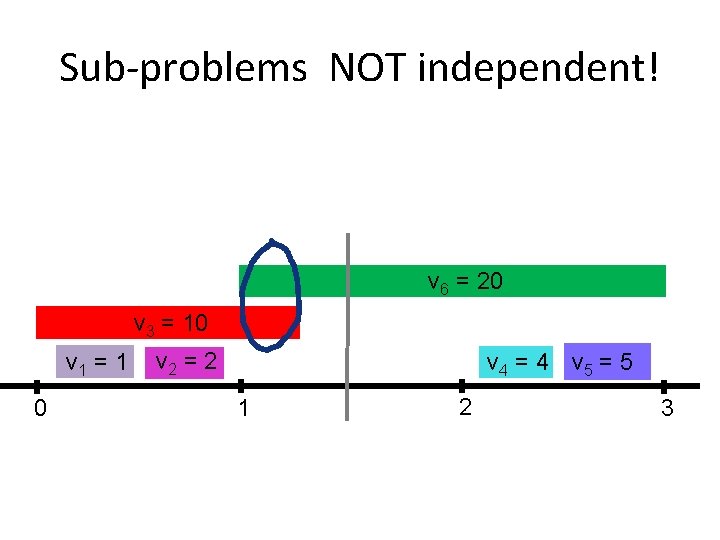
Sub-problems NOT independent! v 6 = 20 v 3 = 10 v 1 = 1 0 v 2 = 2 v 4 = 4 v 5 = 5 1 2 3
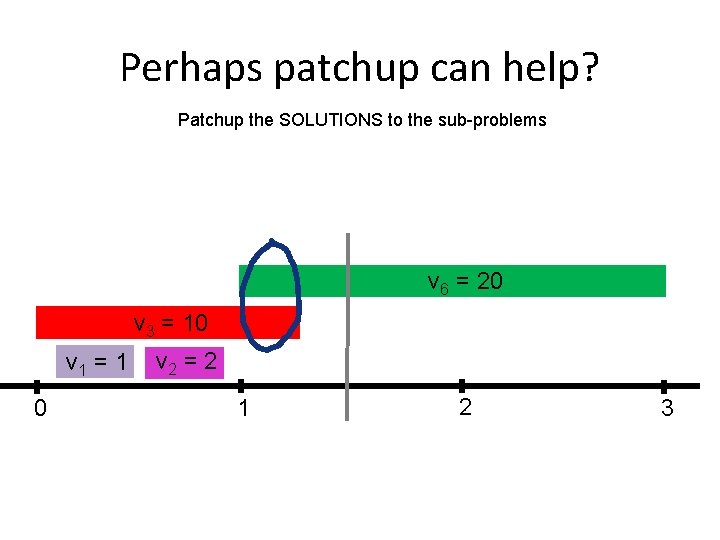
Perhaps patchup can help? Patchup the SOLUTIONS to the sub-problems v 6 = 20 v 3 = 10 v 1 = 1 0 v 2 = 2 1 2 3
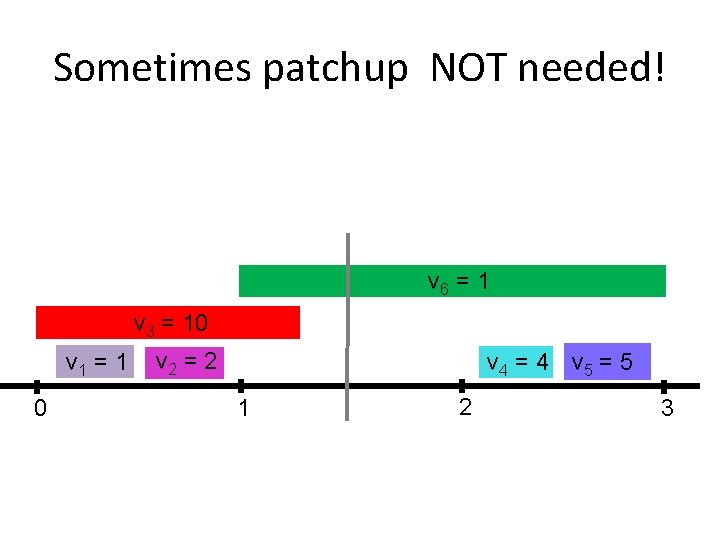
Sometimes patchup NOT needed! v 6 = 1 v 3 = 10 v 1 = 1 0 v 2 = 2 v 4 = 4 v 5 = 5 1 2 3
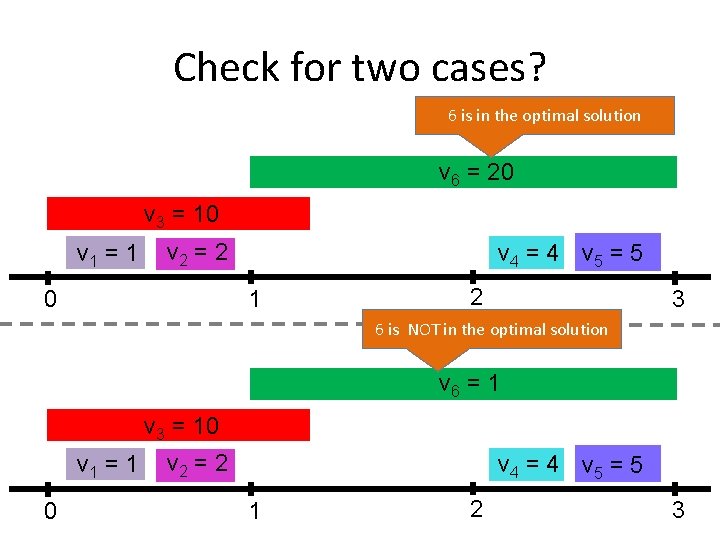
Check for two cases? 6 is in the optimal solution v 6 = 20 v 3 = 10 v 1 = 1 v 2 = 2 v 4 = 4 v 5 = 5 1 0 2 3 6 is NOT in the optimal solution v 6 = 1 v 3 = 10 v 1 = 1 0 v 2 = 2 v 4 = 4 v 5 = 5 1 2 3
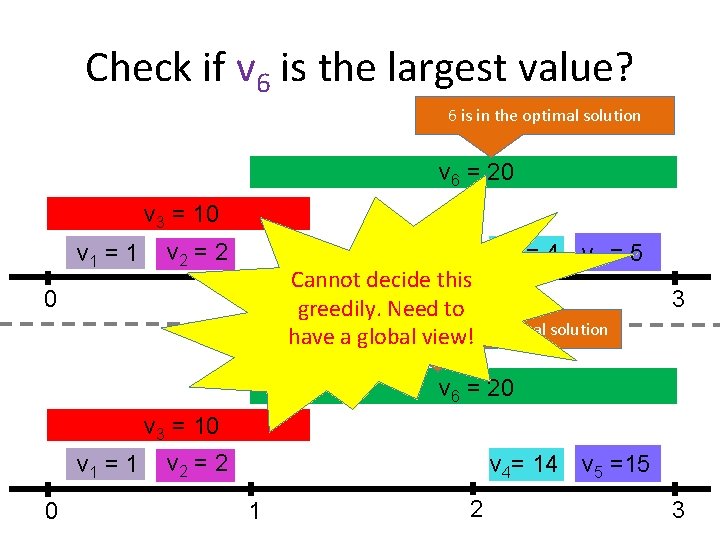
Check if v 6 is the largest value? 6 is in the optimal solution v 6 = 20 v 3 = 10 v 1 = 1 v 2 = 2 v 4 = 4 v 5 = 5 1 0 Cannot decide this greedily. Need to 2 6 is NOT in the optimal solution have a global view! 3 v 66 = 0 20 v 3 = 10 v 1 = 1 0 v 2 = 2 v 4= 14 v 5 =15 1 2 3
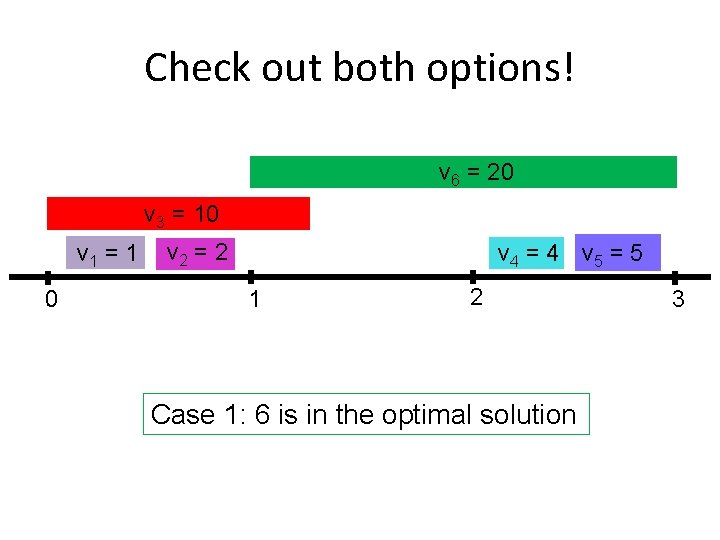
Check out both options! v 6 = 20 v 3 = 10 v 1 = 1 0 v 2 = 2 v 4 = 4 v 5 = 5 1 2 Case 1: 6 is in the optimal solution 3
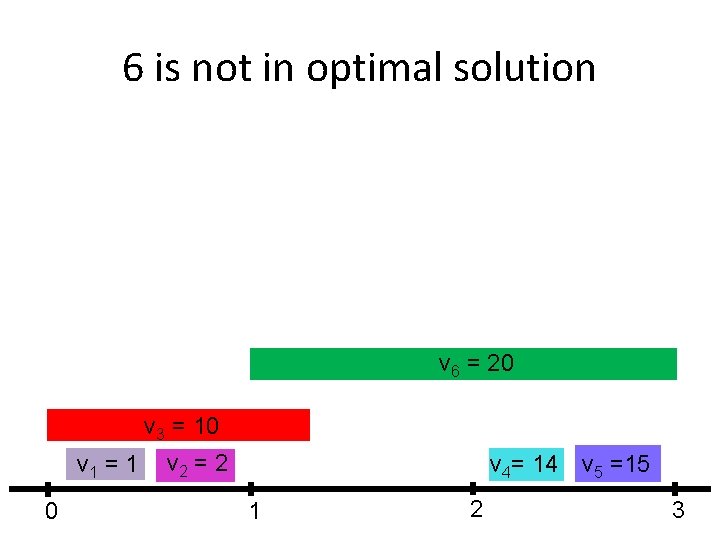
6 is not in optimal solution v 6 = 20 v 3 = 10 v 1 = 1 0 v 2 = 2 v 4= 14 v 5 =15 1 2 3
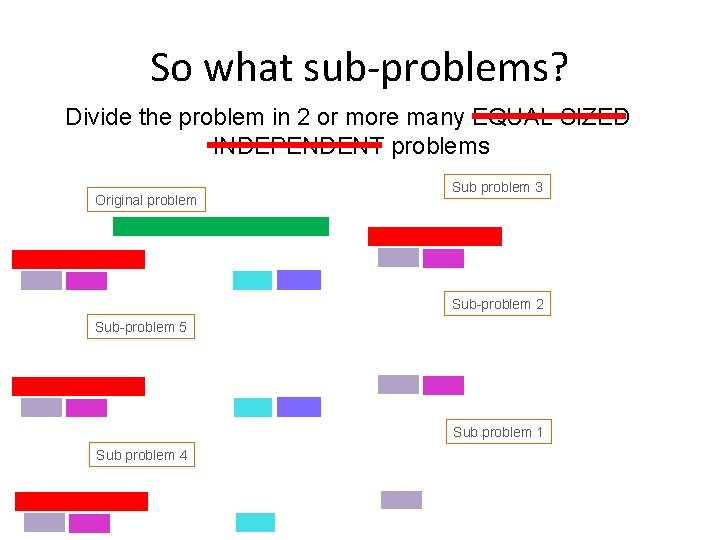
So what sub-problems? Divide the problem in 2 or more many EQUAL SIZED INDEPENDENT problems Original problem Sub problem 3 Sub-problem 2 Sub-problem 5 Sub problem 1 Sub problem 4