
Lecture 27 OUTLINE The BJT contd Smallsignal model
Lecture 27 OUTLINE The BJT (cont’d) • Small-signal model • Cutoff frequency • Transient (switching) response Reading: Pierret 12; Hu 8. 8 -8. 9
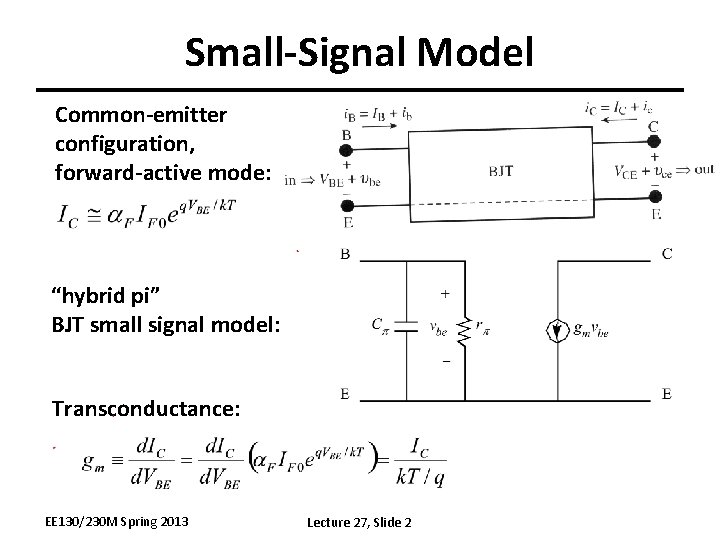
Small-Signal Model Common-emitter configuration, forward-active mode: “hybrid pi” BJT small signal model: Transconductance: EE 130/230 M Spring 2013 Lecture 27, Slide 2
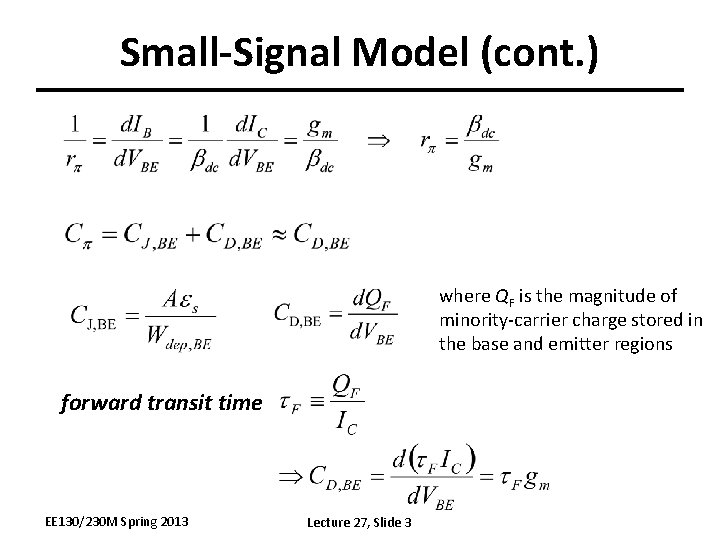
Small-Signal Model (cont. ) where QF is the magnitude of minority-carrier charge stored in the base and emitter regions forward transit time EE 130/230 M Spring 2013 Lecture 27, Slide 3
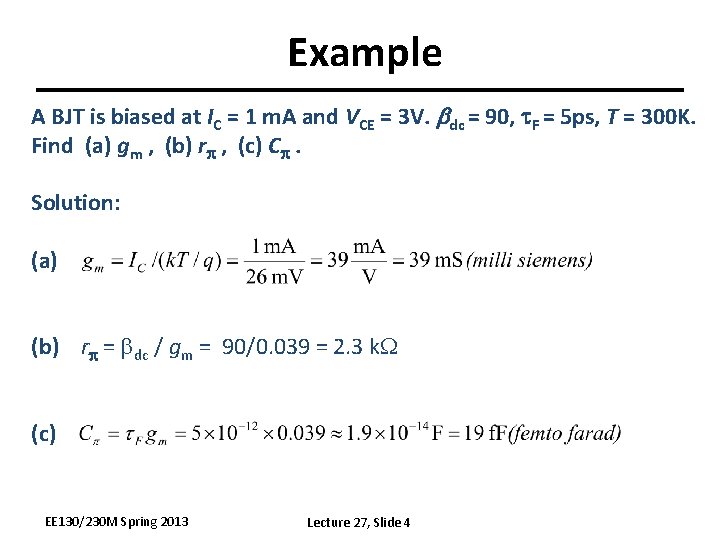
Example A BJT is biased at IC = 1 m. A and VCE = 3 V. bdc = 90, t. F = 5 ps, T = 300 K. Find (a) gm , (b) rp , (c) Cp. Solution: (a) (b) rp = bdc / gm = 90/0. 039 = 2. 3 k. W (c) EE 130/230 M Spring 2013 Lecture 27, Slide 4
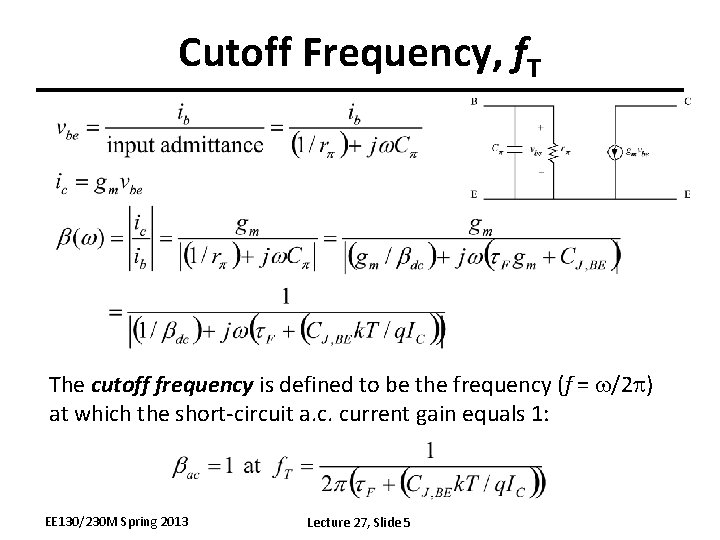
Cutoff Frequency, f. T The cutoff frequency is defined to be the frequency (f = w/2 p) at which the short-circuit a. c. current gain equals 1: EE 130/230 M Spring 2013 Lecture 27, Slide 5
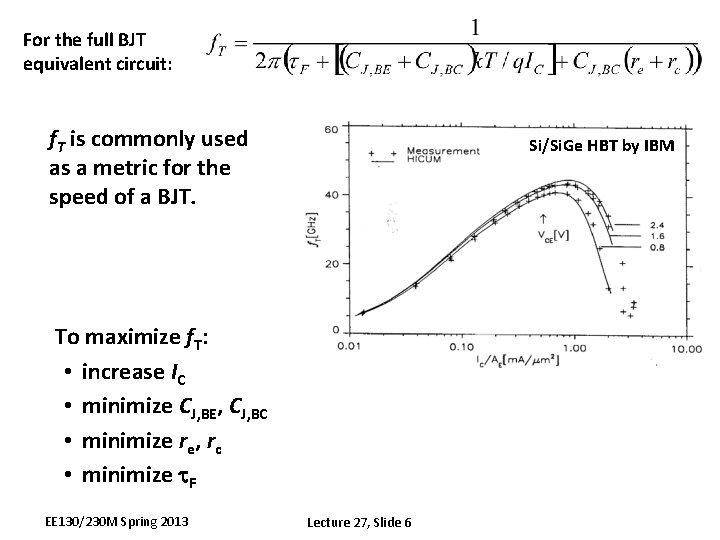
For the full BJT equivalent circuit: f. T is commonly used as a metric for the speed of a BJT. Si/Si. Ge HBT by IBM To maximize f. T: • increase IC • minimize CJ, BE, CJ, BC • minimize re, rc • minimize t. F EE 130/230 M Spring 2013 Lecture 27, Slide 6
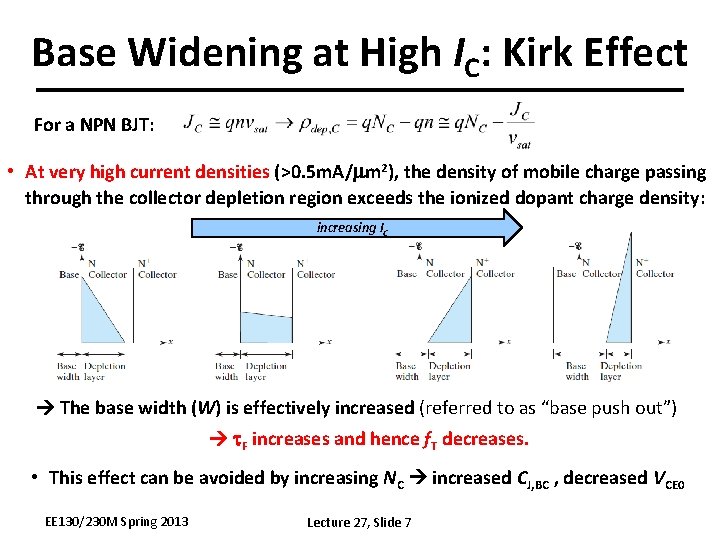
Base Widening at High IC: Kirk Effect For a NPN BJT: • At very high current densities (>0. 5 m. A/mm 2), the density of mobile charge passing through the collector depletion region exceeds the ionized dopant charge density: increasing IC The base width (W) is effectively increased (referred to as “base push out”) t. F increases and hence f. T decreases. • This effect can be avoided by increasing NC increased CJ, BC , decreased VCE 0 EE 130/230 M Spring 2013 Lecture 27, Slide 7
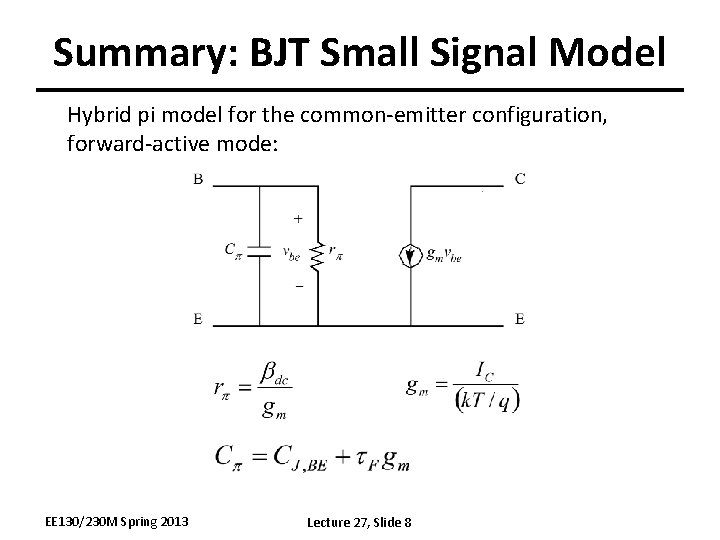
Summary: BJT Small Signal Model Hybrid pi model for the common-emitter configuration, forward-active mode: EE 130/230 M Spring 2013 Lecture 27, Slide 8
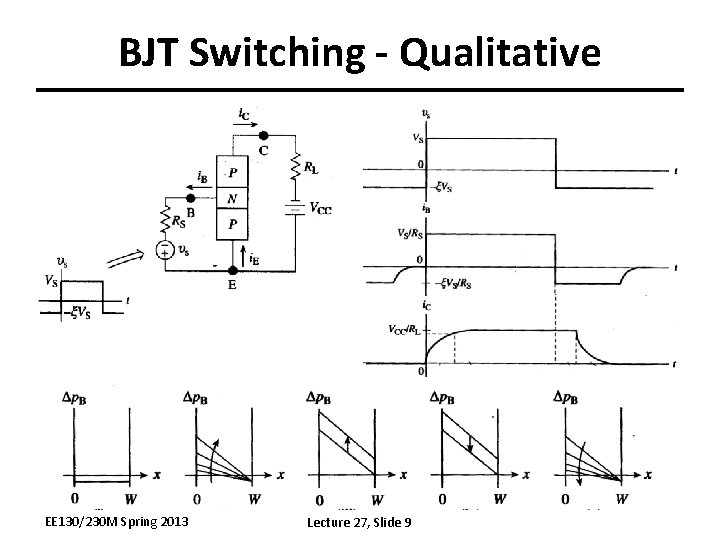
BJT Switching - Qualitative EE 130/230 M Spring 2013 Lecture 27, Slide 9
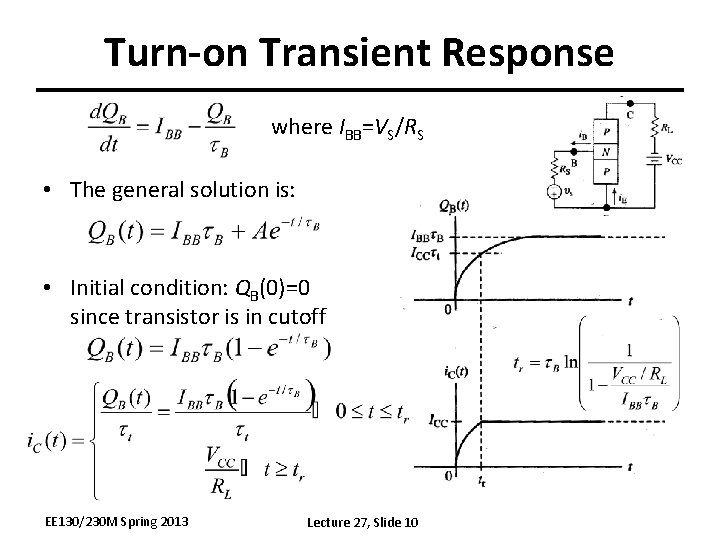
Turn-on Transient Response where IBB=VS/RS • The general solution is: • Initial condition: QB(0)=0 since transistor is in cutoff EE 130/230 M Spring 2013 Lecture 27, Slide 10
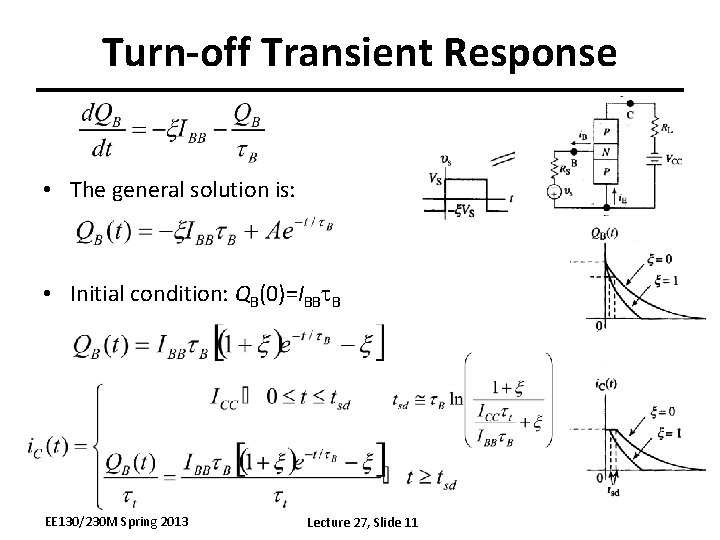
Turn-off Transient Response • The general solution is: • Initial condition: QB(0)=IBBt. B EE 130/230 M Spring 2013 Lecture 27, Slide 11
Reducing t. B for Faster Turn-Off • The speed at which a BJT is turned off is dependent on the amount of excess minority-carrier charge stored in the base, QB, and also the recombination lifetime, t. B. – By reducing t. B, the carrier removal rate is increased Example: Add recombination centers (Au atoms) in the base EE 130/230 M Spring 2013 Lecture 27, Slide 12
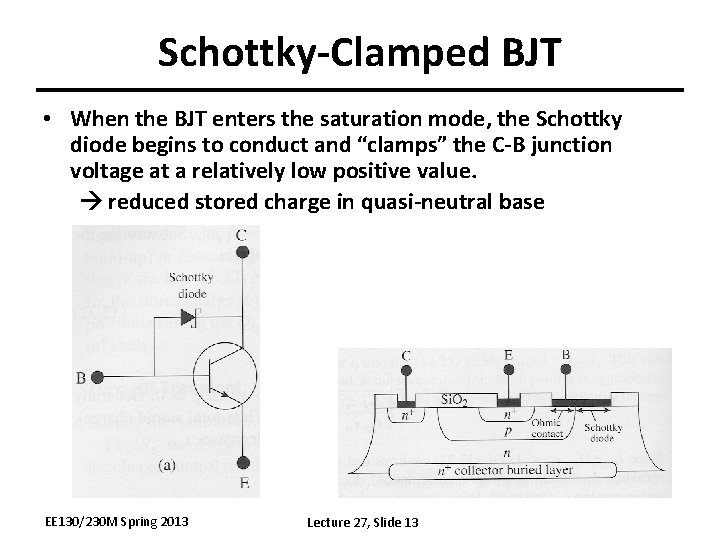
Schottky-Clamped BJT • When the BJT enters the saturation mode, the Schottky diode begins to conduct and “clamps” the C-B junction voltage at a relatively low positive value. reduced stored charge in quasi-neutral base EE 130/230 M Spring 2013 Lecture 27, Slide 13
- Slides: 13