
Lecture 27 Choice of materials Choice of materials
- Slides: 16
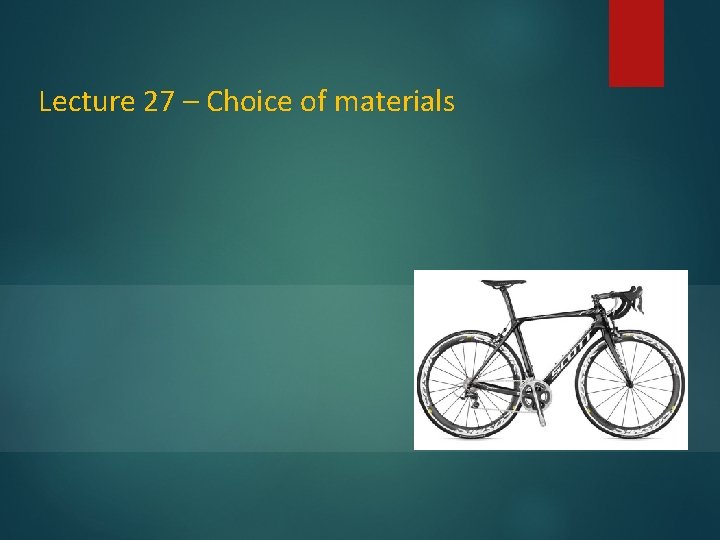
Lecture 27 – Choice of materials
Choice of materials Reference Text Section Higgins RA & Bolton, 2710. Materials for Engineers and Technicians, 5 th ed, Butterworth Heinemann Ch 27 Reference Text Section Engineering Materials and Processes
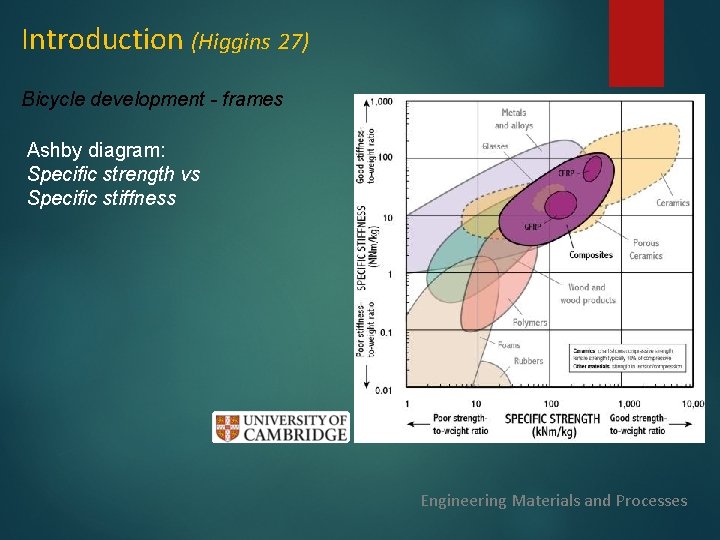
Introduction (Higgins 27) Bicycle development - frames Ashby diagram: Specific strength vs Specific stiffness Engineering Materials and Processes
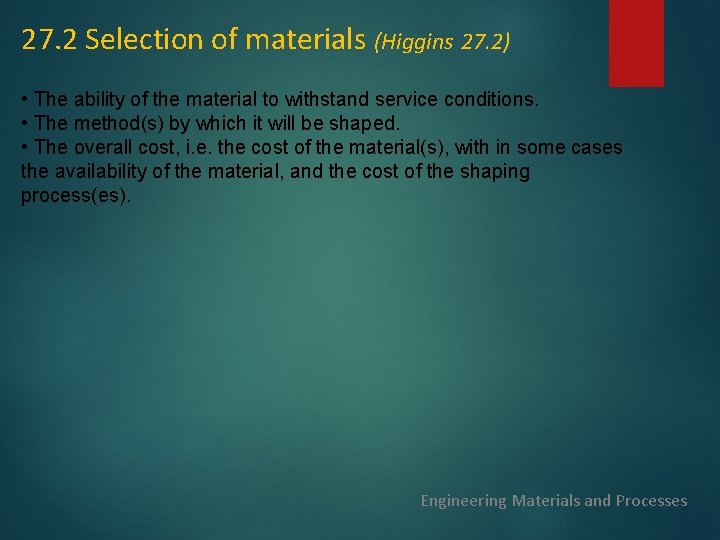
27. 2 Selection of materials (Higgins 27. 2) • The ability of the material to withstand service conditions. • The method(s) by which it will be shaped. • The overall cost, i. e. the cost of the material(s), with in some cases the availability of the material, and the cost of the shaping process(es). Engineering Materials and Processes
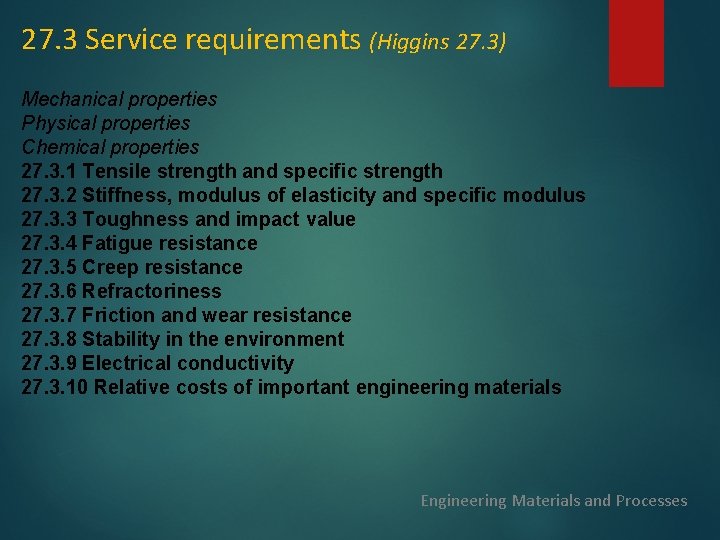
27. 3 Service requirements (Higgins 27. 3) Mechanical properties Physical properties Chemical properties 27. 3. 1 Tensile strength and specific strength 27. 3. 2 Stiffness, modulus of elasticity and specific modulus 27. 3. 3 Toughness and impact value 27. 3. 4 Fatigue resistance 27. 3. 5 Creep resistance 27. 3. 6 Refractoriness 27. 3. 7 Friction and wear resistance 27. 3. 8 Stability in the environment 27. 3. 9 Electrical conductivity 27. 3. 10 Relative costs of important engineering materials Engineering Materials and Processes
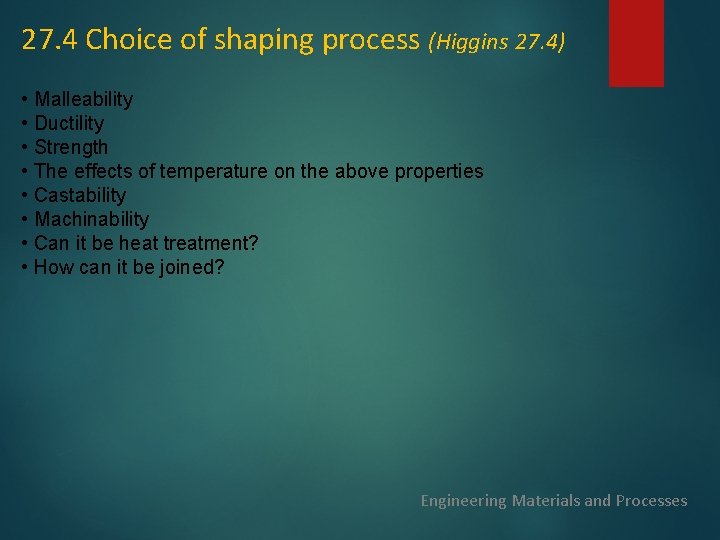
27. 4 Choice of shaping process (Higgins 27. 4) • Malleability • Ductility • Strength • The effects of temperature on the above properties • Castability • Machinability • Can it be heat treatment? • How can it be joined? Engineering Materials and Processes
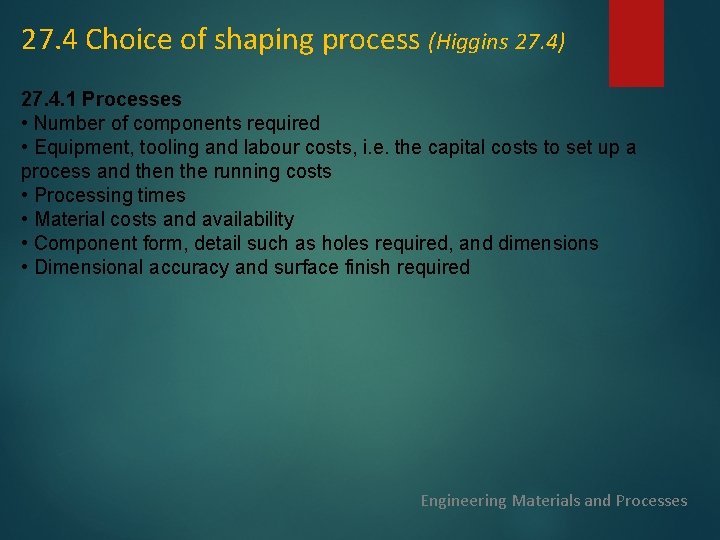
27. 4 Choice of shaping process (Higgins 27. 4) 27. 4. 1 Processes • Number of components required • Equipment, tooling and labour costs, i. e. the capital costs to set up a process and then the running costs • Processing times • Material costs and availability • Component form, detail such as holes required, and dimensions • Dimensional accuracy and surface finish required Engineering Materials and Processes
27. 4 Choice of shaping process (Higgins 27. 4) 27. 8. 2 Changing conditions Engineering Materials and Processes
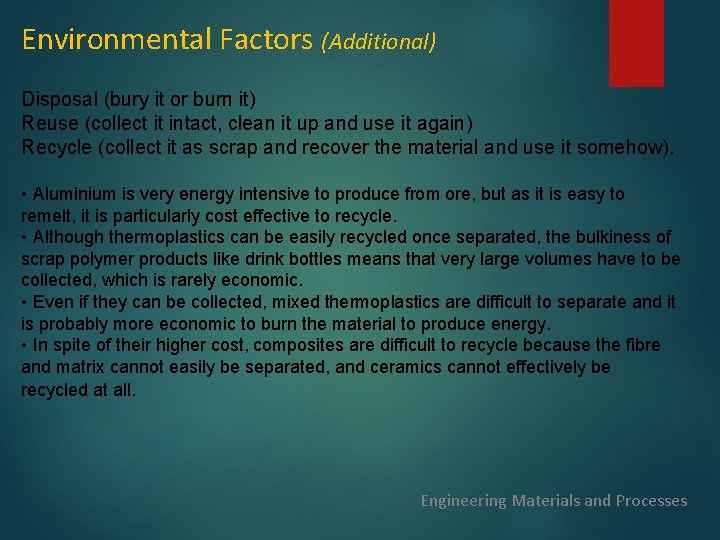
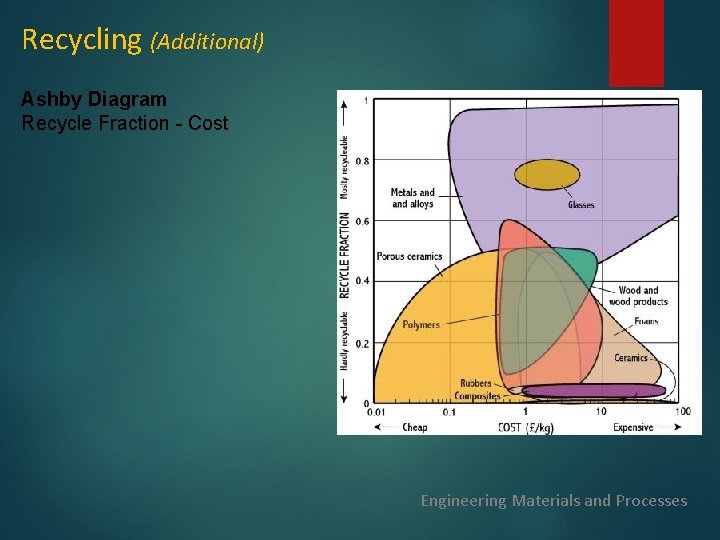
Environmental Factors (Additional) Disposal (bury it or burn it) Reuse (collect it intact, clean it up and use it again) Recycle (collect it as scrap and recover the material and use it somehow). • Aluminium is very energy intensive to produce from ore, but as it is easy to remelt, it is particularly cost effective to recycle. • Although thermoplastics can be easily recycled once separated, the bulkiness of scrap polymer products like drink bottles means that very large volumes have to be collected, which is rarely economic. • Even if they can be collected, mixed thermoplastics are difficult to separate and it is probably more economic to burn the material to produce energy. • In spite of their higher cost, composites are difficult to recycle because the fibre and matrix cannot easily be separated, and ceramics cannot effectively be recycled at all. Engineering Materials and Processes
Recycling (Additional) Ashby Diagram Recycle Fraction - Cost Engineering Materials and Processes
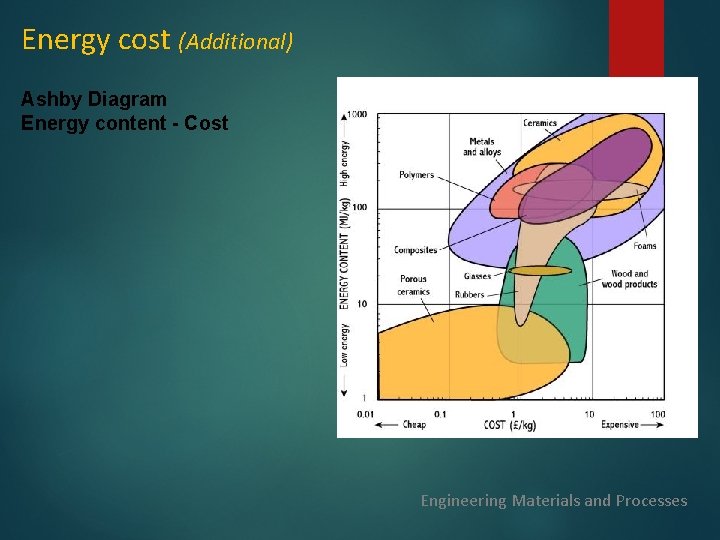
Energy cost (Additional) Ashby Diagram Energy content - Cost Engineering Materials and Processes
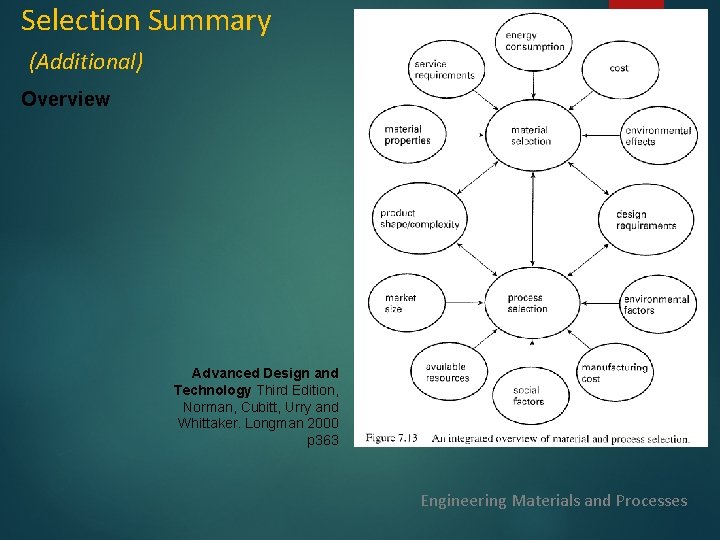
Selection Summary (Additional) Overview Advanced Design and Technology Third Edition, Norman, Cubitt, Urry and Whittaker. Longman 2000 p 363 Engineering Materials and Processes
Resources. Wikipedia: Welding HI-RESOLUTION ASHBY CHARTS: http: //www-materials. eng. cam. ac. uk/mpsite/interactive_charts/hardcopy/colour/Photoshop 300 dpi/ DESIGN CASE STUDIES AND TUTORIAL http: //www-materials. eng. cam. ac. uk/mpsite/design. html Engineering Materials and Processes
Glossary Specific (density/stress etc) Mechanical properties Physical properties Chemical properties Service conditions Duty cycle Industrial design Manufacturing energy content Recycle fraction Disposal Re-use Recycle Product life-cycle Engineering Materials and Processes
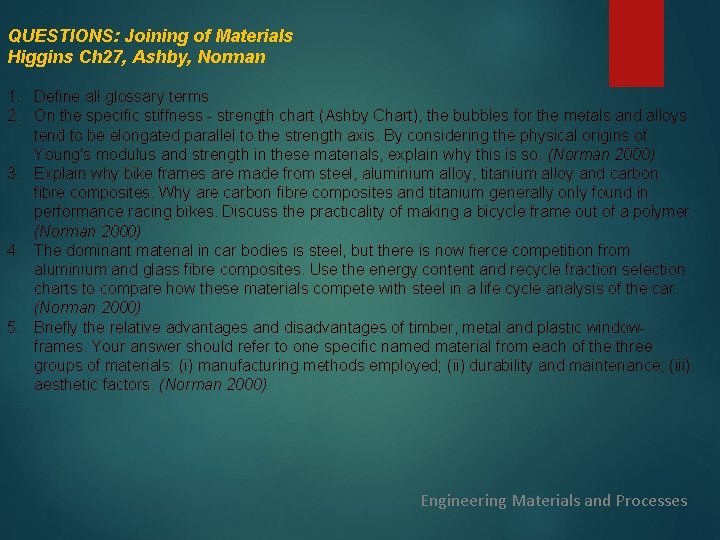
QUESTIONS: Joining of Materials Higgins Ch 27, Ashby, Norman 1. Define all glossary terms 2. On the specific stiffness - strength chart (Ashby Chart), the bubbles for the metals and alloys tend to be elongated parallel to the strength axis. By considering the physical origins of Young's modulus and strength in these materials, explain why this is so. (Norman 2000) 3. Explain why bike frames are made from steel, aluminium alloy, titanium alloy and carbon fibre composites. Why are carbon fibre composites and titanium generally only found in performance racing bikes. Discuss the practicality of making a bicycle frame out of a polymer. (Norman 2000) 4. The dominant material in car bodies is steel, but there is now fierce competition from aluminium and glass fibre composites. Use the energy content and recycle fraction selection charts to compare how these materials compete with steel in a life cycle analysis of the car. (Norman 2000) 5. Briefly the relative advantages and disadvantages of timber, metal and plastic windowframes. Your answer should refer to one specific named material from each of the three groups of materials: (i) manufacturing methods employed; (ii) durability and maintenance; (iii) aesthetic factors. (Norman 2000) Engineering Materials and Processes
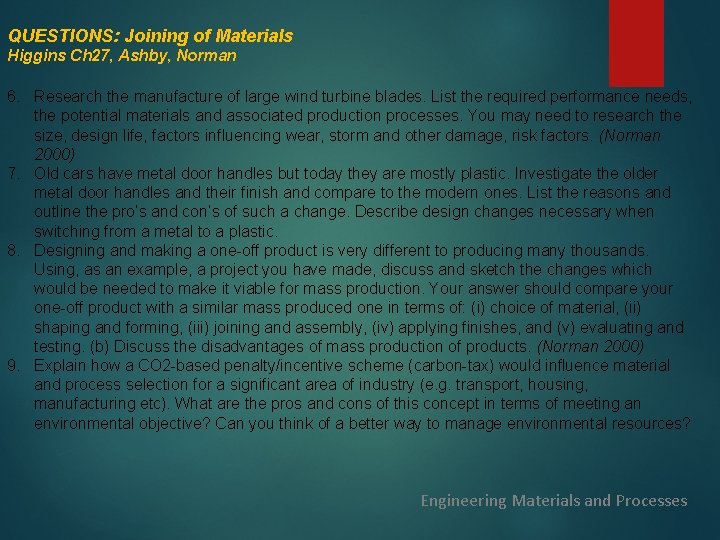
QUESTIONS: Joining of Materials Higgins Ch 27, Ashby, Norman 6. Research the manufacture of large wind turbine blades. List the required performance needs, the potential materials and associated production processes. You may need to research the size, design life, factors influencing wear, storm and other damage, risk factors. (Norman 2000) 7. Old cars have metal door handles but today they are mostly plastic. Investigate the older metal door handles and their finish and compare to the modern ones. List the reasons and outline the pro’s and con’s of such a change. Describe design changes necessary when switching from a metal to a plastic. 8. Designing and making a one-off product is very different to producing many thousands. Using, as an example, a project you have made, discuss and sketch the changes which would be needed to make it viable for mass production. Your answer should compare your one-off product with a similar mass produced one in terms of: (i) choice of material, (ii) shaping and forming, (iii) joining and assembly, (iv) applying finishes, and (v) evaluating and testing. (b) Discuss the disadvantages of mass production of products. (Norman 2000) 9. Explain how a CO 2 -based penalty/incentive scheme (carbon-tax) would influence material and process selection for a significant area of industry (e. g. transport, housing, manufacturing etc). What are the pros and cons of this concept in terms of meeting an environmental objective? Can you think of a better way to manage environmental resources? Engineering Materials and Processes