
Lecture 26 OUTLINE The BJT contd Ideal transistor
Lecture 26 OUTLINE The BJT (cont’d) • • Ideal transistor analysis Narrow base and narrow emitter Ebers-Moll model Base-width modulation Reading: Pierret 11. 1 -11. 2; Hu 8. 2 -8. 6
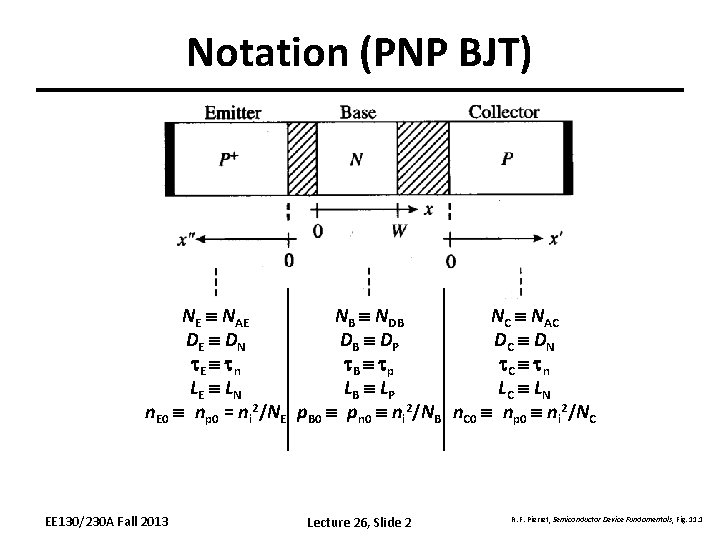
Notation (PNP BJT) NE NAE NB NDB NC NAC DE DN DB DP DC DN t. E tn t. B tp t. C tn LE LN LB LP LC LN n. E 0 np 0 = ni 2/NE p. B 0 pn 0 ni 2/NB n. C 0 np 0 ni 2/NC EE 130/230 A Fall 2013 Lecture 26, Slide 2 R. F. Pierret, Semiconductor Device Fundamentals, Fig. 11. 1
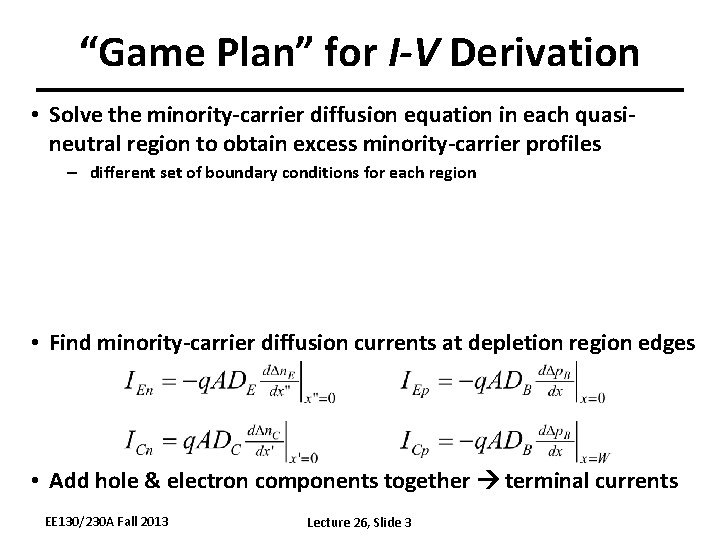
“Game Plan” for I-V Derivation • Solve the minority-carrier diffusion equation in each quasineutral region to obtain excess minority-carrier profiles – different set of boundary conditions for each region • Find minority-carrier diffusion currents at depletion region edges • Add hole & electron components together terminal currents EE 130/230 A Fall 2013 Lecture 26, Slide 3
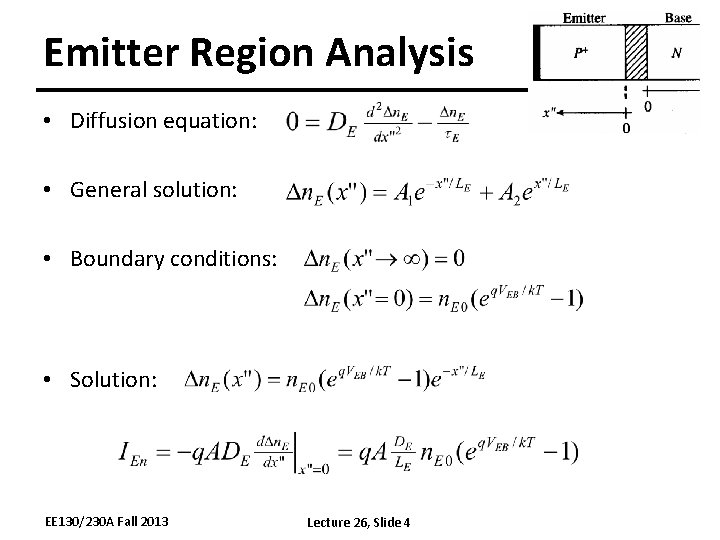
Emitter Region Analysis • Diffusion equation: • General solution: • Boundary conditions: • Solution: EE 130/230 A Fall 2013 Lecture 26, Slide 4
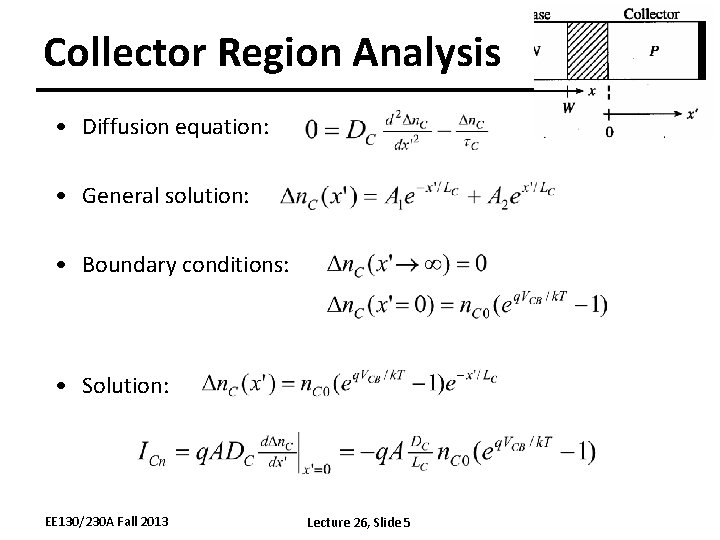
Collector Region Analysis • Diffusion equation: • General solution: • Boundary conditions: • Solution: EE 130/230 A Fall 2013 Lecture 26, Slide 5
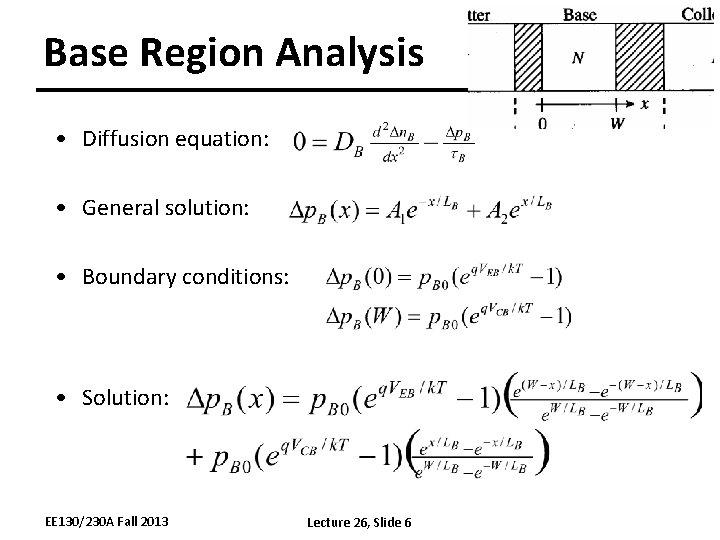
Base Region Analysis • Diffusion equation: • General solution: • Boundary conditions: • Solution: EE 130/230 A Fall 2013 Lecture 26, Slide 6
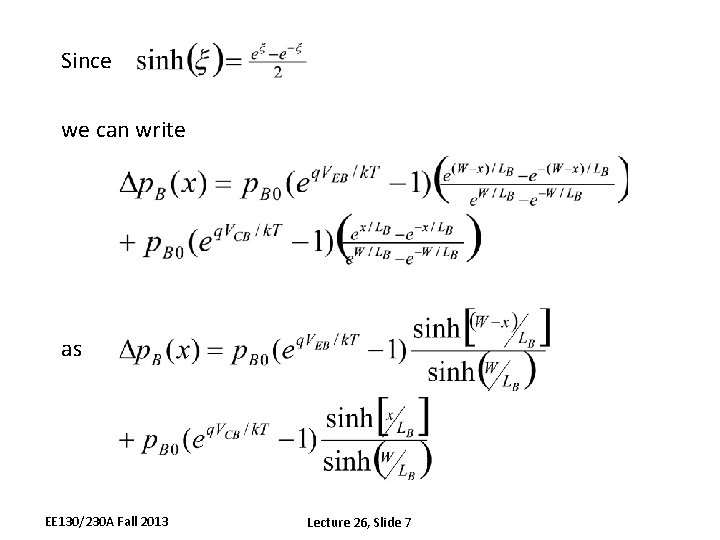
Since we can write as EE 130/230 A Fall 2013 Lecture 26, Slide 7
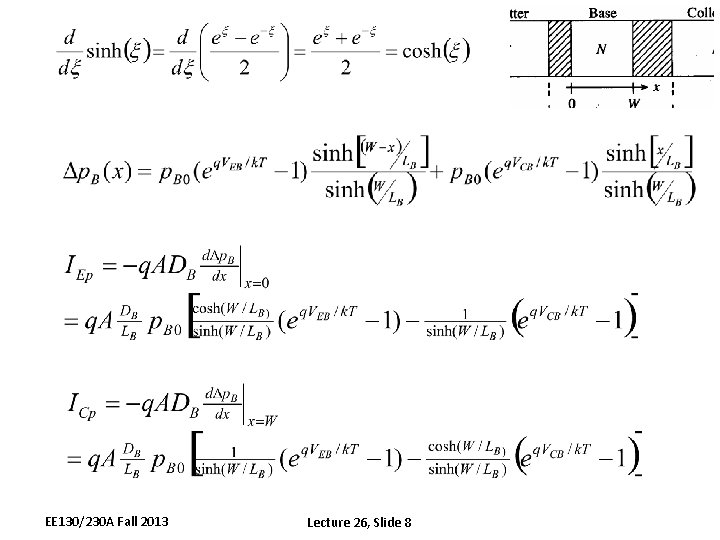
EE 130/230 A Fall 2013 Lecture 26, Slide 8
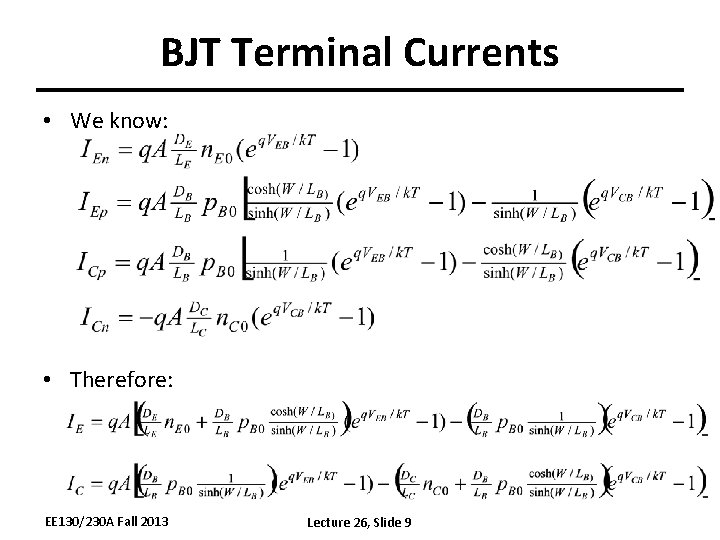
BJT Terminal Currents • We know: • Therefore: EE 130/230 A Fall 2013 Lecture 26, Slide 9
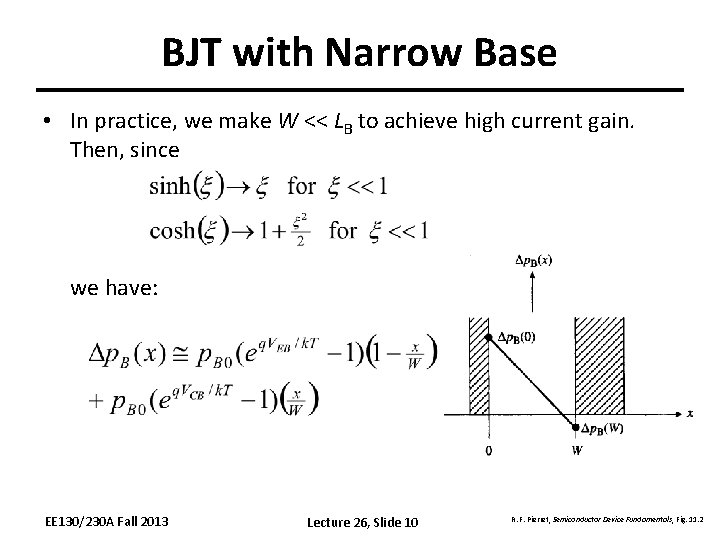
BJT with Narrow Base • In practice, we make W << LB to achieve high current gain. Then, since we have: EE 130/230 A Fall 2013 Lecture 26, Slide 10 R. F. Pierret, Semiconductor Device Fundamentals, Fig. 11. 2
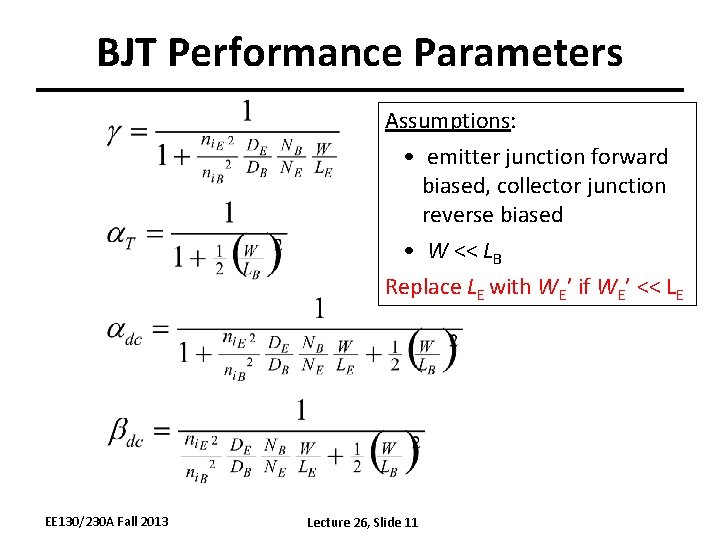
BJT Performance Parameters Assumptions: • emitter junction forward biased, collector junction reverse biased • W << LB Replace LE with WE’ if WE’ << LE EE 130/230 A Fall 2013 Lecture 26, Slide 11
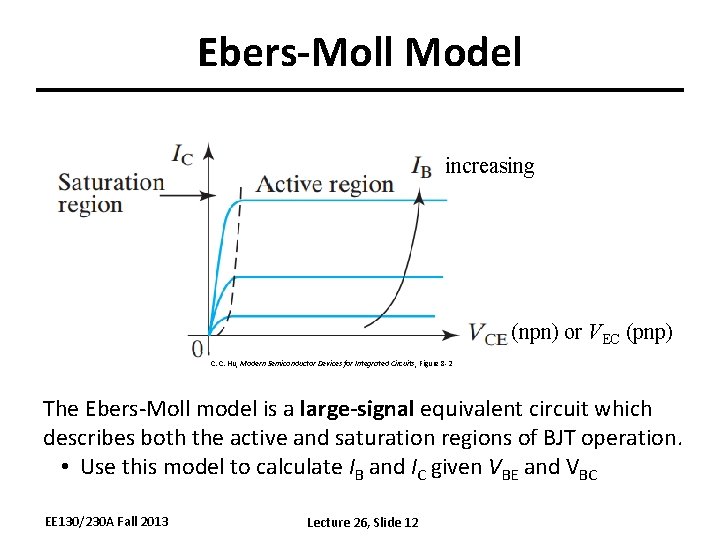
Ebers-Moll Model increasing (npn) or VEC (pnp) C. C. Hu, Modern Semiconductor Devices for Integrated Circuits, Figure 8 -2 The Ebers-Moll model is a large-signal equivalent circuit which describes both the active and saturation regions of BJT operation. • Use this model to calculate IB and IC given VBE and VBC EE 130/230 A Fall 2013 Lecture 26, Slide 12
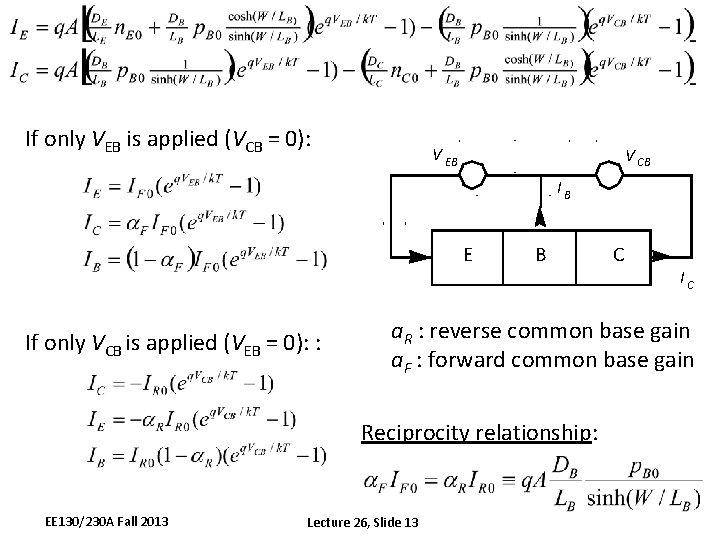
If only VEB is applied (VCB = 0): V EB V CB IB E B C IC If only VCB is applied (VEB = 0): : a. R : reverse common base gain a. F : forward common base gain Reciprocity relationship: EE 130/230 A Fall 2013 Lecture 26, Slide 13
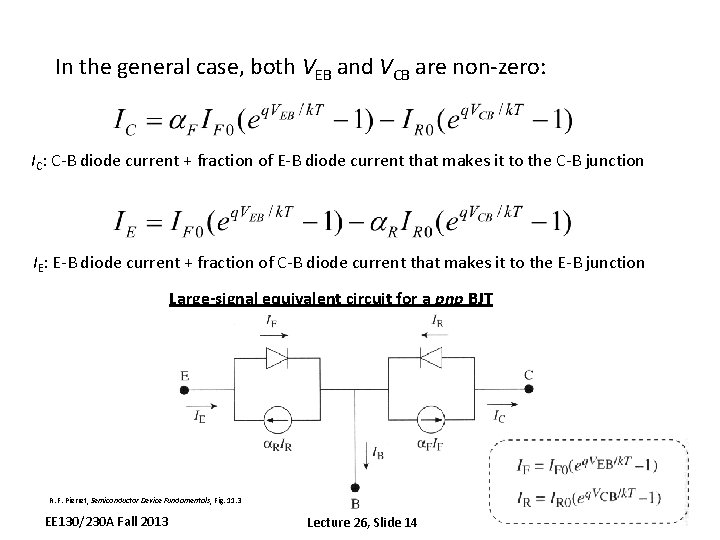
In the general case, both VEB and VCB are non-zero: IC: C-B diode current + fraction of E-B diode current that makes it to the C-B junction IE: E-B diode current + fraction of C-B diode current that makes it to the E-B junction Large-signal equivalent circuit for a pnp BJT R. F. Pierret, Semiconductor Device Fundamentals, Fig. 11. 3 EE 130/230 A Fall 2013 Lecture 26, Slide 14
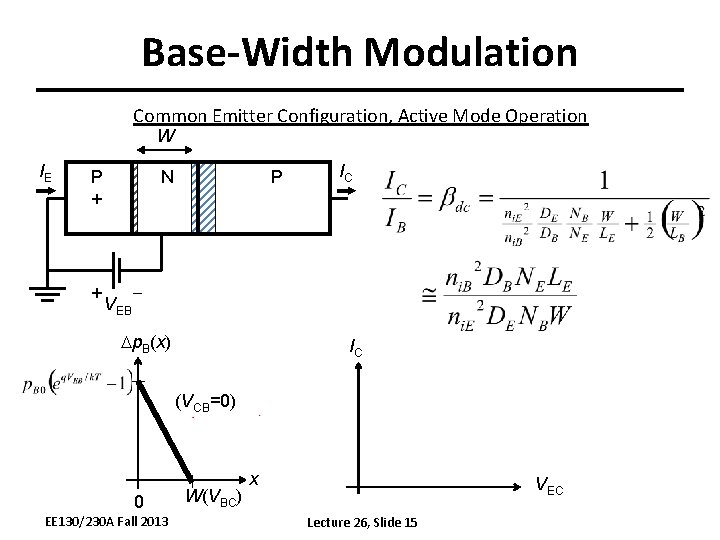
Base-Width Modulation Common Emitter Configuration, Active Mode Operation W IE P + + N VEB P IC Dp. B(x) IC (VCB=0) 0 EE 130/230 A Fall 2013 W(VBC) x VEC Lecture 26, Slide 15
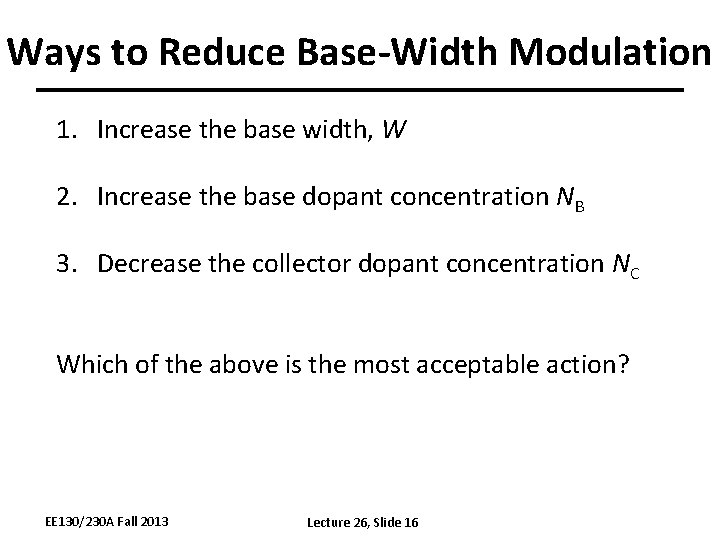
Ways to Reduce Base-Width Modulation 1. Increase the base width, W 2. Increase the base dopant concentration NB 3. Decrease the collector dopant concentration NC Which of the above is the most acceptable action? EE 130/230 A Fall 2013 Lecture 26, Slide 16
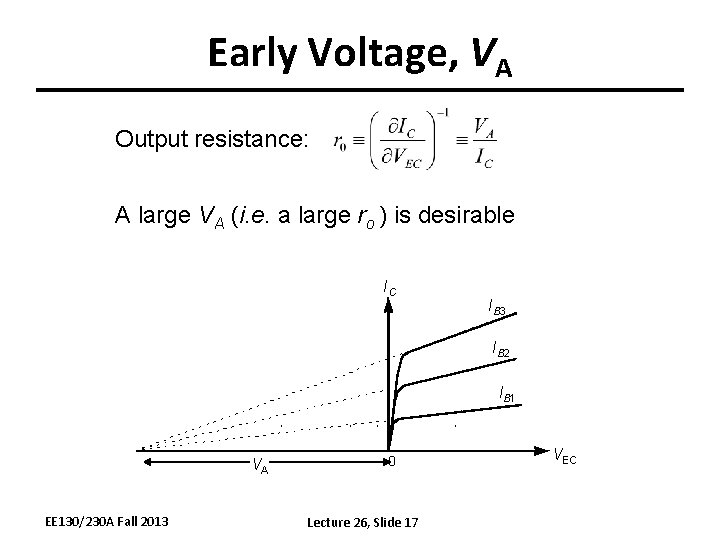
Early Voltage, VA Output resistance: A large VA (i. e. a large ro ) is desirable IC IB 3 IB 2 IB 1 VA EE 130/230 A Fall 2013 0 Lecture 26, Slide 17 VEC
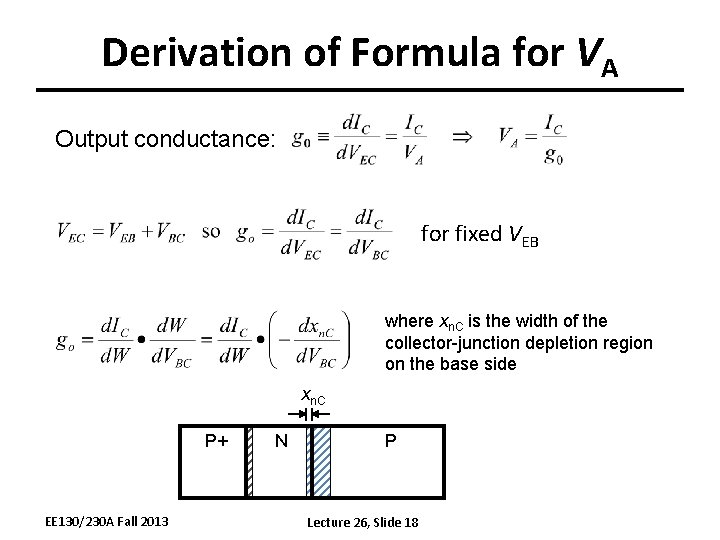
Derivation of Formula for VA Output conductance: for fixed VEB where xn. C is the width of the collector-junction depletion region on the base side xn. C P+ EE 130/230 A Fall 2013 N P Lecture 26, Slide 18
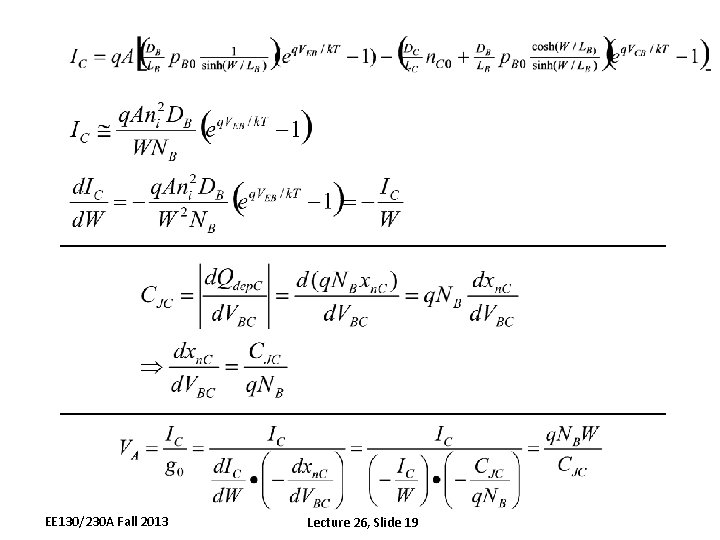
EE 130/230 A Fall 2013 Lecture 26, Slide 19
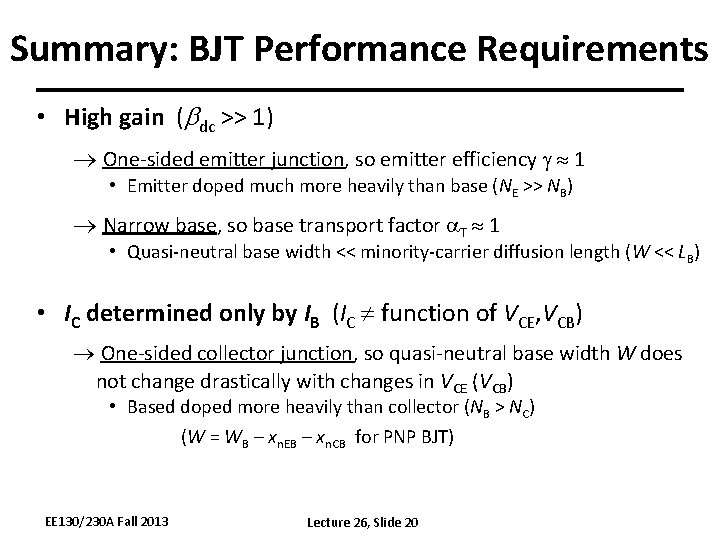
Summary: BJT Performance Requirements • High gain (bdc >> 1) ® One-sided emitter junction, so emitter efficiency g 1 • Emitter doped much more heavily than base (NE >> NB) ® Narrow base, so base transport factor a. T 1 • Quasi-neutral base width << minority-carrier diffusion length (W << LB) • IC determined only by IB (IC function of VCE, VCB) ® One-sided collector junction, so quasi-neutral base width W does not change drastically with changes in VCE (VCB) • Based doped more heavily than collector (NB > NC) (W = WB – xn. EB – xn. CB for PNP BJT) EE 130/230 A Fall 2013 Lecture 26, Slide 20
- Slides: 20