
Lecture 26 of 41 Analogy and CaseBased Reasoning
Lecture 26 of 41 Analogy and Case-Based Reasoning, Part II: CBR and Analogical Reasoning & Learning William H. Hsu Department of Computer Science, KSU Canvas course redirector: http: //bit. ly/kstate-ai-class Course web site: http: //kdd. cs. ksu. edu/Courses/CIS 530/ Instructor home page: http: //www. cs. ksu. edu/~bhsu Reading for This Class: Handouts on Case-Based Reasoning (CBR), Analogical Reasoning Reference: “An Introduction to CBR”, Kolodner (AI Review, 1992) Reading for Next Class: Chapter 13, p. 480 – 503, § 14. 7, p. 546 - 551, Russell and Norvig 3 e CIS 530 / 730 Artificial Intelligence Lecture 26 of 41 Part A (1 of 2) Computer Science Kansas State University
Where we Are Today CIS 530 / 730 Artificial Intelligence Lecture 26 of 41 Part A (1 of 2) Computer Science Kansas State University
Pros & Cons of CBR l Advantages solutions are quickly proposed ðderivation from scratch is avoided domains do not need to be completely understood cases useful for open-ended/ill-defined concepts highlights important features l Disadvantages old cases may be poor library may be biased most appropriate cases may not be retrieved retrieval/adaptation knowledge still needed CIS 530 / 730 Artificial Intelligence Lecture 26 of 41 Part A (1 of 2) Computer Science Kansas State University
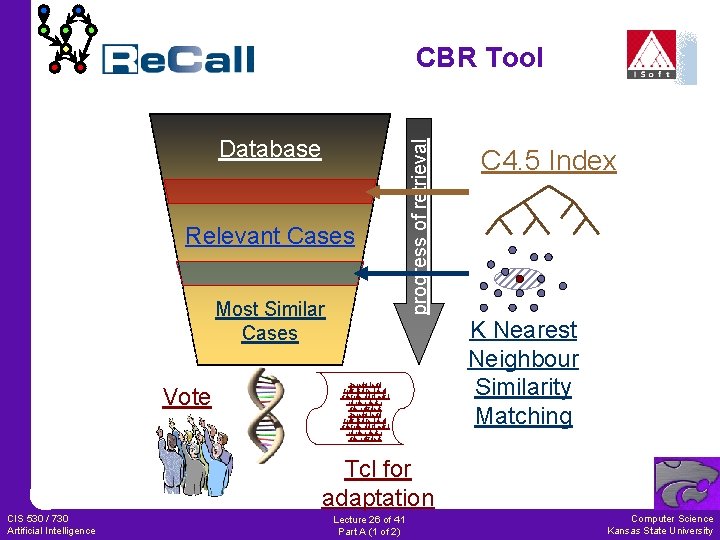
Database Relevant Cases Most Similar Cases Vote progress of retrieval CBR Tool Gshadg hjshfd fhdjf hjkdhfs hjdshfl hfdjsfhdjs hjdhfl hsdfhl hd hdjsh hjsdkh hfds hhfkfd shk C 4. 5 Index K Nearest Neighbour Similarity Matching Tcl for adaptation CIS 530 / 730 Artificial Intelligence Lecture 26 of 41 Part A (1 of 2) Computer Science Kansas State University
CBR Resources l Books I. Watson. Applying Knowledge Management: Techniques For Building Corporate Memories. Morgan Kaufmann, 2003. I. Watson. Applying Case-Based Reasoning: Techniques for Enterprise Systems. Morgan Kaufmann, 1997. l CBR on the web http: //groups. yahoo. com/group/case-based-reasoning/ l CBR Commercial Solutions Orenge from www. empolis. com Kaidara Adviser from (www. kaidara. com) e. Gain (www. egain. com) ðCustomer Service & Contact Centre Software l CBR Tools at DWCU CBR-Works from www. empolis. com Re. Call from www. isoft. fr Weka from www. cs. waikato. ac. nz CIS 530 / 730 Artificial Intelligence Lecture 26 of 41 Part A (1 of 2) Computer Science Kansas State University
Learning by analogy Prof. Gheorghe Tecuci Learning Agents Laboratory Computer Science Department George Mason University CIS 530 / 730 Artificial Intelligence Lecture 26 of 41 Part A (1 of 2) Computer Science Kansas State University
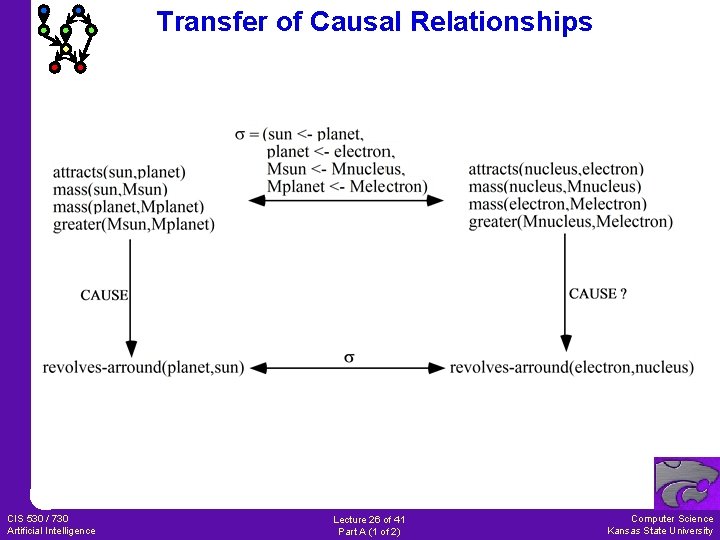
Transfer of Causal Relationships CIS 530 / 730 Artificial Intelligence Lecture 26 of 41 Part A (1 of 2) Computer Science Kansas State University
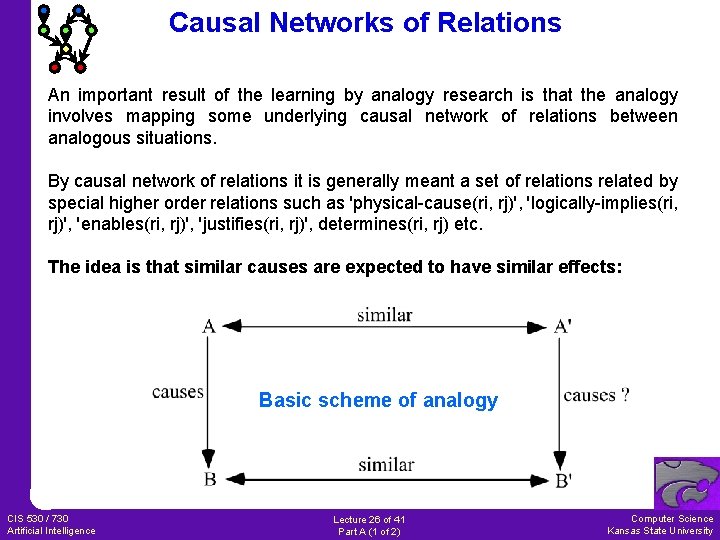
Causal Networks of Relations An important result of the learning by analogy research is that the analogy involves mapping some underlying causal network of relations between analogous situations. By causal network of relations it is generally meant a set of relations related by special higher order relations such as 'physical-cause(ri, rj)', 'logically-implies(ri, rj)', 'enables(ri, rj)', 'justifies(ri, rj)', determines(ri, rj) etc. The idea is that similar causes are expected to have similar effects: Basic scheme of analogy CIS 530 / 730 Artificial Intelligence Lecture 26 of 41 Part A (1 of 2) Computer Science Kansas State University
Overview Learning by analogy: definition Design issues The structure mapping theory Determinations Problem solving by analogy Exercises Recommended reading CIS 530 / 730 Artificial Intelligence Lecture 26 of 41 Part A (1 of 2) Computer Science Kansas State University
![Gentner’s Structure Mapping Theory [1]: Key Idea The main claim of this theory is](http://slidetodoc.com/presentation_image_h/d4e061f697ff6ffd32c43e6003aee33e/image-10.jpg "Gentner’s Structure Mapping Theory [1]: Key Idea The main claim of this theory is")
Gentner’s Structure Mapping Theory [1]: Key Idea The main claim of this theory is that relations between objects, rather than attributes of objects, are mapped from source to target. Moreover, a relation that belongs to a mappable system of mutually interconnecting relationships is more likely to be imported into the target than isolated relation (the systematicity principle). See: Gentner D. , The mechanisms of analogical reasoning, in J. W. Shavlik, T. G. Dietterich (eds), Readings in Machine Learning, Morgan Kaufmann, 1990. CIS 530 / 730 Artificial Intelligence Lecture 26 of 41 Part A (1 of 2) Computer Science Kansas State University
![Gentner’s Structure Mapping Theory [2]: Methodology Analogy maps the objects of the source onto](http://slidetodoc.com/presentation_image_h/d4e061f697ff6ffd32c43e6003aee33e/image-11.jpg "Gentner’s Structure Mapping Theory [2]: Methodology Analogy maps the objects of the source onto")
Gentner’s Structure Mapping Theory [2]: Methodology Analogy maps the objects of the source onto the objects of the target: s 1 « t 1, . . . , sn « tn These object correspondences are used to generate the candidate set of inferences in the target domain. Predicates from the source are carried across to the target, using the node substitutions dictated by the object correspondences, according to the following rules: 1. Discard attributes of objects A(si) -/-> A(ti) For instance, the yellow color of the sun is not transferred to the hydrogen nucleus. 2. Try to preserve relations between objects R(si, sj) -? -> R(ti, tj) That is, some relations are transferred to the target, while others are not. 3. The systematicity principle: the relations that are most likely to be transferred are those belonging to systems of interconnected relations R'(R 1(si, sj), R 2(sk, sl)) ® R'(R 1(ti, tj), R 2(tk, tl)) CIS 530 / 730 Artificial Intelligence Lecture 26 of 41 Part A (1 of 2) Computer Science Kansas State University
![Literal Similarity, Analogy, & Abstraction [1] Gentner's theory distinguishes between literal similarity, analogy, and](http://slidetodoc.com/presentation_image_h/d4e061f697ff6ffd32c43e6003aee33e/image-12.jpg "Literal Similarity, Analogy, & Abstraction [1] Gentner's theory distinguishes between literal similarity, analogy, and")
Literal Similarity, Analogy, & Abstraction [1] Gentner's theory distinguishes between literal similarity, analogy, and abstraction. One says that a target T is literally similar with a source S if and only if a large number of predicates is mapped from source to target, relative to the number of nonmapped predicates and, also, the mapped predicates include both attributes of objects and relations between objects. For instance, 'kool-aid' is literally similar with 'water' since it has most of the features of 'water' (both attributes of objects and relations between objects). Give other examples of literally similar entities. CIS 530 / 730 Artificial Intelligence Lecture 26 of 41 Part A (1 of 2) Computer Science Kansas State University
![Literal Similarity, Analogy, & Abstraction [2] One says that a target T is analogous](http://slidetodoc.com/presentation_image_h/d4e061f697ff6ffd32c43e6003aee33e/image-13.jpg "Literal Similarity, Analogy, & Abstraction [2] One says that a target T is analogous")
Literal Similarity, Analogy, & Abstraction [2] One says that a target T is analogous with a source S if and only if relations between objects, but few or no attributes of objects, can be mapped from source to target. For instance, 'heat' is analogous to 'water'. One says that a source S is an abstraction of a target T if and only if the source is an abstract relational structure and each predicate (a relation between objects or an attribute of an object) from the abstract source is mapped into a less abstract predicate of the target; there are no nonmapped predicates. For instance, 'through-variable' is an abstraction of 'heat', where by 'through-variable' we mean something that flows across a difference in potential. Give other examples of abstractions. CIS 530 / 730 Artificial Intelligence Lecture 26 of 41 Part A (1 of 2) Computer Science Kansas State University
![Similarity, Analogy, and Abstraction: Discussion [1] Given that two entities overlap in relations, they](http://slidetodoc.com/presentation_image_h/d4e061f697ff6ffd32c43e6003aee33e/image-14.jpg "Similarity, Analogy, and Abstraction: Discussion [1] Given that two entities overlap in relations, they")
Similarity, Analogy, and Abstraction: Discussion [1] Given that two entities overlap in relations, they are more literally similar to the extent that their object attributes also overlap. Therefore, literal similarity might be seen as a particular case of analogy. Abstraction may also be seen as a special case of analogy in which all the predicates of the source entity are mapped into the target entity. What could we conclude from these observations? CIS 530 / 730 Artificial Intelligence Lecture 26 of 41 Part A (1 of 2) Computer Science Kansas State University
- Slides: 14