
Lecture 26 Mechanical Properties I Metals Ceramics Reading
![Engineering Stress & Strain [Callister 6. 2] tension compression from Callister Lecture 26, summer](https://slidetodoc.com/presentation_image_h/341042f32b9bb402341b7c07f36889aa/image-2.jpg "Engineering Stress & Strain [Callister 6. 2] tension compression from Callister Lecture 26, summer")
![Elasticity vs. Plasticity [Callister 6. 2] • Elastic behavior • 0 when 0 •](https://slidetodoc.com/presentation_image_h/341042f32b9bb402341b7c07f36889aa/image-3.jpg "Elasticity vs. Plasticity [Callister 6. 2] • Elastic behavior • 0 when 0 •")
![Poisson’s Ratio [Callister 6. 5] • Elastic dimensional change will occur transverse to applied](https://slidetodoc.com/presentation_image_h/341042f32b9bb402341b7c07f36889aa/image-4.jpg "Poisson’s Ratio [Callister 6. 5] • Elastic dimensional change will occur transverse to applied")
![Elastic Behavior [Callister 6. 3] • Stress-strain curve for loading … • … is](https://slidetodoc.com/presentation_image_h/341042f32b9bb402341b7c07f36889aa/image-5.jpg "Elastic Behavior [Callister 6. 3] • Stress-strain curve for loading … • … is")
![Modulus of Elasticity and the Interatomic Potential [Callister 6. 3] • Recall that energy](https://slidetodoc.com/presentation_image_h/341042f32b9bb402341b7c07f36889aa/image-6.jpg "Modulus of Elasticity and the Interatomic Potential [Callister 6. 3] • Recall that energy")
![Modulus of Elasticity and the Interatomic Potential [Callister 6. 3] • F = d(energy)/dr](https://slidetodoc.com/presentation_image_h/341042f32b9bb402341b7c07f36889aa/image-7.jpg "Modulus of Elasticity and the Interatomic Potential [Callister 6. 3] • F = d(energy)/dr")
![Modulus of Elasticity and the Interatomic Potential [Callister 6. 3] • Modulus of elasticity](https://slidetodoc.com/presentation_image_h/341042f32b9bb402341b7c07f36889aa/image-8.jpg "Modulus of Elasticity and the Interatomic Potential [Callister 6. 3] • Modulus of elasticity")
![Elastic Modulus: Temperature Dependence [Callister 6. 3] • E gradually as T Callister Fig.](https://slidetodoc.com/presentation_image_h/341042f32b9bb402341b7c07f36889aa/image-10.jpg "Elastic Modulus: Temperature Dependence [Callister 6. 3] • E gradually as T Callister Fig.")
![Mechanical Properties of Metals [Callister 6. 5] • Plastic behavior: some strain remains after](https://slidetodoc.com/presentation_image_h/341042f32b9bb402341b7c07f36889aa/image-11.jpg "Mechanical Properties of Metals [Callister 6. 5] • Plastic behavior: some strain remains after")
![Mechanical Properties of Metals [Callister 6. 5] • Plastic behavior in a tensile test](https://slidetodoc.com/presentation_image_h/341042f32b9bb402341b7c07f36889aa/image-12.jpg "Mechanical Properties of Metals [Callister 6. 5] • Plastic behavior in a tensile test")
![Mechanical Properties of Metals [Callister 6. 5] • Brittle vs. ductile Two measures of](https://slidetodoc.com/presentation_image_h/341042f32b9bb402341b7c07f36889aa/image-13.jpg "Mechanical Properties of Metals [Callister 6. 5] • Brittle vs. ductile Two measures of")
![Modulus of Resilience [Callister 6. 6] • Measure of a material’s capacity to absorb](https://slidetodoc.com/presentation_image_h/341042f32b9bb402341b7c07f36889aa/image-16.jpg "Modulus of Resilience [Callister 6. 6] • Measure of a material’s capacity to absorb")
![Modulus of Toughness [Callister 6. 6] • A measure of energy absorbed during fracture](https://slidetodoc.com/presentation_image_h/341042f32b9bb402341b7c07f36889aa/image-17.jpg "Modulus of Toughness [Callister 6. 6] • A measure of energy absorbed during fracture")
![True Stress and Strain [Callister 6. 7] • Engineering stress and strain: based on](https://slidetodoc.com/presentation_image_h/341042f32b9bb402341b7c07f36889aa/image-18.jpg "True Stress and Strain [Callister 6. 7] • Engineering stress and strain: based on")
![True Stress and Strain [Callister 6. 7] • Engineering stress and strain: based on](https://slidetodoc.com/presentation_image_h/341042f32b9bb402341b7c07f36889aa/image-19.jpg "True Stress and Strain [Callister 6. 7] • Engineering stress and strain: based on")
![Mechanical Properties of Ceramics [Callister 13. 8] • Virtually no plasticity at room T](https://slidetodoc.com/presentation_image_h/341042f32b9bb402341b7c07f36889aa/image-20.jpg "Mechanical Properties of Ceramics [Callister 13. 8] • Virtually no plasticity at room T")
![Mechanical Properties of Ceramics [Callister 13. 8] • Flexural strength: measured in 3 -point](https://slidetodoc.com/presentation_image_h/341042f32b9bb402341b7c07f36889aa/image-21.jpg "Mechanical Properties of Ceramics [Callister 13. 8] • Flexural strength: measured in 3 -point")
![Mechanical Properties of Ceramics [Callister 13. 8] • Moduli usu. higher than for metals](https://slidetodoc.com/presentation_image_h/341042f32b9bb402341b7c07f36889aa/image-22.jpg "Mechanical Properties of Ceramics [Callister 13. 8] • Moduli usu. higher than for metals")
- Slides: 22
Lecture 26: Mechanical Properties I: Metals & Ceramics Reading assignment: Callister 6. 1 -6. 3, 6. 5 -6. 9, 13. 8 -13. 9 Learning objectives: • Understand the difference between elastic and plastic deformation • Know how to determine mechanical properties from the results of a tensile test • Elastic modulus • Yield strength • Tensile strength • Strain to failure • Understand how the mechanical properties of ceramics differ from those of ductile metals Lecture 26, summer 2007 Mechanical Properties I: Metals & Ceramics ENGR 145, Chemistry of Materials Case Western Reserve University
Engineering Stress & Strain [Callister 6. 2] tension compression from Callister Lecture 26, summer 2007 Mechanical Properties I: Metals & Ceramics ENGR 145, Chemistry of Materials Case Western Reserve University
Elasticity vs. Plasticity [Callister 6. 2] • Elastic behavior • 0 when 0 • Reversible deformation — no permanent shape change after load is removed • Plastic behavior • ≠ 0 when 0 • Some strain remains after load has been removed Lecture 26, summer 2007 Mechanical Properties I: Metals & Ceramics ENGR 145, Chemistry of Materials Case Western Reserve University
Poisson’s Ratio [Callister 6. 5] • Elastic dimensional change will occur transverse to applied uniaxial load: Poisson’s ratio Lecture 26, summer 2007 Mechanical Properties I: Metals & Ceramics ENGR 145, Chemistry of Materials Case Western Reserve University
Elastic Behavior [Callister 6. 3] • Stress-strain curve for loading … • … is retraced on unloading • Linear elastic behavior: Hooke’s law modulus of elasticity (a. k. a. Young’s modulus) • Note: not all elastic behavior is linear (see e. g. Callister Figure 6. 6) … • … but all elastic behavior is reversible Lecture 26, summer 2007 Mechanical Properties I: Metals & Ceramics ENGR 145, Chemistry of Materials Case Western Reserve University Callister Fig. 6. 5
Modulus of Elasticity and the Interatomic Potential [Callister 6. 3] • Recall that energy between atoms depends on their separation • Recall also that Minimum in energy zero net force Applying tension or compression raises energy of material compression Lecture 26, summer 2007 Mechanical Properties I: Metals & Ceramics tension ENGR 145, Chemistry of Materials Case Western Reserve University Callister Fig. 2. 8 b
Modulus of Elasticity and the Interatomic Potential [Callister 6. 3] • F = d(energy)/dr • Modulus of elasticity d. F/dr E d 2(energy)/dr 2 — curvature of interatomic potential near ro Lecture 26, summer 2007 Mechanical Properties I: Metals & Ceramics ENGR 145, Chemistry of Materials Case Western Reserve University Callister Fig. 2. 8 a
Modulus of Elasticity and the Interatomic Potential [Callister 6. 3] • Modulus of elasticity d. F/dr high modulus low modulus Lecture 26, summer 2007 Mechanical Properties I: Metals & Ceramics ENGR 145, Chemistry of Materials Case Western Reserve University Callister Fig. 6. 7
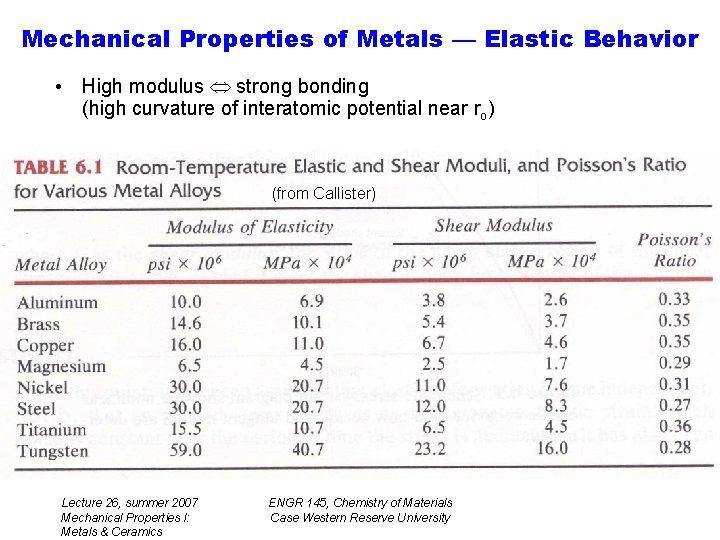
Mechanical Properties of Metals — Elastic Behavior • High modulus strong bonding (high curvature of interatomic potential near ro) (from Callister) Lecture 26, summer 2007 Mechanical Properties I: Metals & Ceramics ENGR 145, Chemistry of Materials Case Western Reserve University
Elastic Modulus: Temperature Dependence [Callister 6. 3] • E gradually as T Callister Fig. 2. 8 Callister Fig 6. 8 Lecture 26, summer 2007 Mechanical Properties I: Metals & Ceramics ENGR 145, Chemistry of Materials Case Western Reserve University
Mechanical Properties of Metals [Callister 6. 5] • Plastic behavior: some strain remains after removal of load • Yield strength: stress that will result in a specified residual strain 0. 2% yield strength 0. 002=0. 2%) Lecture 26, summer 2007 Mechanical Properties I: Metals & Ceramics ENGR 145, Chemistry of Materials Case Western Reserve University
Mechanical Properties of Metals [Callister 6. 5] • Plastic behavior in a tensile test • Yielding • Tensile strength (M) (a. k. a. ultimate tensile strength) • Necking • Fracture (F) Callister Fig. 6. 11 Lecture 26, summer 2007 Mechanical Properties I: Metals & Ceramics ENGR 145, Chemistry of Materials Case Western Reserve University
Mechanical Properties of Metals [Callister 6. 5] • Brittle vs. ductile Two measures of ductility: % elongation % area reduction Callister Fig. 6. 13 Lecture 26, summer 2007 Mechanical Properties I: Metals & Ceramics ENGR 145, Chemistry of Materials Case Western Reserve University
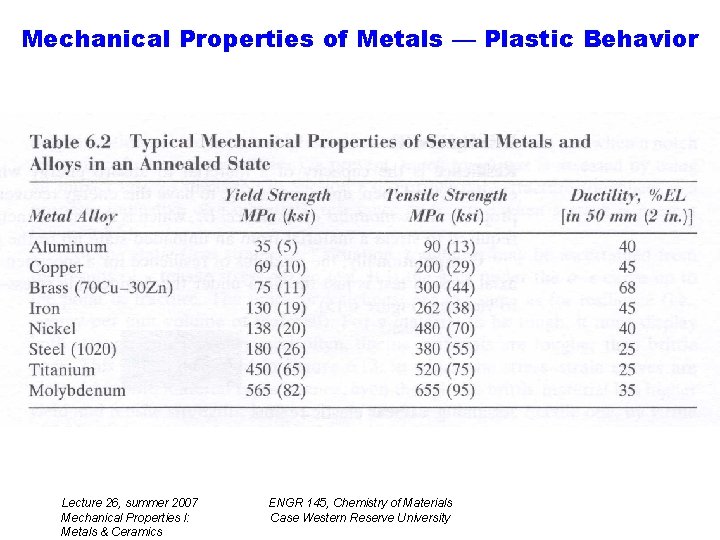
Mechanical Properties of Metals — Plastic Behavior Lecture 26, summer 2007 Mechanical Properties I: Metals & Ceramics ENGR 145, Chemistry of Materials Case Western Reserve University
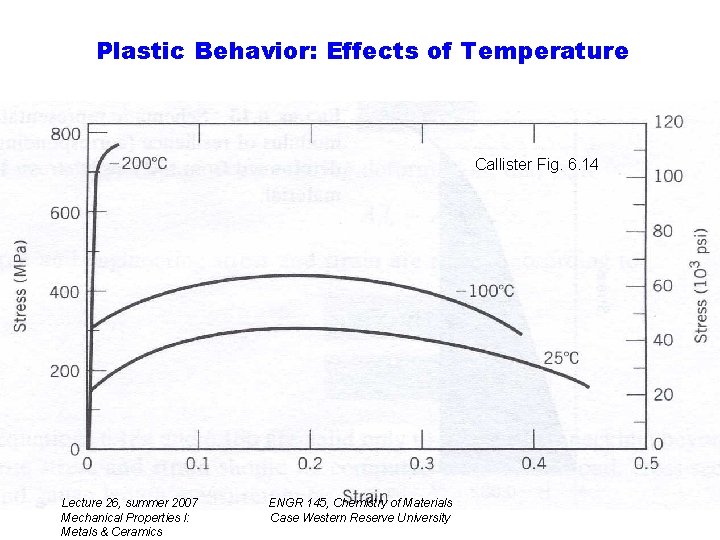
Plastic Behavior: Effects of Temperature Callister Fig. 6. 14 Lecture 26, summer 2007 Mechanical Properties I: Metals & Ceramics ENGR 145, Chemistry of Materials Case Western Reserve University
Modulus of Resilience [Callister 6. 6] • Measure of a material’s capacity to absorb mechanical energy elastically • Area under stress-strain curve has units of energy per unit volume • Approximate this integral with: Callister Fig. 6. 15 Lecture 26, summer 2007 Mechanical Properties I: Metals & Ceramics ENGR 145, Chemistry of Materials Case Western Reserve University
Modulus of Toughness [Callister 6. 6] • A measure of energy absorbed during fracture • Area under stress-strain curve has units of energy per unit volume • Approximate this area as or Lecture 26, summer 2007 Mechanical Properties I: Metals & Ceramics ENGR 145, Chemistry of Materials Case Western Reserve University Callister Fig. 6. 13
True Stress and Strain [Callister 6. 7] • Engineering stress and strain: based on initial dimensions • True stress and strain: based on instantaneous dimensions (i) Lecture 26, summer 2007 Mechanical Properties I: Metals & Ceramics ENGR 145, Chemistry of Materials Case Western Reserve University Callister Fig. 6. 1
True Stress and Strain [Callister 6. 7] • Engineering stress and strain: based on initial dimensions • True stress and true strain: based on instantaneous dimensions Start of necking Lecture 26, summer 2007 Mechanical Properties I: Metals & Ceramics ENGR 145, Chemistry of Materials Case Western Reserve University Callister Fig. 6. 16
Mechanical Properties of Ceramics [Callister 13. 8] • Virtually no plasticity at room T • Strain to failure typically < 0. 2% • Linear to fracture Lecture 26, summer 2007 Mechanical Properties I: Metals & Ceramics ENGR 145, Chemistry of Materials Case Western Reserve University Callister Fig. 13. 29
Mechanical Properties of Ceramics [Callister 13. 8] • Flexural strength: measured in 3 -point bending • a. k. a. modulus of rupture, 3 -point bend strength, fracture strength Compression Tension rectangular cross-section Lecture 26, summer 2007 Mechanical Properties I: Metals & Ceramics circular cross-section ENGR 145, Chemistry of Materials Case Western Reserve University Callister Fig. 13. 28
Mechanical Properties of Ceramics [Callister 13. 8] • Moduli usu. higher than for metals Lecture 26, summer 2007 Mechanical Properties I: Metals & Ceramics • Wide spread in strengths ENGR 145, Chemistry of Materials Case Western Reserve University