
Lecture 25 OUTLINE The Bipolar Junction Transistor Introduction

Lecture 25 OUTLINE The Bipolar Junction Transistor • Introduction • BJT Fundamentals Reading: Pierret 10; Hu 8. 1
Introduction • In recent decades, the higher layout density and low-power advantage of CMOS technology has eroded the BJT’s dominance in integrated-circuit products. (higher circuit density better system performance) • BJTs are still preferred in some integrated circuit applications because of their high speed and superior intrinsic gain. ü faster circuit speed û larger power dissipation limits device density (~104 transistors/chip) EE 130/230 A Fall 2013 Lecture 25, Slide 2

BJT Types and Definitions • The BJT is a 3 -terminal device, with two types: PNP and NPN VEB = VE – VB VCB = VC – VB VEC = VE – VC = VEB - VCB VBE = VB – VE VBC = VB – VC VCE = VC – VE = VCB - VEB Note: The current flow sign convention used in the Pierret textbook does not follow IEEE convention (currents defined as positive flowing into a terminal); nevertheless, we will use it. EE 130/230 A Fall 2013 Lecture 25, Slide 3 R. F. Pierret, Semiconductor Device Fundamentals, p. 372

Review: Current Flow in a Reverse-Biased pn Junction • In a reverse-biased pn junction, there is negligible diffusion of majority carriers across the junction. The reverse saturation current is due to drift of minority carriers across the junction and depends on the rate of minority-carrier generation close to the junction (within ~one diffusion length of the depletion region). Þ We can increase this reverse current by increasing the rate of minority-carrier generation, e. g. by Ø optical excitation of carriers (e. g. photodiode) Ø electrical injection of minority carriers into the vicinity of the junction… EE 130/230 A Fall 2013 Lecture 25, Slide 4

PNP BJT Operation (Qualitative) A forward-biased “emitter” pn junction is used to inject minority carriers into the vicinity of a reverse-biased “collector” pn junction. The collector current is controlled via the base-emitter junction. “Active mode”: • VEB > 0 • VCB < 0 ICn “Collector” “Emitter” “Base” ICp EE 130/230 A Fall 2013 current gain Lecture 25, Slide 5
BJT Design • To achieve high current gain: – The injected minority carriers should not recombine within the quasi-neutral base region – The emitter junction current is comprised almost entirely of carriers injected into the base (rather than carriers injected into the emitter) EE 130/230 A Fall 2013 Lecture 25, Slide 6
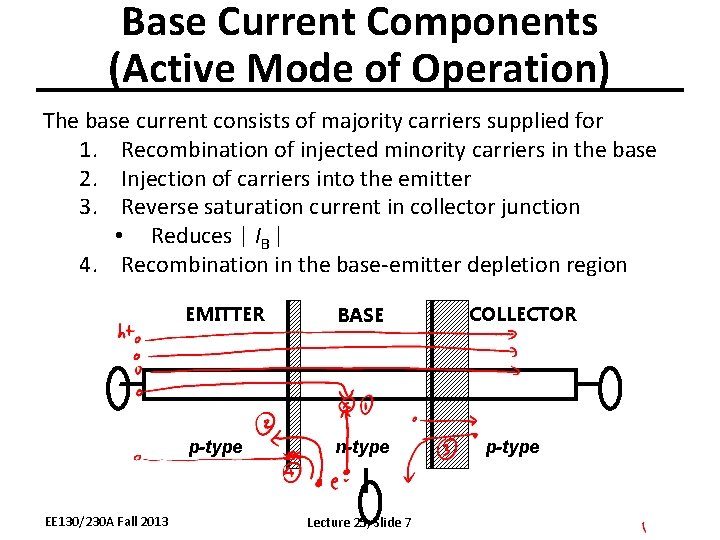
Base Current Components (Active Mode of Operation) The base current consists of majority carriers supplied for 1. Recombination of injected minority carriers in the base 2. Injection of carriers into the emitter 3. Reverse saturation current in collector junction • Reduces | IB | 4. Recombination in the base-emitter depletion region EE 130/230 A Fall 2013 EMITTER BASE p-type n-type Lecture 25, Slide 7 COLLECTOR p-type

BJT Circuit Configurations R. F. Pierret, Semiconductor Device Fundamentals, Fig. 10. 3 Output Characteristics for Common-Emitter Configuration EE 130/230 A Fall 2013 Lecture 25, Slide 8 R. F. Pierret, Semiconductor Device Fundamentals, Fig. 10. 4

BJT Modes of Operation R. F. Pierret, Semiconductor Device Fundamentals, Fig. 10. 5 Common-emitter output characteristics (IC vs. VCE) Mode Emitter Junction Collector Junction CUTOFF reverse bias Forward ACTIVE forward bias reverse bias* Reverse ACTIVE reverse bias* forward bias SATURATION forward bias EE 130/230 A Fall 2013 Lecture 25, Slide 9 *more precisely: not strongly forward biased

BJT Electrostatics • Under normal operating conditions, the BJT may be viewed electrostatically as two independent pn junctions EE 130/230 A Fall 2013 Lecture 25, Slide 10 R. F. Pierret, Semiconductor Device Fundamentals, Fig. 10. 7
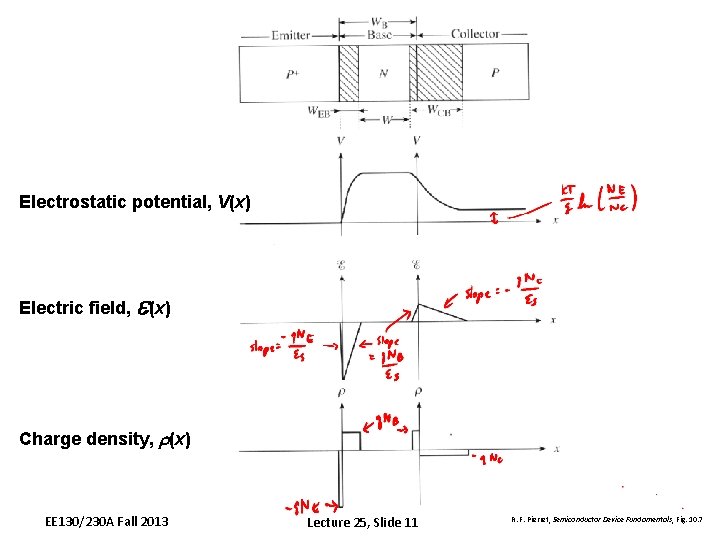
Electrostatic potential, V(x) e Electric field, (x) Charge density, r(x) EE 130/230 A Fall 2013 Lecture 25, Slide 11 R. F. Pierret, Semiconductor Device Fundamentals, Fig. 10. 7
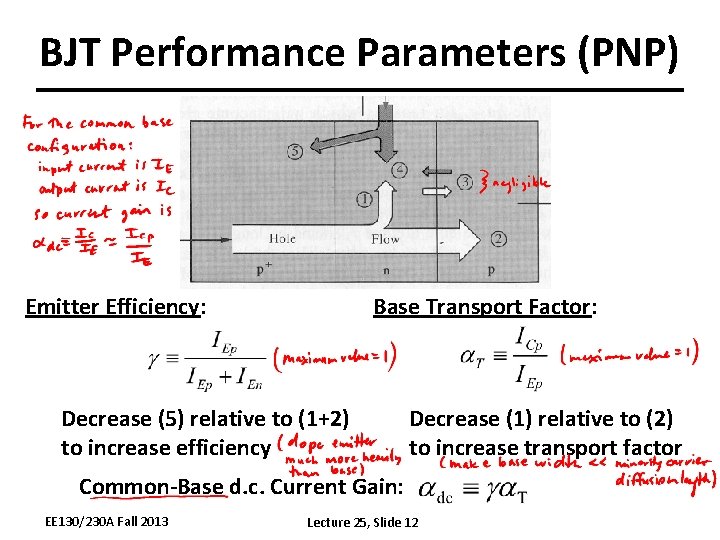
BJT Performance Parameters (PNP) Emitter Efficiency: Base Transport Factor: Decrease (5) relative to (1+2) to increase efficiency Decrease (1) relative to (2) to increase transport factor Common-Base d. c. Current Gain: EE 130/230 A Fall 2013 Lecture 25, Slide 12
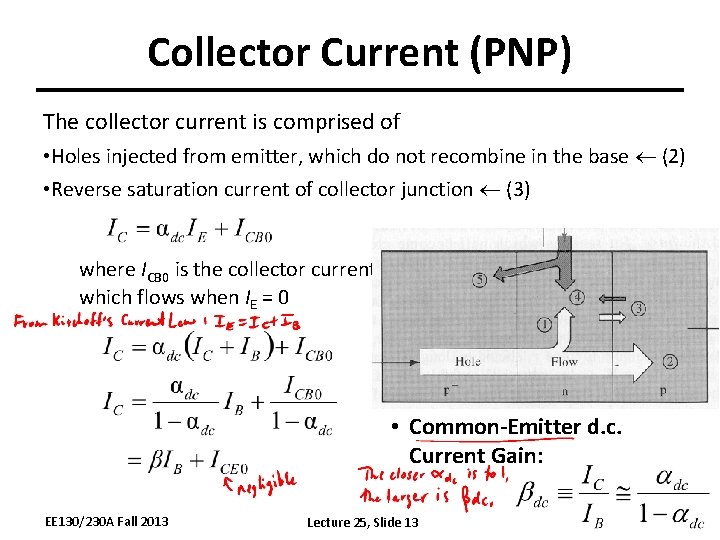
Collector Current (PNP) The collector current is comprised of • Holes injected from emitter, which do not recombine in the base (2) • Reverse saturation current of collector junction (3) where ICB 0 is the collector current which flows when IE = 0 • Common-Emitter d. c. Current Gain: EE 130/230 A Fall 2013 Lecture 25, Slide 13

Summary: BJT Fundamentals • Notation & conventions: IE = IB + IC pnp BJT npn BJT • Electrostatics: – Under normal operating conditions, the BJT may be viewed electrostatically as two independent pn junctions EE 130/230 A Fall 2013 Lecture 25, Slide 14
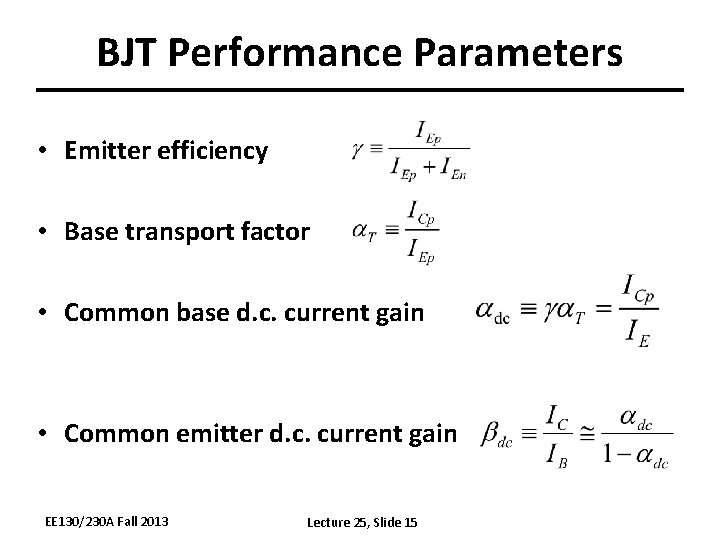
BJT Performance Parameters • Emitter efficiency • Base transport factor • Common base d. c. current gain • Common emitter d. c. current gain EE 130/230 A Fall 2013 Lecture 25, Slide 15
- Slides: 15