
Lecture 25 Eye Movement and Vision Sclera Light
- Slides: 13
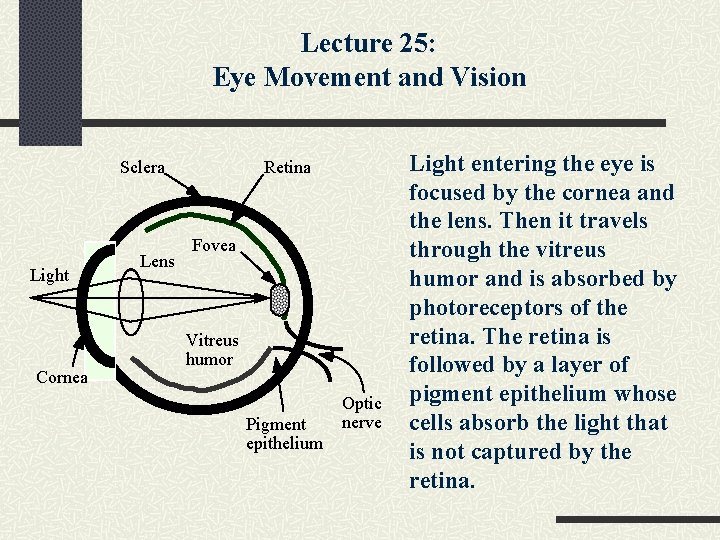
Lecture 25: Eye Movement and Vision Sclera Light Cornea Lens Retina Fovea Vitreus humor Pigment epithelium Optic nerve Light entering the eye is focused by the cornea and the lens. Then it travels through the vitreus humor and is absorbed by photoreceptors of the retina. The retina is followed by a layer of pigment epithelium whose cells absorb the light that is not captured by the retina.
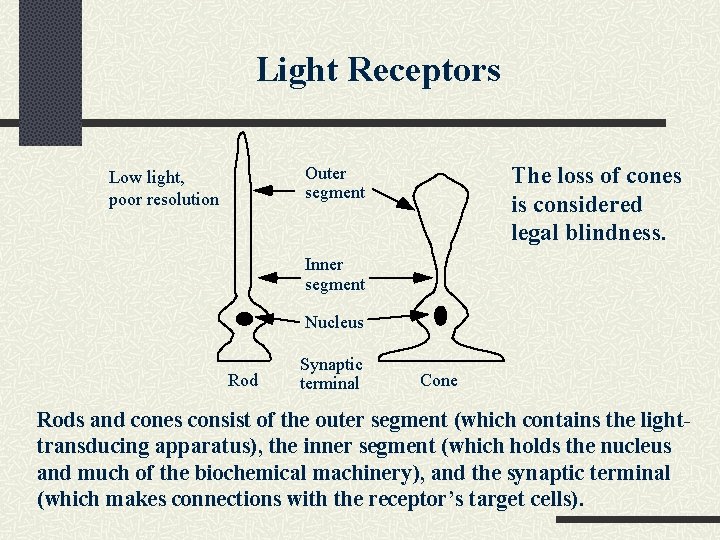
Light Receptors The loss of cones is considered legal blindness. Outer segment Low light, poor resolution Inner segment Nucleus Rod Synaptic terminal Cone Rods and cones consist of the outer segment (which contains the lighttransducing apparatus), the inner segment (which holds the nucleus and much of the biochemical machinery), and the synaptic terminal (which makes connections with the receptor’s target cells).
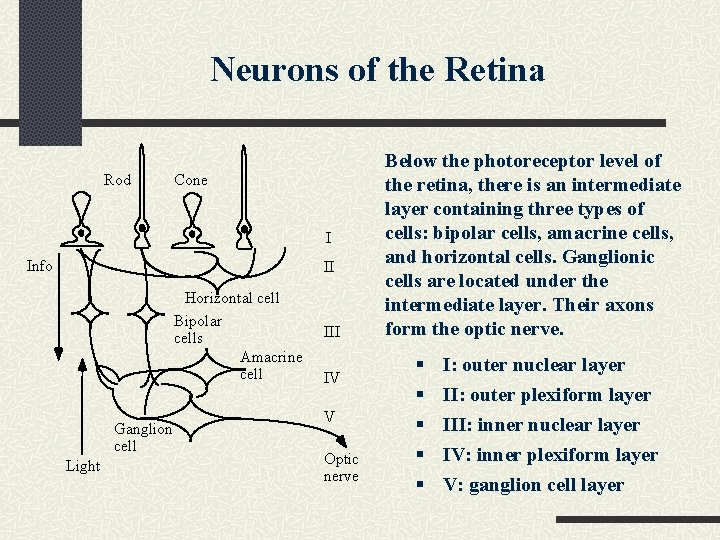
Neurons of the Retina Rod Cone I Info II Horizontal cell Bipolar cells Amacrine cell Ganglion cell Light III IV V Optic nerve Below the photoreceptor level of the retina, there is an intermediate layer containing three types of cells: bipolar cells, amacrine cells, and horizontal cells. Ganglionic cells are located under the intermediate layer. Their axons form the optic nerve. § § § I: outer nuclear layer II: outer plexiform layer III: inner nuclear layer IV: inner plexiform layer V: ganglion cell layer
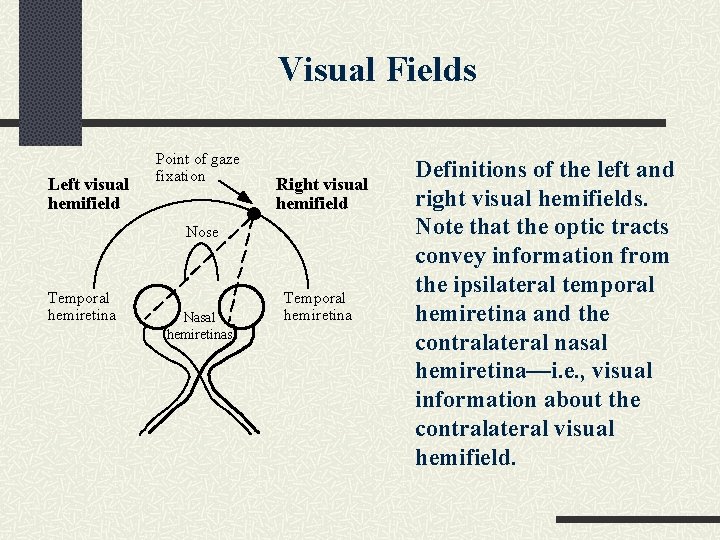
Visual Fields Left visual hemifield Point of gaze fixation Right visual hemifield Nose Temporal hemiretina Nasal hemiretinas Temporal hemiretina Definitions of the left and right visual hemifields. Note that the optic tracts convey information from the ipsilateral temporal hemiretina and the contralateral nasal hemiretina—i. e. , visual information about the contralateral visual hemifield.
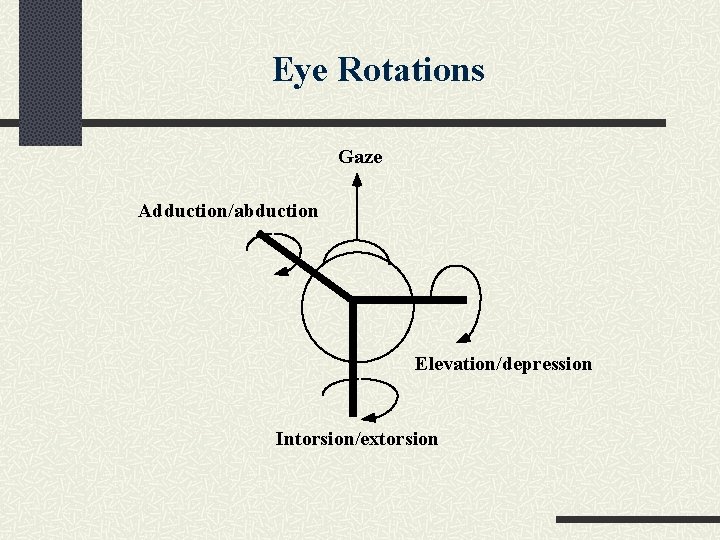
Eye Rotations Gaze Adduction/abduction Elevation/depression Intorsion/extorsion
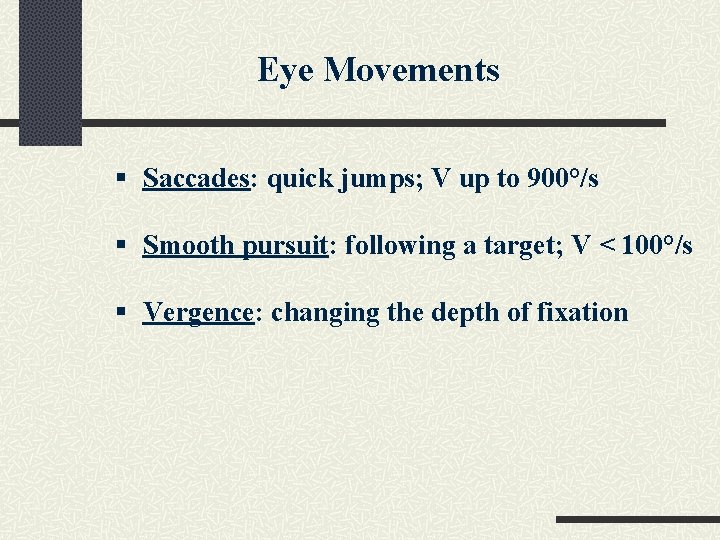
Eye Movements § Saccades: quick jumps; V up to 900°/s § Smooth pursuit: following a target; V < 100°/s § Vergence: changing the depth of fixation
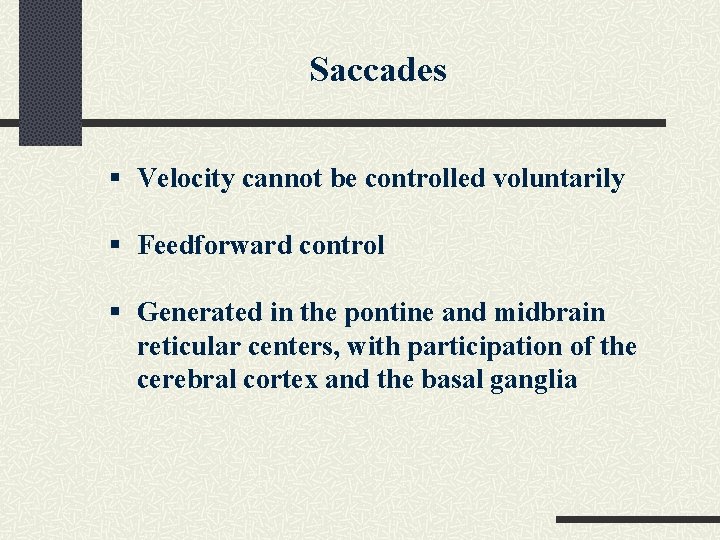
Saccades § Velocity cannot be controlled voluntarily § Feedforward control § Generated in the pontine and midbrain reticular centers, with participation of the cerebral cortex and the basal ganglia
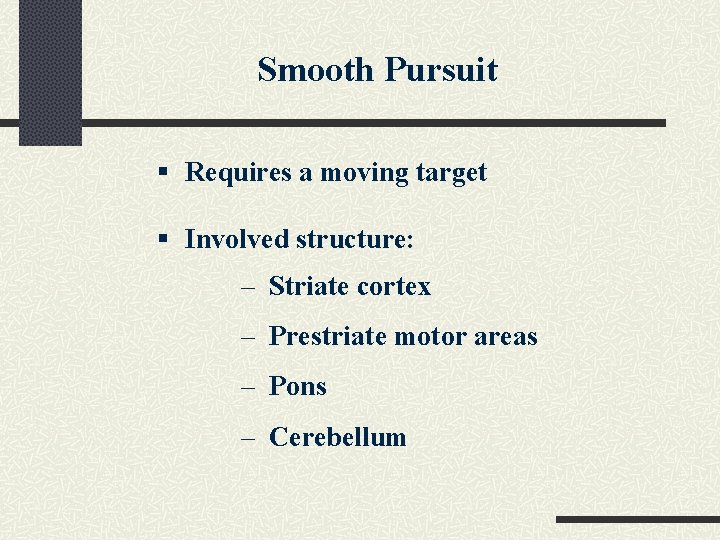
Smooth Pursuit § Requires a moving target § Involved structure: – Striate cortex – Prestriate motor areas – Pons – Cerebellum
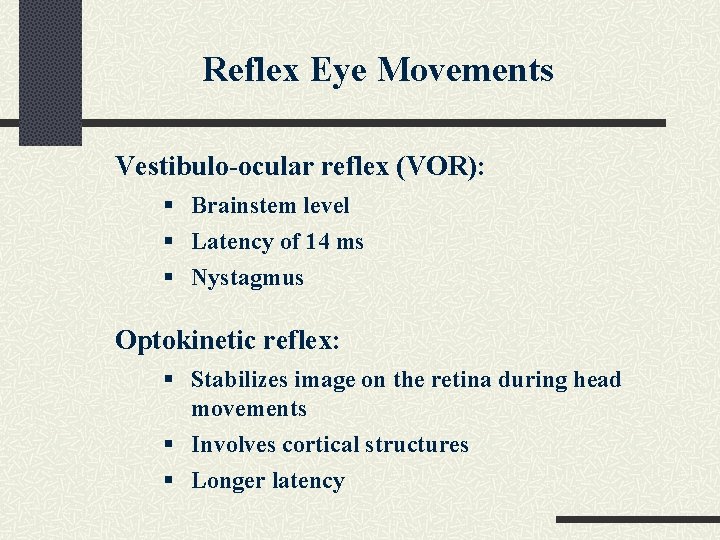
Reflex Eye Movements Vestibulo-ocular reflex (VOR): § Brainstem level § Latency of 14 ms § Nystagmus Optokinetic reflex: § Stabilizes image on the retina during head movements § Involves cortical structures § Longer latency
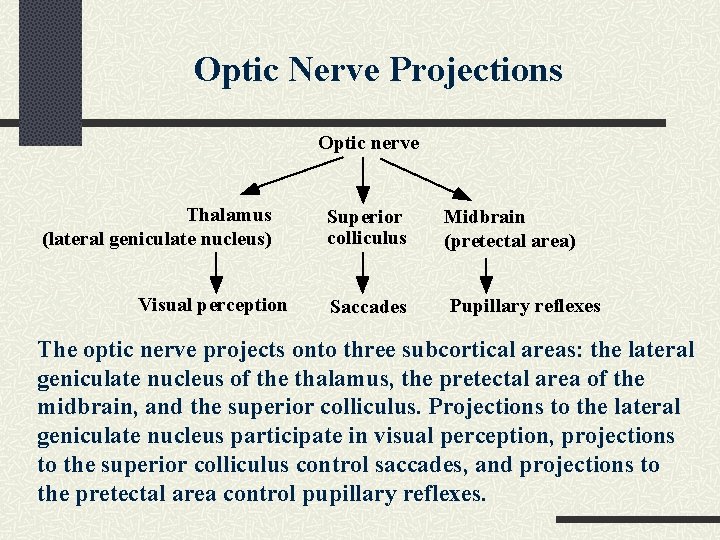
Optic Nerve Projections Optic nerve Thalamus (lateral geniculate nucleus) Visual perception Superior colliculus Saccades Midbrain (pretectal area) Pupillary reflexes The optic nerve projects onto three subcortical areas: the lateral geniculate nucleus of the thalamus, the pretectal area of the midbrain, and the superior colliculus. Projections to the lateral geniculate nucleus participate in visual perception, projections to the superior colliculus control saccades, and projections to the pretectal area control pupillary reflexes.
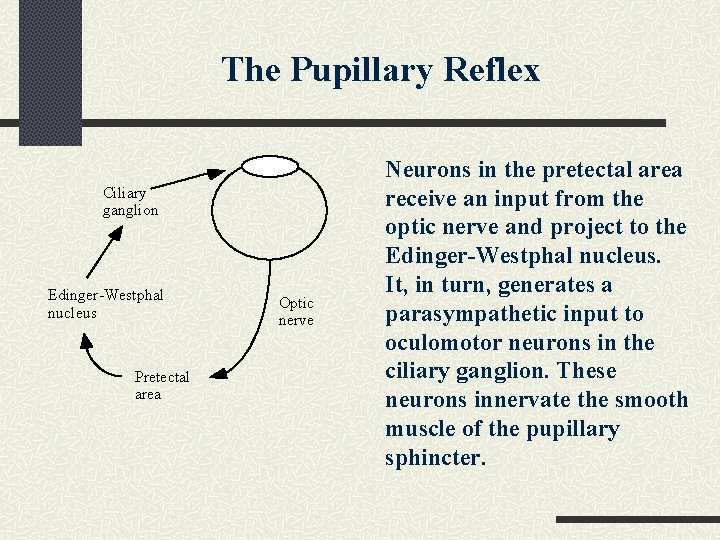
The Pupillary Reflex Ciliary ganglion Edinger-Westphal nucleus Pretectal area Optic nerve Neurons in the pretectal area receive an input from the optic nerve and project to the Edinger-Westphal nucleus. It, in turn, generates a parasympathetic input to oculomotor neurons in the ciliary ganglion. These neurons innervate the smooth muscle of the pupillary sphincter.
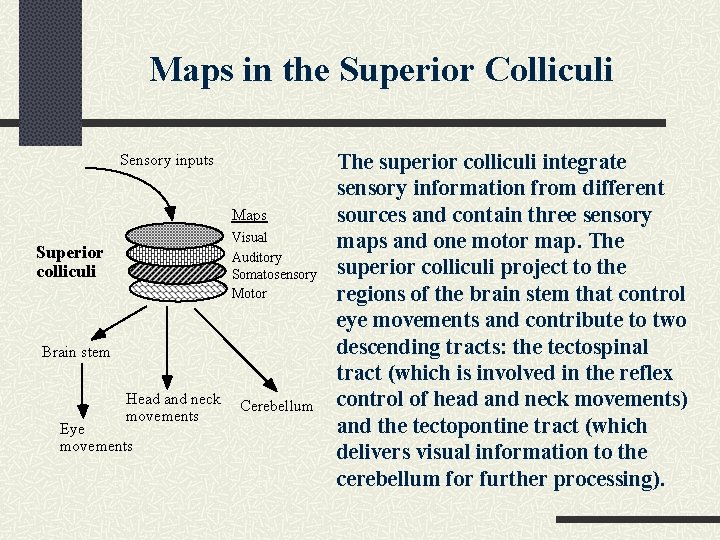
Maps in the Superior Colliculi Sensory inputs Maps Visual Auditory Somatosensory Motor Superior colliculi Brain stem Head and neck movements Eye movements Cerebellum The superior colliculi integrate sensory information from different sources and contain three sensory maps and one motor map. The superior colliculi project to the regions of the brain stem that control eye movements and contribute to two descending tracts: the tectospinal tract (which is involved in the reflex control of head and neck movements) and the tectopontine tract (which delivers visual information to the cerebellum for further processing).
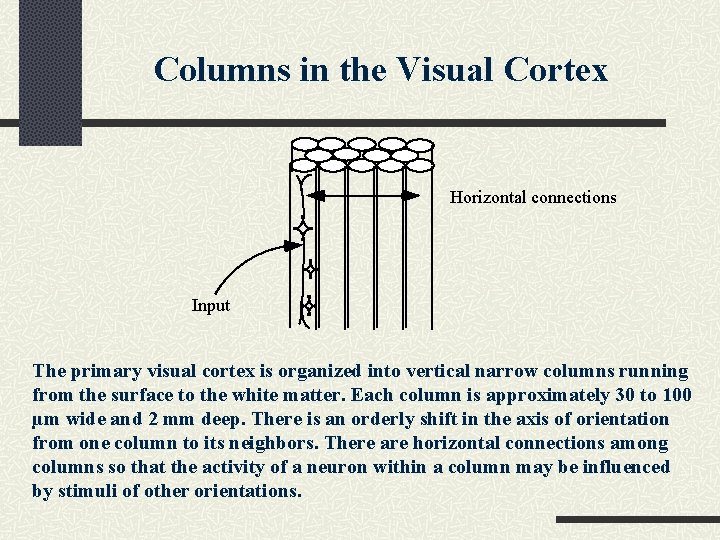
Columns in the Visual Cortex Horizontal connections Input The primary visual cortex is organized into vertical narrow columns running from the surface to the white matter. Each column is approximately 30 to 100 µm wide and 2 mm deep. There is an orderly shift in the axis of orientation from one column to its neighbors. There are horizontal connections among columns so that the activity of a neuron within a column may be influenced by stimuli of other orientations.