
Lecture 24 Limits on human population and impacts

- Slides: 34
Lecture 24 – Limits on human population and impacts on the Earth System Reading – P. 464 -465, 473, 523 -539, 577 -592 Quiz 9 available from 2 p. m. until noon on Monday.
Final • Wednesday 12 th December from 1. 30 -3. 30 p. m. in this room (ALP 1300) • Same format as midterm but longer with ~ 60 multiple choice questions and 40 pts of short answers • Half questions on Lectures 1 -19 and half questions on Lectures 20 -27. • Assigned seating will be posted the night before the exam. • You will need: – Datalink form 20420 – I will not have any spare with me at the final – Pencil – Student photo ID – Double-sided half-letter sized (8. 5 x 5. 5 inch) page of notes • Provisional study guide is now available on website and will be updated after remaining lectures. • There is no practice final but I will post some sample Part B questions for you. Use the midterms, practice quizzes, discussions, iclicker Qs to study. • Review session will be on Friday 7 th Dec from 4 -4. 50 p. m. in ELH 100
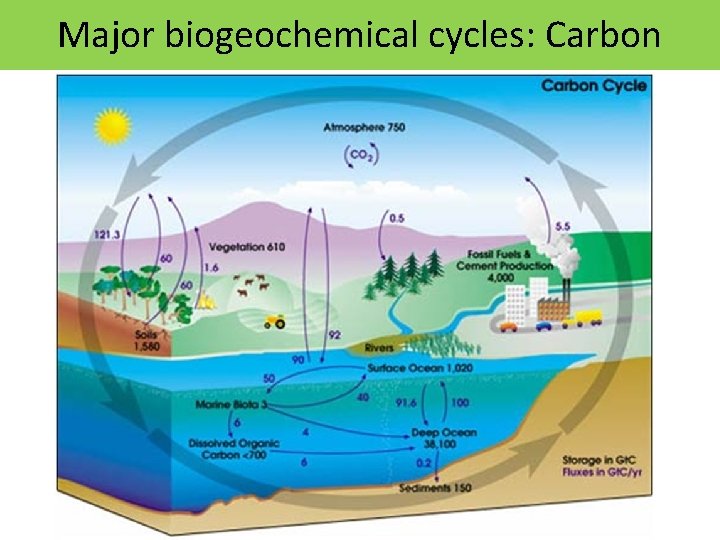
Major biogeochemical cycles: Carbon
Major biogeochemical cycles: Carbon 1. What reservoirs are there? 2. What are the sources and sinks of those reservoirs? 3. What is the residence time of carbon in those reservoirs? 4. Are there any feedbacks that influence carbon?
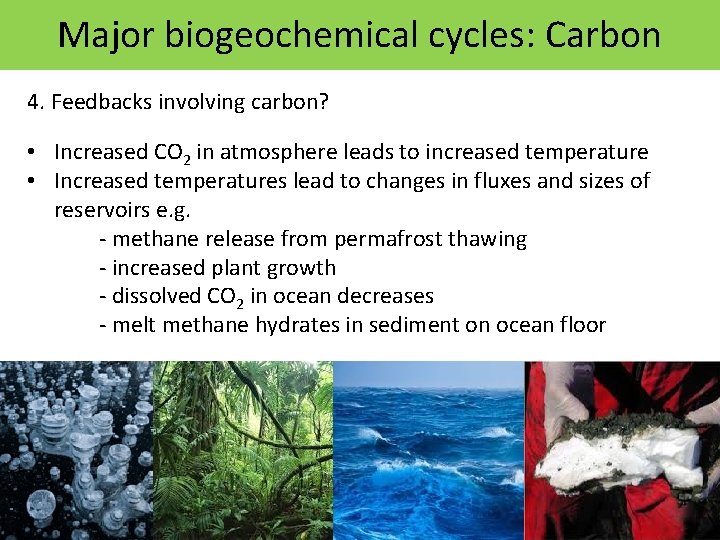
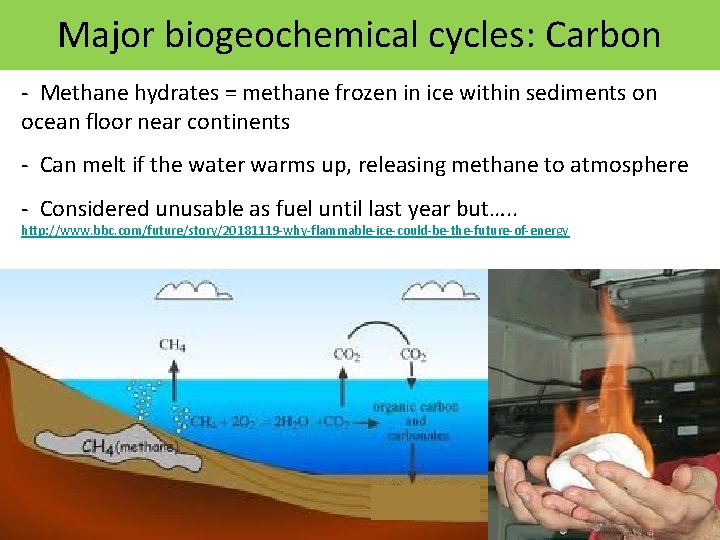
Major biogeochemical cycles: Carbon 4. Feedbacks involving carbon? • Increased CO 2 in atmosphere leads to increased temperature • Increased temperatures lead to changes in fluxes and sizes of reservoirs e. g. - methane release from permafrost thawing - increased plant growth - dissolved CO 2 in ocean decreases - melt methane hydrates in sediment on ocean floor
Major biogeochemical cycles: Carbon - Methane hydrates = methane frozen in ice within sediments on ocean floor near continents - Can melt if the water warms up, releasing methane to atmosphere - Considered unusable as fuel until last year but…. . http: //www. bbc. com/future/story/20181119 -why-flammable-ice-could-be-the-future-of-energy
i. Clicker question Which of these is a negative feedback on carbon in the atmosphere? a) increased air temperatures lead to permafrost thaw and so release of carbon dioxide and methane b) increased CO 2 in atmosphere leads to increased plant growth c) ocean temperatures warm so less CO 2 can dissolve in the water d) ocean temperatures increase which can melt methane clathrates from sediment on continental shelves
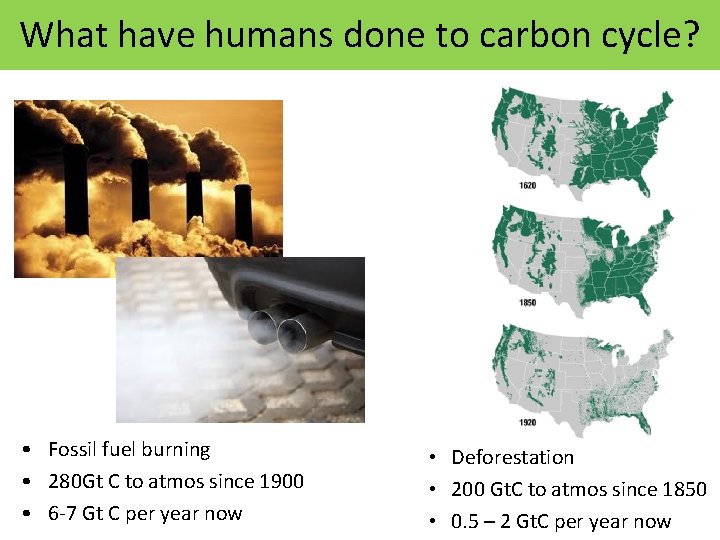
What have humans done to carbon cycle? • Fossil fuel burning • 280 Gt C to atmos since 1900 • 6 -7 Gt C per year now • Deforestation • 200 Gt. C to atmos since 1850 • 0. 5 – 2 Gt. C per year now
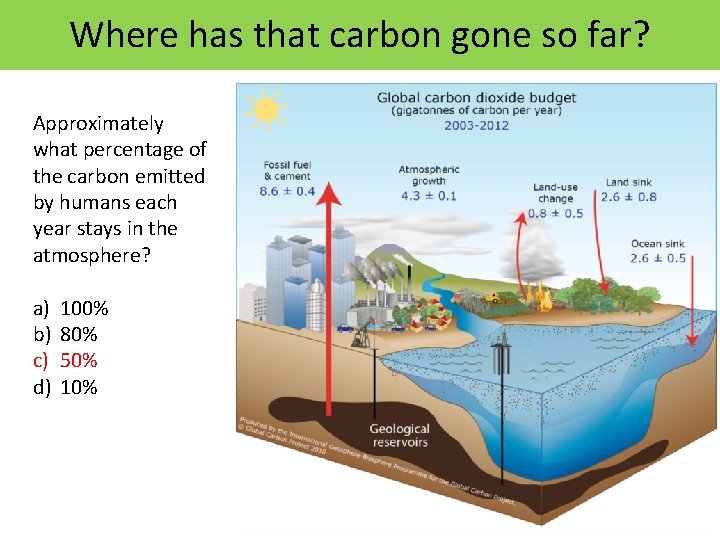
Where has that carbon gone so far? Approximately what percentage of the carbon emitted by humans each year stays in the atmosphere? a) b) c) d) 100% 80% 50% 10%
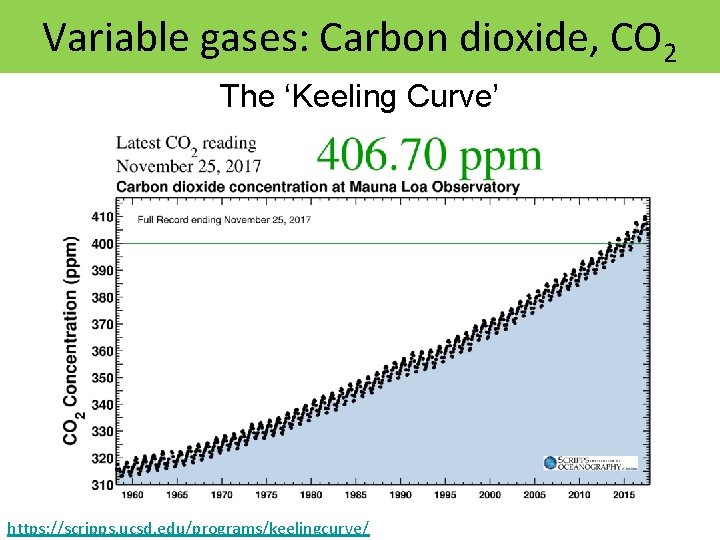
Variable gases: Carbon dioxide, CO 2 The ‘Keeling Curve’ https: //scripps. ucsd. edu/programs/keelingcurve/
Where has that carbon gone so far? Only half of carbon we have released to atmosphere is still there. Where has the rest gone? 1. Into oceans
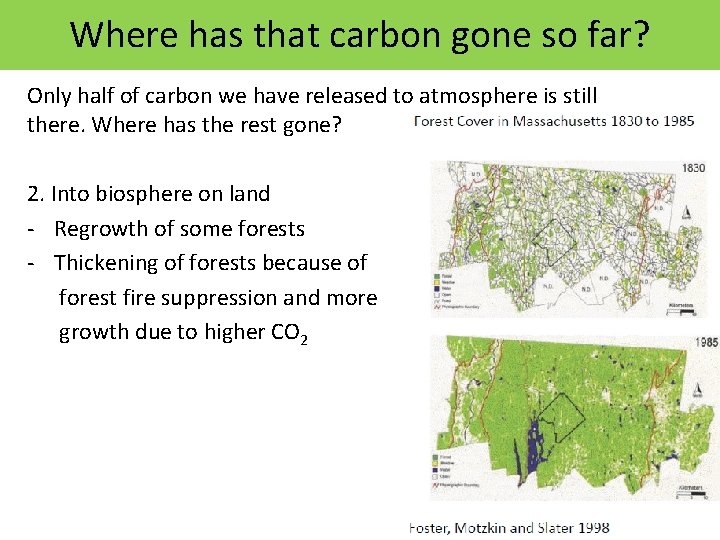
Where has that carbon gone so far? Only half of carbon we have released to atmosphere is still there. Where has the rest gone? 2. Into biosphere on land - Regrowth of some forests - Thickening of forests because of forest fire suppression and more growth due to higher CO 2
Where will carbon go in future? Can we count on oceans and the biosphere to continue to take up half of our emissions? NO! Why? - Because we emit more and more CO 2 each year - Warmer oceans will dissolve less CO 2 - Forests cannot grow everywhere and are limited by water supply or nutrients
Learning Outcomes • Be able to describe the different phases of population change, how and why birth and death rates change, and their influence on population • Carrying capacity for humans on Earth – be able to describe and explain what the limiting factors on human population growth might be • Understand that human resource use per capita is not equal throughout the world and that this is constantly changing • Be able to identify, describe and explain human activities that impact the hydrosphere, the geosphere/biosphere, and the atmosphere
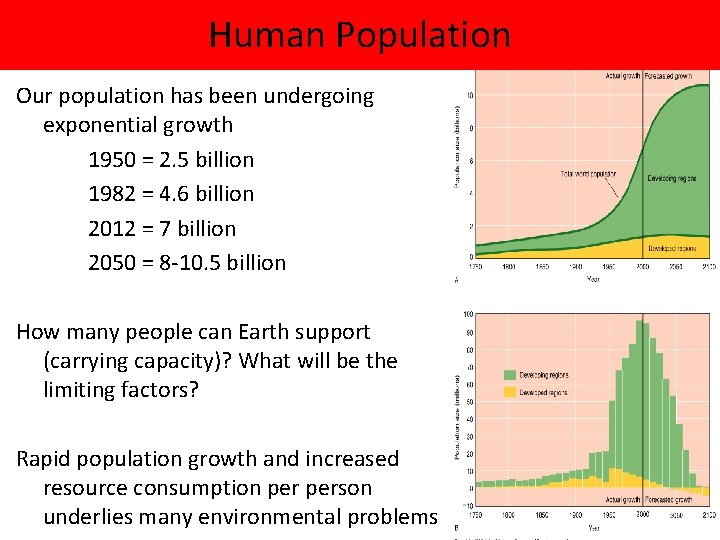
Human Population Our population has been undergoing exponential growth 1950 = 2. 5 billion 1982 = 4. 6 billion 2012 = 7 billion 2050 = 8 -10. 5 billion How many people can Earth support (carrying capacity)? What will be the limiting factors? Rapid population growth and increased resource consumption person underlies many environmental problems
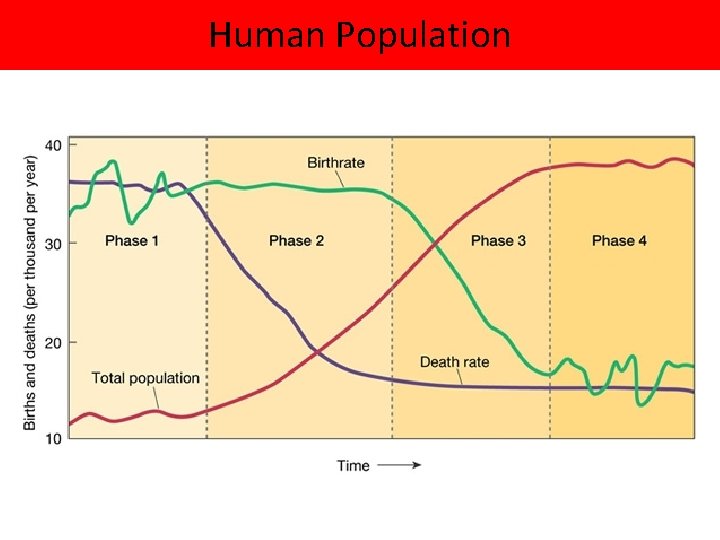
Human Population
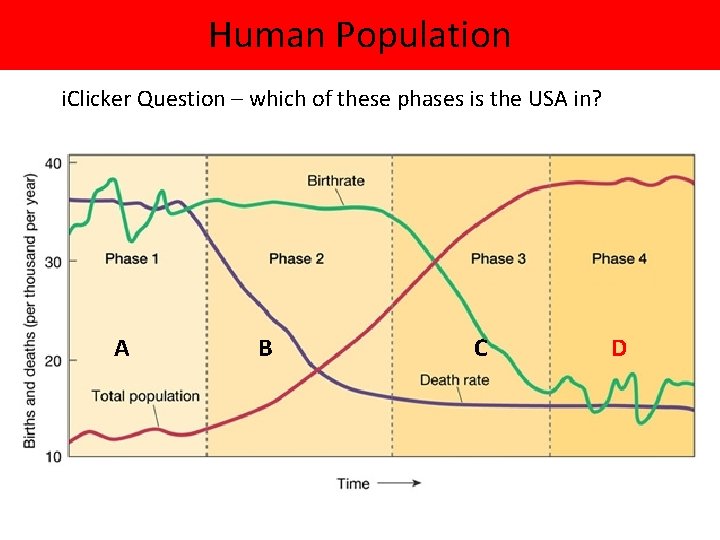
Human Population i. Clicker Question – which of these phases is the USA in? A B C D
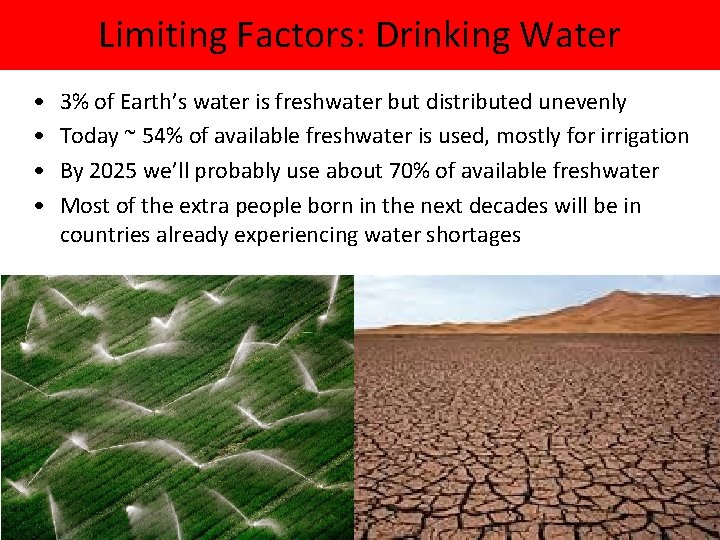
Limiting Factors: Drinking Water • • 3% of Earth’s water is freshwater but distributed unevenly Today ~ 54% of available freshwater is used, mostly for irrigation By 2025 we’ll probably use about 70% of available freshwater Most of the extra people born in the next decades will be in countries already experiencing water shortages
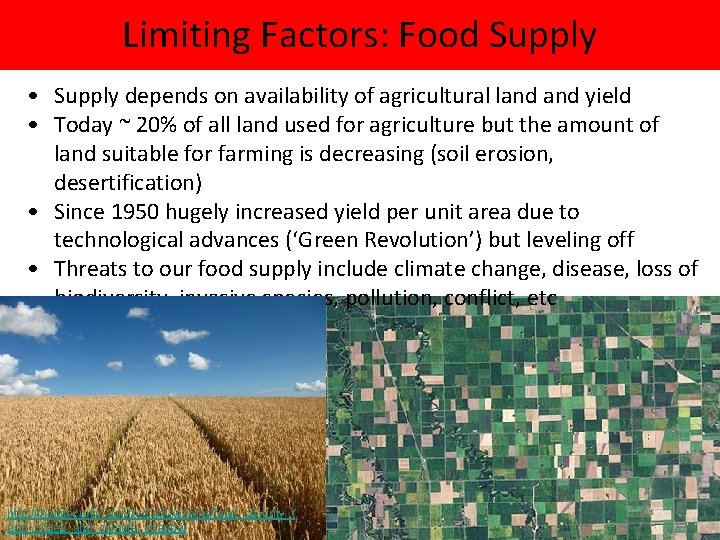
Limiting Factors: Food Supply • Supply depends on availability of agricultural land yield • Today ~ 20% of all land used for agriculture but the amount of land suitable for farming is decreasing (soil erosion, desertification) • Since 1950 hugely increased yield per unit area due to technological advances (‘Green Revolution’) but leveling off • Threats to our food supply include climate change, disease, loss of biodiversity, invasive species, pollution, conflict, etc http: //foodsecurity. stanford. edu/events/food_security_f ood_prices_and_climate_change/
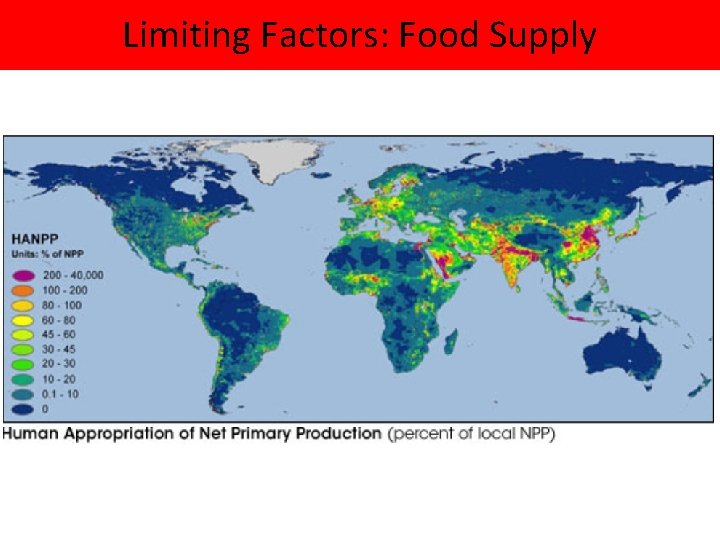
Limiting Factors: Food Supply
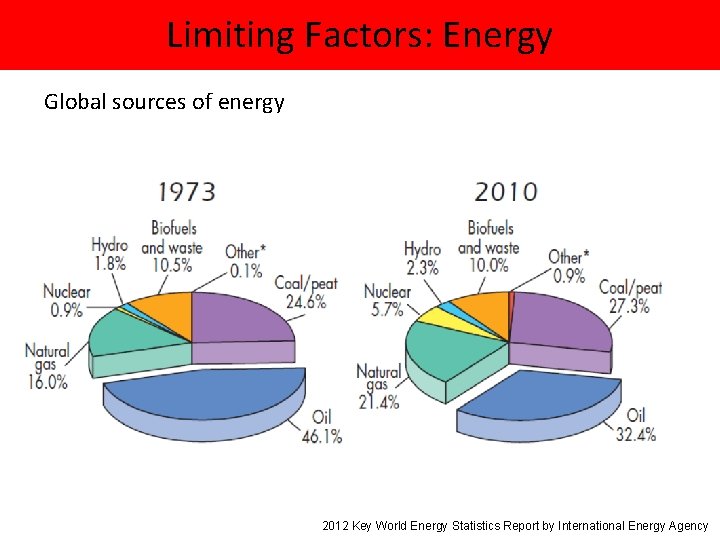
Limiting Factors: Energy Global sources of energy 2012 Key World Energy Statistics Report by International Energy Agency
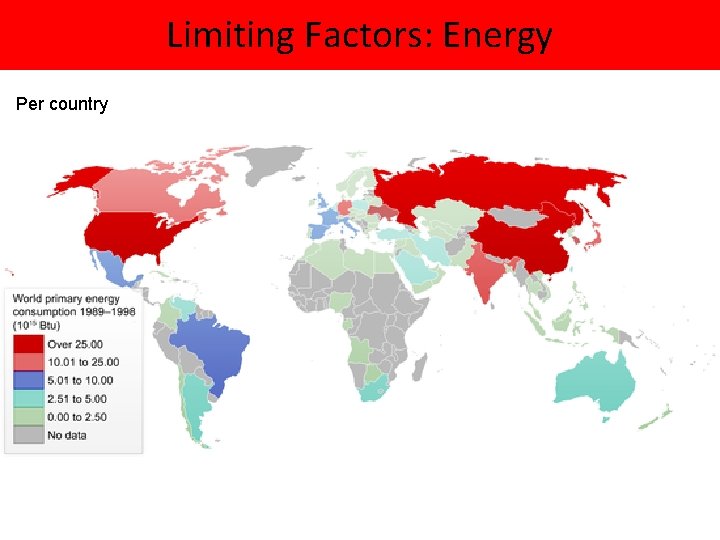
Limiting Factors: Energy Per country
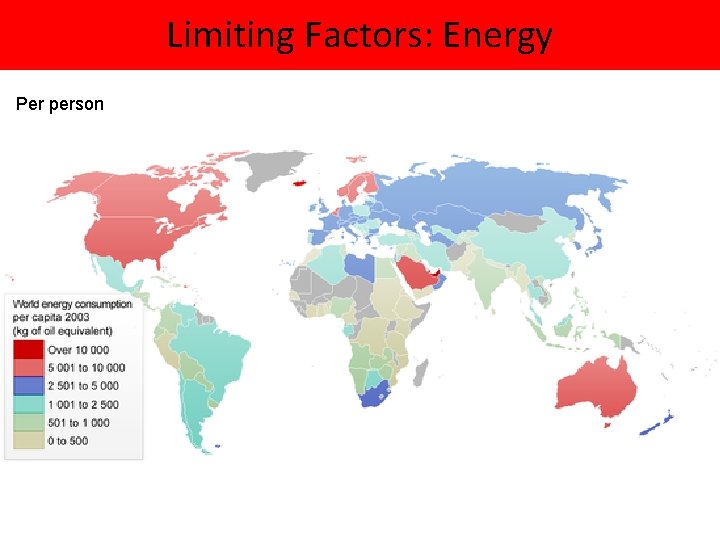
Limiting Factors: Energy Per person
Limiting Factors: Energy Alternative sources of energy include: - Nuclear power - Solar power - Biomass energy (either by burning or conversion to ethanol or gas) - Wind power - Hydropower - Tidal power - Geothermal power All have advantages and disadvantages. Many simply represent engineering challenges e. g. variation of production, how to transport energy produced etc.
i. Clicker Question Which of these is a non-renewable resource? a) biofuel made from crops b) fish c) uranium d) wind e) groundwater
Renewable vs Nonrenewable resources • Resource = something useful/necessary • Non-renewable resources = only replenished on extremely long timescales (if at all) • Renewable resources = can be replenished on timescales relevant to humans • However renewable resources require management to remain renewable!
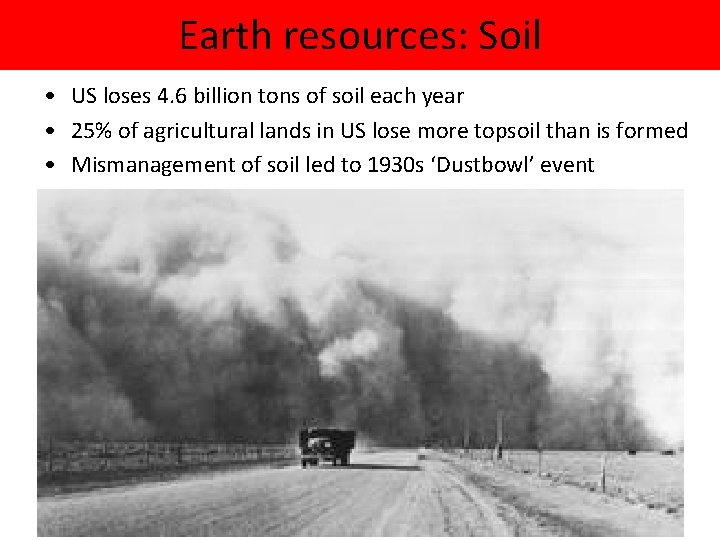
Earth resources: Soil • US loses 4. 6 billion tons of soil each year • 25% of agricultural lands in US lose more topsoil than is formed • Mismanagement of soil led to 1930 s ‘Dustbowl’ event
Human Population How many people can the Earth support? Perhaps our questions instead should be: How many at what level of material well-being? How many with what distribution of material well-being? How many with what technology? How many with what values, tastes and fashions? How many in what physical, chemical and biological environments?
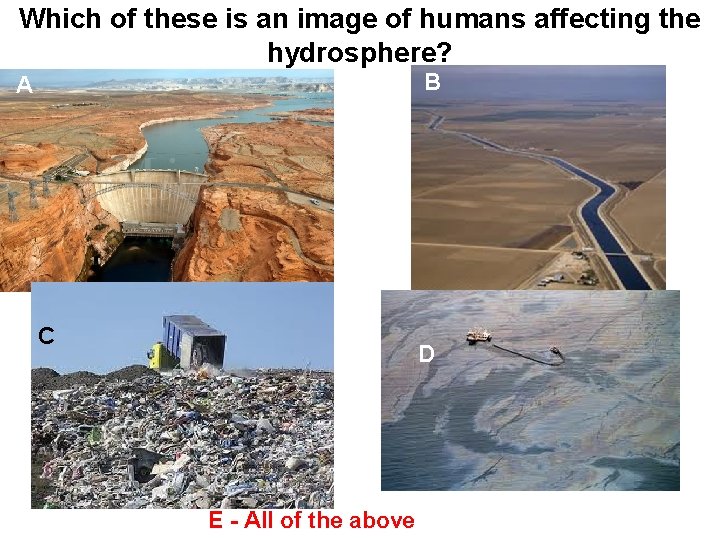
Which of these is an image of humans affecting the hydrosphere? B A C D E - All of the above
Human impacts on the Earth System How have humans affected: Geosphere Soil lost through erosion, quality degraded by pollution with metals, organic molecules. Quarrying and mining alters geosphere. Hydrosphere Changed distribution/amount of water by dams, irrigation, channelizing rivers, melting ice and snow due to warmer temps. Affected quality of freshwater and ocean water with heavy metals, pesticides, fertilizers, ocean acidification, etc Biosphere Deforestation, overhunting, invasive species, desertification Overfishing, damaging fishing practices, ocean acidification, dead zones Atmosphere Acid rain, smog, dust, greenhouse gases, ozone hole
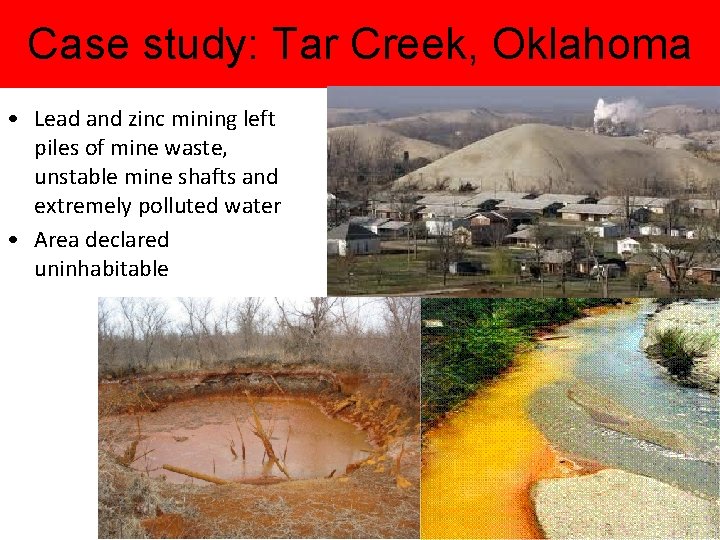
Case study: Tar Creek, Oklahoma • Lead and zinc mining left piles of mine waste, unstable mine shafts and extremely polluted water • Area declared uninhabitable
Human impacts on the Earth System The bad news: - With increasing population there is ever increasing stress on resources and increasing pollution in many places - No good answers for how to balance human demands against earth system – often moral and political issues rather than simply scientific issues The good news: - Increasing awareness/education and improving technology helps in resource management, preservation, and repair - Increasing awareness of impact of sustainability on economy, public health, social factors, national security and therefore more public pressure for substantial change to our society
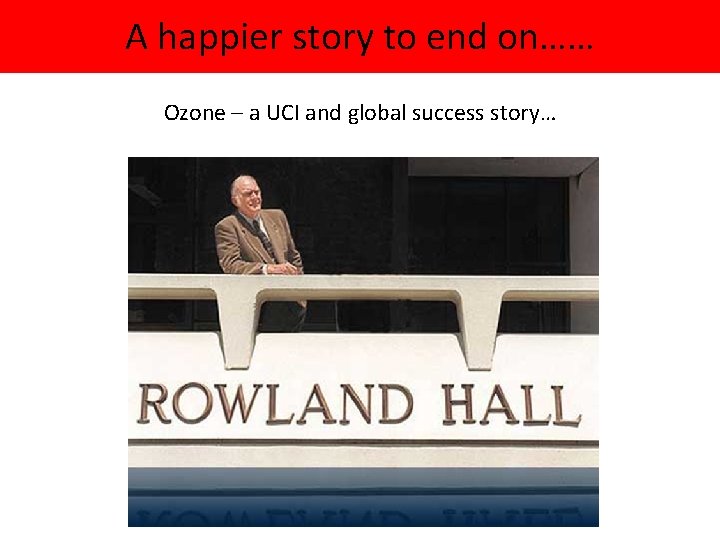
A happier story to end on…… Ozone – a UCI and global success story…
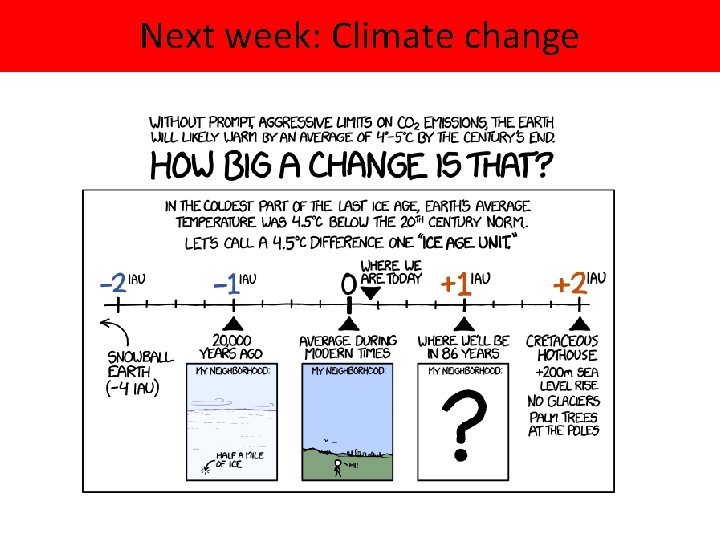
Next week: Climate change