
Lecture 23 Relativity Looking forward at why different
- Slides: 35
Lecture 23: Relativity Looking forward at … • why different observers can disagree about whether two events are simultaneous. • how relativity predicts that moving clocks run slow, and what experimental evidence confirms this. • how the length of an object changes due to the object’s motion. • how theory of relativity modifies the relationship between velocity and momentum. © 2016 Pearson Education Inc.
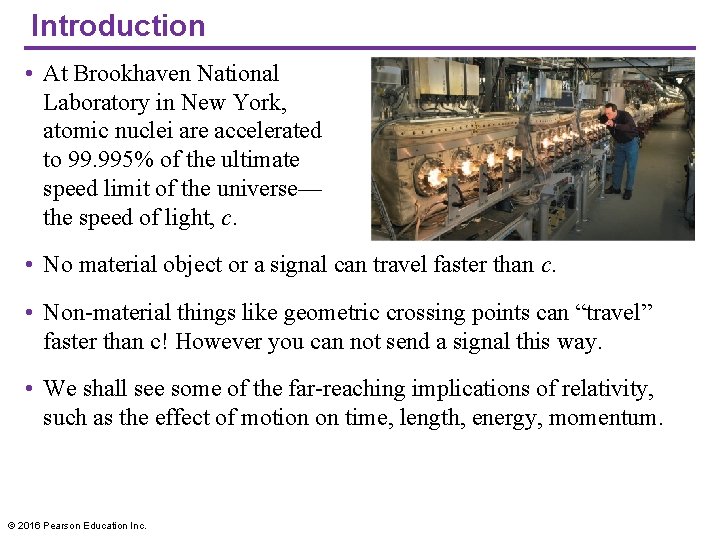
Introduction • At Brookhaven National Laboratory in New York, atomic nuclei are accelerated to 99. 995% of the ultimate speed limit of the universe— the speed of light, c. • No material object or a signal can travel faster than c. • Non-material things like geometric crossing points can “travel” faster than c! However you can not send a signal this way. • We shall see some of the far-reaching implications of relativity, such as the effect of motion on time, length, energy, momentum. © 2016 Pearson Education Inc.
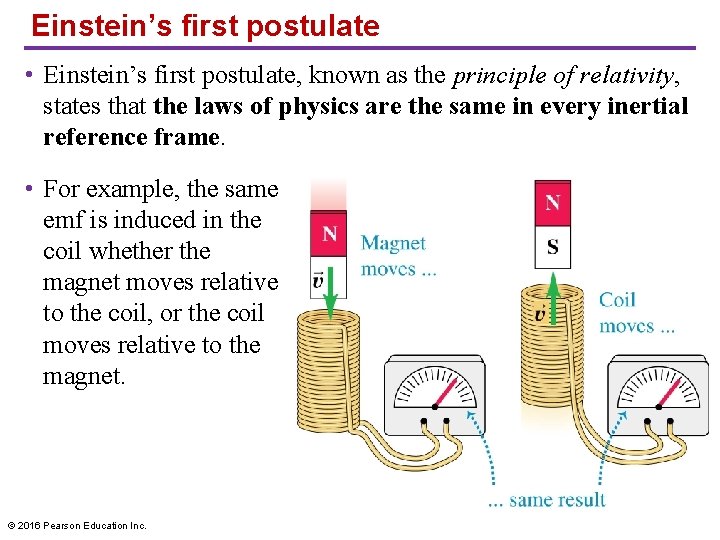
Einstein’s first postulate • Einstein’s first postulate, known as the principle of relativity, states that the laws of physics are the same in every inertial reference frame. • For example, the same emf is induced in the coil whether the magnet moves relative to the coil, or the coil moves relative to the magnet. © 2016 Pearson Education Inc.
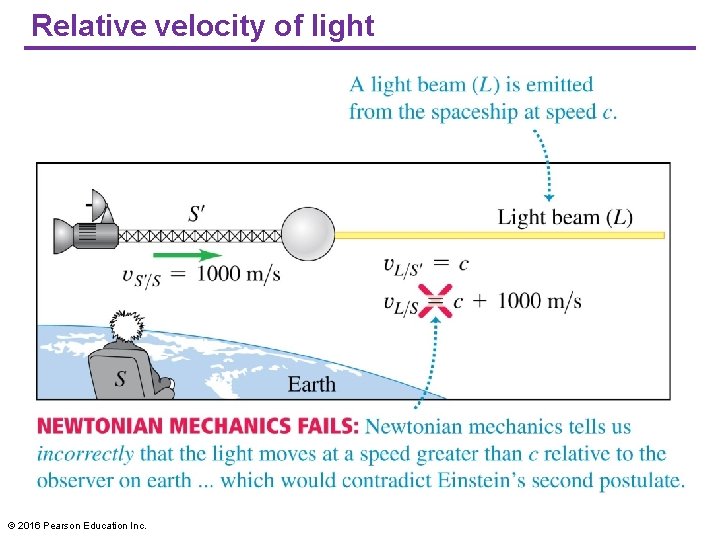
Einstein’s second postulate • Einstein’s second postulate is that the speed of light in vacuum is the same in all inertial frames of reference and is independent of the motion of the source. • Suppose two observers measure the speed of light in vacuum. • One is at rest with respect to the light source, and the other is moving away from it. • According to the principle of relativity, the two observers must obtain the same result, despite the fact that one is moving with respect to the other. © 2016 Pearson Education Inc.
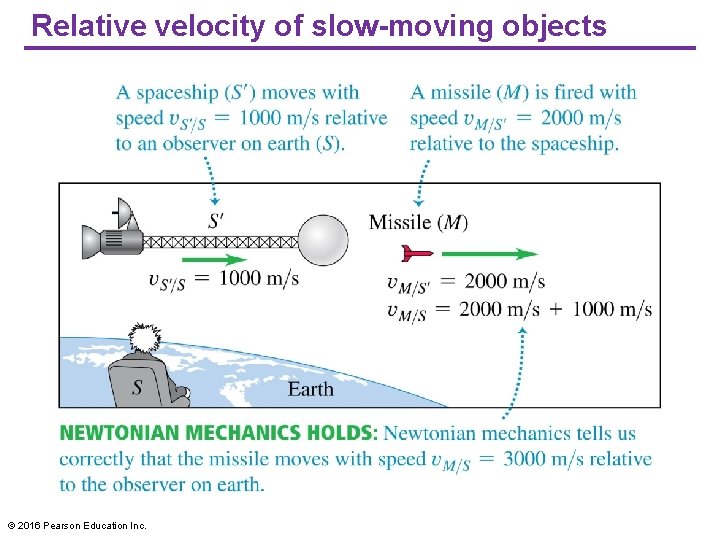
Relative velocity of slow-moving objects © 2016 Pearson Education Inc.
Relative velocity of light © 2016 Pearson Education Inc.
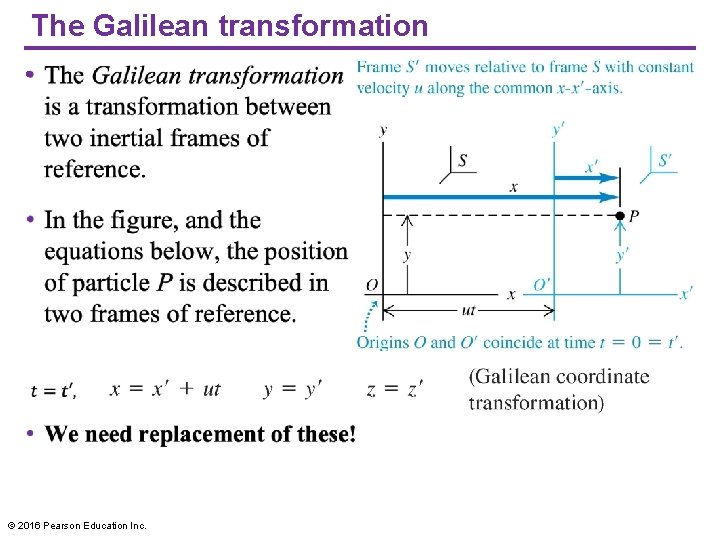
The Galilean transformation • © 2016 Pearson Education Inc.
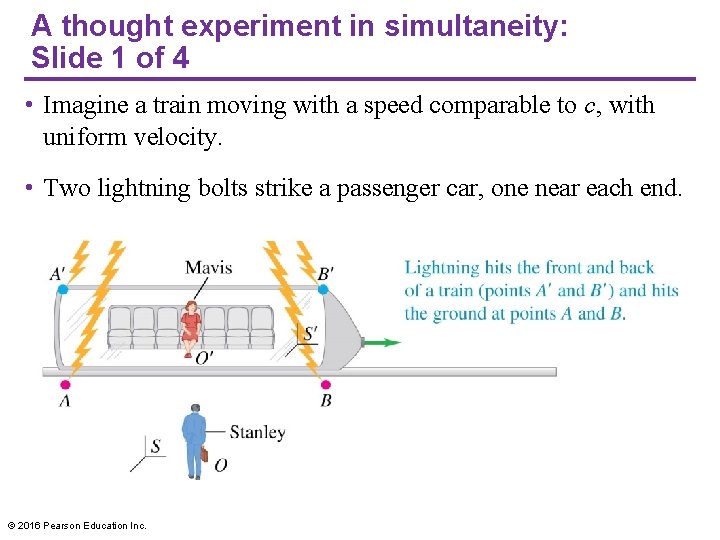
A thought experiment in simultaneity: Slide 1 of 4 • Imagine a train moving with a speed comparable to c, with uniform velocity. • Two lightning bolts strike a passenger car, one near each end. © 2016 Pearson Education Inc.
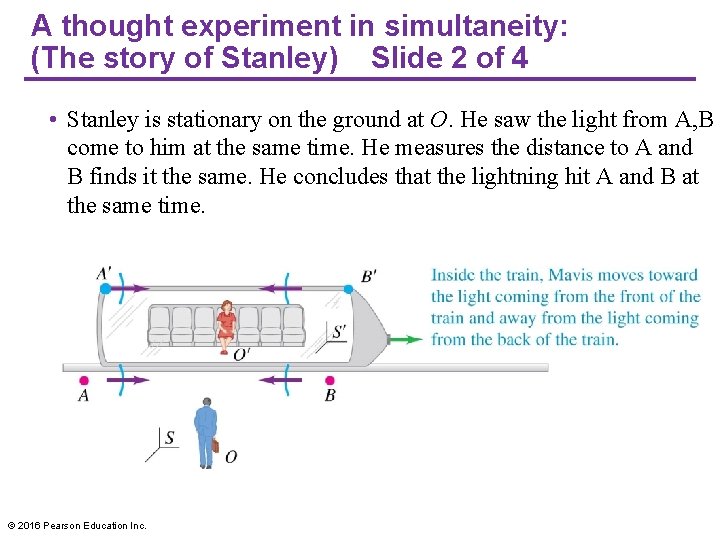
A thought experiment in simultaneity: (The story of Stanley) Slide 2 of 4 • Stanley is stationary on the ground at O. He saw the light from A, B come to him at the same time. He measures the distance to A and B finds it the same. He concludes that the lightning hit A and B at the same time. © 2016 Pearson Education Inc.
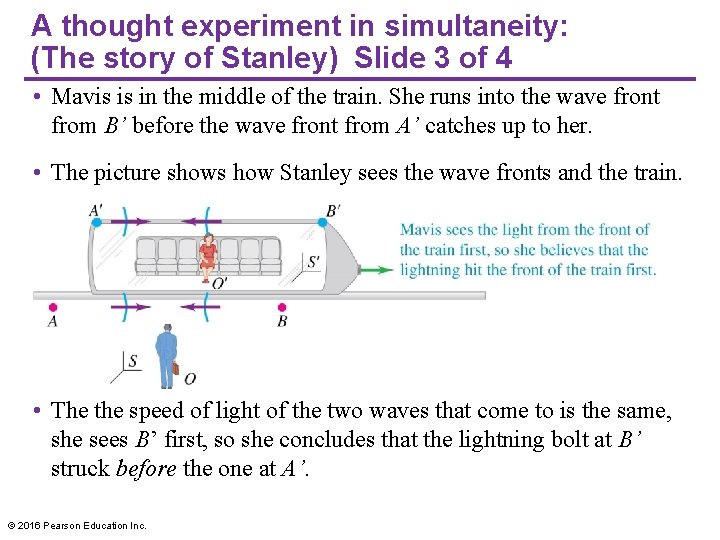
A thought experiment in simultaneity: (The story of Stanley) Slide 3 of 4 • Mavis is in the middle of the train. She runs into the wave front from B’ before the wave front from A’ catches up to her. • The picture shows how Stanley sees the wave fronts and the train. • The the speed of light of the two waves that come to is the same, she sees B’ first, so she concludes that the lightning bolt at B’ struck before the one at A’. © 2016 Pearson Education Inc.
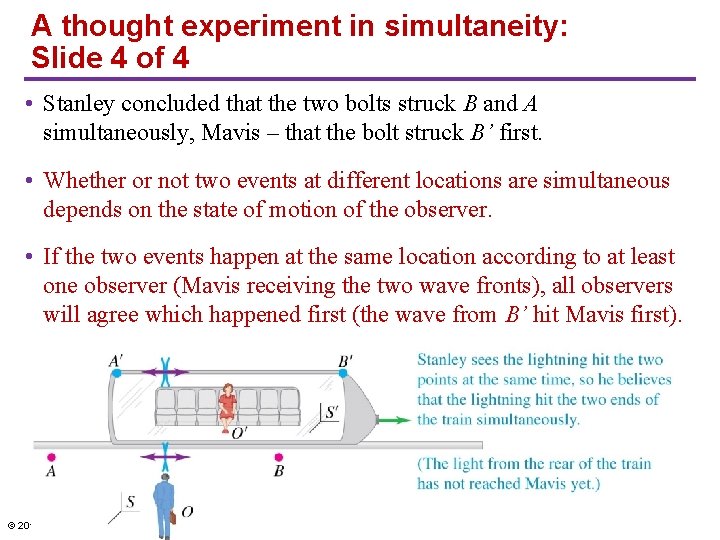
A thought experiment in simultaneity: Slide 4 of 4 • Stanley concluded that the two bolts struck B and A simultaneously, Mavis – that the bolt struck B’ first. • Whether or not two events at different locations are simultaneous depends on the state of motion of the observer. • If the two events happen at the same location according to at least one observer (Mavis receiving the two wave fronts), all observers will agree which happened first (the wave from B’ hit Mavis first). © 2016 Pearson Education Inc.
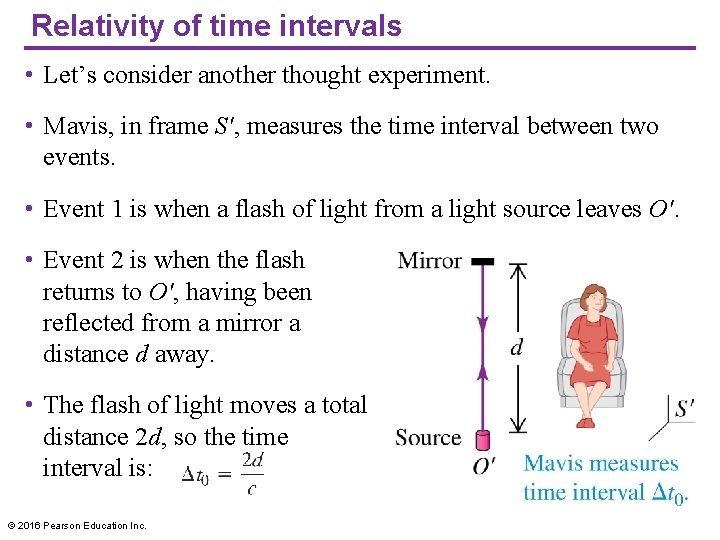
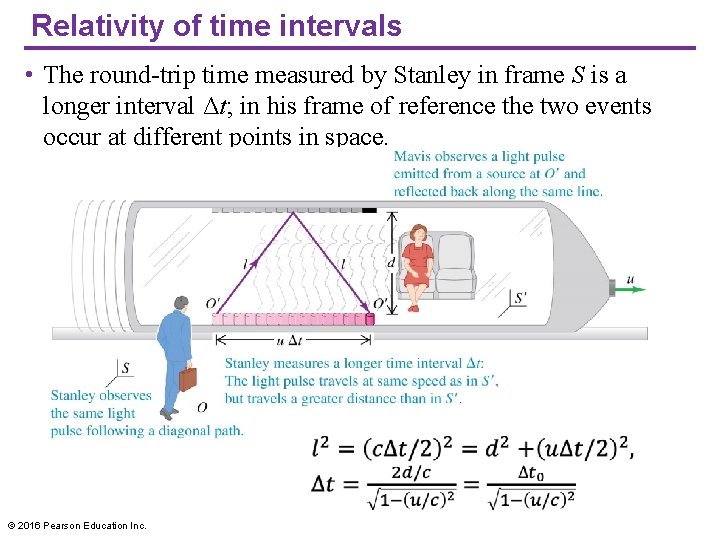
Relativity of time intervals • Let’s consider another thought experiment. • Mavis, in frame S', measures the time interval between two events. • Event 1 is when a flash of light from a light source leaves O'. • Event 2 is when the flash returns to O', having been reflected from a mirror a distance d away. • The flash of light moves a total distance 2 d, so the time interval is: © 2016 Pearson Education Inc.
Relativity of time intervals • The round-trip time measured by Stanley in frame S is a longer interval Δt; in his frame of reference the two events occur at different points in space. © 2016 Pearson Education Inc.
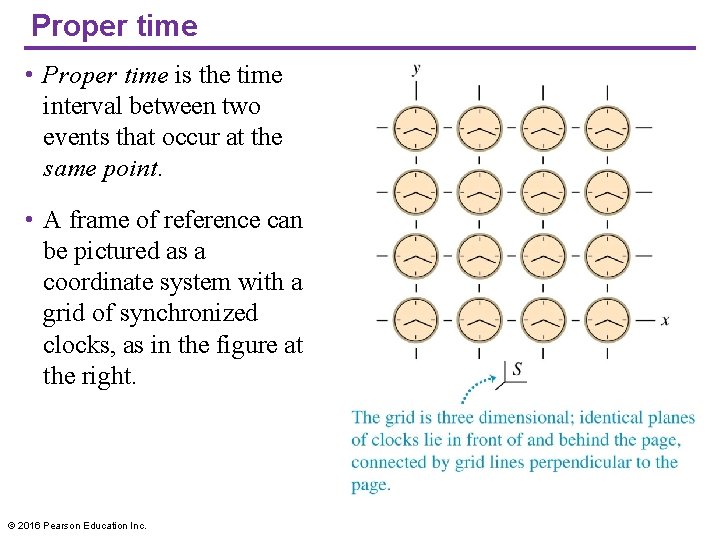
Proper time • Proper time is the time interval between two events that occur at the same point. • A frame of reference can be pictured as a coordinate system with a grid of synchronized clocks, as in the figure at the right. © 2016 Pearson Education Inc.
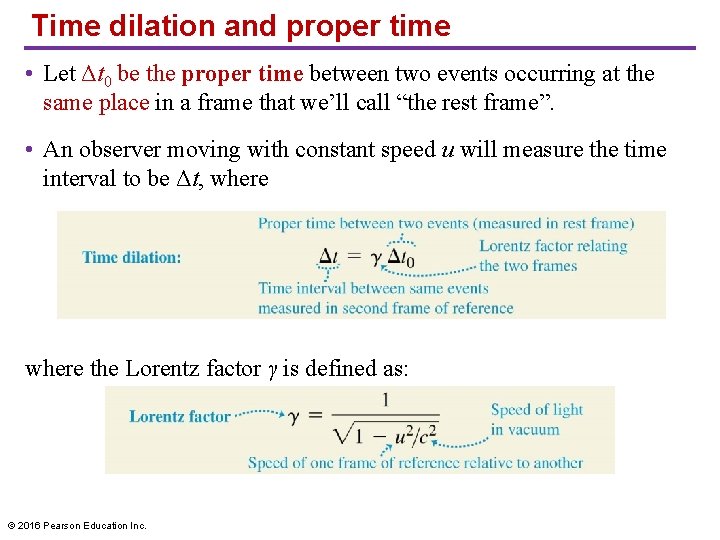
Time dilation and proper time • Let Δt 0 be the proper time between two events occurring at the same place in a frame that we’ll call “the rest frame”. • An observer moving with constant speed u will measure the time interval to be Δt, where the Lorentz factor γ is defined as: © 2016 Pearson Education Inc.
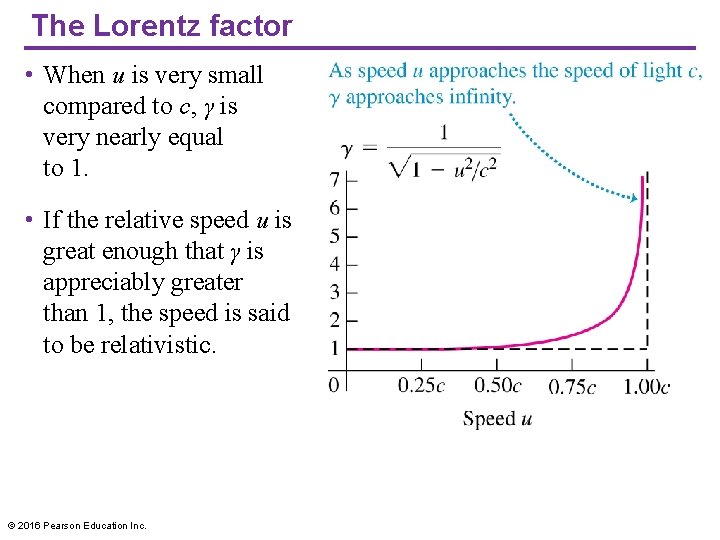
The Lorentz factor • When u is very small compared to c, γ is very nearly equal to 1. • If the relative speed u is great enough that γ is appreciably greater than 1, the speed is said to be relativistic. © 2016 Pearson Education Inc.
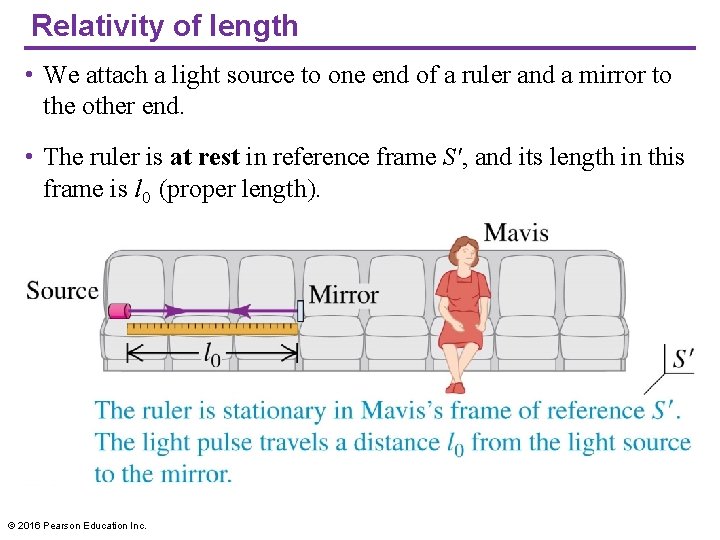
Relativity of length • We attach a light source to one end of a ruler and a mirror to the other end. • The ruler is at rest in reference frame S', and its length in this frame is l 0 (proper length). © 2016 Pearson Education Inc.
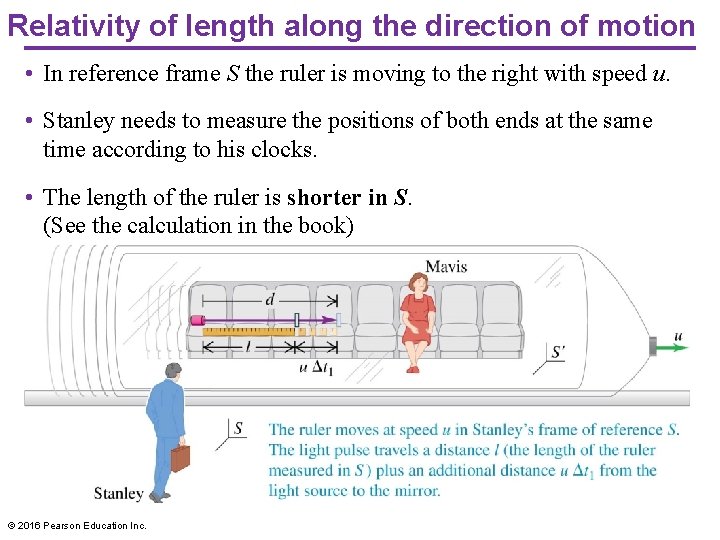
Relativity of length along the direction of motion • In reference frame S the ruler is moving to the right with speed u. • Stanley needs to measure the positions of both ends at the same time according to his clocks. • The length of the ruler is shorter in S. (See the calculation in the book) © 2016 Pearson Education Inc.
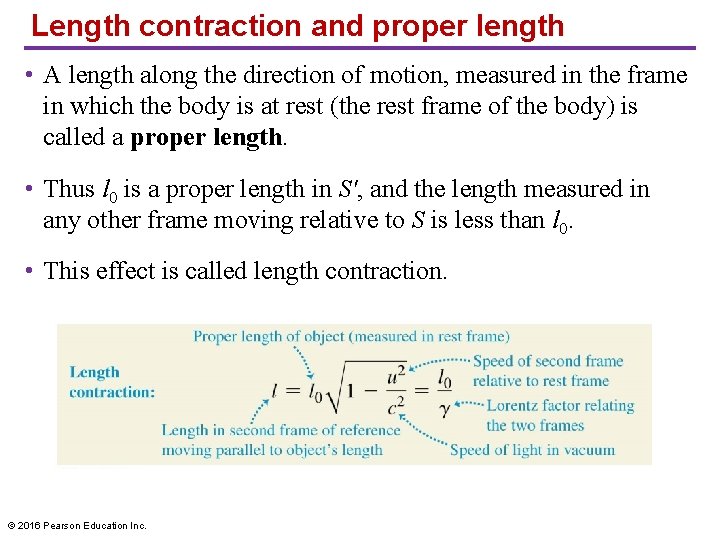
Length contraction and proper length • A length along the direction of motion, measured in the frame in which the body is at rest (the rest frame of the body) is called a proper length. • Thus l 0 is a proper length in S', and the length measured in any other frame moving relative to S is less than l 0. • This effect is called length contraction. © 2016 Pearson Education Inc.
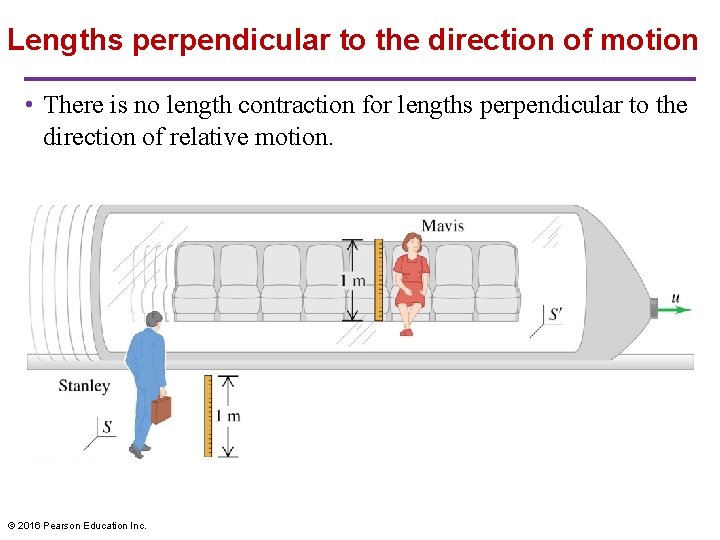
Lengths perpendicular to the direction of motion • There is no length contraction for lengths perpendicular to the direction of relative motion. © 2016 Pearson Education Inc.
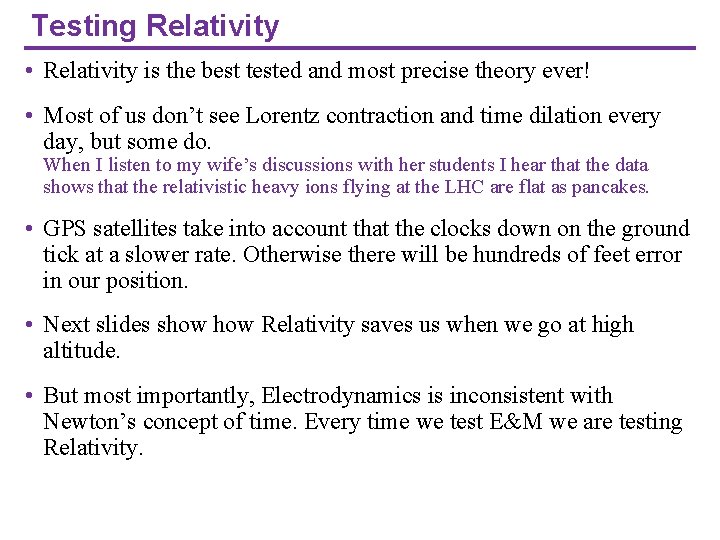
Testing Relativity • Relativity is the best tested and most precise theory ever! • Most of us don’t see Lorentz contraction and time dilation every day, but some do. When I listen to my wife’s discussions with her students I hear that the data shows that the relativistic heavy ions flying at the LHC are flat as pancakes. • GPS satellites take into account that the clocks down on the ground tick at a slower rate. Otherwise there will be hundreds of feet error in our position. • Next slides show Relativity saves us when we go at high altitude. • But most importantly, Electrodynamics is inconsistent with Newton’s concept of time. Every time we test E&M we are testing Relativity.
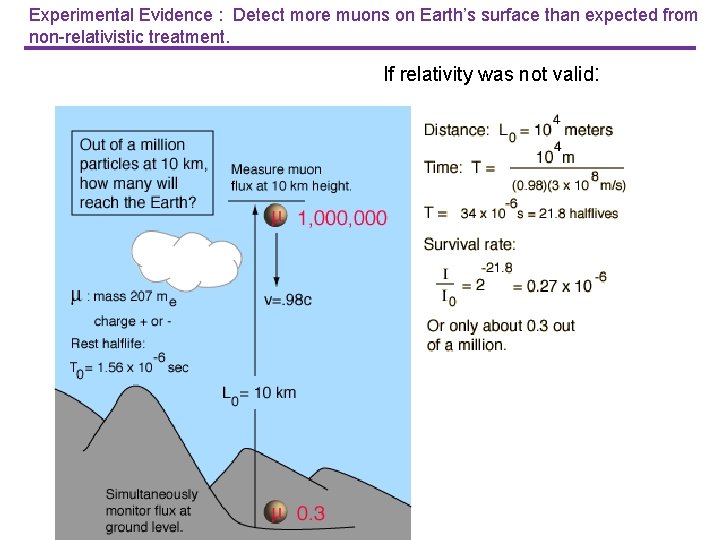
Experimental Evidence : Detect more muons on Earth’s surface than expected from non-relativistic treatment. If relativity was not valid:
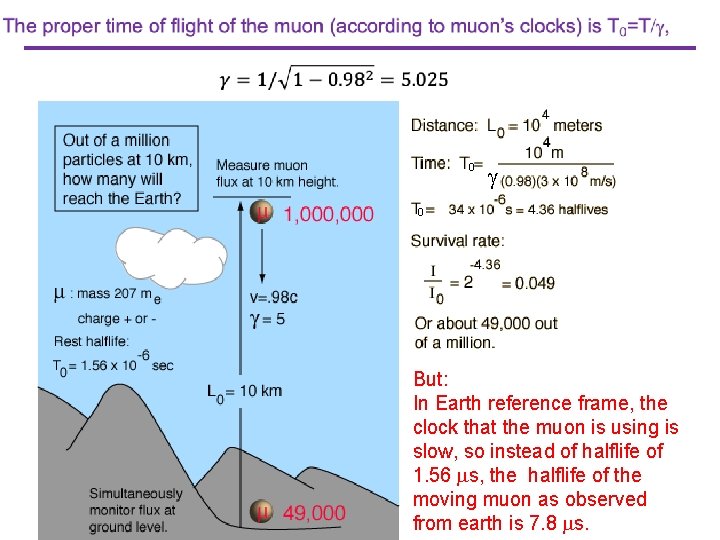
0 g 0 But: In Earth reference frame, the clock that the muon is using is slow, so instead of halflife of 1. 56 ms, the halflife of the moving muon as observed from earth is 7. 8 ms.
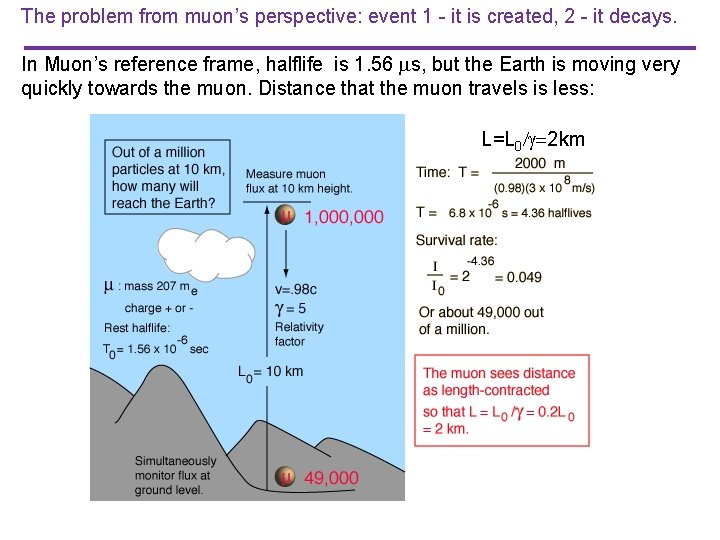
The problem from muon’s perspective: event 1 - it is created, 2 - it decays. In Muon’s reference frame, halflife is 1. 56 ms, but the Earth is moving very quickly towards the muon. Distance that the muon travels is less: L=L 0/g=2 km
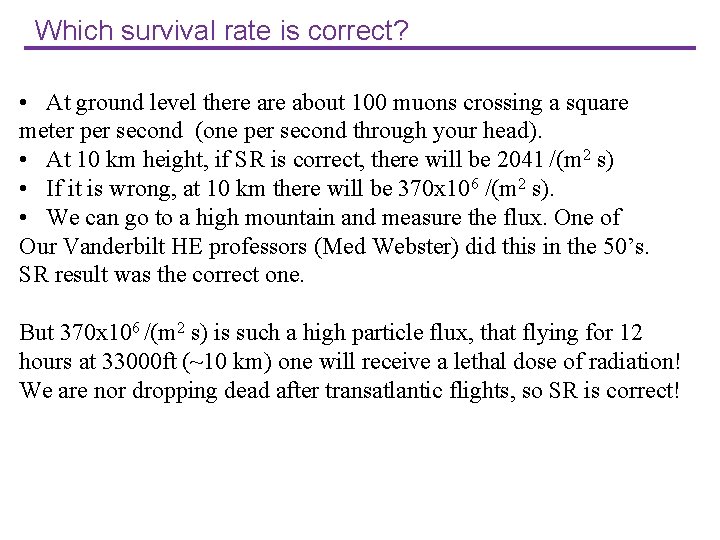
Which survival rate is correct? • At ground level there about 100 muons crossing a square meter per second (one per second through your head). • At 10 km height, if SR is correct, there will be 2041 /(m 2 s) • If it is wrong, at 10 km there will be 370 x 106 /(m 2 s). • We can go to a high mountain and measure the flux. One of Our Vanderbilt HE professors (Med Webster) did this in the 50’s. SR result was the correct one. But 370 x 106 /(m 2 s) is such a high particle flux, that flying for 12 hours at 33000 ft (~10 km) one will receive a lethal dose of radiation! We are nor dropping dead after transatlantic flights, so SR is correct!
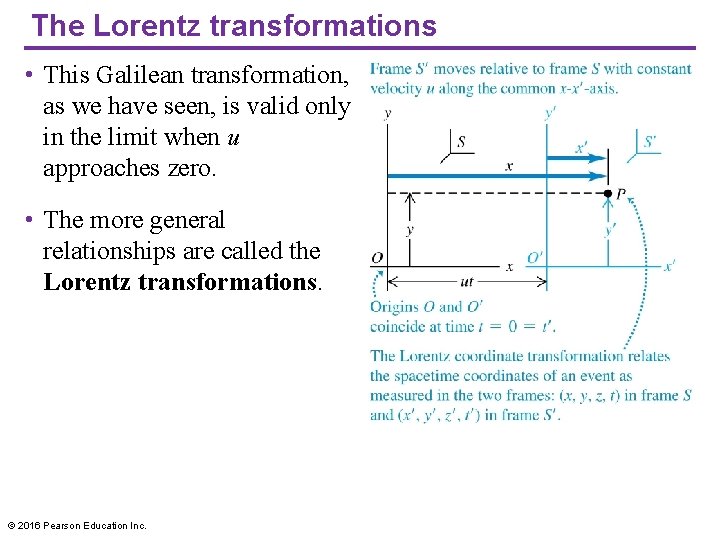
The Lorentz transformations • This Galilean transformation, as we have seen, is valid only in the limit when u approaches zero. • The more general relationships are called the Lorentz transformations. © 2016 Pearson Education Inc.
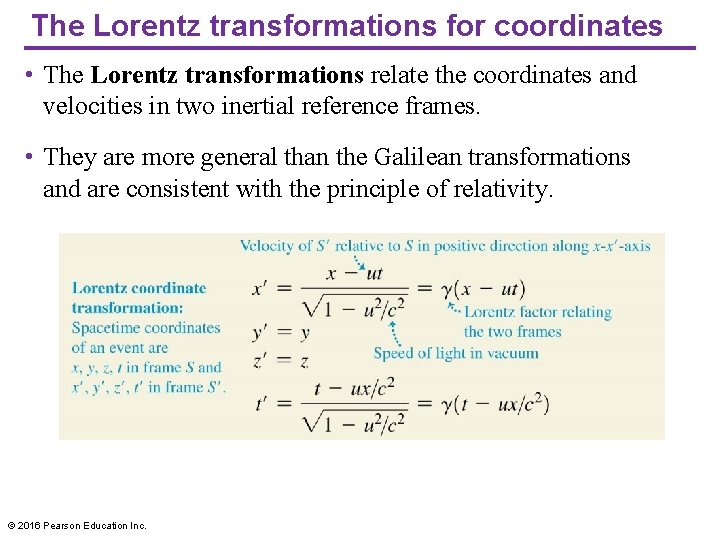
The Lorentz transformations for coordinates • The Lorentz transformations relate the coordinates and velocities in two inertial reference frames. • They are more general than the Galilean transformations and are consistent with the principle of relativity. © 2016 Pearson Education Inc.
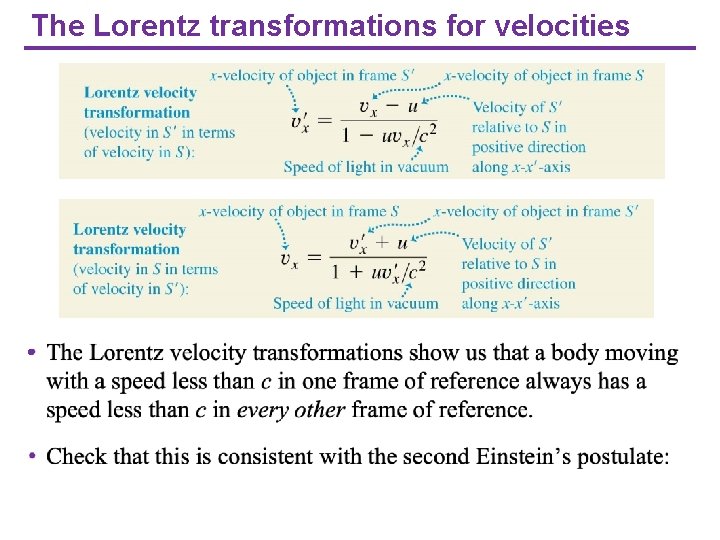
The Lorentz transformations for velocities •
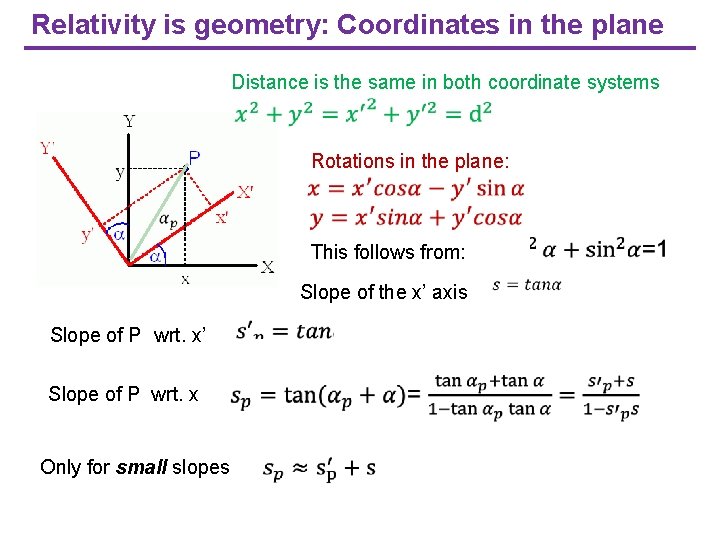
Relativity is geometry: Coordinates in the plane Distance is the same in both coordinate systems Rotations in the plane: This follows from: Slope of the x’ axis Slope of P wrt. x’ Slope of P wrt. x Only for small slopes
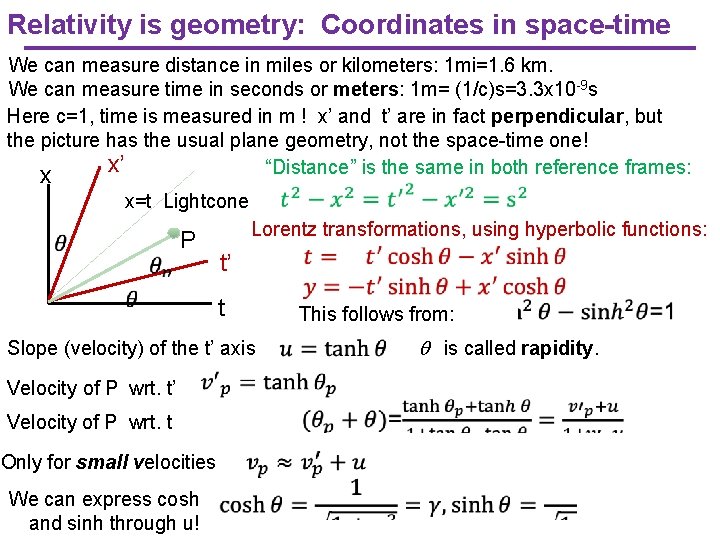
Relativity is geometry: Coordinates in space-time We can measure distance in miles or kilometers: 1 mi=1. 6 km. We can measure time in seconds or meters: 1 m= (1/c)s=3. 3 x 10 -9 s Here c=1, time is measured in m ! x’ and t’ are in fact perpendicular, but the picture has the usual plane geometry, not the space-time one! x’ “Distance” is the same in both reference frames: x x=t Lightcone P Lorentz transformations, using hyperbolic functions: t’ t Slope (velocity) of the t’ axis Velocity of P wrt. t’ Velocity of P wrt. t Only for small velocities We can express cosh and sinh through u! This follows from: q is called rapidity.
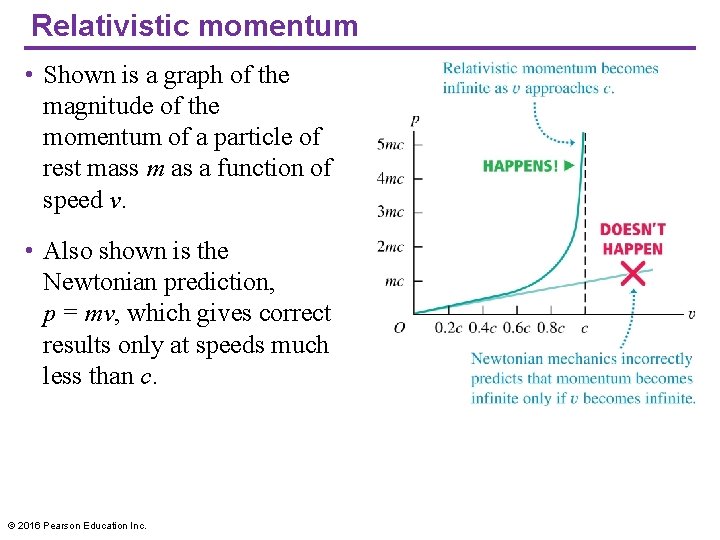
Relativistic momentum • Shown is a graph of the magnitude of the momentum of a particle of rest mass m as a function of speed v. • Also shown is the Newtonian prediction, p = mv, which gives correct results only at speeds much less than c. © 2016 Pearson Education Inc.
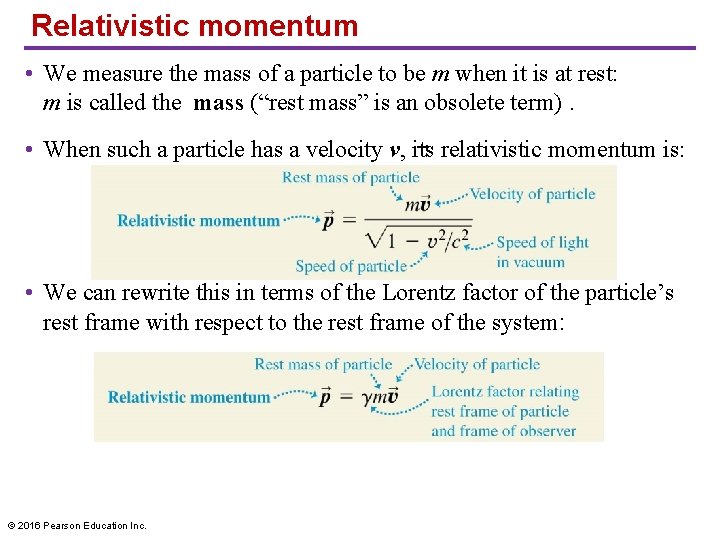
Relativistic momentum • We measure the mass of a particle to be m when it is at rest: m is called the mass (“rest mass” is an obsolete term). • When such a particle has a velocity v, its relativistic momentum is: • We can rewrite this in terms of the Lorentz factor of the particle’s rest frame with respect to the rest frame of the system: © 2016 Pearson Education Inc.
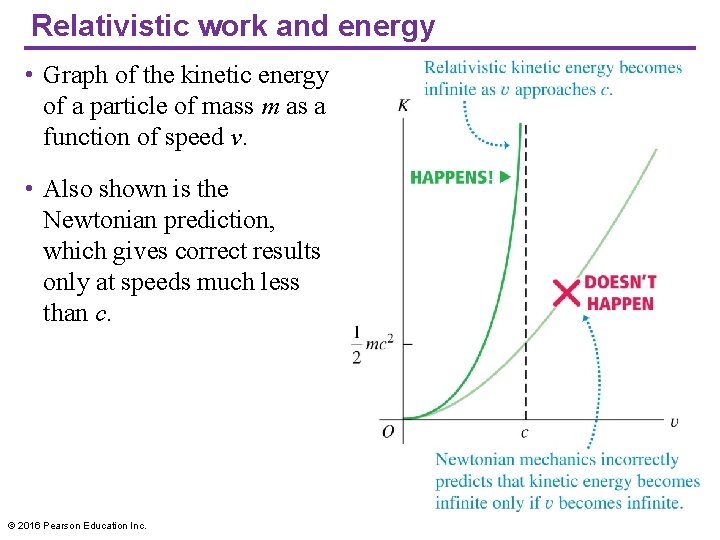
Relativistic work and energy • Graph of the kinetic energy of a particle of mass m as a function of speed v. • Also shown is the Newtonian prediction, which gives correct results only at speeds much less than c. © 2016 Pearson Education Inc.
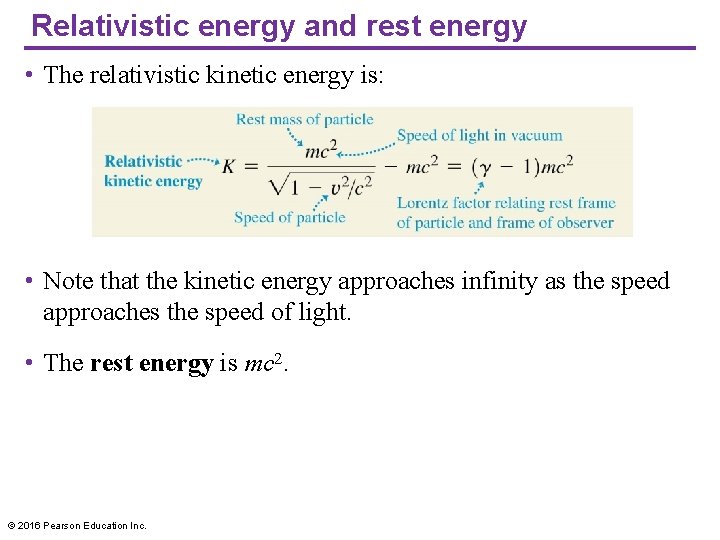
Relativistic energy and rest energy • The relativistic kinetic energy is: • Note that the kinetic energy approaches infinity as the speed approaches the speed of light. • The rest energy is mc 2. © 2016 Pearson Education Inc.
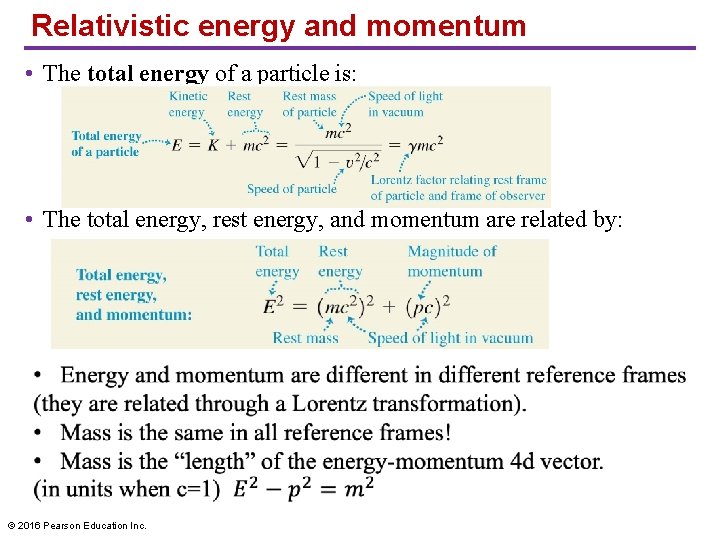
Relativistic energy and momentum • The total energy of a particle is: • The total energy, rest energy, and momentum are related by: © 2016 Pearson Education Inc.