
Lecture 23 Introduction to Genetic Algorithms Tuesday November
Lecture 23 Introduction to Genetic Algorithms Tuesday, November 16, 1999 William H. Hsu Department of Computing and Information Sciences, KSU http: //www. cis. ksu. edu/~bhsu Readings: Sections 9. 1 -9. 4, Mitchell Chapter 1, Sections 6. 1 -6. 5, Goldberg Section 3. 3. 4, Shavlik and Dietterich (Booker, Goldberg, Holland) CIS 798: Intelligent Systems and Machine Learning Kansas State University Department of Computing and Information Sciences
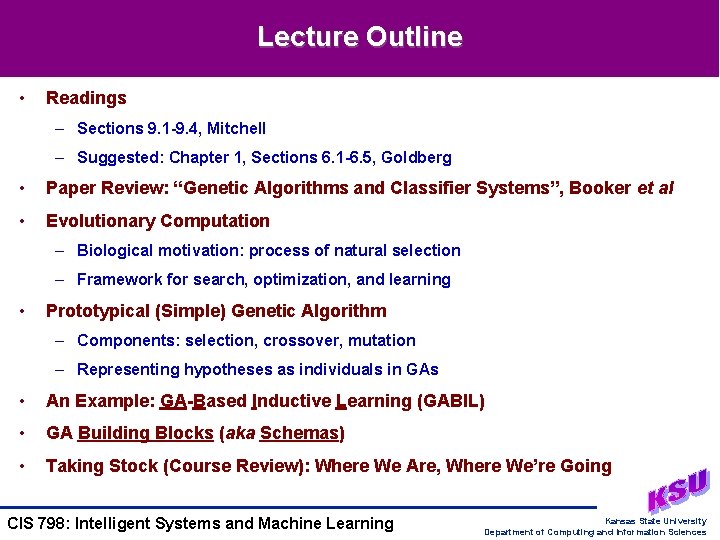
Lecture Outline • Readings – Sections 9. 1 -9. 4, Mitchell – Suggested: Chapter 1, Sections 6. 1 -6. 5, Goldberg • Paper Review: “Genetic Algorithms and Classifier Systems”, Booker et al • Evolutionary Computation – Biological motivation: process of natural selection – Framework for search, optimization, and learning • Prototypical (Simple) Genetic Algorithm – Components: selection, crossover, mutation – Representing hypotheses as individuals in GAs • An Example: GA-Based Inductive Learning (GABIL) • GA Building Blocks (aka Schemas) • Taking Stock (Course Review): Where We Are, Where We’re Going CIS 798: Intelligent Systems and Machine Learning Kansas State University Department of Computing and Information Sciences
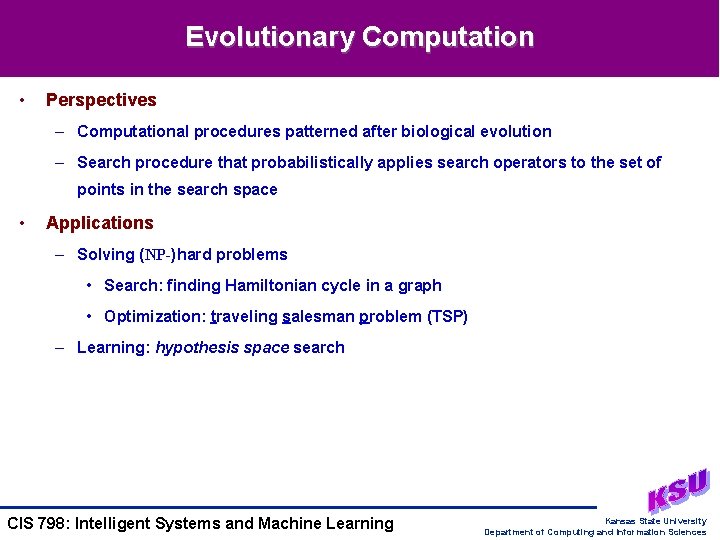
Evolutionary Computation • Perspectives – Computational procedures patterned after biological evolution – Search procedure that probabilistically applies search operators to the set of points in the search space • Applications – Solving (NP-)hard problems • Search: finding Hamiltonian cycle in a graph • Optimization: traveling salesman problem (TSP) – Learning: hypothesis space search CIS 798: Intelligent Systems and Machine Learning Kansas State University Department of Computing and Information Sciences

Biological Evolution • Lamarck and Others – Species “transmute” over time – Learning in single individual can increase its fitness (survivability) • Darwin and Wallace – Consistent, heritable variation among individuals in population – Natural selection of the fittest • Mendel on Genetics – Mechanism for inheriting traits – Genotype phenotype mapping • Genotype: functional unit(s) of heredity (genes) that an organism posesses • Phenotype: overt (observable) features of living organism CIS 798: Intelligent Systems and Machine Learning Kansas State University Department of Computing and Information Sciences

Simple Genetic Algorithm (SGA) • Algorithm Simple-Genetic-Algorithm (Fitness, Fitness-Threshold, p, r, m) // p: population size; r: replacement rate (aka generation gap width), m: string size – P p random hypotheses // initialize population – FOR each h in P DO f[h] Fitness(h) // evaluate Fitness: hypothesis R – WHILE (Max(f) < Fitness-Threshold) DO • 1. Select: Probabilistically select (1 - r)p members of P to add to PS • 2. Crossover: – Probabilistically select (r · p)/2 pairs of hypotheses from P – FOR each pair <h 1, h 2> DO PS += Crossover (<h 1, h 2>) // PS[t+1] = PS[t] + <offspring 1, offspring 2> • 3. Mutate: Invert a randomly selected bit in m · p random members of PS • 4. Update: P PS • 5. Evaluate: FOR each h in P DO f[h] Fitness(h) – RETURN the hypothesis h in P that has maximum fitness f[h] CIS 798: Intelligent Systems and Machine Learning Kansas State University Department of Computing and Information Sciences
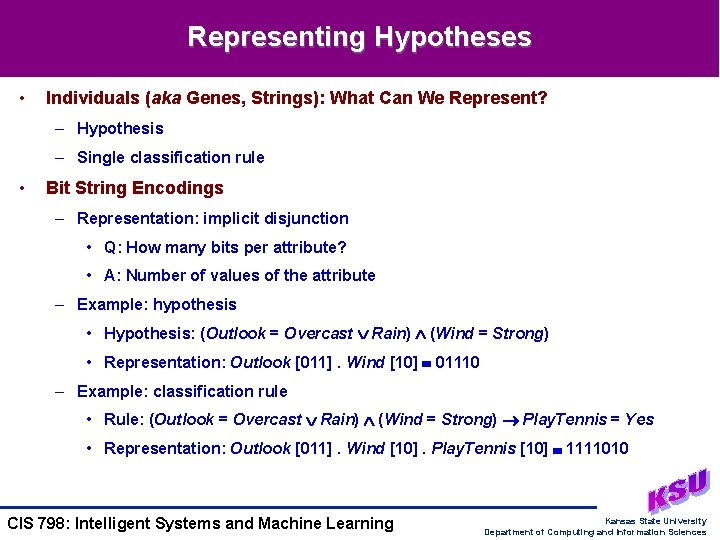
Representing Hypotheses • Individuals (aka Genes, Strings): What Can We Represent? – Hypothesis – Single classification rule • Bit String Encodings – Representation: implicit disjunction • Q: How many bits per attribute? • A: Number of values of the attribute – Example: hypothesis • Hypothesis: (Outlook = Overcast Rain) (Wind = Strong) • Representation: Outlook [011]. Wind [10] 01110 – Example: classification rule • Rule: (Outlook = Overcast Rain) (Wind = Strong) Play. Tennis = Yes • Representation: Outlook [011]. Wind [10]. Play. Tennis [10] 1111010 CIS 798: Intelligent Systems and Machine Learning Kansas State University Department of Computing and Information Sciences
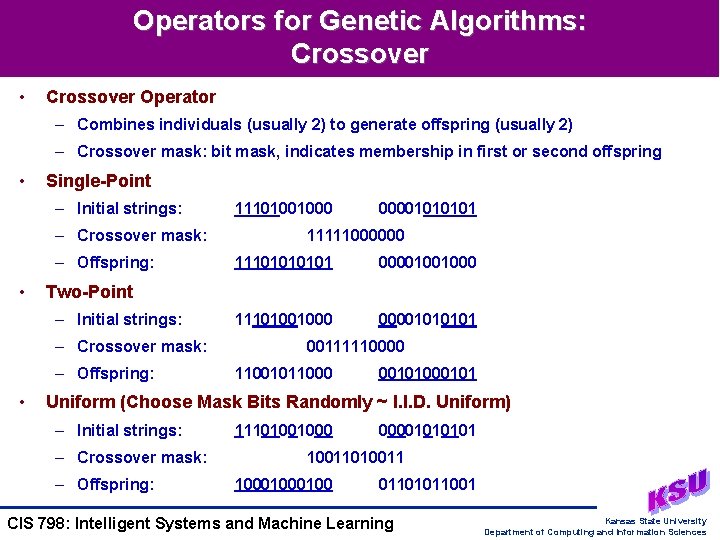
Operators for Genetic Algorithms: Crossover • Crossover Operator – Combines individuals (usually 2) to generate offspring (usually 2) – Crossover mask: bit mask, indicates membership in first or second offspring • Single-Point – Initial strings: – Crossover mask: – Offspring: • 0000101 11111000000 1110101 00001001000 11101001000 0000101 Two-Point – Initial strings: – Crossover mask: – Offspring: • 11101001000 00111110000 11001011000 00101000101 Uniform (Choose Mask Bits Randomly ~ I. I. D. Uniform) – Initial strings: – Crossover mask: – Offspring: 11101001000 0000101 10011010011 1000100 01101011001 CIS 798: Intelligent Systems and Machine Learning Kansas State University Department of Computing and Information Sciences
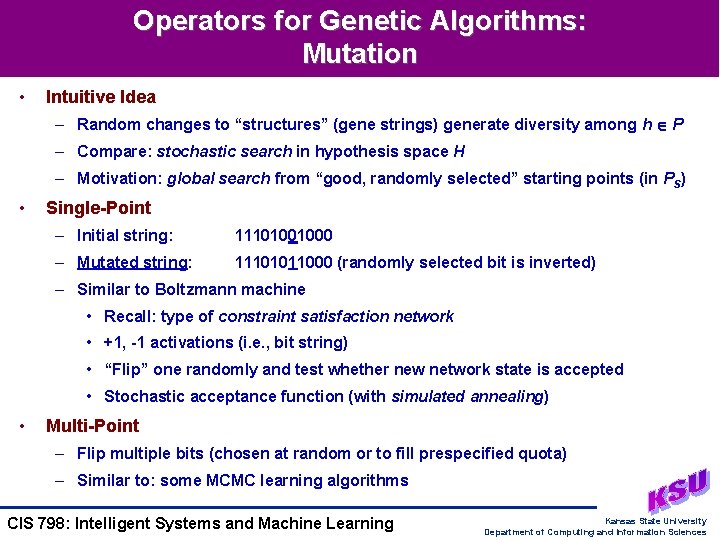
Operators for Genetic Algorithms: Mutation • Intuitive Idea – Random changes to “structures” (gene strings) generate diversity among h P – Compare: stochastic search in hypothesis space H – Motivation: global search from “good, randomly selected” starting points (in PS) • Single-Point – Initial string: 11101001000 – Mutated string: 11101011000 (randomly selected bit is inverted) – Similar to Boltzmann machine • Recall: type of constraint satisfaction network • +1, -1 activations (i. e. , bit string) • “Flip” one randomly and test whether new network state is accepted • Stochastic acceptance function (with simulated annealing) • Multi-Point – Flip multiple bits (chosen at random or to fill prespecified quota) – Similar to: some MCMC learning algorithms CIS 798: Intelligent Systems and Machine Learning Kansas State University Department of Computing and Information Sciences
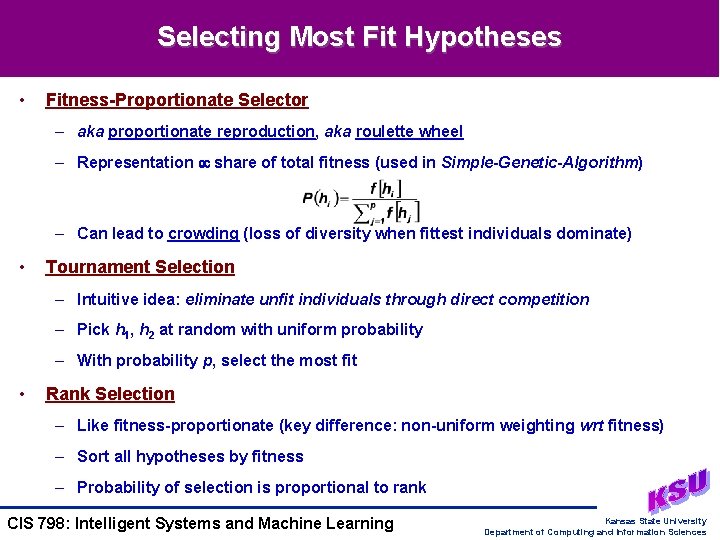
Selecting Most Fit Hypotheses • Fitness-Proportionate Selector – aka proportionate reproduction, aka roulette wheel – Representation share of total fitness (used in Simple-Genetic-Algorithm) – Can lead to crowding (loss of diversity when fittest individuals dominate) • Tournament Selection – Intuitive idea: eliminate unfit individuals through direct competition – Pick h 1, h 2 at random with uniform probability – With probability p, select the most fit • Rank Selection – Like fitness-proportionate (key difference: non-uniform weighting wrt fitness) – Sort all hypotheses by fitness – Probability of selection is proportional to rank CIS 798: Intelligent Systems and Machine Learning Kansas State University Department of Computing and Information Sciences
![GA-Based Inductive Learning (GABIL) • GABIL System [Dejong et al, 1993] – Given: concept](http://slidetodoc.com/presentation_image_h2/64be23535aab305c41dae0b8d8ed74e4/image-10.jpg "GA-Based Inductive Learning (GABIL) • GABIL System [Dejong et al, 1993] – Given: concept")
GA-Based Inductive Learning (GABIL) • GABIL System [Dejong et al, 1993] – Given: concept learning problem and examples – Learn: disjunctive set of propositional rules – Goal: results competitive with those for current decision tree learning algorithms (e. g. , C 4. 5) • Fitness Function: Fitness(h) = (Correct(h))2 • Representation – Rules: IF a 1 = T a 2 = F THEN c = T; IF a 2 = T THEN c = F – Bit string encoding: a 1 [10]. a 2 [01]. c [1]. a 1 [11]. a 2 [10]. c [0] = 10011 11100 • Genetic Operators – Want variable-length rule sets – Want only well-formed bit string hypotheses CIS 798: Intelligent Systems and Machine Learning Kansas State University Department of Computing and Information Sciences
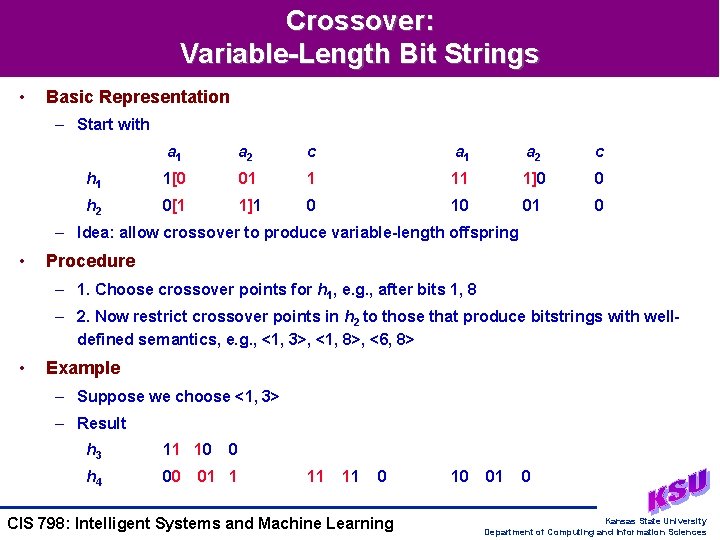
Crossover: Variable-Length Bit Strings • Basic Representation – Start with a 1 a 2 c h 1 1[0 01 1 11 1]0 0 h 2 0[1 1]1 0 10 01 0 – Idea: allow crossover to produce variable-length offspring • Procedure – 1. Choose crossover points for h 1, e. g. , after bits 1, 8 – 2. Now restrict crossover points in h 2 to those that produce bitstrings with welldefined semantics, e. g. , <1, 3>, <1, 8>, <6, 8> • Example – Suppose we choose <1, 3> – Result h 3 11 10 h 4 00 0 01 1 11 11 0 CIS 798: Intelligent Systems and Machine Learning 10 01 0 Kansas State University Department of Computing and Information Sciences
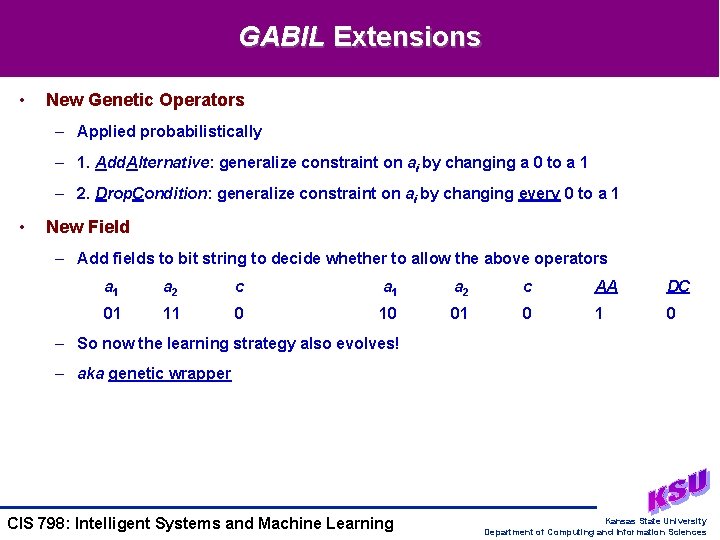
GABIL Extensions • New Genetic Operators – Applied probabilistically – 1. Add. Alternative: generalize constraint on ai by changing a 0 to a 1 – 2. Drop. Condition: generalize constraint on ai by changing every 0 to a 1 • New Field – Add fields to bit string to decide whether to allow the above operators a 1 a 2 c AA DC 01 11 0 10 01 0 – So now the learning strategy also evolves! – aka genetic wrapper CIS 798: Intelligent Systems and Machine Learning Kansas State University Department of Computing and Information Sciences
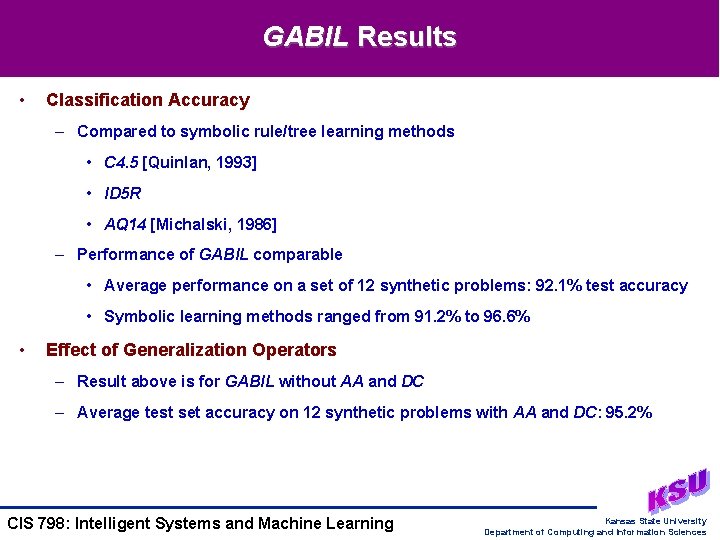
GABIL Results • Classification Accuracy – Compared to symbolic rule/tree learning methods • C 4. 5 [Quinlan, 1993] • ID 5 R • AQ 14 [Michalski, 1986] – Performance of GABIL comparable • Average performance on a set of 12 synthetic problems: 92. 1% test accuracy • Symbolic learning methods ranged from 91. 2% to 96. 6% • Effect of Generalization Operators – Result above is for GABIL without AA and DC – Average test set accuracy on 12 synthetic problems with AA and DC: 95. 2% CIS 798: Intelligent Systems and Machine Learning Kansas State University Department of Computing and Information Sciences
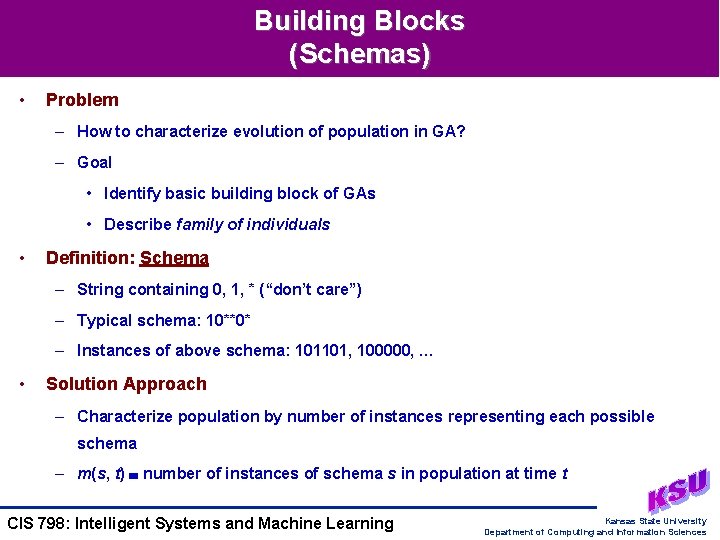
Building Blocks (Schemas) • Problem – How to characterize evolution of population in GA? – Goal • Identify basic building block of GAs • Describe family of individuals • Definition: Schema – String containing 0, 1, * (“don’t care”) – Typical schema: 10**0* – Instances of above schema: 101101, 100000, … • Solution Approach – Characterize population by number of instances representing each possible schema – m(s, t) number of instances of schema s in population at time t CIS 798: Intelligent Systems and Machine Learning Kansas State University Department of Computing and Information Sciences
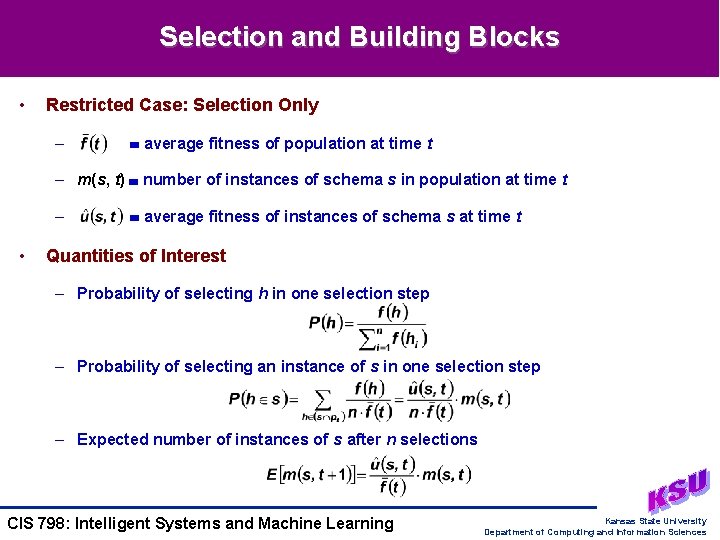
Selection and Building Blocks • Restricted Case: Selection Only – average fitness of population at time t – m(s, t) number of instances of schema s in population at time t – • average fitness of instances of schema s at time t Quantities of Interest – Probability of selecting h in one selection step – Probability of selecting an instance of s in one selection step – Expected number of instances of s after n selections CIS 798: Intelligent Systems and Machine Learning Kansas State University Department of Computing and Information Sciences
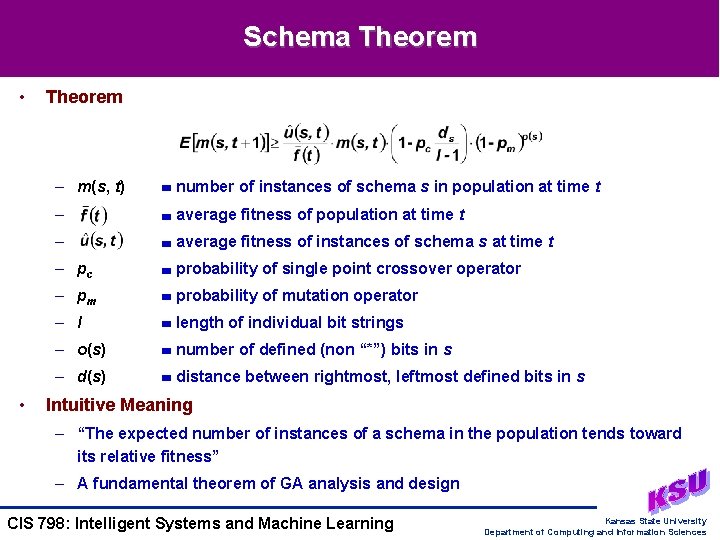
Schema Theorem • • Theorem – m(s, t) number of instances of schema s in population at time t – average fitness of instances of schema s at time t – pc probability of single point crossover operator – pm probability of mutation operator – l length of individual bit strings – o(s) number of defined (non “*”) bits in s – d(s) distance between rightmost, leftmost defined bits in s Intuitive Meaning – “The expected number of instances of a schema in the population tends toward its relative fitness” – A fundamental theorem of GA analysis and design CIS 798: Intelligent Systems and Machine Learning Kansas State University Department of Computing and Information Sciences
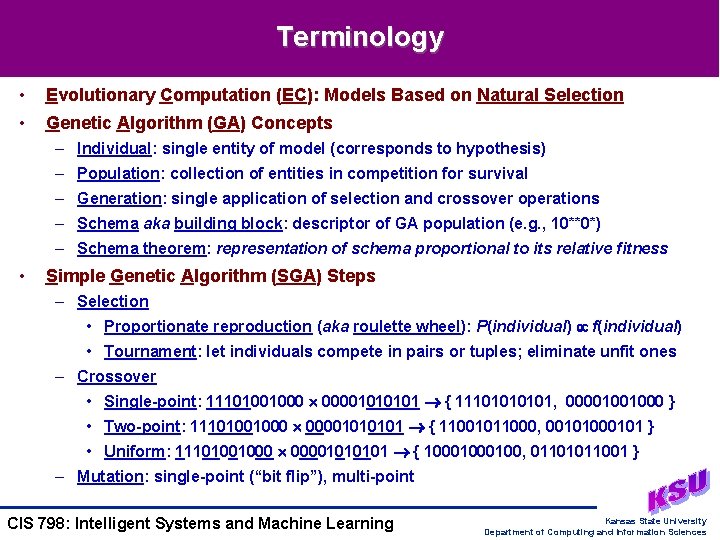
Terminology • Evolutionary Computation (EC): Models Based on Natural Selection • Genetic Algorithm (GA) Concepts – Individual: single entity of model (corresponds to hypothesis) – Population: collection of entities in competition for survival – Generation: single application of selection and crossover operations – Schema aka building block: descriptor of GA population (e. g. , 10**0*) – Schema theorem: representation of schema proportional to its relative fitness • Simple Genetic Algorithm (SGA) Steps – Selection • Proportionate reproduction (aka roulette wheel): P(individual) f(individual) • Tournament: let individuals compete in pairs or tuples; eliminate unfit ones – Crossover • Single-point: 11101001000 0000101 { 1110101, 00001001000 } • Two-point: 11101001000 0000101 { 11001011000, 00101000101 } • Uniform: 11101001000 0000101 { 1000100, 01101011001 } – Mutation: single-point (“bit flip”), multi-point CIS 798: Intelligent Systems and Machine Learning Kansas State University Department of Computing and Information Sciences
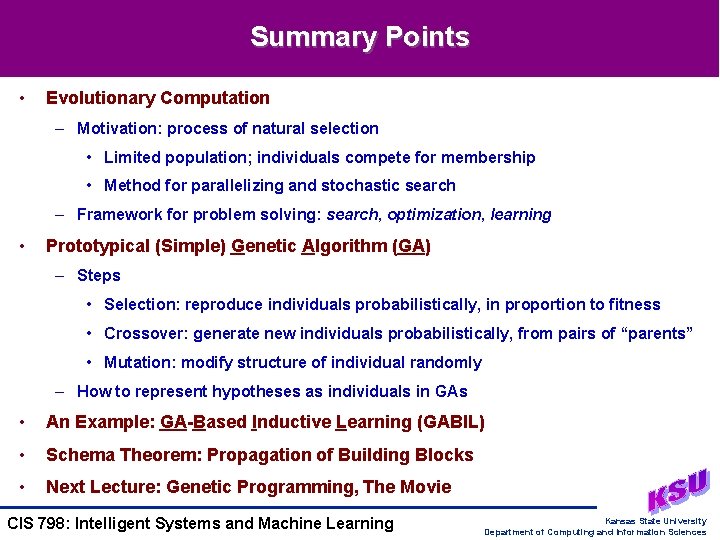
Summary Points • Evolutionary Computation – Motivation: process of natural selection • Limited population; individuals compete for membership • Method for parallelizing and stochastic search – Framework for problem solving: search, optimization, learning • Prototypical (Simple) Genetic Algorithm (GA) – Steps • Selection: reproduce individuals probabilistically, in proportion to fitness • Crossover: generate new individuals probabilistically, from pairs of “parents” • Mutation: modify structure of individual randomly – How to represent hypotheses as individuals in GAs • An Example: GA-Based Inductive Learning (GABIL) • Schema Theorem: Propagation of Building Blocks • Next Lecture: Genetic Programming, The Movie CIS 798: Intelligent Systems and Machine Learning Kansas State University Department of Computing and Information Sciences
- Slides: 18