
Lecture 23 Interconnection Networks Topics Router microarchitecture topologies
- Slides: 23
Lecture 23: Interconnection Networks • Topics: Router microarchitecture, topologies • Final exam next Tuesday: same rules as the first midterm • Next semester: CS/EE 7810: Advanced Computer Arch, same time, similar topics but more in-depth treatment, project-intensive 1
Virtual Channel Flow Control • Incoming flits are placed in buffers • For this flit to jump to the next router, it must acquire three resources: Ø A free virtual channel on its intended hop § We know that a virtual channel is free when the tail flit goes through Ø Free buffer entries for that virtual channel § This is determined with credit or on/off management Ø A free cycle on the physical channel § Competition among the packets that share a physical channel 2
Buffer Management • Credit-based: keep track of the number of free buffers in the downstream node; the downstream node sends back signals to increment the count when a buffer is freed; need enough buffers to hide the round-trip latency • On/Off: the upstream node sends back a signal when its buffers are close to being full – reduces upstream signaling and counters, but can waste buffer space 3
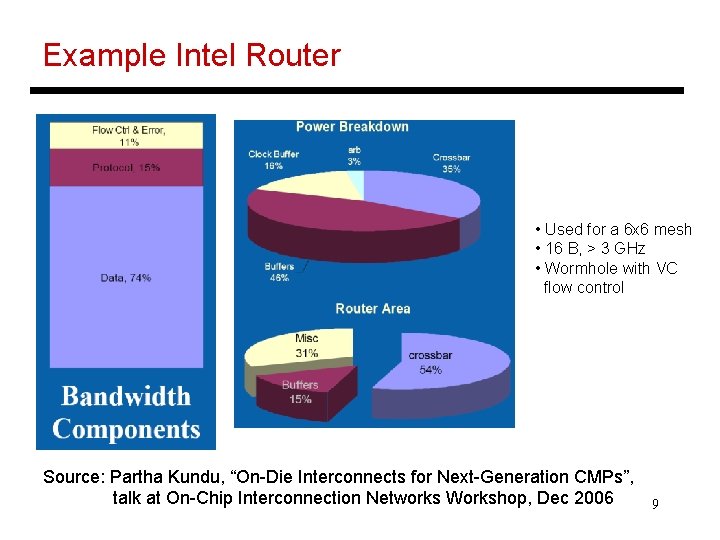
Router Functions • Crossbar, buffer, arbiter, VC state and allocation, buffer management, ALUs, control logic, routing • Typical on-chip network power breakdown: § 30% link § 30% buffers § 30% crossbar 4
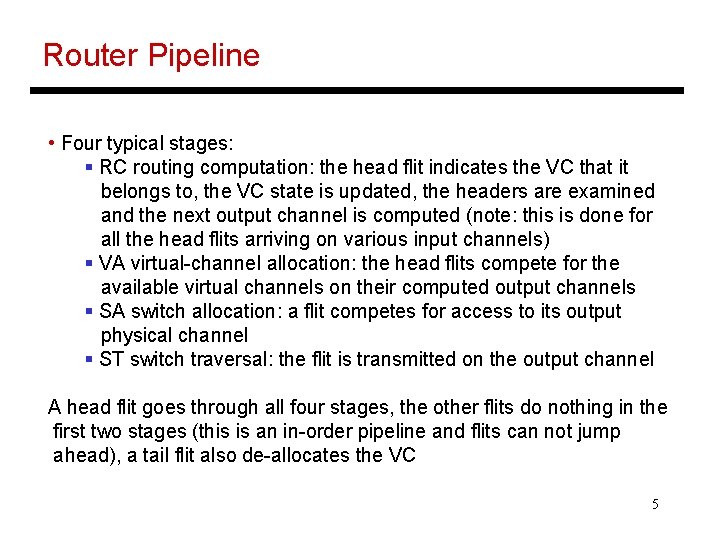
Router Pipeline • Four typical stages: § RC routing computation: the head flit indicates the VC that it belongs to, the VC state is updated, the headers are examined and the next output channel is computed (note: this is done for all the head flits arriving on various input channels) § VA virtual-channel allocation: the head flits compete for the available virtual channels on their computed output channels § SA switch allocation: a flit competes for access to its output physical channel § ST switch traversal: the flit is transmitted on the output channel A head flit goes through all four stages, the other flits do nothing in the first two stages (this is an in-order pipeline and flits can not jump ahead), a tail flit also de-allocates the VC 5
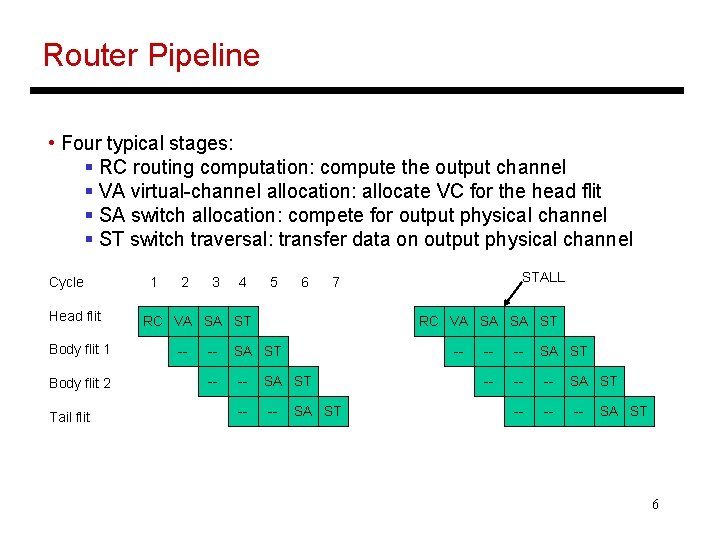
Router Pipeline • Four typical stages: § RC routing computation: compute the output channel § VA virtual-channel allocation: allocate VC for the head flit § SA switch allocation: compete for output physical channel § ST switch traversal: transfer data on output physical channel Cycle Head flit Body flit 1 Body flit 2 Tail flit 1 2 3 4 5 6 RC VA SA ST -- --- RC VA SA SA ST --- STALL 7 -- SA ST -- -- -- SA ST 6
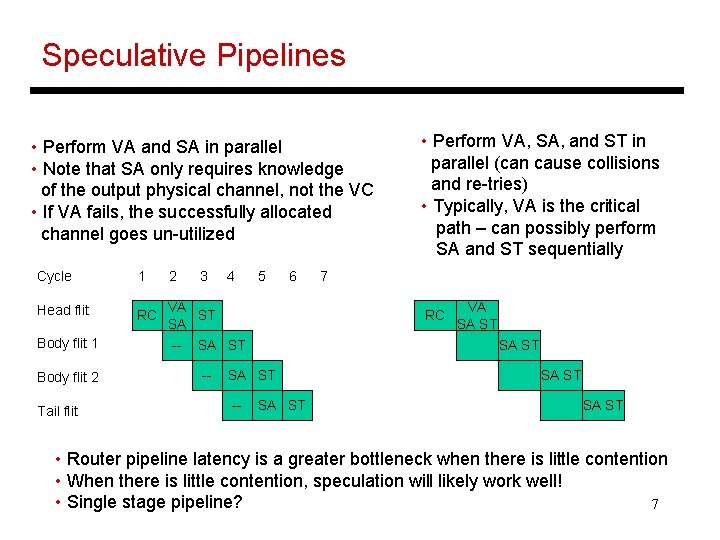
Speculative Pipelines • Perform VA and SA in parallel • Note that SA only requires knowledge of the output physical channel, not the VC • If VA fails, the successfully allocated channel goes un-utilized Cycle 1 2 Head flit RC VA ST SA Body flit 1 Body flit 2 Tail flit -- 3 4 5 6 7 RC SA ST -- • Perform VA, SA, and ST in parallel (can cause collisions and re-tries) • Typically, VA is the critical path – can possibly perform SA and ST sequentially SA ST -- VA SA ST • Router pipeline latency is a greater bottleneck when there is little contention • When there is little contention, speculation will likely work well! • Single stage pipeline? 7
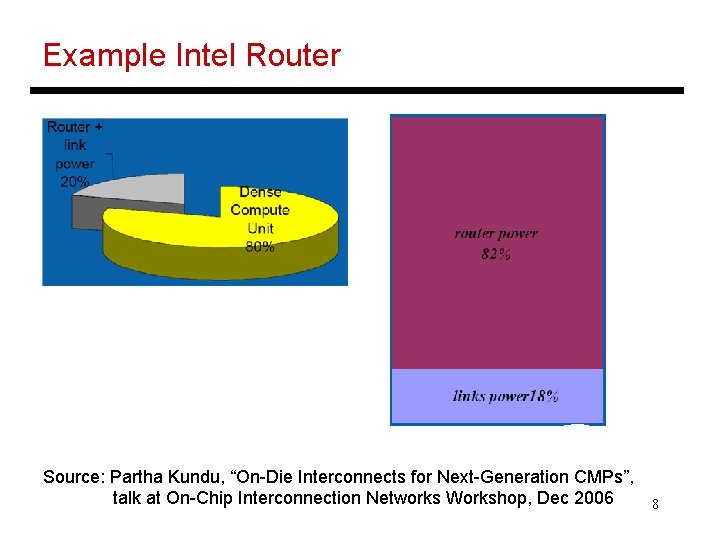
Example Intel Router Source: Partha Kundu, “On-Die Interconnects for Next-Generation CMPs”, talk at On-Chip Interconnection Networks Workshop, Dec 2006 8
Example Intel Router • Used for a 6 x 6 mesh • 16 B, > 3 GHz • Wormhole with VC flow control Source: Partha Kundu, “On-Die Interconnects for Next-Generation CMPs”, talk at On-Chip Interconnection Networks Workshop, Dec 2006 9
Current Trends • Growing interest in eliminating the area/power overheads of router buffers; traffic levels are also relatively low, so virtual-channel buffered routed networks may be overkill • Option 1: use a bus for short distances (16 cores) and use a hierarchy of buses to travel long distances • Option 2: hot-potato or bufferless routing 10
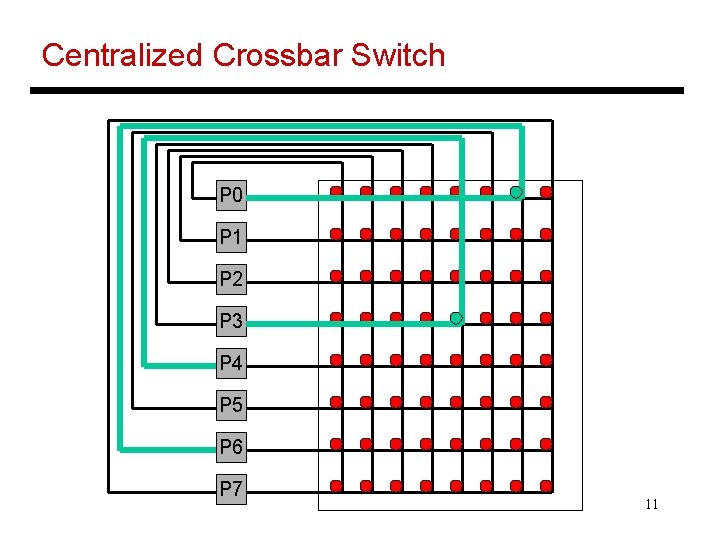
Centralized Crossbar Switch P 0 P 1 P 2 P 3 P 4 P 5 P 6 P 7 11
Crossbar Properties • Assuming each node has one input and one output, a crossbar can provide maximum bandwidth: N messages can be sent as long as there are N unique sources and N unique destinations • Maximum overhead: WN 2 internal switches, where W is data width and N is number of nodes • To reduce overhead, use smaller switches as building blocks – trade off overhead for lower effective bandwidth 12
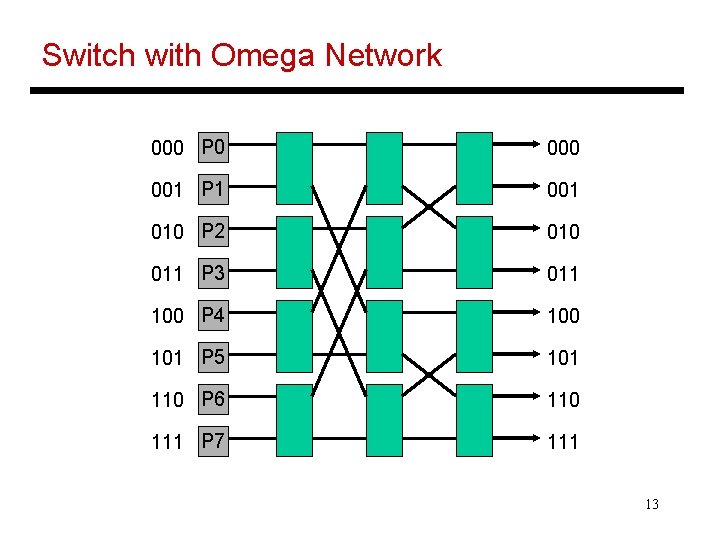
Switch with Omega Network 000 P 0 001 P 1 001 010 P 2 010 011 P 3 011 100 P 4 100 101 P 5 101 110 P 6 110 111 P 7 111 13
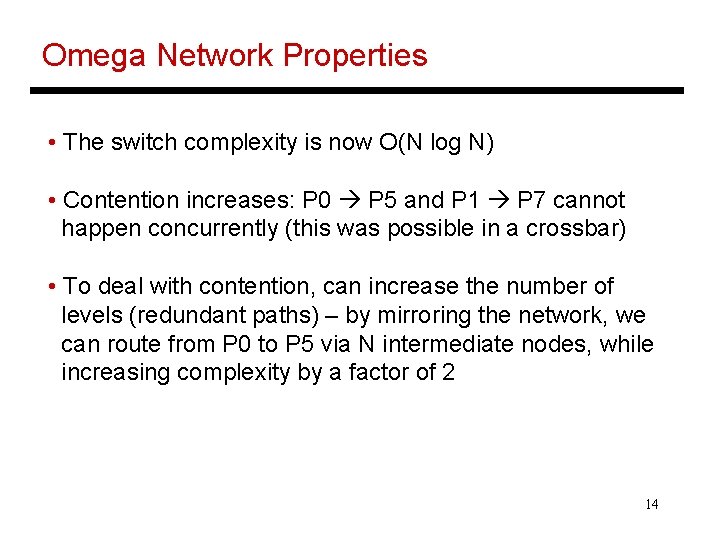
Omega Network Properties • The switch complexity is now O(N log N) • Contention increases: P 0 P 5 and P 1 P 7 cannot happen concurrently (this was possible in a crossbar) • To deal with contention, can increase the number of levels (redundant paths) – by mirroring the network, we can route from P 0 to P 5 via N intermediate nodes, while increasing complexity by a factor of 2 14
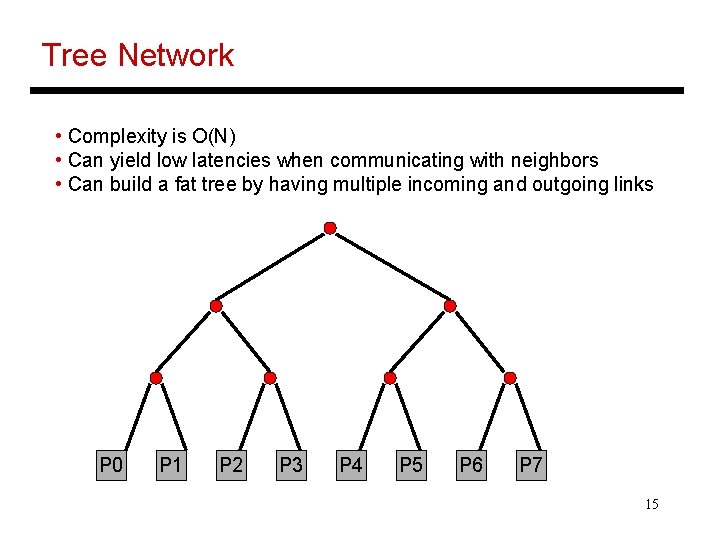
Tree Network • Complexity is O(N) • Can yield low latencies when communicating with neighbors • Can build a fat tree by having multiple incoming and outgoing links P 0 P 1 P 2 P 3 P 4 P 5 P 6 P 7 15
Bisection Bandwidth • Split N nodes into two groups of N/2 nodes such that the bandwidth between these two groups is minimum: that is the bisection bandwidth • Why is it relevant: if traffic is completely random, the probability of a message going across the two halves is ½ – if all nodes send a message, the bisection bandwidth will have to be N/2 • The concept of bisection bandwidth confirms that the tree network is not suited for random traffic patterns, but for localized traffic patterns 16
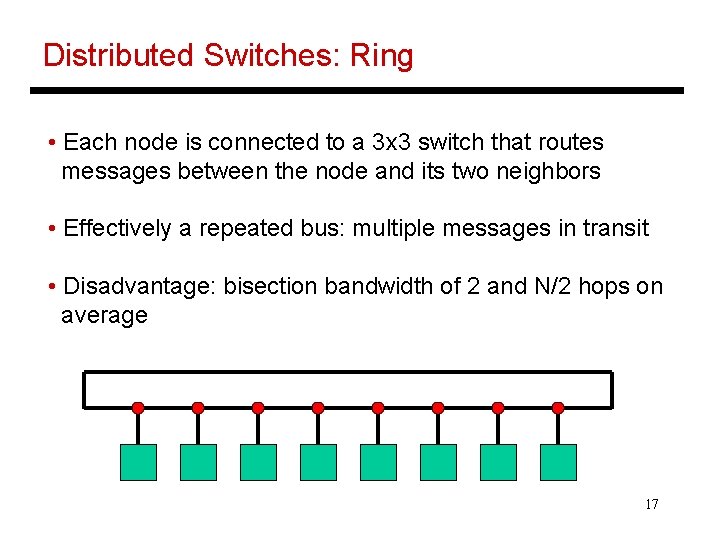
Distributed Switches: Ring • Each node is connected to a 3 x 3 switch that routes messages between the node and its two neighbors • Effectively a repeated bus: multiple messages in transit • Disadvantage: bisection bandwidth of 2 and N/2 hops on average 17
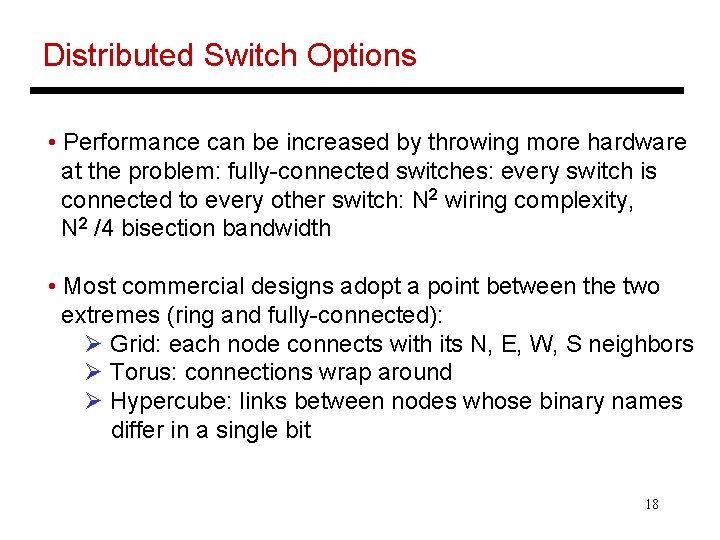
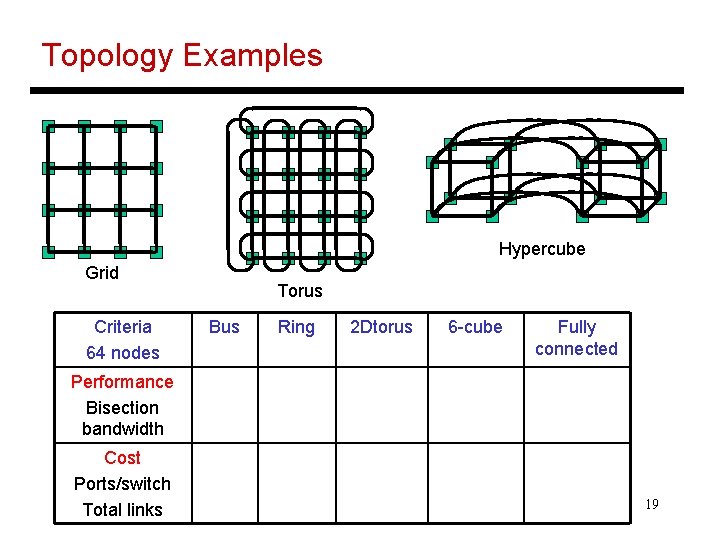
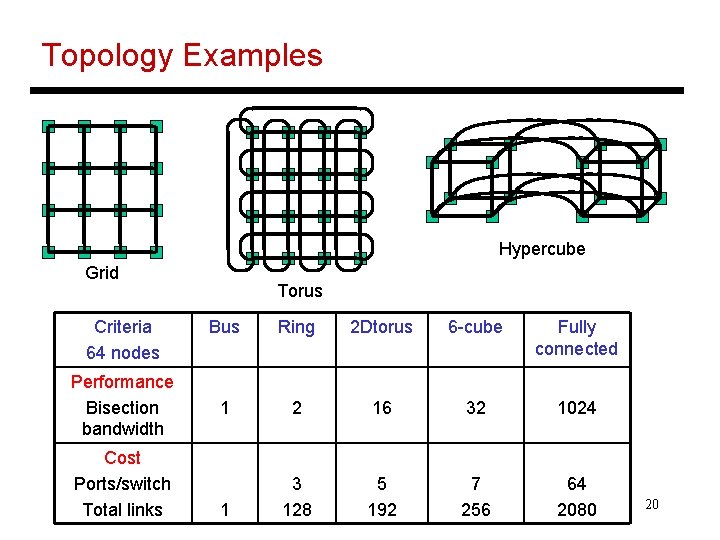
Distributed Switch Options • Performance can be increased by throwing more hardware at the problem: fully-connected switches: every switch is connected to every other switch: N 2 wiring complexity, N 2 /4 bisection bandwidth • Most commercial designs adopt a point between the two extremes (ring and fully-connected): Ø Grid: each node connects with its N, E, W, S neighbors Ø Torus: connections wrap around Ø Hypercube: links between nodes whose binary names differ in a single bit 18
Topology Examples Hypercube Grid Criteria 64 nodes Torus Bus Ring 2 Dtorus 6 -cube Fully connected Performance Bisection bandwidth Cost Ports/switch Total links 19
Topology Examples Hypercube Grid Criteria 64 nodes Performance Bisection bandwidth Cost Ports/switch Total links Torus Bus Ring 2 Dtorus 6 -cube Fully connected 1 2 16 32 1024 1 3 128 5 192 7 256 64 2080 20
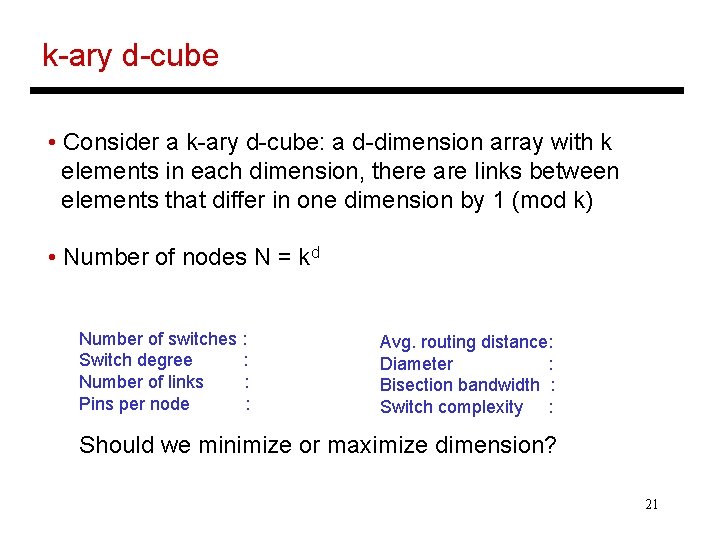
k-ary d-cube • Consider a k-ary d-cube: a d-dimension array with k elements in each dimension, there are links between elements that differ in one dimension by 1 (mod k) • Number of nodes N = kd Number of switches : Switch degree : Number of links : Pins per node : Avg. routing distance: Diameter : Bisection bandwidth : Switch complexity : Should we minimize or maximize dimension? 21
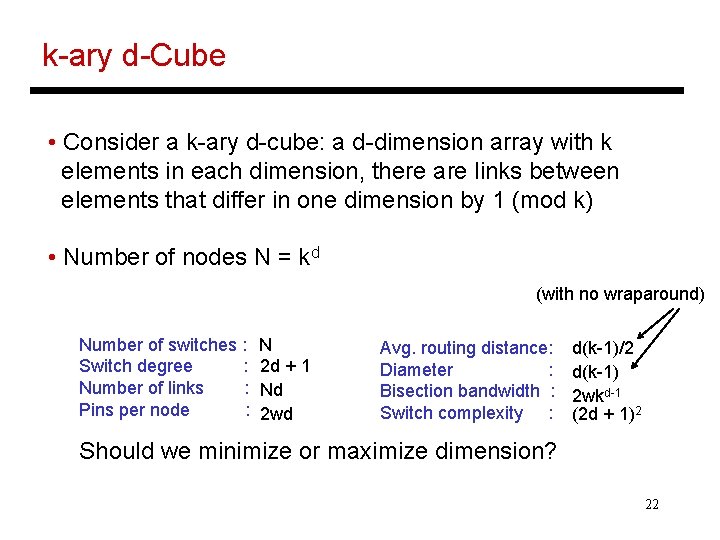
k-ary d-Cube • Consider a k-ary d-cube: a d-dimension array with k elements in each dimension, there are links between elements that differ in one dimension by 1 (mod k) • Number of nodes N = kd (with no wraparound) Number of switches : Switch degree : Number of links : Pins per node : N 2 d + 1 Nd 2 wd Avg. routing distance: Diameter : Bisection bandwidth : Switch complexity : d(k-1)/2 d(k-1) 2 wkd-1 (2 d + 1)2 Should we minimize or maximize dimension? 22
Title • Bullet 23