
Lecture 23 Fabrication OUTLINE IC Fabrication Technology Introduction
Lecture #23 Fabrication OUTLINE • IC Fabrication Technology – Introduction – the task at hand – Doping – Oxidation – Thin-film deposition – Lithography – Etch – Lithography trends – Plasma processing – Chemical mechanical polishing Reading (Rabaey et al. ) • Sections 2. 1 -2. 2 EECS 40, Fall 2004 Lecture 23, Slide 1 Prof. White

Moore’s Law – Increasing Number of Transistors on a Chip Transistor count vs. year on Intel computer chips Year Transistors Per Chip 1972 3, 500 1974 6, 000 1978 29, 000 1982 134, 000 1985 275, 000 1989 1, 200, 000 1993 3, 100, 000 1995 5, 500, 000 1997 7, 500, 000 1999 19, 000 2000 28, 100, 000 EECS 40, Fall 2004 Number of transistors per chip doubles every 18 to 24 months Lecture 23, Slide 2 Prof. White

MOSFET Layout and Cross-Section Top View: Cross Section: EECS 40, Fall 2004 Lecture 23, Slide 3 Prof. White

N-channel MOSFET Schematic Cross-Sectional View Layout (Top View) EECS 40, Fall 2004 Lecture 23, Slide 4 4 lithography steps are required: 1. active area 2. gate electrode 3. contact 4. metal interconnects Prof. White

Computing the Output Capacitance 2 l=0. 25 m Example 5. 4 (pp. 197 -203) VDD In Out PMOS W/L=9 l/2 l Poly-Si Out In NMOS W/L=3 l/2 l GND Metal 1 EECS 40, Fall 2004 Lecture 23, Slide 5 Prof. White

Integrated Circuit Fabrication Goal: Mass fabrication (i. e. simultaneous fabrication) of many “chips”, each a circuit (e. g. a microprocessor or memory chip) containing millions or billions of transistors Method: Lay down thin films of semiconductors, metals and insulators and pattern each layer with a process much like printing (lithography). Materials used in a basic CMOS integrated circuit: • Si substrate – selectively doped in various regions • Si. O 2 insulator • Polycrystalline silicon – used for the gate electrodes EECS 40, Fall 2004 Lecture 23, Slide 6 Prof. White

Si Substrates (Wafers) Crystals are grown from a melt in boules (cylinders) with specified dopant concentrations. They are ground perfectly round and oriented (a “flat” or “notch” is ground along the boule) and then sliced like baloney into wafers. The wafers are then polished. 300 mm Typical wafer cost: $50 Sizes: 150 mm, 200 mm, 300 mm diameter EECS 40, Fall 2004 Lecture 23, Slide 7 “notch” indicates crystal orientation Prof. White

Adding Dopants into Si Suppose we have a wafer of Si which is p-type and we want to change the surface to n-type. The way in which this is done is by ion implantation. Dopant ions are shot out of an “ion gun” called an ion implanter, into the surface of the wafer. Eaton HE 3 High-Energy Implanter, showing the ion beam hitting the end-station Typical implant energies are in the range 1 -200 ke. V. After the ion implantation, the wafers are heated to a high temperature (~1000 o. C). This “annealing” step heals the damage and causes the implanted dopant atoms to move into substitutional lattice sites. EECS 40, Fall 2004 Lecture 23, Slide 8 Prof. White

Dopant Diffusion • The implanted depth-profile of dopant atoms is peaked. dopant atom concentration (logarithmic scale) as-implanted profile depth, x • In order to achieve a more uniform dopant profile, hightemperature annealing is used to diffuse the dopants • Dopants can also be directly introduced into the surface of a wafer by diffusion (rather than by ion implantation) from a dopant-containing ambient or doped solid source EECS 40, Fall 2004 Lecture 23, Slide 9 Prof. White

Formation of Insulating Films • The favored insulator is pure silicon dioxide (Si. O 2). • A Si. O 2 film can be formed by one of two methods: 1. Oxidation of Si at high temperature in O 2 or steam ambient 2. Deposition of a silicon dioxide film Applied Materials lowpressure chemical-vapor deposition (CVD) chamber ASM A 412 batch oxidation furnace EECS 40, Fall 2004 Lecture 23, Slide 10 Prof. White

Thermal Oxidation or “wet” oxidation “dry” oxidation • Temperature range: § 700 o. C to 1100 o. C • Process: § O 2 or H 2 O diffuses through Si. O 2 and reacts with Si at the interface to form more Si. O 2 • 1 m of Si. O 2 formed consumes ~0. 5 m of Si EECS 40, Fall 2004 Lecture 23, Slide 11 oxide thickness time, t Prof. White

Example: Thermal Oxidation of Silicon wafer, 100 m thick Thermal oxidation grows Si. O 2 on Si, but it consumes Si, so the wafer gets thinner. Suppose we grow 1 m of oxide: 101 m 99 m EECS 40, Fall 2004 99 m thick Si, with 1 m Si. O 2 all around total thickness = 101 m Lecture 23, Slide 12 Prof. White

Effect of Oxidation Rate Dependence on Thickness • The thermal oxidation rate slows with oxide thickness. Consider a Si wafer with a patterned oxide layer: Si. O 2 thickness = 1 m Si Now suppose we grow 0. 1 m of Si. O 2: Note the 0. 04 m step in the Si surface! Si. O 2 thickness = 1. 02 m EECS 40, Fall 2004 Lecture 23, Slide 13 Si. O 2 thickness = 0. 1 m Prof. White

Selective Oxidation Techniques Window Oxidation EECS 40, Fall 2004 Local Oxidation (LOCOS) Lecture 23, Slide 14 Prof. White

Chemical Vapor Deposition (CVD) of Si. O 2 “LTO” • Temperature range: § 350 o. C to 450 o. C for silane • Process: § Precursor gases dissociate at the wafer surface to form Si. O 2 § No Si on the wafer surface is consumed • Film thickness is controlled by the deposition time EECS 40, Fall 2004 Lecture 23, Slide 15 oxide thickness time, t Prof. White

Chemical Vapor Deposition (CVD) of Si Polycrystalline silicon (“poly-Si”): Like Si. O 2, Si can be deposited by Chemical Vapor Deposition: • Wafer is heated to ~600 o. C • Silicon-containing gas (Si. H 4) is injected into the furnace: Si. H 4 = Si + 2 H 2 Si film made up of crystallites Si. O 2 Silicon wafer Properties: • sheet resistance (heavily doped, 0. 5 m thick) = 20 /� • can withstand high-temperature anneals major advantage EECS 40, Fall 2004 Lecture 23, Slide 16 Prof. White

Physical Vapor Deposition (“Sputtering”) Used to deposit Al films: Negative Bias ( k. V) Al target I Highly energetic argon ions batter the surface of a metal target, knocking atoms loose, which then land on the surface of the wafer Al Ar+ Al Ar plasma Al film wafer Sometimes the substrate is heated, to ~300 o. C Gas pressure: 1 to 10 m. Torr sputtering yield Deposition rate ion current EECS 40, Fall 2004 Lecture 23, Slide 17 Prof. White

Patterning the Layers Planar processing consists of a sequence of additive and subtractive steps with lateral patterning oxidation deposition implantation etching lithography Lithography refers to the process of transferring a pattern to the surface of the wafer Equipment, materials, and processes needed: • A mask (for each layer to be patterned) with the desired pattern • A light-sensitive material (called photoresist) covering the wafer so as to receive the pattern • A light source and method of projecting the image of the mask onto the photoresist (“printer” or “projection stepper” or “projection scanner”) • A method of “developing” the photoresist, that is selectively removing it from the regions where it was exposed EECS 40, Fall 2004 Lecture 23, Slide 18 Prof. White

The Photo-Lithographic Process optical mask oxidation photoresist exposure photoresist removal (ashing) process step EECS 40, Fall 2004 photoresist coating spin, rinse, dry acid etch Lecture 23, Slide 19 photoresist develop Prof. White

Photoresist Exposure • A glass mask with a black/clear pattern is used to expose a wafer coated with ~1 m thick photoresist UV light Mask Lens Image of mask appears here (3 dark areas, 4 light areas) photoresist Si wafer Mask image is demagnified by n. X “ 10 X stepper” “ 4 X stepper” “ 1 X stepper” Areas exposed to UV light are susceptible to chemical removal EECS 40, Fall 2004 Lecture 23, Slide 20 Prof. White

Exposure using “Stepper” Tool field size increases with technology generation scribe line 1 2 wafer images Translational motion EECS 40, Fall 2004 Lecture 23, Slide 21 Prof. White

Photoresist Development • Solutions with high p. H dissolve the areas which were exposed to UV light; unexposed areas are not dissolved Exposed areas of photoresist Developed photoresist EECS 40, Fall 2004 Lecture 23, Slide 22 Prof. White

Lithography Example • Mask pattern (on glass plate) A A B B • Look at cuts (cross sections) at various planes (A-A and B-B) EECS 40, Fall 2004 Lecture 23, Slide 23 Prof. White

“A-A” Cross-Section The resist is exposed in the ranges 0 < x < 2 m & 3 < x < 5 m: 0 1 2 3 4 5 x [ m] mask pattern resist 0 1 2 3 4 5 x [ m] The resist will dissolve in high p. H solutions wherever it was exposed: resist after development 0 EECS 40, Fall 2004 1 2 3 4 Lecture 23, Slide 24 5 x [ m] Prof. White

“B-B” Cross-Section The photoresist is exposed in the ranges 0 < x < 5 m: mask pattern resist 0 1 2 3 4 5 x [ m] resist after development 0 EECS 40, Fall 2004 1 2 3 4 Lecture 23, Slide 25 5 x [ m] Prof. White

Pattern Transfer by Etching In order to transfer the photoresist pattern to an underlying film, we need a “subtractive” process that removes the film, ideally with minimal change in the pattern and with minimal removal of the underlying material(s) ® Selective etch processes (using plasma or aqueous chemistry) have been developed for most IC materials First: pattern photoresist Si Si. O 2 Next: Etch oxide We have exposed mask pattern, and developed the resist oxide etchant … photoresist is resistant. etch stops on silicon (“selective etchant”) Last: strip resist only resist is attacked Jargon for this entire sequence of process steps: “pattern using XX mask” EECS 40, Fall 2004 Lecture 23, Slide 26 Prof. White

Photolithography quartz plate chromium • 2 types of photoresist: – positive tone: portion exposed to light will be dissolved in developer solution – negative tone: portion exposed to light will NOT be dissolved in developer solution from Atlas of IC Technologies by W. Maly EECS 40, Fall 2004 Lecture 23, Slide 27 Prof. White

Lithography Trends • Lithography determines the minimum feature size and limits the throughput that can be achieved in an IC manufacturing process. Thus, lithography research & development efforts are directed at 1. achieving higher resolution → shorter wavelengths 365 nm 248 nm 193 nm 13 nm “i-line” “DUV” “EUV” 2. improving resist materials → higher sensitivity, for shorter exposure times (throughput target is 60 wafers/hr) EECS 40, Fall 2004 Lecture 23, Slide 28 Prof. White

Plasma Processing • Plasmas are used to enhance various processes: – CVD: Energy from RF electric field assists the dissociation of gaseous molecules, to allow for thin-film deposition at higher rates and/or lower temperatures. – Etch: Ionized etchant species are more reactive and can be accelerated toward wafer (biased at negative DC potential), to provide directional etching for more precise transfer of lithographically defined features. Reactive Ion Etcher plasma wafer RF: 13. 56 MHz EECS 40, Fall 2004 Lecture 23, Slide 29 Prof. White

Dry Etching vs. Wet Etching from Atlas of IC Technologies by W. Maly ü better control of etched feature sizes EECS 40, Fall 2004 Lecture 23, Slide 30 ü better etch selectivity Prof. White

Micromachining to make MEMS devices An example of a micromachined part – the world’s smallest guitar. The strings are only 5 nm wide and they actually can be made to vibrate when touched (carefully) with a fine probe. Guitar made by SURFACE MICROMACHING (below). EECS 40, Fall 2004 Lecture 23, Slide 31 Prof. White

Rapid Thermal Annealing (RTA) Sub-micron MOSFETs need ultra-shallow junctions (xj<50 nm) Dopant diffusion during “activation” anneal must be minimized Short annealing time (<1 min. ) at high temperature is required • Ordinary furnaces (e. g. used for thermal oxidation and CVD) heat and cool wafers at a slow rate (<50 o. C per minute) • Special annealing tools have been developed to enable much faster temperature ramping, and precise control of annealing time – ramp rates as fast as 200 o. C/second – anneal times as short as 0. 5 second – typically single-wafer process chamber: EECS 40, Fall 2004 Lecture 23, Slide 32 Prof. White
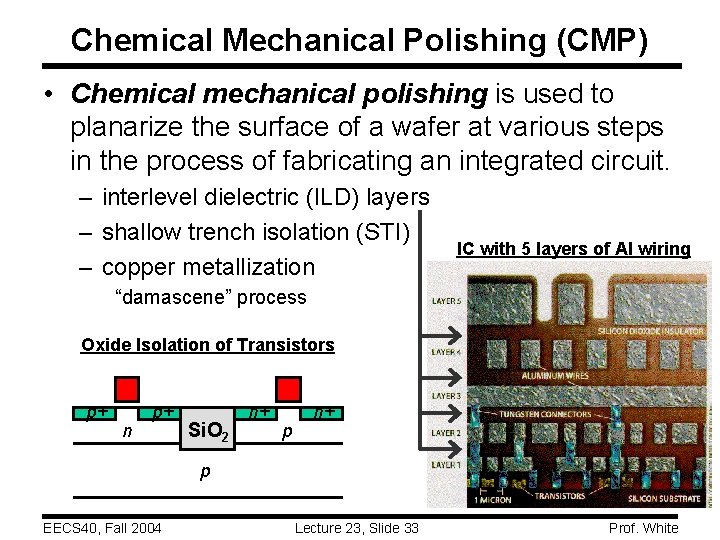
Chemical Mechanical Polishing (CMP) • Chemical mechanical polishing is used to planarize the surface of a wafer at various steps in the process of fabricating an integrated circuit. – interlevel dielectric (ILD) layers – shallow trench isolation (STI) – copper metallization IC with 5 layers of Al wiring “damascene” process Oxide Isolation of Transistors p+ n p+ Si. O 2 n+ p EECS 40, Fall 2004 Lecture 23, Slide 33 Prof. White

Copper Metallization “Dual Damascene Process” (IBM Corporation) (1) courtesy of Sung Gyu Pyo, Hynix Semiconductor (2) (3) EECS 40, Fall 2004 (4) (5) Lecture 23, Slide 34 Prof. White
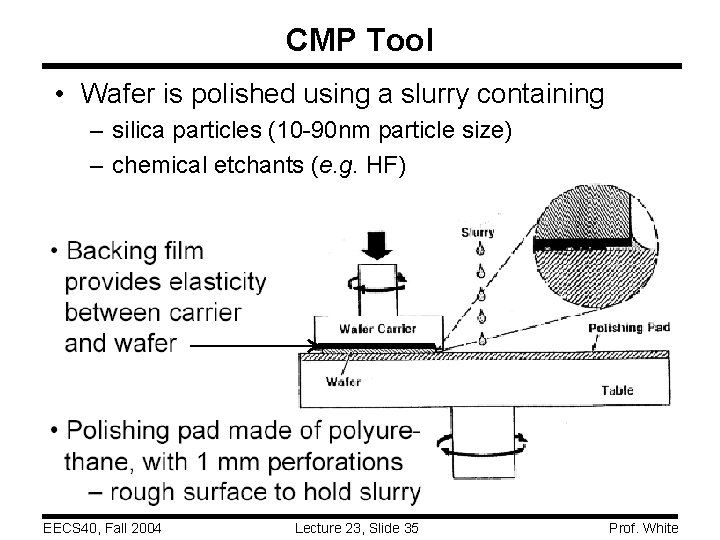
CMP Tool • Wafer is polished using a slurry containing – silica particles (10 -90 nm particle size) – chemical etchants (e. g. HF) EECS 40, Fall 2004 Lecture 23, Slide 35 Prof. White
- Slides: 35