
Lecture 23 Composite Materials Composite Materials Reference Text
- Slides: 14
Lecture 23 – Composite Materials
Composite Materials Reference Text Section Higgins RA & Bolton, 2310. Materials for Engineers and Technicians, 5 th ed, Butterworth Heinemann Ch 23 Reference Text Section Engineering Materials and Processes
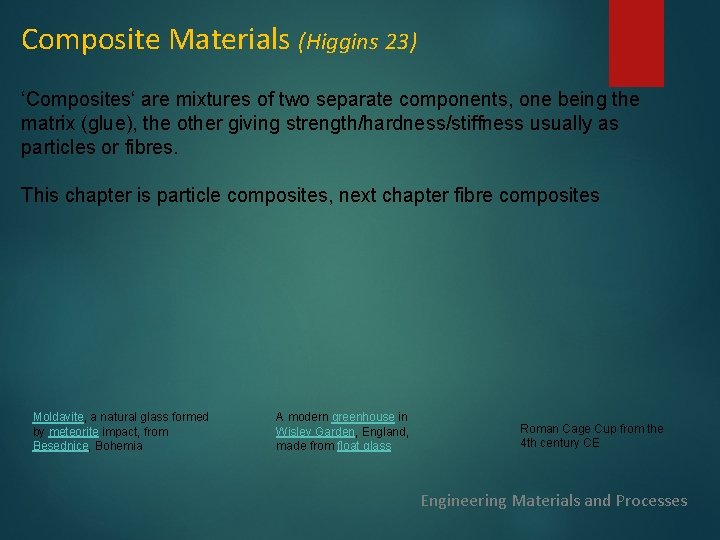
Composite Materials (Higgins 23) ‘Composites‘ are mixtures of two separate components, one being the matrix (glue), the other giving strength/hardness/stiffness usually as particles or fibres. This chapter is particle composites, next chapter fibre composites Moldavite, a natural glass formed by meteorite impact, from Besednice, Bohemia A modern greenhouse in Wisley Garden, England, made from float glass Roman Cage Cup from the 4 th century CE Engineering Materials and Processes
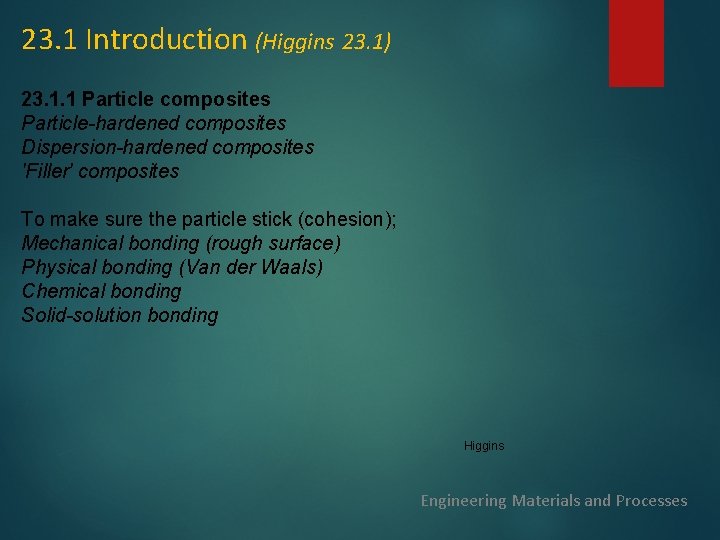
23. 1 Introduction (Higgins 23. 1) 23. 1. 1 Particle composites Particle-hardened composites Dispersion-hardened composites 'Filler' composites To make sure the particle stick (cohesion); Mechanical bonding (rough surface) Physical bonding (Van der Waals) Chemical bonding Solid-solution bonding Higgins Engineering Materials and Processes
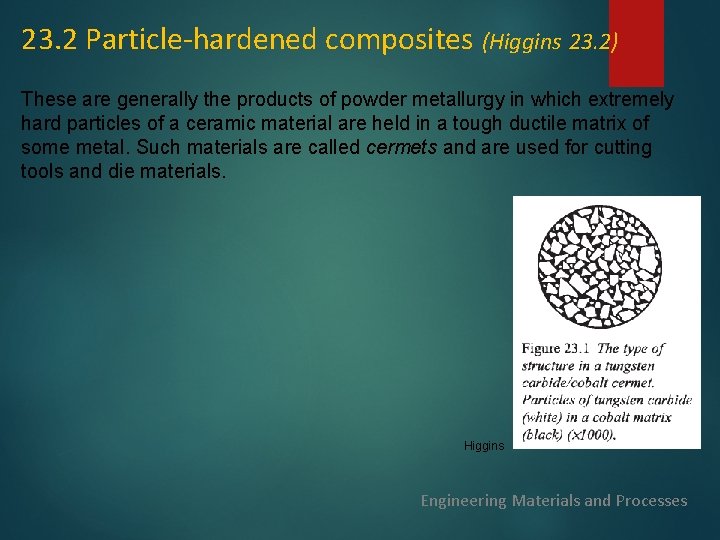
23. 2 Particle-hardened composites (Higgins 23. 2) These are generally the products of powder metallurgy in which extremely hard particles of a ceramic material are held in a tough ductile matrix of some metal. Such materials are called cermets and are used for cutting tools and die materials. Higgins Engineering Materials and Processes
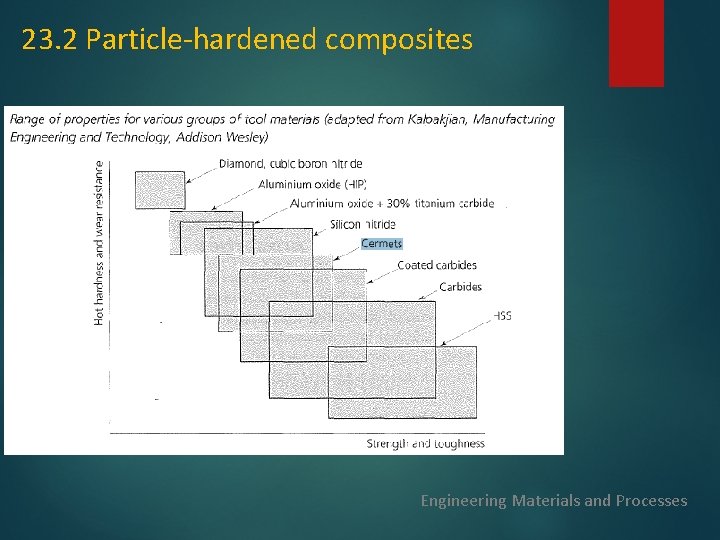
23. 2 Particle-hardened composites Engineering Materials and Processes
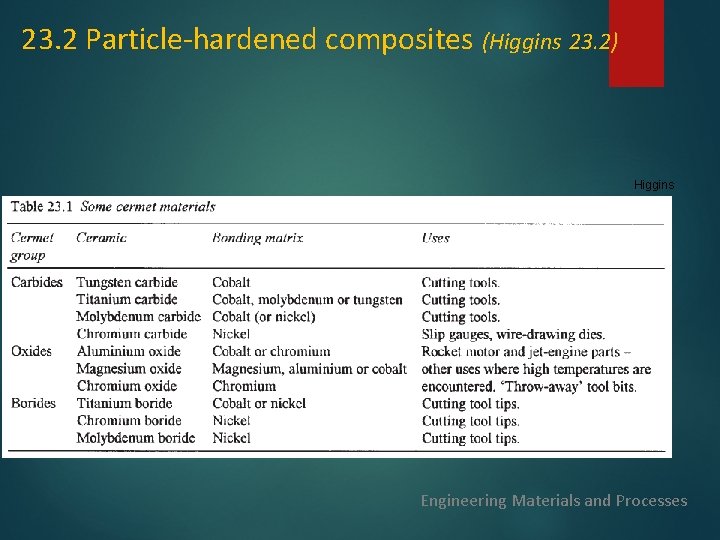
23. 2 Particle-hardened composites (Higgins 23. 2) Higgins Engineering Materials and Processes
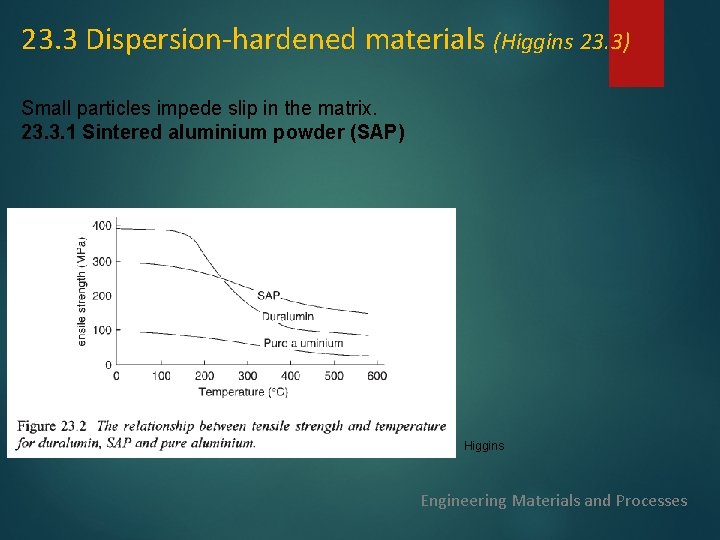
23. 3 Dispersion-hardened materials (Higgins 23. 3) Small particles impede slip in the matrix. 23. 3. 1 Sintered aluminium powder (SAP) Higgins Engineering Materials and Processes
23. 3 Dispersion-hardened materials (Higgins 23. 3) 23. 3. 2 Manufacturing processes 23. 3. 3 Modern superalloys Higgins Engineering Materials and Processes
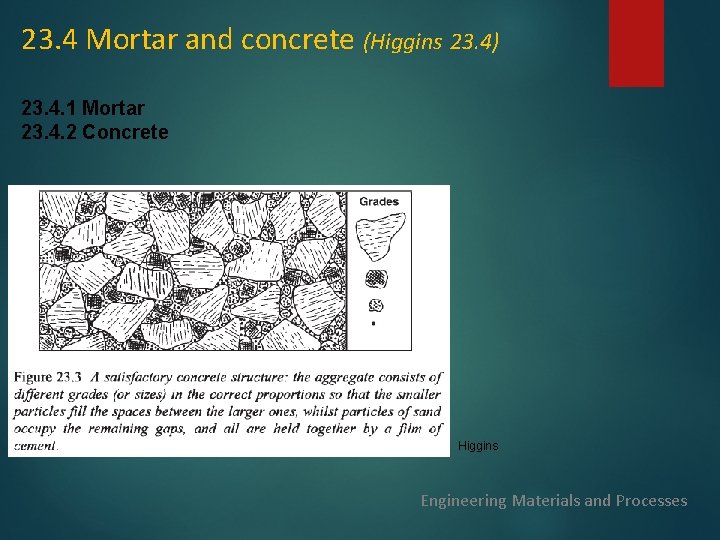
23. 4 Mortar and concrete (Higgins 23. 4) 23. 4. 1 Mortar 23. 4. 2 Concrete Higgins Engineering Materials and Processes
23. 5 Tarmacadam (Higgins 23. 5) Higgins Engineering Materials and Processes
Resources. Wikipedia: Concrete Engineering Materials and Processes
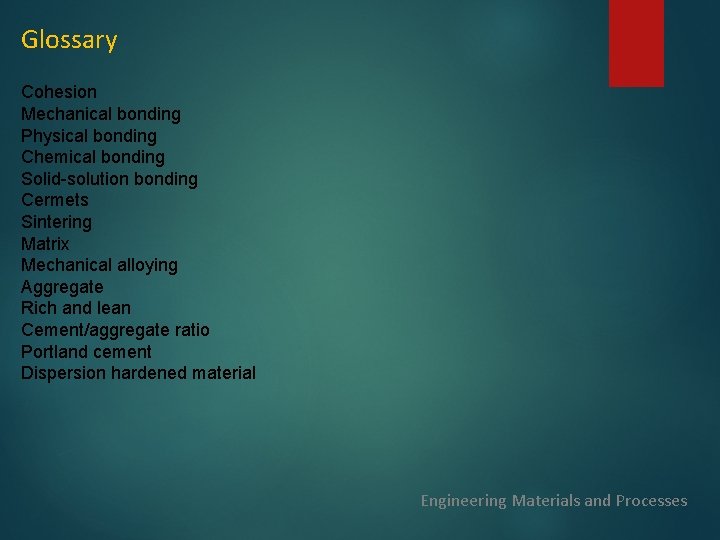
Glossary Cohesion Mechanical bonding Physical bonding Chemical bonding Solid-solution bonding Cermets Sintering Matrix Mechanical alloying Aggregate Rich and lean Cement/aggregate ratio Portland cement Dispersion hardened material Engineering Materials and Processes
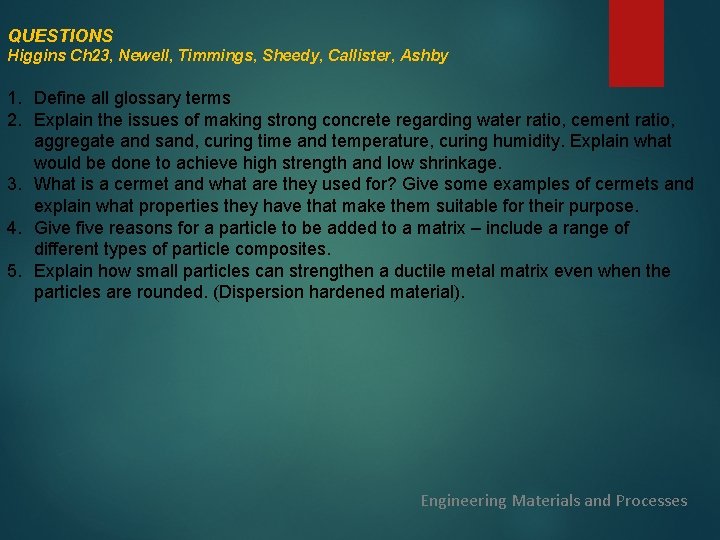
QUESTIONS Higgins Ch 23, Newell, Timmings, Sheedy, Callister, Ashby 1. Define all glossary terms 2. Explain the issues of making strong concrete regarding water ratio, cement ratio, aggregate and sand, curing time and temperature, curing humidity. Explain what would be done to achieve high strength and low shrinkage. 3. What is a cermet and what are they used for? Give some examples of cermets and explain what properties they have that make them suitable for their purpose. 4. Give five reasons for a particle to be added to a matrix – include a range of different types of particle composites. 5. Explain how small particles can strengthen a ductile metal matrix even when the particles are rounded. (Dispersion hardened material). Engineering Materials and Processes