
Lecture 21 Toposort and Reductions CSE 373 Data
![Using Arrays: Find find(A): index = jump to A node’s index 1 while array[index]](https://slidetodoc.com/presentation_image_h2/48c19ac1ca25fa5bda3e599b759cc7c4/image-4.jpg "Using Arrays: Find find(A): index = jump to A node’s index 1 while array[index]")



- Slides: 45
Lecture 21: Toposort and Reductions CSE 373: Data Structures and Algorithms CSE 373 21 SP – CHAMPION 1
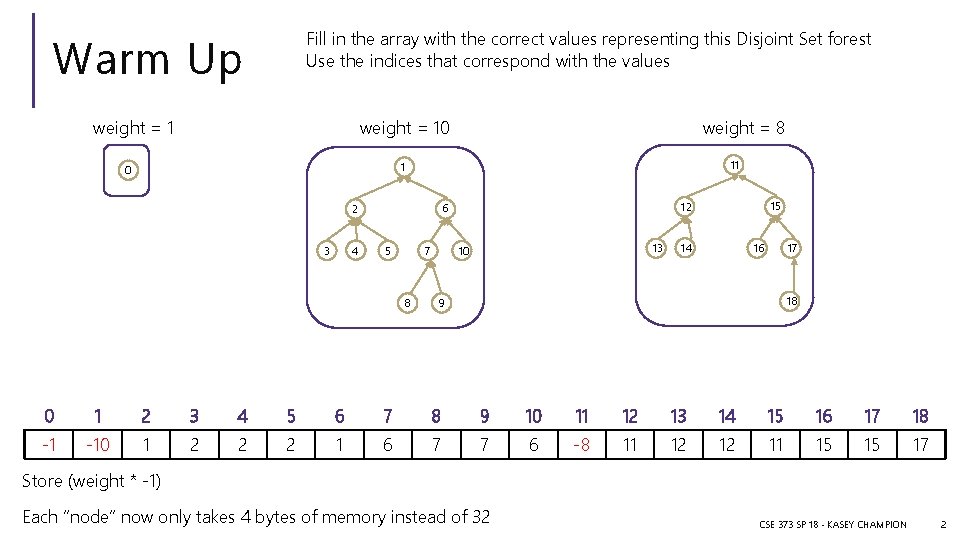
Fill in the array with the correct values representing this Disjoint Set forest Use the indices that correspond with the values Warm Up weight = 1 weight = 8 weight = 10 11 1 0 4 3 5 7 8 15 12 6 2 13 10 14 16 17 18 9 0 1 2 3 4 5 6 7 8 9 10 11 12 13 14 15 16 17 18 -1 -1 -10 1 2 2 2 1 6 7 7 6 -1 -8 11 12 12 11 15 15 17 Store (weight * -1) Each “node” now only takes 4 bytes of memory instead of 32 CSE 373 SP 18 - KASEY CHAMPION 2
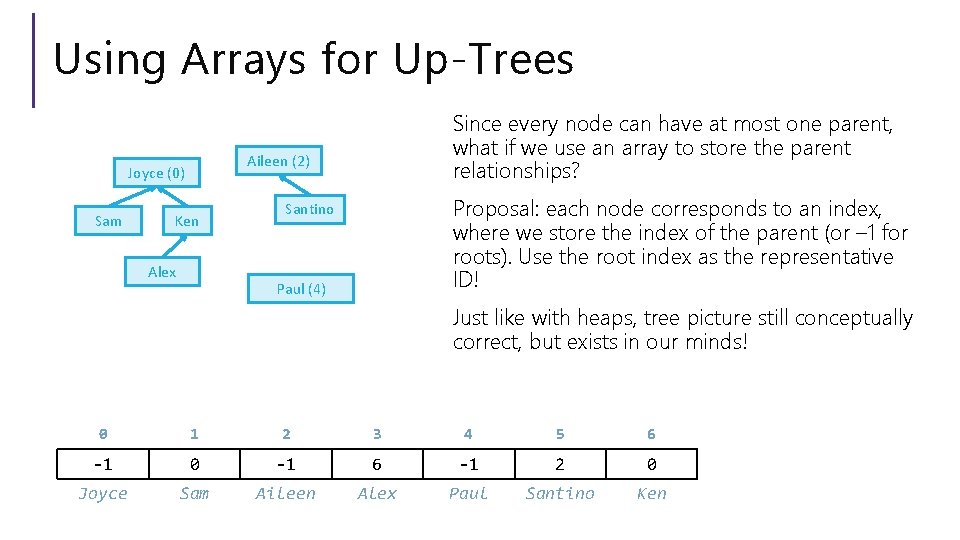
Using Arrays for Up-Trees Aileen (2) Joyce (0) Sam Since every node can have at most one parent, what if we use an array to store the parent relationships? Ken Alex Proposal: each node corresponds to an index, where we store the index of the parent (or – 1 for roots). Use the root index as the representative ID! Santino Paul (4) Just like with heaps, tree picture still conceptually correct, but exists in our minds! 0 1 2 3 4 5 6 -1 0 -1 6 -1 2 0 Joyce Sam Aileen Alex Paul Santino Ken
Using Arrays: Find find(A): index = jump to A node’s index 1 while array[index] > 0: 2 index = array[index] path compression 3 return index Initial jump to element still done with extra Map But traversing up the tree can be done purely within the array! • Can still do path compression by setting all indices along the way to the root index! Joyce (0) Alex Aileen Sam … Ken Sam 1 find(Alex) 1 2 3 -1 0 -1 6 0 Joyce Sam Aileen Alex 3 Santino = 0 Alex 0 Aileen (2) 4 5 6 -1 2 0 Paul Santino Ken 2 Paul (4)
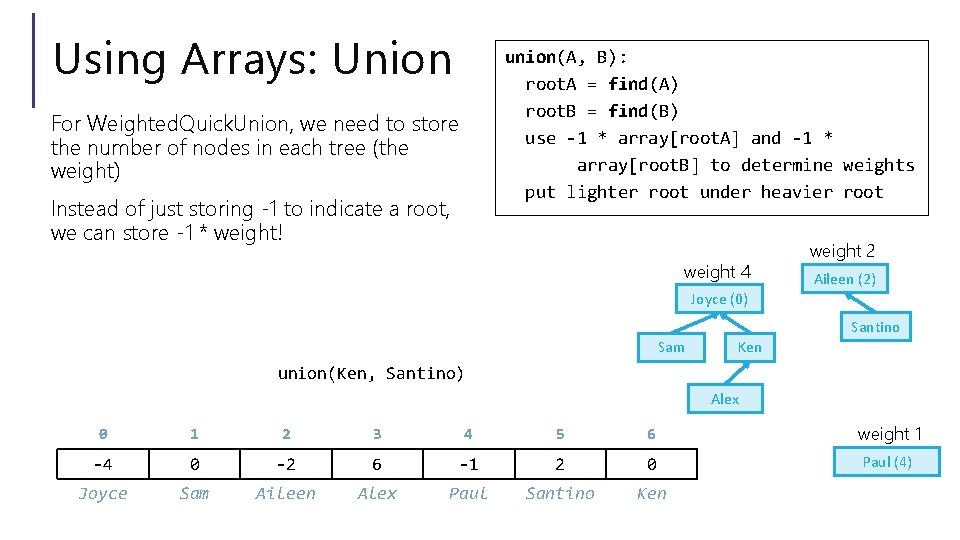
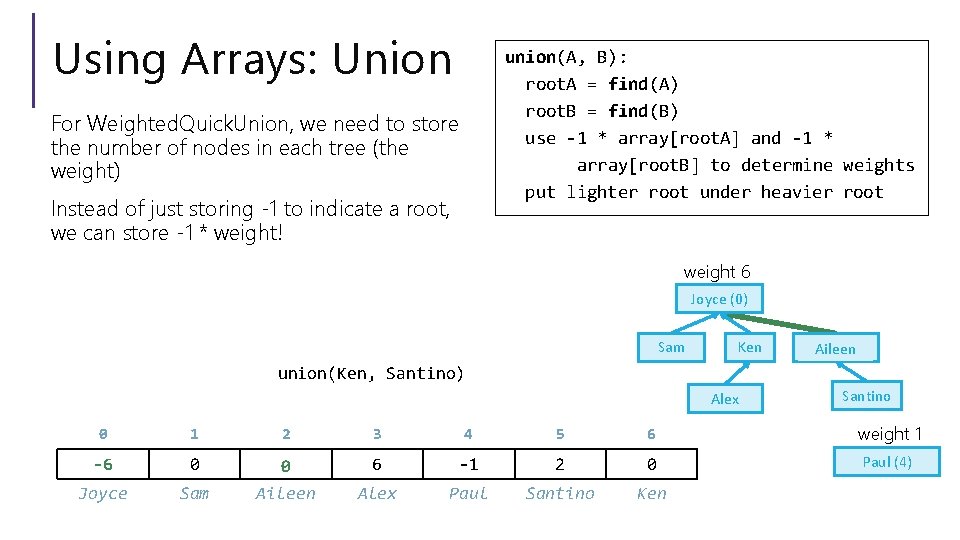
Using Arrays: Union union(A, B): root. A = find(A) root. B = find(B) use -1 * array[root. A] and -1 * array[root. B] to determine weights put lighter root under heavier root For Weighted. Quick. Union, we need to store the number of nodes in each tree (the weight) Instead of just storing -1 to indicate a root, we can store -1 * weight! weight 4 weight 2 Aileen (2) Joyce (0) Santino Sam Ken union(Ken, Santino) Alex 0 1 2 3 4 5 6 weight 1 -4 0 -2 6 -1 2 0 Paul (4) Joyce Sam Aileen Alex Paul Santino Ken
Using Arrays: Union union(A, B): root. A = find(A) root. B = find(B) use -1 * array[root. A] and -1 * array[root. B] to determine weights put lighter root under heavier root For Weighted. Quick. Union, we need to store the number of nodes in each tree (the weight) Instead of just storing -1 to indicate a root, we can store -1 * weight! weight 6 Joyce (0) Sam Ken Aileen(2) union(Ken, Santino) Alex Santino 0 1 2 3 4 5 6 weight 1 -4 -6 0 -2 0 6 -1 2 0 Paul (4) Joyce Sam Aileen Alex Paul Santino Ken
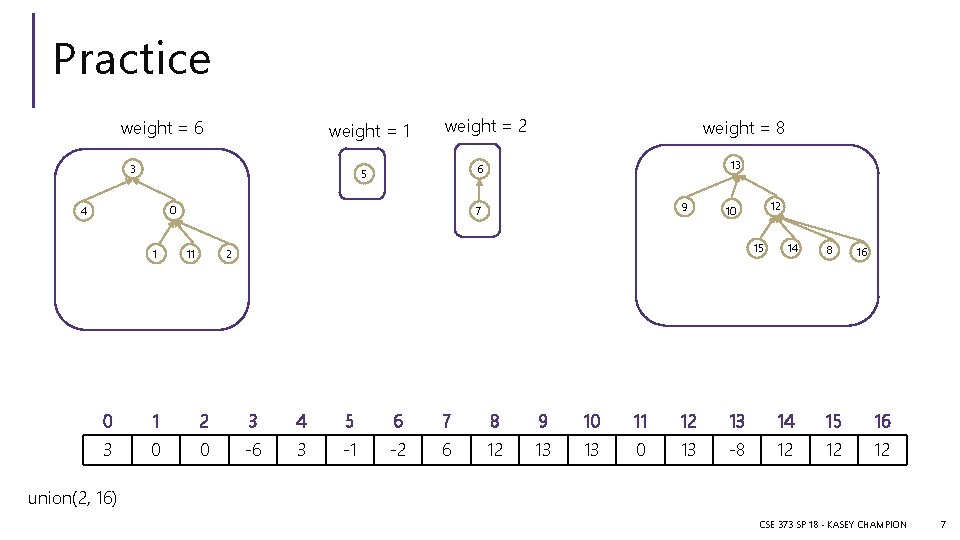
Practice weight = 6 weight = 1 3 weight = 2 0 1 13 6 5 4 weight = 8 9 7 11 12 10 15 2 14 8 16 0 1 2 3 4 5 6 7 8 9 10 11 12 13 14 15 16 3 0 0 -6 3 -1 -2 6 12 13 13 0 13 -8 12 12 12 union(2, 16) CSE 373 SP 18 - KASEY CHAMPION 7
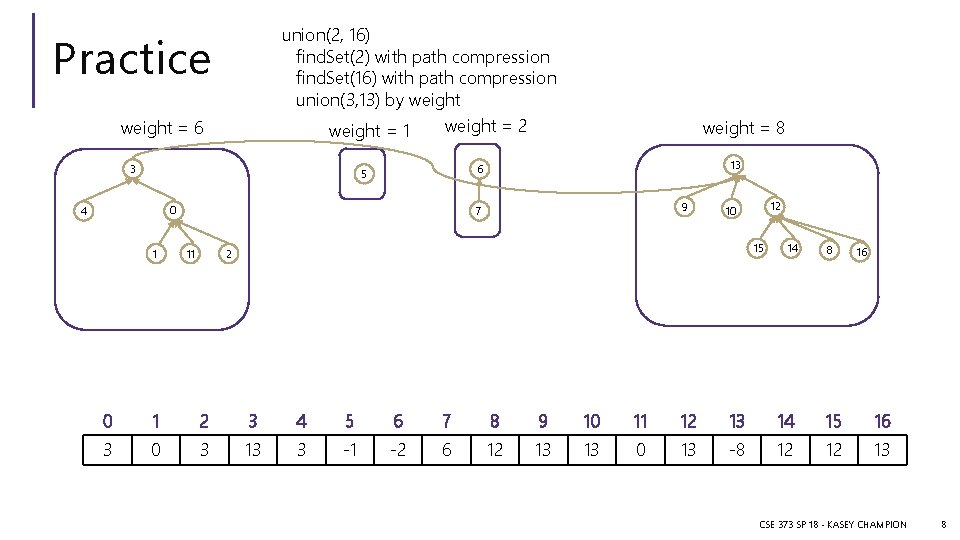
union(2, 16) find. Set(2) with path compression find. Set(16) with path compression union(3, 13) by weight = 2 weight = 1 Practice weight = 6 3 0 1 13 6 5 4 weight = 8 9 7 11 12 10 15 2 14 8 16 0 1 2 3 4 5 6 7 8 9 10 11 12 13 14 15 16 3 0 3 13 3 -1 -2 6 12 13 13 0 13 -8 12 12 13 CSE 373 SP 18 - KASEY CHAMPION 8
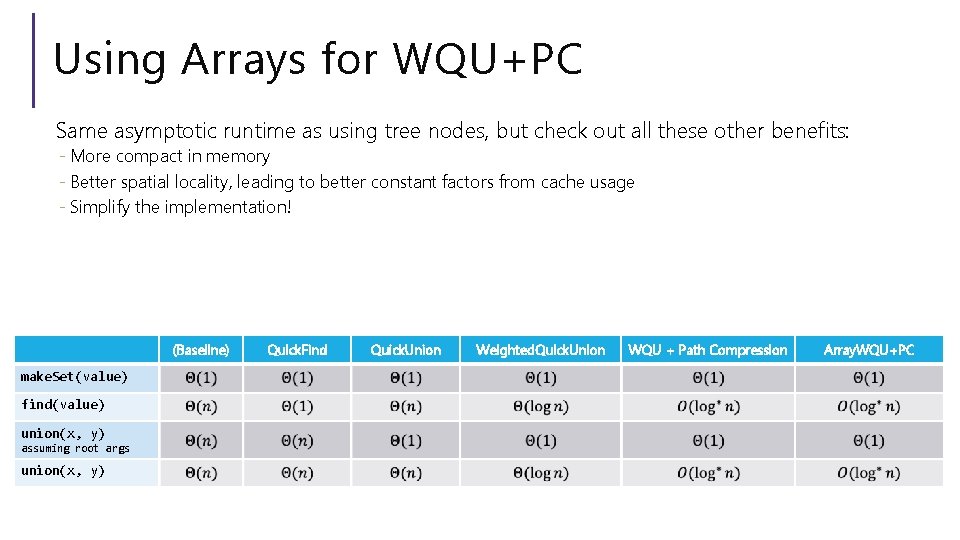
Using Arrays for WQU+PC Same asymptotic runtime as using tree nodes, but check out all these other benefits: - More compact in memory - Better spatial locality, leading to better constant factors from cache usage - Simplify the implementation! (Baseline) make. Set(value) find(value) union(x, y) assuming root args union(x, y) Quick. Find Quick. Union Weighted. Quick. Union WQU + Path Compression Array. WQU+PC
Implementing Dijkstra’s
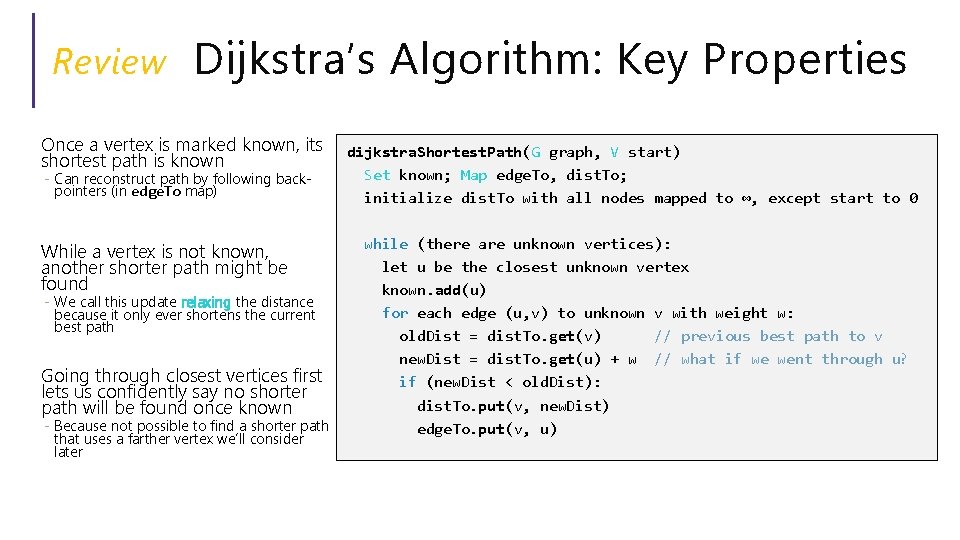
Review Dijkstra’s Algorithm: Key Properties Once a vertex is marked known, its shortest path is known - Can reconstruct path by following backpointers (in edge. To map) While a vertex is not known, another shorter path might be found - We call this update relaxing the distance because it only ever shortens the current best path Going through closest vertices first lets us confidently say no shorter path will be found once known - Because not possible to find a shorter path that uses a farther vertex we’ll consider later dijkstra. Shortest. Path(G graph, V start) Set known; Map edge. To, dist. To; initialize dist. To with all nodes mapped to ∞, except start to 0 while (there are unknown vertices): let u be the closest unknown vertex known. add(u) for each edge (u, v) to unknown v with weight w: old. Dist = dist. To. get(v) // previous best path to v new. Dist = dist. To. get(u) + w // what if we went through u? if (new. Dist < old. Dist): dist. To. put(v, new. Dist) edge. To. put(v, u)
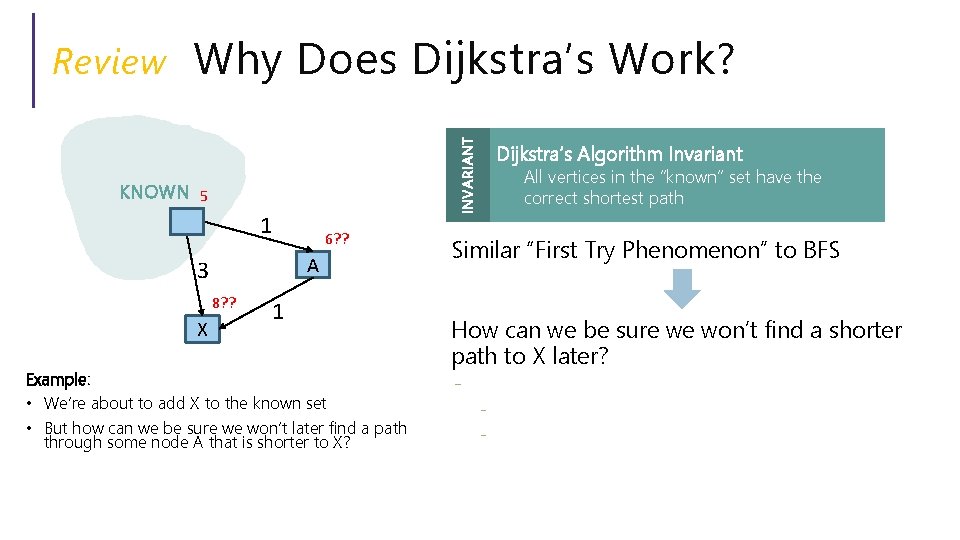
Why Does Dijkstra’s Work? INVARIANT Review KNOWN 5 1 A 3 8? ? X 6? ? 1 Example: • We’re about to add X to the known set • But how can we be sure we won’t later find a path through some node A that is shorter to X? • Because if we could, Dijkstra’s would explore A first Dijkstra’s Algorithm Invariant All vertices in the “known” set have the correct shortest path Similar “First Try Phenomenon” to BFS How can we be sure we won’t find a shorter path to X later? - Key Intuition: Dijkstra’s works because: - IF we always add the closest vertices to “known” first, THEN by the time a vertex is added, any possible relaxing has happened and the path we know is always the shortest!
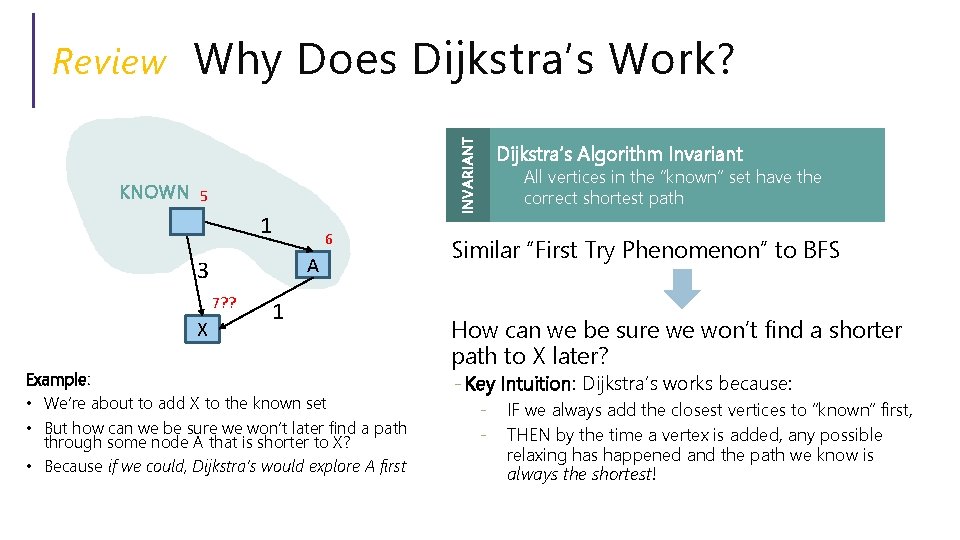
Why Does Dijkstra’s Work? INVARIANT Review KNOWN 5 1 A 3 7? ? X 6 1 Example: • We’re about to add X to the known set • But how can we be sure we won’t later find a path through some node A that is shorter to X? • Because if we could, Dijkstra’s would explore A first Dijkstra’s Algorithm Invariant All vertices in the “known” set have the correct shortest path Similar “First Try Phenomenon” to BFS How can we be sure we won’t find a shorter path to X later? - Key Intuition: Dijkstra’s works because: - IF we always add the closest vertices to “known” first, THEN by the time a vertex is added, any possible relaxing has happened and the path we know is always the shortest!
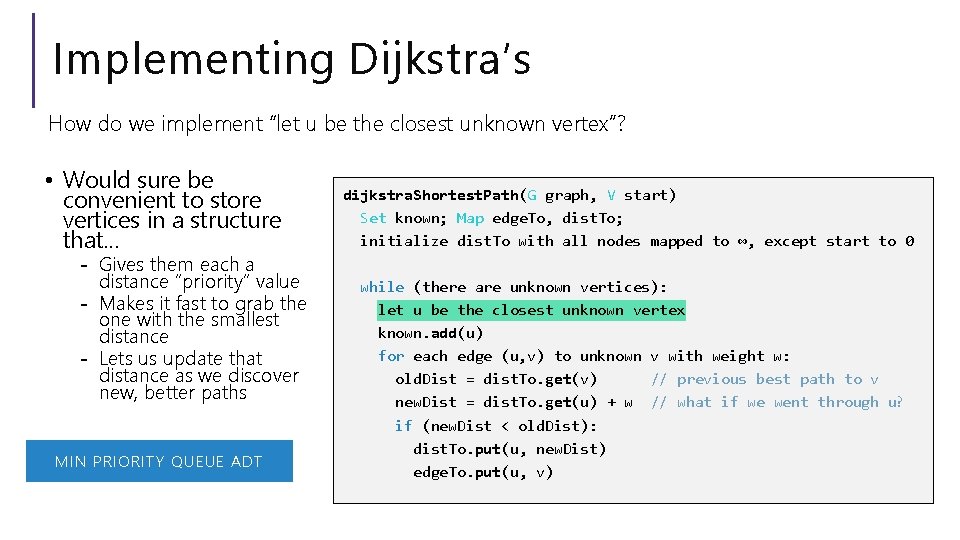
Implementing Dijkstra’s How do we implement “let u be the closest unknown vertex”? • Would sure be convenient to store vertices in a structure that… - Gives them each a distance “priority” value - Makes it fast to grab the one with the smallest distance - Lets us update that distance as we discover new, better paths MIN PRIORITY QUEUE ADT dijkstra. Shortest. Path(G graph, V start) Set known; Map edge. To, dist. To; initialize dist. To with all nodes mapped to ∞, except start to 0 while (there are unknown vertices): let u be the closest unknown vertex known. add(u) for each edge (u, v) to unknown v with weight w: old. Dist = dist. To. get(v) // previous best path to v new. Dist = dist. To. get(u) + w // what if we went through u? if (new. Dist < old. Dist): dist. To. put(u, new. Dist) edge. To. put(u, v)
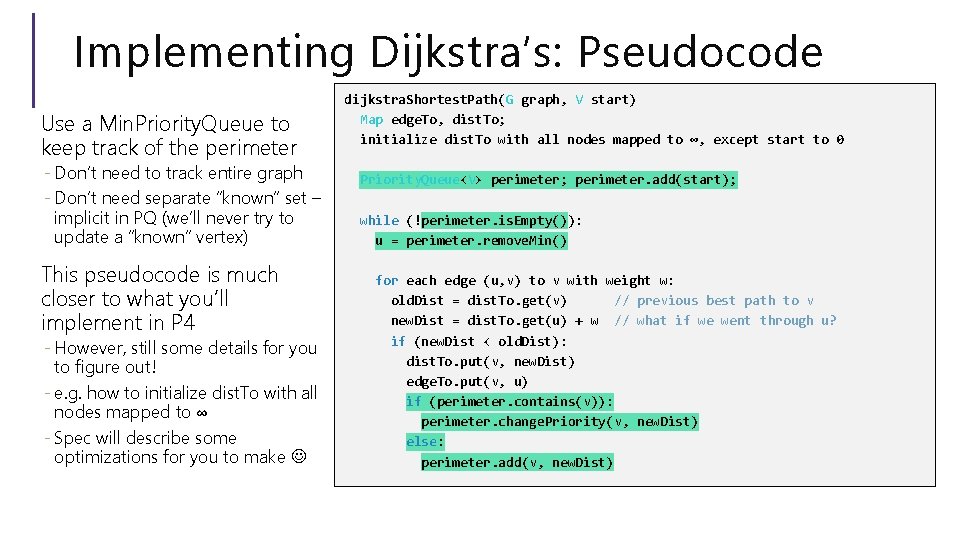
Implementing Dijkstra’s: Pseudocode Use a Min. Priority. Queue to keep track of the perimeter - Don’t need to track entire graph - Don’t need separate “known” set – implicit in PQ (we’ll never try to update a “known” vertex) This pseudocode is much closer to what you’ll implement in P 4 - However, still some details for you to figure out! - e. g. how to initialize dist. To with all nodes mapped to ∞ - Spec will describe some optimizations for you to make dijkstra. Shortest. Path(G graph, V start) Map edge. To, dist. To; initialize dist. To with all nodes mapped to ∞, except start to 0 Priority. Queue<V> perimeter; perimeter. add(start); while (!perimeter. is. Empty()): u = perimeter. remove. Min() for each edge (u, v) to v with weight w: old. Dist = dist. To. get(v) // previous best path to v new. Dist = dist. To. get(u) + w // what if we went through u? if (new. Dist < old. Dist): dist. To. put(v, new. Dist) edge. To. put(v, u) if (perimeter. contains(v)): perimeter. change. Priority(v, new. Dist) else: perimeter. add(v, new. Dist)
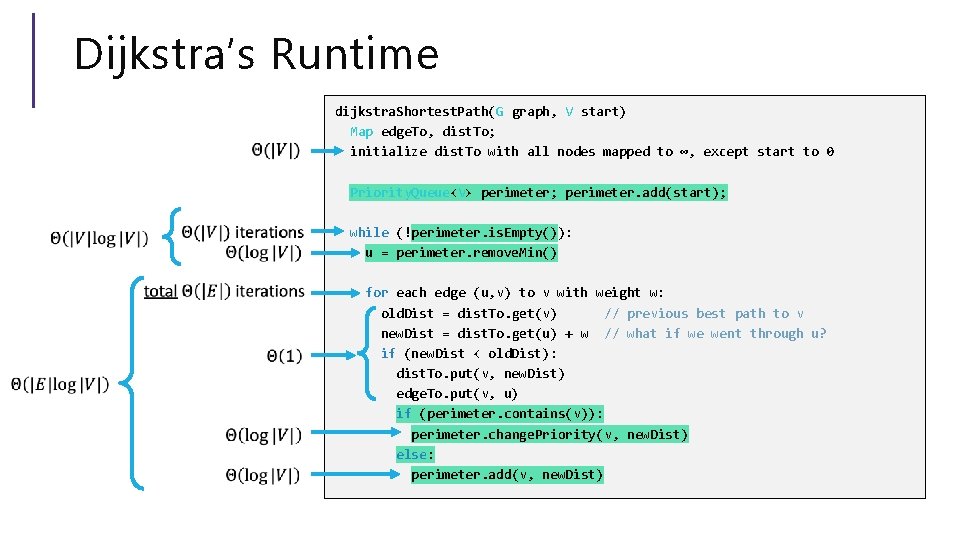
Dijkstra’s Runtime dijkstra. Shortest. Path(G graph, V start) Map edge. To, dist. To; initialize dist. To with all nodes mapped to ∞, except start to 0 Priority. Queue<V> perimeter; perimeter. add(start); while (!perimeter. is. Empty()): u = perimeter. remove. Min() for each edge (u, v) to v with weight w: old. Dist = dist. To. get(v) // previous best path to v new. Dist = dist. To. get(u) + w // what if we went through u? if (new. Dist < old. Dist): dist. To. put(v, new. Dist) edge. To. put(v, u) if (perimeter. contains(v)): perimeter. change. Priority(v, new. Dist) else: perimeter. add(v, new. Dist)
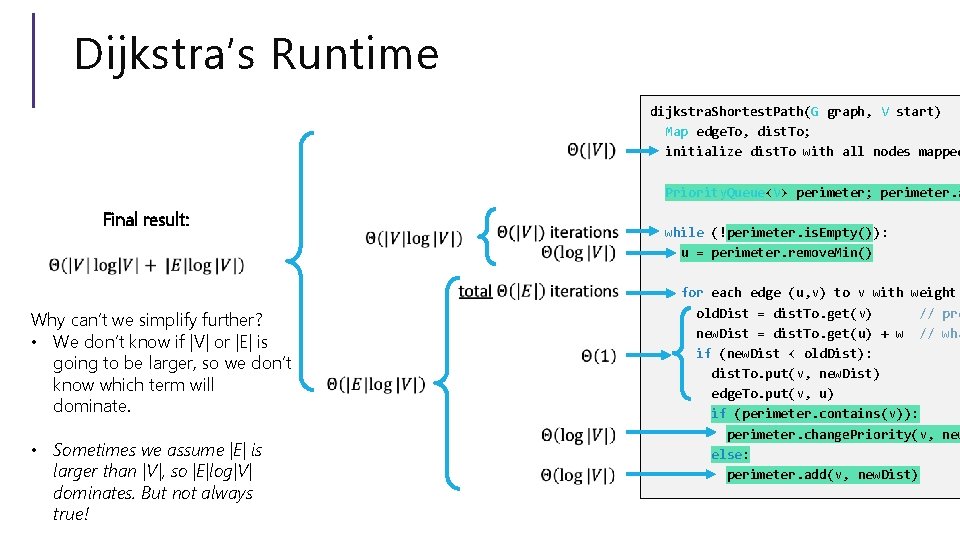
Dijkstra’s Runtime dijkstra. Shortest. Path(G graph, V start) Map edge. To, dist. To; initialize dist. To with all nodes mapped Priority. Queue<V> perimeter; perimeter. a Final result: Why can’t we simplify further? • We don’t know if |V| or |E| is going to be larger, so we don’t know which term will dominate. • Sometimes we assume |E| is larger than |V|, so |E|log|V| dominates. But not always true! while (!perimeter. is. Empty()): u = perimeter. remove. Min() for each edge (u, v) to v with weight old. Dist = dist. To. get(v) // pre new. Dist = dist. To. get(u) + w // wha if (new. Dist < old. Dist): dist. To. put(v, new. Dist) edge. To. put(v, u) if (perimeter. contains(v)): perimeter. change. Priority(v, new else: perimeter. add(v, new. Dist)
Topological Sort
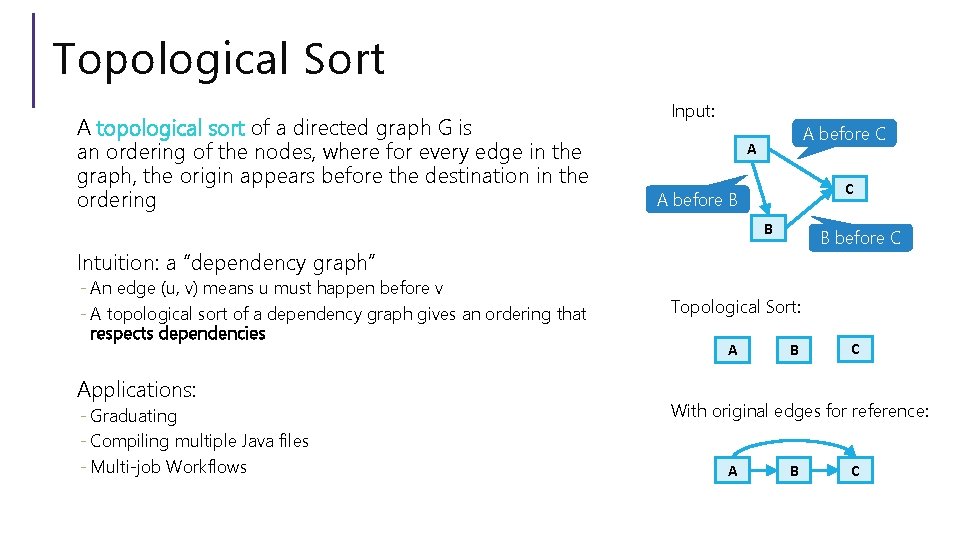
Topological Sort A topological sort of a directed graph G is an ordering of the nodes, where for every edge in the graph, the origin appears before the destination in the ordering Input: A before C A before B B B before C Intuition: a “dependency graph” - An edge (u, v) means u must happen before v - A topological sort of a dependency graph gives an ordering that respects dependencies Applications: - Graduating - Compiling multiple Java files - Multi-job Workflows Topological Sort: A B C With original edges for reference: A B C
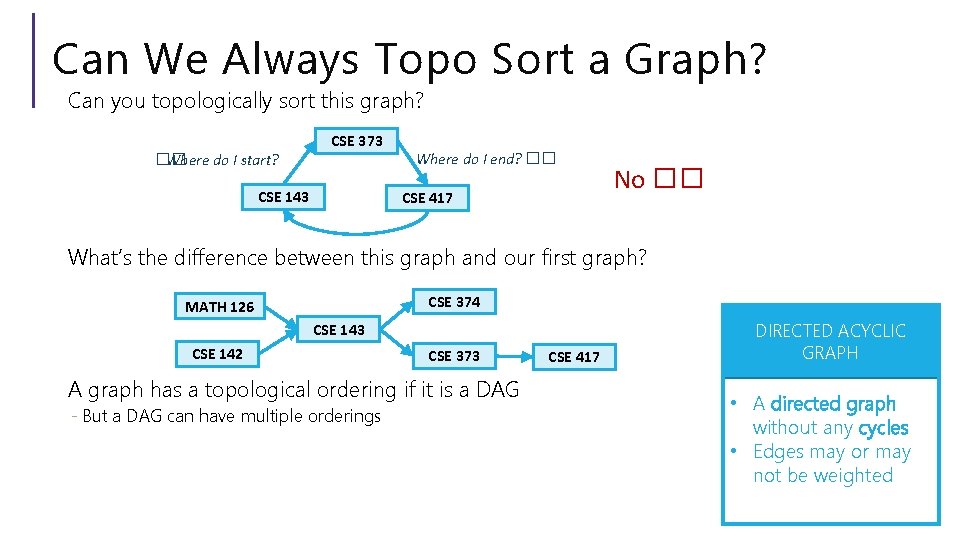
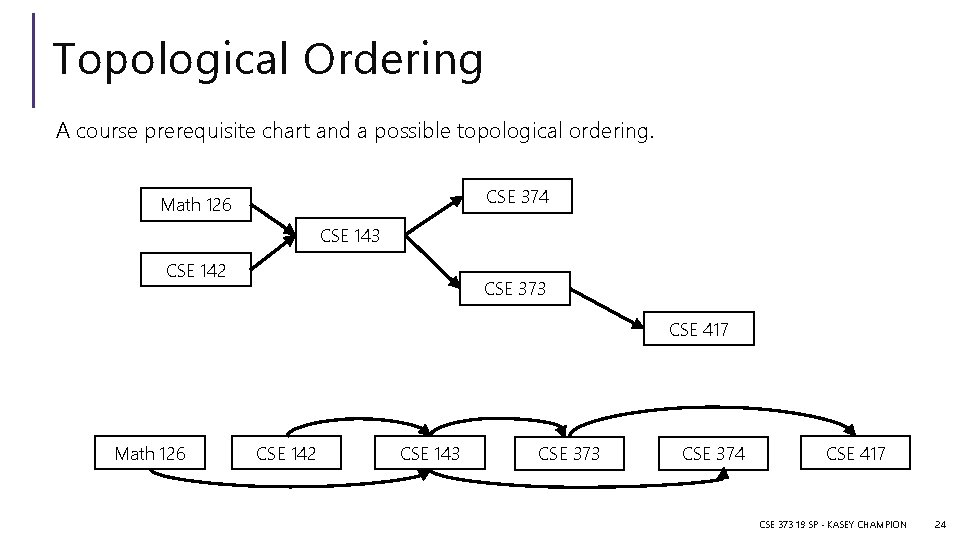
Can We Always Topo Sort a Graph? Can you topologically sort this graph? �� Where do I start? CSE 373 CSE 143 Where do I end? �� CSE 417 No �� What’s the difference between this graph and our first graph? CSE 374 MATH 126 CSE 143 CSE 142 CSE 373 A graph has a topological ordering if it is a DAG - But a DAG can have multiple orderings CSE 417 DIRECTED ACYCLIC GRAPH • A directed graph without any cycles • Edges may or may not be weighted
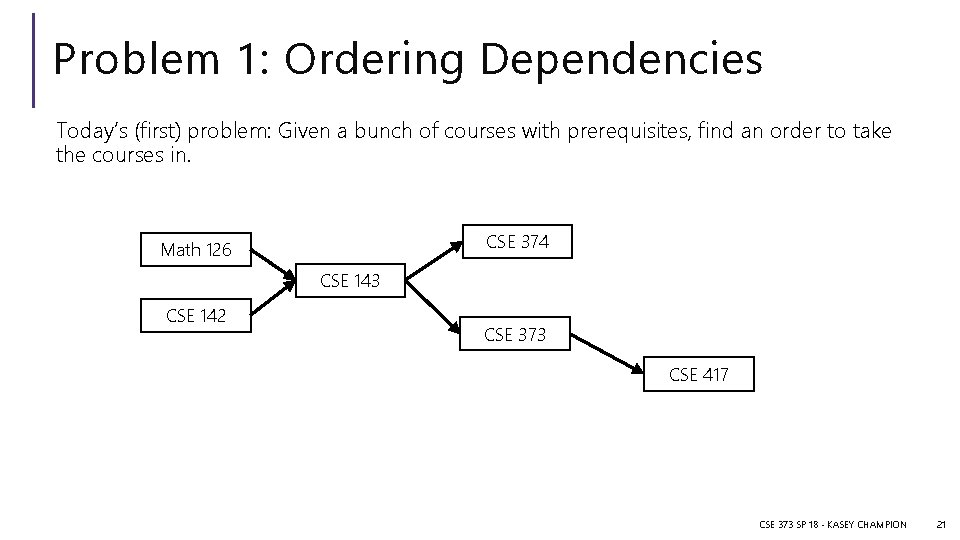
Problem 1: Ordering Dependencies Today’s (first) problem: Given a bunch of courses with prerequisites, find an order to take the courses in. CSE 374 Math 126 CSE 143 CSE 142 CSE 373 CSE 417 CSE 373 SP 18 - KASEY CHAMPION 21
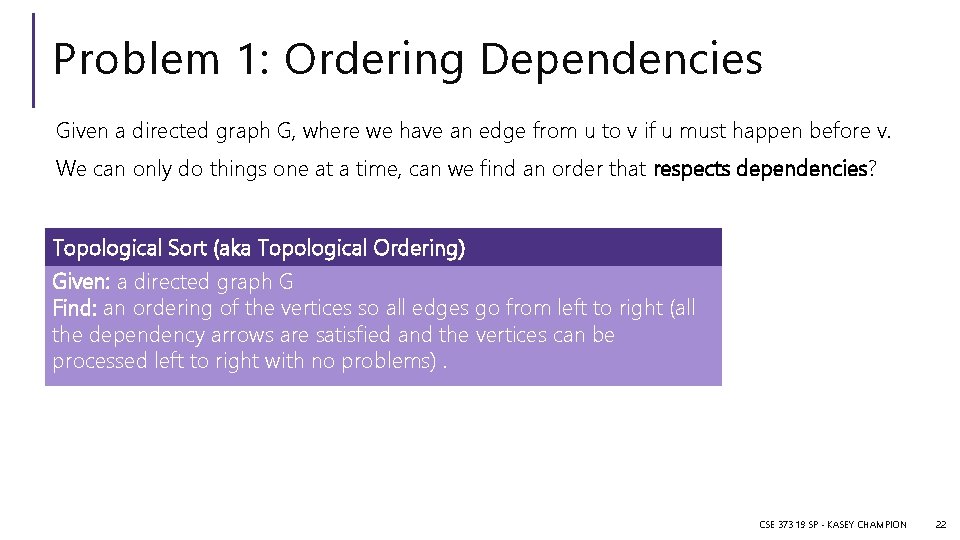
Problem 1: Ordering Dependencies Given a directed graph G, where we have an edge from u to v if u must happen before v. We can only do things one at a time, can we find an order that respects dependencies? Topological Sort (aka Topological Ordering) Given: a directed graph G Find: an ordering of the vertices so all edges go from left to right (all the dependency arrows are satisfied and the vertices can be processed left to right with no problems). CSE 373 19 SP - KASEY CHAMPION 22
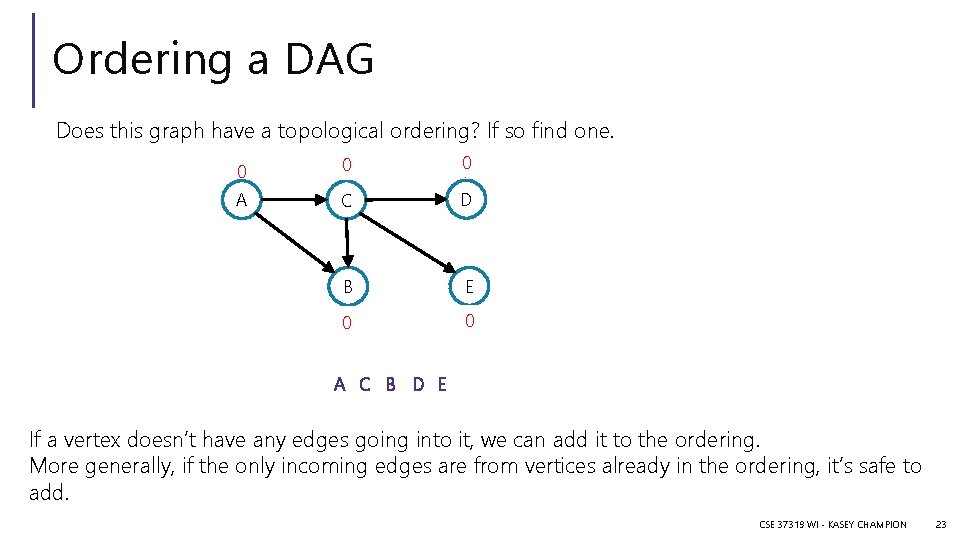
Ordering a DAG Does this graph have a topological ordering? If so find one. 0 01 0 1 A C D B E 021 10 A C B D E If a vertex doesn’t have any edges going into it, we can add it to the ordering. More generally, if the only incoming edges are from vertices already in the ordering, it’s safe to add. CSE 373 19 WI - KASEY CHAMPION 23
Topological Ordering A course prerequisite chart and a possible topological ordering. CSE 374 Math 126 CSE 143 CSE 142 CSE 373 CSE 417 Math 126 CSE 142 CSE 143 CSE 374 CSE 417 CSE 373 19 SP - KASEY CHAMPION 24
Reductions
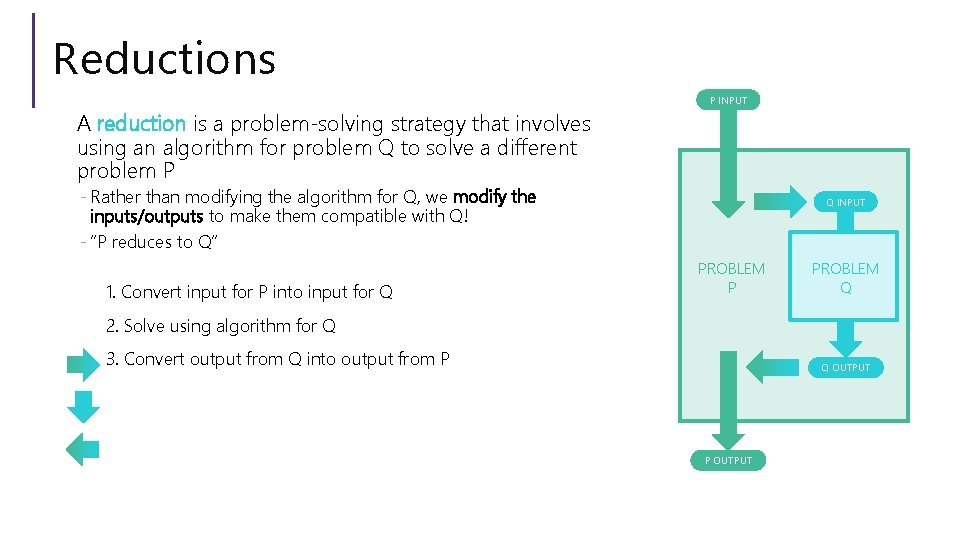
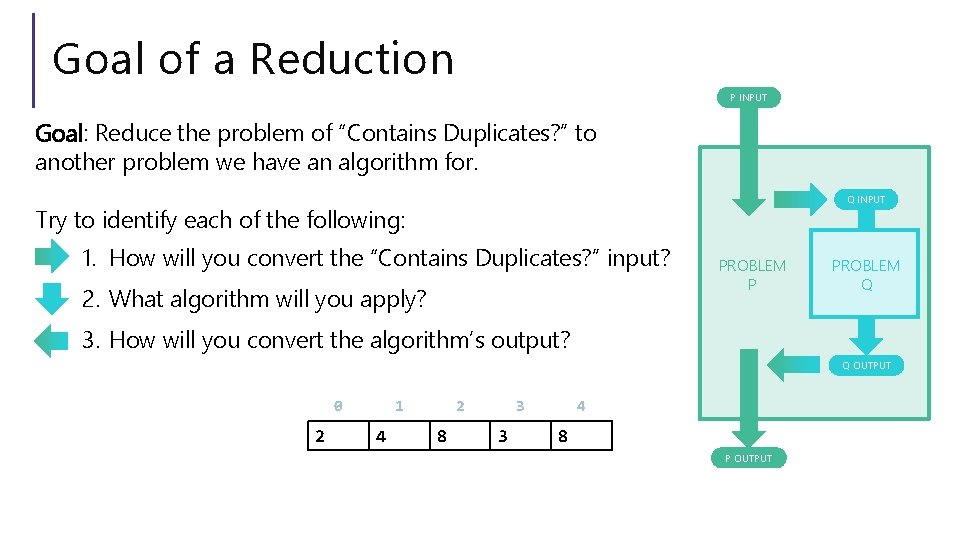
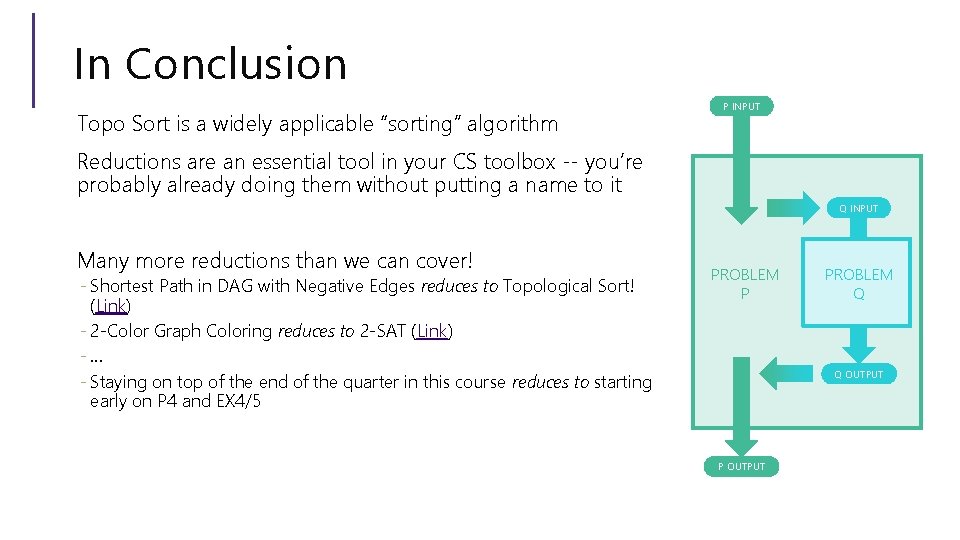
Reductions P INPUT A reduction is a problem-solving strategy that involves using an algorithm for problem Q to solve a different problem P - Rather than modifying the algorithm for Q, we modify the inputs/outputs to make them compatible with Q! - “P reduces to Q” 1. Convert input for P into input for Q Q INPUT PROBLEM P PROBLEM Q 2. Solve using algorithm for Q 3. Convert output from Q into output from P Q OUTPUT P OUTPUT
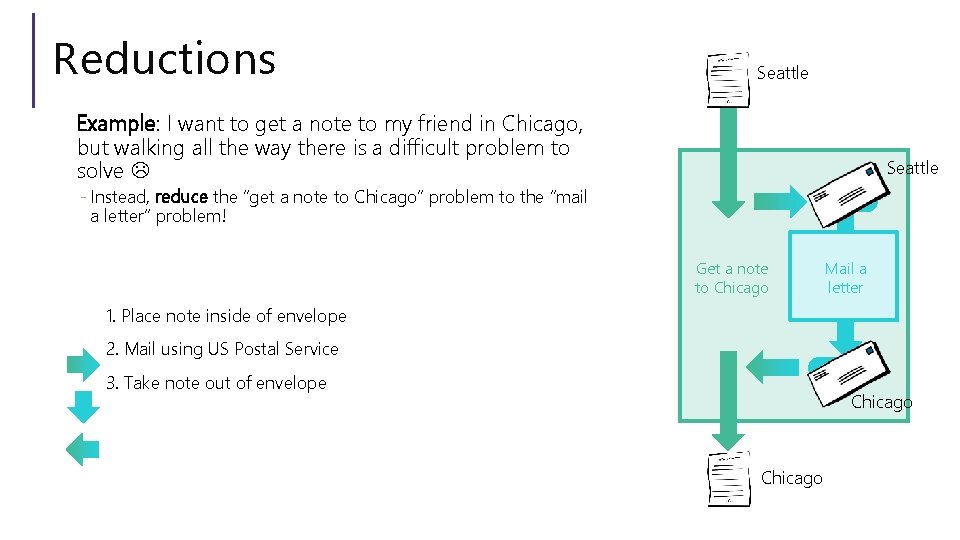
Reductions Seattle Example: I want to get a note to my friend in Chicago, but walking all the way there is a difficult problem to solve Seattle - Instead, reduce the “get a note to Chicago” problem to the “mail a letter” problem! Q INPUT Get a note to Chicago Mail a letter 1. Place note inside of envelope 2. Mail using US Postal Service 3. Take note out of envelope Q OUTPUT Chicago
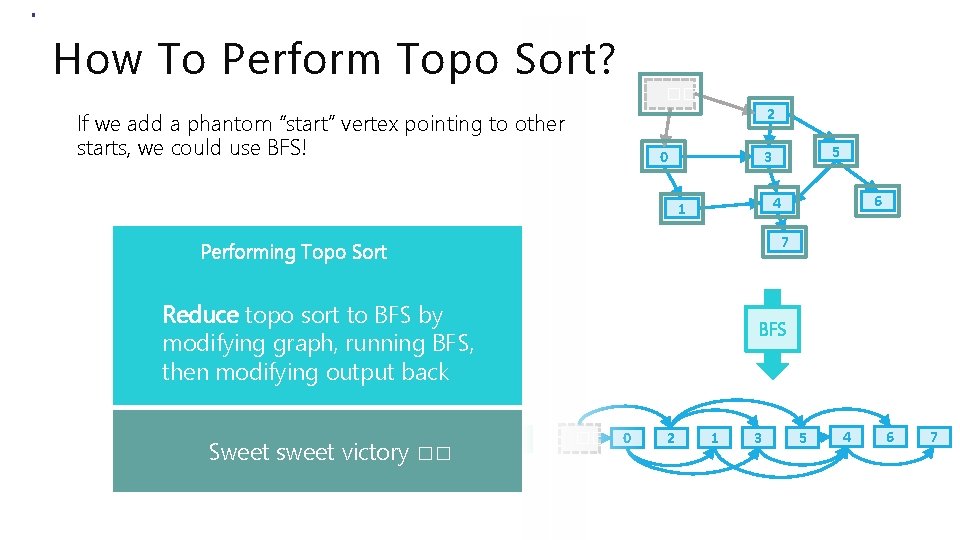
How To Perform Topo Sort? �� 2 If we add a phantom “start” vertex pointing to other starts, we could use BFS! 0 7 Performing Topo Sort Reduce topo sort to BFS by modifying graph, running BFS, then modifying output back 2 1 3 5 4 6 6 4 1 0 5 3 7 Sweet sweet victory �� BFS �� 0 2 1 3 5 4 6 7
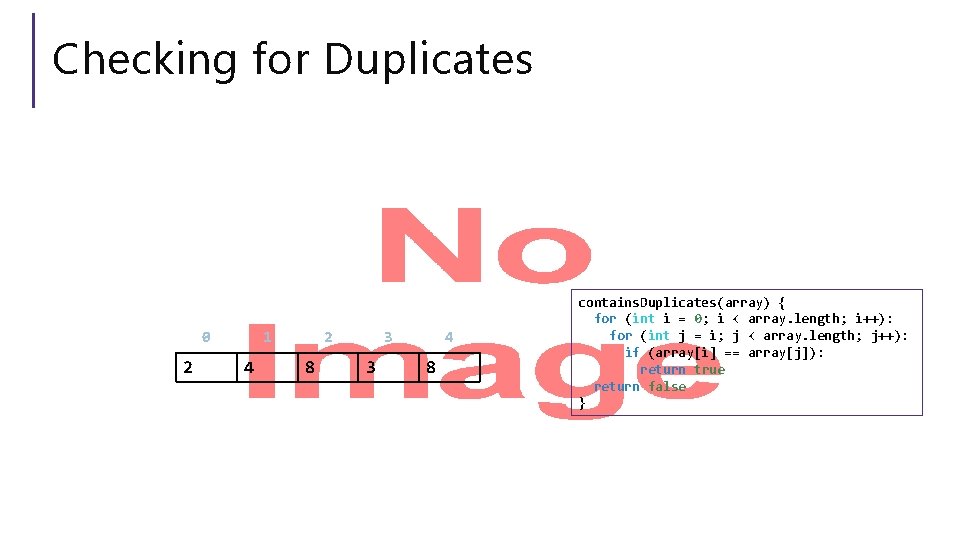
Checking for Duplicates 0 2 1 4 2 8 3 3 4 8 contains. Duplicates(array) { for (int i = 0; i < array. length; i++): for (int j = i; j < array. length; j++): if (array[i] == array[j]): return true return false }
Goal of a Reduction P INPUT Goal: Reduce the problem of “Contains Duplicates? ” to another problem we have an algorithm for. Q INPUT Try to identify each of the following: 1. How will you convert the “Contains Duplicates? ” input? 2. What algorithm will you apply? PROBLEM P PROBLEM Q 3. How will you convert the algorithm’s output? Q OUTPUT 0 2 1 4 2 8 3 3 4 8 P OUTPUT
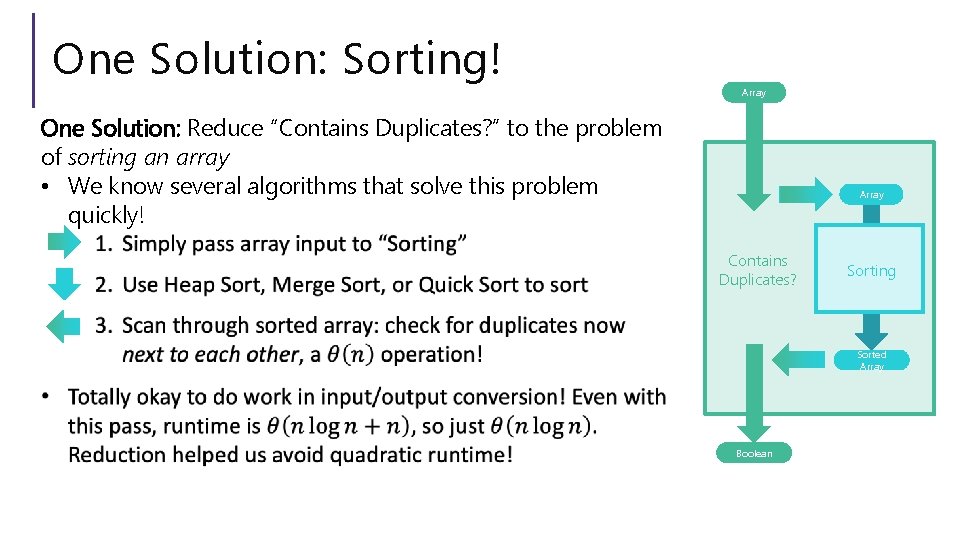
One Solution: Sorting! Array One Solution: Reduce “Contains Duplicates? ” to the problem of sorting an array • We know several algorithms that solve this problem quickly! Array Contains Duplicates? Sorting Sorted Array Boolean
Graph Modeling Review
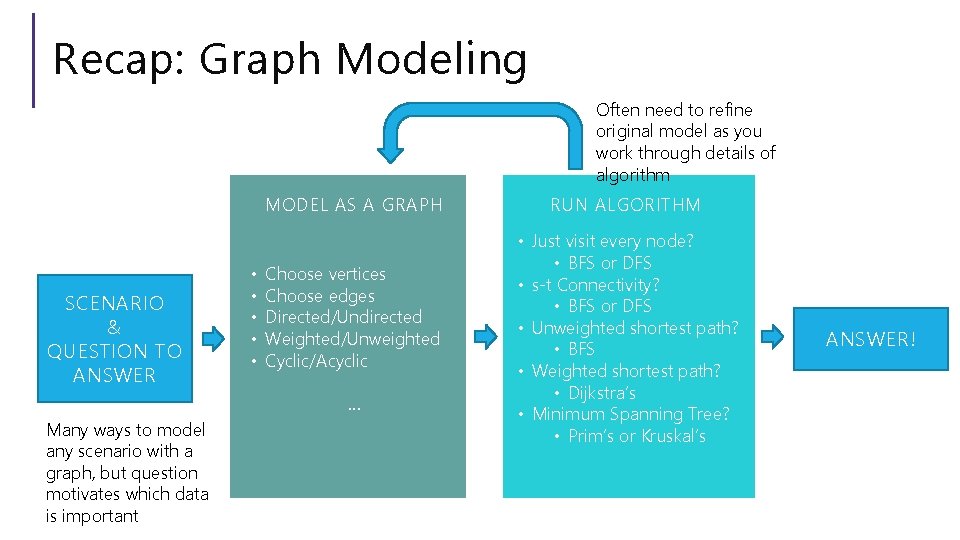
Recap: Graph Modeling Often need to refine original model as you work through details of algorithm MODEL AS A GRAPH SCENARIO & QUESTION TO ANSWER • • • Choose vertices Choose edges Directed/Undirected Weighted/Unweighted Cyclic/Acyclic … Many ways to model any scenario with a graph, but question motivates which data is important RUN ALGORITHM • Just visit every node? • BFS or DFS • s-t Connectivity? • BFS or DFS • Unweighted shortest path? • BFS • Weighted shortest path? • Dijkstra’s • Minimum Spanning Tree? • Prim’s or Kruskal’s ANSWER!
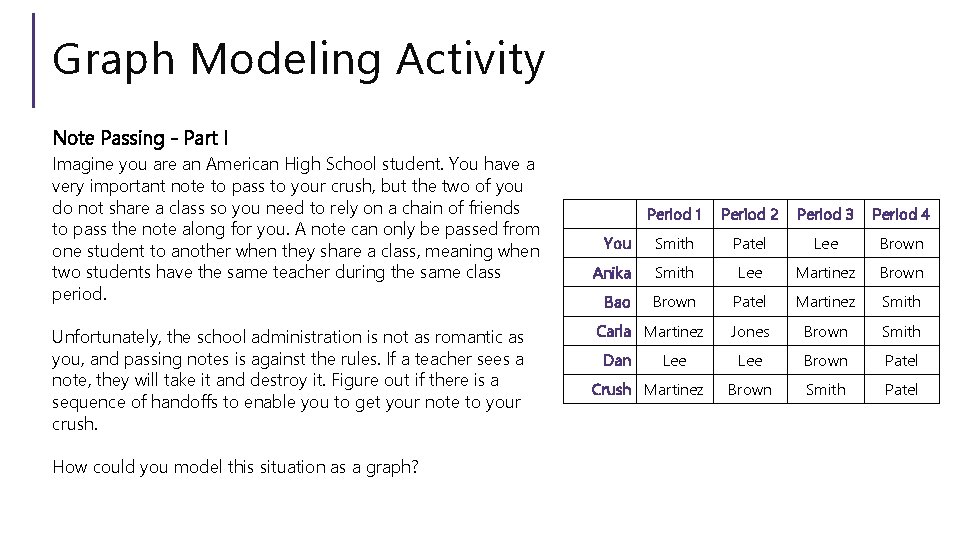
Graph Modeling Activity Note Passing - Part I Imagine you are an American High School student. You have a very important note to pass to your crush, but the two of you do not share a class so you need to rely on a chain of friends to pass the note along for you. A note can only be passed from one student to another when they share a class, meaning when two students have the same teacher during the same class period. Unfortunately, the school administration is not as romantic as you, and passing notes is against the rules. If a teacher sees a note, they will take it and destroy it. Figure out if there is a sequence of handoffs to enable you to get your note to your crush. How could you model this situation as a graph? Period 1 Period 2 Period 3 Period 4 You Smith Patel Lee Brown Anika Smith Lee Martinez Brown Bao Brown Patel Martinez Smith Jones Brown Smith Lee Brown Patel Brown Smith Patel Carla Martinez Dan Lee Crush Martinez
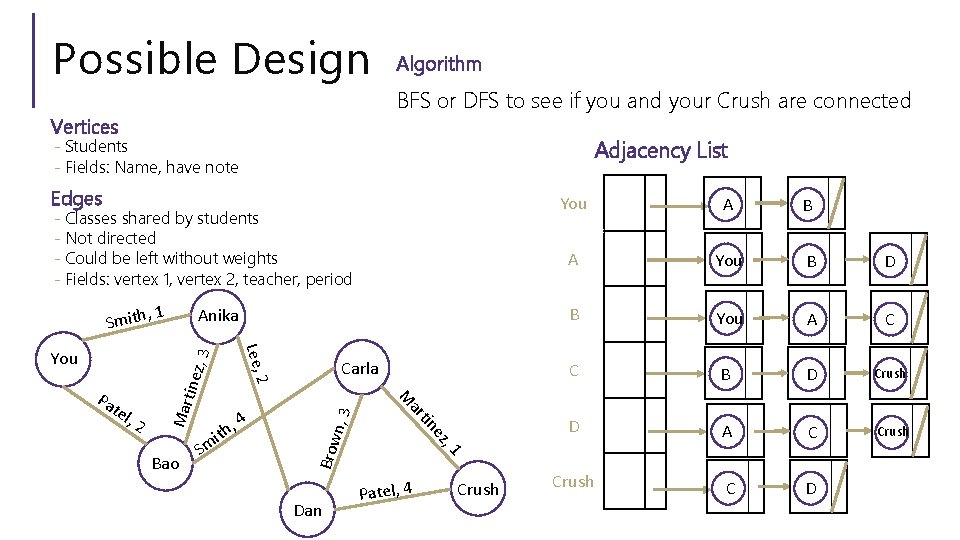
Possible Design Vertices Algorithm BFS or DFS to see if you and your Crush are connected - Students - Fields: Name, have note Adjacency List Edges - Classes shared by students - Not directed - Could be left without weights - Fields: vertex 1, vertex 2, teacher, period , 1 Anika n, 3 ez , 4 tin B A You B D B You A C C B D Crush D A C Crush C D Dan , 1 Sm ith ar Bao A M , 2 Carla 2 Pa tel Mar tine z, 3 Lee, You Brow Smith You Patel, 4 Crush
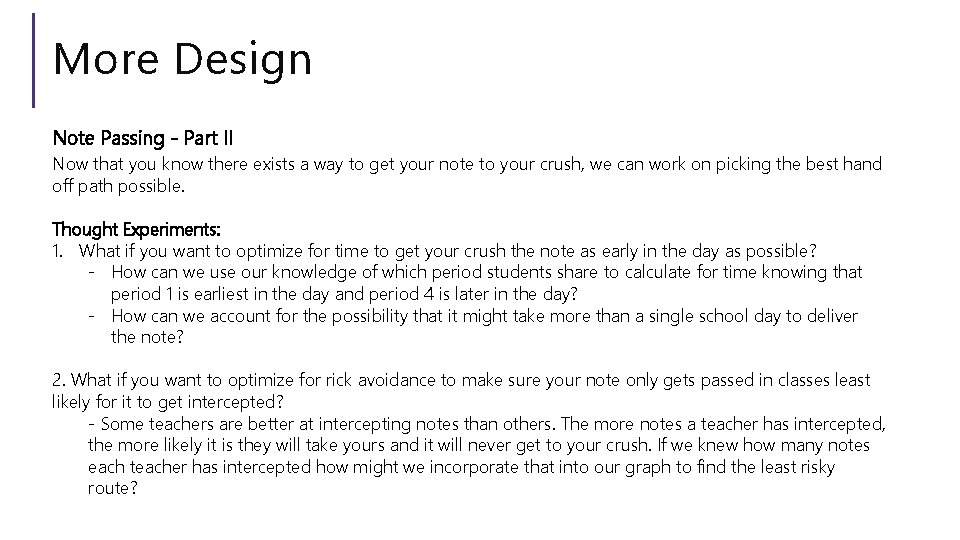
More Design Note Passing - Part II Now that you know there exists a way to get your note to your crush, we can work on picking the best hand off path possible. Thought Experiments: 1. What if you want to optimize for time to get your crush the note as early in the day as possible? - How can we use our knowledge of which period students share to calculate for time knowing that period 1 is earliest in the day and period 4 is later in the day? - How can we account for the possibility that it might take more than a single school day to deliver the note? 2. What if you want to optimize for rick avoidance to make sure your note only gets passed in classes least likely for it to get intercepted? - Some teachers are better at intercepting notes than others. The more notes a teacher has intercepted, the more likely it is they will take yours and it will never get to your crush. If we knew how many notes each teacher has intercepted how might we incorporate that into our graph to find the least risky route?
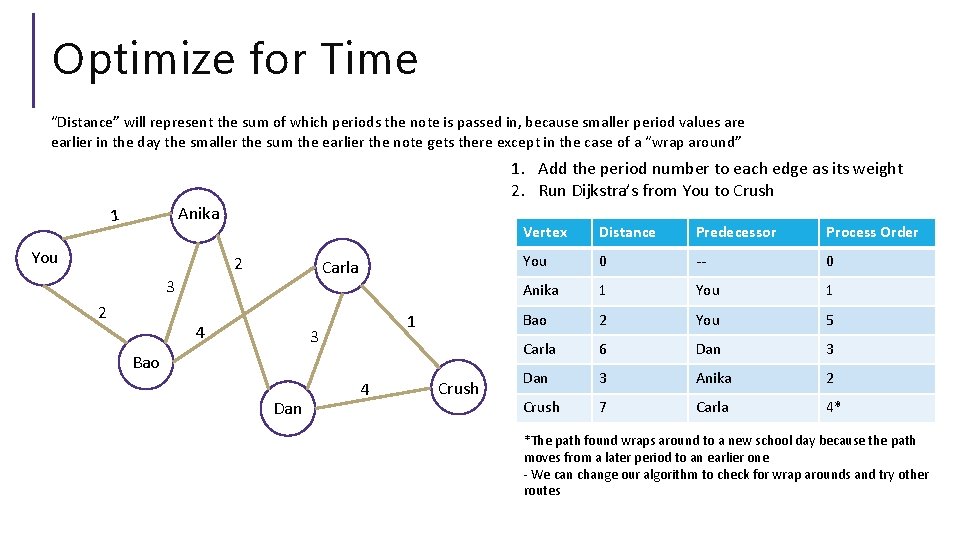
Optimize for Time “Distance” will represent the sum of which periods the note is passed in, because smaller period values are earlier in the day the smaller the sum the earlier the note gets there except in the case of a “wrap around” 1. Add the period number to each edge as its weight 2. Run Dijkstra’s from You to Crush Anika 1 You 2 Carla 3 2 4 1 3 Bao Dan 4 Crush Vertex Distance Predecessor Process Order You 0 -- 0 Anika 1 You 1 Bao 2 You 5 Carla 6 Dan 3 Anika 2 Crush 7 Carla 4* *The path found wraps around to a new school day because the path moves from a later period to an earlier one - We can change our algorithm to check for wrap arounds and try other routes
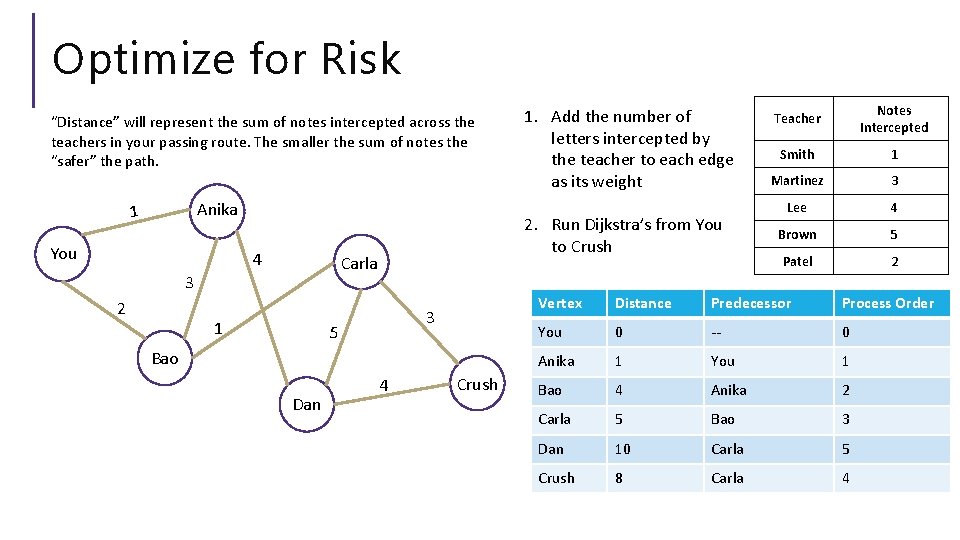
Optimize for Risk “Distance” will represent the sum of notes intercepted across the teachers in your passing route. The smaller the sum of notes the “safer” the path. Anika 1 You 4 2 2. Run Dijkstra’s from You to Crush Carla 3 1 3 5 Bao Dan 1. Add the number of letters intercepted by the teacher to each edge as its weight 4 Crush Teacher Notes Intercepted Smith 1 Martinez 3 Lee 4 Brown 5 Patel 2 Vertex Distance Predecessor Process Order You 0 -- 0 Anika 1 You 1 Bao 4 Anika 2 Carla 5 Bao 3 Dan 10 Carla 5 Crush 8 Carla 4
Seam Carving
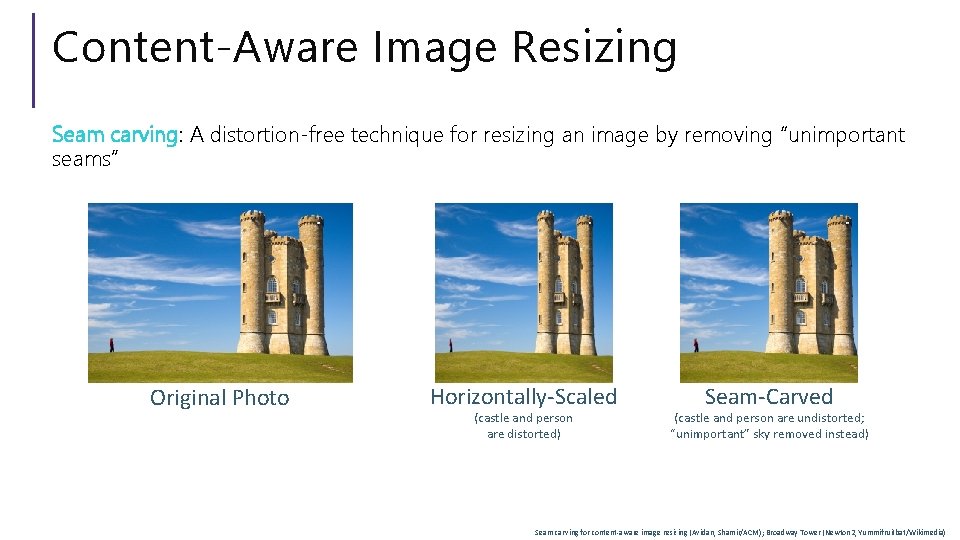
Content-Aware Image Resizing Seam carving: A distortion-free technique for resizing an image by removing “unimportant seams” Original Photo Horizontally-Scaled (castle and person are distorted) Seam-Carved (castle and person are undistorted; “unimportant” sky removed instead) Seam carving for content-aware image resizing (Avidan, Shamir/ACM); Broadway Tower (Newton 2, Yummifruitbat/Wikimedia)
41 Demo: https: //www. youtube. com/watch? v=v. IFCV 2 sp. Ktg
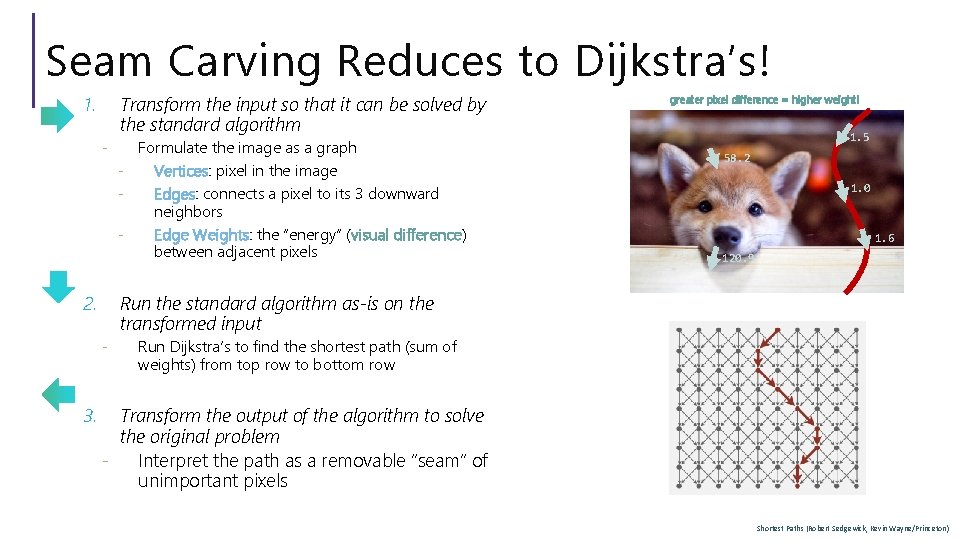
Seam Carving Reduces to Dijkstra’s! 1. - 2. - 3. Transform the input so that it can be solved by the standard algorithm Formulate the image as a graph Vertices: pixel in the image Edges: connects a pixel to its 3 downward neighbors Edge Weights: the “energy” (visual difference) between adjacent pixels greater pixel difference = higher weight! 1. 5 58. 2 1. 0 1. 6 120. 9 Run the standard algorithm as-is on the transformed input Run Dijkstra’s to find the shortest path (sum of weights) from top row to bottom row Transform the output of the algorithm to solve the original problem - Interpret the path as a removable “seam” of unimportant pixels Shortest Paths (Robert Sedgewick, Kevin Wayne/Princeton)
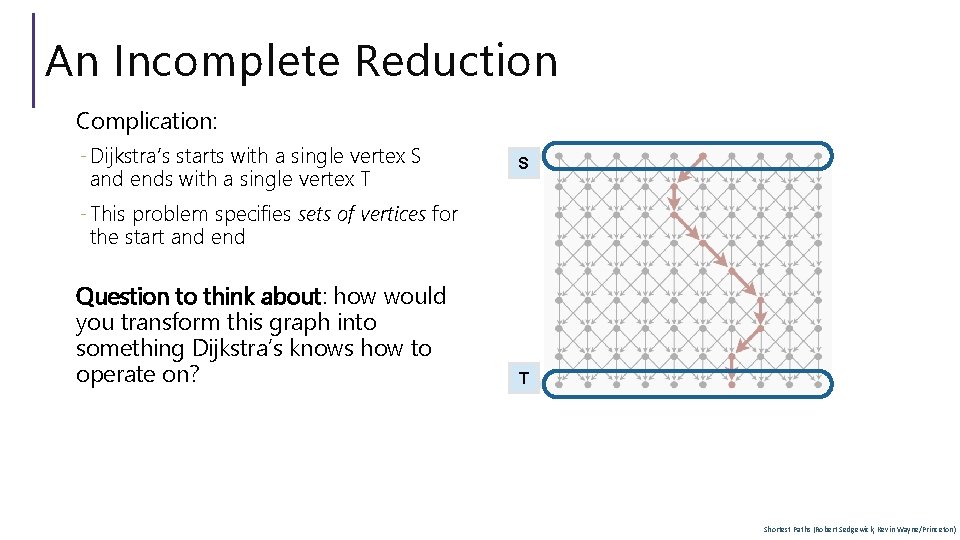
An Incomplete Reduction Complication: - Dijkstra’s starts with a single vertex S and ends with a single vertex T S - This problem specifies sets of vertices for the start and end Question to think about: how would you transform this graph into something Dijkstra’s knows how to operate on? T Shortest Paths (Robert Sedgewick, Kevin Wayne/Princeton)
In Conclusion Topo Sort is a widely applicable “sorting” algorithm P INPUT Reductions are an essential tool in your CS toolbox -- you’re probably already doing them without putting a name to it Q INPUT Many more reductions than we can cover! - Shortest Path in DAG with Negative Edges reduces to Topological Sort! (Link) - 2 -Color Graph Coloring reduces to 2 -SAT (Link) -… - Staying on top of the end of the quarter in this course reduces to starting early on P 4 and EX 4/5 PROBLEM P PROBLEM Q Q OUTPUT P OUTPUT
Appendix