
Lecture 21 The Brain and Cranial Nerves Chapter
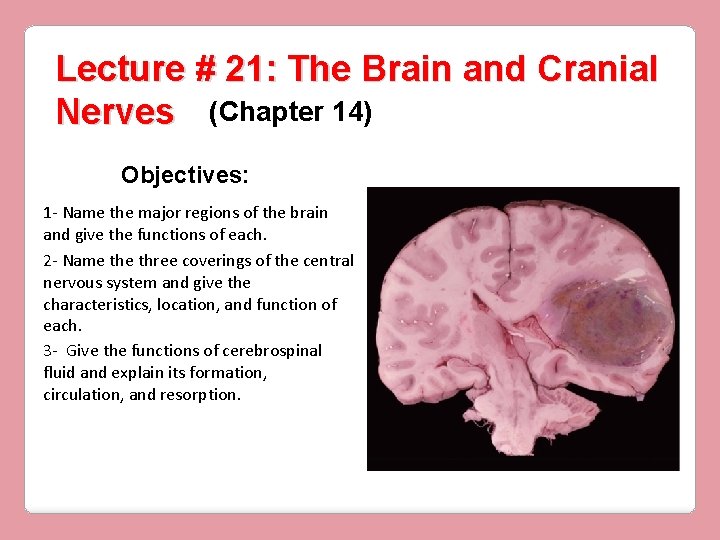
Lecture # 21: The Brain and Cranial Nerves (Chapter 14) Objectives: 1 - Name the major regions of the brain and give the functions of each. 2 - Name three coverings of the central nervous system and give the characteristics, location, and function of each. 3 - Give the functions of cerebrospinal fluid and explain its formation, circulation, and resorption.
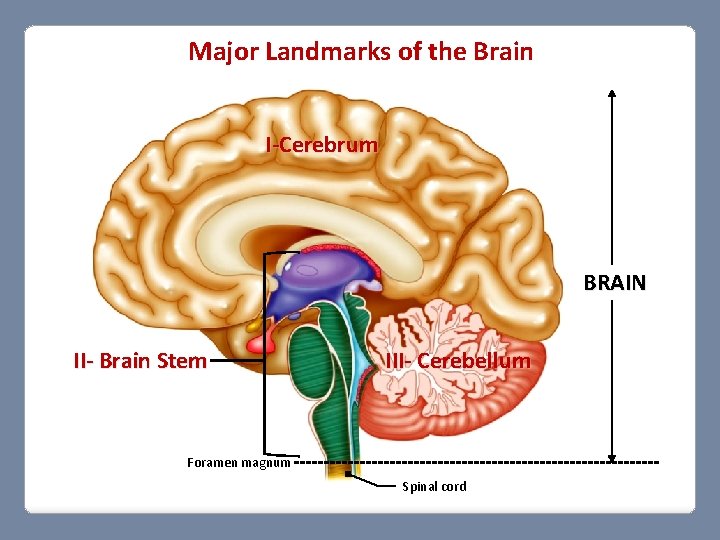
Major Landmarks of the Brain I-Cerebrum BRAIN II- Brain Stem III- Cerebellum Foramen magnum Spinal cord
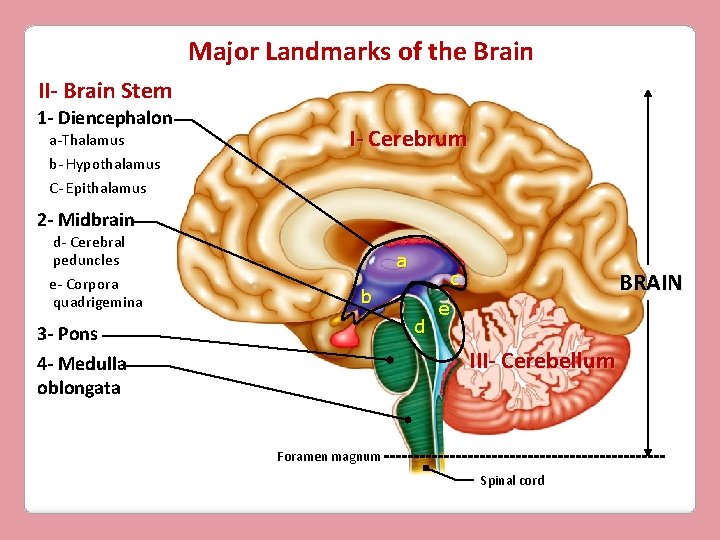
Major Landmarks of the Brain II- Brain Stem 1 - Diencephalon a-Thalamus b- Hypothalamus C- Epithalamus I- Cerebrum 2 - Midbrain d- Cerebral peduncles e- Corpora quadrigemina a b d 3 - Pons 4 - Medulla oblongata BRAIN c e III- Cerebellum Foramen magnum Spinal cord
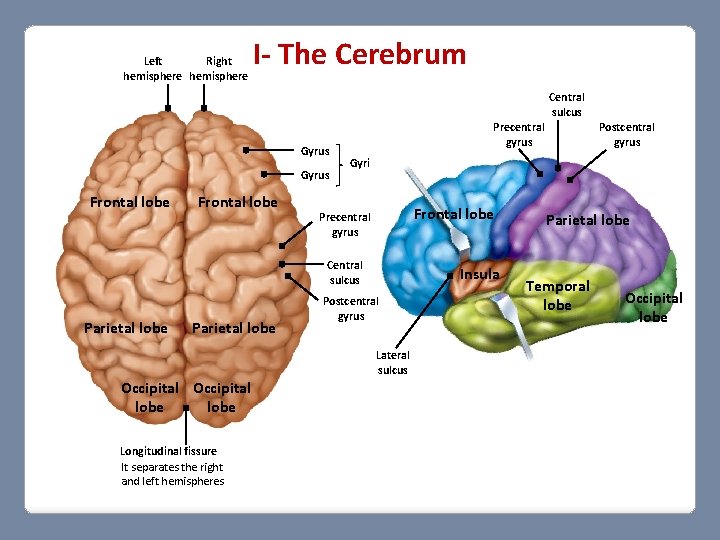
Left Right hemisphere I- The Cerebrum Central sulcus Gyrus Frontal lobe Gyri Frontal lobe Precentral gyrus Central sulcus Parietal lobe Insula Postcentral gyrus Lateral sulcus Occipital lobe Longitudinal fissure It separates the right and left hemispheres Postcentral gyrus Precentral gyrus Parietal lobe Temporal lobe Occipital lobe
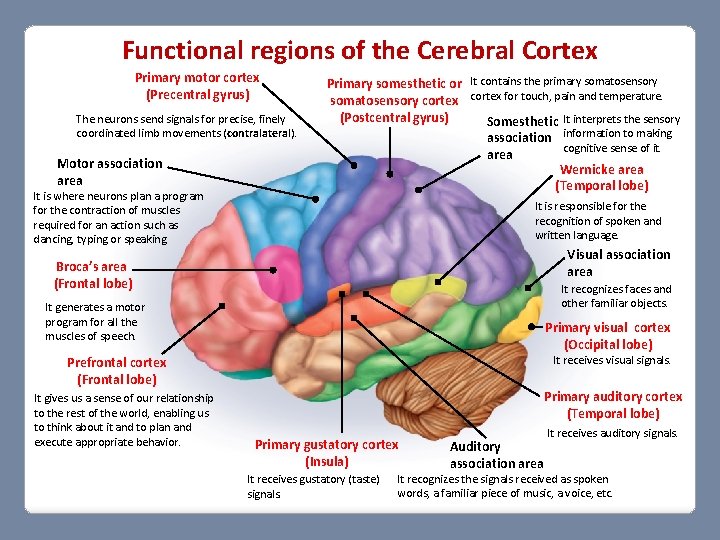
Functional regions of the Cerebral Cortex Primary motor cortex (Precentral gyrus) The neurons send signals for precise, finely coordinated limb movements (contralateral). Motor association area It is where neurons plan a program for the contraction of muscles required for an action such as dancing, typing or speaking. Primary somesthetic or It contains the primary somatosensory cortex for touch, pain and temperature. (Postcentral gyrus) Somesthetic It interprets the sensory association information to making cognitive sense of it. area Wernicke area (Temporal lobe) It is responsible for the recognition of spoken and written language. Visual association area Broca’s area (Frontal lobe) It recognizes faces and other familiar objects. It generates a motor program for all the muscles of speech. Primary visual cortex (Occipital lobe) It receives visual signals. Prefrontal cortex (Frontal lobe) It gives us a sense of our relationship to the rest of the world, enabling us to think about it and to plan and execute appropriate behavior. Primary auditory cortex (Temporal lobe) Primary gustatory cortex (Insula) It receives gustatory (taste) signals. Auditory association area It receives auditory signals. It recognizes the signals received as spoken words, a familiar piece of music, a voice, etc.
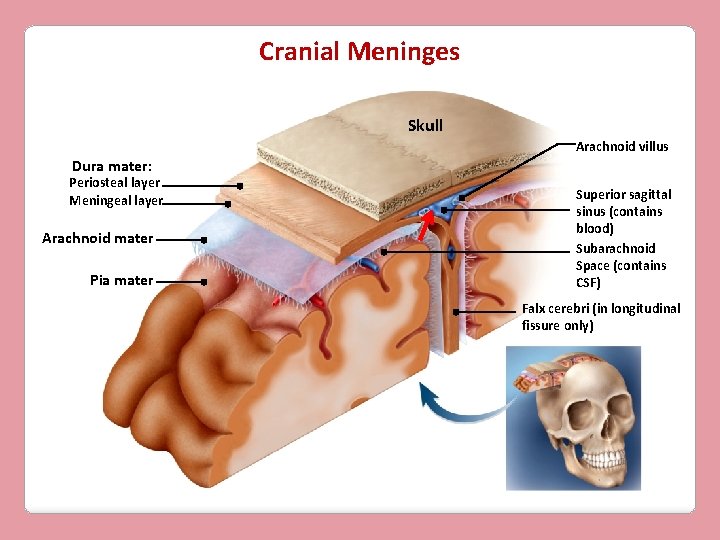
Cranial Meninges Skull Arachnoid villus Dura mater: Periosteal layer Meningeal layer Arachnoid mater Pia mater Superior sagittal sinus (contains blood) Subarachnoid Space (contains CSF) Falx cerebri (in longitudinal fissure only)
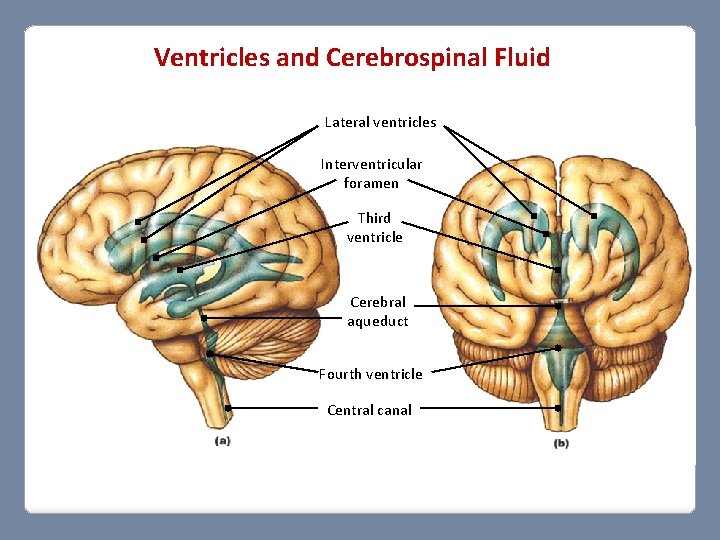
Ventricles and Cerebrospinal Fluid Lateral ventricles Interventricular foramen Third ventricle Cerebral aqueduct Fourth ventricle Central canal
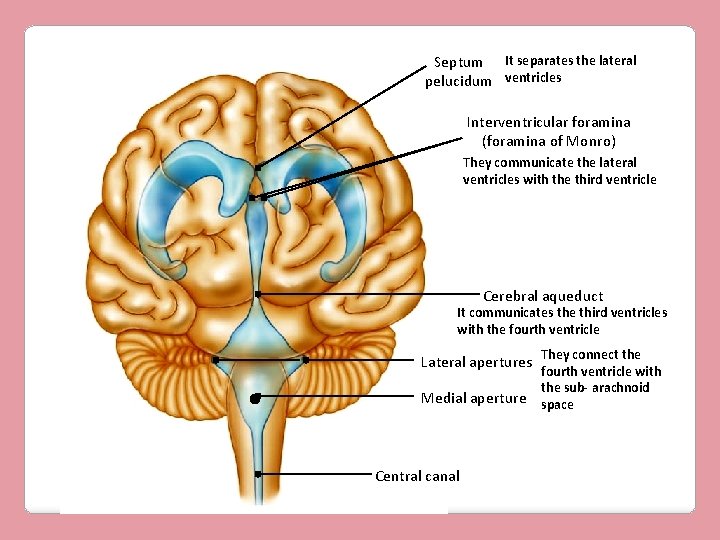
Septum It separates the lateral pelucidum ventricles Interventricular foramina (foramina of Monro) They communicate the lateral ventricles with the third ventricle Cerebral aqueduct It communicates the third ventricles with the fourth ventricle Lateral apertures They connect the Medial aperture Central canal fourth ventricle with the sub- arachnoid space
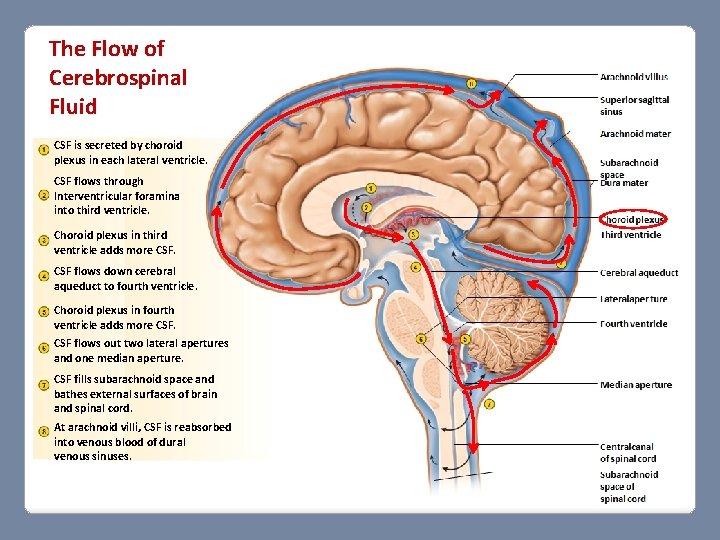
The Flow of Cerebrospinal Fluid CSF is secreted by choroid plexus in each lateral ventricle. CSF flows through Interventricular foramina into third ventricle. Choroid plexus in third ventricle adds more CSF flows down cerebral aqueduct to fourth ventricle. Choroid plexus in fourth ventricle adds more CSF flows out two lateral apertures and one median aperture. CSF fills subarachnoid space and bathes external surfaces of brain and spinal cord. At arachnoid villi, CSF is reabsorbed into venous blood of dural venous sinuses.
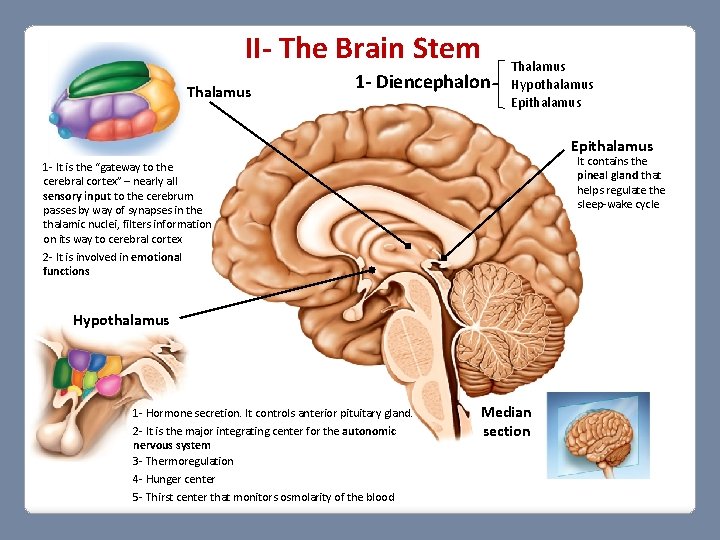
II- The Brain Stem Thalamus 1 - Diencephalon Thalamus Hypothalamus Epithalamus It contains the pineal gland that helps regulate the sleep-wake cycle 1 - It is the “gateway to the cerebral cortex” – nearly all sensory input to the cerebrum passes by way of synapses in the thalamic nuclei, filters information on its way to cerebral cortex 2 - It is involved in emotional functions Hypothalamus 1 - Hormone secretion. It controls anterior pituitary gland. 2 - It is the major integrating center for the autonomic nervous system 3 - Thermoregulation 4 - Hunger center 5 - Thirst center that monitors osmolarity of the blood Median section
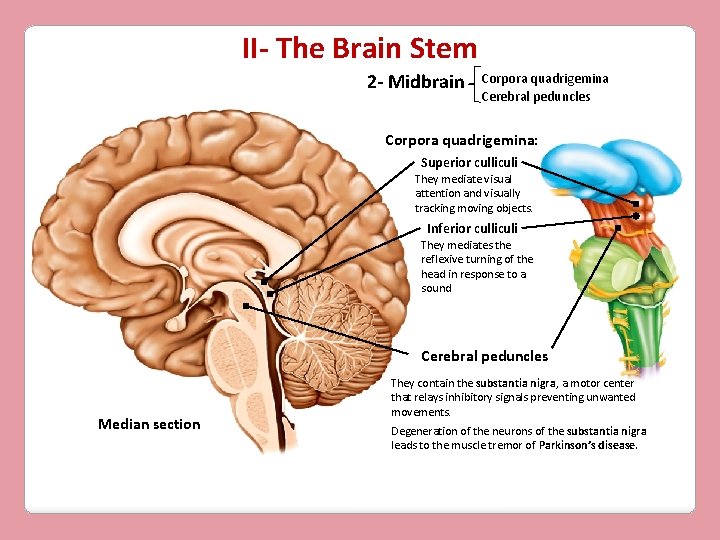
II- The Brain Stem 2 - Midbrain Corpora quadrigemina Cerebral peduncles Corpora quadrigemina: Superior culliculi They mediate visual attention and visually tracking moving objects. Inferior culliculi They mediates the reflexive turning of the head in response to a sound Cerebral peduncles Median section They contain the substantia nigra, a motor center that relays inhibitory signals preventing unwanted movements. Degeneration of the neurons of the substantia nigra leads to the muscle tremor of Parkinson’s disease.
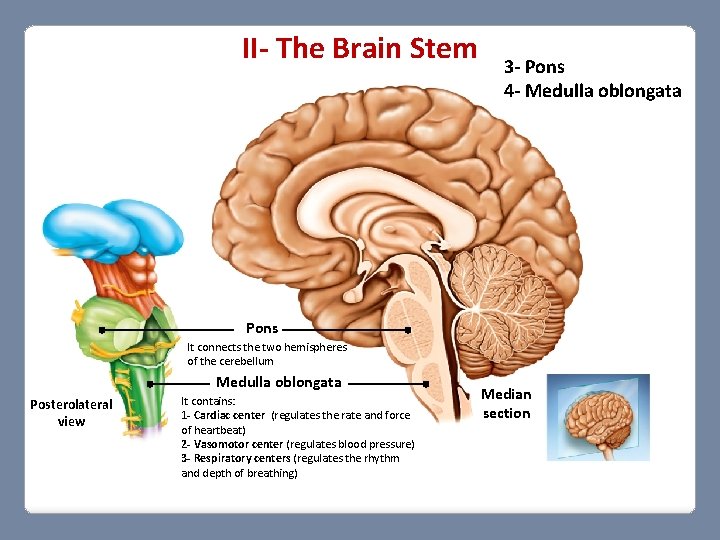
II- The Brain Stem 3 - Pons 4 - Medulla oblongata Pons It connects the two hemispheres of the cerebellum Medulla oblongata Posterolateral view It contains: 1 - Cardiac center (regulates the rate and force of heartbeat) 2 - Vasomotor center (regulates blood pressure) 3 - Respiratory centers (regulates the rhythm and depth of breathing) Median section
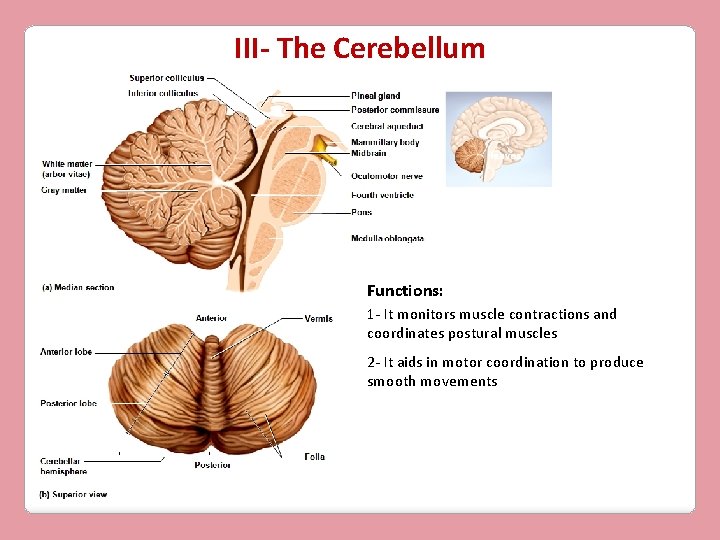
III- The Cerebellum Functions: 1 - It monitors muscle contractions and coordinates postural muscles 2 - It aids in motor coordination to produce smooth movements
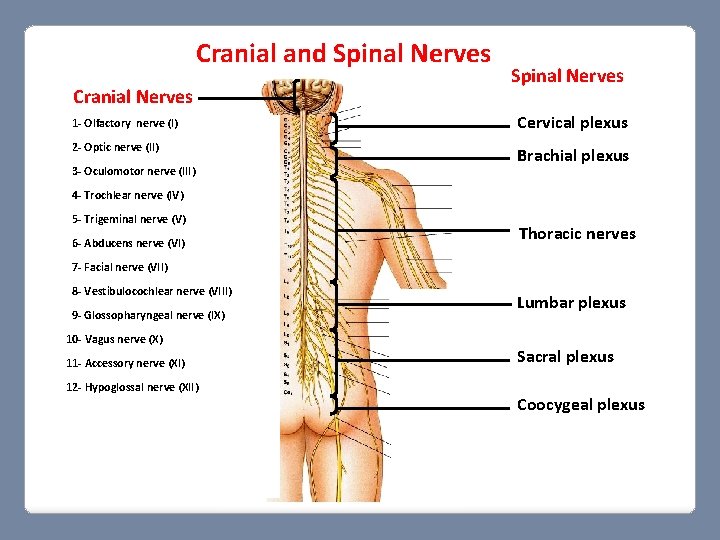
Cranial and Spinal Nerves Cranial Nerves Spinal Nerves 1 - Olfactory nerve (I) Cervical plexus 2 - Optic nerve (II) Brachial plexus 3 - Oculomotor nerve (III) 4 - Trochlear nerve (IV) 5 - Trigeminal nerve (V) 6 - Abducens nerve (VI) Thoracic nerves 7 - Facial nerve (VII) 8 - Vestibulocochlear nerve (VIII) 9 - Glossopharyngeal nerve (IX) 10 - Vagus nerve (X) 11 - Accessory nerve (XI) 12 - Hypoglossal nerve (XII) Lumbar plexus Sacral plexus Coocygeal plexus
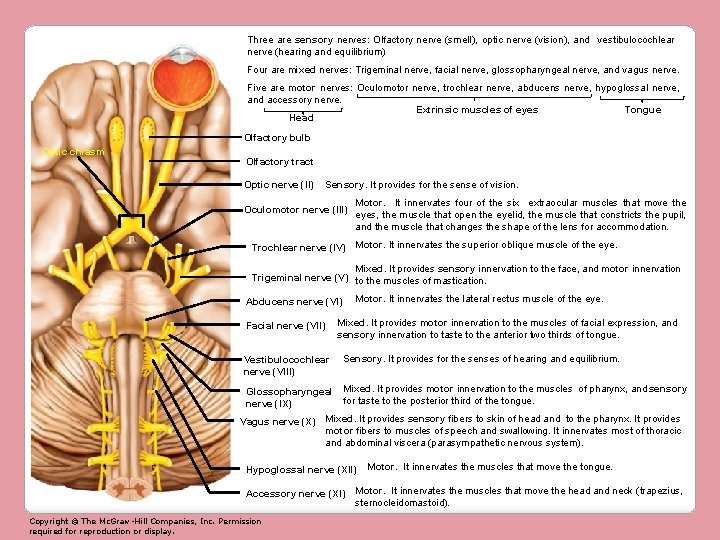
Three are sensory nerves: Olfactory nerve (smell), optic nerve (vision), and vestibulocochlear nerve (hearing and equilibrium) Four are mixed nerves: Trigeminal nerve, facial nerve, glossopharyngeal nerve, and vagus nerve. Five are motor nerves: Oculomotor nerve, trochlear nerve, abducens nerve, hypoglossal nerve, and accessory nerve. Tongue Extrinsic muscles of eyes Head Olfactory bulb Optic chiasm Olfactory tract Optic nerve (II) Sensory. It provides for the sense of vision. Oculomotor nerve (III) Motor. It innervates four of the six extraocular muscles that move the eyes, the muscle that open the eyelid, the muscle that constricts the pupil, and the muscle that changes the shape of the lens for accommodation. Trochlear nerve (IV) Motor. It innervates the superior oblique muscle of the eye. Mixed. It provides sensory innervation to the face, and motor innervation Trigeminal nerve (V) to the muscles of mastication. Motor. It innervates the lateral rectus muscle of the eye. Abducens nerve (VI) Facial nerve (VII) Mixed. It provides motor innervation to the muscles of facial expression, and sensory innervation to taste to the anterior two thirds of tongue. Vestibulocochlear nerve (VIII) Sensory. It provides for the senses of hearing and equilibrium. Glossopharyngeal nerve (IX) Mixed. It provides motor innervation to the muscles of pharynx, and sensory for taste to the posterior third of the tongue. Vagus nerve (X) Mixed. It provides sensory fibers to skin of head and to the pharynx. It provides motor fibers to muscles of speech and swallowing. It innervates most of thoracic and abdominal viscera (parasympathetic nervous system). Hypoglossal nerve (XII) Accessory nerve (XI) Copyright © The Mc. Graw-Hill Companies, Inc. Permission required for reproduction or display. Motor. It innervates the muscles that move the tongue. Motor. It innervates the muscles that move the head and neck (trapezius, sternocleidomastoid).
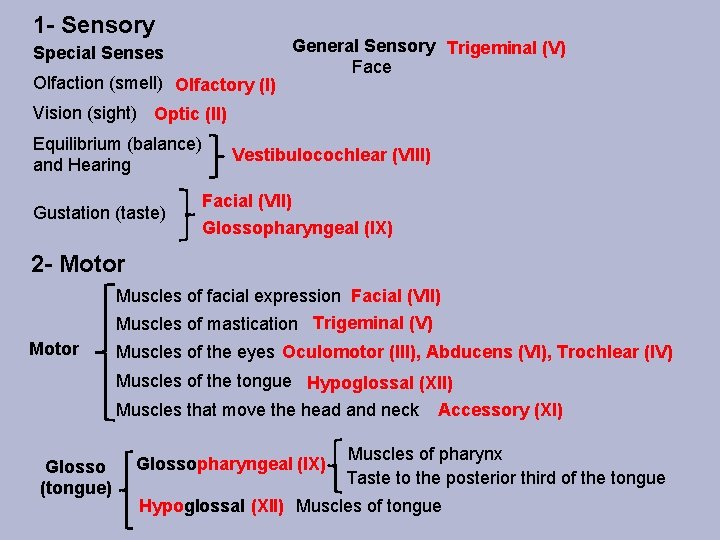
1 - Sensory Special Senses Olfaction (smell) Olfactory (I) General Sensory Trigeminal (V) Face Vision (sight) Optic (II) Equilibrium (balance) and Hearing Gustation (taste) Vestibulocochlear (VIII) Facial (VII) Glossopharyngeal (IX) 2 - Motor Muscles of facial expression Facial (VII) Muscles of mastication Trigeminal (V) Motor Muscles of the eyes Oculomotor (III), Abducens (VI), Trochlear (IV) Muscles of the tongue Hypoglossal (XII) Muscles that move the head and neck Accessory (XI) Glosso (tongue) Glossopharyngeal (IX) Muscles of pharynx Taste to the posterior third of the tongue Hypoglossal (XII) Muscles of tongue
- Slides: 16