
Lecture 21 Core Design Parallel Algorithms Today ARM

- Slides: 30
Lecture 21: Core Design, Parallel Algorithms • Today: ARM Cortex A-15, power, sort and matrix algorithms 1
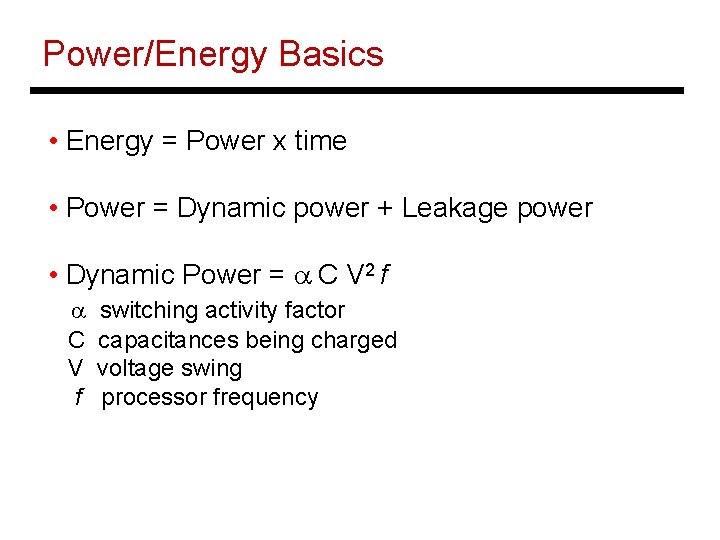
Power/Energy Basics • Energy = Power x time • Power = Dynamic power + Leakage power • Dynamic Power = a C V 2 f a C V f switching activity factor capacitances being charged voltage swing processor frequency
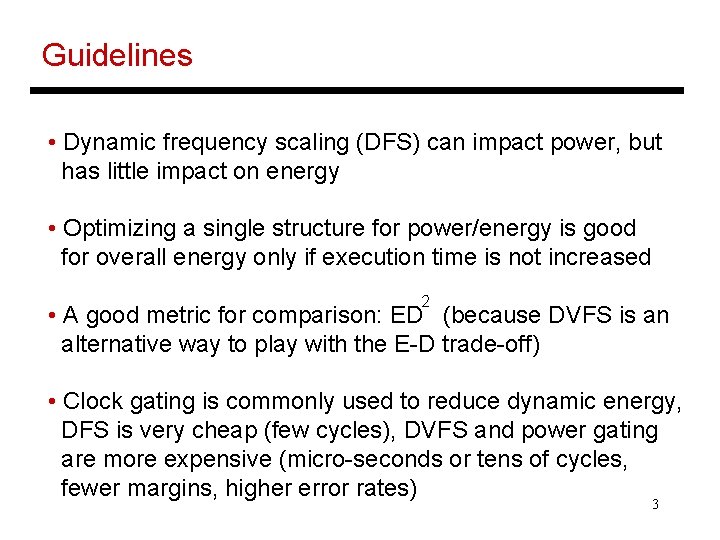
Guidelines • Dynamic frequency scaling (DFS) can impact power, but has little impact on energy • Optimizing a single structure for power/energy is good for overall energy only if execution time is not increased 2 • A good metric for comparison: ED (because DVFS is an alternative way to play with the E-D trade-off) • Clock gating is commonly used to reduce dynamic energy, DFS is very cheap (few cycles), DVFS and power gating are more expensive (micro-seconds or tens of cycles, fewer margins, higher error rates) 3
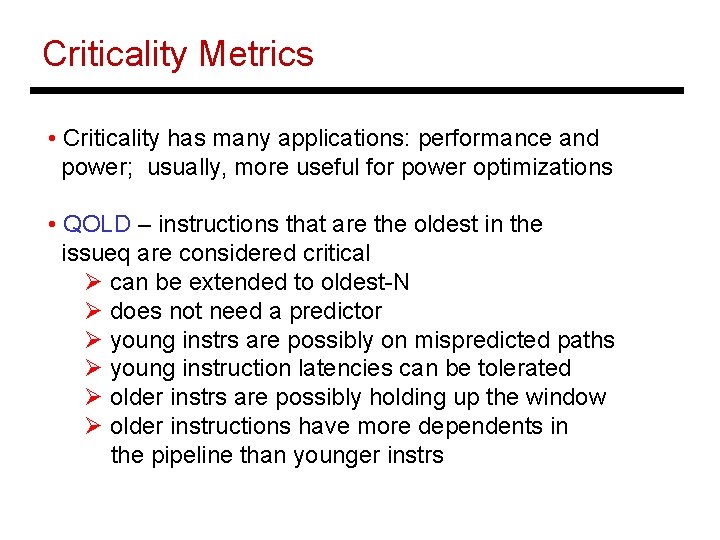
Criticality Metrics • Criticality has many applications: performance and power; usually, more useful for power optimizations • QOLD – instructions that are the oldest in the issueq are considered critical Ø can be extended to oldest-N Ø does not need a predictor Ø young instrs are possibly on mispredicted paths Ø young instruction latencies can be tolerated Ø older instrs are possibly holding up the window Ø older instructions have more dependents in the pipeline than younger instrs
Other Criticality Metrics • QOLDDEP: Producing instructions for oldest in q • ALOLD: Oldest instr in ROB • FREED-N: Instr completion frees up at least N dependent instrs • Wake-Up: Instr completion triggers a chain of wake-up operations • Instruction types: cache misses, branch mpreds, and instructions that feed them
Parallel Algorithms – Processor Model • High communication latencies pursue coarse-grain parallelism (the focus of the course so far) • Next, focus on fine-grain parallelism • VLSI improvements enough transistors to accommodate numerous processing units on a chip and (relatively) low communication latencies • Consider a special-purpose processor with thousands of processing units, each with small-bit ALUs and limited register storage 6
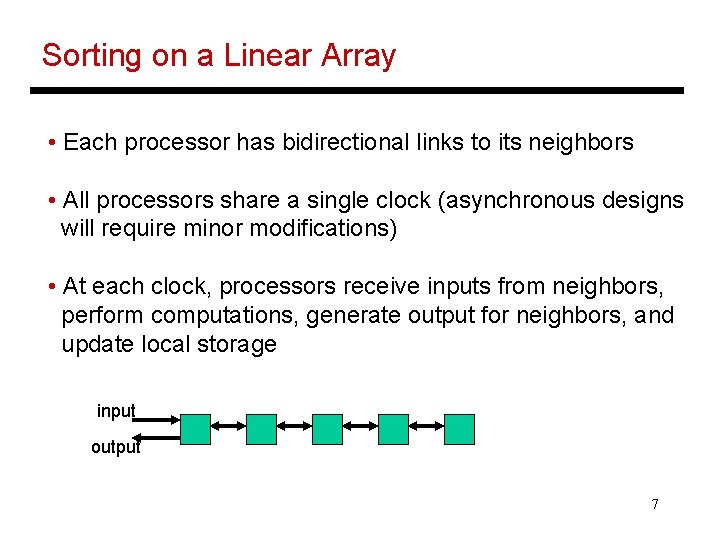
Sorting on a Linear Array • Each processor has bidirectional links to its neighbors • All processors share a single clock (asynchronous designs will require minor modifications) • At each clock, processors receive inputs from neighbors, perform computations, generate output for neighbors, and update local storage input output 7
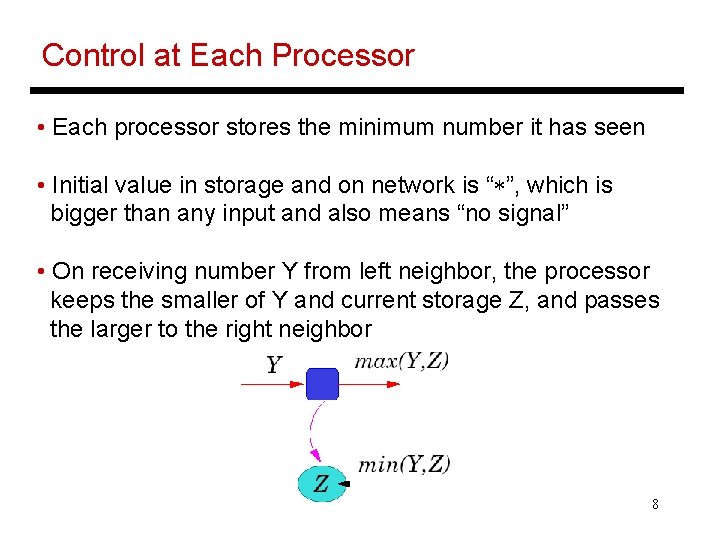
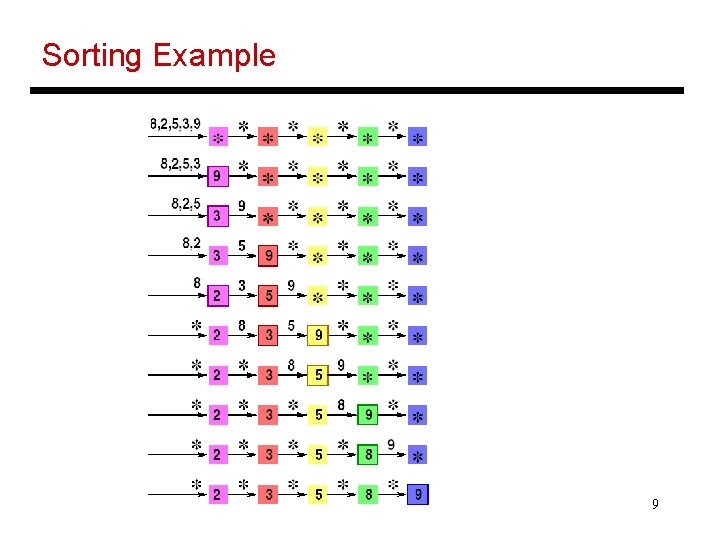
Control at Each Processor • Each processor stores the minimum number it has seen • Initial value in storage and on network is “*”, which is bigger than any input and also means “no signal” • On receiving number Y from left neighbor, the processor keeps the smaller of Y and current storage Z, and passes the larger to the right neighbor 8
Sorting Example 9
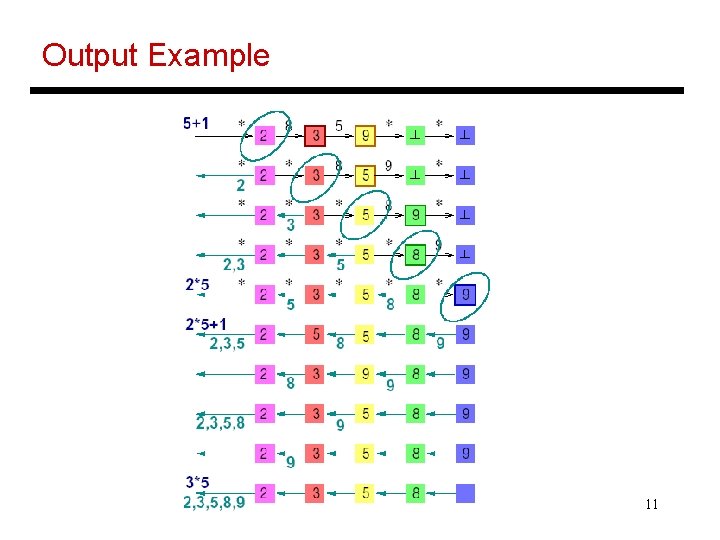
Result Output • The output process begins when a processor receives a non-*, followed by a “*” • Each processor forwards its storage to its left neighbor and subsequent data it receives from right neighbors • How many steps does it take to sort N numbers? • What is the speedup and efficiency? 10
Output Example 11
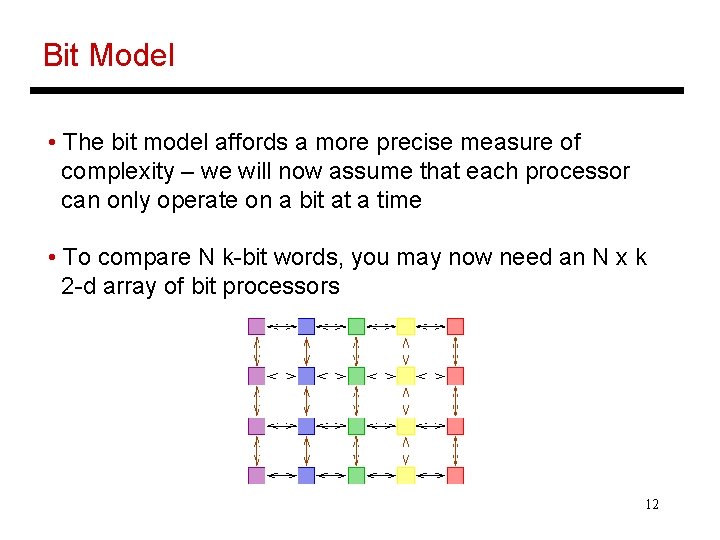
Bit Model • The bit model affords a more precise measure of complexity – we will now assume that each processor can only operate on a bit at a time • To compare N k-bit words, you may now need an N x k 2 -d array of bit processors 12
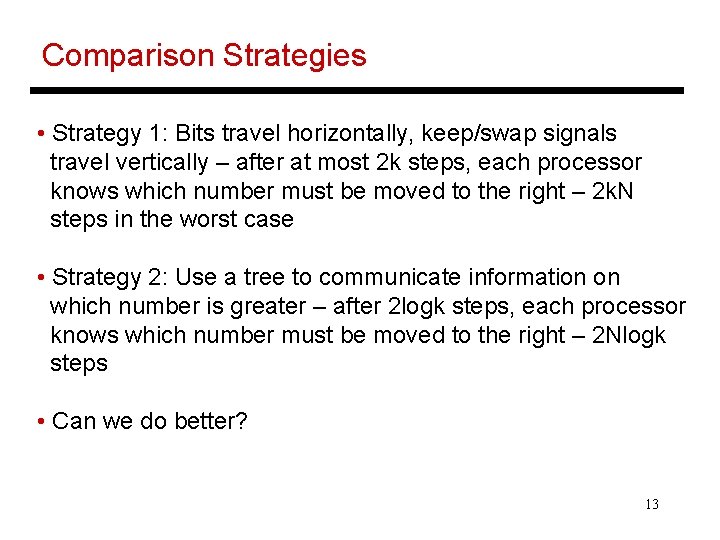
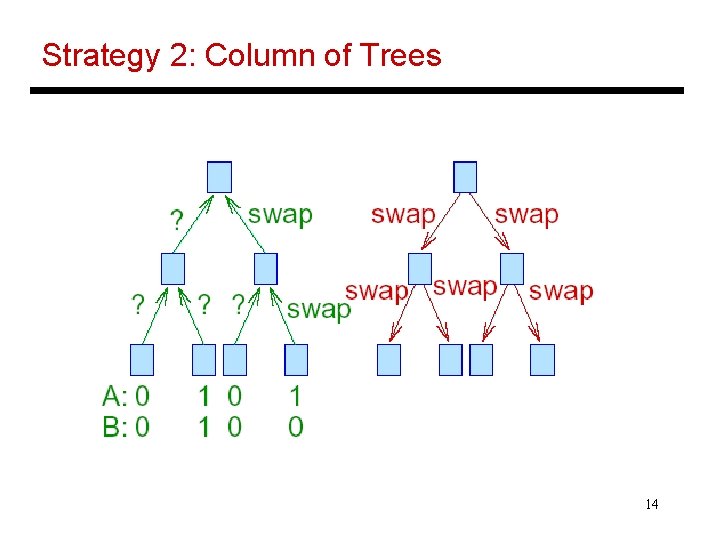
Comparison Strategies • Strategy 1: Bits travel horizontally, keep/swap signals travel vertically – after at most 2 k steps, each processor knows which number must be moved to the right – 2 k. N steps in the worst case • Strategy 2: Use a tree to communicate information on which number is greater – after 2 logk steps, each processor knows which number must be moved to the right – 2 Nlogk steps • Can we do better? 13
Strategy 2: Column of Trees 14
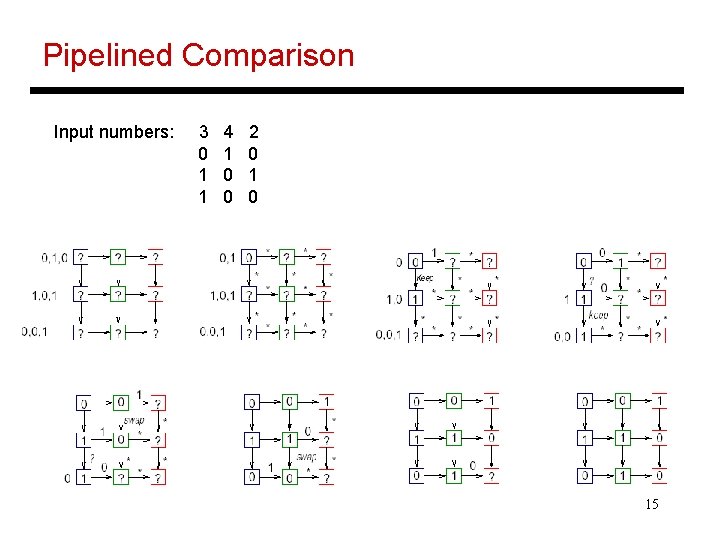
Pipelined Comparison Input numbers: 3 0 1 1 4 1 0 0 2 0 15
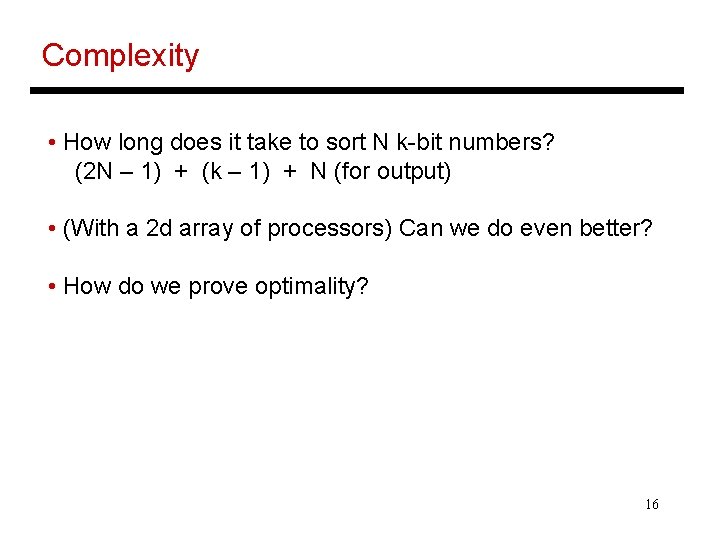
Complexity • How long does it take to sort N k-bit numbers? (2 N – 1) + (k – 1) + N (for output) • (With a 2 d array of processors) Can we do even better? • How do we prove optimality? 16
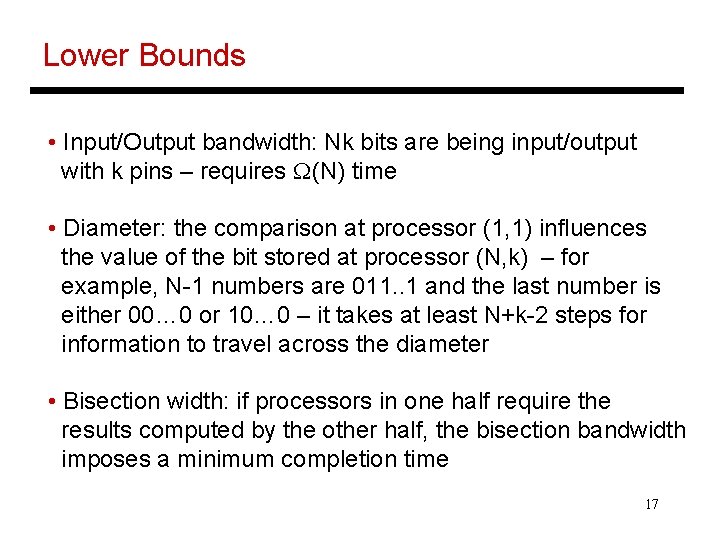
Lower Bounds • Input/Output bandwidth: Nk bits are being input/output with k pins – requires W(N) time • Diameter: the comparison at processor (1, 1) influences the value of the bit stored at processor (N, k) – for example, N-1 numbers are 011. . 1 and the last number is either 00… 0 or 10… 0 – it takes at least N+k-2 steps for information to travel across the diameter • Bisection width: if processors in one half require the results computed by the other half, the bisection bandwidth imposes a minimum completion time 17
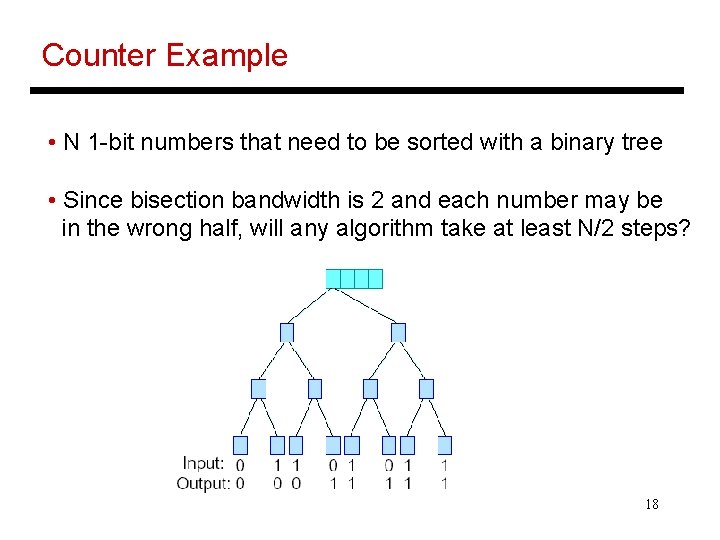
Counter Example • N 1 -bit numbers that need to be sorted with a binary tree • Since bisection bandwidth is 2 and each number may be in the wrong half, will any algorithm take at least N/2 steps? 18
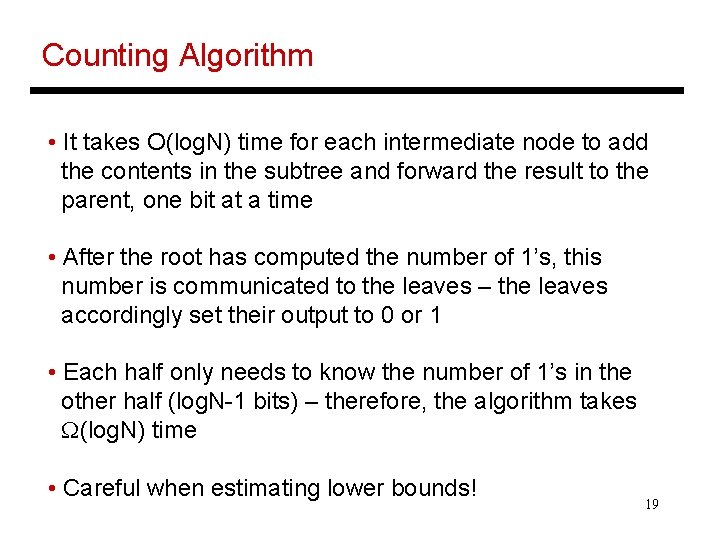
Counting Algorithm • It takes O(log. N) time for each intermediate node to add the contents in the subtree and forward the result to the parent, one bit at a time • After the root has computed the number of 1’s, this number is communicated to the leaves – the leaves accordingly set their output to 0 or 1 • Each half only needs to know the number of 1’s in the other half (log. N-1 bits) – therefore, the algorithm takes W(log. N) time • Careful when estimating lower bounds! 19
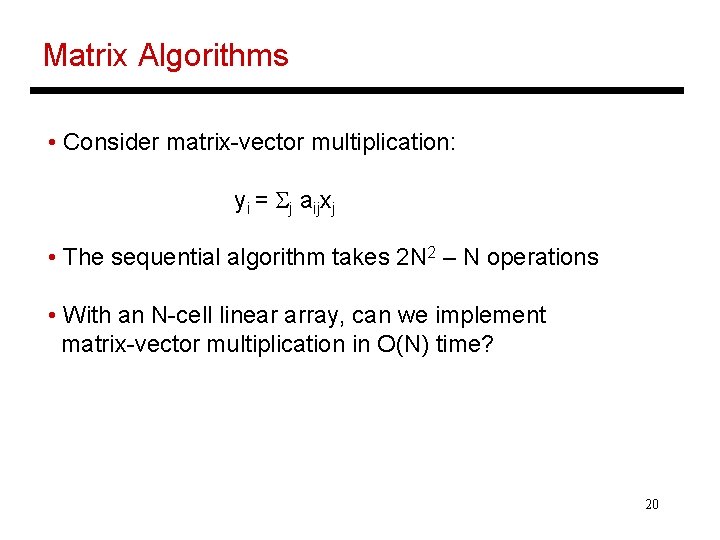
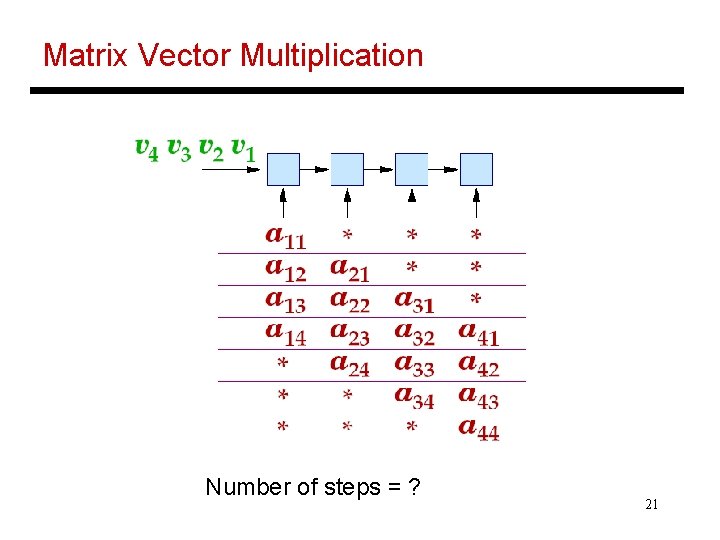
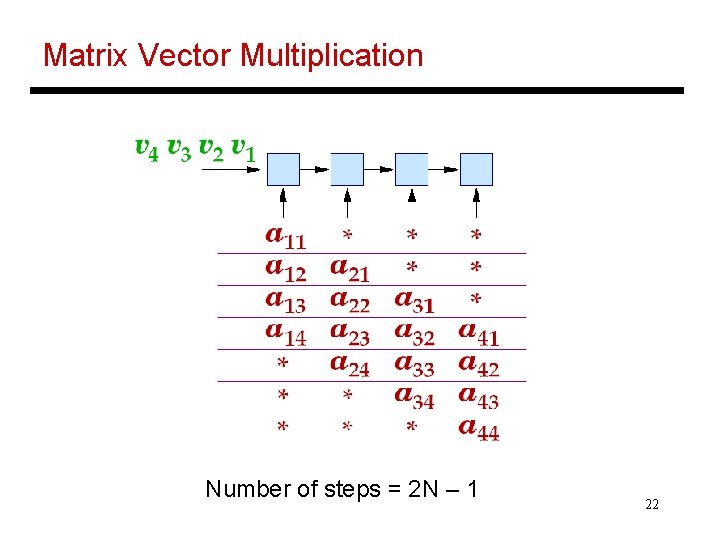
Matrix Algorithms • Consider matrix-vector multiplication: yi = Sj aijxj • The sequential algorithm takes 2 N 2 – N operations • With an N-cell linear array, can we implement matrix-vector multiplication in O(N) time? 20
Matrix Vector Multiplication Number of steps = ? 21
Matrix Vector Multiplication Number of steps = 2 N – 1 22
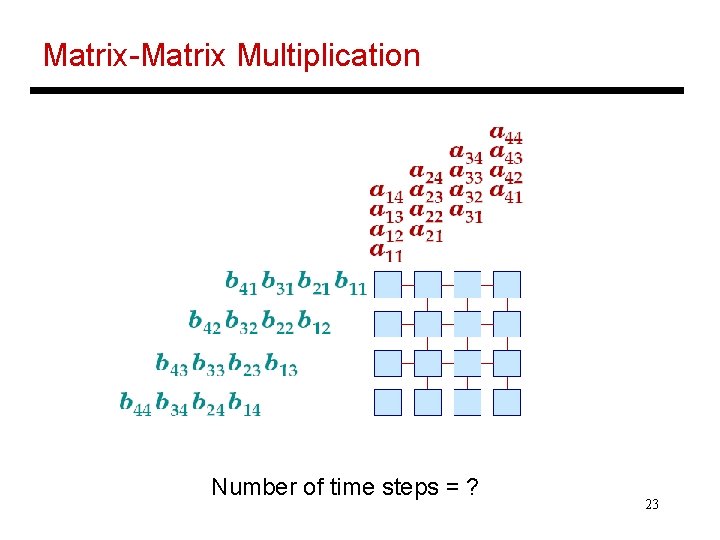
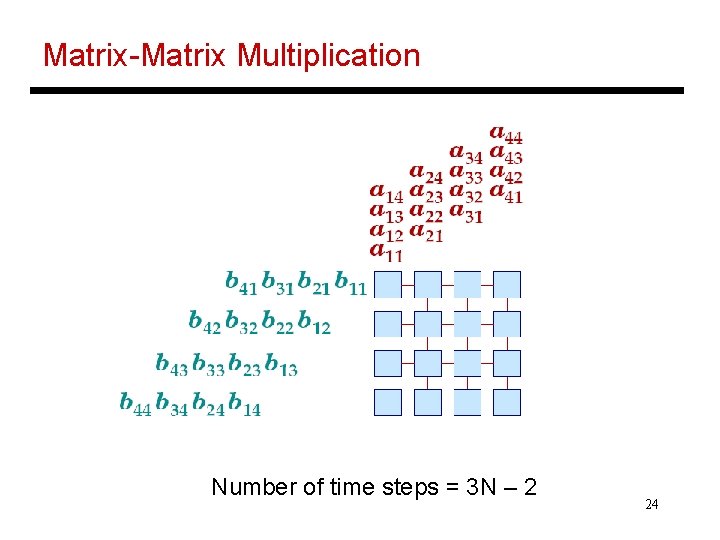
Matrix-Matrix Multiplication Number of time steps = ? 23
Matrix-Matrix Multiplication Number of time steps = 3 N – 2 24
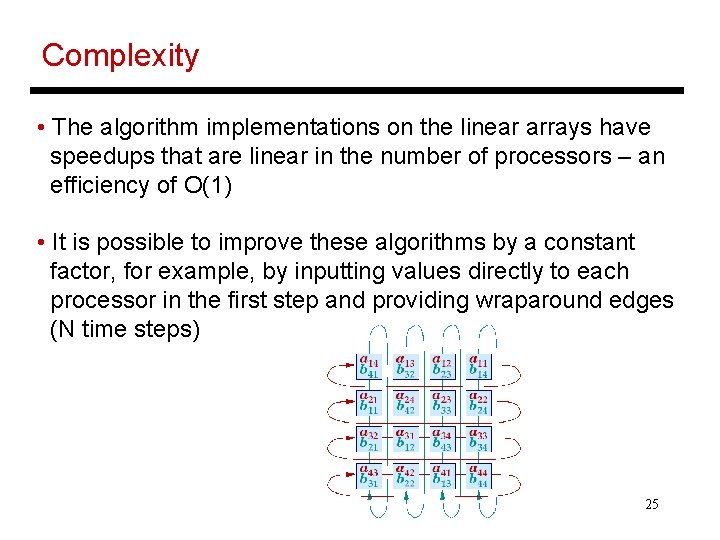
Complexity • The algorithm implementations on the linear arrays have speedups that are linear in the number of processors – an efficiency of O(1) • It is possible to improve these algorithms by a constant factor, for example, by inputting values directly to each processor in the first step and providing wraparound edges (N time steps) 25
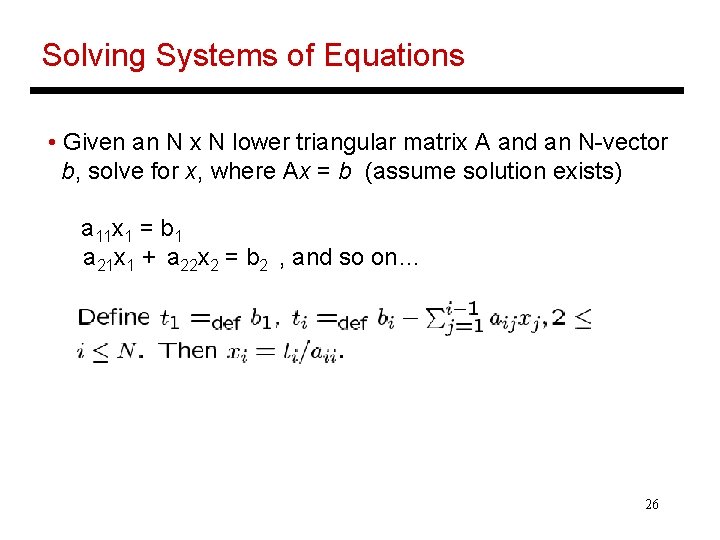
Solving Systems of Equations • Given an N x N lower triangular matrix A and an N-vector b, solve for x, where Ax = b (assume solution exists) a 11 x 1 = b 1 a 21 x 1 + a 22 x 2 = b 2 , and so on… 26
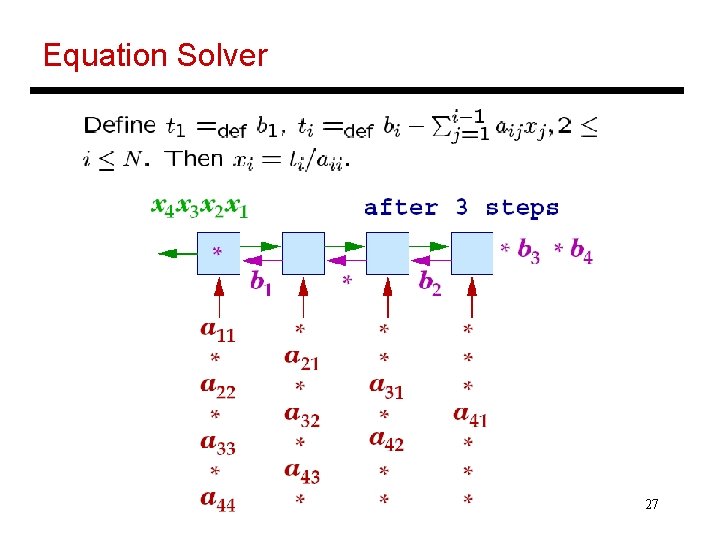
Equation Solver 27
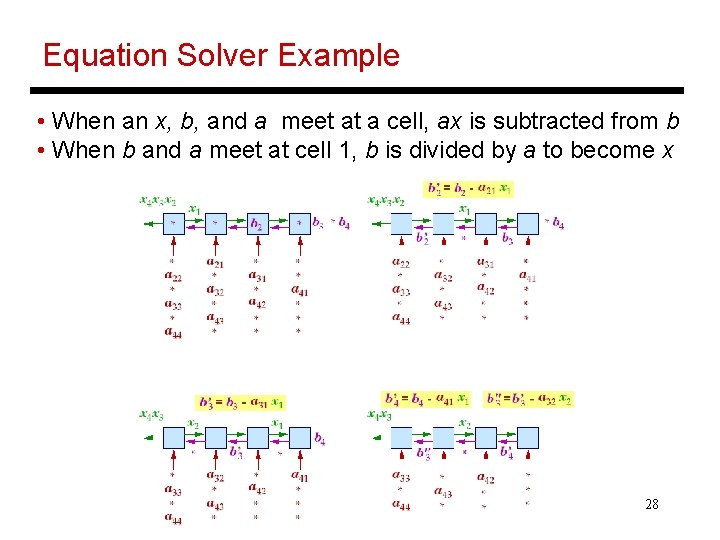
Equation Solver Example • When an x, b, and a meet at a cell, ax is subtracted from b • When b and a meet at cell 1, b is divided by a to become x 28
Complexity • Time steps = 2 N – 1 • Speedup = O(N), efficiency = O(1) • Note that half the processors are idle every time step – can improve efficiency by solving two interleaved equation systems simultaneously 29
Title • Bullet 30