
Lecture 20 What is in our blood What

Lecture 20: What is in our blood? What are the functions of red blood cells? • Transport of nutrients & wastes • Thermoregulation (Exam 1) • Immunity (Exam 4) • Fluid & p. H Balance (Exam 5) • Hematocrit • Albumins • Red Blood Cells • Hemoglobin, cell shape • Development, EPO, anemia • Oxygen carrying capacity • Blood viscosity, blood doping • Sickle-cell Disease • Breakdown & waste removal 3/4/2021 Dr. Karen Petersen, Biol. 118, Autumn 2016 1
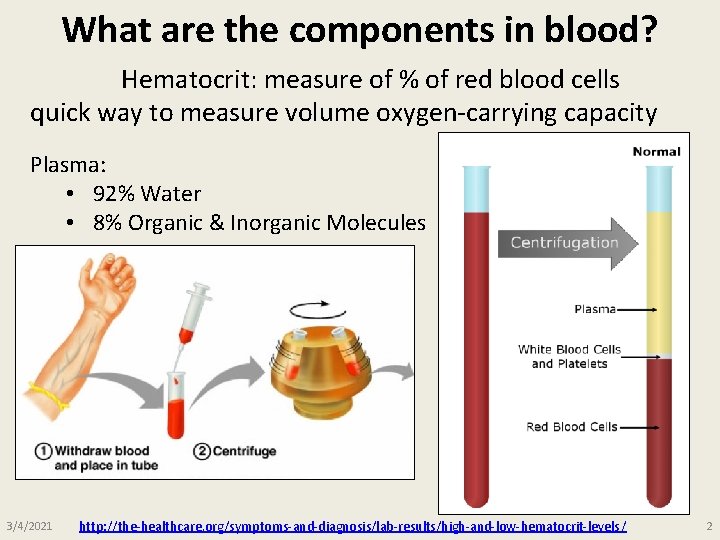
What are the components in blood? Hematocrit: measure of % of red blood cells quick way to measure volume oxygen-carrying capacity Plasma: • 92% Water • 8% Organic & Inorganic Molecules 3/4/2021 http: //the-healthcare. org/symptoms-and-diagnosis/lab-results/high-and-low-hematocrit-levels/ 2
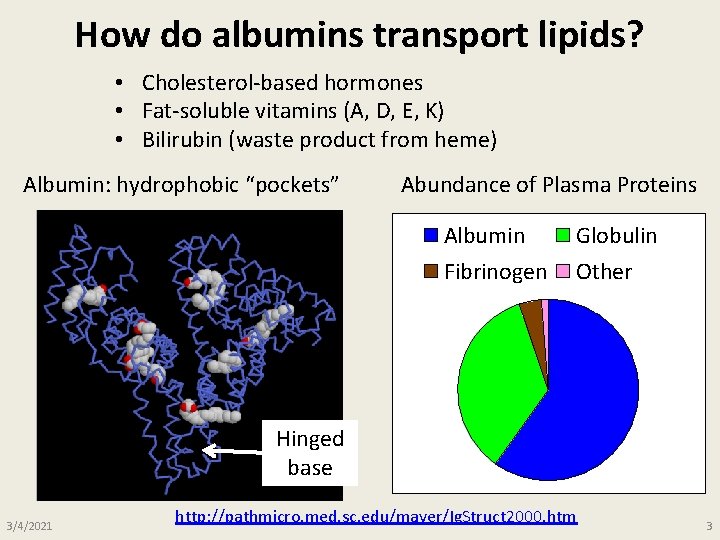
How do albumins transport lipids? • Cholesterol-based hormones • Fat-soluble vitamins (A, D, E, K) • Bilirubin (waste product from heme) Albumin: hydrophobic “pockets” Abundance of Plasma Proteins Albumin Fibrinogen Globulin Other Hinged base 3/4/2021 http: //pathmicro. med. sc. edu/mayer/Ig. Struct 2000. htm 3
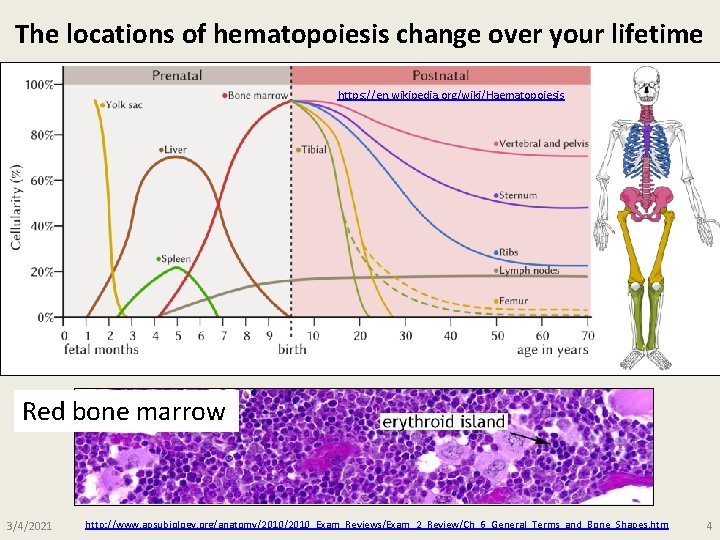
The locations of hematopoiesis change over your lifetime https: //en. wikipedia. org/wiki/Haematopoiesis Red bone marrow 3/4/2021 http: //www. apsubiology. org/anatomy/2010_Exam_Reviews/Exam_2_Review/Ch_6_General_Terms_and_Bone_Shapes. htm 4
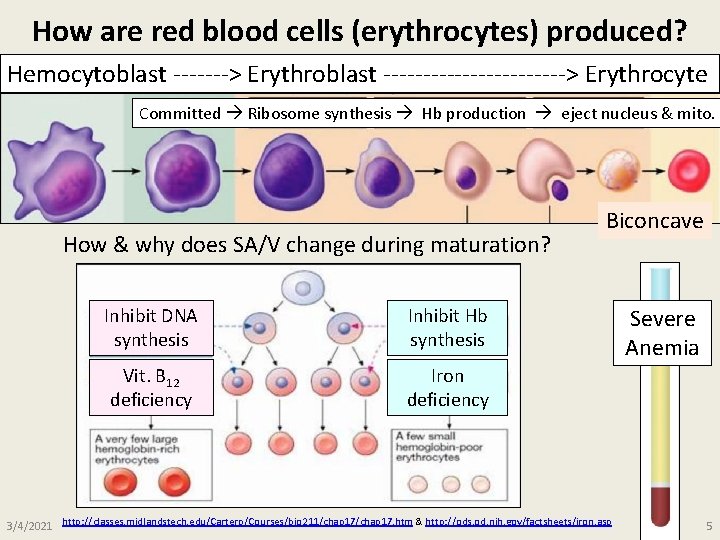
How are red blood cells (erythrocytes) produced? Hemocytoblast -------> Erythroblast ------------> Erythrocyte Committed Ribosome synthesis Hb production eject nucleus & mito. https: //www. nlm. nih. gov/medlineplus/ency/anatomyvideos/000104. htm How & why does SA/V change during maturation? Inhibit DNA synthesis Inhibit Hb synthesis Vit. B 12 deficiency Iron deficiency Biconcave 3/4/2021 http: //classes. midlandstech. edu/Carterp/Courses/bio 211/chap 17. htm & http: //ods. od. nih. gov/factsheets/iron. asp Severe Anemia 5
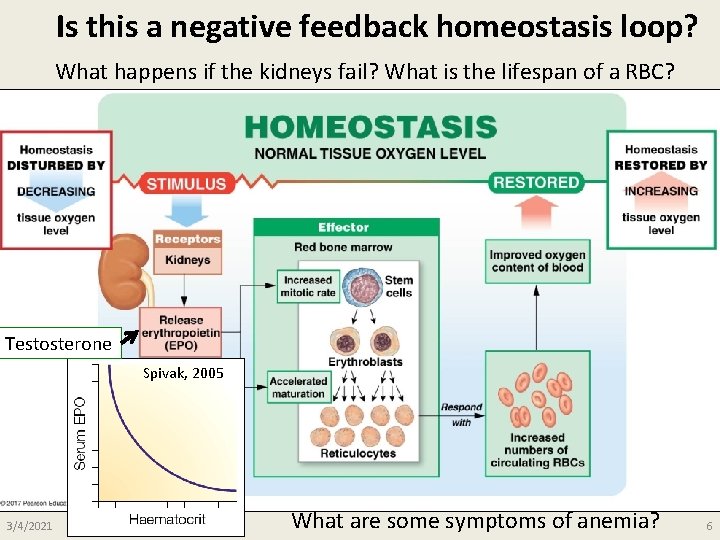
Is this a negative feedback homeostasis loop? How is the oxygen. What happens if the kidneys fail? What is the lifespan of a RBC? carrying capacity of the blood regulated? Testosterone Spivak, 2005 3/4/2021 What are some symptoms of anemia? 6
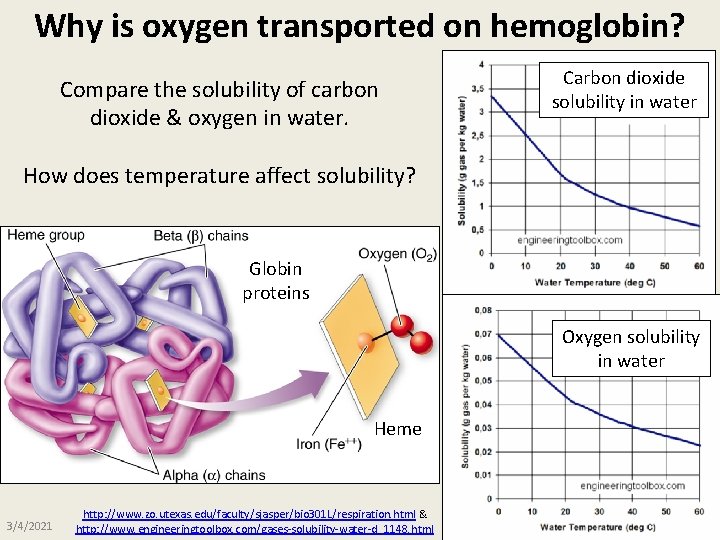
Why is oxygen transported on hemoglobin? Compare the solubility of carbon dioxide & oxygen in water. Carbon dioxide solubility in water How does temperature affect solubility? Globin proteins Oxygen solubility in water Heme 3/4/2021 http: //www. zo. utexas. edu/faculty/sjasper/bio 301 L/respiration. html & http: //www. engineeringtoolbox. com/gases-solubility-water-d_1148. html 7
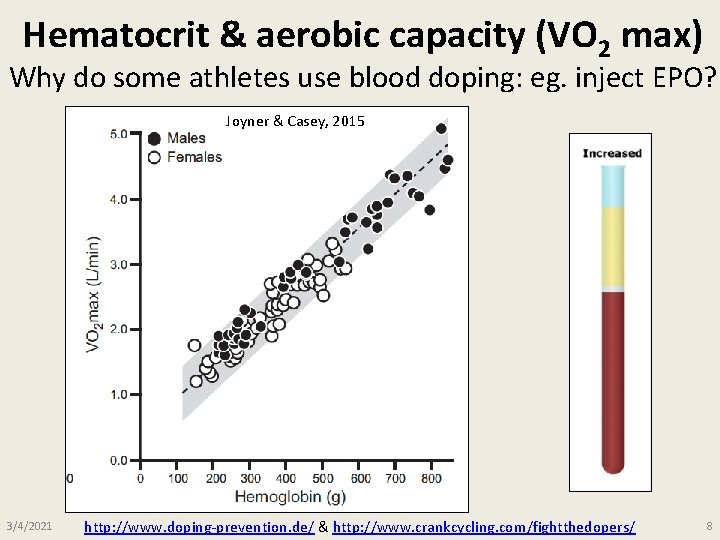
Hematocrit & aerobic capacity (VO 2 max) Why do some athletes use blood doping: eg. inject EPO? Joyner & Casey, 2015 3/4/2021 http: //www. doping-prevention. de/ & http: //www. crankcycling. com/fightthedopers/ 8
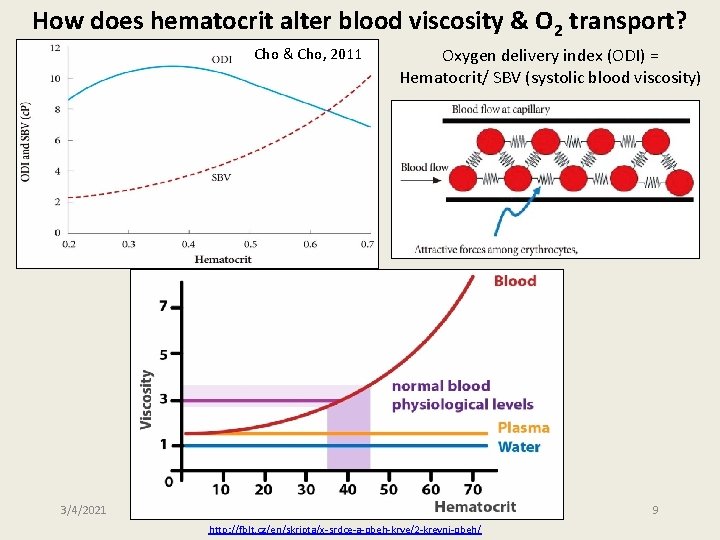
How does hematocrit alter blood viscosity & O 2 transport? Cho & Cho, 2011 Oxygen delivery index (ODI) = Hematocrit/ SBV (systolic blood viscosity) 3/4/2021 9 http: //fblt. cz/en/skripta/x-srdce-a-obeh-krve/2 -krevni-obeh/
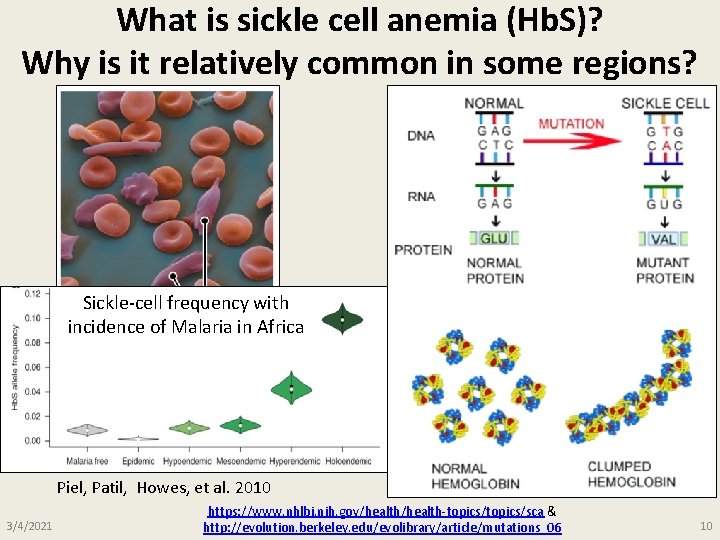
What is sickle cell anemia (Hb. S)? Why is it relatively common in some regions? Sickle-cell frequency with incidence of Malaria in Africa Piel, Patil, Howes, et al. 2010 3/4/2021 https: //www. nhlbi. nih. gov/health-topics/sca & http: //evolution. berkeley. edu/evolibrary/article/mutations_06 10
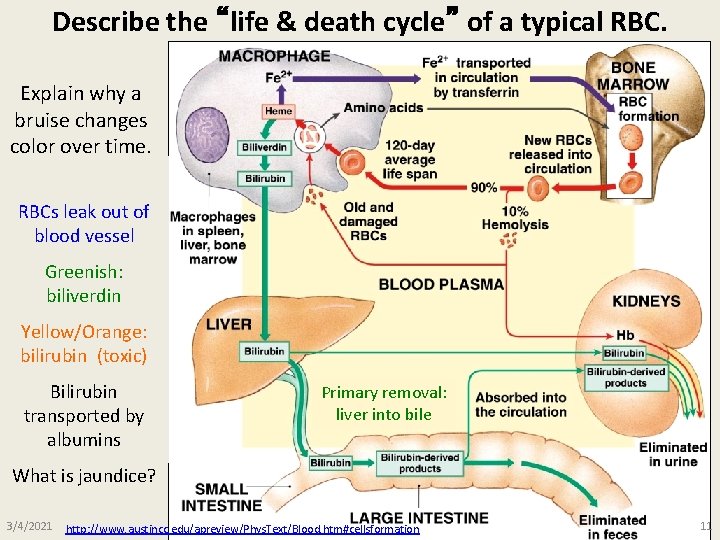
Describe the “life & death cycle” of a typical RBC. Explain why a bruise changes color over time. RBCs leak out of blood vessel Greenish: biliverdin Yellow/Orange: bilirubin (toxic) Bilirubin transported by albumins Primary removal: liver into bile What is jaundice? 3/4/2021 http: //www. austincc. edu/apreview/Phys. Text/Blood. htm#cellsformation 11
Topics to understand & review: 1. 2. 3. 4. 5. 6. 7. 8. 9. Describe the design & transport function of albumins. Where albumins made? Compare the relative abundance of erythrocytes (RBCs). Describe the size & shape of a red blood cell. Does this cell have a higher surface to volume ratio than a typical “round” cell? How could a high SA/V ratio be useful? Why should a RBC be flexible? Where are RBCs produced in an adult vs. before birth? What is the stem cell for all blood cells? Describe RBC maturation. Why do RBCs lose nucleus & mitochondria? Describe the negative feedback loop that regulates the oxygen content of blood. What organ produces EPO (erythropoietin)? What happens if the kidneys “fail”? Why does living at high elevation increase your hematocrit? Describe the structure of hemoglobin. What are the function(s) of the heme region & of the globin proteins. Why is iron a necessary nutrient for hemoglobin formation? Where does O 2 attach? How many Oxygen (O 2) molecules can 1 hemoglobin carry? What does hematocrit measure? How is this information produced? How & why do hematocrits differ between men & women, how do they change in men with age? How does testosterone affect RBC production? Graph the relationship between hemoglobin concentration & max. aerobic capacity ((VO 2 max). What are the benefits to blood doping in athletic performance? Diagram the relationship between hematocrit with blood viscosity & oxygen delivery index. How does blood viscosity affect blood flow & your risk of a heart attack? What is sickle cell anemia? How does it affect an individual? Why is it evolve multiple times in regions where malaria is prevalent? Describe the breakdown of old RBCs: Where normally does it occur? What happens to iron, to heme? How is bilirubin normally removed? What happens in a bruise? What is jaundice & what causes it? 3/4/2021 12
Additional Resources 1. Camaschella C. 2015. Iron-deficiency anemia. Review. N Engl J Med 372: 1832 -1843. 2. Chang Y-L, Hung S-H, Ling W, et al. 2013. Association between ischemic stroke and iron-deficiency anemia: a population-based study. PLo. S ONE 8(12): e 82952. 3. Cho Y-I, Cho DJ. 2011. Hemorheology and microvascular disorders. Korean Circ J. 41(6): 287– 295. 4. Coglianese EE, Qureshi MM, Vasan, et al. 2012. Usefulness of the blood hematocrit level to predict development of heart failure in a community. The American Journal of Cardiology 109(2): 241– 245. 5. Hernandez, CMR & Oo TH. 2015. Advances in mechanisms, diagnosis, and treatment of pernicious anemia. Discovery Medicine 19(104): 159 -168. 6. Joyner MJ, Casey DP. 2015. Regulation of increased blood flow (hyperemia) to muscles during exercise: A hierarchy of competing physiological needs. Physiol Rev 95: 549– 601. 7. Miller JL. 2013. Iron deficiency anemia: a common and curable disease. Cold Spring Harb Perspect Med 3: a 011866 8. Momaya A, Fawal M, Estes R. 2015. Performance-enhancing substances in sports: a review of the literature. Sports Med. 45(4): 517 -531. 9. Murphy WG. 2014. The sex difference in haemoglobin levels in adults — Mechanisms, causes, and consequences. Blood Reviews 28(2): 41 -47. 10. Murphy WG, Tong E, Murphy C. 2010. Why do women have similar erythropoietin levels to men but lower hemoglobin levels? Blood. 116: 2861– 2862. 11. Patel KV. 2008. Variability and heritability of hemoglobin concentration: an opportunity to improve understanding of anemia in older adults. Haematologica 93: 1281 -1283. 12. Piel FB, Patil AP, Howes RE, et al. 2010. Global distribution of the sickle cell gene and geographical confirmation of the malaria hypothesis. Nature Comm. 1(104) doi: 10. 1038/ncomms 1104 13. Shipton MJ & Thachil J. 2015. Vitamin B 12 deficiency – A 21 st century perspective. Clinical Medicine 15(2): 145– 150. 14. Spivak JL. 2005. The anaemia of cancer: death by a thousand cuts. Nature Reviews Cancer 5: 543 -555. 15. Zorzoli M, & Rossi F 2010. Implementation of the biological passport: The experience of the International Cycling Union. Drug Testing and Analysis 2: 542547. http: //dx. doi. org/10. 1002/dta. 173 3/4/2021 13
- Slides: 13