
Lecture 20 Query Execution Monday November 18 2002
Lecture 20: Query Execution Monday, November 18, 2002 1
Outline • Query execution: 15. 1 – 15. 5 2

Architecture of a Database Engine SQL query Parse Query optimization Select Logical Plan Select Physical Plan Query Execution Logical plan Physical plan 3
An Algebra for Queries • Logical operators – what they do • Physical operators – how they do it 4

Logical Operators in the Algebra • • Union, intersection, difference Selection Projection P Join ⋈ Duplicate elimination d Grouping g Sorting t Relational Algebra 5
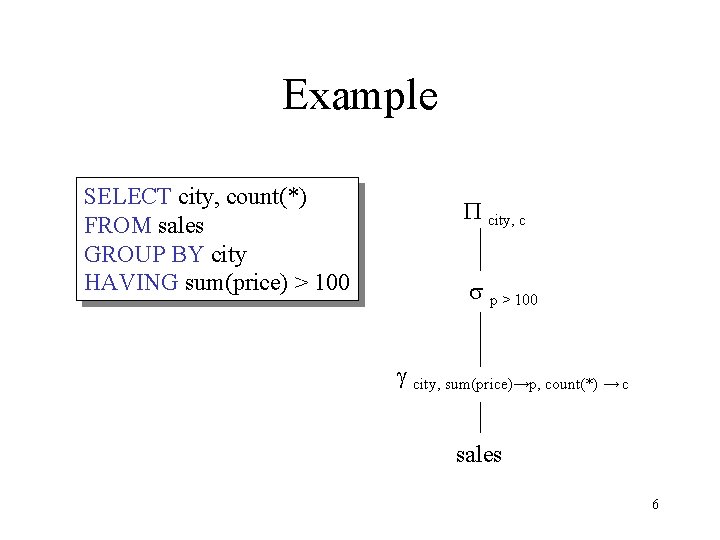
Example SELECT city, count(*) FROM sales GROUP BY city HAVING sum(price) > 100 P city, c p > 100 g city, sum(price)→p, count(*) → c sales 6
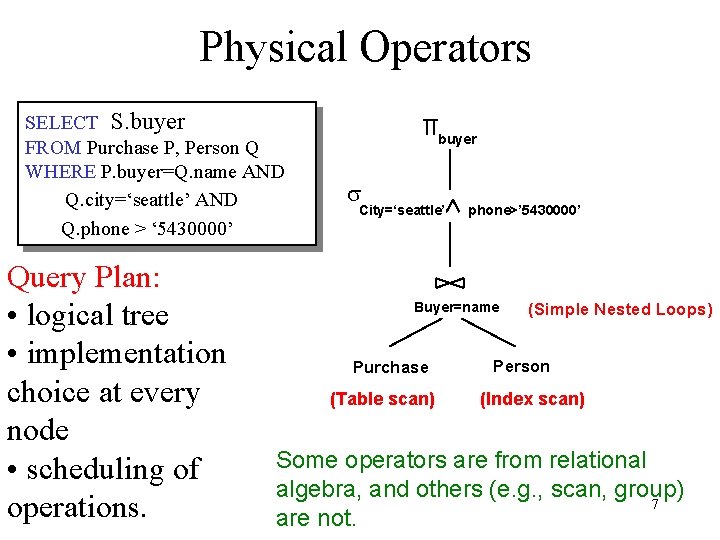
Physical Operators SELECT S. buyer FROM Purchase P, Person Q WHERE P. buyer=Q. name AND Q. city=‘seattle’ AND Q. phone > ‘ 5430000’ Query Plan: • logical tree • implementation choice at every node • scheduling of operations. buyer City=‘seattle’ phone>’ 5430000’ Buyer=name Purchase (Table scan) (Simple Nested Loops) Person (Index scan) Some operators are from relational algebra, and others (e. g. , scan, group) 7 are not.
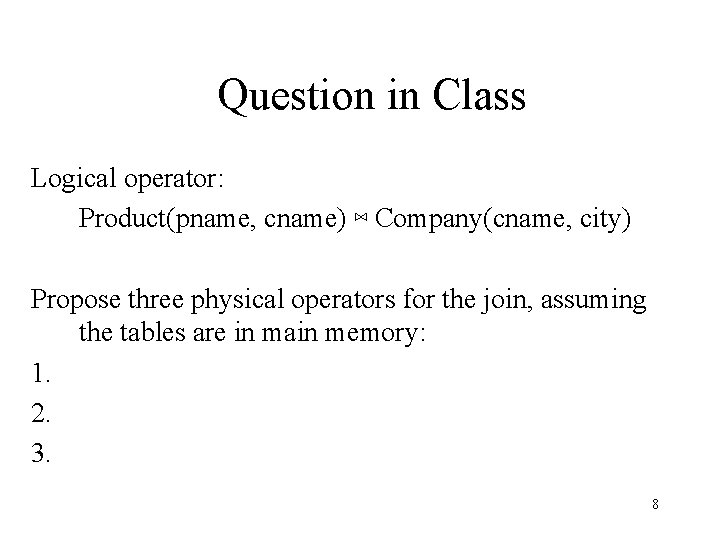
Question in Class Logical operator: Product(pname, cname) ⋈ Company(cname, city) Propose three physical operators for the join, assuming the tables are in main memory: 1. 2. 3. 8
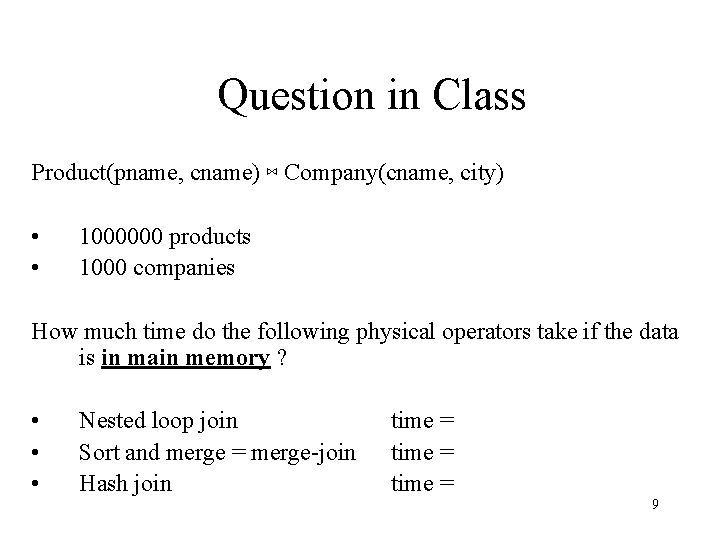
Question in Class Product(pname, cname) ⋈ Company(cname, city) • • 1000000 products 1000 companies How much time do the following physical operators take if the data is in main memory ? • • • Nested loop join Sort and merge = merge-join Hash join time = 9
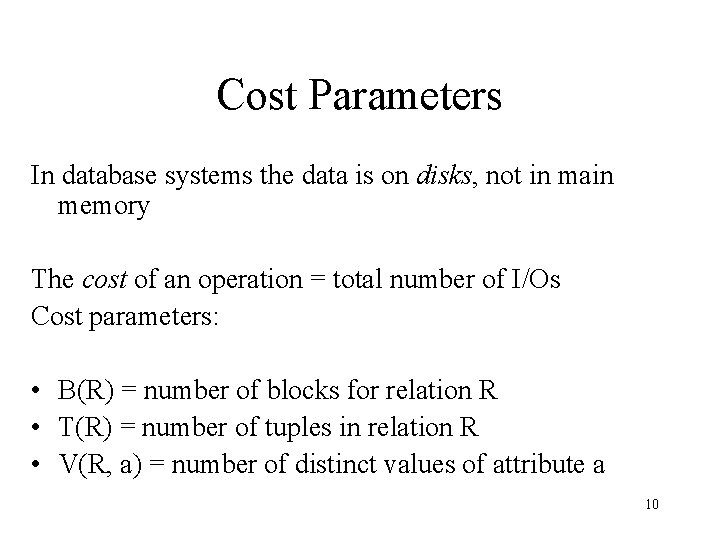
Cost Parameters In database systems the data is on disks, not in main memory The cost of an operation = total number of I/Os Cost parameters: • B(R) = number of blocks for relation R • T(R) = number of tuples in relation R • V(R, a) = number of distinct values of attribute a 10
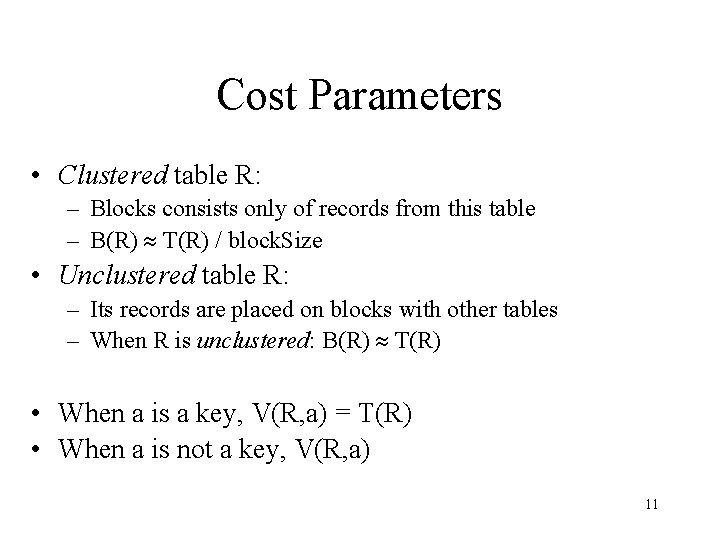
Cost Parameters • Clustered table R: – Blocks consists only of records from this table – B(R) T(R) / block. Size • Unclustered table R: – Its records are placed on blocks with other tables – When R is unclustered: B(R) T(R) • When a is a key, V(R, a) = T(R) • When a is not a key, V(R, a) 11
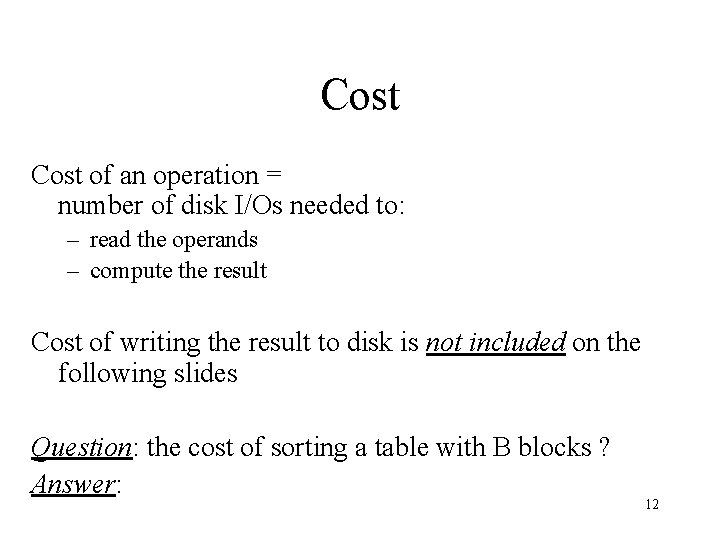
Cost of an operation = number of disk I/Os needed to: – read the operands – compute the result Cost of writing the result to disk is not included on the following slides Question: the cost of sorting a table with B blocks ? Answer: 12
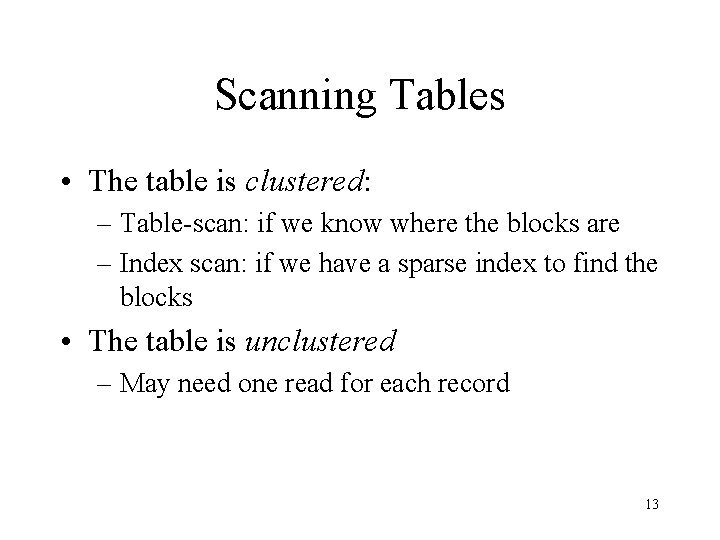
Scanning Tables • The table is clustered: – Table-scan: if we know where the blocks are – Index scan: if we have a sparse index to find the blocks • The table is unclustered – May need one read for each record 13
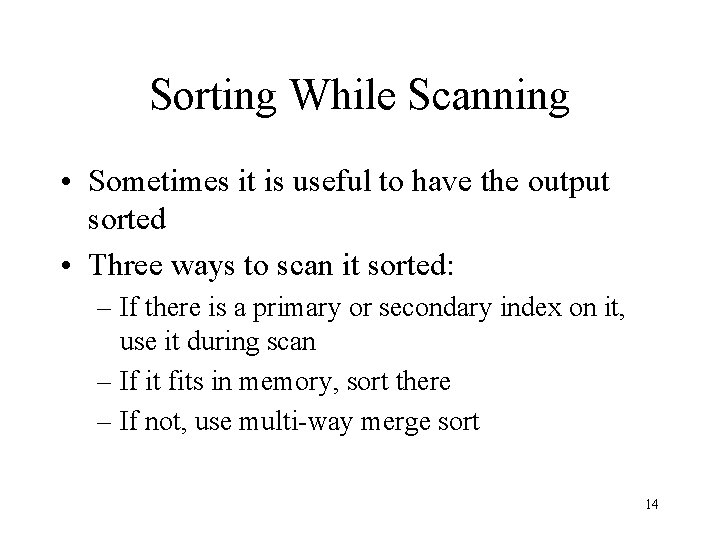
Sorting While Scanning • Sometimes it is useful to have the output sorted • Three ways to scan it sorted: – If there is a primary or secondary index on it, use it during scan – If it fits in memory, sort there – If not, use multi-way merge sort 14
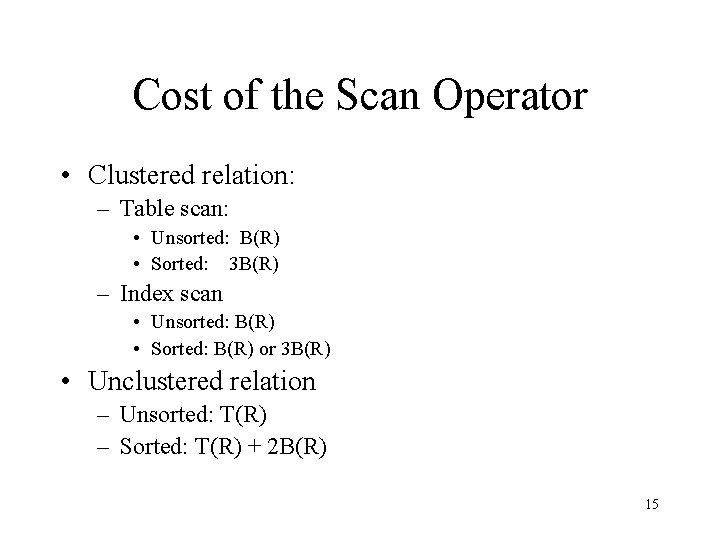
Cost of the Scan Operator • Clustered relation: – Table scan: • Unsorted: B(R) • Sorted: 3 B(R) – Index scan • Unsorted: B(R) • Sorted: B(R) or 3 B(R) • Unclustered relation – Unsorted: T(R) – Sorted: T(R) + 2 B(R) 15
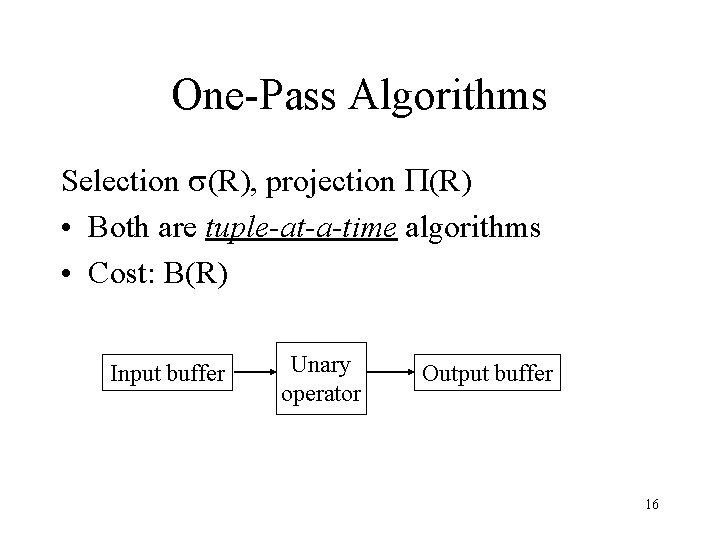
One-Pass Algorithms Selection (R), projection P(R) • Both are tuple-at-a-time algorithms • Cost: B(R) Input buffer Unary operator Output buffer 16
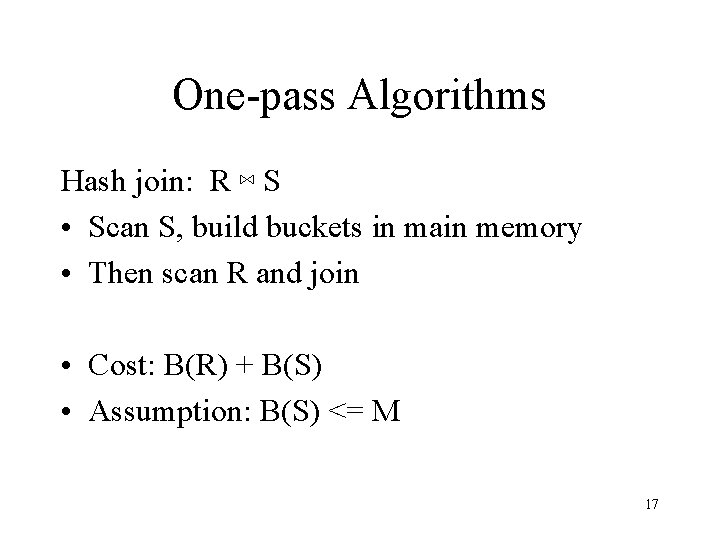
One-pass Algorithms Hash join: R ⋈ S • Scan S, build buckets in main memory • Then scan R and join • Cost: B(R) + B(S) • Assumption: B(S) <= M 17
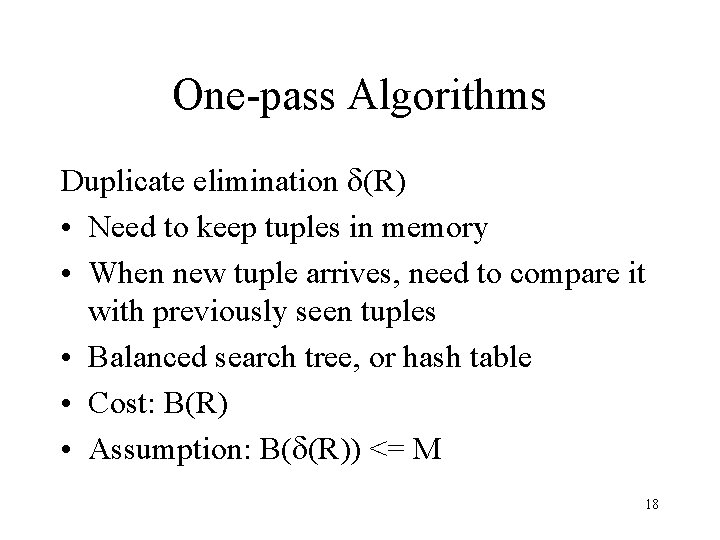
One-pass Algorithms Duplicate elimination d(R) • Need to keep tuples in memory • When new tuple arrives, need to compare it with previously seen tuples • Balanced search tree, or hash table • Cost: B(R) • Assumption: B(d(R)) <= M 18
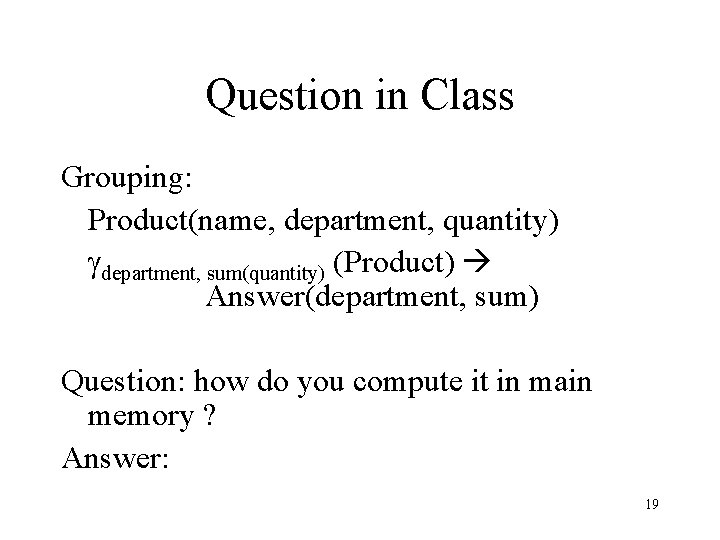
Question in Class Grouping: Product(name, department, quantity) gdepartment, sum(quantity) (Product) Answer(department, sum) Question: how do you compute it in main memory ? Answer: 19
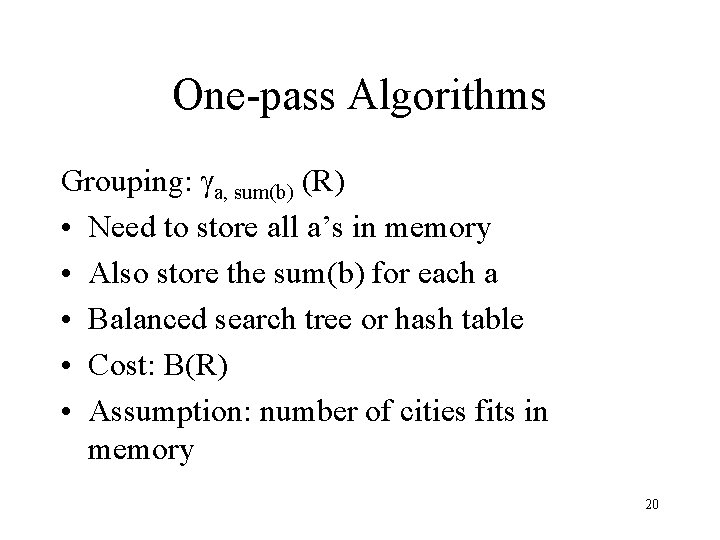
One-pass Algorithms Grouping: ga, sum(b) (R) • Need to store all a’s in memory • Also store the sum(b) for each a • Balanced search tree or hash table • Cost: B(R) • Assumption: number of cities fits in memory 20
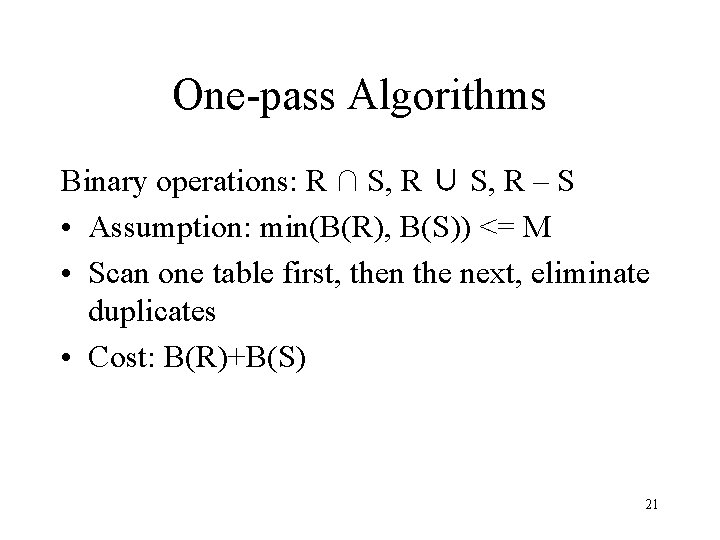
One-pass Algorithms Binary operations: R ∩ S, R ∪ S, R – S • Assumption: min(B(R), B(S)) <= M • Scan one table first, then the next, eliminate duplicates • Cost: B(R)+B(S) 21
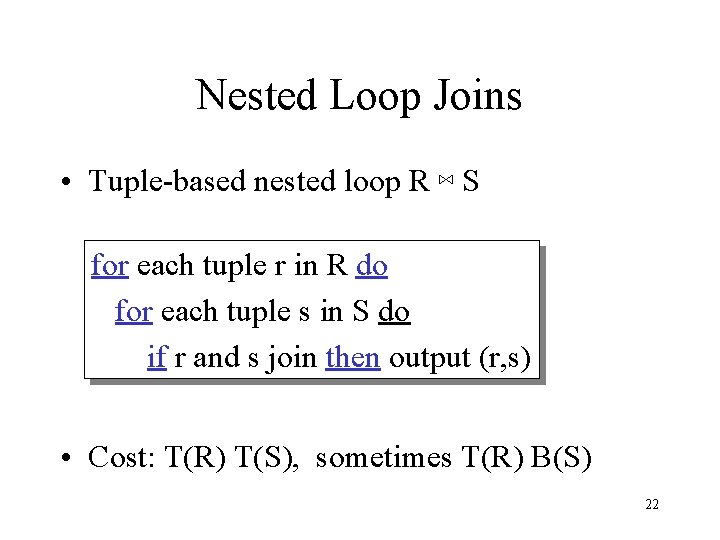
Nested Loop Joins • Tuple-based nested loop R ⋈ S for each tuple r in R do for each tuple s in S do if r and s join then output (r, s) • Cost: T(R) T(S), sometimes T(R) B(S) 22
Nested Loop Joins • We can be much more clever • Question: how would you compute the join in the following cases ? What is the cost ? – B(R) = 1000, B(S) = 2, M = 4 – B(R) = 1000, B(S) = 4, M = 4 – B(R) = 1000, B(S) = 6, M = 4 23
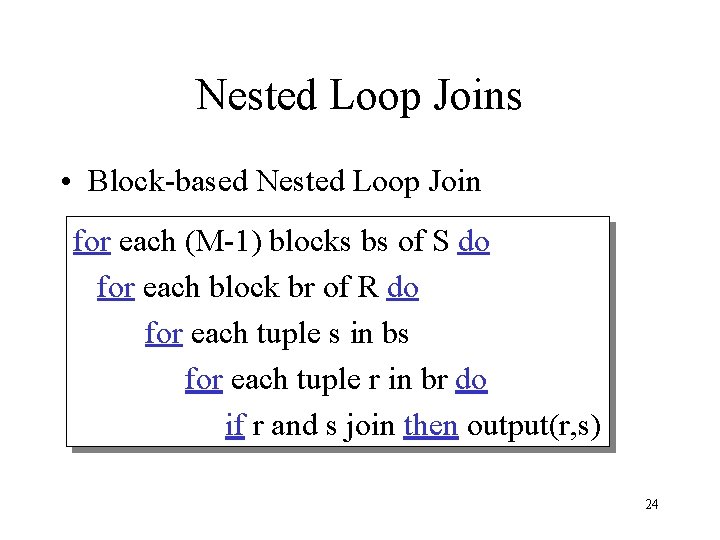
Nested Loop Joins • Block-based Nested Loop Join for each (M-1) blocks bs of S do for each block br of R do for each tuple s in bs for each tuple r in br do if r and s join then output(r, s) 24
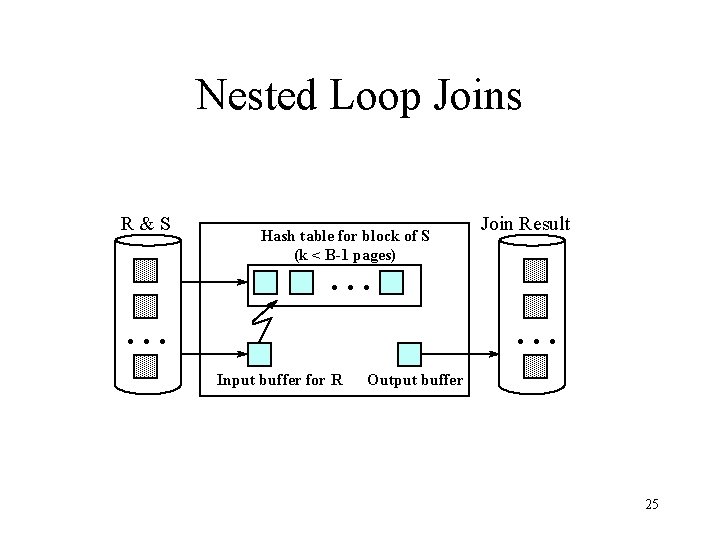
Nested Loop Joins R&S Hash table for block of S (k < B-1 pages) Join Result . . Input buffer for R Output buffer 25
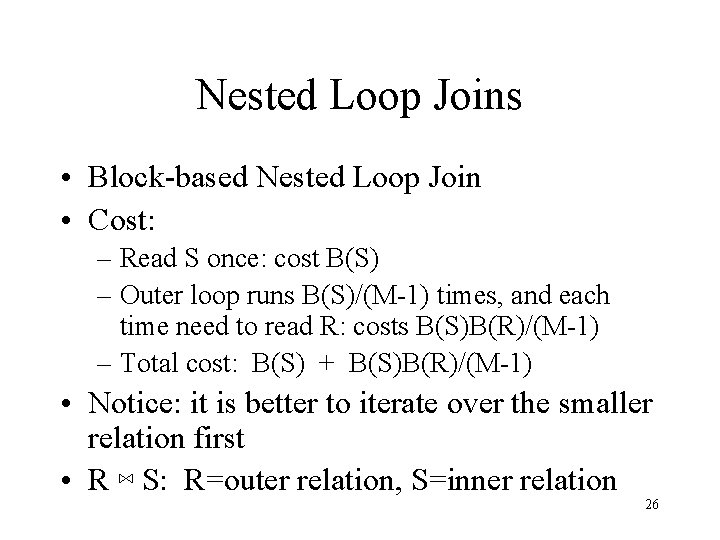
Nested Loop Joins • Block-based Nested Loop Join • Cost: – Read S once: cost B(S) – Outer loop runs B(S)/(M-1) times, and each time need to read R: costs B(S)B(R)/(M-1) – Total cost: B(S) + B(S)B(R)/(M-1) • Notice: it is better to iterate over the smaller relation first • R ⋈ S: R=outer relation, S=inner relation 26
Two-Pass Algorithms Based on Sorting • Recall: multi-way merge sort needs only two passes ! • Assumption: B(R) <= M 2 • Cost for sorting: 3 B(R) 27
Two-Pass Algorithms Based on Sorting Duplicate elimination d(R) • Trivial idea: sort first, then eliminate duplicates • Step 1: sort chunks of size M, write – cost 2 B(R) • Step 2: merge M-1 runs, but include each tuple only once – cost B(R) • Total cost: 3 B(R), Assumption: B(R) <= M 2 28
Two-Pass Algorithms Based on Sorting Grouping: ga, sum(b) (R) • Same as before: sort, then compute the sum(b) for each group of a’s • Total cost: 3 B(R) • Assumption: B(R) <= M 2 29
Two-Pass Algorithms Based on Sorting Binary operations: R ∪ S, R ∩ S, R – S • Idea: sort R, sort S, then do the right thing • A closer look: – Step 1: split R into runs of size M, then split S into runs of size M. Cost: 2 B(R) + 2 B(S) – Step 2: merge M/2 runs from R; merge M/2 runs from S; ouput a tuple on a case by cases basis • Total cost: 3 B(R)+3 B(S) • Assumption: B(R)+B(S)<= M 2 30
Two-Pass Algorithms Based on Sorting Join R ⋈ S • Start by sorting both R and S on the join attribute: – Cost: 4 B(R)+4 B(S) (because need to write to disk) • Read both relations in sorted order, match tuples – Cost: B(R)+B(S) • Difficulty: many tuples in R may match many in S – If at least one set of tuples fits in M, we are OK – Otherwise need nested loop, higher cost • Total cost: 5 B(R)+5 B(S) • Assumption: B(R) <= M 2, B(S) <= M 2 31
Two-Pass Algorithms Based on Sorting Join R ⋈ S • If the number of tuples in R matching those in S is small (or vice versa) we can compute the join during the merge phase • Total cost: 3 B(R)+3 B(S) • Assumption: B(R) + B(S) <= M 2 32
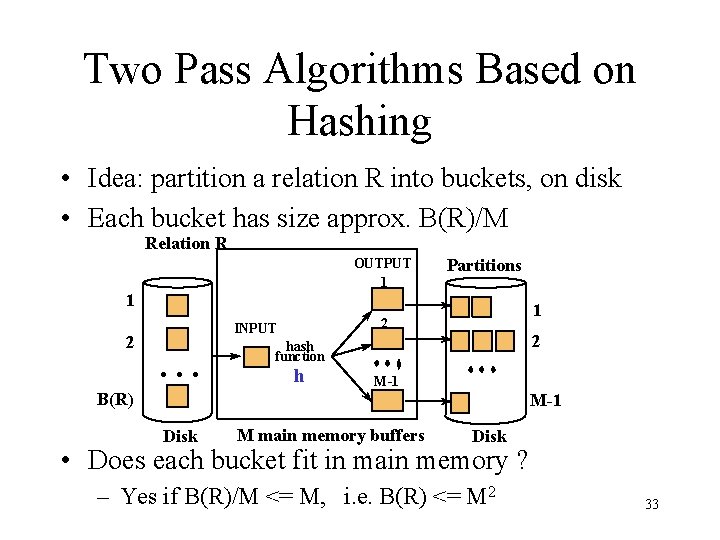
Two Pass Algorithms Based on Hashing • Idea: partition a relation R into buckets, on disk • Each bucket has size approx. B(R)/M Relation R OUTPUT 1 1 2 B(R) 1 2 INPUT . . . Partitions 2 hash function h M-1 Disk M main memory buffers Disk • Does each bucket fit in main memory ? – Yes if B(R)/M <= M, i. e. B(R) <= M 2 33
Hash Based Algorithms for d • Recall: d(R) = duplicate elimination • Step 1. Partition R into buckets • Step 2. Apply d to each bucket (may read in main memory) • Cost: 3 B(R) • Assumption: B(R) <= M 2 34
Hash Based Algorithms for g • Recall: g(R) = grouping and aggregation • Step 1. Partition R into buckets • Step 2. Apply g to each bucket (may read in main memory) • Cost: 3 B(R) • Assumption: B(R) <= M 2 35
- Slides: 35