
Lecture 20 Production Activity Control Revision Books Introduction
Lecture 20 Production Activity Control (Revision) Books • Introduction to Materials Management, Sixth Edition, J. R. Tony Arnold, P. E. , CFPIM, CIRM, Fleming College, Emeritus, Stephen N. Chapman, Ph. D. , CFPIM, North Carolina State University, Lloyd M. Clive, P. E. , CFPIM, Fleming College • Operations Management for Competitive Advantage, 11 th Edition, by Chase, Jacobs, and Aquilano, 2005, N. Y. : Mc. Graw Hill/Irwin. • Operations Management, 11/E, Jay Heizer, Texas Lutheran University, Barry Render, Graduate School of Business, Rollins College, Prentice Hall
Objectives • • • • Production activity control Gantt chart Critical ratio scheduling Finite loading Scheduling Assignment method Sequencing Slack Johnson's Rule Monitoring Advance planning and scheduling Scheduling procedure Employee Scheduling

Production Activity Control • PAC in the MPC System – Shop Floor Control – Vendor Scheduling • Production Activity Control Techniques – – Basic Data Gantt Charts Priority Scheduling Finite Loading • Process Design Impact on Scheduling – Batch Manufacturing – Work Orders – Repetitive Manufacturing – JIT 3

Production Activity Control in the MPC System 4
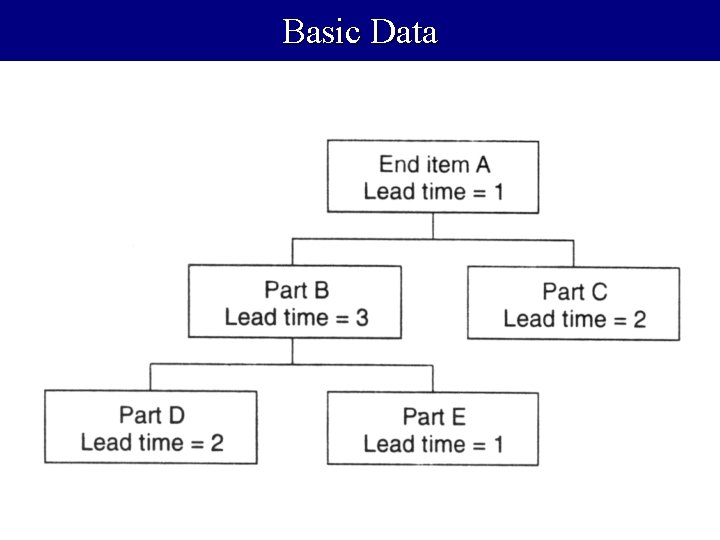
Basic Data
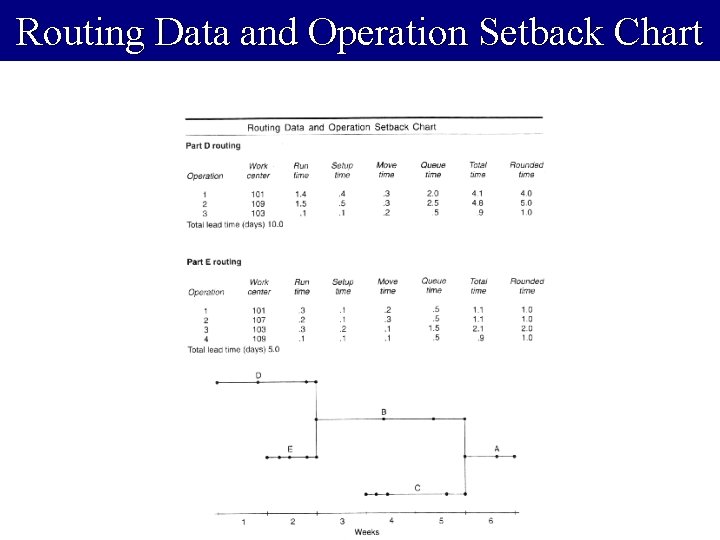
Routing Data and Operation Setback Chart 6
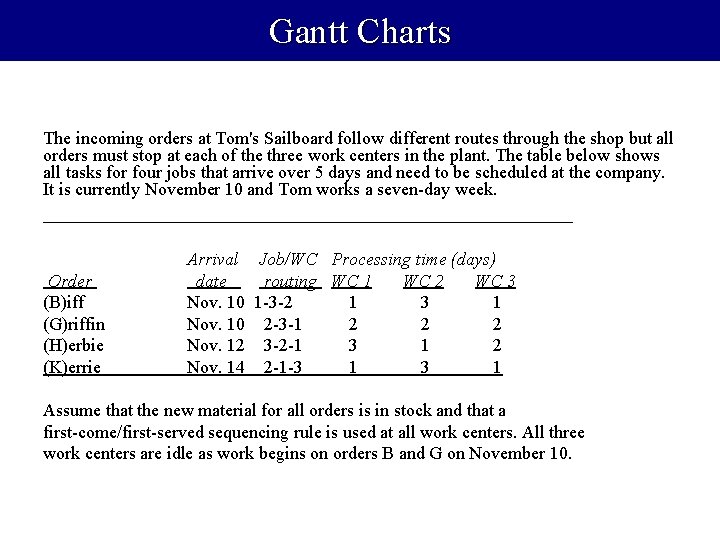
Gantt Charts The incoming orders at Tom's Sailboard follow different routes through the shop but all orders must stop at each of the three work centers in the plant. The table below shows all tasks for four jobs that arrive over 5 days and need to be scheduled at the company. It is currently November 10 and Tom works a seven day week. ___________________________ Order (B)iff (G)riffin (H)erbie (K)errie Arrival Job/WC Processing time (days) date routing WC 1 WC 2 WC 3 Nov. 10 1 3 2 1 3 1 Nov. 10 2 3 1 2 2 2 Nov. 12 3 2 1 3 1 2 Nov. 14 2 1 3 1 Assume that the new material for all orders is in stock and that a first come/first served sequencing rule is used at all work centers. All three work centers are idle as work begins on orders B and G on November 10.
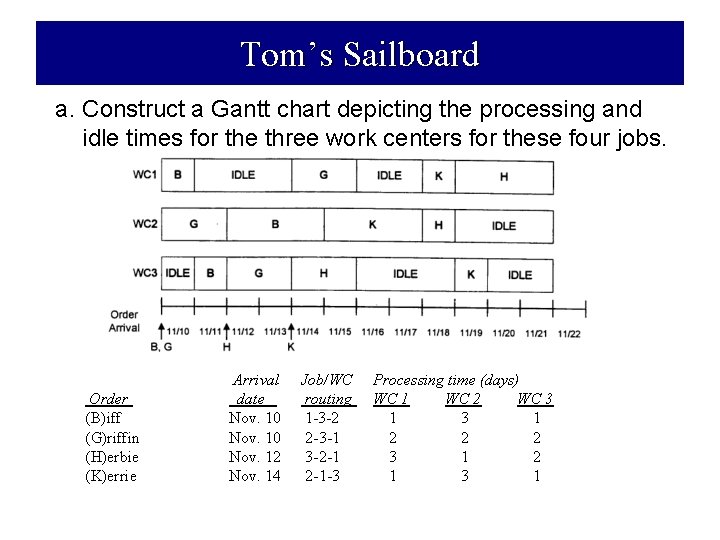
Tom’s Sailboard a. Construct a Gantt chart depicting the processing and idle times for the three work centers for these four jobs. Order (B)iff (G)riffin (H)erbie (K)errie Arrival date Nov. 10 Nov. 12 Nov. 14 Job/WC routing 1 3 2 2 3 1 3 2 1 3 Processing time (days) WC 1 WC 2 WC 3 1 2 2 2 3 1 2 1 3 1
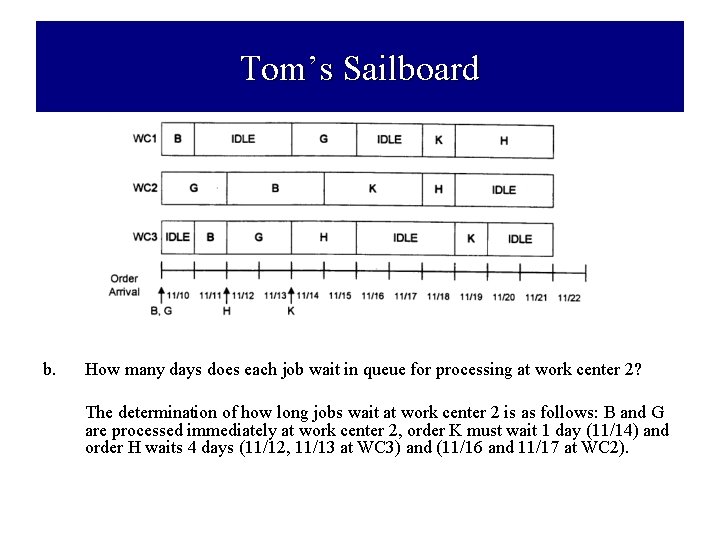
Tom’s Sailboard b. How many days does each job wait in queue for processing at work center 2? The determination of how long jobs wait at work center 2 is as follows: B and G are processed immediately at work center 2, order K must wait 1 day (11/14) and order H waits 4 days (11/12, 11/13 at WC 3) and (11/16 and 11/17 at WC 2).
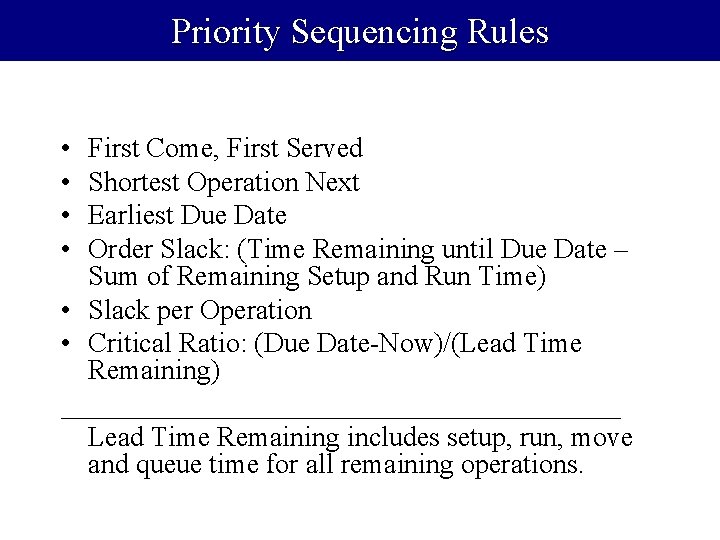
Priority Sequencing Rules • • First Come, First Served Shortest Operation Next Earliest Due Date Order Slack: (Time Remaining until Due Date – Sum of Remaining Setup and Run Time) • Slack per Operation • Critical Ratio: (Due Date Now)/(Lead Time Remaining) ____________________ Lead Time Remaining includes setup, run, move and queue time for all remaining operations.
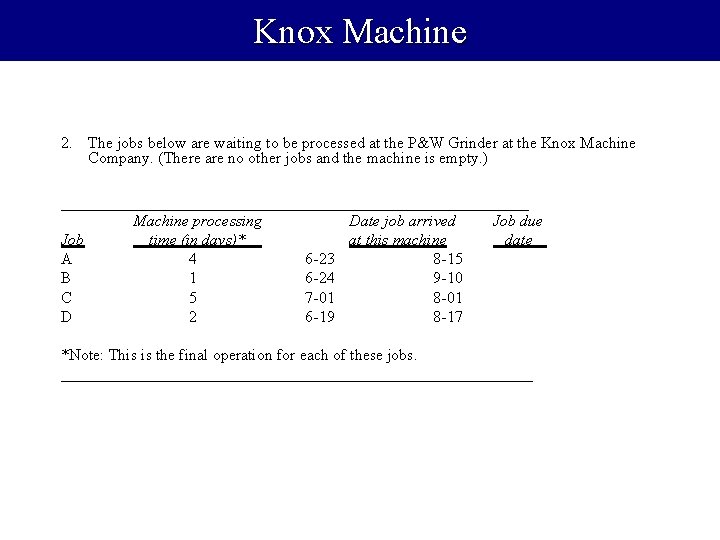
Knox Machine 2. The jobs below are waiting to be processed at the P&W Grinder at the Knox Machine Company. (There are no other jobs and the machine is empty. ) _____________ Job A B C D Machine processing time (in days)*__ 4 1 5 2 6 23 6 24 7 01 6 19 Date job arrived at this machine 8 15 9 10 8 01 8 17 Job due date__ *Note: This is the final operation for each of these jobs. ______________________________
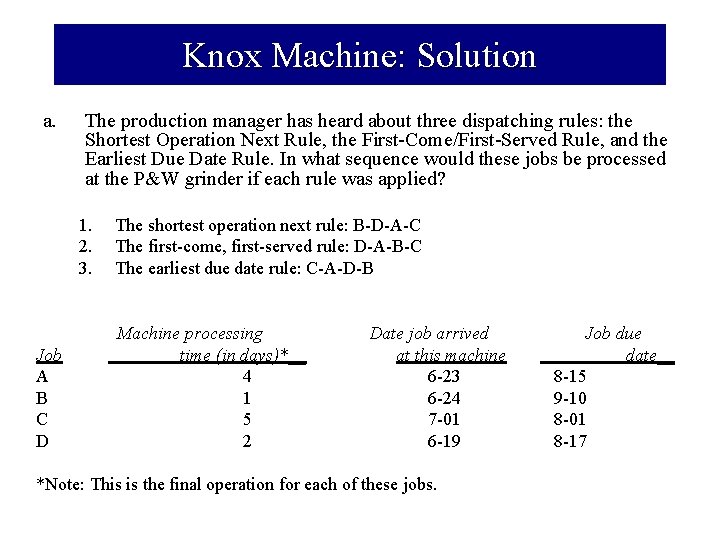
Knox Machine: Solution a. The production manager has heard about three dispatching rules: the Shortest Operation Next Rule, the First Come/First Served Rule, and the Earliest Due Date Rule. In what sequence would these jobs be processed at the P&W grinder if each rule was applied? 1. 2. 3. Job A B C D The shortest operation next rule: B D A C The first come, first served rule: D A B C The earliest due date rule: C A D B Machine processing time (in days)*__ 4 1 5 2 Date job arrived at this machine 6 23 6 24 7 01 6 19 *Note: This is the final operation for each of these jobs. Job due date__ 8 15 9 10 8 01 8 17
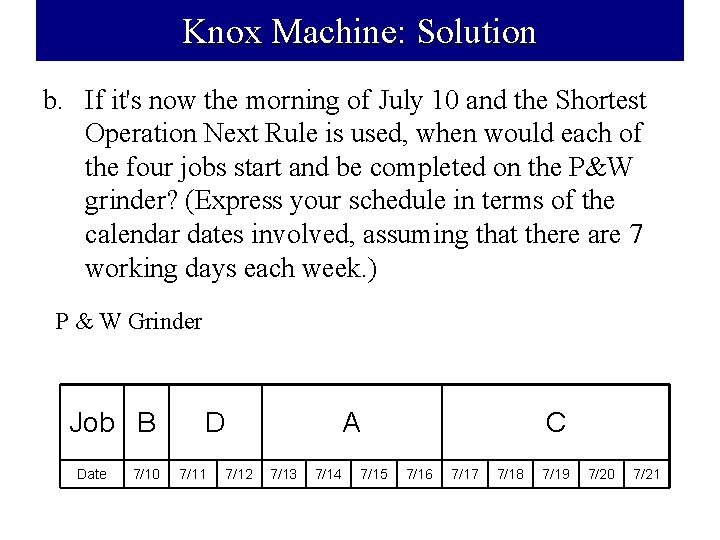
Knox Machine: Solution b. If it's now the morning of July 10 and the Shortest Operation Next Rule is used, when would each of the four jobs start and be completed on the P&W grinder? (Express your schedule in terms of the calendar dates involved, assuming that there are 7 working days each week. ) P & W Grinder Job B Date 7/10 D 7/11 A 7/12 7/13 7/14 7/15 C 7/16 7/17 7/18 7/19 7/20 7/21
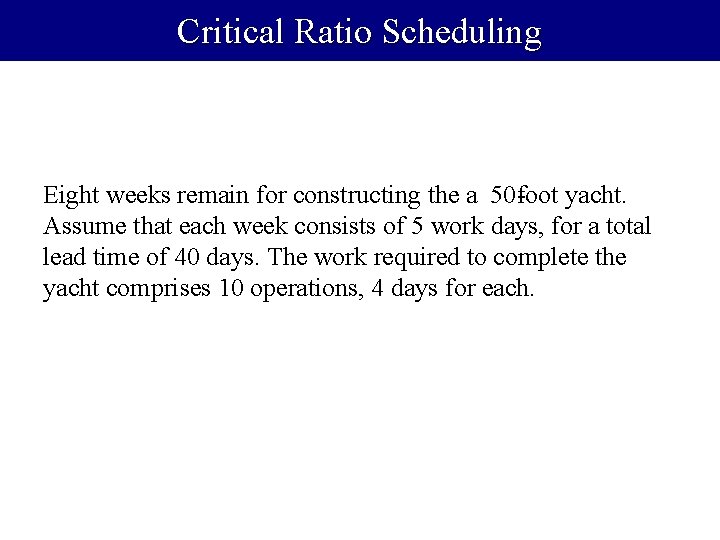
Critical Ratio Scheduling Eight weeks remain for constructing the a 50 foot yacht. Assume that each week consists of 5 work days, for a total lead time of 40 days. The work required to complete the yacht comprises 10 operations, 4 days for each.
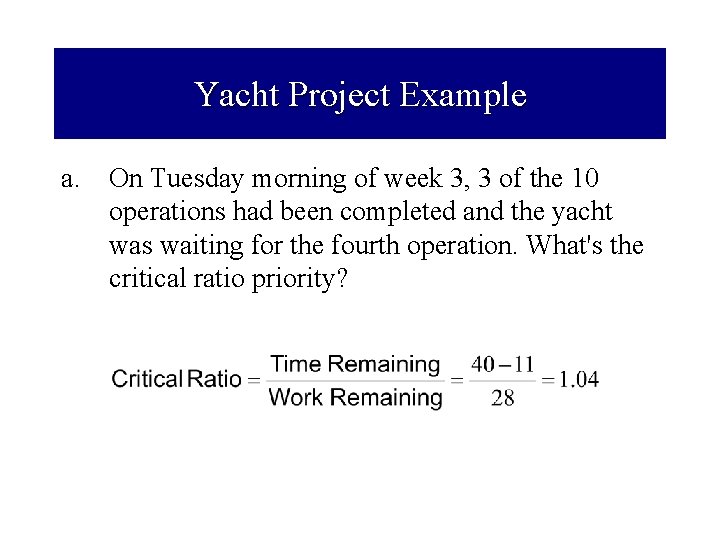
Yacht Project Example a. On Tuesday morning of week 3, 3 of the 10 operations had been completed and the yacht was waiting for the fourth operation. What's the critical ratio priority?
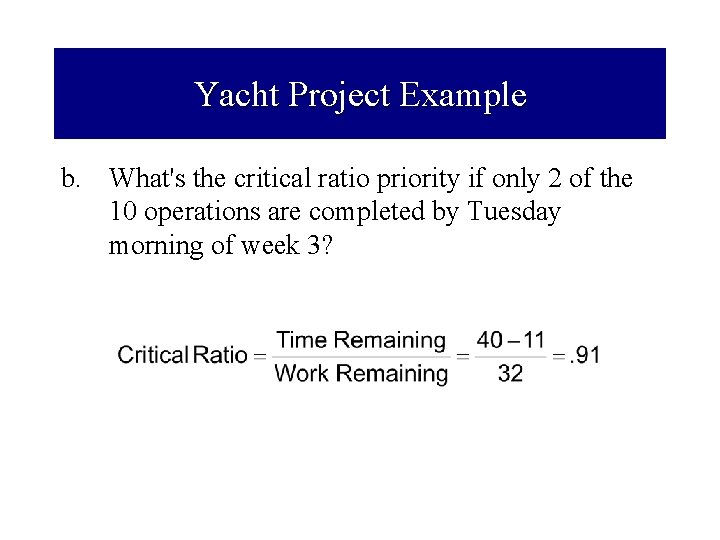
Yacht Project Example b. What's the critical ratio priority if only 2 of the 10 operations are completed by Tuesday morning of week 3?
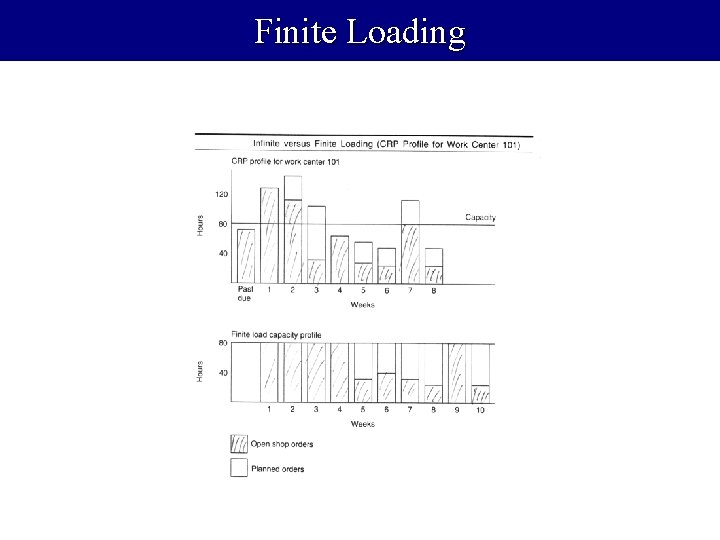
Finite Loading

The Bundy Company produces for three products (A, K, and P). Each order goes through the same three machine centers, but not necessarily in the same sequence. Each order must be finished at a machine center before another can be started. Orders cannot be split. The shop works a single eight hour shift five days per week. Assume that the time to move between machines is negligible. each machine center is operated eight hours per day. All three machines are currently available for scheduling, and no further orders will arrive.

The Bundy Company Machine center Order routing 1 A 3 1 2 K 2 3 1 P 3 2 1 Processing time at machine center ___(in days)____ Order 2 3 due date 1 3 2 14 3 12 2 3 4 10 Note: Order due dates are fixed based on the shop calendar. It is now 8: 00 A. M. Monday (day 1), Monday of next week is day 6, etc.
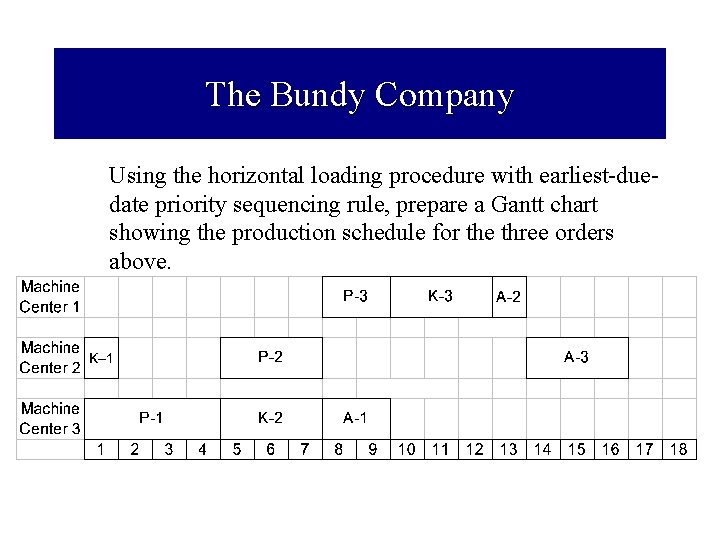
The Bundy Company Using the horizontal loading procedure with earliest due date priority sequencing rule, prepare a Gantt chart showing the production schedule for the three orders above.
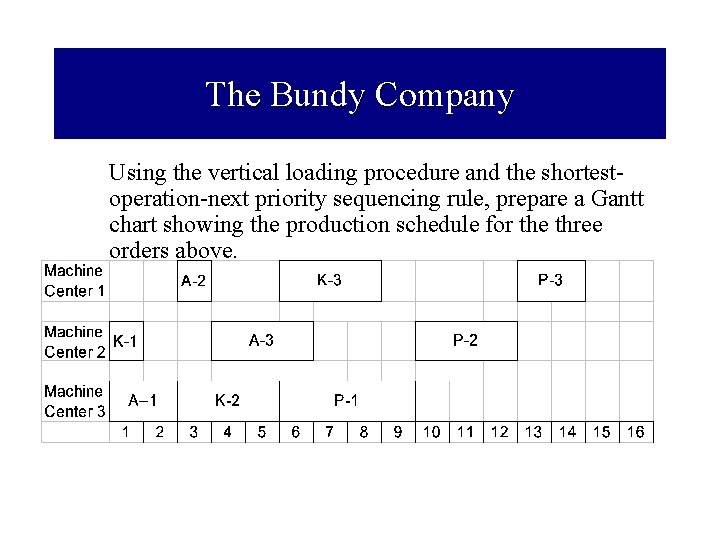
The Bundy Company Using the vertical loading procedure and the shortest operation next priority sequencing rule, prepare a Gantt chart showing the production schedule for the three orders above.

Scheduling

What is Scheduling? • Last stage of planning before production occurs • Specifies when labor, equipment, and facilities are needed to produce a product or provide a service

Scheduled Operations • Batch Production • Process Industry – Linear programming – Aggregate planning – EOQ with non – Master scheduling instantaneous – Material requirements replenishment planning (MRP) • Mass Production – Assembly line balancing – Capacity requirements • Project planning (CRP) – Project scheduling techniques (PERT, CPM)

Objectives in Scheduling • • • Meet customer due dates Minimize job lateness Minimize response time Minimize completion time Minimize time in the system • Minimize overtime • Maximize machine or labor utilization • Minimize idle time • Minimize work in process inventory
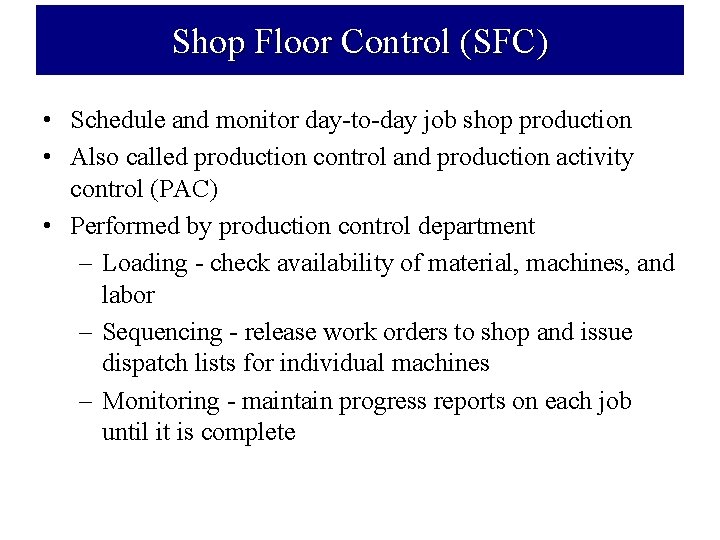
Shop Floor Control (SFC) • Schedule and monitor day to day job shop production • Also called production control and production activity control (PAC) • Performed by production control department – Loading check availability of material, machines, and labor – Sequencing release work orders to shop and issue dispatch lists for individual machines – Monitoring maintain progress reports on each job until it is complete
Loading • Process of assigning work to limited resources • Perform work with most efficient resources • Use assignment method of linear programming to determine allocation
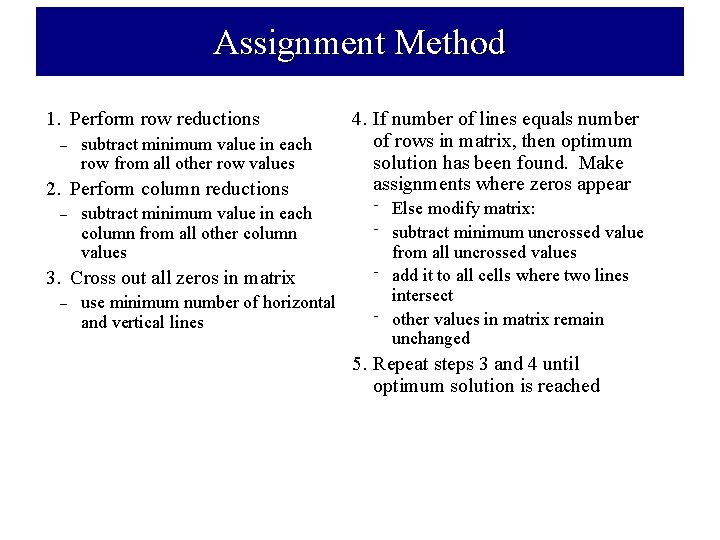
Assignment Method 1. Perform row reductions – subtract minimum value in each row from all other row values 2. Perform column reductions – subtract minimum value in each column from all other column values 3. Cross out all zeros in matrix – use minimum number of horizontal and vertical lines 4. If number of lines equals number of rows in matrix, then optimum solution has been found. Make assignments where zeros appear ‾ ‾ Else modify matrix: subtract minimum uncrossed value from all uncrossed values add it to all cells where two lines intersect other values in matrix remain unchanged 5. Repeat steps 3 and 4 until optimum solution is reached
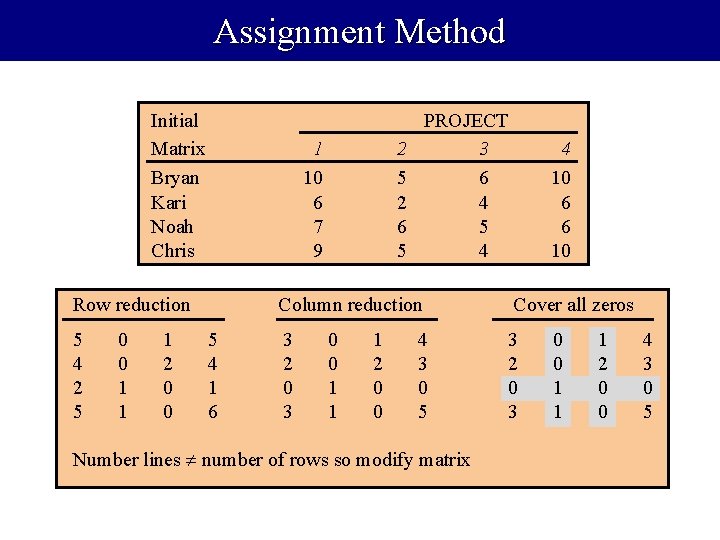
Assignment Method Initial Matrix Bryan Kari Noah Chris 1 10 6 7 9 Row reduction 5 4 2 5 0 0 1 1 1 2 0 0 5 4 1 6 PROJECT 3 6 4 5 4 2 5 2 6 5 4 10 6 6 10 Column reduction Cover all zeros 3 2 0 3 0 0 1 1 1 2 0 0 4 3 0 5 Number lines number of rows so modify matrix 0 0 1 1 1 2 0 0 4 3 0 5
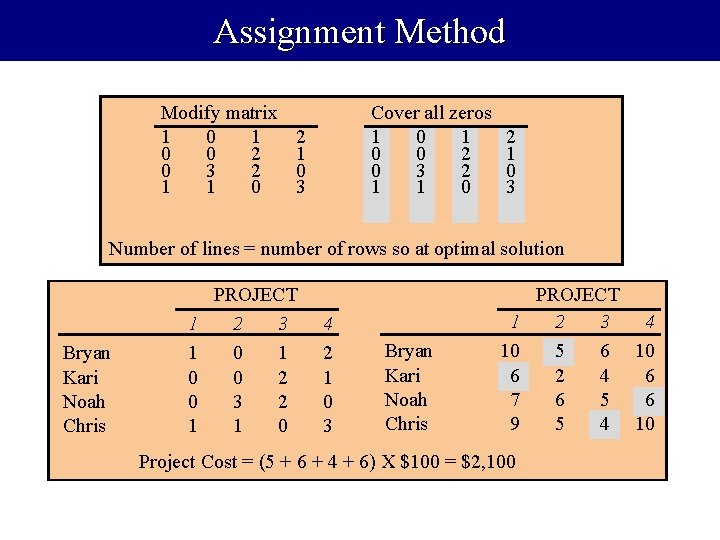
Assignment Method Modify matrix 1 0 0 2 0 3 2 1 1 0 Cover all zeros 1 0 0 2 0 3 2 1 1 0 2 1 0 3 Number of lines = number of rows so at optimal solution Bryan Kari Noah Chris 1 1 0 0 1 PROJECT 2 3 0 1 0 2 3 2 1 0 4 2 1 0 3 Bryan Kari Noah Chris 1 10 6 7 9 Project Cost = (5 + 6 + 4 + 6) X $100 = $2, 100 PROJECT 2 3 4 5 6 10 2 4 6 6 5 4 10

Assignment Method Setup Solution goes here Only 1 leader can be assigned to each project Click “Solve” for solution Sum of all rows and columns = 1
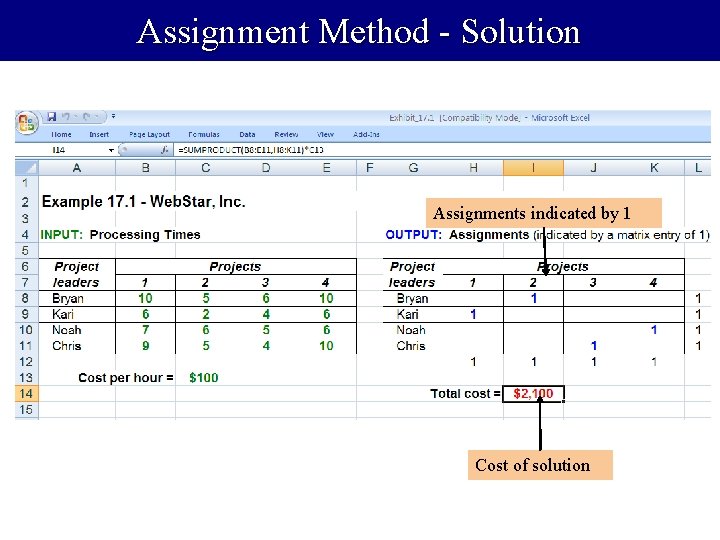
Assignment Method Solution Assignments indicated by 1 Cost of solution
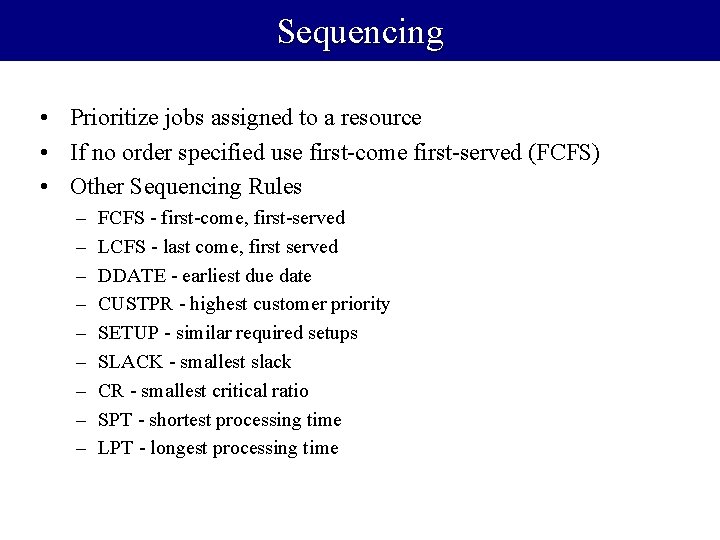
Sequencing • Prioritize jobs assigned to a resource • If no order specified use first come first served (FCFS) • Other Sequencing Rules – – – – – FCFS first come, first served LCFS last come, first served DDATE earliest due date CUSTPR highest customer priority SETUP similar required setups SLACK smallest slack CR smallest critical ratio SPT shortest processing time LPT longest processing time
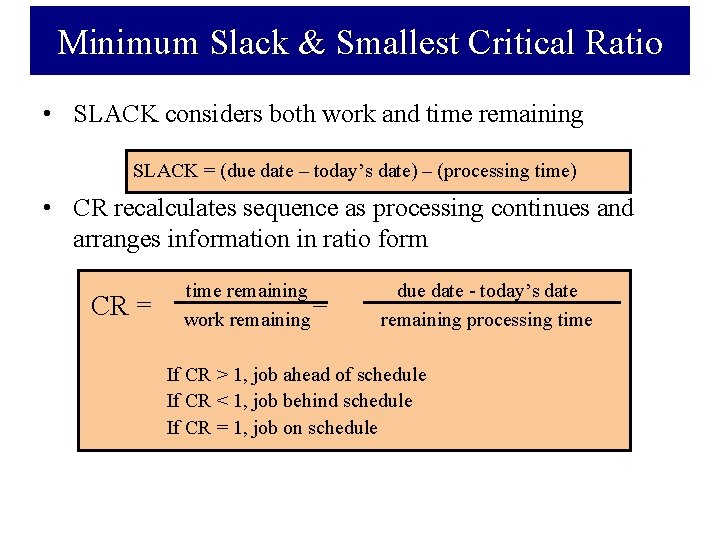
Minimum Slack & Smallest Critical Ratio • SLACK considers both work and time remaining SLACK = (due date – today’s date) – (processing time) • CR recalculates sequence as processing continues and arranges information in ratio form CR = time remaining = work remaining due date today’s date remaining processing time If CR > 1, job ahead of schedule If CR < 1, job behind schedule If CR = 1, job on schedule
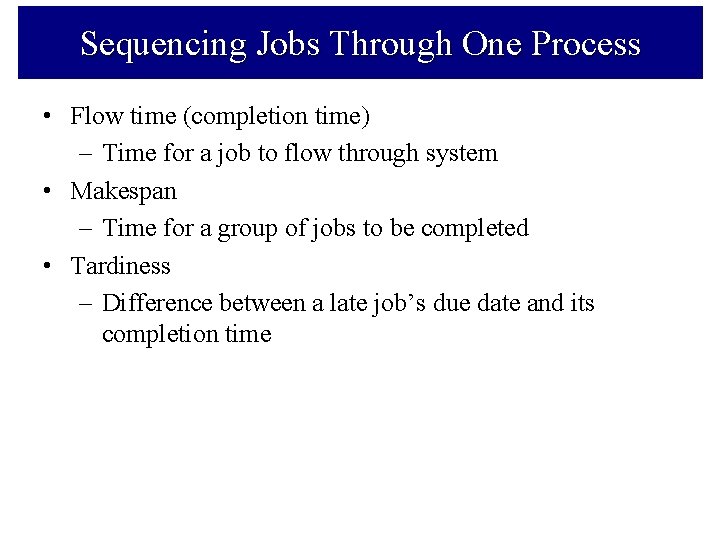
Sequencing Jobs Through One Process • Flow time (completion time) – Time for a job to flow through system • Makespan – Time for a group of jobs to be completed • Tardiness – Difference between a late job’s due date and its completion time
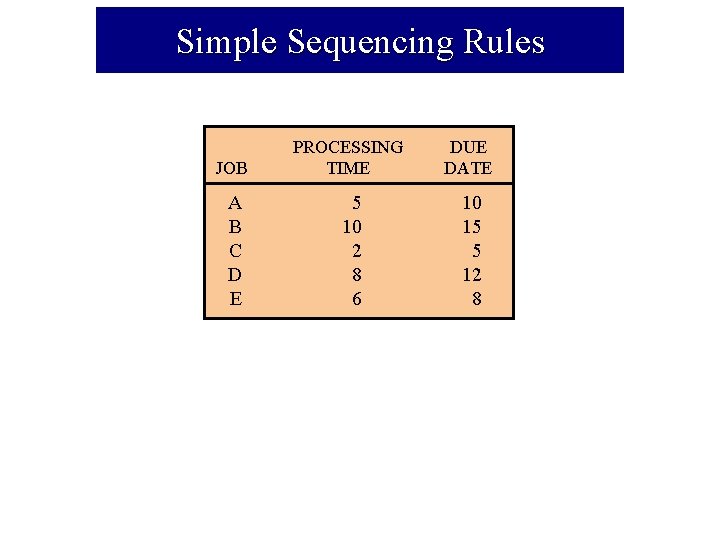
Simple Sequencing Rules JOB PROCESSING TIME DUE DATE A B C D E 5 10 2 8 6 10 15 5 12 8
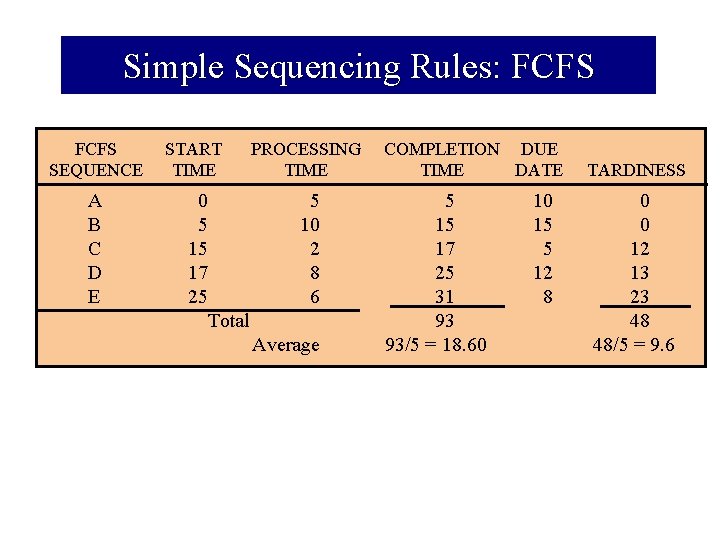
Simple Sequencing Rules: FCFS SEQUENCE START TIME PROCESSING TIME A B C D E 0 5 15 17 25 5 10 2 8 6 Total Average COMPLETION DUE TIME DATE 5 15 17 25 31 93 93/5 = 18. 60 10 15 5 12 8 TARDINESS 0 0 12 13 23 48 48/5 = 9. 6
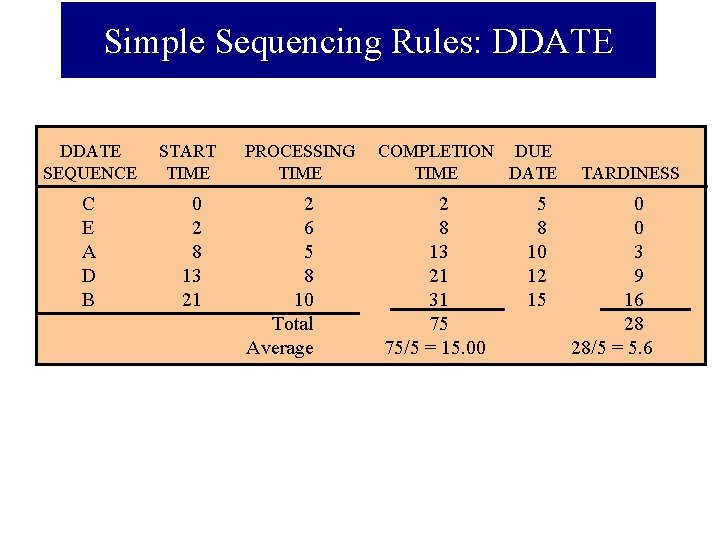
Simple Sequencing Rules: DDATE SEQUENCE START TIME C E A D B 0 2 8 13 21 PROCESSING TIME 2 6 5 8 10 Total Average COMPLETION DUE TIME DATE 2 8 13 21 31 75 75/5 = 15. 00 5 8 10 12 15 TARDINESS 0 0 3 9 16 28 28/5 = 5. 6
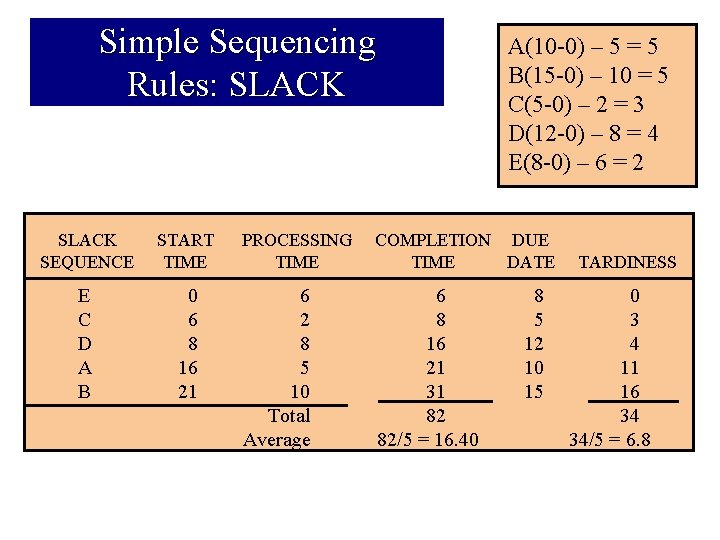
Simple Sequencing Rules: SLACK SEQUENCE START TIME E C D A B 0 6 8 16 21 A(10 0) – 5 = 5 B(15 0) – 10 = 5 C(5 0) – 2 = 3 D(12 0) – 8 = 4 E(8 0) – 6 = 2 PROCESSING TIME COMPLETION DUE TIME DATE 6 2 8 5 10 Total Average 6 8 16 21 31 82 82/5 = 16. 40 8 5 12 10 15 TARDINESS 0 3 4 11 16 34 34/5 = 6. 8
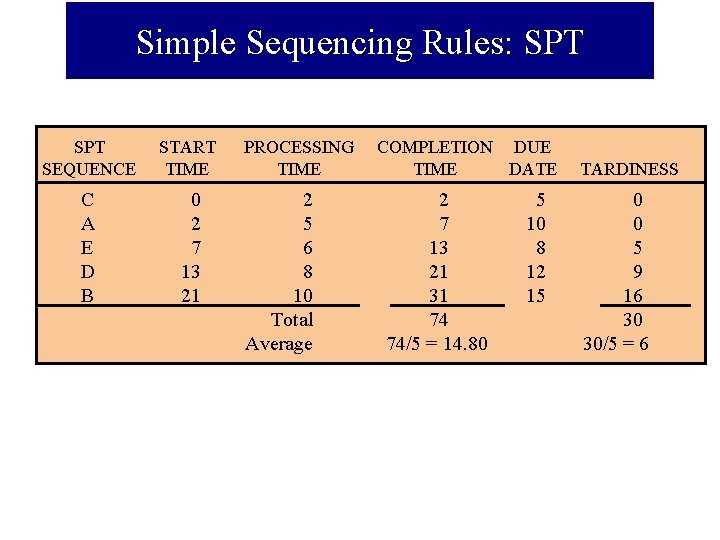
Simple Sequencing Rules: SPT SEQUENCE START TIME C A E D B 0 2 7 13 21 PROCESSING TIME 2 5 6 8 10 Total Average COMPLETION DUE TIME DATE 2 7 13 21 31 74 74/5 = 14. 80 5 10 8 12 15 TARDINESS 0 0 5 9 16 30 30/5 = 6
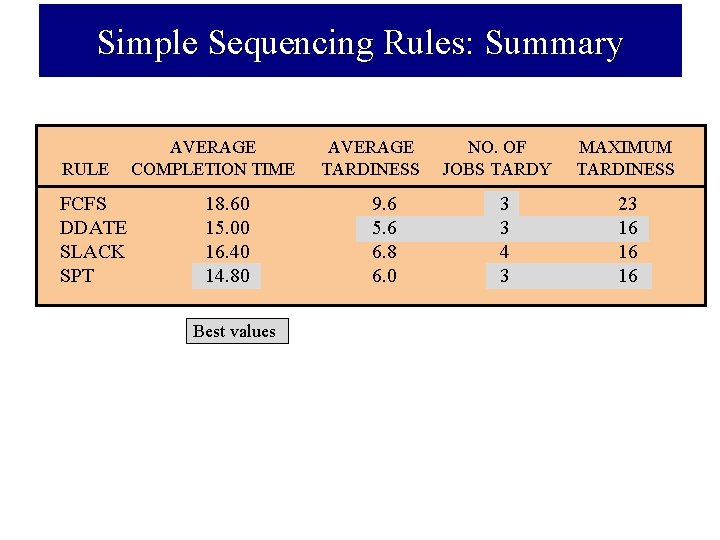
Simple Sequencing Rules: Summary RULE FCFS DDATE SLACK SPT AVERAGE COMPLETION TIME 18. 60 15. 00 16. 40 14. 80 Best values AVERAGE TARDINESS 9. 6 5. 6 6. 8 6. 0 NO. OF JOBS TARDY 3 3 4 3 MAXIMUM TARDINESS 23 16 16 16

Sequencing Jobs Through Two Serial Process Johnson’s Rule 1. 2. 3. 4. 5. List time required to process each job at each process. Set up a one dimensional matrix to represent desired sequence with # of slots equal to # of jobs. Select smallest processing time at either process. If that time is on process 1, put the job as near to beginning of sequence as possible. If smallest time occurs on process 2, put the job as near to the end of the sequence as possible. Remove job from list. Repeat steps 2 4 until all slots in matrix are filled and all jobs are sequenced.

Sequencing With Excel

Johnson’s Rule JOB PROCESS 1 PROCESS 2 A B C D E 6 11 7 9 5 8 6 3 7 10 E A D B C
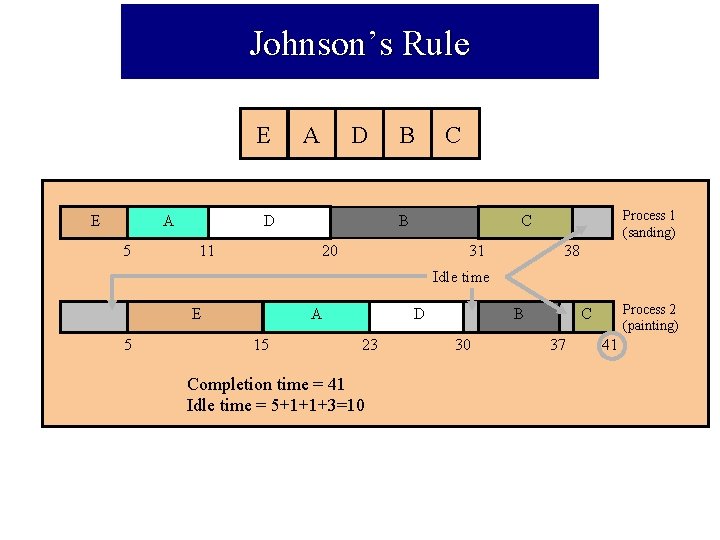
Johnson’s Rule E E A 5 A D D 11 B C B Process 1 (sanding) C 20 31 38 Idle time E 5 A 15 D 23 Completion time = 41 Idle time = 5+1+1+3=10 B 30 Process 2 (painting) C 37 41
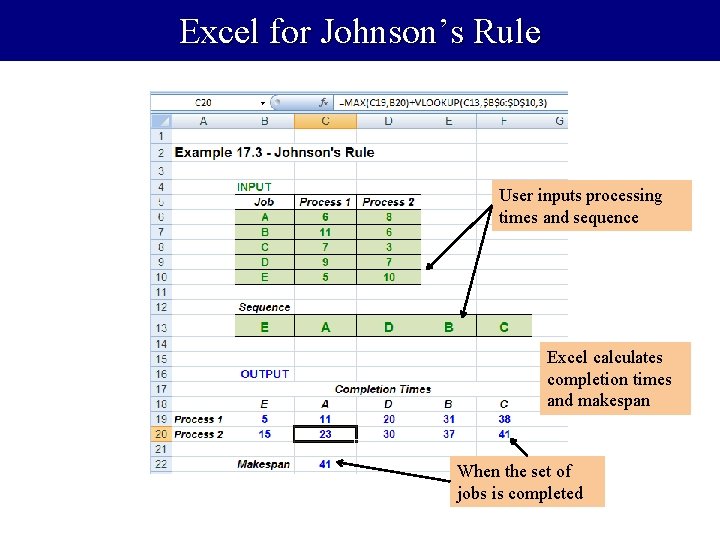
Excel for Johnson’s Rule User inputs processing times and sequence Excel calculates completion times and makespan When the set of jobs is completed
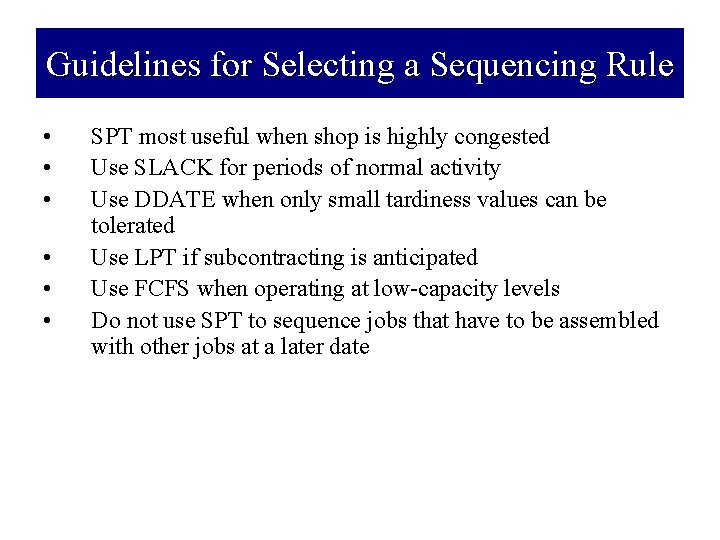
Guidelines for Selecting a Sequencing Rule • • • SPT most useful when shop is highly congested Use SLACK for periods of normal activity Use DDATE when only small tardiness values can be tolerated Use LPT if subcontracting is anticipated Use FCFS when operating at low capacity levels Do not use SPT to sequence jobs that have to be assembled with other jobs at a later date
Monitoring • Work package – Shop paperwork that travels with a job • Gantt Chart – Shows both planned and completed activities against a time scale • Input/Output Control – Monitors the input and output from each work center
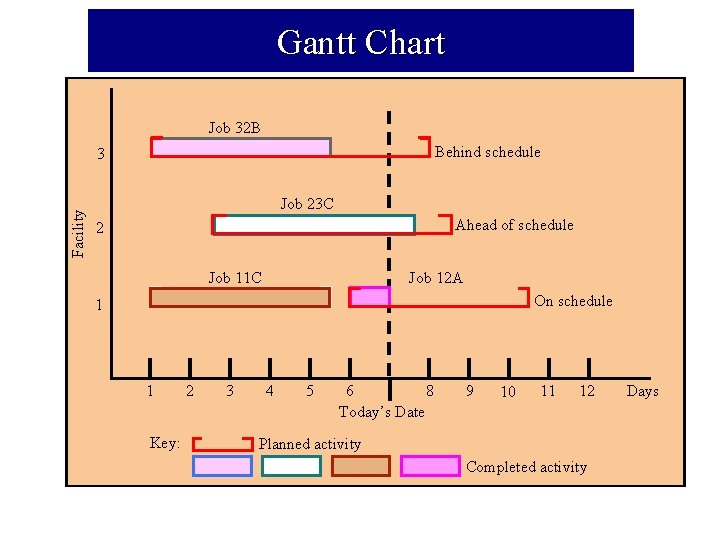
Gantt Chart Job 32 B Behind schedule Facility 3 Job 23 C Ahead of schedule 2 Job 11 C Job 12 A On schedule 1 1 Key: 2 3 4 5 6 8 Today’s Date 9 10 11 12 Planned activity Completed activity Days

Input/Output Control PERIOD Planned input Actual input Deviation Planned output Actual output Deviation Backlog 30 1 2 3 4 TOTAL 65 65 70 70 75 75 270 0 0 300 0 0 20 10 5 0

Input/Output Control PERIOD Planned input Actual input Deviation Planned output Actual output Deviation Backlog 30 1 2 3 4 65 60 5 75 75 0 15 65 60 5 75 75 0 0 70 65 5 75 65 10 0 TOTAL 270 250 20 300 280 20
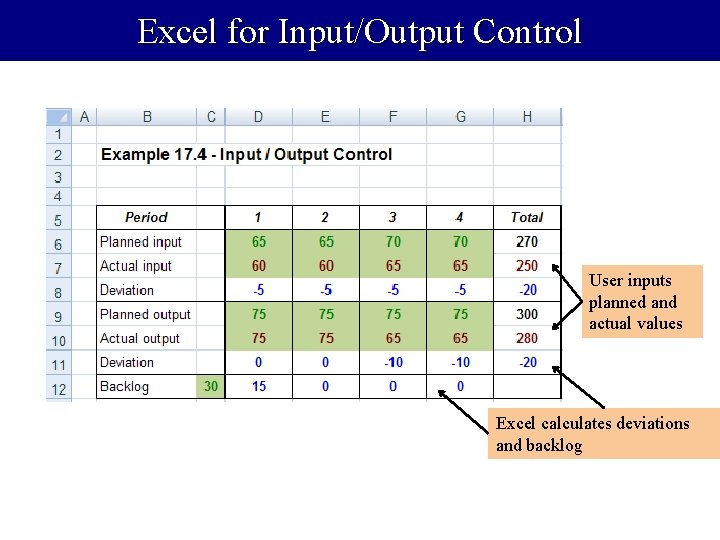
Excel for Input/Output Control User inputs planned and actual values Excel calculates deviations and backlog
Advanced Planning and Scheduling Systems • Infinite scheduling assumes infinite capacity – Loads without regard to capacity – Then levels the load and sequences jobs • Finite scheduling assumes finite (limited) capacity – Sequences jobs as part of the loading decision – Resources are never loaded beyond capacity
Advanced Planning and Scheduling Systems • Advanced planning and scheduling (APS) – Add ins to ERP systems – Constraint based programming (CBP) identifies a solution space and evaluates alternatives – Genetic algorithms based on natural selection properties of genetics – Manufacturing execution system (MES) monitors status, usage, availability, quality
Advanced Planning and Scheduling
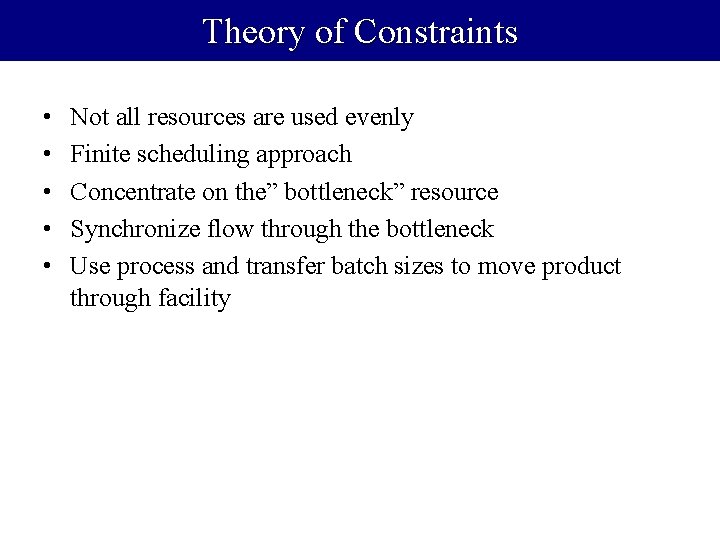
Theory of Constraints • • • Not all resources are used evenly Finite scheduling approach Concentrate on the” bottleneck” resource Synchronize flow through the bottleneck Use process and transfer batch sizes to move product through facility
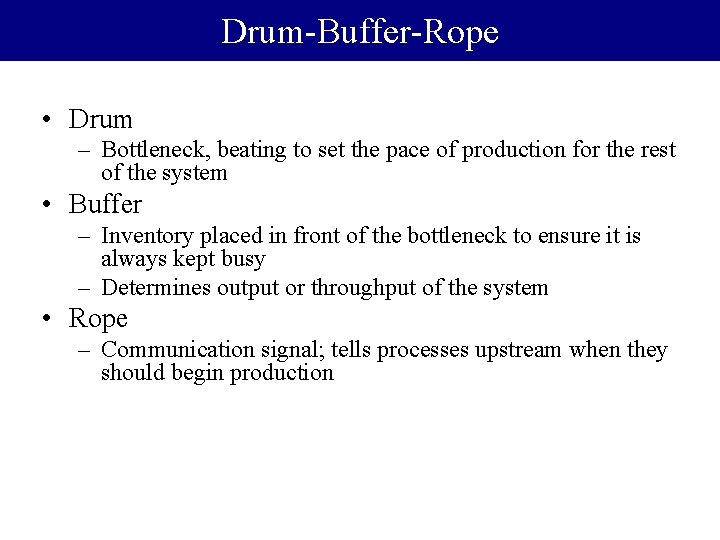
Drum Buffer Rope • Drum – Bottleneck, beating to set the pace of production for the rest of the system • Buffer – Inventory placed in front of the bottleneck to ensure it is always kept busy – Determines output or throughput of the system • Rope – Communication signal; tells processes upstream when they should begin production

Synchronous Manufacturing A B C D B 3 1 7 C 3 2 15 D 3 3 5 B 2 2 3 C 2 1 10 D 2 2 8 B 1 1 5 C 1 3 2 D 1 3 10 Key: i Ij k l Item i Operation j of item i performed at machine center k takes l minutes to process
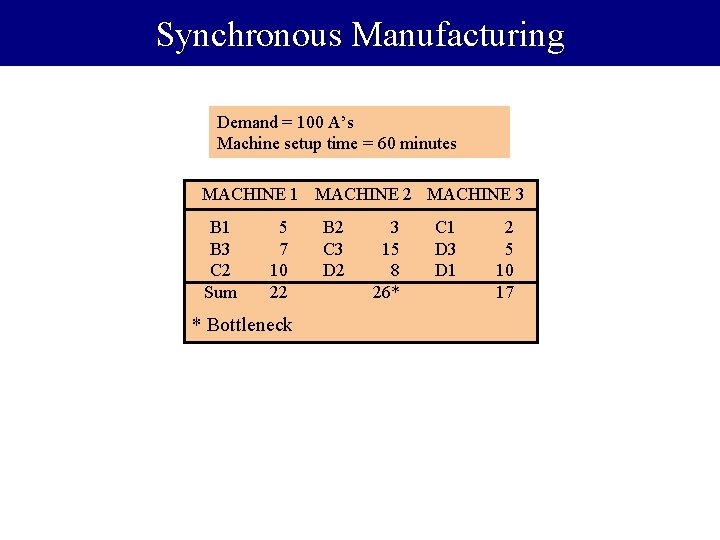
Synchronous Manufacturing Demand = 100 A’s Machine setup time = 60 minutes MACHINE 1 MACHINE 2 MACHINE 3 B 1 B 3 C 2 Sum 5 7 10 22 * Bottleneck B 2 C 3 D 2 3 15 8 26* C 1 D 3 D 1 2 5 10 17
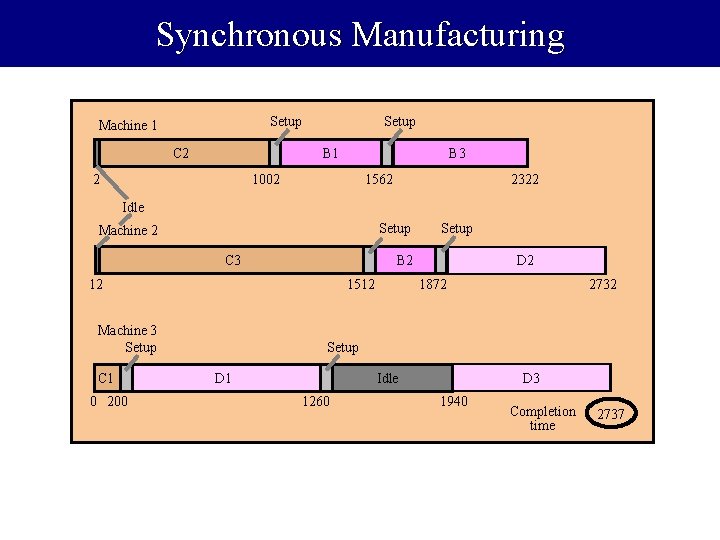
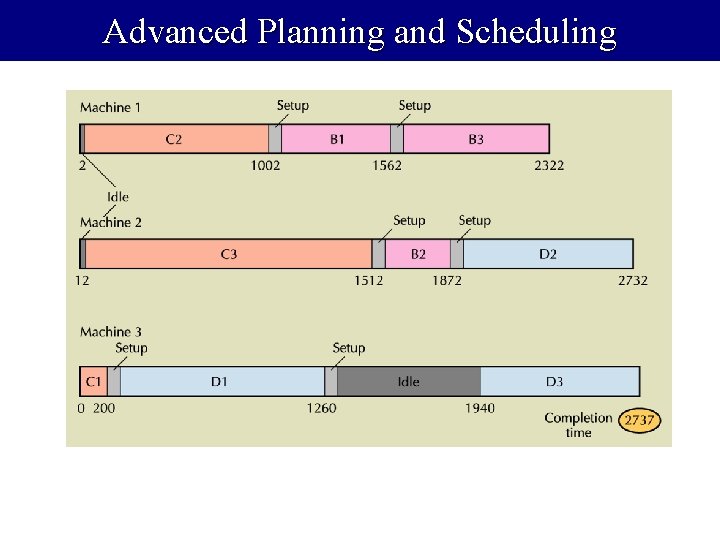
Synchronous Manufacturing Setup Machine 1 C 2 Setup B 1 2 B 3 1002 1562 2322 Idle Setup Machine 2 C 3 B 2 12 1512 Machine 3 Setup C 1 0 200 Setup D 2 1872 2732 Setup D 1 Idle 1260 D 3 1940 Completion time 2737
Employee Scheduling • • Labor is very flexible resource Scheduling workforce is complicated, repetitive task Assignment method can be used Heuristics are commonly used

Employee Scheduling Heuristic 1. 2. 3. 4. 5. Let N = no. of workers available Di = demand for workers on day i X = day working O = day off Assign the first N D 1 workers day 1 off. Assign the next N D 2 workers day 2 off. Continue in a similar manner until all days are have been scheduled If number of workdays for full time employee < 5, assign remaining workdays so consecutive days off are possible Assign any remaining work to part time employees If consecutive days off are desired, consider switching schedules among days with the same demand requirements
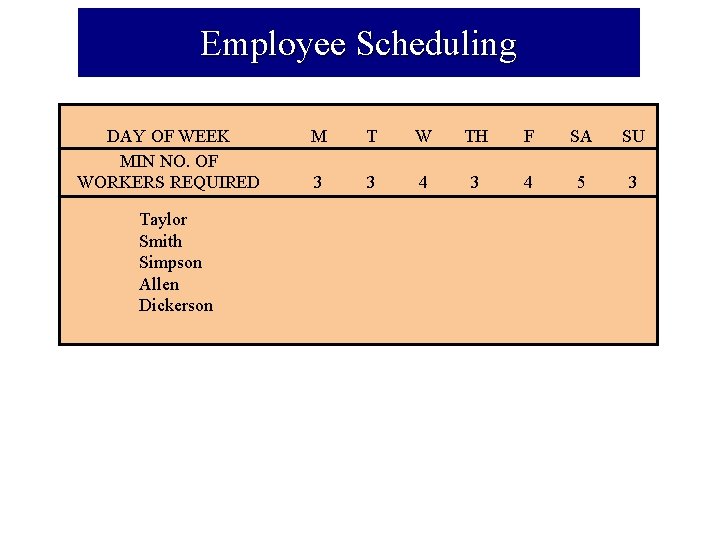
Employee Scheduling DAY OF WEEK MIN NO. OF WORKERS REQUIRED Taylor Smith Simpson Allen Dickerson M T W TH F SA SU 3 3 4 5 3
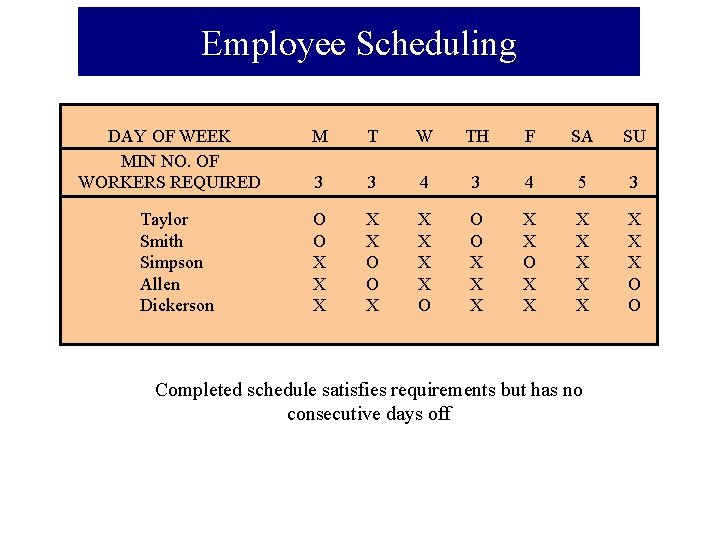
Employee Scheduling DAY OF WEEK MIN NO. OF WORKERS REQUIRED Taylor Smith Simpson Allen Dickerson M T W TH F SA SU 3 3 4 5 3 O O X X X X X O O O X X X X O O Completed schedule satisfies requirements but has no consecutive days off
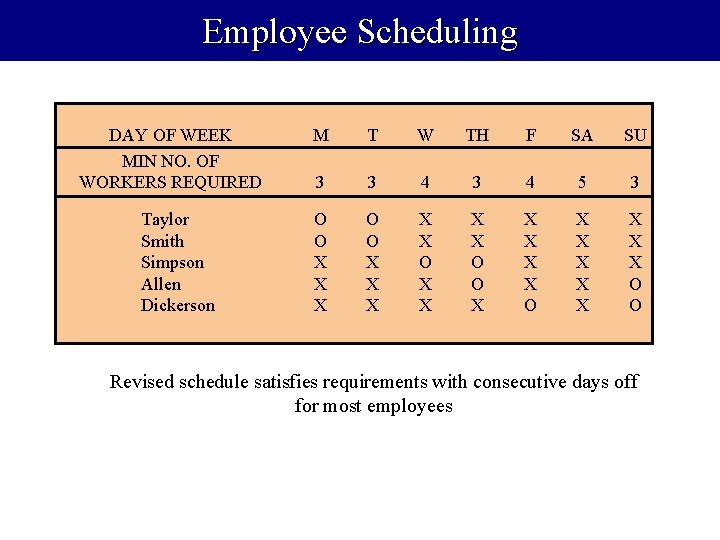
Employee Scheduling DAY OF WEEK MIN NO. OF WORKERS REQUIRED Taylor Smith Simpson Allen Dickerson M T W TH F SA SU 3 3 4 5 3 O O X X X X X O O X X X X O O Revised schedule satisfies requirements with consecutive days off for most employees

End of Lecture 20
- Slides: 66