
Lecture 20 Chemical Reaction Engineering CRE is the
- Slides: 46
Lecture 20 Chemical Reaction Engineering (CRE) is the field that studies the rates and mechanisms of chemical reactions and the design of the reactors in which they take place.
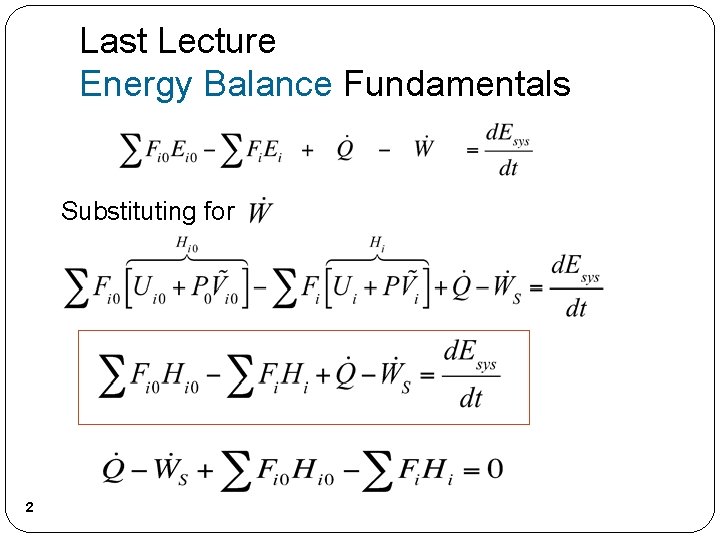
Last Lecture Energy Balance Fundamentals Substituting for 2
Web Lecture 20 Class Lecture 16 -Thursday 3/14/2013 �Reactors with Heat Exchange �User friendly Energy Balance Derivations �Adiabatic �Heat Exchange Constant Ta �Heat Exchange Variable Ta Co-current �Heat Exchange Variable Ta Counter Current 3
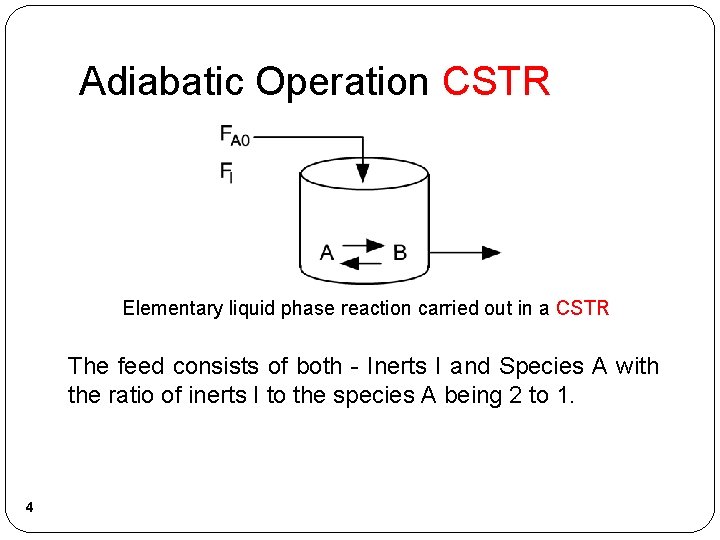
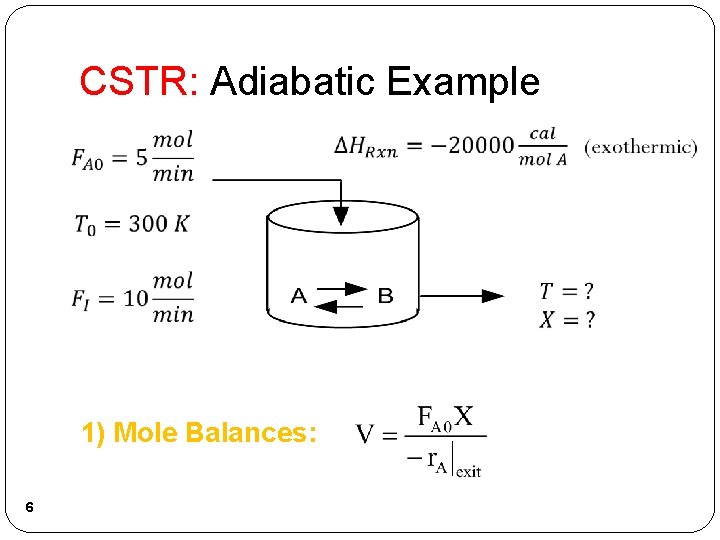
Adiabatic Operation CSTR Elementary liquid phase reaction carried out in a CSTR The feed consists of both - Inerts I and Species A with the ratio of inerts I to the species A being 2 to 1. 4
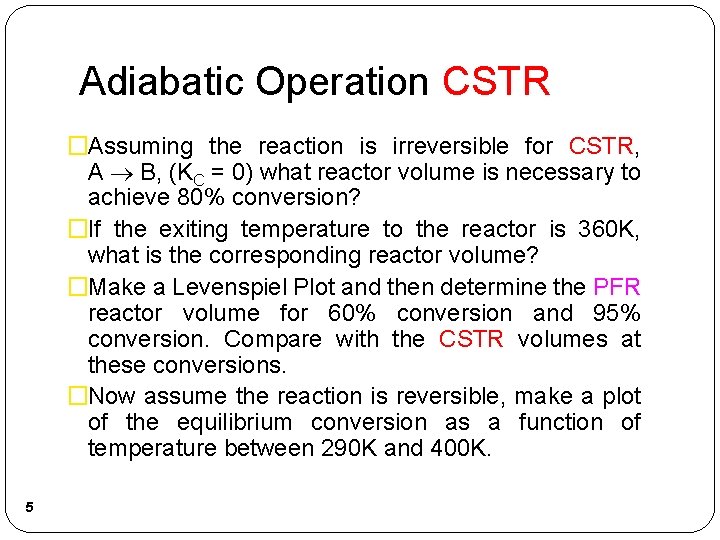
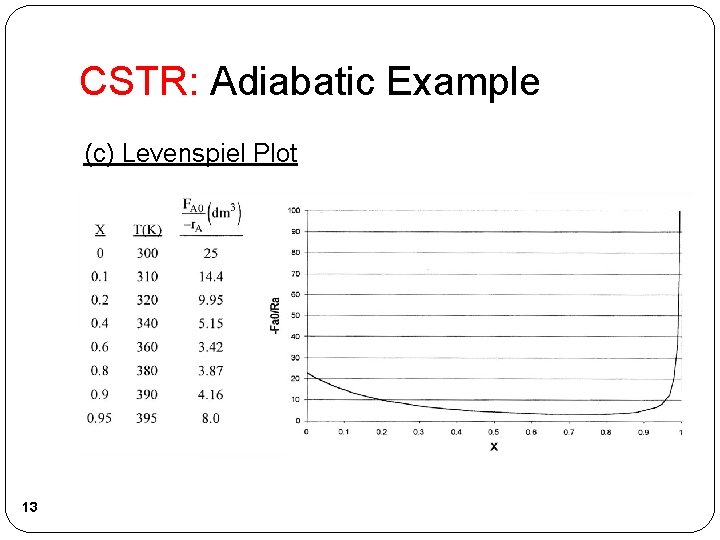
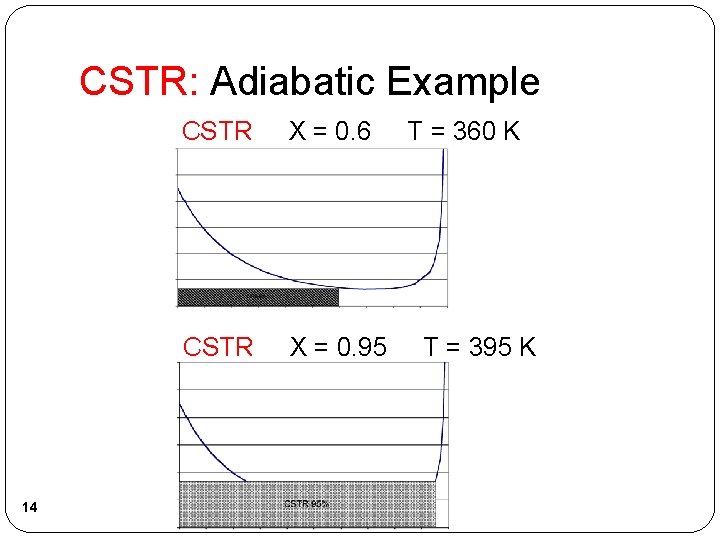
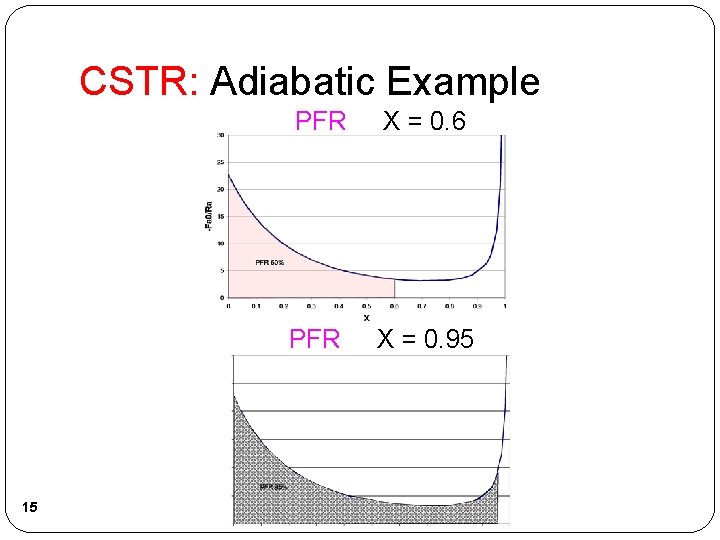
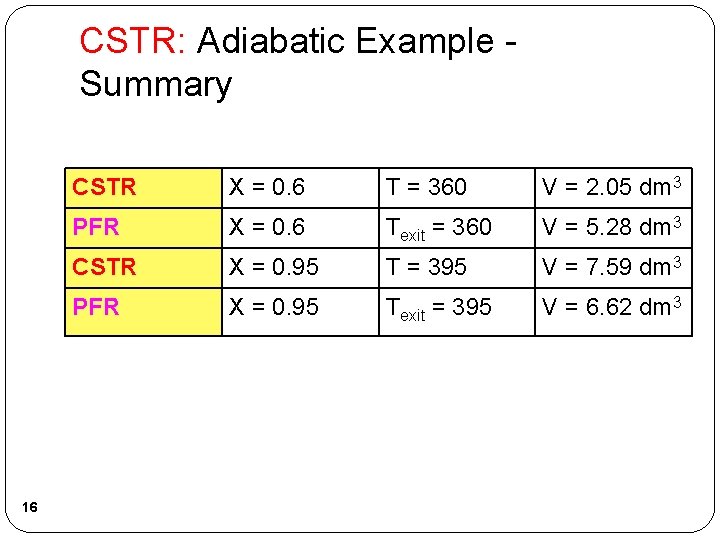
Adiabatic Operation CSTR �Assuming the reaction is irreversible for CSTR, A B, (KC = 0) what reactor volume is necessary to achieve 80% conversion? �If the exiting temperature to the reactor is 360 K, what is the corresponding reactor volume? �Make a Levenspiel Plot and then determine the PFR reactor volume for 60% conversion and 95% conversion. Compare with the CSTR volumes at these conversions. �Now assume the reaction is reversible, make a plot of the equilibrium conversion as a function of temperature between 290 K and 400 K. 5
CSTR: Adiabatic Example 1) Mole Balances: 6
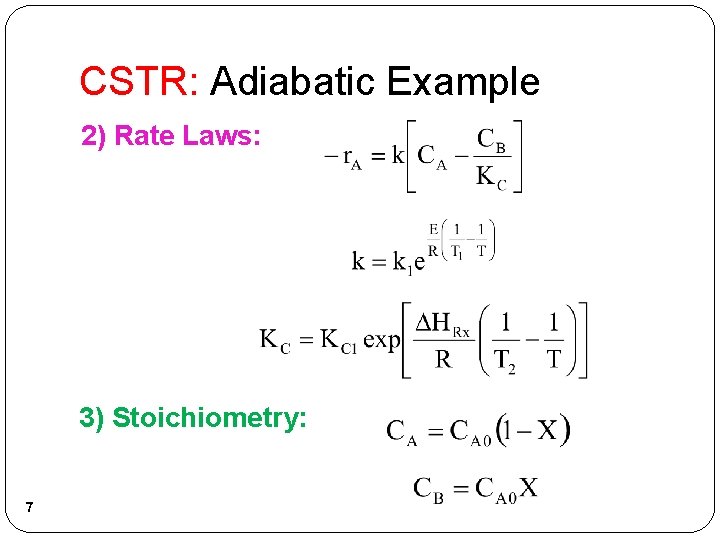
CSTR: Adiabatic Example 2) Rate Laws: 3) Stoichiometry: 7
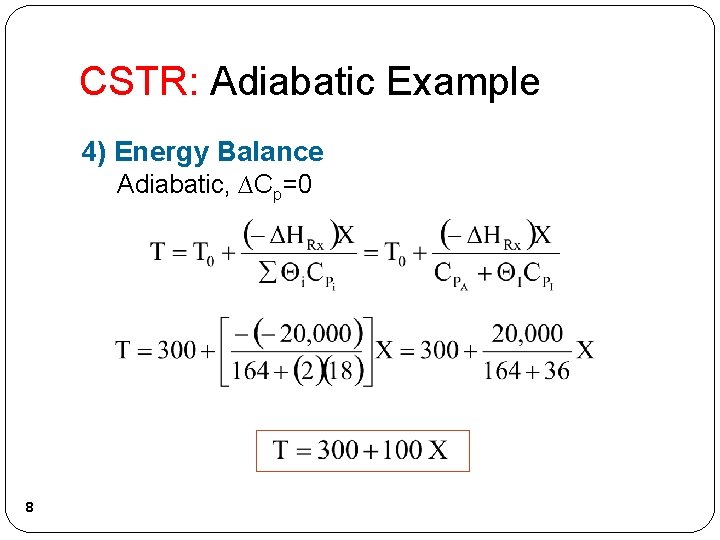
CSTR: Adiabatic Example 4) Energy Balance Adiabatic, ∆Cp=0 8
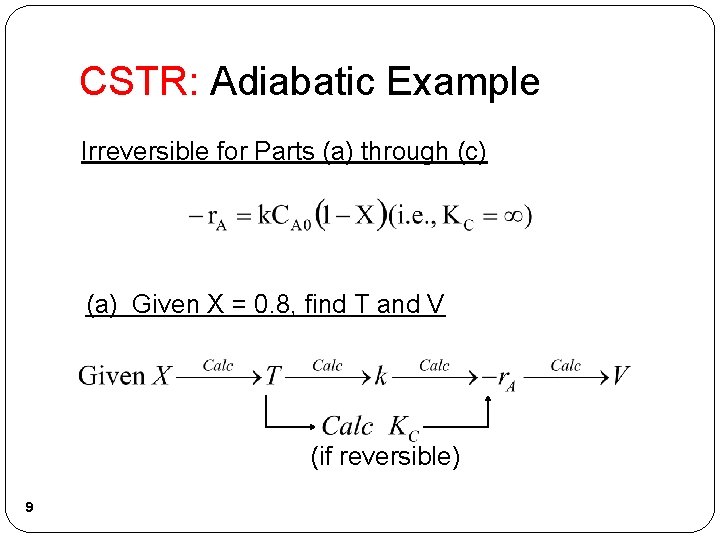
CSTR: Adiabatic Example Irreversible for Parts (a) through (c) (a) Given X = 0. 8, find T and V (if reversible) 9
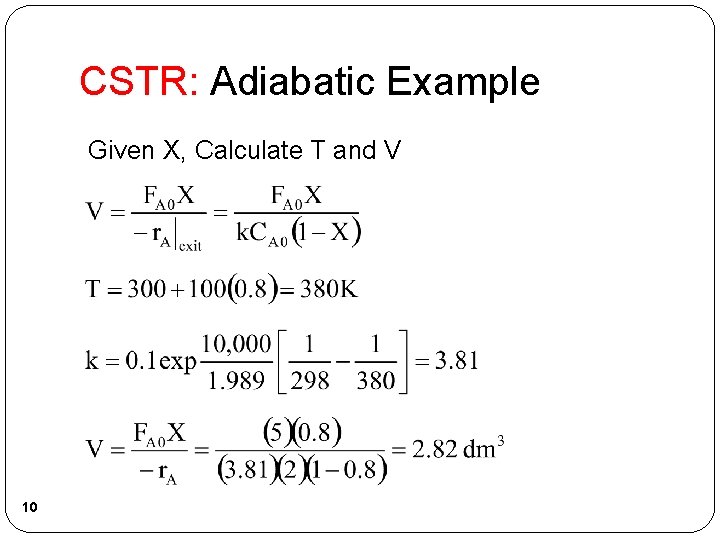
CSTR: Adiabatic Example Given X, Calculate T and V 10
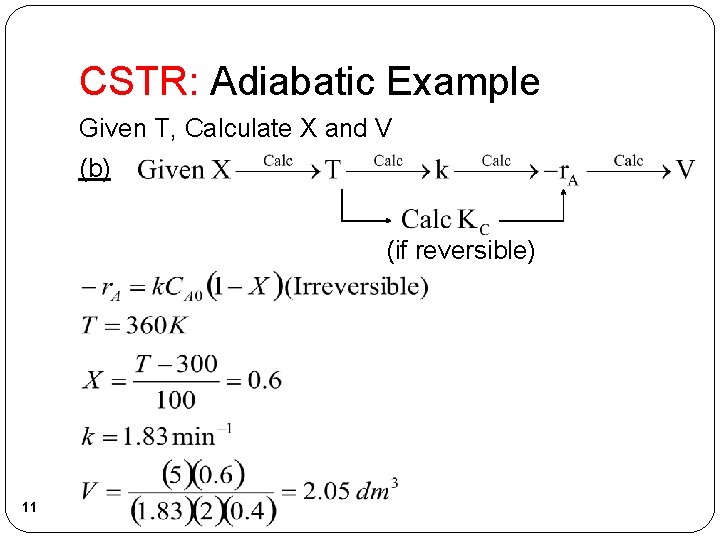
CSTR: Adiabatic Example Given T, Calculate X and V (b) (if reversible) 11
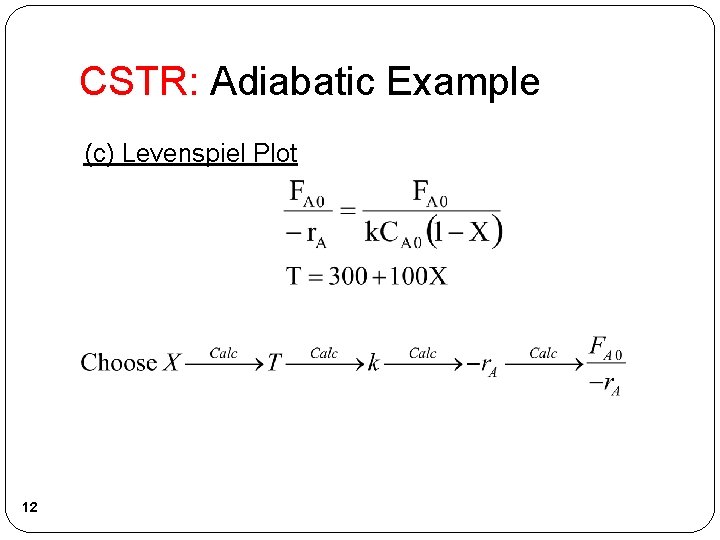
CSTR: Adiabatic Example (c) Levenspiel Plot 12
CSTR: Adiabatic Example (c) Levenspiel Plot 13
CSTR: Adiabatic Example CSTR X = 0. 6 T = 360 K CSTR X = 0. 95 T = 395 K 14
CSTR: Adiabatic Example PFR X = 0. 6 PFR X = 0. 95 15
CSTR: Adiabatic Example - Summary 16 CSTR X = 0. 6 T = 360 V = 2. 05 dm 3 PFR X = 0. 6 Texit = 360 V = 5. 28 dm 3 CSTR X = 0. 95 T = 395 V = 7. 59 dm 3 PFR X = 0. 95 Texit = 395 V = 6. 62 dm 3
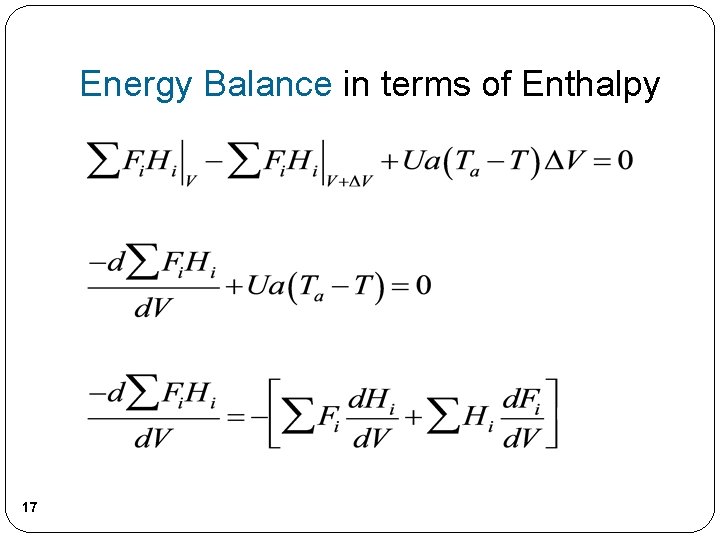
Energy Balance in terms of Enthalpy 17
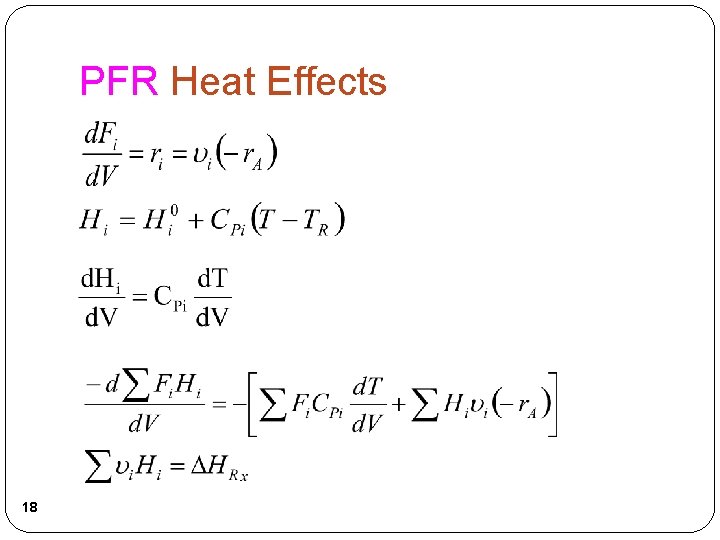
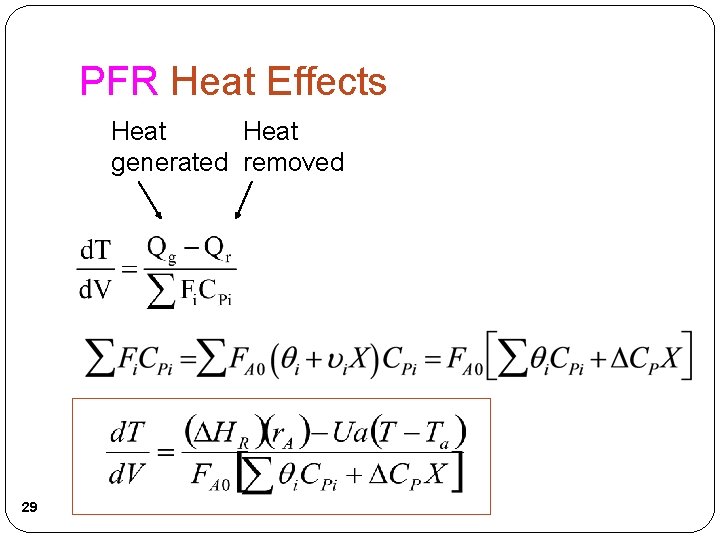
PFR Heat Effects 18
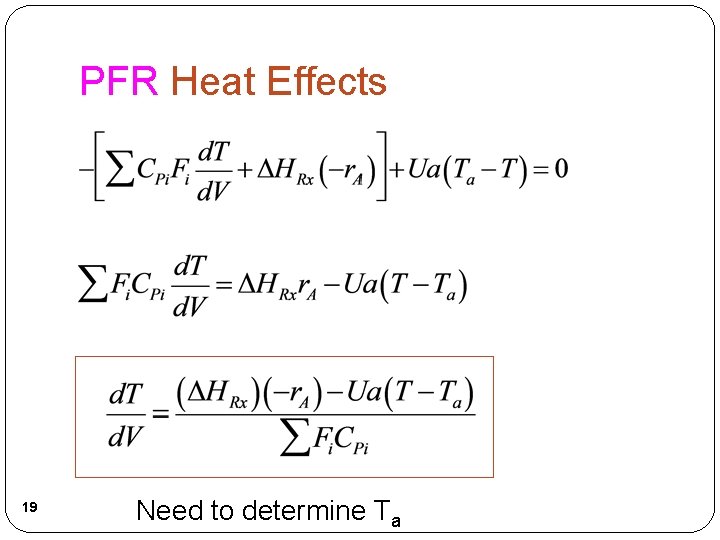
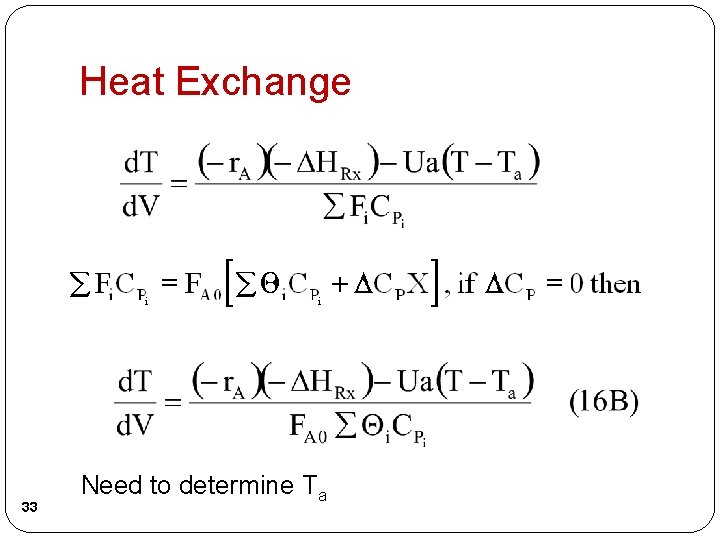
PFR Heat Effects 19 Need to determine Ta
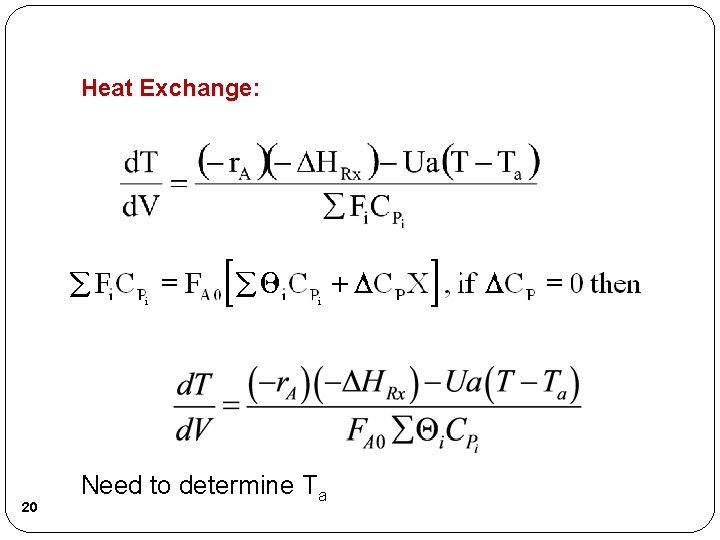
Heat Exchange: 20 Need to determine Ta
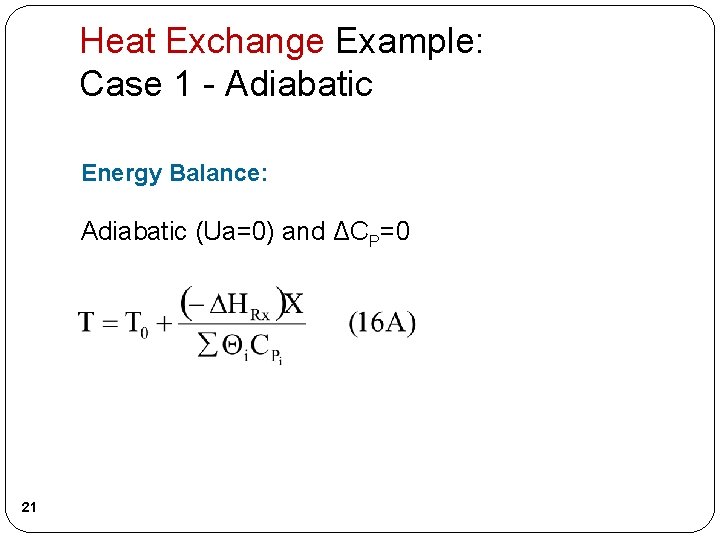
Heat Exchange Example: Case 1 - Adiabatic Energy Balance: Adiabatic (Ua=0) and ΔCP=0 21
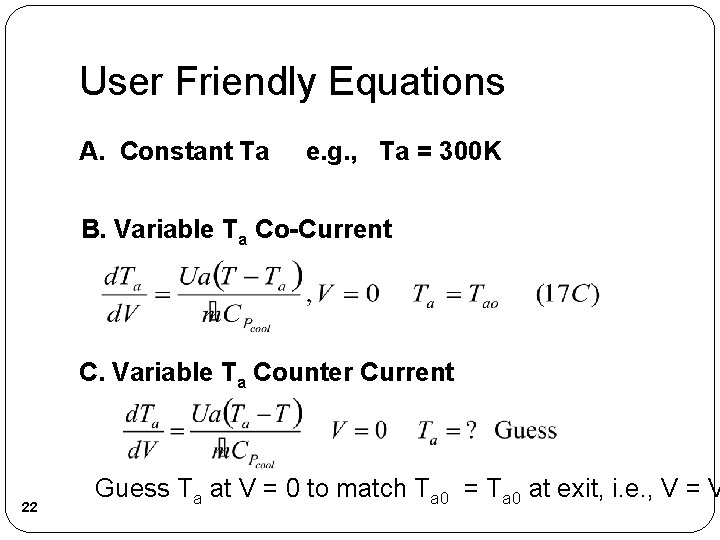
User Friendly Equations A. Constant Ta e. g. , Ta = 300 K B. Variable Ta Co-Current C. Variable Ta Counter Current 22 Guess Ta at V = 0 to match Ta 0 = Ta 0 at exit, i. e. , V = V
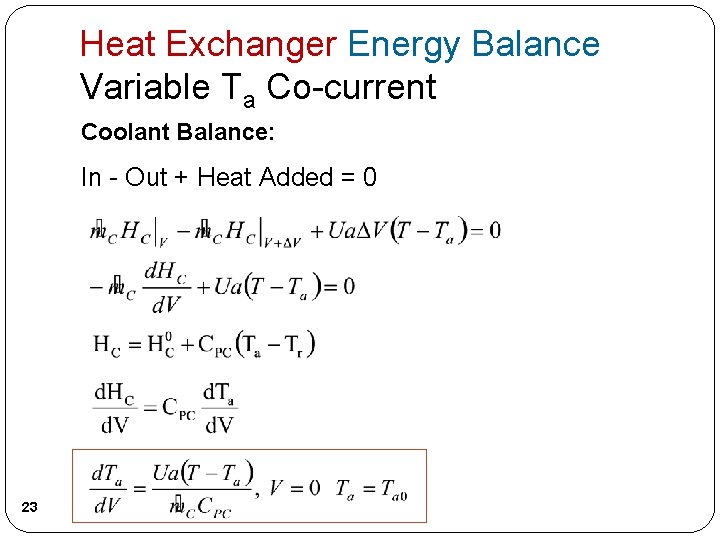
Heat Exchanger Energy Balance Variable Ta Co-current Coolant Balance: In - Out + Heat Added = 0 23
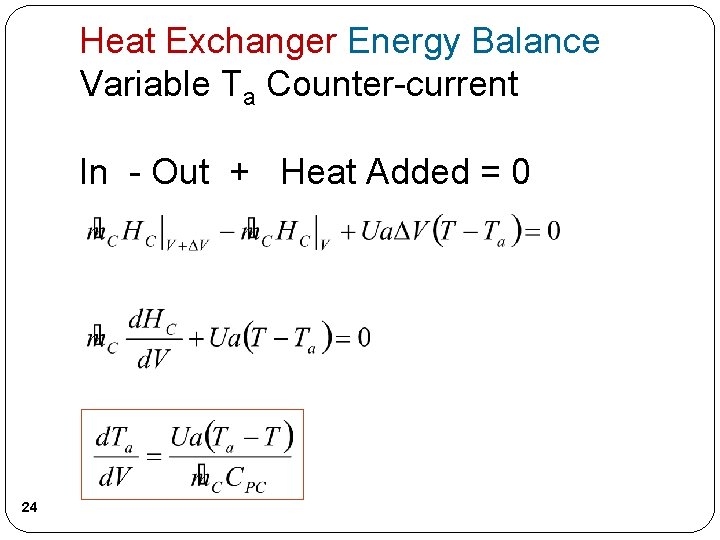
Heat Exchanger Energy Balance Variable Ta Counter-current In - Out + Heat Added = 0 24
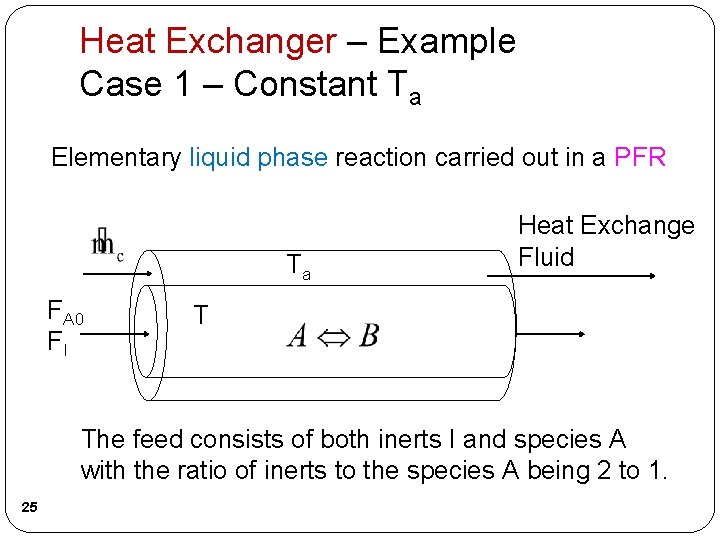
Heat Exchanger – Example Case 1 – Constant Ta Elementary liquid phase reaction carried out in a PFR Ta FA 0 FI Heat Exchange Fluid T The feed consists of both inerts I and species A with the ratio of inerts to the species A being 2 to 1. 25
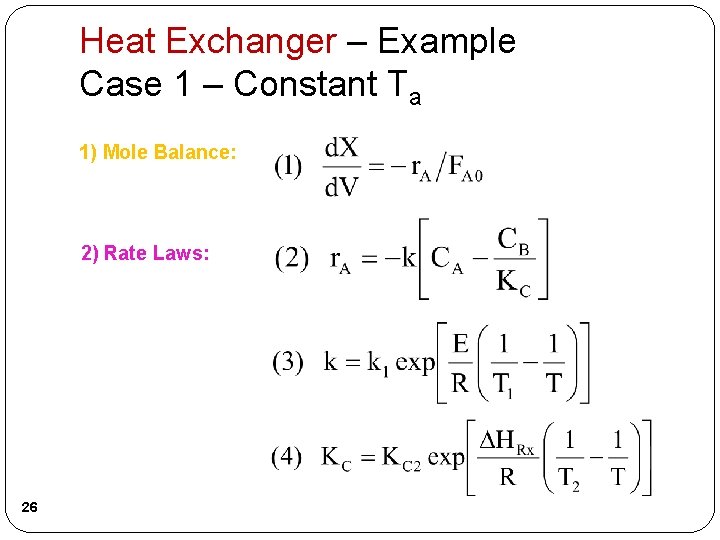
Heat Exchanger – Example Case 1 – Constant Ta 1) Mole Balance: 2) Rate Laws: 26
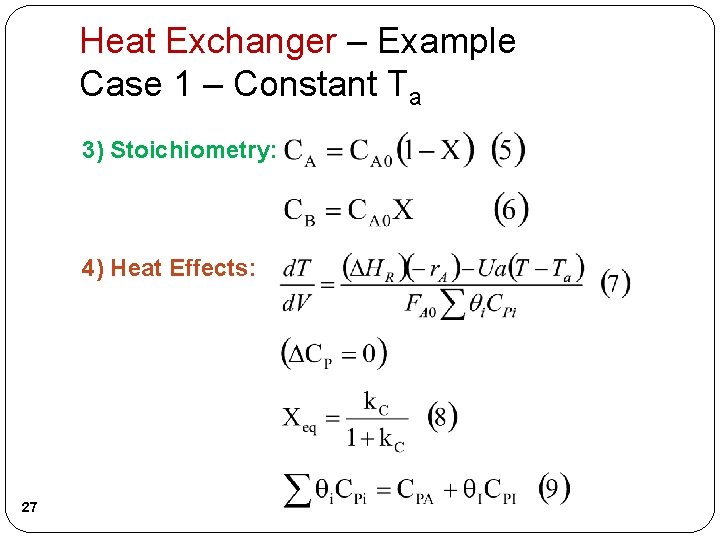
Heat Exchanger – Example Case 1 – Constant Ta 3) Stoichiometry: 4) Heat Effects: 27
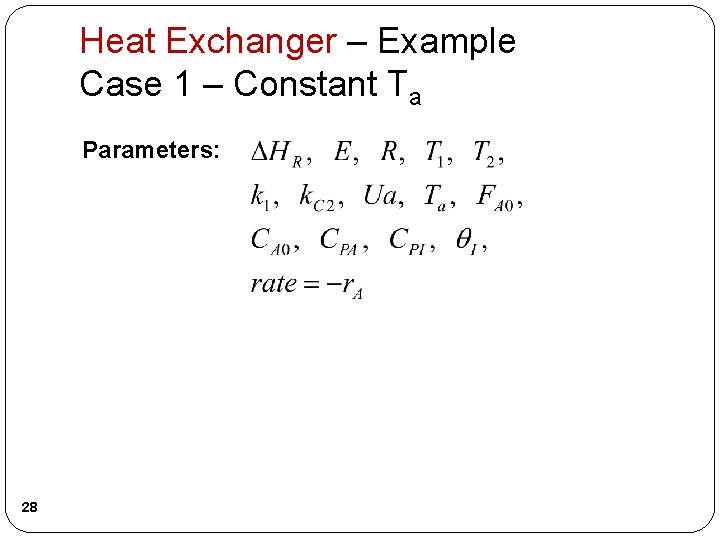
Heat Exchanger – Example Case 1 – Constant Ta Parameters: 28
PFR Heat Effects Heat generated removed 29
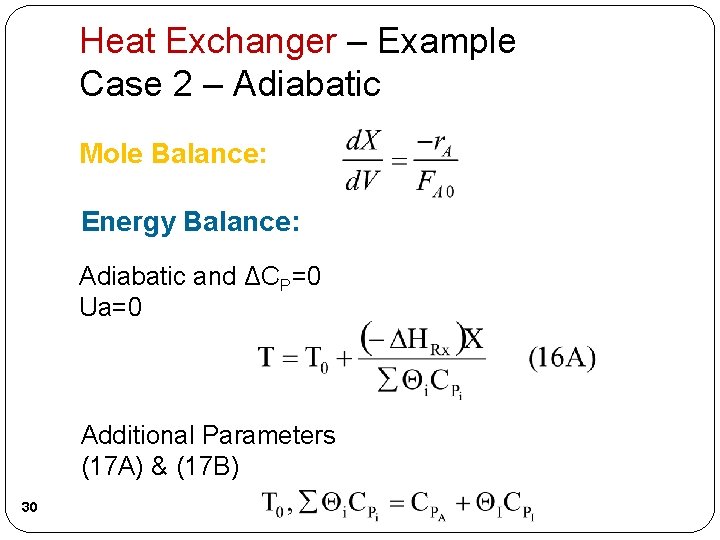
Heat Exchanger – Example Case 2 – Adiabatic Mole Balance: Energy Balance: Adiabatic and ΔCP=0 Ua=0 Additional Parameters (17 A) & (17 B) 30
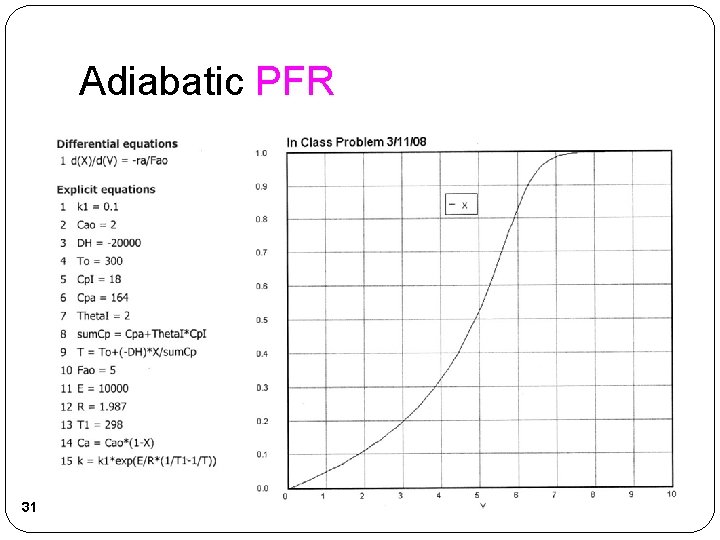
Adiabatic PFR 31
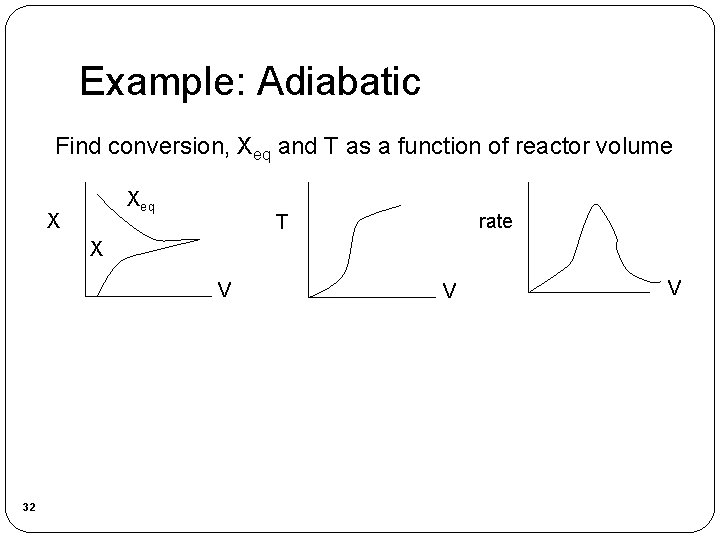
Example: Adiabatic Find conversion, Xeq and T as a function of reactor volume Xeq X rate T X V 32 V V
Heat Exchange 33 Need to determine Ta
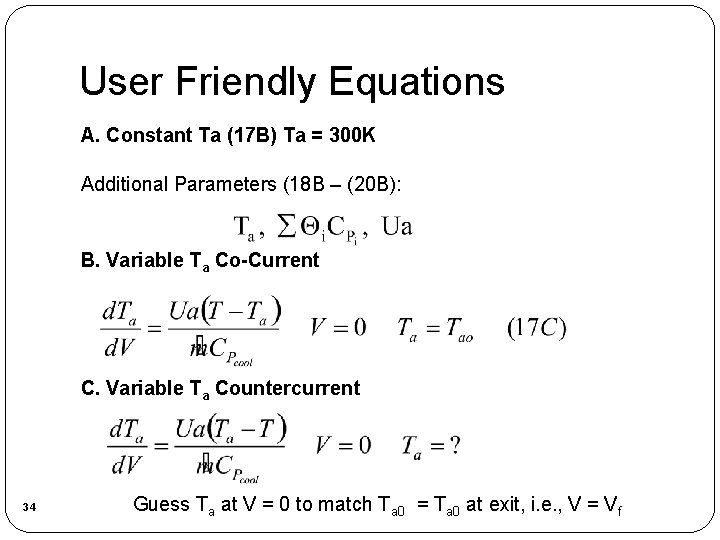
User Friendly Equations A. Constant Ta (17 B) Ta = 300 K Additional Parameters (18 B – (20 B): B. Variable Ta Co-Current C. Variable Ta Countercurrent 34 Guess Ta at V = 0 to match Ta 0 = Ta 0 at exit, i. e. , V = Vf
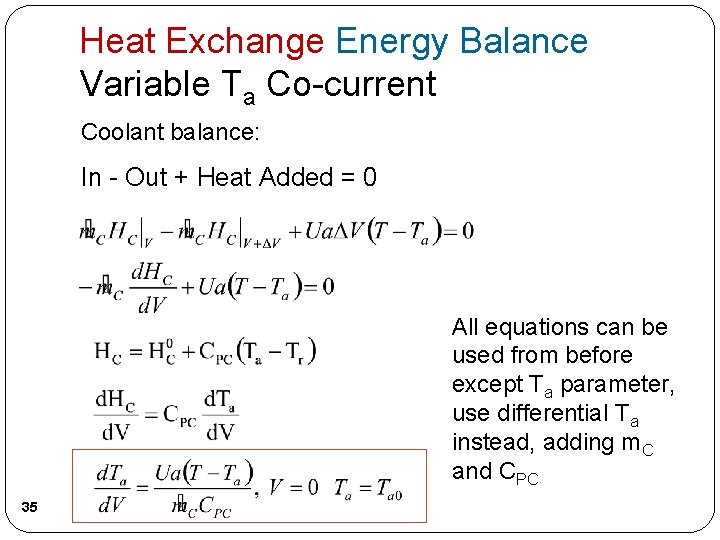
Heat Exchange Energy Balance Variable Ta Co-current Coolant balance: In - Out + Heat Added = 0 All equations can be used from before except Ta parameter, use differential Ta instead, adding m. C and CPC 35
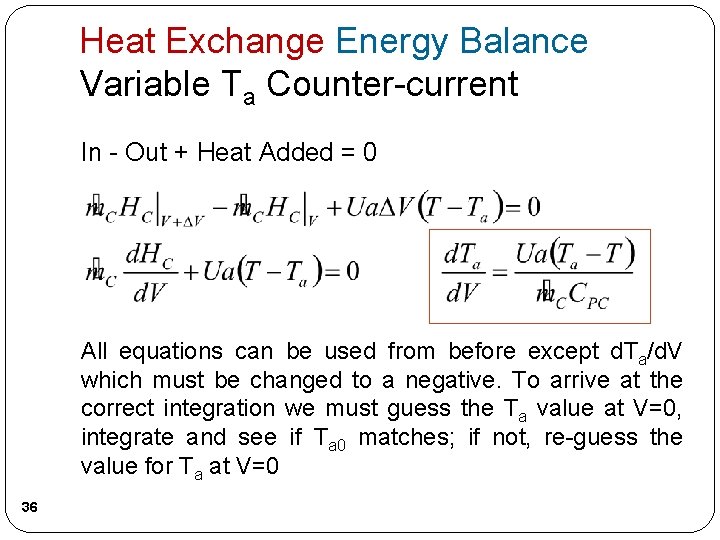
Heat Exchange Energy Balance Variable Ta Counter-current In - Out + Heat Added = 0 All equations can be used from before except d. Ta/d. V which must be changed to a negative. To arrive at the correct integration we must guess the Ta value at V=0, integrate and see if Ta 0 matches; if not, re-guess the value for Ta at V=0 36
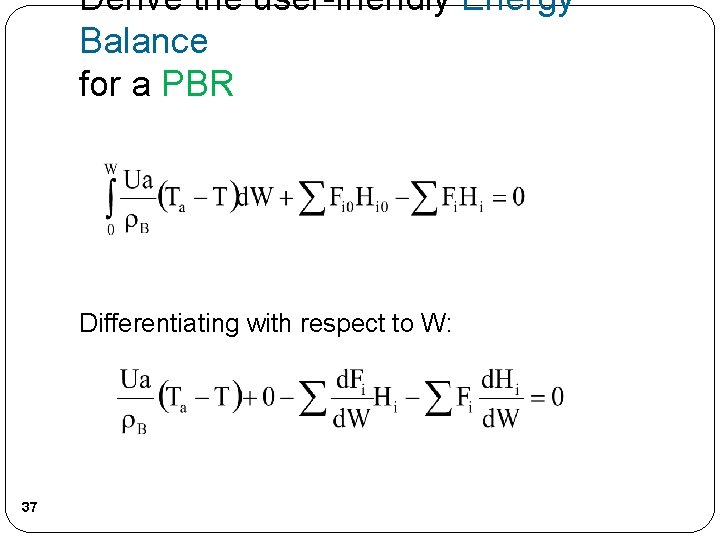
Derive the user-friendly Energy Balance for a PBR Differentiating with respect to W: 37
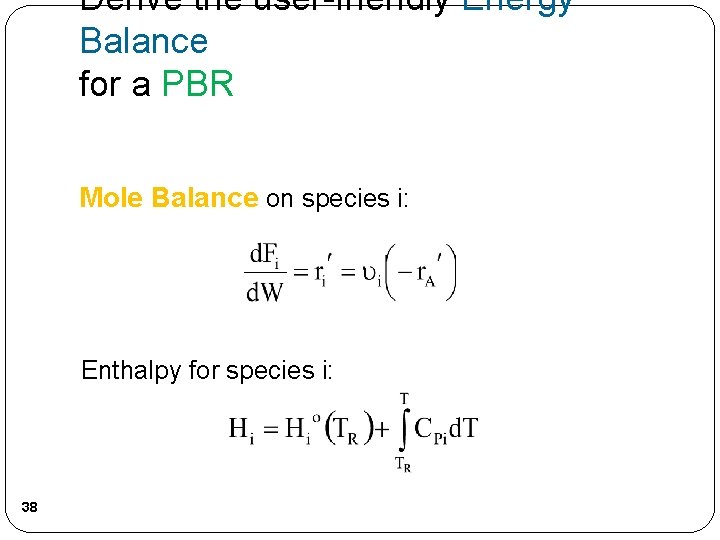
Derive the user-friendly Energy Balance for a PBR Mole Balance on species i: Enthalpy for species i: 38
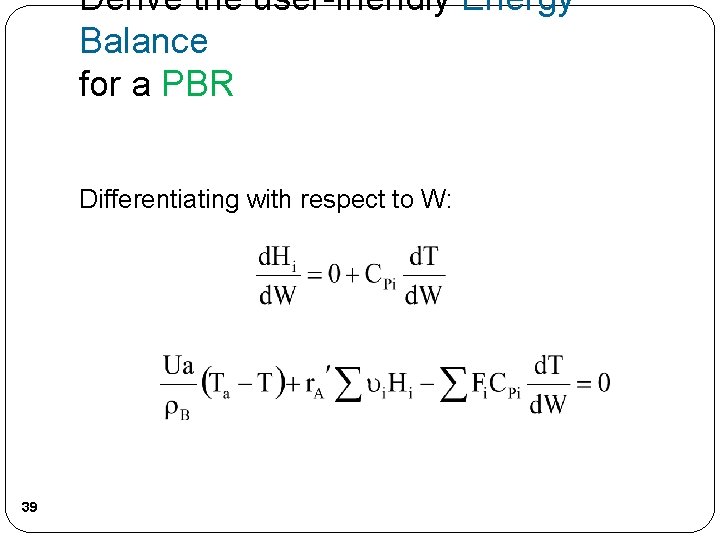
Derive the user-friendly Energy Balance for a PBR Differentiating with respect to W: 39
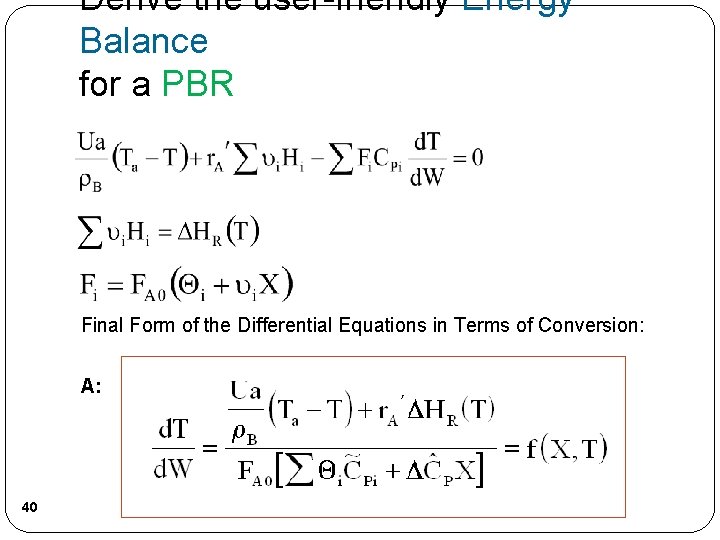
Derive the user-friendly Energy Balance for a PBR Final Form of the Differential Equations in Terms of Conversion: A: 40
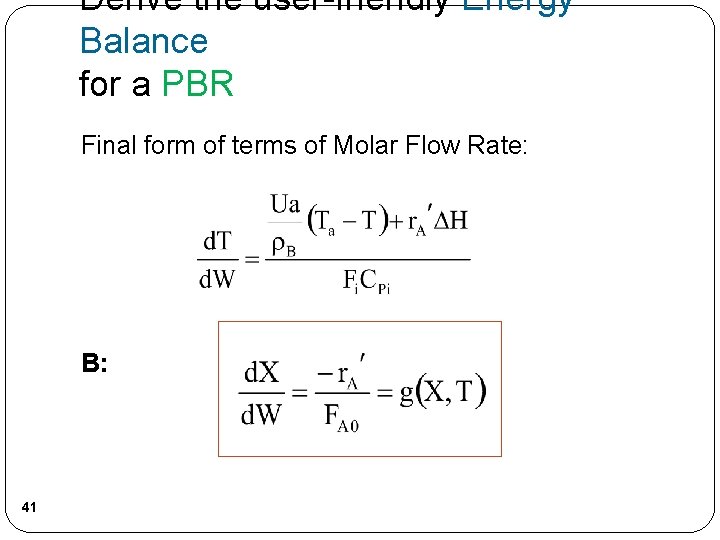
Derive the user-friendly Energy Balance for a PBR Final form of terms of Molar Flow Rate: B: 41
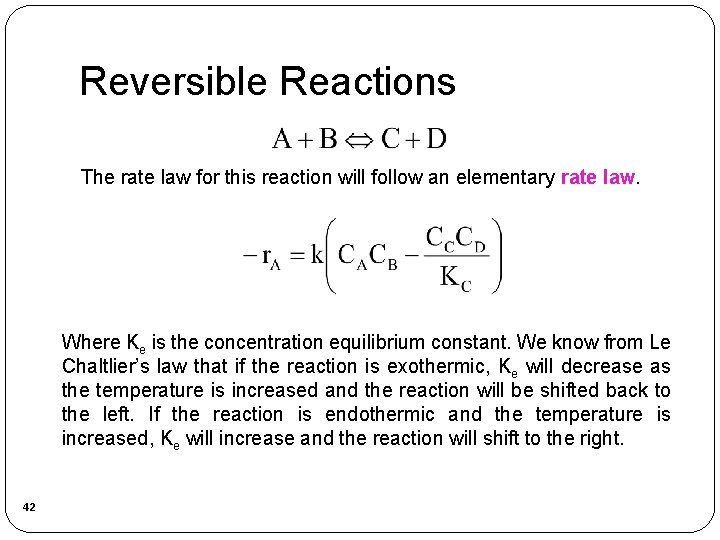
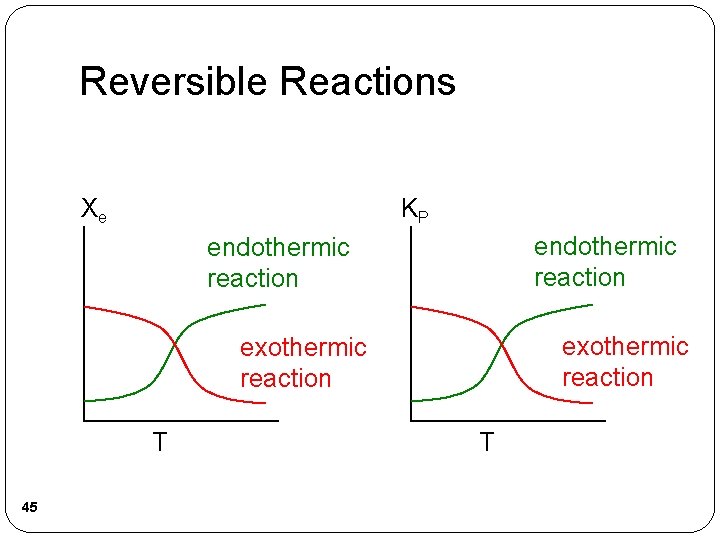
Reversible Reactions The rate law for this reaction will follow an elementary rate law. Where Ke is the concentration equilibrium constant. We know from Le Chaltlier’s law that if the reaction is exothermic, Ke will decrease as the temperature is increased and the reaction will be shifted back to the left. If the reaction is endothermic and the temperature is increased, Ke will increase and the reaction will shift to the right. 42
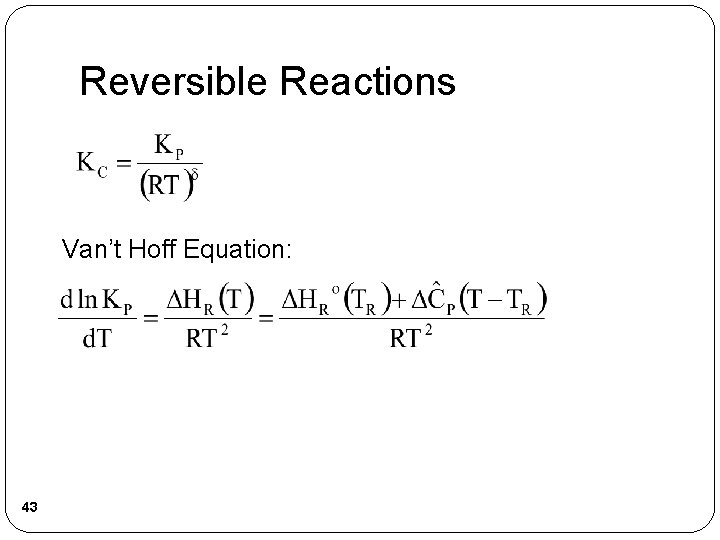
Reversible Reactions Van’t Hoff Equation: 43
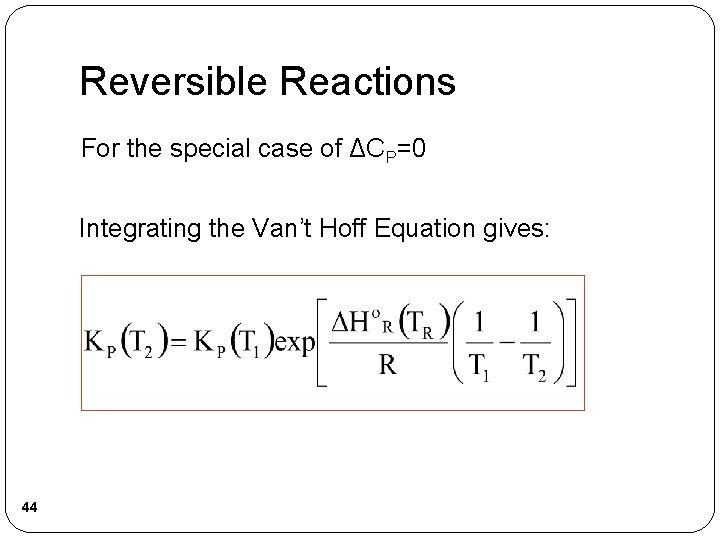
Reversible Reactions For the special case of ΔCP=0 Integrating the Van’t Hoff Equation gives: 44
Reversible Reactions Xe KP endothermic reaction exothermic reaction T 45 T
End of Lecture 20 46