
Lecture 20 1 LEVITATION ABOVE A SUPERCONDUCTOR Lecture
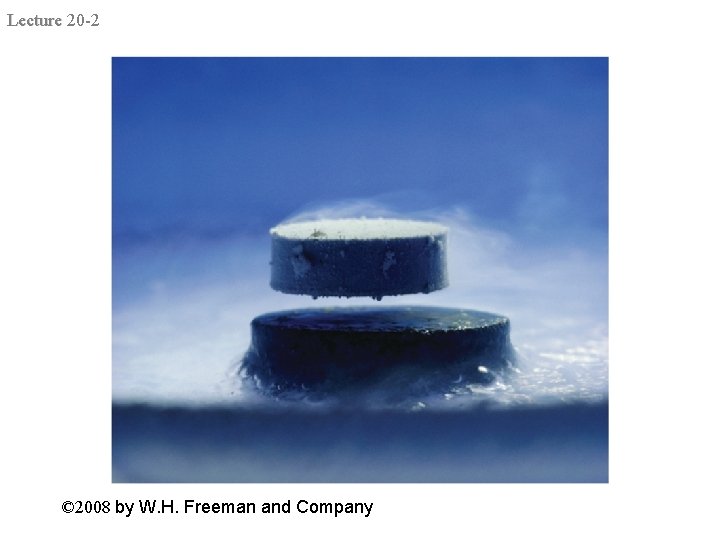
Lecture 20 -1 LEVITATION ABOVE A SUPERCONDUCTOR
Lecture 20 -2 © 2008 by W. H. Freeman and Company
Lecture 20 -3 READING QUIZ 1 Which of the following statements is incorrect? A| In an A. C. circuit an ideal resistor is a frequency independent component. B| At zero frequency the reactance of an ideal capacitor is infinite. C| At resonance in a driven series RLC circuit the circulating current has a minimum value. D| In an A. C. circuit the inductive reactance of an ideal inductor increases with frequency.
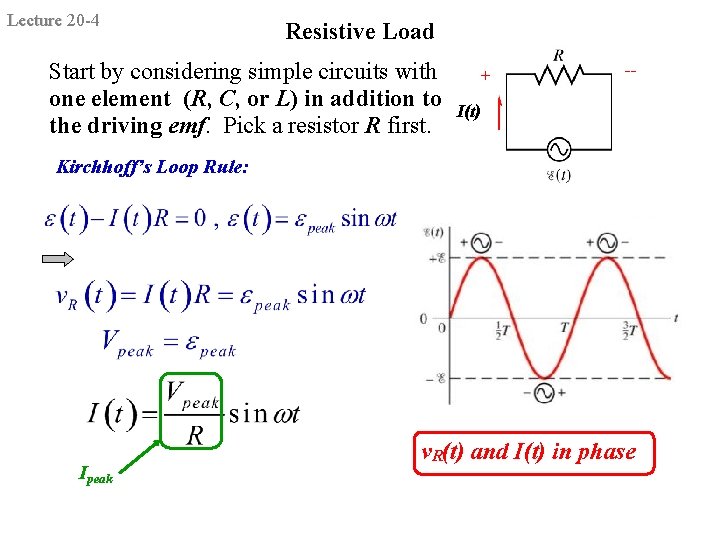
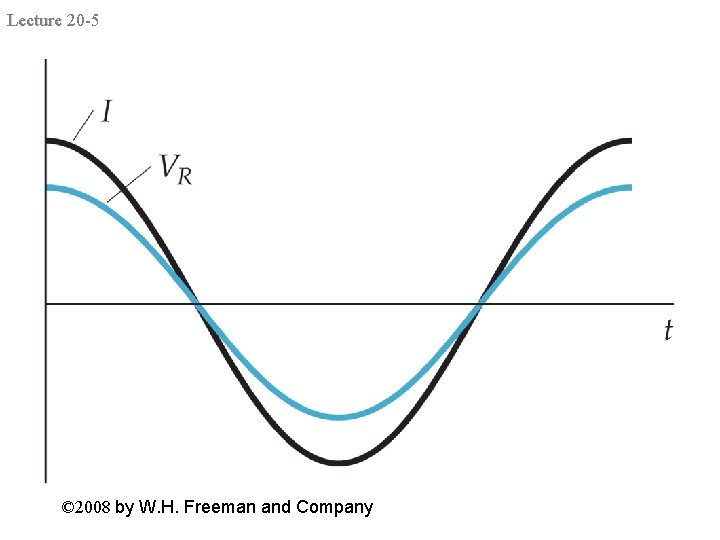
Lecture 20 -4 Resistive Load Start by considering simple circuits with one element (R, C, or L) in addition to the driving emf. Pick a resistor R first. + -- I(t) Kirchhoff’s Loop Rule: Ipeak v. R(t) and I(t) in phase
Lecture 20 -5 © 2008 by W. H. Freeman and Company
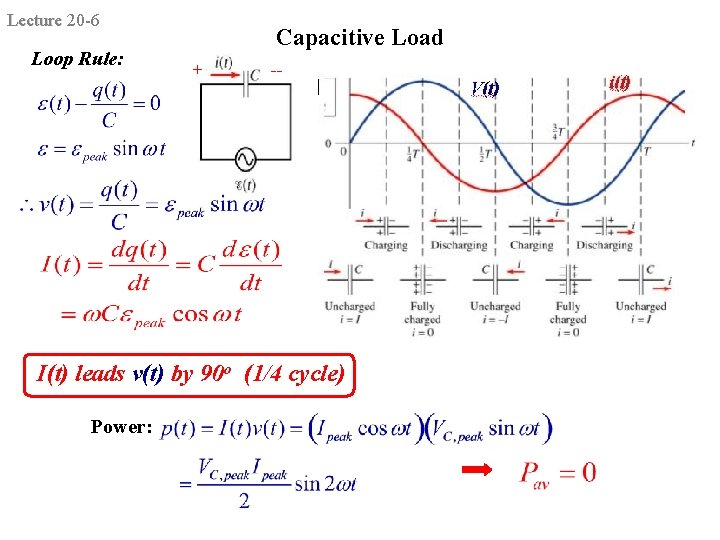
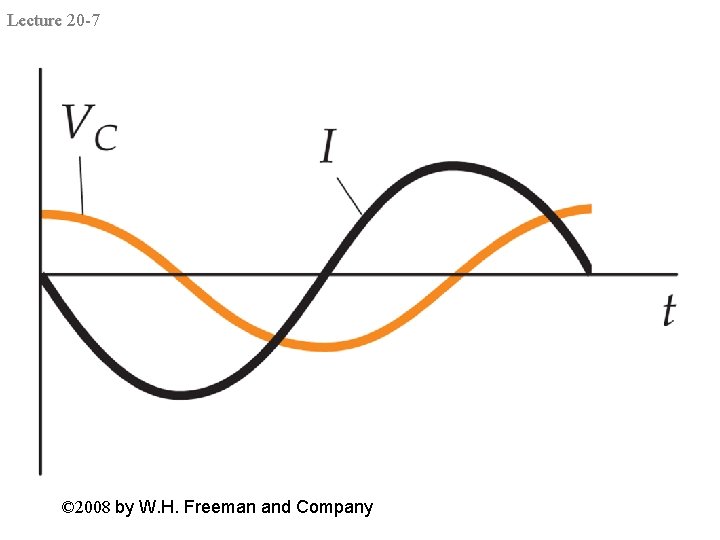
Lecture 20 -6 Loop Rule: Capacitive Load + -- I(t) leads v(t) by 90 o (1/4 cycle) Power:
Lecture 20 -7 © 2008 by W. H. Freeman and Company
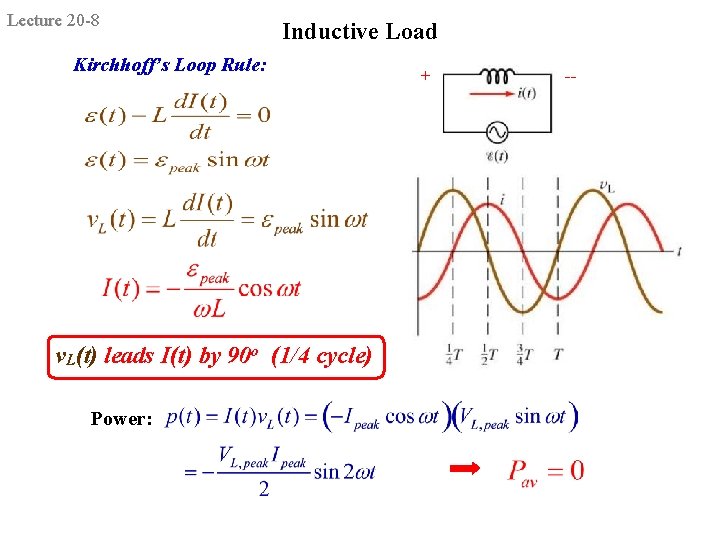
Lecture 20 -8 Inductive Load Kirchhoff’s Loop Rule: v. L(t) leads I(t) by 90 o (1/4 cycle) Power: + --
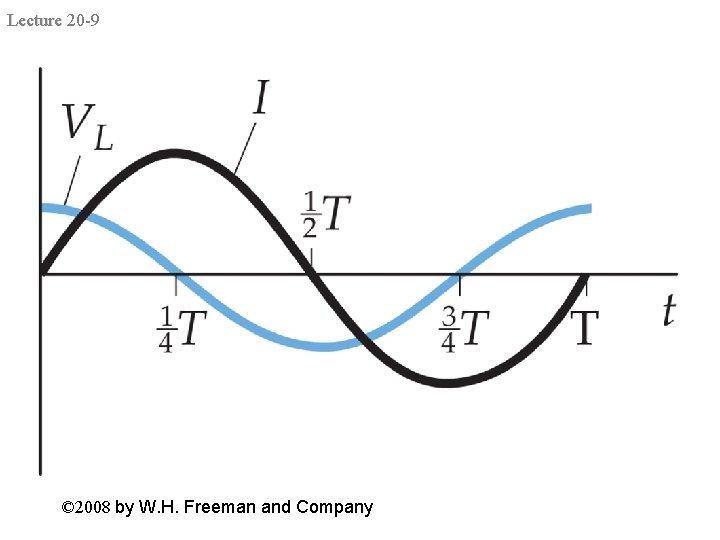
Lecture 20 -9 © 2008 by W. H. Freeman and Company
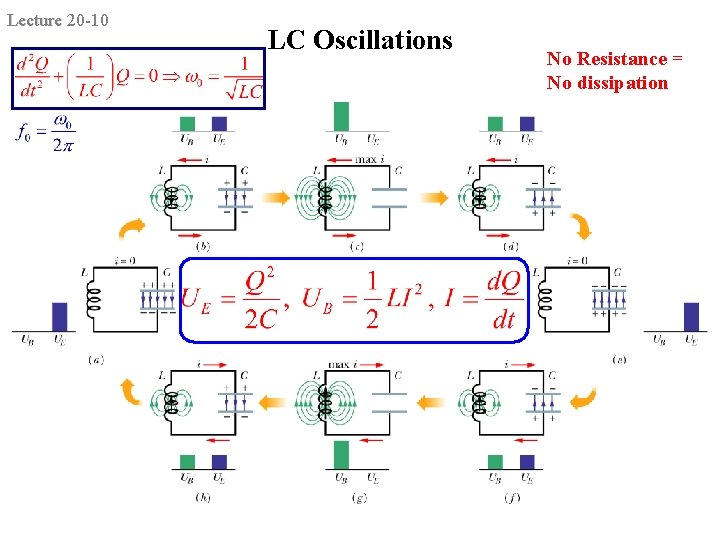
Lecture 20 -10 LC Oscillations No Resistance = No dissipation
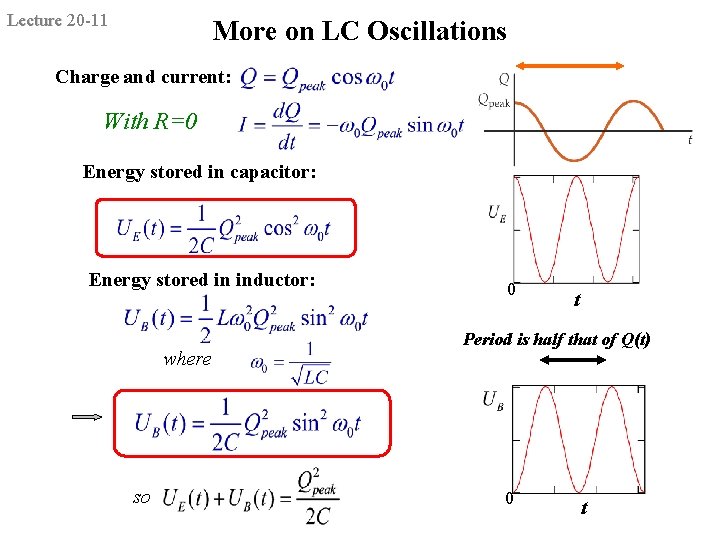
Lecture 20 -11 More on LC Oscillations Charge and current: With R=0 Energy stored in capacitor: Energy stored in inductor: where so 0 t Period is half that of Q(t) 0 t
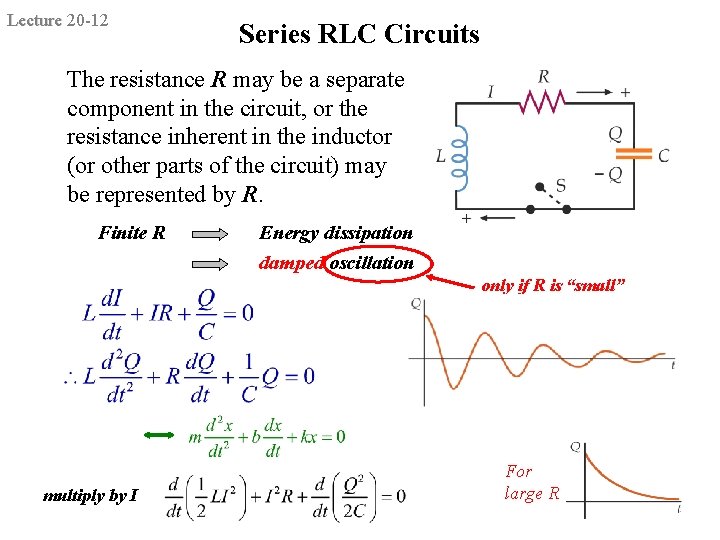
Lecture 20 -12 Series RLC Circuits The resistance R may be a separate component in the circuit, or the resistance inherent in the inductor (or other parts of the circuit) may be represented by R. Finite R Energy dissipation damped oscillation only if R is “small” multiply by I For large R
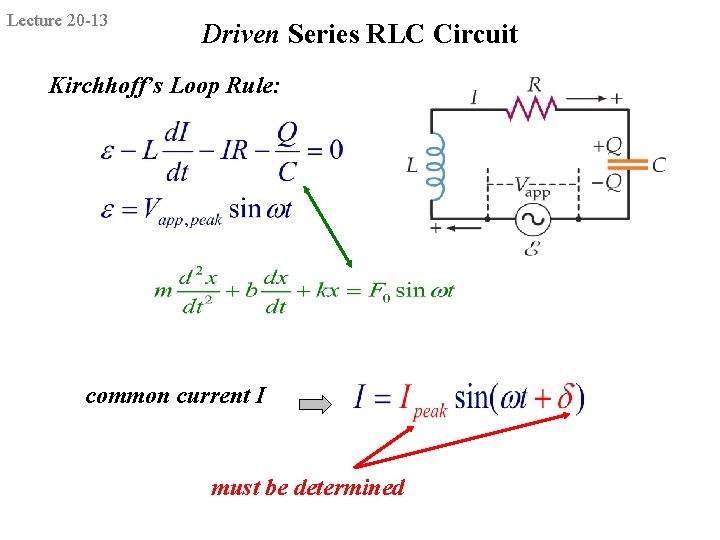
Lecture 20 -13 Driven Series RLC Circuit Kirchhoff’s Loop Rule: common current I must be determined
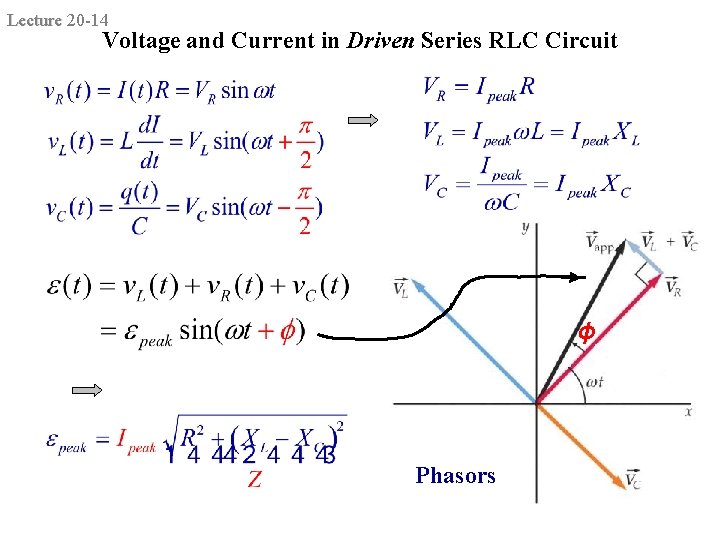
Lecture 20 -14 Voltage and Current in Driven Series RLC Circuit ϕ Phasors
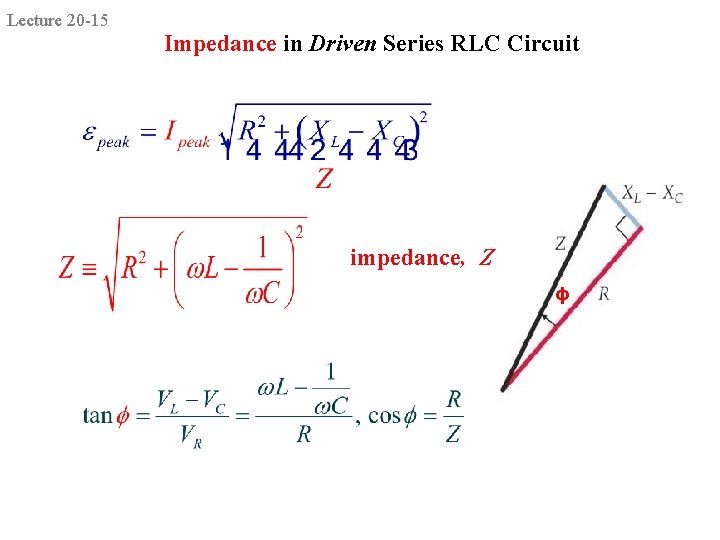
Lecture 20 -15 Impedance in Driven Series RLC Circuit impedance, Z ϕ
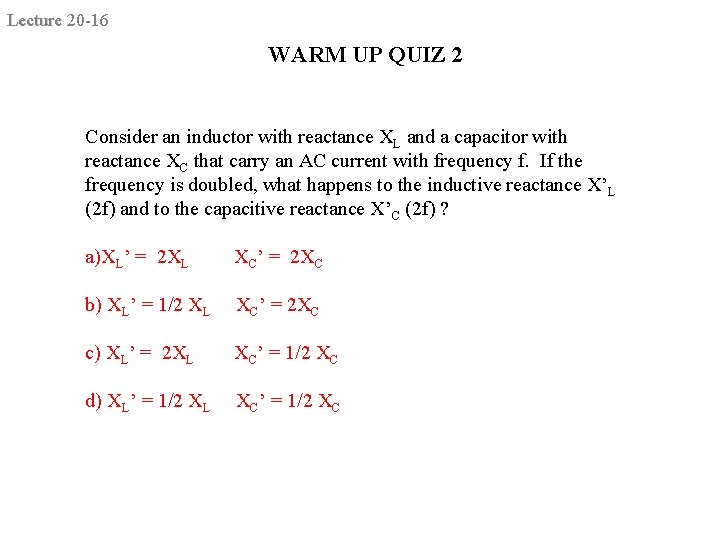
Lecture 20 -16 WARM UP QUIZ 2 Consider an inductor with reactance XL and a capacitor with reactance XC that carry an AC current with frequency f. If the frequency is doubled, what happens to the inductive reactance X’L (2 f) and to the capacitive reactance X’C (2 f) ? a)XL’ = 2 XL XC’ = 2 XC b) XL’ = 1/2 XL XC’ = 2 XC c) XL’ = 2 XL XC’ = 1/2 XC d) XL’ = 1/2 XL XC’ = 1/2 XC
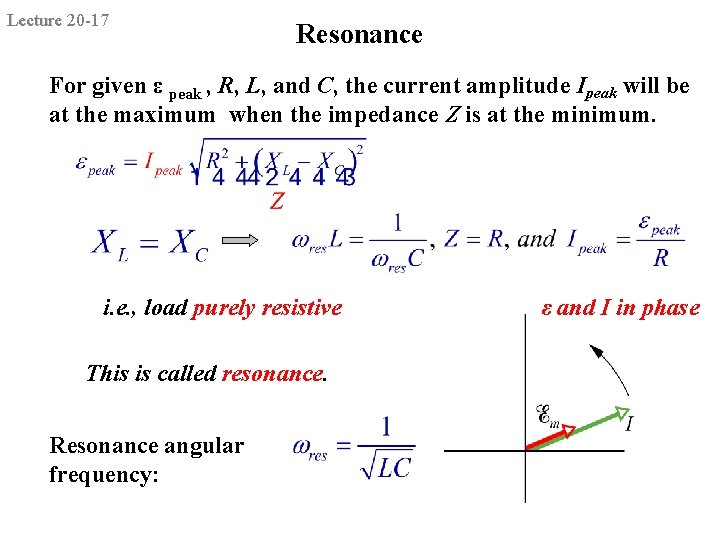
Lecture 20 -17 Resonance For given ε peak , R, L, and C, the current amplitude Ipeak will be at the maximum when the impedance Z is at the minimum. i. e. , load purely resistive This is called resonance. Resonance angular frequency: ε and I in phase
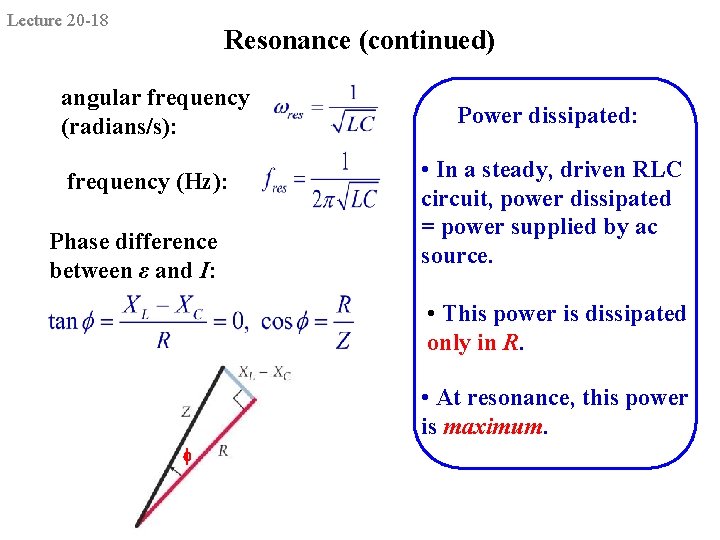
Lecture 20 -18 Resonance (continued) angular frequency (radians/s): frequency (Hz): Phase difference between ε and I: Power dissipated: • In a steady, driven RLC circuit, power dissipated = power supplied by ac source. • This power is dissipated only in R. • At resonance, this power is maximum.
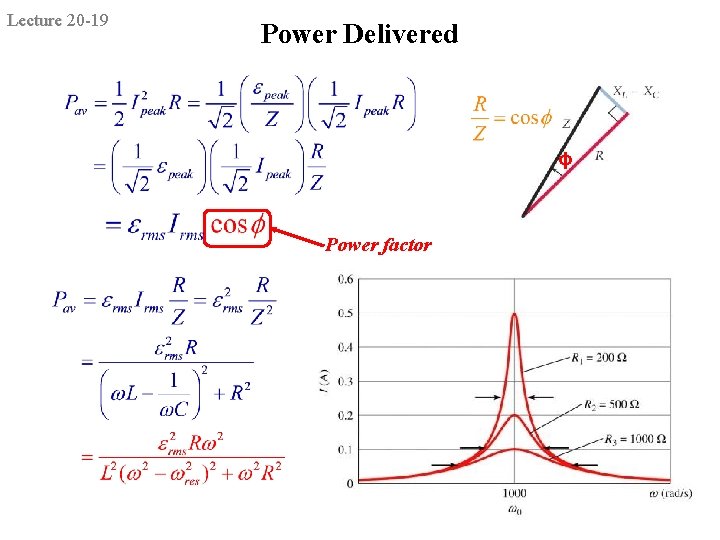
Lecture 20 -19 Power Delivered ϕ Power factor
Lecture 20 -20 DEMO RESONANCE 6 C-12
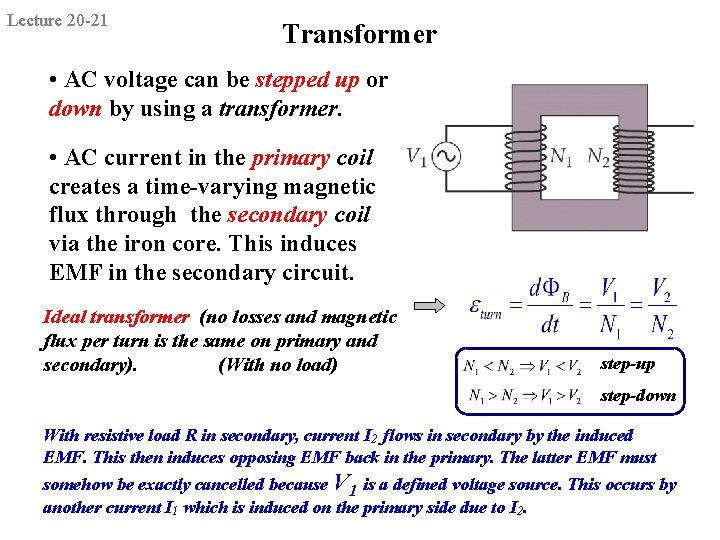
Lecture 20 -21 Transformer • AC voltage can be stepped up or down by using a transformer. • AC current in the primary coil creates a time-varying magnetic flux through the secondary coil via the iron core. This induces EMF in the secondary circuit. Ideal transformer (no losses and magnetic flux per turn is the same on primary and secondary). (With no load) step-up step-down With resistive load R in secondary, current I 2 flows in secondary by the induced EMF. This then induces opposing EMF back in the primary. The latter EMF must somehow be exactly cancelled because V 1 is a defined voltage source. This occurs by another current I 1 which is induced on the primary side due to I 2.
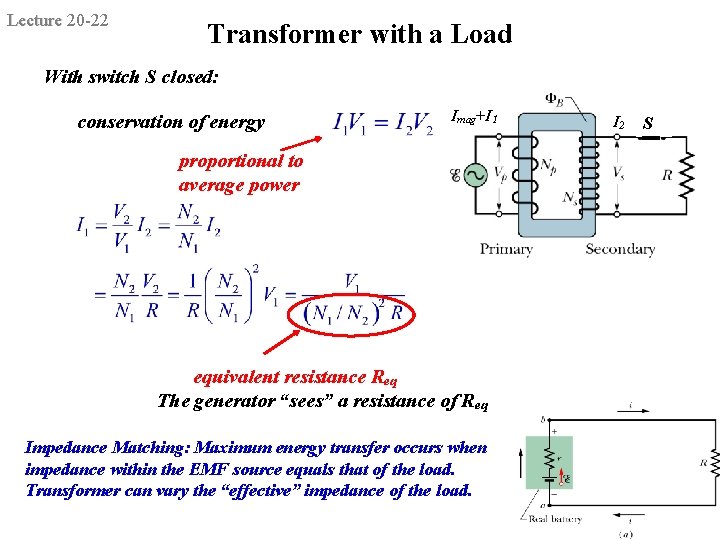
Lecture 20 -22 Transformer with a Load With switch S closed: conservation of energy Imag+I 1 proportional to average power equivalent resistance Req The generator “sees” a resistance of Req Impedance Matching: Maximum energy transfer occurs when impedance within the EMF source equals that of the load. Transformer can vary the “effective” impedance of the load. I 2 S
Lecture 20 -23 DEMO JACOB’S LADDER 6 D 13
Lecture 20 -24 Physics 241 – 10: 30 QUIZ 3 NOVEMBER 3, 2011 An LC circuit has a natural frequency of 100 MHz. If you want to decrease the natural frequency to 71 MHz, which of the following will accomplish that? a) Double C b) Double both L and C c) Halve C d) Halve both L and C e) Double L and halve C
Lecture 20 -25 Physics 241 -- 11: 30 QUIZ 3. NOVEMBER 3, 2011 An LC circuit has a natural frequency of 100 MHz. If you want to increase the natural frequency to 141 MHz, which of the following will accomplish that? a) Double L b) Double both L and C c) Halve L d) Halve both L and C e) Double L and halve C
Lecture 20 -26 Physics 241 -- 11: 30 QUIZ 3 March 29, 2011 An LC circuit has a natural frequency of 141 MHz. If you want to decrease the natural frequency to 100 MHz, which of the following will accomplish that? a) Double L b) Double both L and C c) Halve L d) Halve both L and C e) Double L and halve C
- Slides: 26