
Lecture 2 WAN Technologies Objectives q Define LAN
Lecture # 2 WAN Technologies
Objectives q Define LAN and WAN and tell how they are used. q WAN Technologies Overview q WAN Technologies L. Rania Ahmed Tabeidi 2
Different LAN and WAN technologies. q LAN (Local Area Network) : q Local is generally referred to a network contained within a building or an office or a campus. (You might have a LAN for example on a University campus or between office blocks in an office park). q Have a small geographical range and do not need any leased telecommunication lines L. Rania Ahmed Tabeidi 3
Different LAN and WAN technologies cont. . . q One LAN can be connected to other LANs over any distance via telephone lines and radio waves q LANs have a high data transfer rate q To set up a LAN -relatively speaking- is cheap If you want to put an extra couple of network points or an extra couple of devices on the network. L. Rania Ahmed Tabeidi 4
Different LAN and WAN technologies cont. . . q WAN (Wide Area Network): q A WAN is generally slow. If we compare that to a LAN, we said that Ethernet could run up to 1000 Mbps, currently, the fastest WAN is 155 Mbps, so you can see in a LAN we can talk up to 1000 Mbps whereas in a WAN, currently. q WAN is expensive. If we look at the path of telecommunications, we need to connect two offices, one in Aldmmam and one in Alkhartoum together - it 's an expensive operation even for a slow line. L. Rania Ahmed Tabeidi 5
Different LAN and WAN technologies cont. . . q Internet is the best example of a WAN q WANs (like the Internet) are not owned by any one organization but rather exist under collective or distributed ownership and management q WANs tend to use technology like ATM, Frame Relay and X. 25 for connectivity over the longer distances L. Rania Ahmed Tabeidi 6
Different LAN and WAN technologies cont. . . q Have a large geographical range generally spreading across boundaries and need leased telecommunication lines. q Computers connected to a wide-area network are often connected through public networks, such as the telephone system. They can also be connected through leased lines or satellites. L. Rania Ahmed Tabeidi 7
WAN Terminology
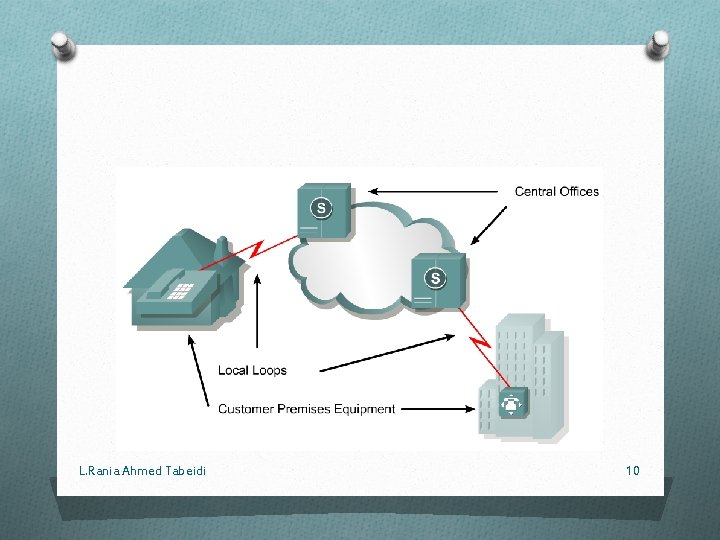
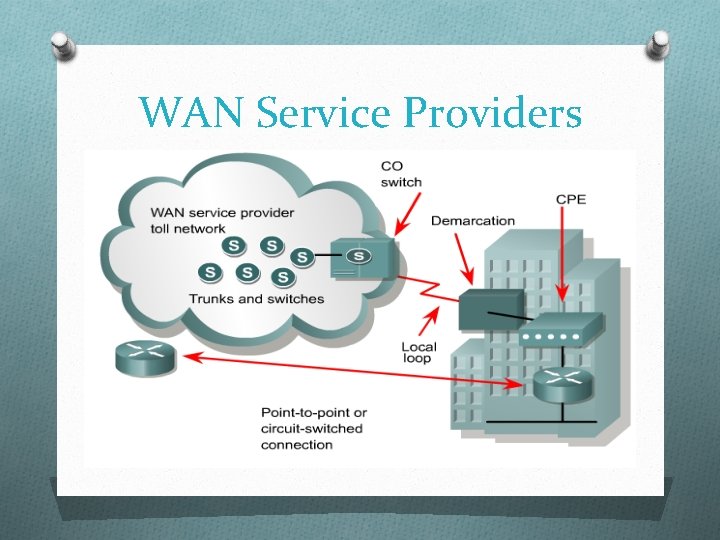
WAN Terminology q Devices on the subscriber premises are called Customer Premises Equipment (CPE). q The subscriber owns the CPE or leases the CPE from the service provider. q A copper or fiber cable connects the CPE to the service provider’s nearest exchange or central office (CO). q This cabling is often called the local loop, or "last-mile".
L. Rania Ahmed Tabeidi 10

WAN Terminology cont… q A dialed call is connected locally to other local loops, or non-locally through a trunk to a primary center. q It then goes to a sectional center and on to a regional or international carrier center as the call travels to its destination.
WAN Service Providers
WAN Terminology cont… q Devices that put data on the local loop are called data circuit- terminating equipment, or Data Communications Equipment (DCE). q The customer devices that pass the data to the DCE are called Data Terminal Equipment (DTE). q The DCE primarily provides an interface for the DTE into the communication link on the WAN cloud.
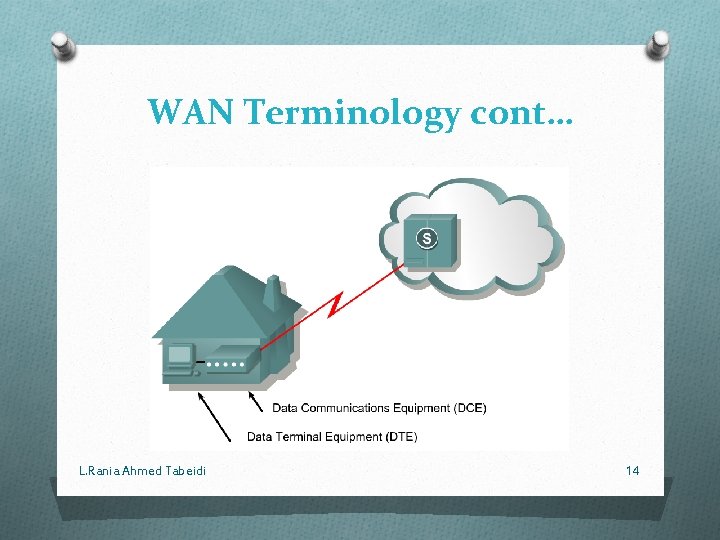
WAN Terminology cont… L. Rania Ahmed Tabeidi 14
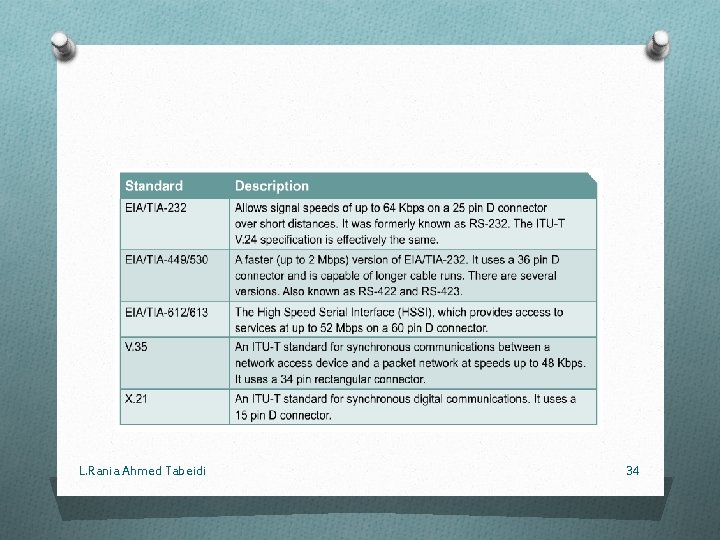
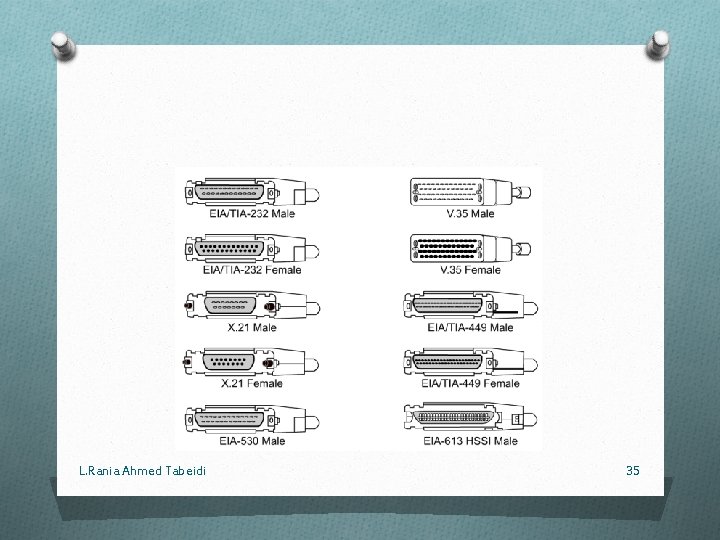
WAN Terminology cont… q The DTE/DCE interface uses various physical layer protocols, such as High-Speed Serial Interface (HSSI) and V. 35. q These protocols establish the codes and electrical parameters the devices use to communicate with each other.
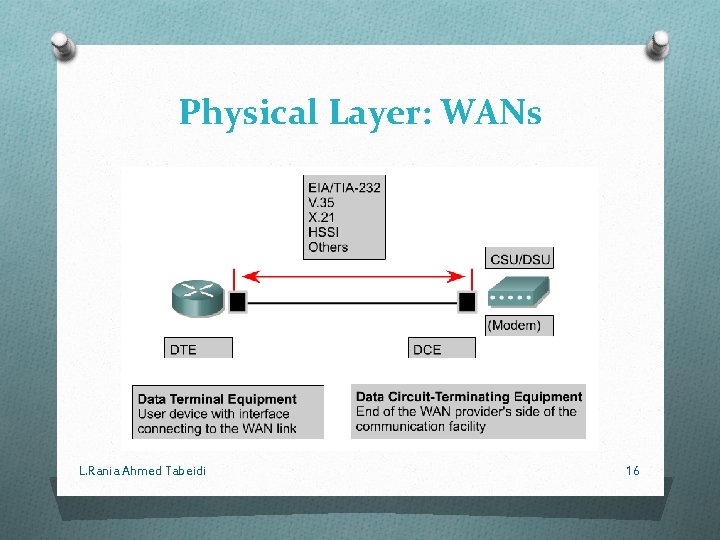
Physical Layer: WANs L. Rania Ahmed Tabeidi 16
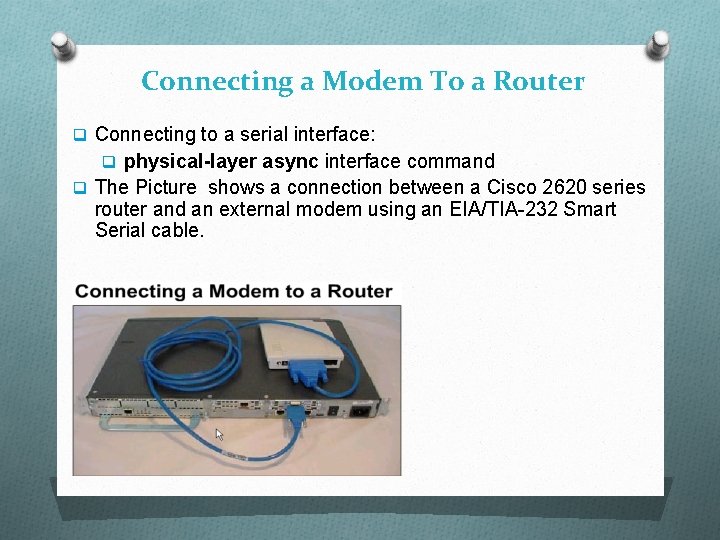
Connecting a Modem To a Router q Connecting to a serial interface: q physical-layer async interface command q The Picture shows a connection between a Cisco 2620 series router and an external modem using an EIA/TIA-232 Smart Serial cable.
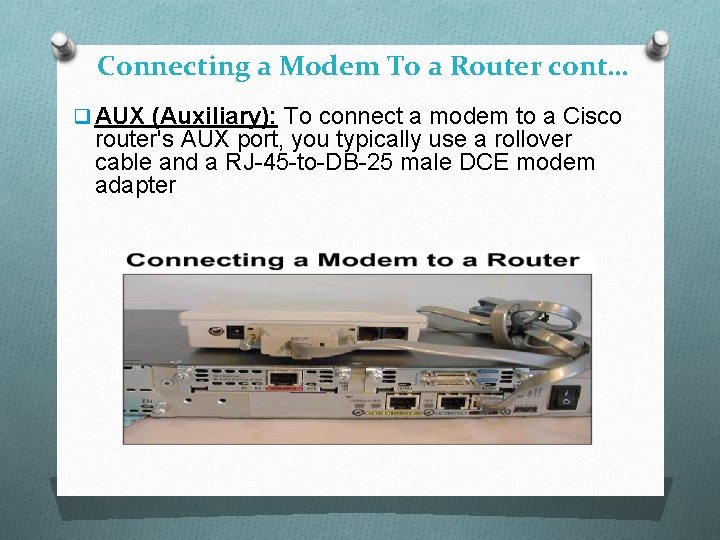
Connecting a Modem To a Router cont… q AUX (Auxiliary): To connect a modem to a Cisco router's AUX port, you typically use a rollover cable and a RJ-45 -to-DB-25 male DCE modem adapter
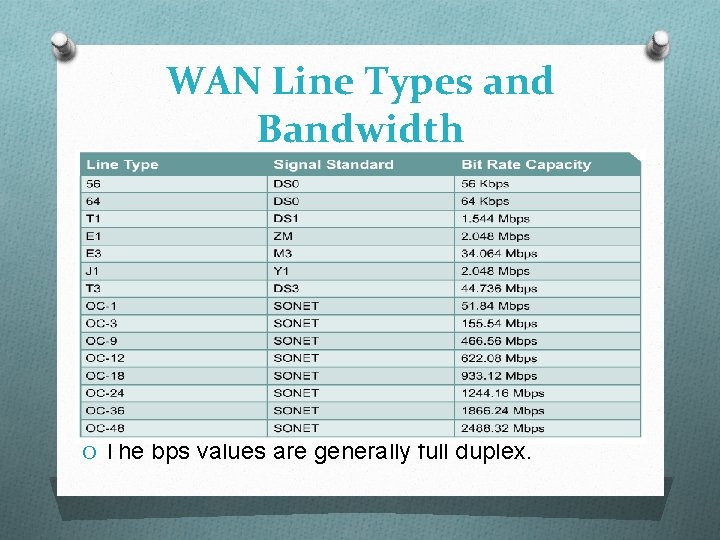
WAN Line Types and Bandwidth O The bps values are generally full duplex.
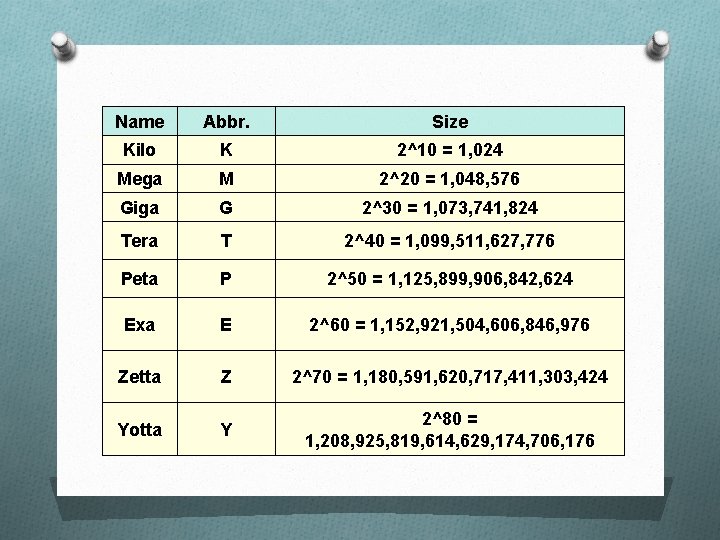
Name Abbr. Size Kilo K 2^10 = 1, 024 Mega M 2^20 = 1, 048, 576 Giga G 2^30 = 1, 073, 741, 824 Tera T 2^40 = 1, 099, 511, 627, 776 Peta P 2^50 = 1, 125, 899, 906, 842, 624 Exa E 2^60 = 1, 152, 921, 504, 606, 846, 976 Zetta Z 2^70 = 1, 180, 591, 620, 717, 411, 303, 424 Yotta Y 2^80 = 1, 208, 925, 819, 614, 629, 174, 706, 176
Link establishment and full and half duplex q Link partners are allowed to skip offering configurations of which they are capable. This allows the network administrator to force ports to a selected speed and duplex setting, without disabling Auto-Negotiation.
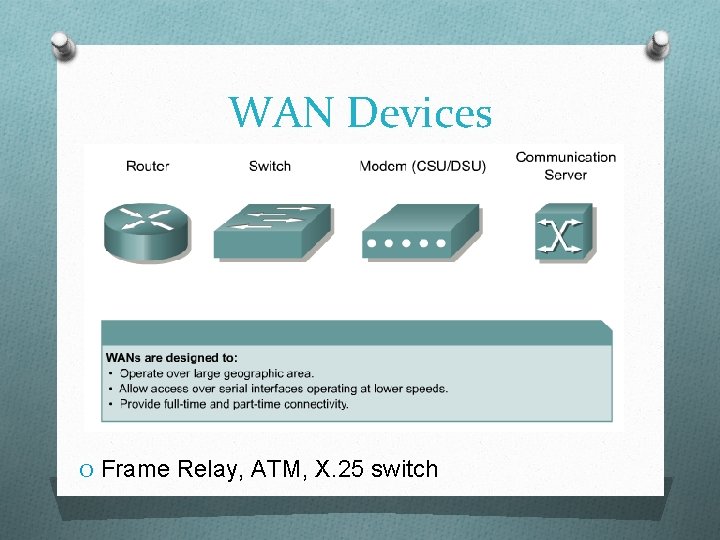
WAN Devices O Frame Relay, ATM, X. 25 switch
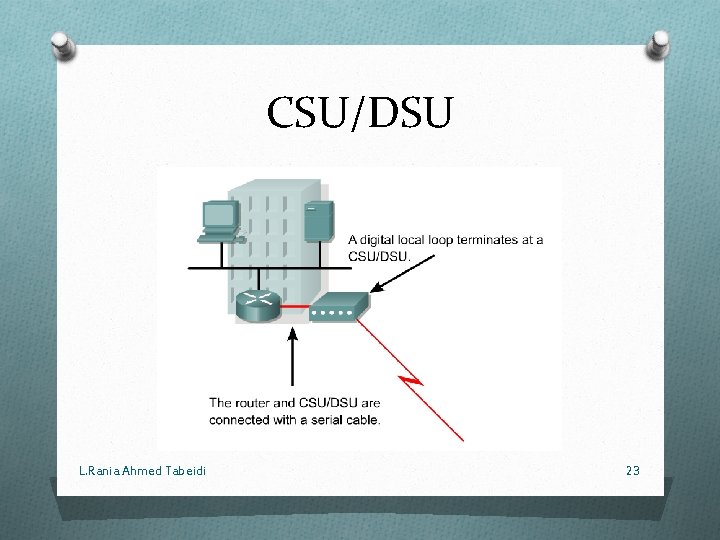
CSU/DSU L. Rania Ahmed Tabeidi 23
L. Rania Ahmed Tabeidi 24
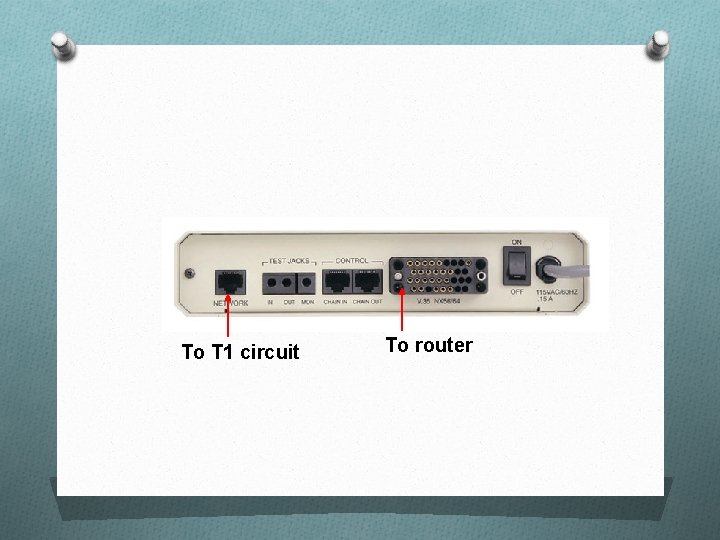
To T 1 circuit To router
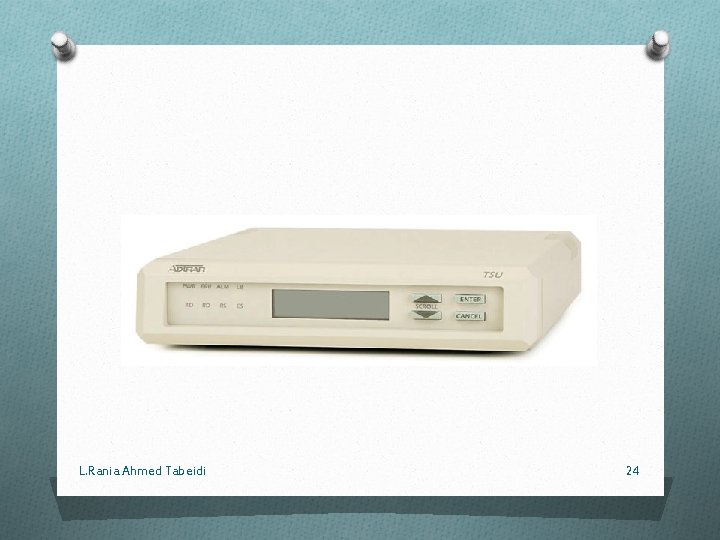
q For digital lines, a channel service unit (CSU) and a data service unit (DSU) are required. q We won’t go into the differences here. q The two are often combined into a single piece of equipment, called the CSU/DSU. L. Rania Ahmed Tabeidi 26
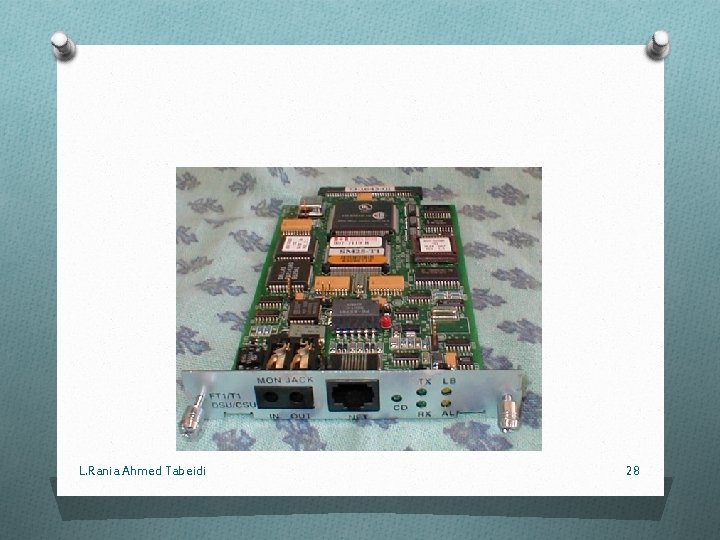
CSU/DSU Interface Card q The CSU/DSU may also be built into the interface card in the router.
L. Rania Ahmed Tabeidi 28
Modems q Modems transmit data over voice-grade telephone lines by modulating and demodulating the signal. q The digital signals are superimposed on an analog voice signal that is modulated for transmission. q At the receiving end the analog signals are returned to their digital form, or demodulated.
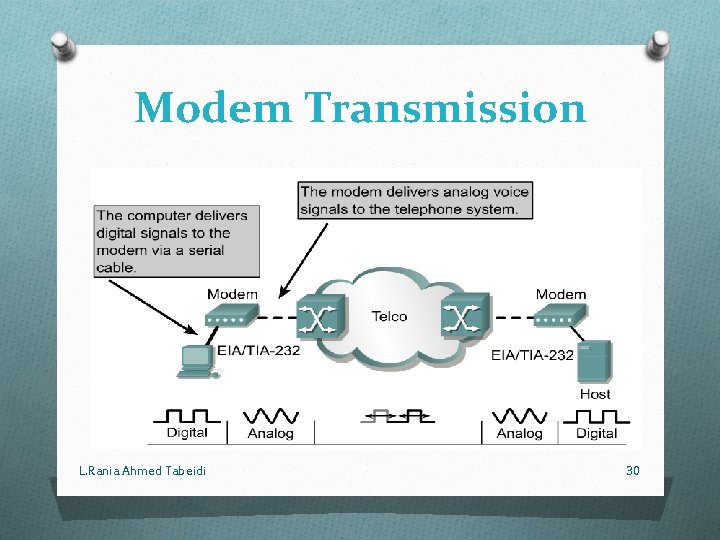
Modem Transmission L. Rania Ahmed Tabeidi 30
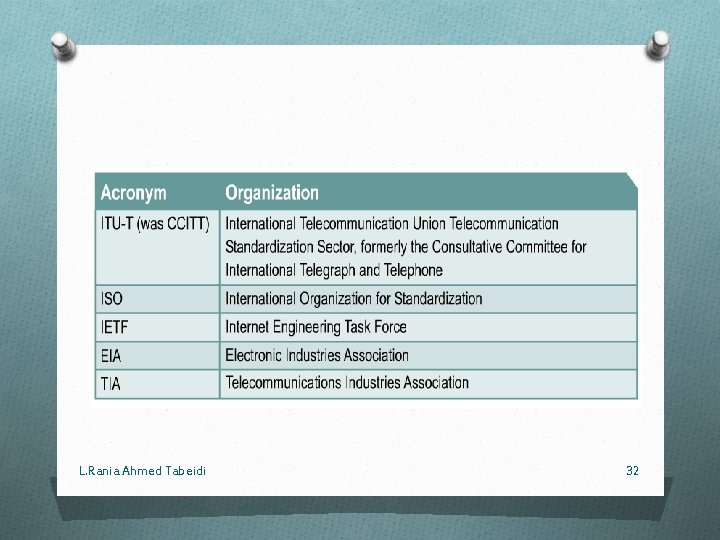
WAN Standards Organizations q WAN standards typically describe both physical layer delivery methods and data link layer requirements, including physical addressing, flow control, and encapsulation. q WAN standards are defined and managed by a number of recognized authorities.
L. Rania Ahmed Tabeidi 32
Physical Layer Standards q The physical layer protocols describe how to provide electrical, mechanical, operational, and functional connections to the services provided by a communications service provider.
L. Rania Ahmed Tabeidi 34
L. Rania Ahmed Tabeidi 35
End Slide Show # 2 L. Rania Ahmed Tabeidi 36
- Slides: 36