
Lecture 2 The Most Common Writing Errors Formal

- Slides: 11
Lecture 2 - The Most Common Writing Errors Formal and Academic Papers
Academic writing is different from creative writing or journalistic writing! • Do not write the way you speak. • Do not use slang. • Do not expect your reader to know what you mean. • Do not write in fragments. • Use complete sentences. • Always use Standard Written English (SWE)
Bad Habits to Avoid in Academic Writing • • Second person “you” Inconsistent person Inconsistent tense Abbreviations Do not use: ya, thru, wanna, gonna Do not use: etc. , & Avoid ending verbs with “en” or “in” instead of “ing”: waitin, watchen
Pronoun/Antecedent Agreement and Reference • Pronouns take the place of nouns (he, she, it, they, I, you) • The antecedent is the word to which the pronoun refers.
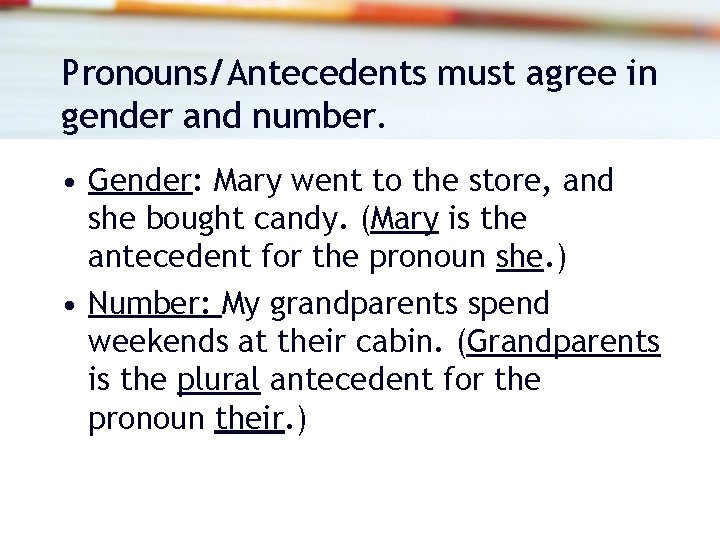
Pronouns/Antecedents must agree in gender and number. • Gender: Mary went to the store, and she bought candy. (Mary is the antecedent for the pronoun she. ) • Number: My grandparents spend weekends at their cabin. (Grandparents is the plural antecedent for the pronoun their. )
Subject/Verb Agreement • Subjects and verbs must agree in number (singular or plural) and person(first, second, third). • Number: Everyone on the committee has experienced problems. The people have many voices. • Person: She has a wonderful voice. They have much work to do.
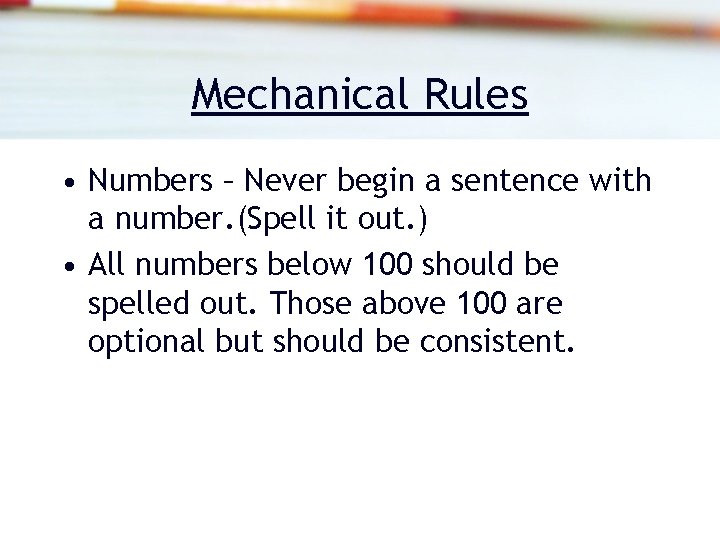
Mechanical Rules • Numbers – Never begin a sentence with a number. (Spell it out. ) • All numbers below 100 should be spelled out. Those above 100 are optional but should be consistent.
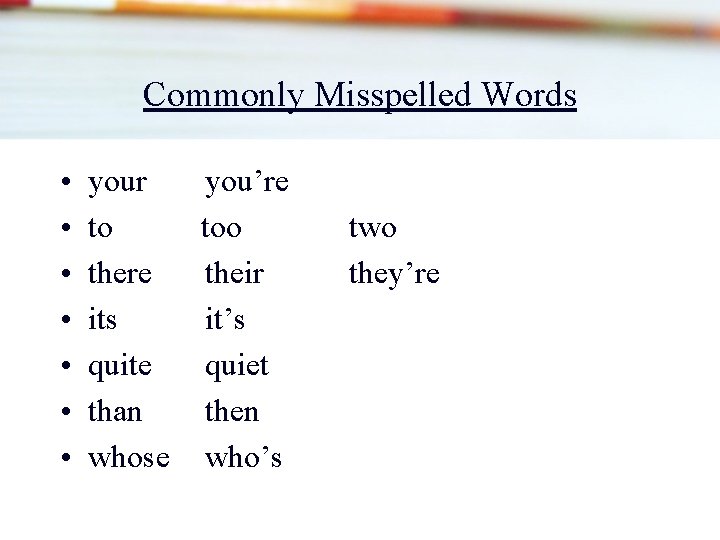
Commonly Misspelled Words • • your you’re to too there their its it’s quite quiet than then whose who’s two they’re
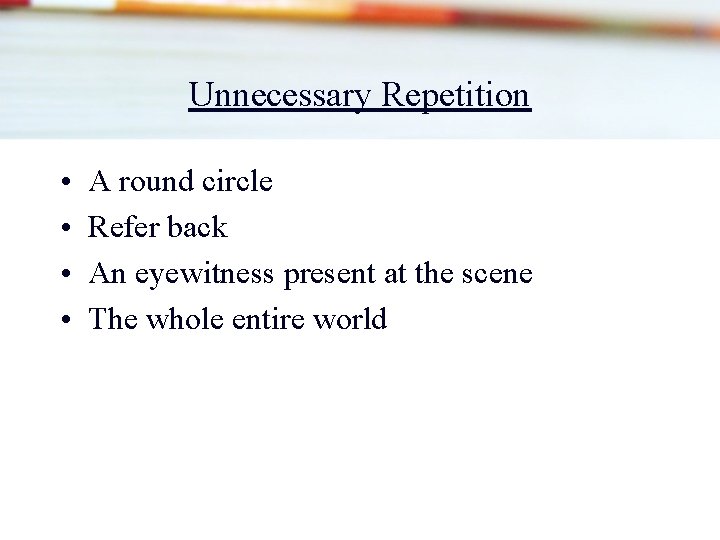
Unnecessary Repetition • • A round circle Refer back An eyewitness present at the scene The whole entire world
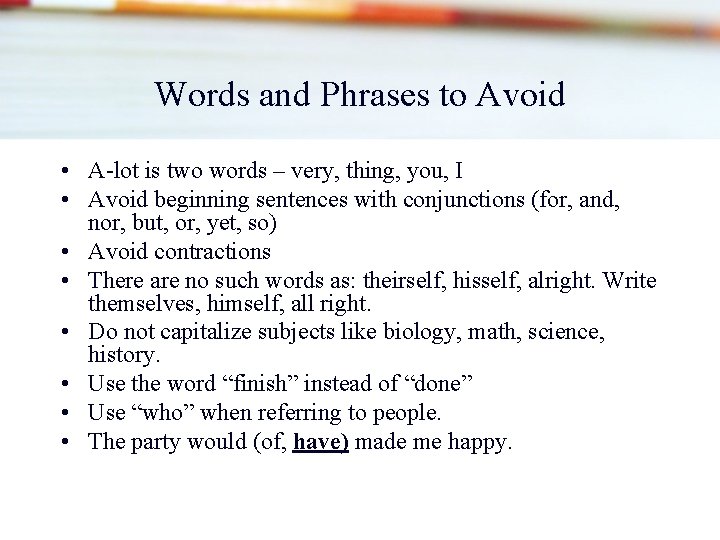
Words and Phrases to Avoid • A-lot is two words – very, thing, you, I • Avoid beginning sentences with conjunctions (for, and, nor, but, or, yet, so) • Avoid contractions • There are no such words as: theirself, hisself, alright. Write themselves, himself, all right. • Do not capitalize subjects like biology, math, science, history. • Use the word “finish” instead of “done” • Use “who” when referring to people. • The party would (of, have) made me happy.
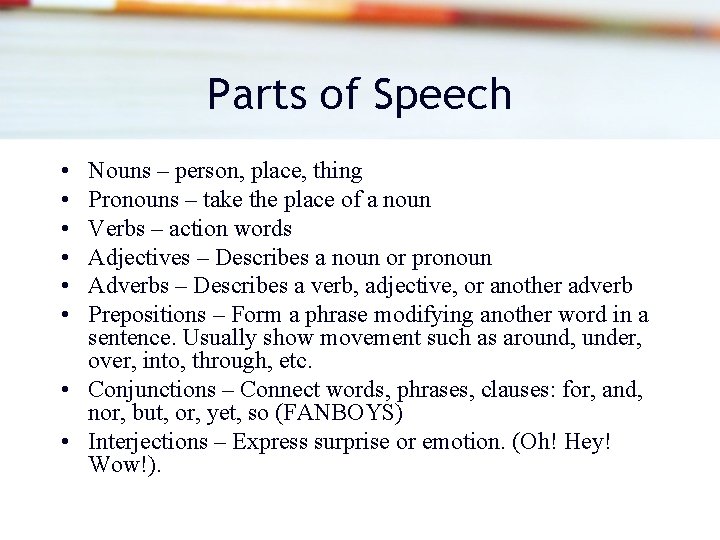
Parts of Speech • • • Nouns – person, place, thing Pronouns – take the place of a noun Verbs – action words Adjectives – Describes a noun or pronoun Adverbs – Describes a verb, adjective, or another adverb Prepositions – Form a phrase modifying another word in a sentence. Usually show movement such as around, under, over, into, through, etc. • Conjunctions – Connect words, phrases, clauses: for, and, nor, but, or, yet, so (FANBOYS) • Interjections – Express surprise or emotion. (Oh! Hey! Wow!).