
Lecture 2 The Laplace Transform Laplace transform definition

- Slides: 14
Lecture 2: The Laplace Transform • Laplace transform definition • Relation between time and Laplace domains ME 431 Lecture 2 • Laplace transform properties • Initial and Final Value Theorem • Introduction to MATLAB 1
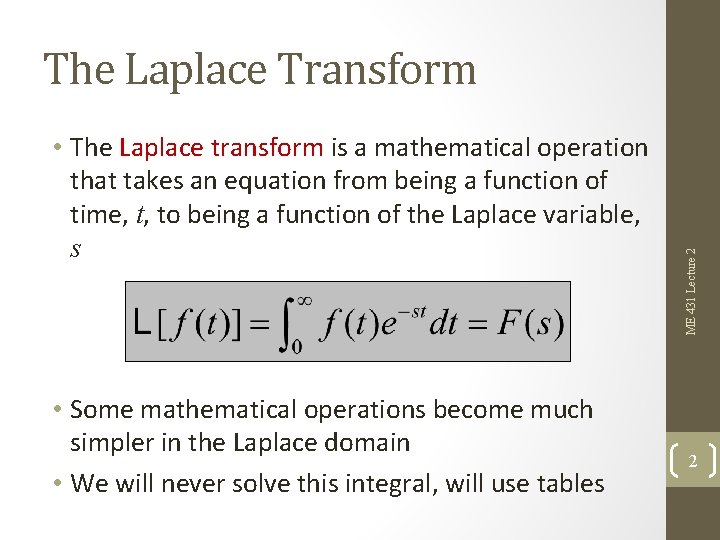
• The Laplace transform is a mathematical operation that takes an equation from being a function of time, t, to being a function of the Laplace variable, s • Some mathematical operations become much simpler in the Laplace domain • We will never solve this integral, will use tables ME 431 Lecture 2 The Laplace Transform 2
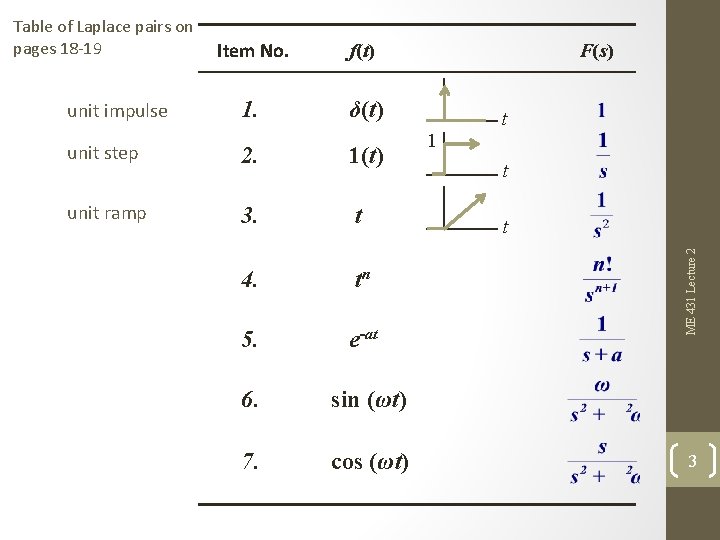
unit impulse Item No. f(t) 1. δ(t) unit step 2. 1(t) unit ramp 3. t 4. tn 5. e-at 6. sin (ωt) 7. cos (ωt) F(s) t 1 t t ME 431 Lecture 2 Table of Laplace pairs on pages 18 -19 3
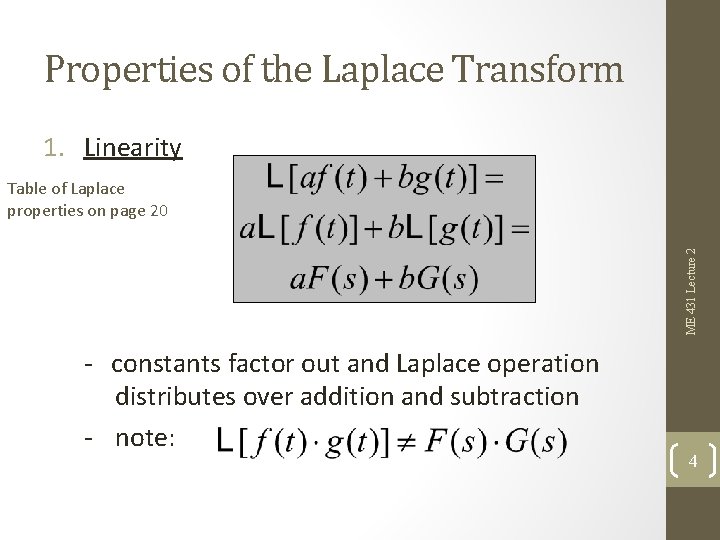
Properties of the Laplace Transform 1. Linearity ME 431 Lecture 2 Table of Laplace properties on page 20 - constants factor out and Laplace operation distributes over addition and subtraction - note: 4
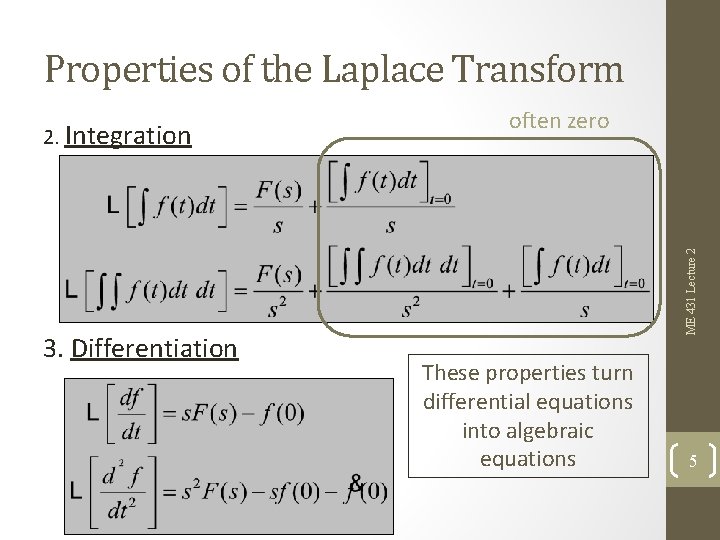
Properties of the Laplace Transform 3. Differentiation often zero ME 431 Lecture 2 2. Integration These properties turn differential equations into algebraic equations 5
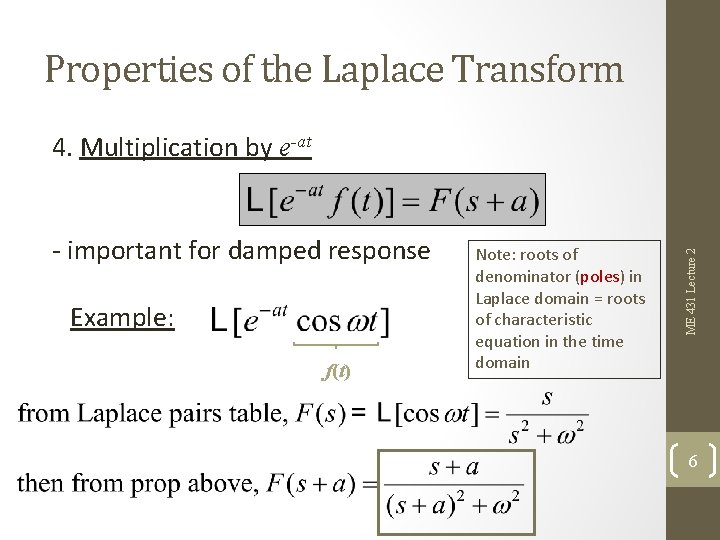
Properties of the Laplace Transform - important for damped response Example: f(t) Note: roots of denominator (poles) in Laplace domain = roots of characteristic equation in the time domain ME 431 Lecture 2 4. Multiplication by e-at 6
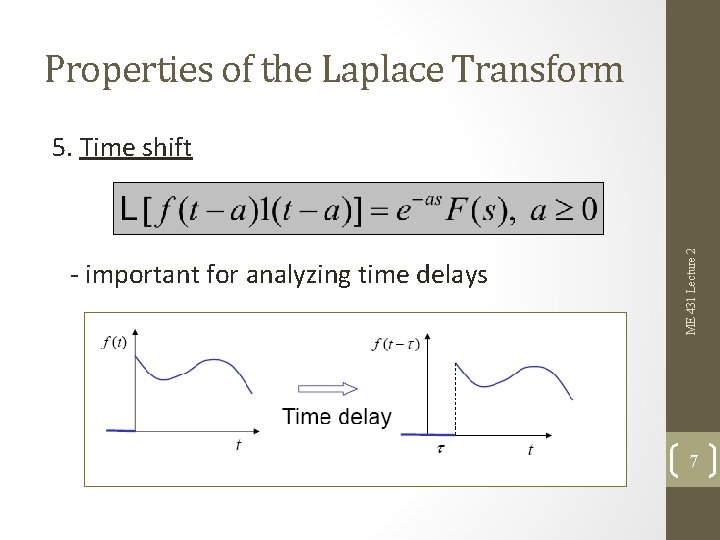
Properties of the Laplace Transform - important for analyzing time delays ME 431 Lecture 2 5. Time shift 7
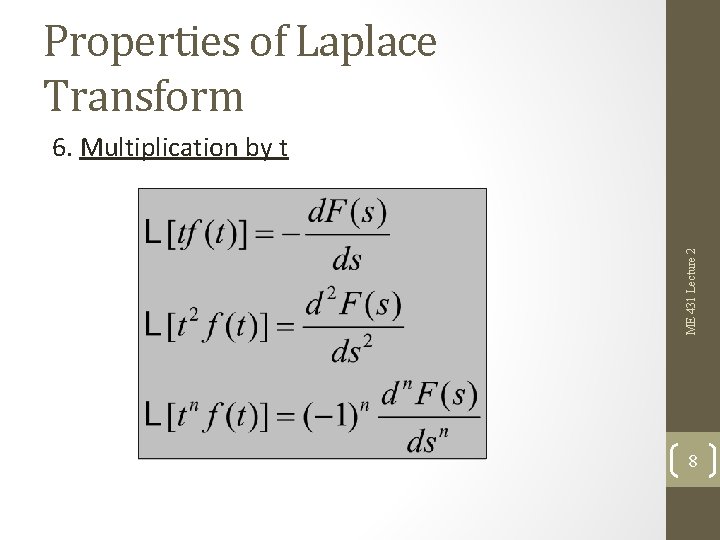
Properties of Laplace Transform ME 431 Lecture 2 6. Multiplication by t 8
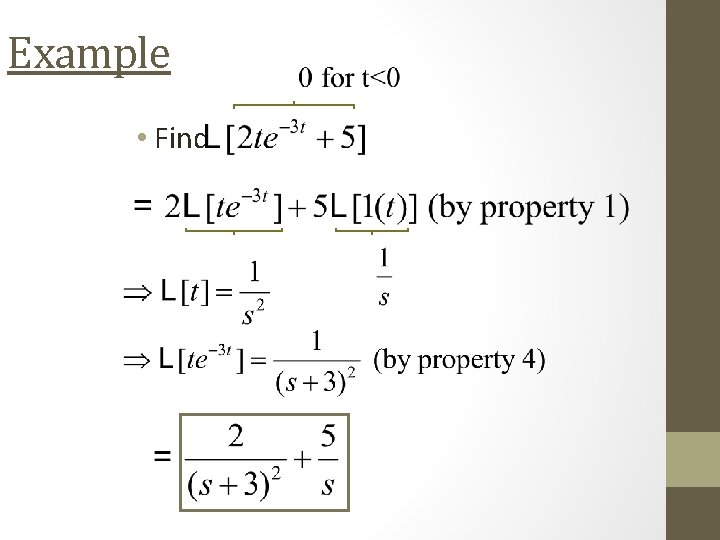
Example • Find
Example
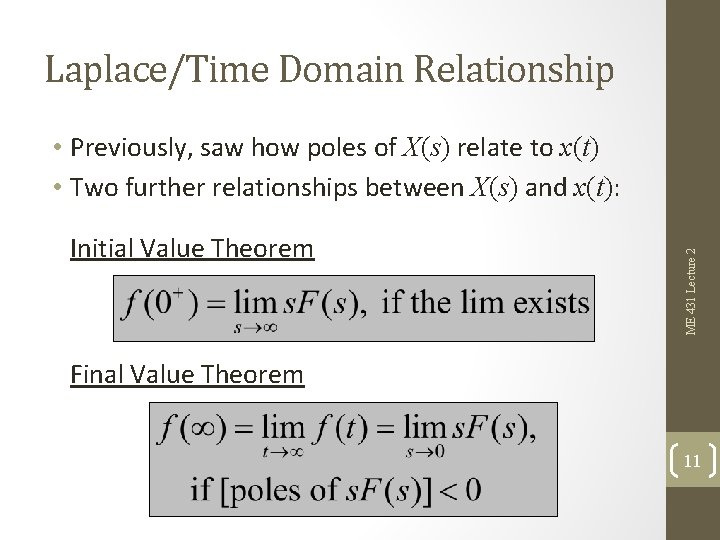
Laplace/Time Domain Relationship Initial Value Theorem ME 431 Lecture 2 • Previously, saw how poles of X(s) relate to x(t) • Two further relationships between X(s) and x(t): Final Value Theorem 11
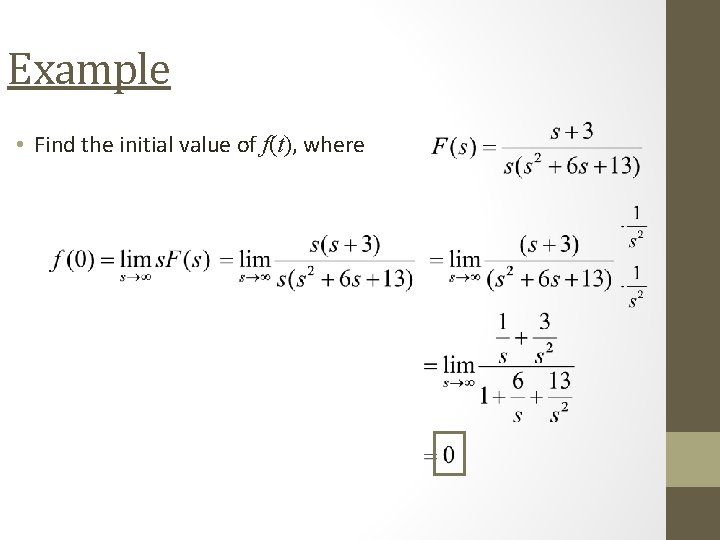
Example • Find the initial value of f(t), where
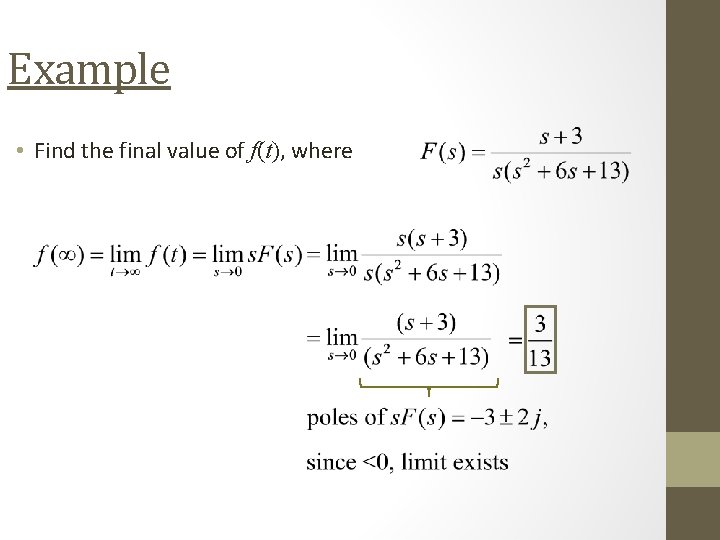
Example • Find the final value of f(t), where
ME 431 Lecture 2 MATLAB Introduction 14