
LECTURE 2 Skeletal System I 1 Introduction The
- Slides: 38
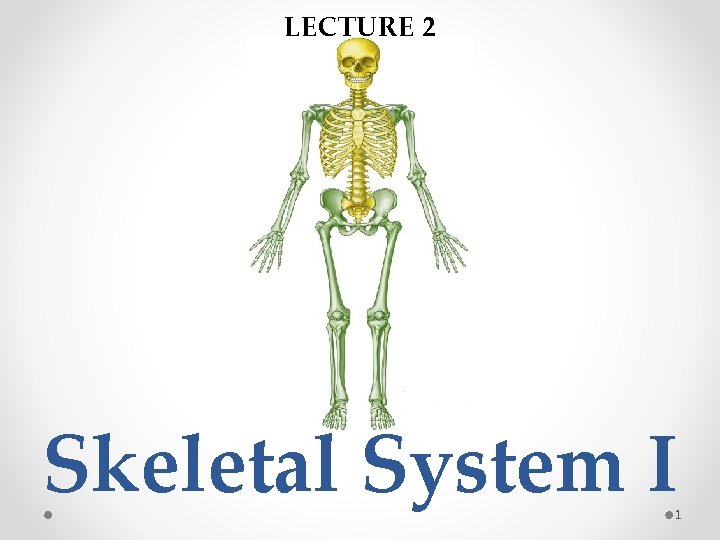
LECTURE 2 Skeletal System I 1
Introduction The adult skeletal system consists of 206 bones. At birth, the skeleton consists of about 270 bones and increases during infancy as (ossification) occurs. During adolescence, however, the number of bones decreases, as separate bones gradually fuse. Bone, or osseous tissue, is a hard, dense connective tissue that forms most of the adult skeleton. Cartilage is a semi-rigid form of connective tissue. 2
The Functions of the Skeletal System 1. Supports the body 2. Facilitates movement 3. Protects internal organs 4. Produces blood cells (Hematopoiesis) 5. Stores and releases minerals and fat 3
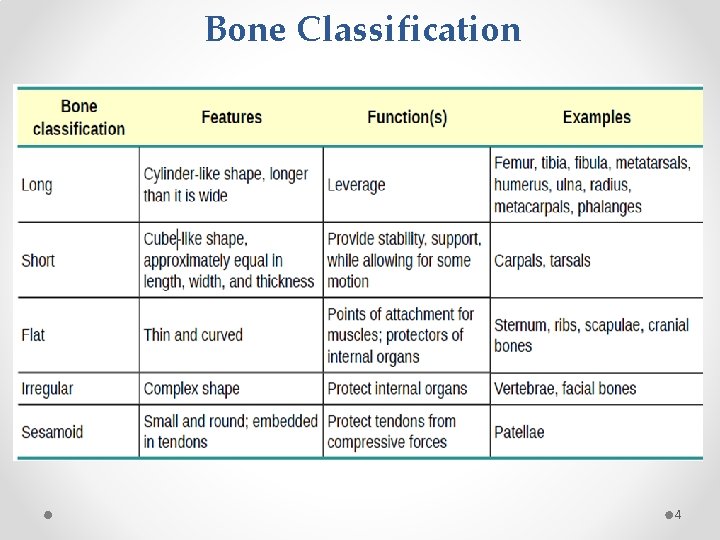
Bone Classification 4
Bone Structure Ø A tough organic matrix (30% by weight). • Collagen fibers (90 to 95%): give bone powerful tensile strength and flexibility. • Ground substance: extracellular fluid + proteoglycans (chondroitin sulfate & hyaluronic acid). ØInorganic compound (bone salts (70% by weight): mainly Ca+2 and PO 4 -3 salts. Also, Mg(OH)2, F & SO 4 -2. Ca salts (hydroxyapatite crystalline) have great compressional strength. 5
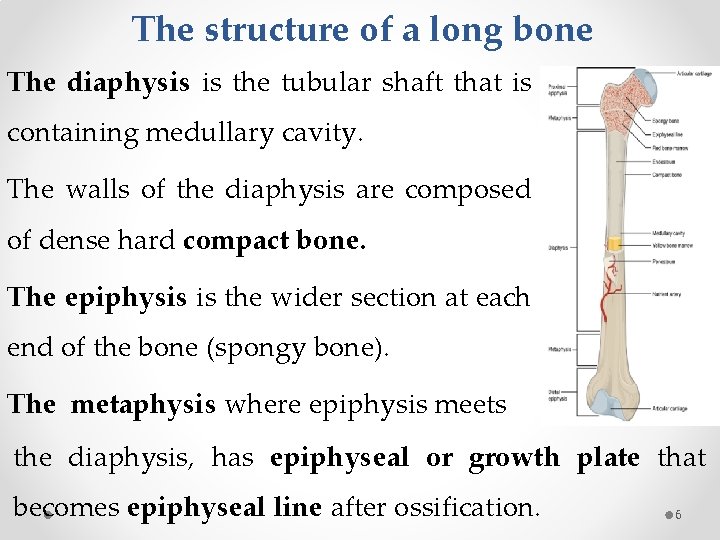
The structure of a long bone The diaphysis is the tubular shaft that is containing medullary cavity. The walls of the diaphysis are composed of dense hard compact bone. The epiphysis is the wider section at each end of the bone (spongy bone). The metaphysis where epiphysis meets the diaphysis, has epiphyseal or growth plate that becomes epiphyseal line after ossification. 6
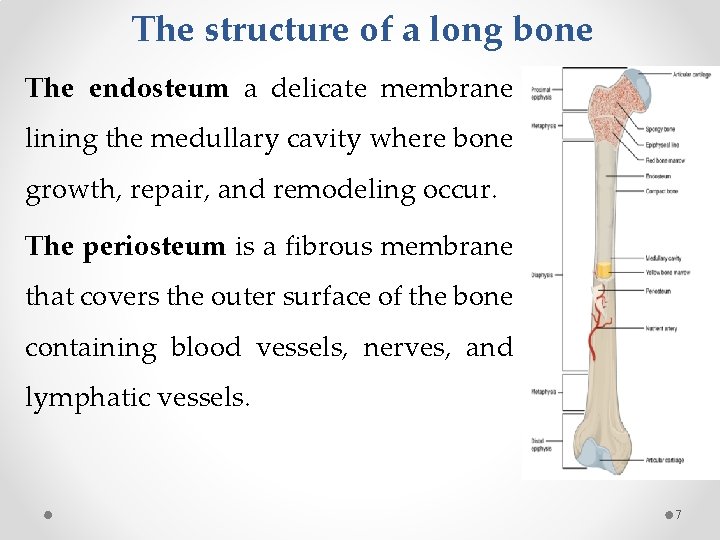
The structure of a long bone The endosteum a delicate membrane lining the medullary cavity where bone growth, repair, and remodeling occur. The periosteum is a fibrous membrane that covers the outer surface of the bone containing blood vessels, nerves, and lymphatic vessels. 7
Bone Cells 1. The osteoblast responsible forming new bone 2. The osteocyte is the primary cell of mature bone and the most common type of bone cell. 3. The osteogenic cell is undifferentiated cells and they are the only bone cells that divide. 4. The osteoclast responsible for bone resorption, or breakdown. They are multinucleated, and originate from monocytes and macrophages not from osteogenic cells. 8
Bone Remodeling Bone modeling describes the process whereby bones are shaped or reshaped by the independent action of osteoblasts and osteoclasts. In adult life, bone undergoes remodeling, in which resorbed old or damaged bone is replaced by new bone. About 5 to 10 % of the skeleton is remodeled annually. A fracture is a broken bone. 9
Calcium Homeostasis Calcium is the most abundant mineral in bone & in the human body. Ø 0. 1 % of the total body calcium is in the extracellular fluid Ø 1 % is in the cells and its organelles Ø 99% is stored in bones. The normal level of calcium in the blood is about 9. 4 mg/d. L (8. 5 -10. 2 mg/d. L). 10
Calcium Homeostasis In hypocalcaemia, when calcium is not binding to calcium receptors of the parathyroid gland , the cells release PTH, which: Ø stimulates osteoclast activity releasing calcium into the blood. Ø promotes reabsorption of calcium from the urine. Ø stimulates the synthesis of vitamin D increasing calcium absorption from any digested food in the small intestine. 11
Calcium Homeostasis Hypercalcaemia stimulates thyroid gland to release calcitonin, which: Ø inhibits osteoclast activity and stimulates calcium uptake by the bones Ø decreases reabsorption of calcium by the kidneys. All of these actions lower blood levels of calcium. When blood calcium levels return to normal, the thyroid gland stops secreting calcitonin. 12
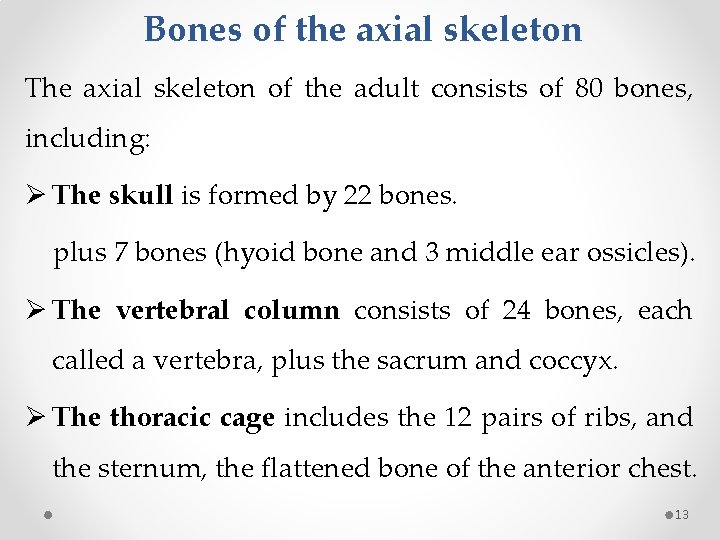
Bones of the axial skeleton The axial skeleton of the adult consists of 80 bones, including: Ø The skull is formed by 22 bones. plus 7 bones (hyoid bone and 3 middle ear ossicles). Ø The vertebral column consists of 24 bones, each called a vertebra, plus the sacrum and coccyx. Ø The thoracic cage includes the 12 pairs of ribs, and the sternum, the flattened bone of the anterior chest. 13
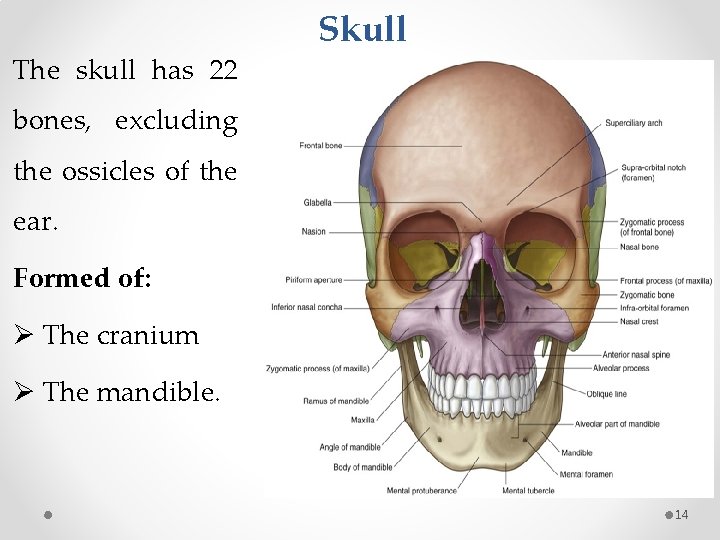
The skull has 22 Skull bones, excluding the ossicles of the ear. Formed of: Ø The cranium Ø The mandible. 14
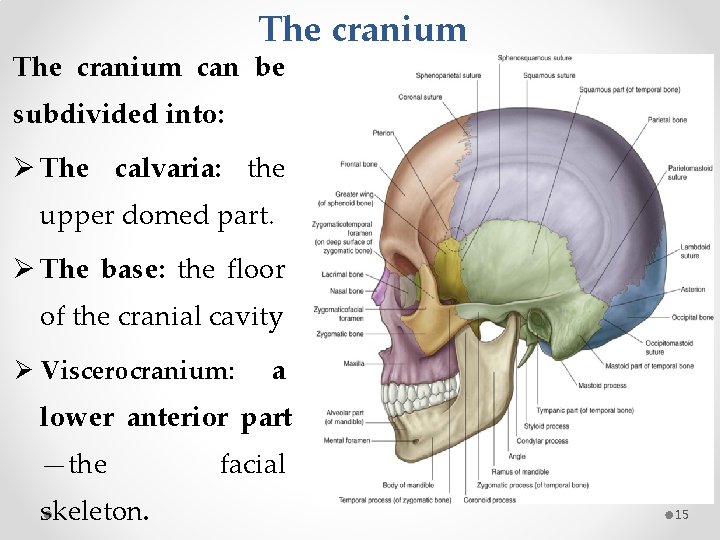
The cranium can be subdivided into: Ø The calvaria: the upper domed part. Ø The base: the floor of the cranial cavity Ø Viscerocranium: a lower anterior part —the skeleton. facial 15
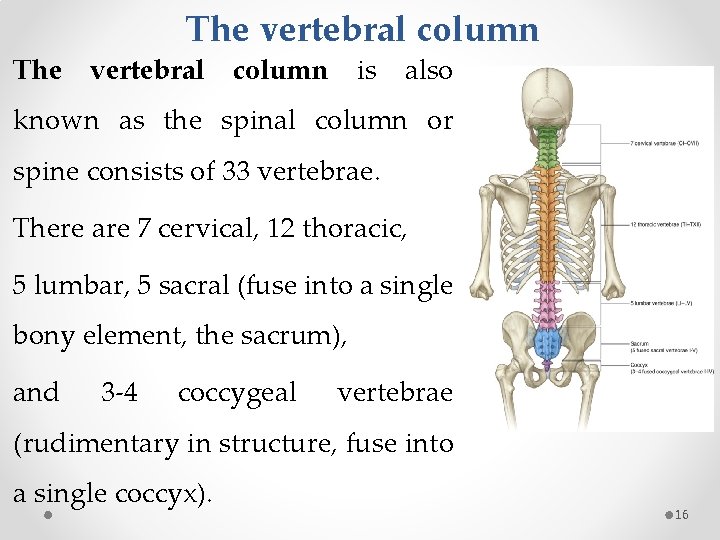
The vertebral column is also known as the spinal column or spine consists of 33 vertebrae. There are 7 cervical, 12 thoracic, 5 lumbar, 5 sacral (fuse into a single bony element, the sacrum), and 3 -4 coccygeal vertebrae (rudimentary in structure, fuse into a single coccyx). 16
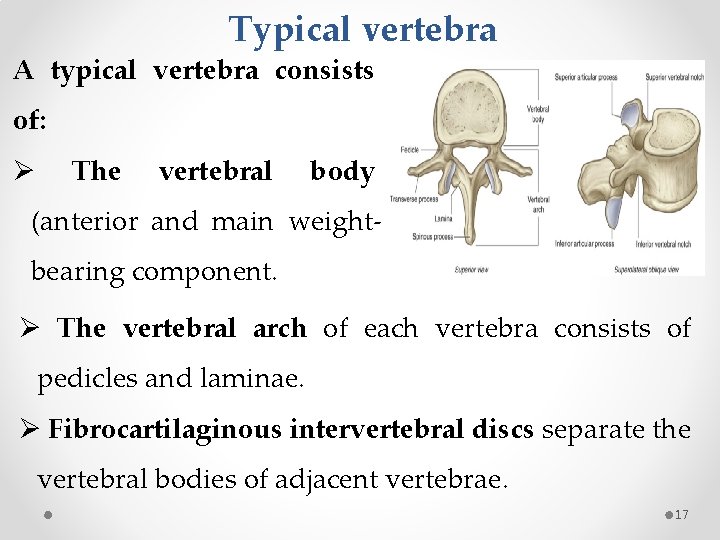
Typical vertebra A typical vertebra consists of: Ø The vertebral body (anterior and main weightbearing component. Ø The vertebral arch of each vertebra consists of pedicles and laminae. Ø Fibrocartilaginous intervertebral discs separate the vertebral bodies of adjacent vertebrae. 17
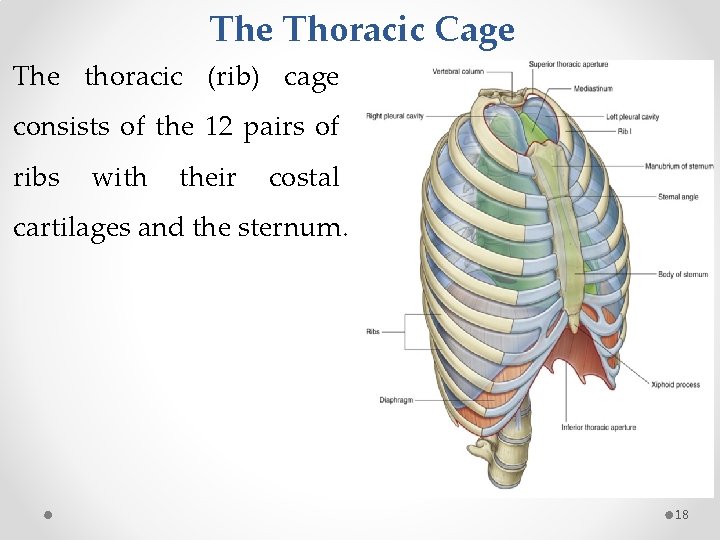
The Thoracic Cage The thoracic (rib) cage consists of the 12 pairs of ribs with their costal cartilages and the sternum. 18
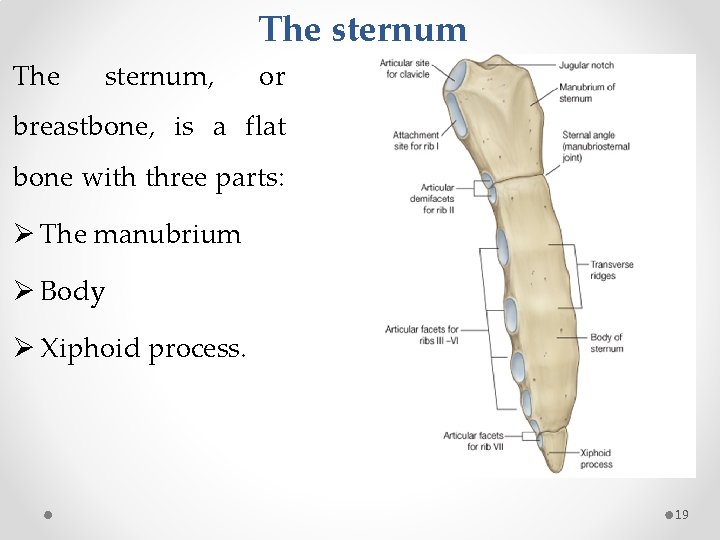
The sternum, or breastbone, is a flat bone with three parts: Ø The manubrium Ø Body Ø Xiphoid process. 19
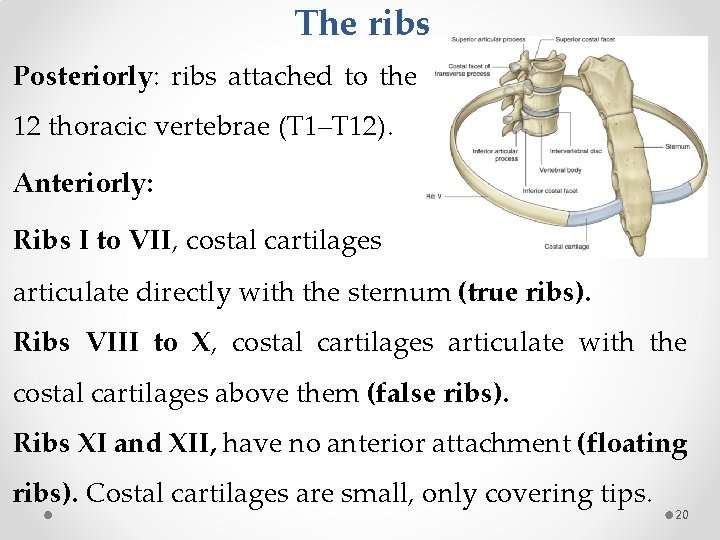
The ribs Posteriorly: ribs attached to the 12 thoracic vertebrae (T 1–T 12). Anteriorly: Ribs I to VII, costal cartilages articulate directly with the sternum (true ribs). Ribs VIII to X, costal cartilages articulate with the costal cartilages above them (false ribs). Ribs XI and XII, have no anterior attachment (floating ribs). Costal cartilages are small, only covering tips. 20
The Appendicular Skeleton The appendicular skeleton includes all bones of the upper and lower limbs, plus the bones that attach each limb to the axial skeleton, pelvic (shoulder) and pelvic girdles. There are 126 bones in the appendicular skeleton of an adult. 21
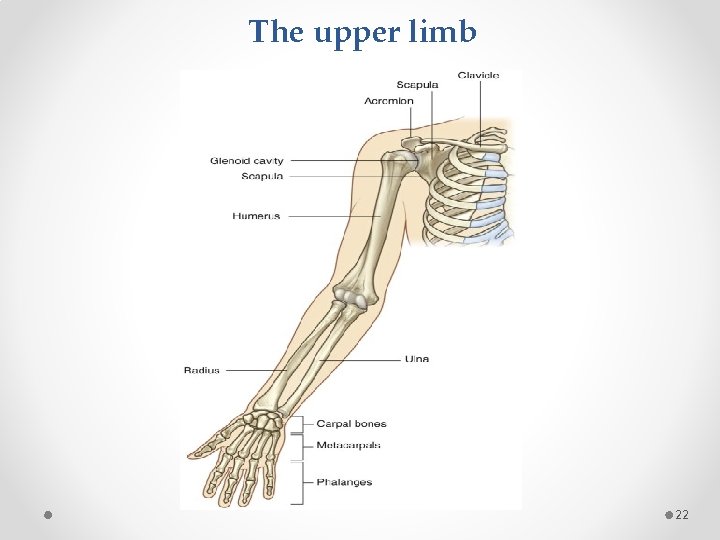
The upper limb 22
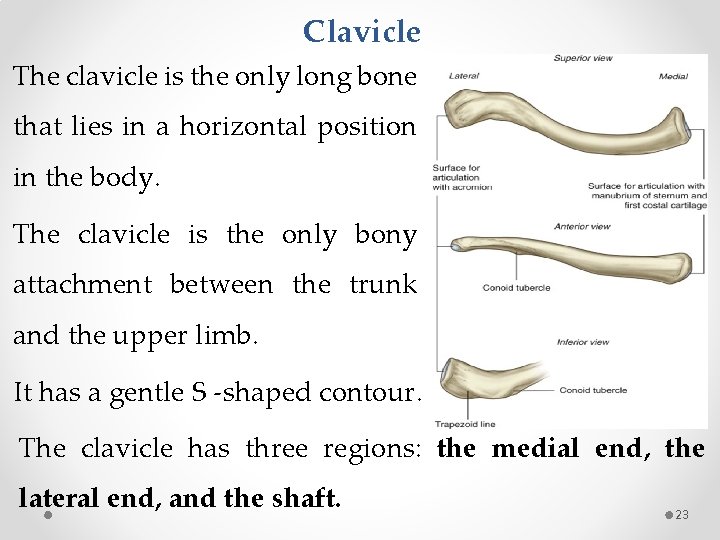
Clavicle The clavicle is the only long bone that lies in a horizontal position in the body. The clavicle is the only bony attachment between the trunk and the upper limb. It has a gentle S -shaped contour. The clavicle has three regions: the medial end, the lateral end, and the shaft. 23
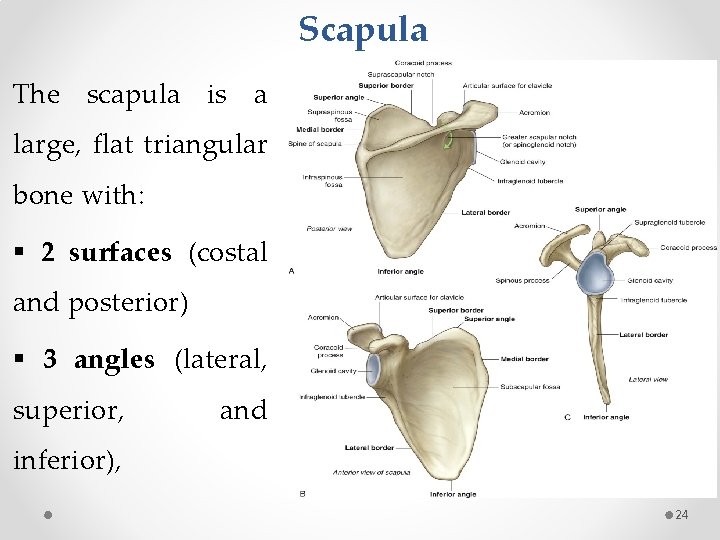
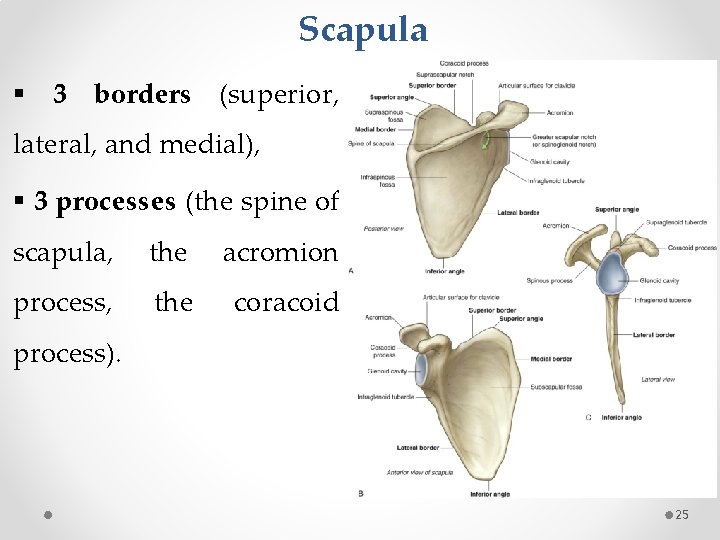
Scapula The scapula is a large, flat triangular bone with: § 2 surfaces (costal and posterior) § 3 angles (lateral, superior, and inferior), 24
Scapula § 3 borders (superior, lateral, and medial), § 3 processes (the spine of scapula, the acromion process, the coracoid process). 25
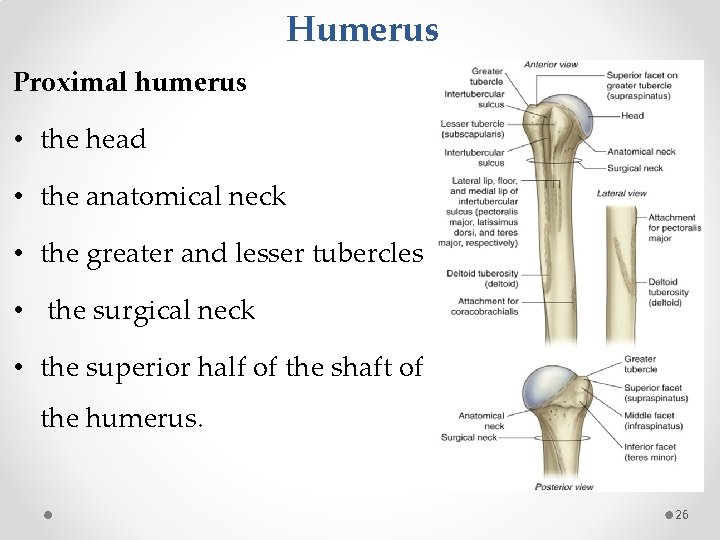
Humerus Proximal humerus • the head • the anatomical neck • the greater and lesser tubercles • the surgical neck • the superior half of the shaft of the humerus. 26
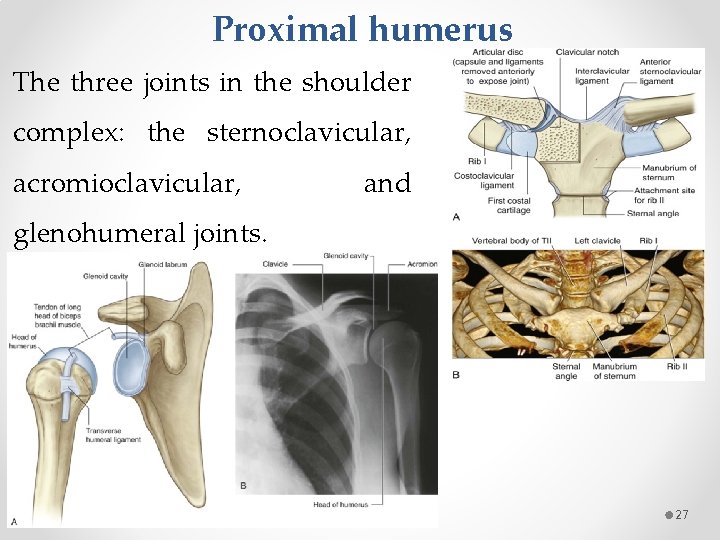
Proximal humerus The three joints in the shoulder complex: the sternoclavicular, acromioclavicular, and glenohumeral joints. 27
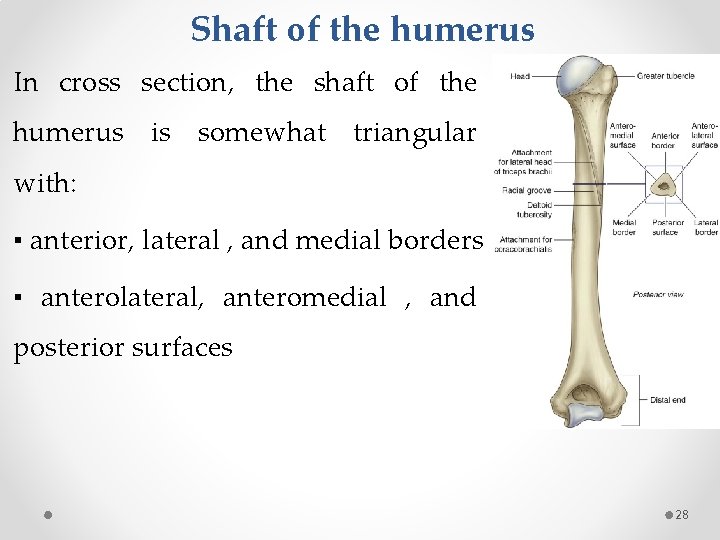
Shaft of the humerus In cross section, the shaft of the humerus is somewhat triangular with: ▪ anterior, lateral , and medial borders ▪ anterolateral, anteromedial , and posterior surfaces 28
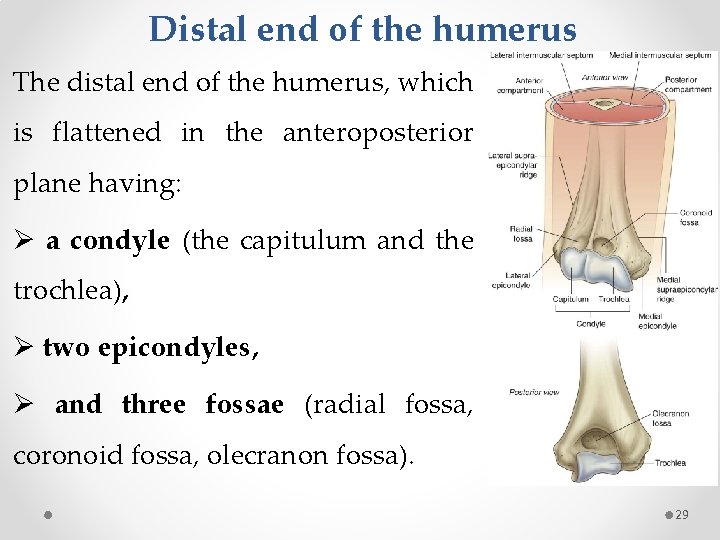
Distal end of the humerus The distal end of the humerus, which is flattened in the anteroposterior plane having: Ø a condyle (the capitulum and the trochlea), Ø two epicondyles, Ø and three fossae (radial fossa, coronoid fossa, olecranon fossa). 29
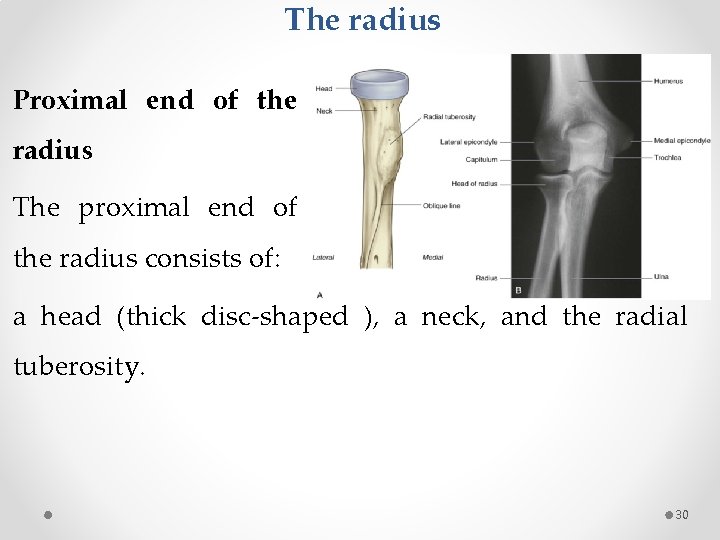
The radius Proximal end of the radius The proximal end of the radius consists of: a head (thick disc-shaped ), a neck, and the radial tuberosity. 30
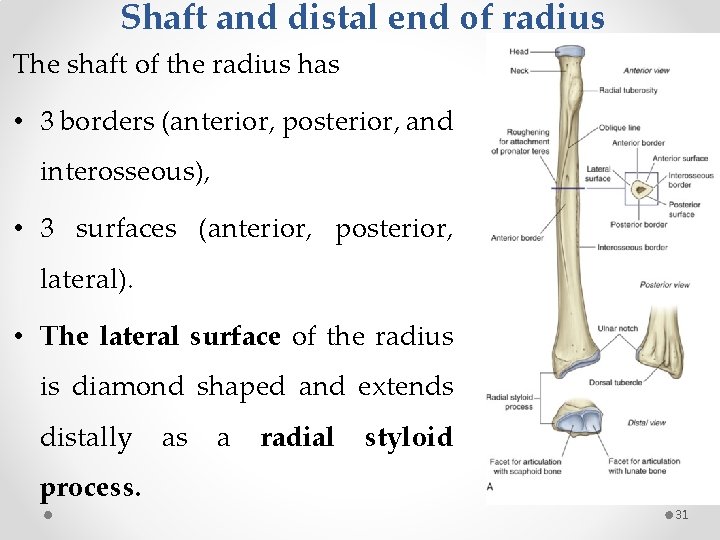
Shaft and distal end of radius The shaft of the radius has • 3 borders (anterior, posterior, and interosseous), • 3 surfaces (anterior, posterior, lateral). • The lateral surface of the radius is diamond shaped and extends distally as a radial styloid process. 31
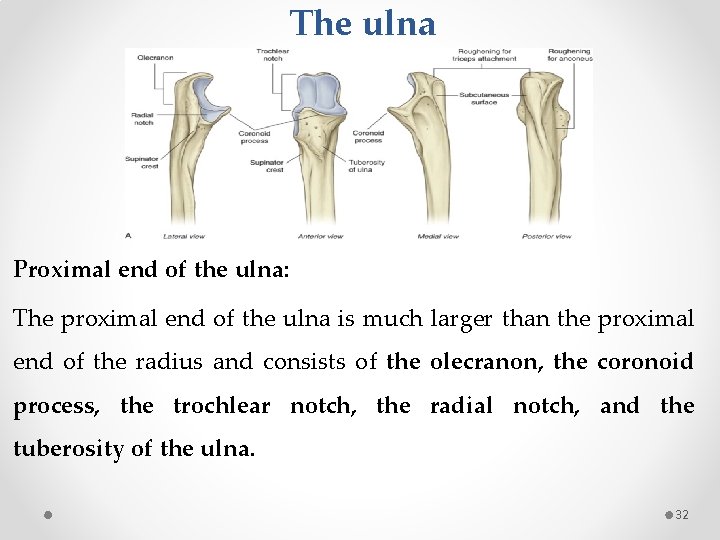
The ulna Proximal end of the ulna: The proximal end of the ulna is much larger than the proximal end of the radius and consists of the olecranon, the coronoid process, the trochlear notch, the radial notch, and the tuberosity of the ulna. 32
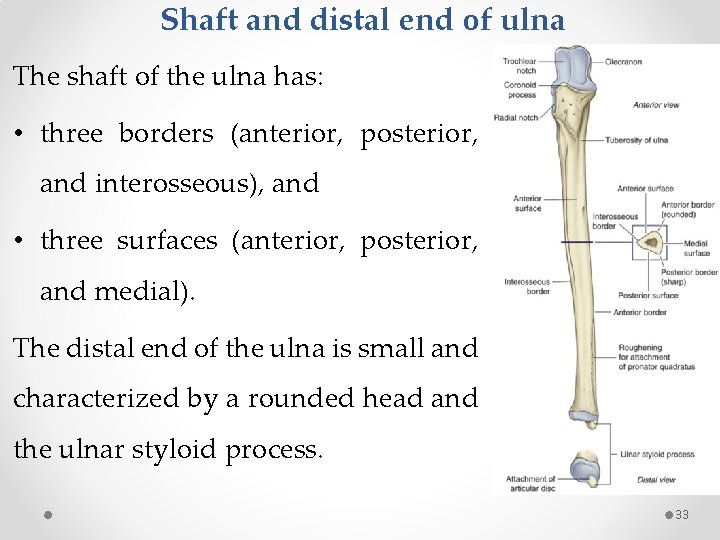
Shaft and distal end of ulna The shaft of the ulna has: • three borders (anterior, posterior, and interosseous), and • three surfaces (anterior, posterior, and medial). The distal end of the ulna is small and characterized by a rounded head and the ulnar styloid process. 33
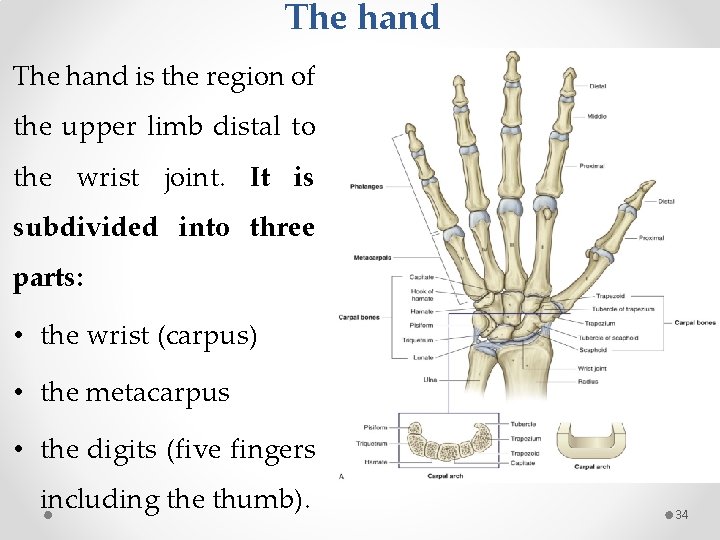
The hand is the region of the upper limb distal to the wrist joint. It is subdivided into three parts: • the wrist (carpus) • the metacarpus • the digits (five fingers including the thumb). 34
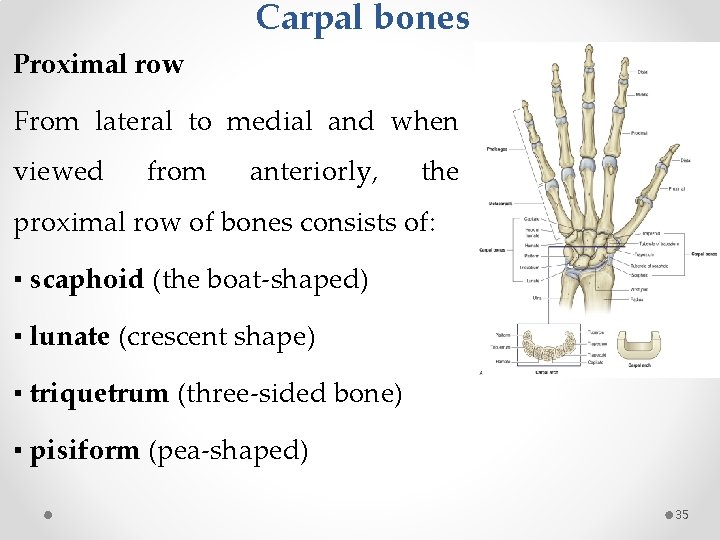
Carpal bones Proximal row From lateral to medial and when viewed from anteriorly, the proximal row of bones consists of: ▪ scaphoid (the boat-shaped) ▪ lunate (crescent shape) ▪ triquetrum (three-sided bone) ▪ pisiform (pea-shaped) 35
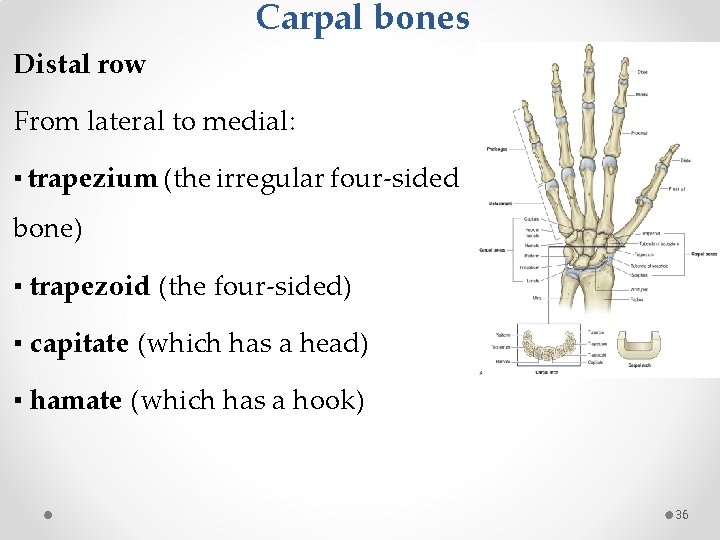
Carpal bones Distal row From lateral to medial: ▪ trapezium (the irregular four-sided bone) ▪ trapezoid (the four-sided) ▪ capitate (which has a head) ▪ hamate (which has a hook) 36
Metacarpals Each of the five metacarpals is related to one digit: Each metacarpal consists of a base, a shaft ( body ), and distally, a head. All of the bases of the metacarpals articulate with the carpal bones; and with each other. All of the heads of the metacarpals articulate with the proximal phalanges of the digits. 37
Phalanges The phalanges are the bones of the digits: The thumb has two—a proximal and a distal phalanx. The rest of the digits have three—a proximal, a middle, and a distal phalanx. Each phalanx has a base, a shaft and a head. The base of each proximal phalanx articulates with the head of the related metacarpal bone. The head of each distal phalanx is nonarticular. 38