
Lecture 2 RTL Design Methodology Transition from Pseudocode



![Protocol (1) An external circuit first loads all round keys S[0], S[1], S[2], …,](https://slidetodoc.com/presentation_image_h2/b5ff8ae5e9f0e3cd20894ed5560fb0f4/image-19.jpg "Protocol (1) An external circuit first loads all round keys S[0], S[1], S[2], …,")
- Slides: 21
Lecture 2 RTL Design Methodology Transition from Pseudocode & Interface to a Corresponding Block Diagram
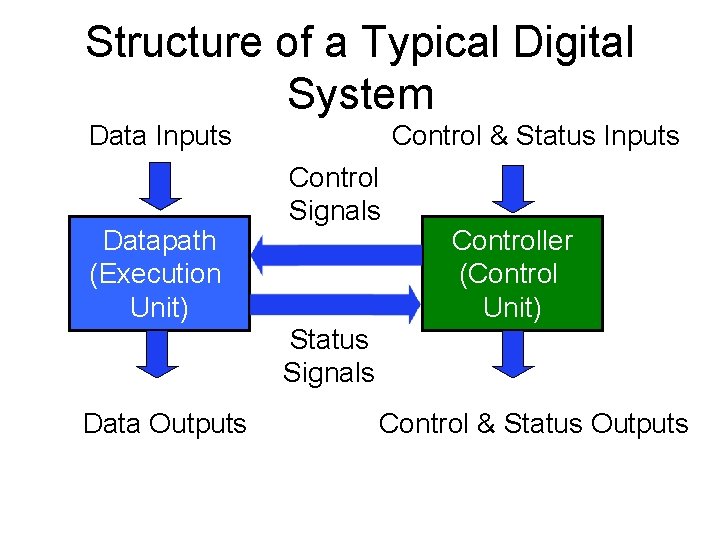
Structure of a Typical Digital System Data Inputs Datapath (Execution Unit) Control & Status Inputs Control Signals Controller (Control Unit) Status Signals Data Outputs Control & Status Outputs
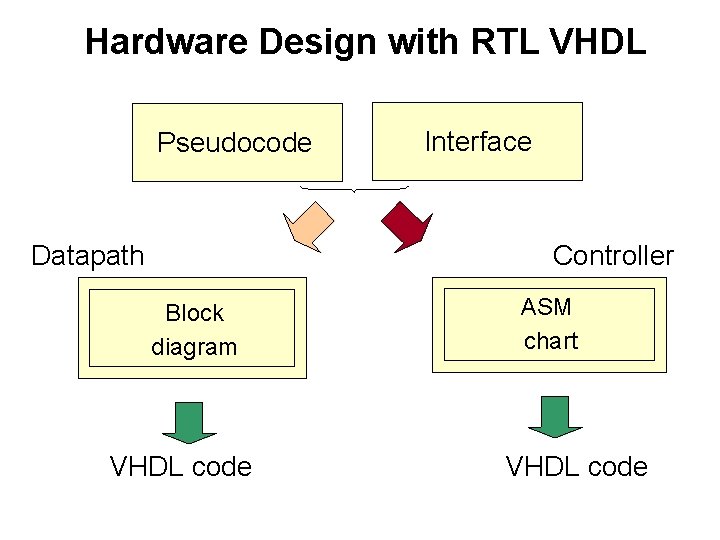
Hardware Design with RTL VHDL Pseudocode Datapath Interface Controller Block diagram VHDL code ASM chart VHDL code
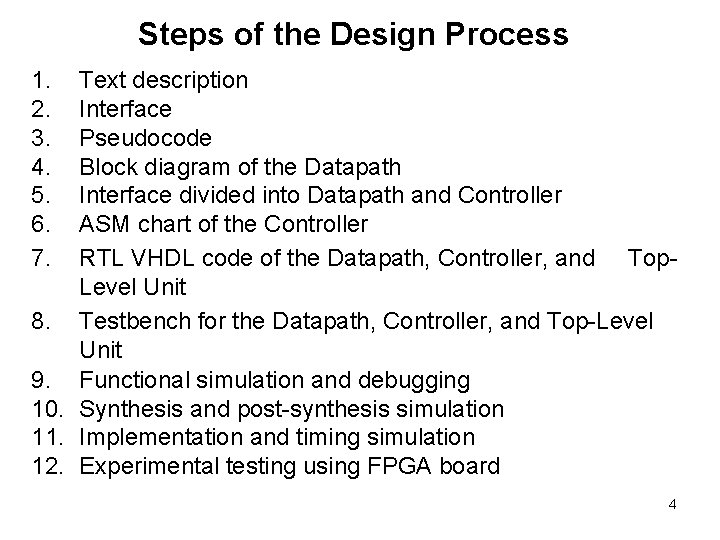
Steps of the Design Process 1. 2. 3. 4. 5. 6. 7. Text description Interface Pseudocode Block diagram of the Datapath Interface divided into Datapath and Controller ASM chart of the Controller RTL VHDL code of the Datapath, Controller, and Top. Level Unit 8. Testbench for the Datapath, Controller, and Top-Level Unit 9. Functional simulation and debugging 10. Synthesis and post-synthesis simulation 11. Implementation and timing simulation 12. Experimental testing using FPGA board 4
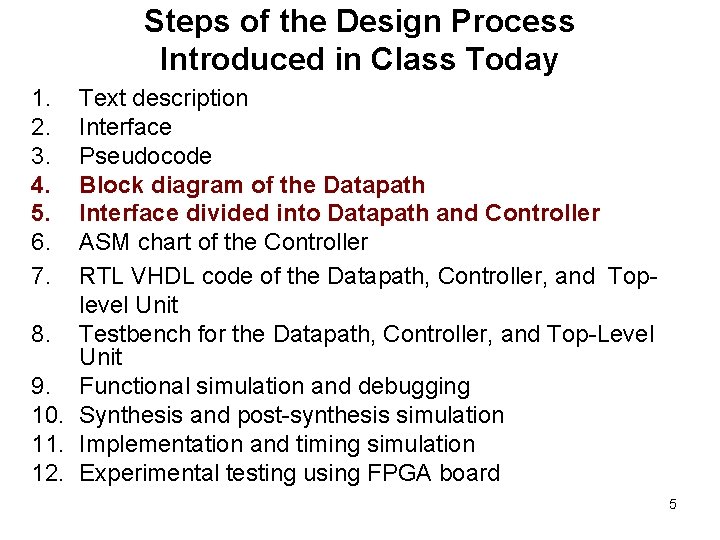
Steps of the Design Process Introduced in Class Today 1. 2. 3. 4. 5. 6. 7. Text description Interface Pseudocode Block diagram of the Datapath Interface divided into Datapath and Controller ASM chart of the Controller RTL VHDL code of the Datapath, Controller, and Toplevel Unit 8. Testbench for the Datapath, Controller, and Top-Level Unit 9. Functional simulation and debugging 10. Synthesis and post-synthesis simulation 11. Implementation and timing simulation 12. Experimental testing using FPGA board 5
Class Exercise 1 STATISTICS
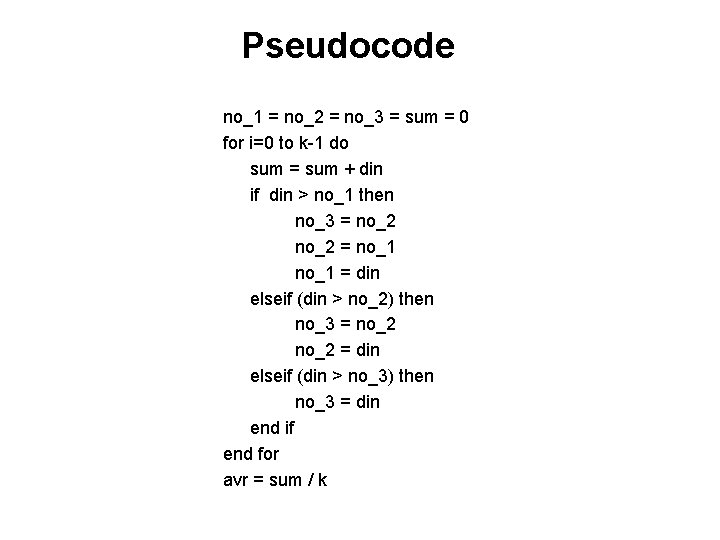
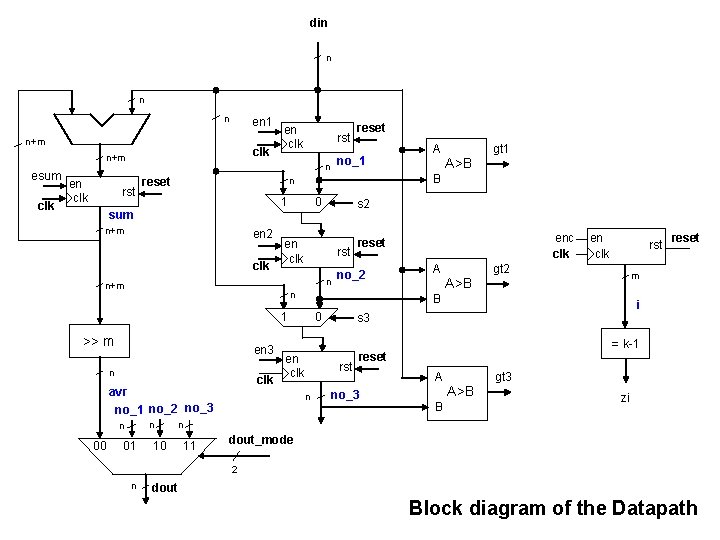
Pseudocode no_1 = no_2 = no_3 = sum = 0 for i=0 to k-1 do sum = sum + din if din > no_1 then no_3 = no_2 = no_1 = din elseif (din > no_2) then no_3 = no_2 = din elseif (din > no_3) then no_3 = din end if end for avr = sum / k
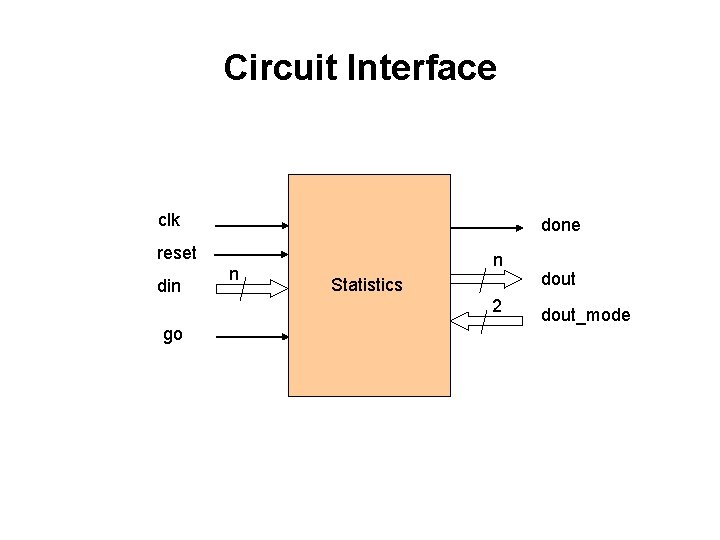
Circuit Interface clk done reset din go n n Statistics 2 dout_mode
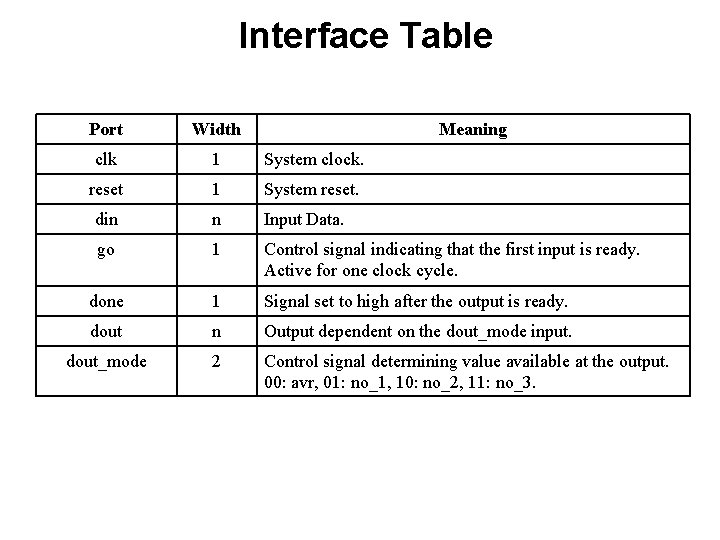
Interface Table Port Width Meaning clk 1 System clock. reset 1 System reset. din n Input Data. go 1 Control signal indicating that the first input is ready. Active for one clock cycle. done 1 Signal set to high after the output is ready. dout n Output dependent on the dout_mode input. dout_mode 2 Control signal determining value available at the output. 00: avr, 01: no_1, 10: no_2, 11: no_3.
STATISTICS: Solutions
din n en 1 n+m clk n+m esum clk en clk rst no_1 n n reset 1 sum n+m en 2 clk 0 rst n n clk avr no_1 no_2 no_3 n n 01 gt 1 B enc clk no_2 A A>B en clk rst gt 2 0 reset m B 1 en 3 A>B reset n >> m A s 2 en clk n+m 00 reset i s 3 = k-1 en clk rst n reset no_3 A B A>B gt 3 zi n 10 11 dout_mode 2 n dout Block diagram of the Datapath
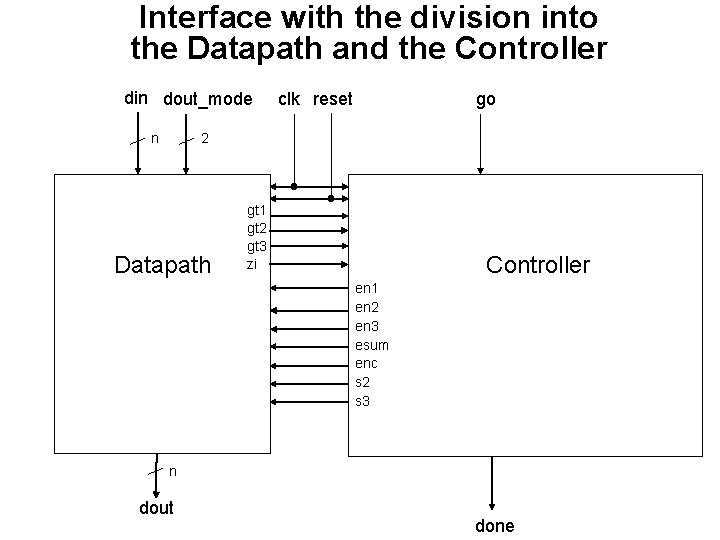
Interface with the division into the Datapath and the Controller din dout_mode n clk reset go 2 Datapath gt 1 gt 2 gt 3 zi Controller en 1 en 2 en 3 esum enc s 2 s 3 n dout done
Class Exercise 2 CIPHER
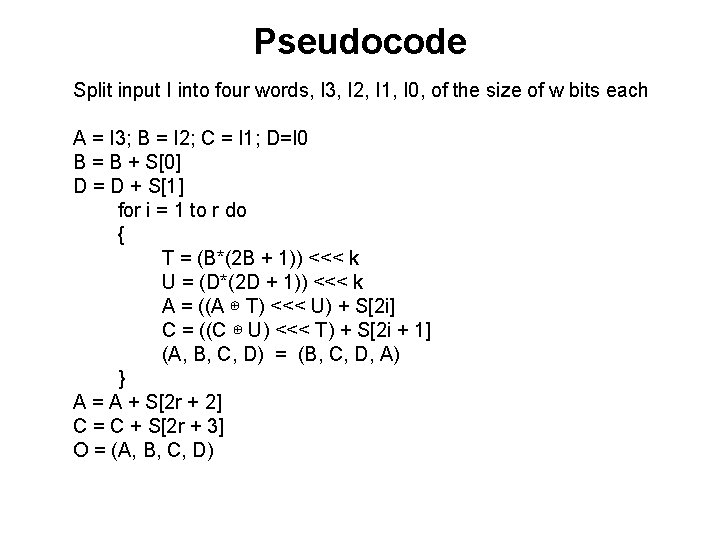
Pseudocode Split input I into four words, I 3, I 2, I 1, I 0, of the size of w bits each A = I 3; B = I 2; C = I 1; D=I 0 B = B + S[0] D = D + S[1] for i = 1 to r do { T = (B*(2 B + 1)) <<< k U = (D*(2 D + 1)) <<< k A = ((A ⊕ T) <<< U) + S[2 i] C = ((C ⊕ U) <<< T) + S[2 i + 1] (A, B, C, D) = (B, C, D, A) } A = A + S[2 r + 2] C = C + S[2 r + 3] O = (A, B, C, D)
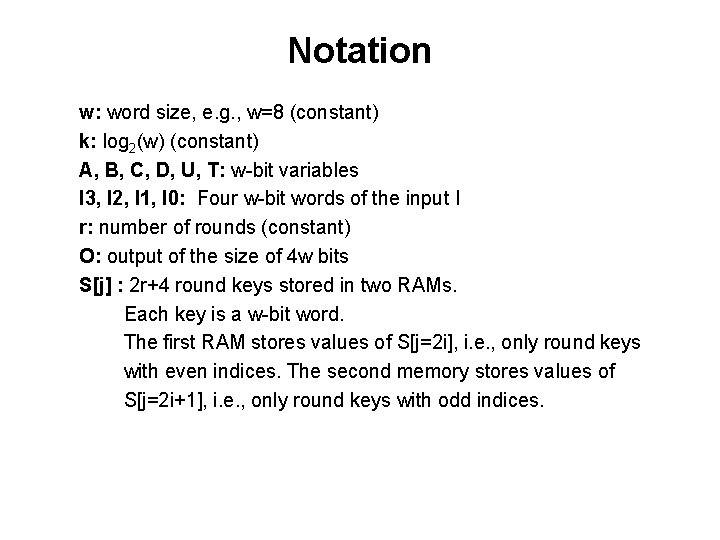
Notation w: word size, e. g. , w=8 (constant) k: log 2(w) (constant) A, B, C, D, U, T: w-bit variables I 3, I 2, I 1, I 0: Four w-bit words of the input I r: number of rounds (constant) O: output of the size of 4 w bits S[j] : 2 r+4 round keys stored in two RAMs. Each key is a w-bit word. The first RAM stores values of S[j=2 i], i. e. , only round keys with even indices. The second memory stores values of S[j=2 i+1], i. e. , only round keys with odd indices.
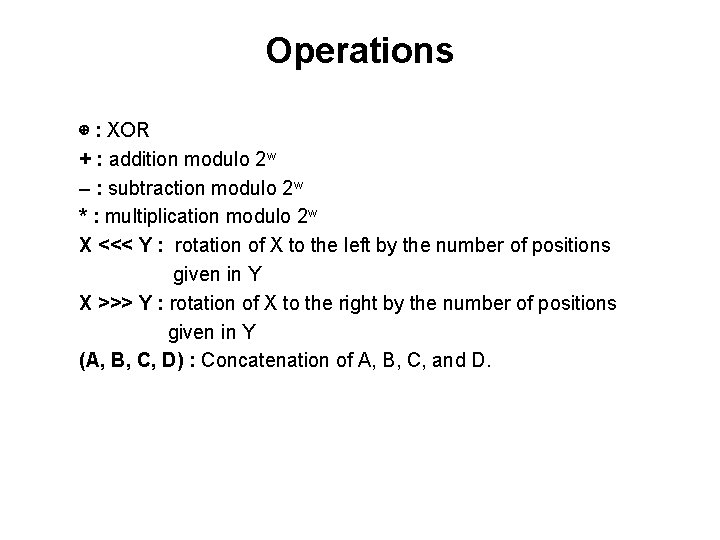
Operations ⊕ : XOR + : addition modulo 2 w – : subtraction modulo 2 w * : multiplication modulo 2 w X <<< Y : rotation of X to the left by the number of positions given in Y X >>> Y : rotation of X to the right by the number of positions given in Y (A, B, C, D) : Concatenation of A, B, C, and D.
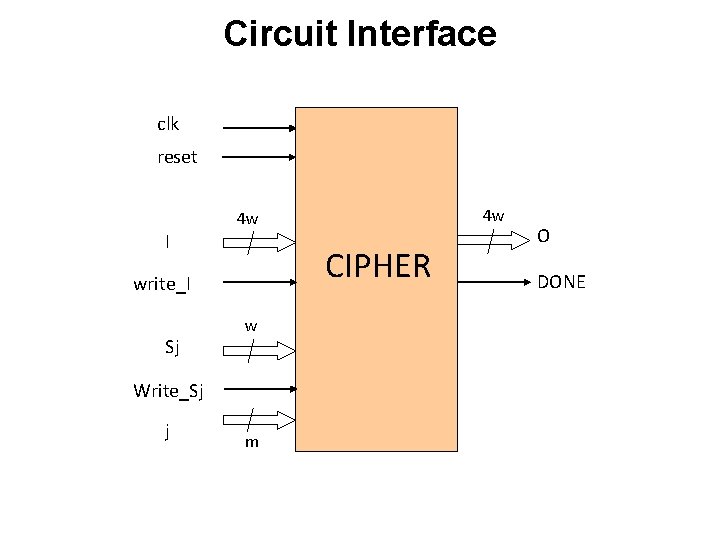
Circuit Interface clk reset 4 w 4 w I CIPHER write_I Sj w Write_Sj j m O DONE
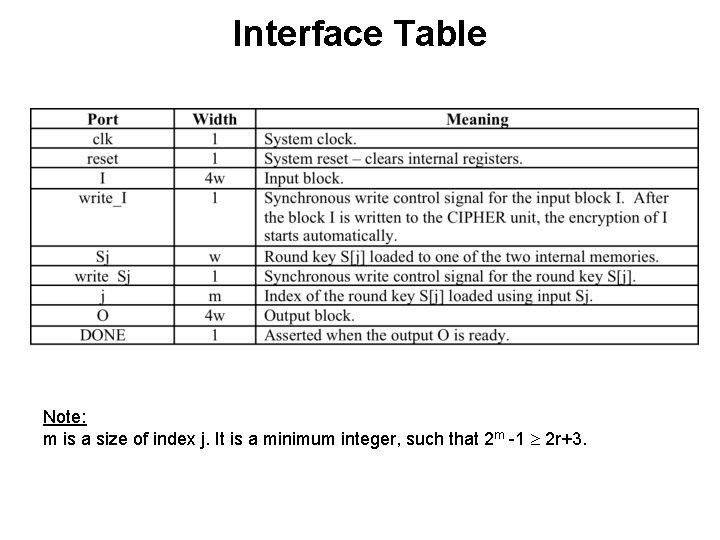
Interface Table Note: m is a size of index j. It is a minimum integer, such that 2 m -1 2 r+3.
Protocol (1) An external circuit first loads all round keys S[0], S[1], S[2], …, S[2 r+2], [2 r+3] to the two internal memories of the CIPHER unit. The first memory stores values of S[j=2 i], i. e. , only round keys with even indices. The second memory stores values of S[j=2 i+1], i. e. only round keys with odd indices. Loading round keys is performed using inputs: Sj, j, write_Sj, clk. Then, the external circuits, loads an input block I to the CIPHER unit, using inputs: I, write_I, clk. After the input block I is loaded to the CIPHER unit, the encryption starts automatically.
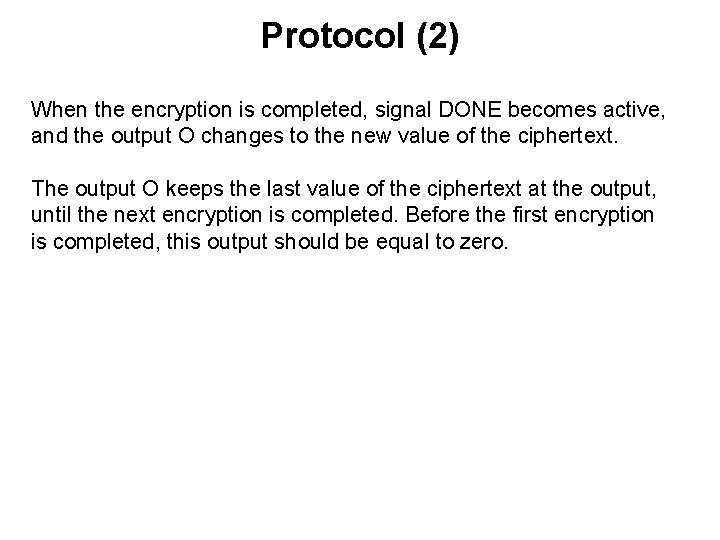
Protocol (2) When the encryption is completed, signal DONE becomes active, and the output O changes to the new value of the ciphertext. The output O keeps the last value of the ciphertext at the output, until the next encryption is completed. Before the first encryption is completed, this output should be equal to zero.
Assumptions • 2 r+4 clock cycles are used to load round keys to internal RAMs • one round of the main for loop of the pseudocode executes in one clock cycle • you can access only one position of each internal memory of round keys per clock cycle As a result, the encryption of a single input block I should last r+2 clock cycles.