
Lecture 2 Review Passive Sign Convention Power Generation




- Slides: 21
Lecture 2 • Review Passive Sign Convention • Power Generation, Absorption • Power Sources • Resistance • Related educational modules: –Sections 1. 1, 1. 2, 1. 3
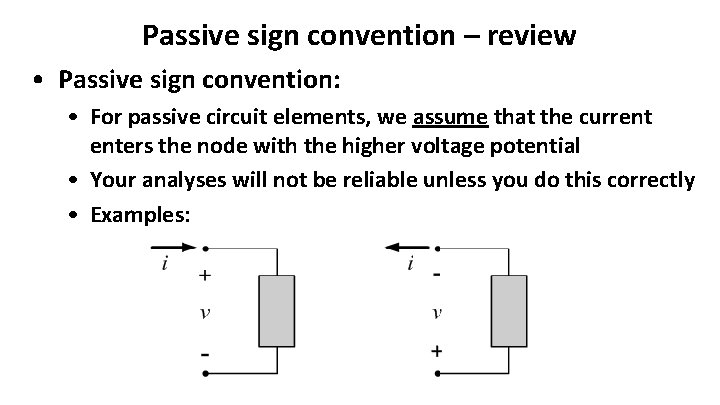
Passive sign convention – review • Passive sign convention: • For passive circuit elements, we assume that the current enters the node with the higher voltage potential • Your analyses will not be reliable unless you do this correctly • Examples:
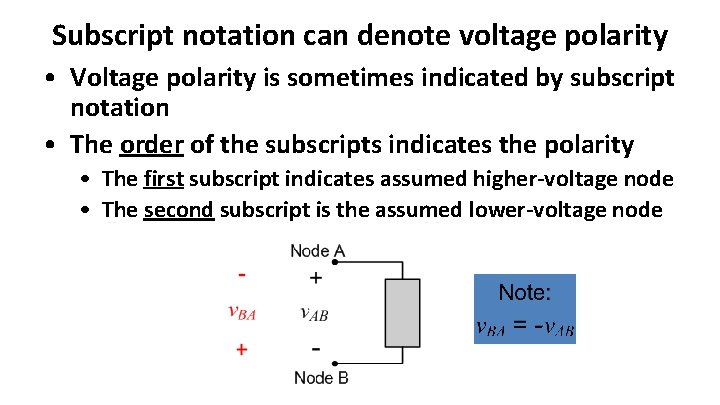
Subscript notation can denote voltage polarity • Voltage polarity is sometimes indicated by subscript notation • The order of the subscripts indicates the polarity • The first subscript indicates assumed higher-voltage node • The second subscript is the assumed lower-voltage node
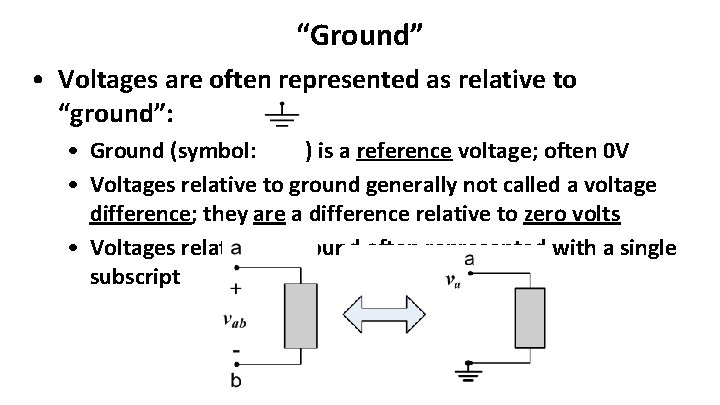
“Ground” • Voltages are often represented as relative to “ground”: • Ground (symbol: ) is a reference voltage; often 0 V • Voltages relative to ground generally not called a voltage difference; they are a difference relative to zero volts • Voltages relative to ground often represented with a single subscript
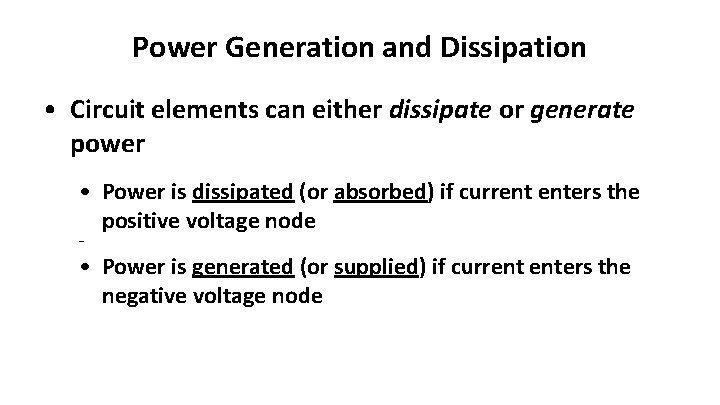
Power Generation and Dissipation • Circuit elements can either dissipate or generate power • Power is dissipated (or absorbed) if current enters the positive voltage node – • Power is generated (or supplied) if current enters the negative voltage node
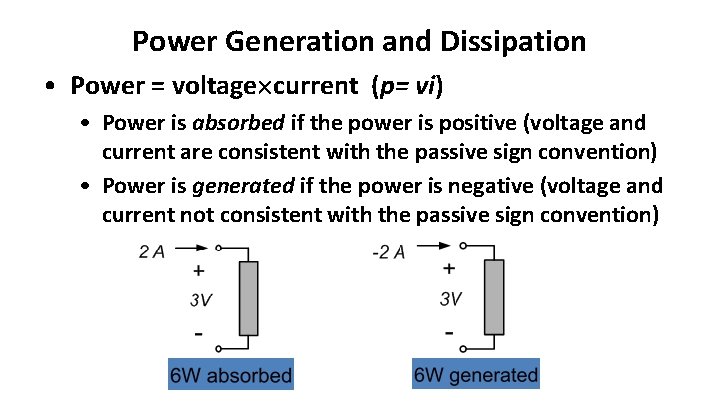
Power Generation and Dissipation • Power = voltage current (p= vi) • Power is absorbed if the power is positive (voltage and current are consistent with the passive sign convention) • Power is generated if the power is negative (voltage and current not consistent with the passive sign convention)
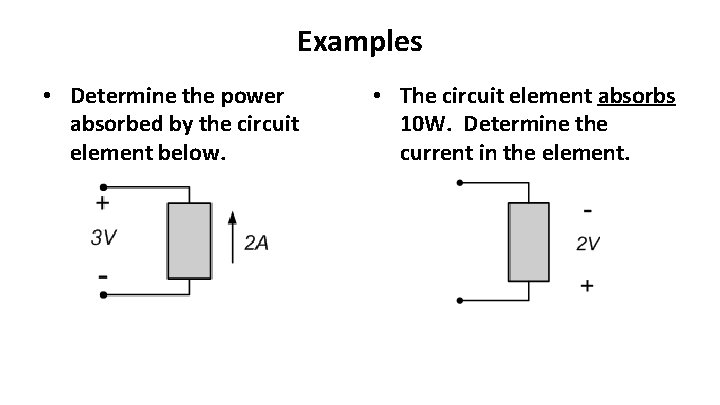
Examples • Determine the power absorbed by the circuit element below. • The circuit element absorbs 10 W. Determine the current in the element.
Power Supplies • Power supplies provide a source of electrical power • Conceptual types of power supplies (models of physical supplies): • Voltage, current sources • Independent, dependent sources • Ideal and non-ideal sources
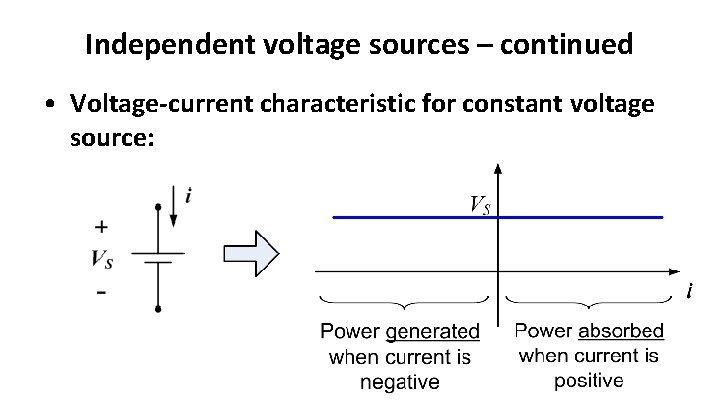
Independent voltage sources • Common symbols: • Independent voltage sources maintain specified voltage, regardless of the current
Independent voltage sources – continued • Voltage-current characteristic for constant voltage source:
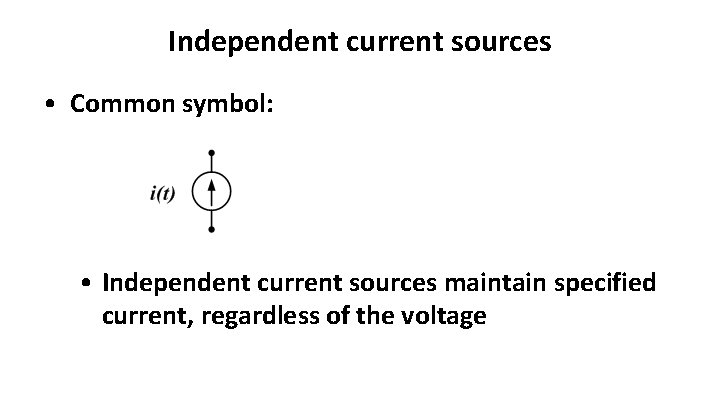
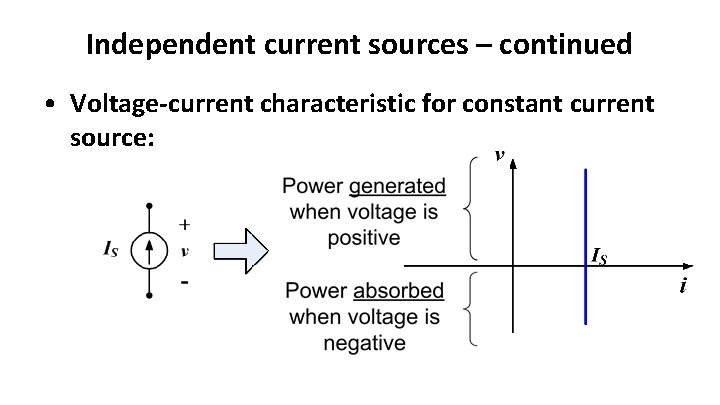
Independent current sources • Common symbol: • Independent current sources maintain specified current, regardless of the voltage
Independent current sources – continued • Voltage-current characteristic for constant current source:
Ideal power sources – limitations • Ideal sources can provide infinite power • Voltage sources provide specified voltage, regardless of the current can be infinite power can be infinite • Current sources provide specified current, regardless of the voltage can be infinite power can be infinite • These models can be unrealistic • We will examine more realistic power source models later
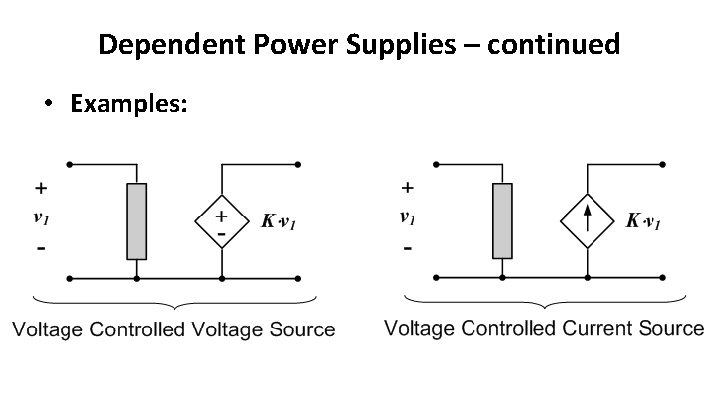
Dependent Power Supplies • Some active circuit elements can be modeled as dependent power sources • The current or voltage delivered by the source is controlled by a current or voltage somewhere else in the circuit • Four possible combinations • • Voltage controlled voltage source (VCVS) Current controlled voltage source (CCVS) Voltage controlled current source (VCCS) Current controlled current source (CCCS)
Dependent Power Supplies – continued • Examples:
Resistors • Circuit symbol: • R is the resistance • Units are ohms ( ) • Voltage-current relation (Ohm’s Law):
Resistors – continued • Notes: • Resistors can only dissipate energy • The voltage-current relation is algebraic
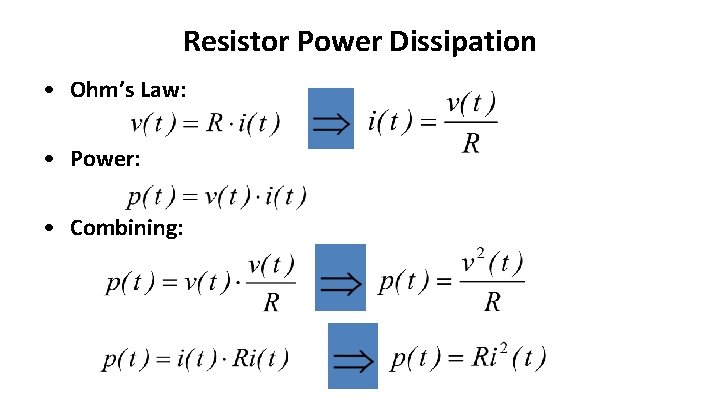
Resistor Power Dissipation • Ohm’s Law: • Power: • Combining:
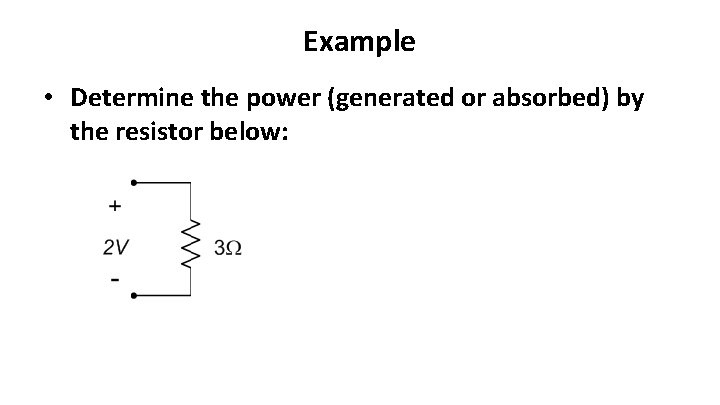
Example • Determine the power (generated or absorbed) by the resistor below:
Conservation of energy • In an electrical circuit, the power generated is the same as the power absorbed • Slightly more mathematically, • Recall that power absorbed is positive and power generated is negative
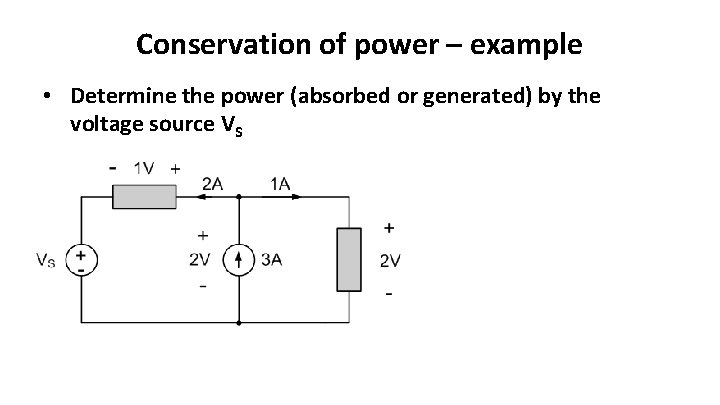
Conservation of power – example • Determine the power (absorbed or generated) by the voltage source VS