
Lecture 2 Review of Basics 2 of 5
Lecture 2 Review of Basics 2 of 5: Viewing and Clipping Wednesday, 28 January 2004 William H. Hsu Department of Computing and Information Sciences, KSU http: //www. kddresearch. org http: //www. cis. ksu. edu/~bhsu Readings: Sections 3. 12, 6. 5 -6. 6, Foley et al Section 6. 7, Hearn and Baker 2 e (Reference) Chapter 2, Sections 4. 9, 5. 7 -5. 8, 7. 3 -7. 6, Angel 2 e (Reference) CIS 736: Computer Graphics Kansas State University Department of Computing and Information Sciences
Lecture Outline • Projections (Concluded) – Review: 5 -step normalizing transformation for perspective projection (Nper) – Final operation in implementing view volume: clipping • Clipping Lines (Introduction) – Cohen-Sutherland algorithm – Cyrus-Beck / Liang-Barsky algorithm • Clipping in 3 D – Extending 2 D line clipping algorithms to 3 D objects – Sketch (more later): clipping in homogeneous coordinates • Introduction to Open. GL (http: //www. opengl. org, http: //www. mesa 3 d. org) – Graphics libraries: history and design rationale – Specification of graphics libraries: application programmer interfaces (API) – Key Open. GL functions • Course Projects: Overview • Next Lecture: More Open. GL, Introduction to Curves CIS 736: Computer Graphics Kansas State University Department of Computing and Information Sciences
3 D Projections and Clipping • Projections (Concluded) – Parallel projection: cuboid view volume – Perspective projection: truncated pyramidal view volume (frustum) – Problem: how to clip? • Clipping – Given: coordinates for primitives (line segments, polygons, circles, ellipses, etc. ) – Determine: visible components of primitives (e. g. , line segments) – Methods • Solving simultaneous equations (quick rejection: testing endpoints) • Solving parametric equations – Objectives: efficiency (e. g. , fewer floating point operations) • Clipping in 3 D – Some 2 D algorithms extendible to 3 D – Specification (and implementation) of view volumes needed • Transparent Implementation in Graphics APIs: Later Today CIS 736: Computer Graphics Kansas State University Department of Computing and Information Sciences
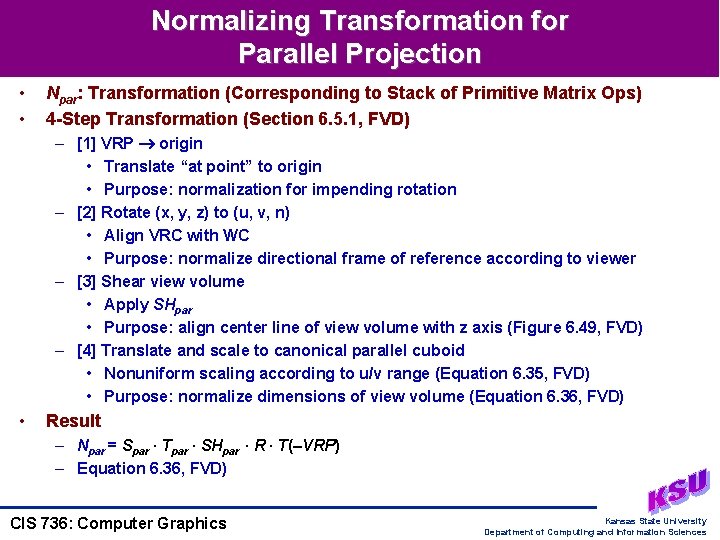
Normalizing Transformation for Parallel Projection • • Npar: Transformation (Corresponding to Stack of Primitive Matrix Ops) 4 -Step Transformation (Section 6. 5. 1, FVD) – [1] VRP origin • Translate “at point” to origin • Purpose: normalization for impending rotation – [2] Rotate (x, y, z) to (u, v, n) • Align VRC with WC • Purpose: normalize directional frame of reference according to viewer – [3] Shear view volume • Apply SHpar • Purpose: align center line of view volume with z axis (Figure 6. 49, FVD) – [4] Translate and scale to canonical parallel cuboid • Nonuniform scaling according to u/v range (Equation 6. 35, FVD) • Purpose: normalize dimensions of view volume (Equation 6. 36, FVD) • Result – Npar = Spar · Tpar · SHpar · R · T(–VRP) – Equation 6. 36, FVD) CIS 736: Computer Graphics Kansas State University Department of Computing and Information Sciences
Normalizing Transformation for Perspective Projection • • Nper: Transformation (Corresponding to Stack of Primitive Matrix Ops) 5 -Step Transformation (Section 6. 5. 2, FVD) – [1] VRP origin • Translate “at point” to origin • Purpose: normalization for impending rotation – [2] Rotate (x, y, z) to (u, v, n) • Align VRC with WC • Purpose: normalize directional frame of reference according to viewer – [3] COP origin • Translate “eye” to origin • Purpose: normalize position of reference according to viewer – [4] Shear view volume • Apply SHpar • Purpose: align center line of view volume with z axis (Figure 6. 53, FVD) – [5] Scale to canonical perspective frustum • Nonuniform scaling according to ratio of sheared-z to u/v range (Equation 6. 39, FVD) • Purpose: normalize dimensions of view volume (Equation 6. 23, FVD) CIS 736: Computer Graphics Kansas State University Department of Computing and Information Sciences
Clipping Lines • Clipping (Sections 3. 11 -3. 12, 6. 5. 3 -6. 5. 4, FVD; Sections 7. 2 -7. 6, Angel) – Problem • Input: coordinates for primitives • Output: visible components of primitives – Equational solutions: simultaneous, parametric – Basic primitive: clip individual points (test against rectangle bounds) • Lines (Section 3. 12, FVD; Section 7. 3, Angel) – Clipping line segment AB against viewing rectangle R – General idea 1 (equational / regional approach) • Divide plane into regions about R, see whether AB can possibly intersect • Find intersections – General idea 2 (parametric approach) • Express line as parametric equation(s): 1 matrix or 2 scalar • Find intersections by plugging into parametric equation (Table 3. 1, FVD) • Use to check clipping cases CIS 736: Computer Graphics Kansas State University Department of Computing and Information Sciences
![Cohen-Sutherland Algorithm • General Idea 1 [Cohen and Sutherland, 1963] – Divide plane into](http://slidetodoc.com/presentation_image_h2/9ba602d9f4420f888de50ed8ad2fb409/image-7.jpg "Cohen-Sutherland Algorithm • General Idea 1 [Cohen and Sutherland, 1963] – Divide plane into")
Cohen-Sutherland Algorithm • General Idea 1 [Cohen and Sutherland, 1963] – Divide plane into 9 regions about and including R – See whether AB can possibly intersect • Outcodes: Quick Rejection Method for Intersection Testing – Unique 4 -bit binary number for each of 9 regions • b 0 = 1 iff y > ymax • b 1 = 1 iff y < ymin • b 2 = 1 iff x > xmax • b 3 = 1 iff x > xmax 1001 1000 1010 0001 0000 0010 0101 0100 0110 xmin – Check clipping cases ymax ymin xmax • 8 floating-point subtractions per line segment, plus integer comparison • Each line segment has 2 outcodes: o 1, o 2 • Case 1: o 1 = o 2 = 0000 – inside; show whole segment • Case 2: o 1 = 0000, o 2 0000 (or vice versa) – partly inside; shorten • Case 3: o 1 & o 2 0000 – totally outside; discard • Case 4: o 1 & o 2 = 0000 – both endpoints outside; check further! CIS 736: Computer Graphics Kansas State University Department of Computing and Information Sciences
![Cyrus-Beck and Liang-Barsky Algorithms • General Idea 2 [Cyrus and Beck; Liang and Barsky]](http://slidetodoc.com/presentation_image_h2/9ba602d9f4420f888de50ed8ad2fb409/image-8.jpg "Cyrus-Beck and Liang-Barsky Algorithms • General Idea 2 [Cyrus and Beck; Liang and Barsky]")
Cyrus-Beck and Liang-Barsky Algorithms • General Idea 2 [Cyrus and Beck; Liang and Barsky] – Express line as parametric equation(s): 1 matrix or 2 scalar – Find intersections by plugging into parametric equation (Table 3. 1, FVD) – Use to check clipping cases • Cyrus-Beck Algorithm – Section 3. 12. 4, FVD – More details next class (Lecture 7) • Liang-Barsky Algorithm – Section 3. 12. 4, FVD; Section 7. 3. 2, Angel – More details next class (Lecture 7) CIS 736: Computer Graphics Kansas State University Department of Computing and Information Sciences
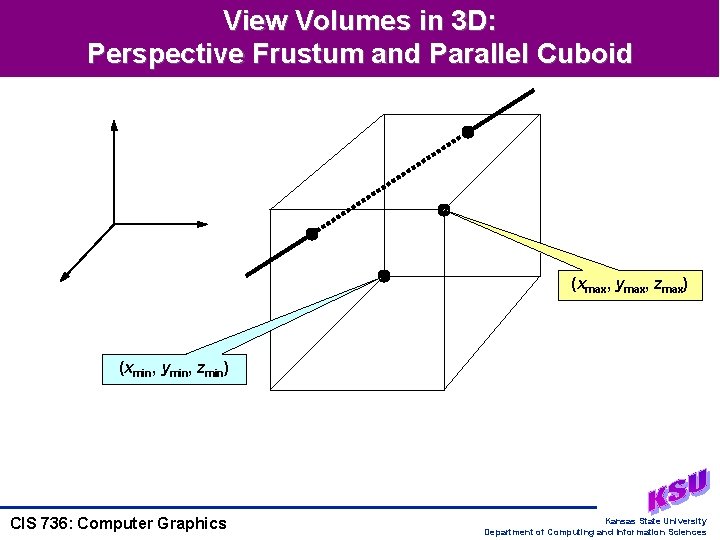
View Volumes in 3 D: Perspective Frustum and Parallel Cuboid (xmax, ymax, zmax) (xmin, ymin, zmin) CIS 736: Computer Graphics Kansas State University Department of Computing and Information Sciences
Generic Graphics Package: Overview • Turn to Your Partners – People in your row – Groups numbered counterclockwise (left front to right front) • Exercise 1 (Now): Generic Graphics Package – Objective: understanding generic graphics kernels – Exercise (5 minutes): list • 3 logical groups of functions that simple graphics kernels have • 1 criterion for deciding whether kernel function should be implemented in hardware, software, or as macro • Exercise 2 (Later Today): Specifying Graphics Transformations – Objective: understanding shear transformation – Specification of shear transformation function – Implementation in Open. GL • Exercise 3 (Later Today): Applying Graphics Transformations – Objective: using shear to implement one type of parallel projection from another – Enhancing capabilities of Open. GL CIS 736: Computer Graphics Kansas State University Department of Computing and Information Sciences
History of Graphics Library (GL) • Original GL (Graphics Library) – Developed by Silicon Graphics, Inc. (SGI) – Used with C under Irix (SGI Unix variant) • Main platforms: SGI Indigo • Later: SGI O 2, Octane • Open. GL Consortium – See [Angel, 2000] and Open. GL sites – Support under operating systems, IDEs (Win. Tel, Linux, Mac. OS, Amiga) – Linux flavor: Mesa (http: //www. mesa 3 d. org) • “ 99% compliant” version, supported by SGI • Open source; licensing / validation fees not paid yet – Recent (last 5 -8 years) adoption for academic teaching, research • Web Resources – Official Open. GL web site: http: //www. opengl. org – Porting guide, other SGI documentation: http: //techpubs. sgi. com: 80/library CIS 736: Computer Graphics Kansas State University Department of Computing and Information Sciences
Open. GL: Overview of Utility Toolkit (GLUT) • Graphics Library Utility Toolkit (GLUT) – Chapter 2, Angel – Supplements and related links: http: //www. aw. com/cseng – Links to web resources, code examples: http: //www. cs. umn. edu/~angel – Programs from book: ftp. cs. umn. edu (pub/angel/BOOK) – General resources: http: //www. opengl. org/Documentation. html • Color – Chapter 13, FVD; Section 2. 4, Angel – More next month • Viewing – Chapters 3 and 6, FVD; Section 2. 5, Angel – Tutorial: http: //www. eecs. tulane. edu/www/Terry/Open. GL/Introduction. html • Window System – Chapter 9, FVD; Section 2. 6, Angel – More in second half of CIS 736: Computer Graphics Kansas State University Department of Computing and Information Sciences
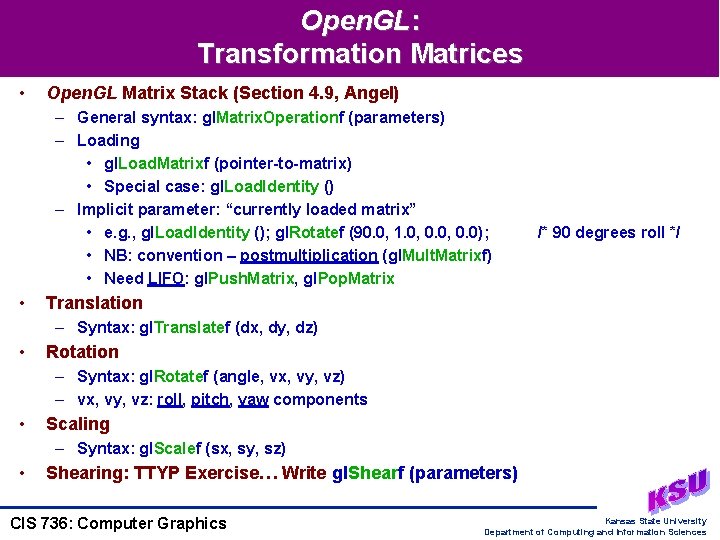
Open. GL: Transformation Matrices • Open. GL Matrix Stack (Section 4. 9, Angel) – General syntax: gl. Matrix. Operationf (parameters) – Loading • gl. Load. Matrixf (pointer-to-matrix) • Special case: gl. Load. Identity () – Implicit parameter: “currently loaded matrix” • e. g. , gl. Load. Identity (); gl. Rotatef (90. 0, 1. 0, 0. 0); • NB: convention – postmultiplication (gl. Mult. Matrixf) • Need LIFO: gl. Push. Matrix, gl. Pop. Matrix • /* 90 degrees roll */ Translation – Syntax: gl. Translatef (dx, dy, dz) • Rotation – Syntax: gl. Rotatef (angle, vx, vy, vz) – vx, vy, vz: roll, pitch, yaw components • Scaling – Syntax: gl. Scalef (sx, sy, sz) • Shearing: TTYP Exercise… Write gl. Shearf (parameters) CIS 736: Computer Graphics Kansas State University Department of Computing and Information Sciences
Open. GL: Viewing API and Look-At Function • Recall: Viewing Reference Coordinate (VRC) System Specification – World coordinates (x, y, z) – Viewing coordinates (u, v, n) • n view plane normal • v projection of VUP (view-up vector), orthogonal to n, in view plane • u third basis vector (orthogonal to n, v; can compute using cross product) • Look-At Function (Section 5. 2. 3, Angel) – Syntax: glu. Look. At (eyex, eyey, eyez, atx, aty, atz, upx, upy, upz) – eyex, eyey, eyez: specification of eyepoint e (COP aka view point aka position) – atx, aty, atz: specification of at point a (view reference point aka VRP) – upx, upy, upz: specification of view up vector (VUP) • Properties of Viewing API – VPN = e - a – Specifies synthetic camera (as discussed last week) • Now: Ready to Project… CIS 736: Computer Graphics Kansas State University Department of Computing and Information Sciences
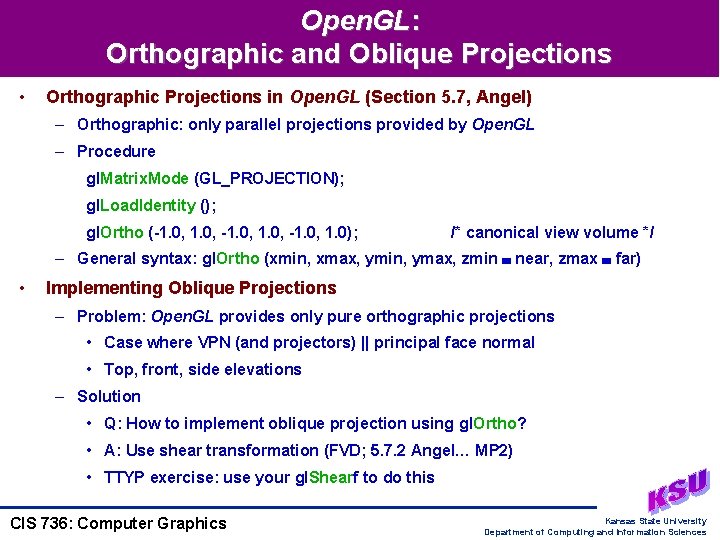
Open. GL: Orthographic and Oblique Projections • Orthographic Projections in Open. GL (Section 5. 7, Angel) – Orthographic: only parallel projections provided by Open. GL – Procedure gl. Matrix. Mode (GL_PROJECTION); gl. Load. Identity (); gl. Ortho (-1. 0, -1. 0, 1. 0); /* canonical view volume */ – General syntax: gl. Ortho (xmin, xmax, ymin, ymax, zmin near, zmax far) • Implementing Oblique Projections – Problem: Open. GL provides only pure orthographic projections • Case where VPN (and projectors) || principal face normal • Top, front, side elevations – Solution • Q: How to implement oblique projection using gl. Ortho? • A: Use shear transformation (FVD; 5. 7. 2 Angel… MP 2) • TTYP exercise: use your gl. Shearf to do this CIS 736: Computer Graphics Kansas State University Department of Computing and Information Sciences
Kansas State University Graphics Facilities • KSU Graphics Infrastructure – Accounts • Computing and Information Sciences (CIS) department • All students should already have logins – Machines: KSU-CIS Beowulf cluster – Software: Mesa (http: //www. mesa 3 d. org) • Systems – Goodland • Dual boot: Windows NT 4. 0, Linux • Matrox Millenium G 400 (32 Mb dual-head AGP) • Priority given to CIS 736 students – Instructional Linux systems: pending, 32 Mb Pentium – Beowulf cluster: pending, (2) quad Pentium III Xeon-500 • For project use only • Contact instructional staff to request packages CIS 736: Computer Graphics Kansas State University Department of Computing and Information Sciences
Course Project: Overview • 3 Components – Project proposal (20%, 50 points) – Implementation (50%, 125 points) – Final report (30%, 75 points) • Project Proposal (Due 25 Feb 2002) – 1 -3 page description of project topic, plan – Guidelines: next (suggested topics, tools to appear on CIS 736 course web page) – See: implementation practicum links (Brown, Cornell, UNC, others) on 736 page • Implementation – Students choice of programming language – Guidelines: next Wednesday (and on 736 page) • Final Report – 4 -6 page report on implementation, experimental results, interpretation – Peer-reviewed (does not determine grade) – Reviews graded (short report worth 60 points, reviews worth 15 points) CIS 736: Computer Graphics Kansas State University Department of Computing and Information Sciences
Course Project: Proposal Guidelines • Report Contents (1 -3 Pages) – Scope: What kind of CG algorithms will you use? – Problem: What display problem are you addressing? – Methodology: How are you addressing the problem? • Scope – What rendering, animation, and visualization tools (or codes) will you use? – What characteristics of the display tools are you trying to deal with / exploit? • Problem – Objective: What is your display objective? – Evaluation: How will you demonstrate (and measure) success? • Methodology – Implementation: What will you implement? (general statement, not specification) – Graphics data representation: How will you manipulate and represent CG data? – Infrastructure: What programming languages and platform(s) will you use? CIS 736: Computer Graphics Kansas State University Department of Computing and Information Sciences
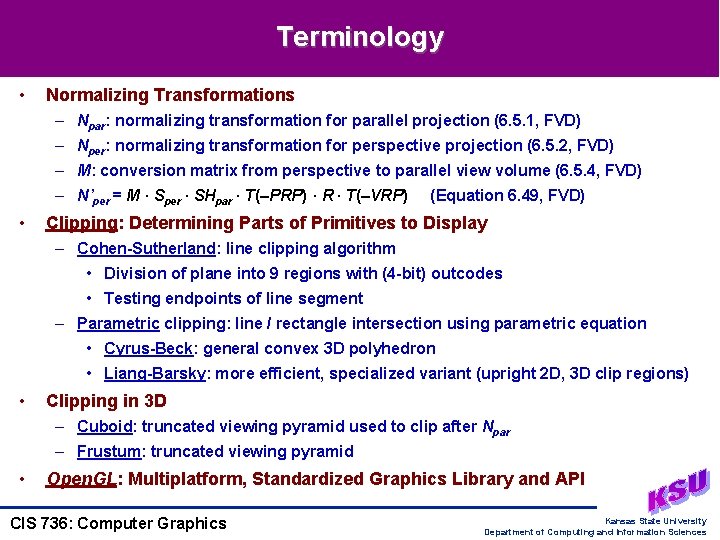
Terminology • Normalizing Transformations – Npar: normalizing transformation for parallel projection (6. 5. 1, FVD) – Nper: normalizing transformation for perspective projection (6. 5. 2, FVD) – M: conversion matrix from perspective to parallel view volume (6. 5. 4, FVD) – N’per = M · Sper · SHpar · T(–PRP) · R · T(–VRP) • (Equation 6. 49, FVD) Clipping: Determining Parts of Primitives to Display – Cohen-Sutherland: line clipping algorithm • Division of plane into 9 regions with (4 -bit) outcodes • Testing endpoints of line segment – Parametric clipping: line / rectangle intersection using parametric equation • Cyrus-Beck: general convex 3 D polyhedron • Liang-Barsky: more efficient, specialized variant (upright 2 D, 3 D clip regions) • Clipping in 3 D – Cuboid: truncated viewing pyramid used to clip after Npar – Frustum: truncated viewing pyramid • Open. GL: Multiplatform, Standardized Graphics Library and API CIS 736: Computer Graphics Kansas State University Department of Computing and Information Sciences
![Summary Points • Projections: Review of Nper – [1] VRP origin – [2] Rotate](http://slidetodoc.com/presentation_image_h2/9ba602d9f4420f888de50ed8ad2fb409/image-20.jpg "Summary Points • Projections: Review of Nper – [1] VRP origin – [2] Rotate")
Summary Points • Projections: Review of Nper – [1] VRP origin – [2] Rotate (x, y, z) to (u, v, n) – [3] COP origin – [4] Shear view volume – [5] Scale to canonical perspective frustum • Clipping Lines: Cohen-Sutherland, Liang-Barsky (Cyrus-Beck) • Clipping in 3 D • Introduction to Open. GL (http: //www. opengl. org, http: //www. mesa 3 d. org) – Graphics libraries: history, design rationale, specification, APIs – Key Open. GL functions • Course Projects: Overview • Next Lecture – More Open. GL (Sections 10. 1 -10. 6, Angel) – Intro to cubic curves (11. 1, 11. 2. 1 -11. 2. 2, FVD; 10. 6 -10. 8, Hearn and Baker) CIS 736: Computer Graphics Kansas State University Department of Computing and Information Sciences
- Slides: 20