
Lecture 2 Python Programming Data Types Bryan Burlingame
Lecture 2 Python Programming & Data Types Bryan Burlingame 6 February 2019

All Material Posted to me 30. org Homework 1 due next week Posted on me 30. org Announcements Read chapter 3 for next week

Running Python is an interpreted language A language in which the instructions are executed by an “interpreter” at run time As an interpreted language, Python is relatively easy to port to many environments to be used by various interpreters Command line Via the Python interpreter Script files Text Jupyter Notebooks Used files containing Python commands in this course Game scripting Blender, Panda 3 D, Kivy

Interpreter command line
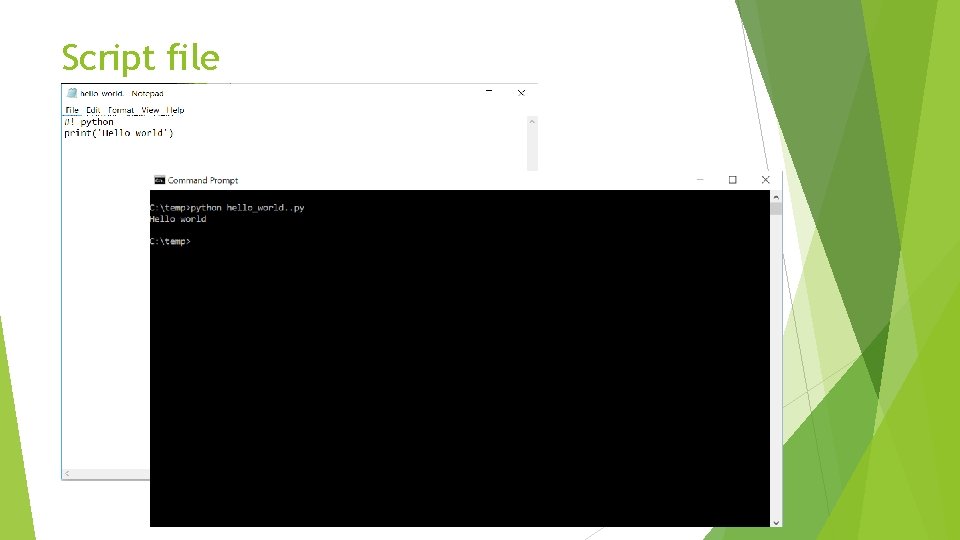
Script file
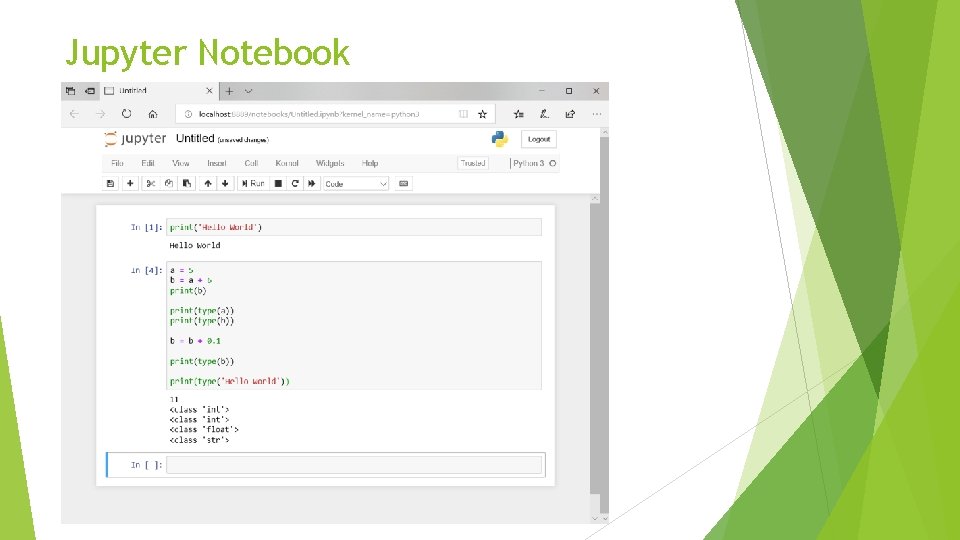
Jupyter Notebook
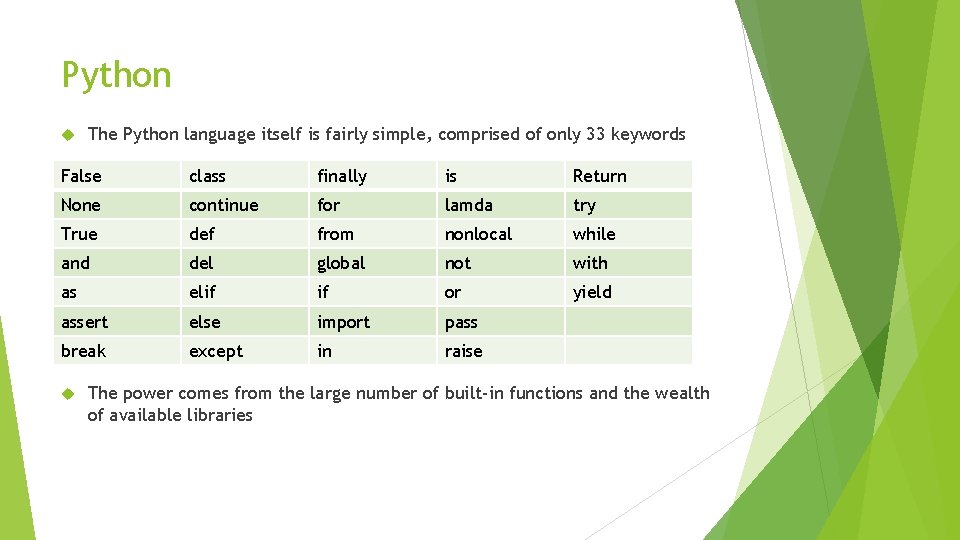
Python The Python language itself is fairly simple, comprised of only 33 keywords False class finally is Return None continue for lamda try True def from nonlocal while and del global not with as elif if or yield assert else import pass break except in raise The power comes from the large number of built-in functions and the wealth of available libraries
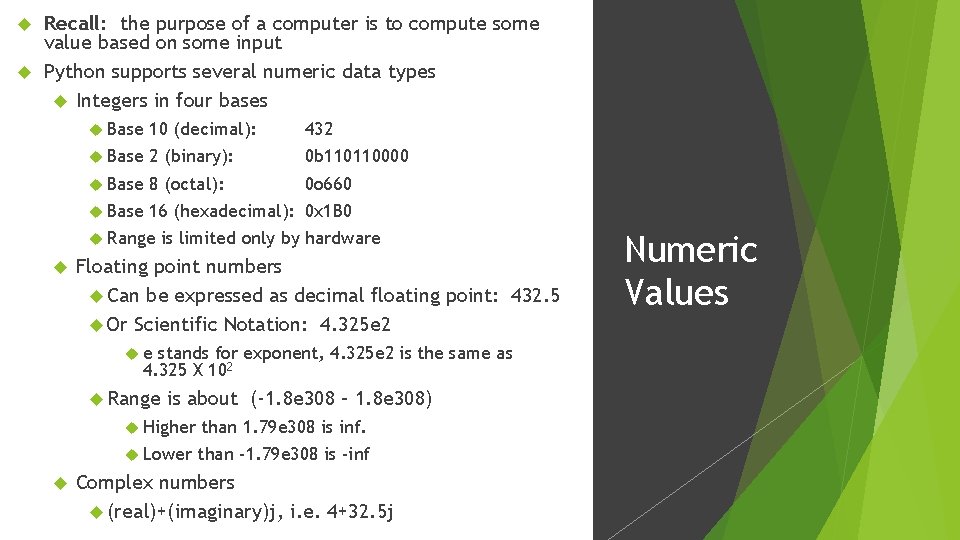
Recall: the purpose of a computer is to compute some value based on some input Python supports several numeric data types Integers in four bases Base 10 (decimal): 432 Base 2 (binary): 0 b 110110000 Base 8 (octal): 0 o 660 Base 16 (hexadecimal): 0 x 1 B 0 Range is limited only by hardware Floating point numbers Can be expressed as decimal floating point: 432. 5 Or Scientific Notation: 4. 325 e 2 e stands for exponent, 4. 325 e 2 is the same as 4. 325 X 102 Range is about (-1. 8 e 308 – 1. 8 e 308) Higher than 1. 79 e 308 is inf. Lower than -1. 79 e 308 is -inf Complex numbers (real)+(imaginary)j, i. e. 4+32. 5 j Numeric Values
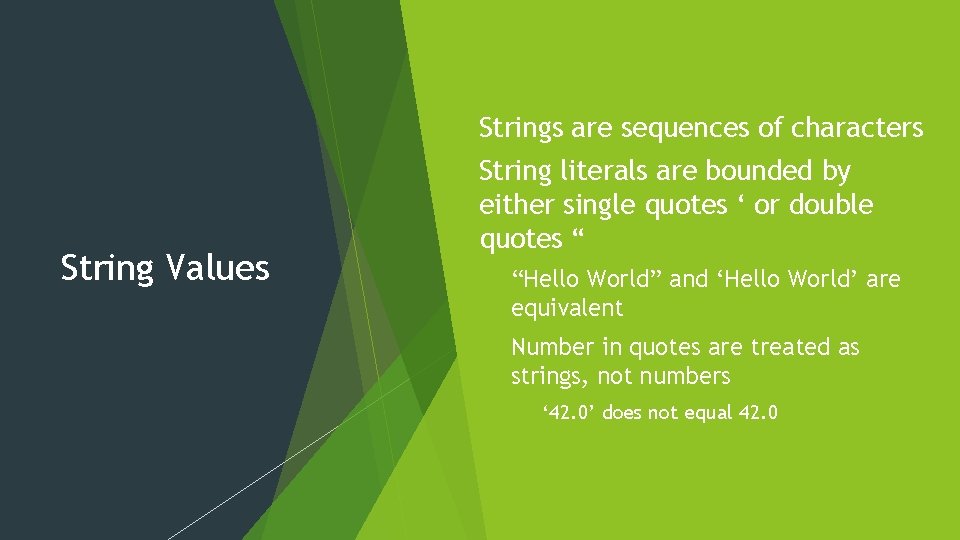
Strings are sequences of characters String Values literals are bounded by either single quotes ‘ or double quotes “ “Hello World” and ‘Hello World’ are equivalent Number in quotes are treated as strings, not numbers ‘ 42. 0’ does not equal 42. 0
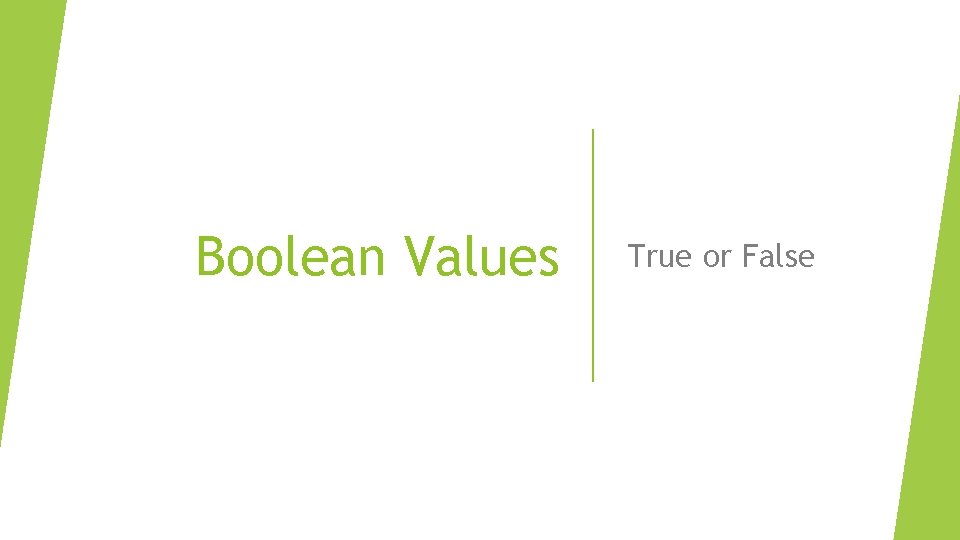
Boolean Values True or False
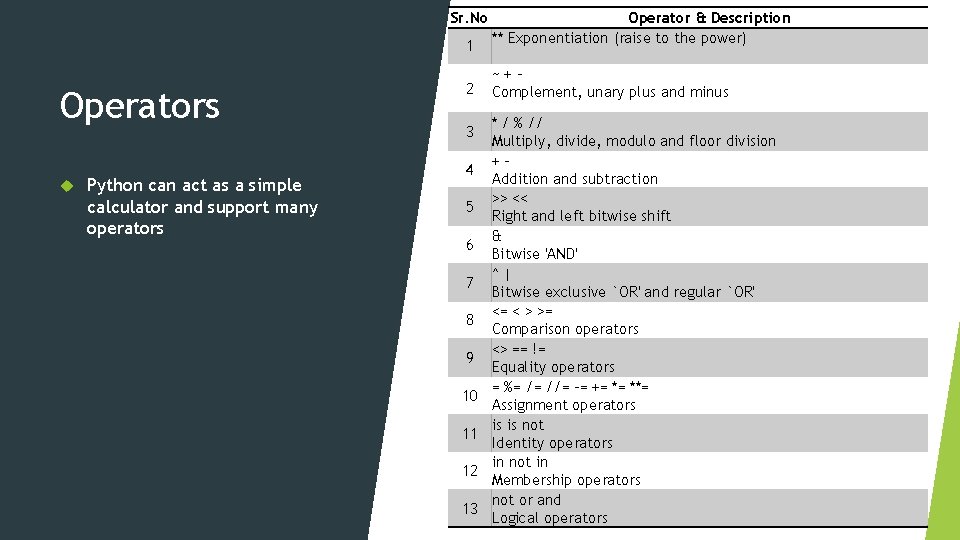
Sr. No 1 Operators Python can act as a simple calculator and support many operators 2 3 4 5 6 7 8 9 10 11 12 13 Operator & Description ** Exponentiation (raise to the power) ~+Complement, unary plus and minus * / % // Multiply, divide, modulo and floor division +Addition and subtraction >> << Right and left bitwise shift & Bitwise 'AND' ^| Bitwise exclusive `OR' and regular `OR' <= < > >= Comparison operators <> == != Equality operators = %= /= //= -= += *= **= Assignment operators is is not Identity operators in not in Membership operators not or and Logical operators
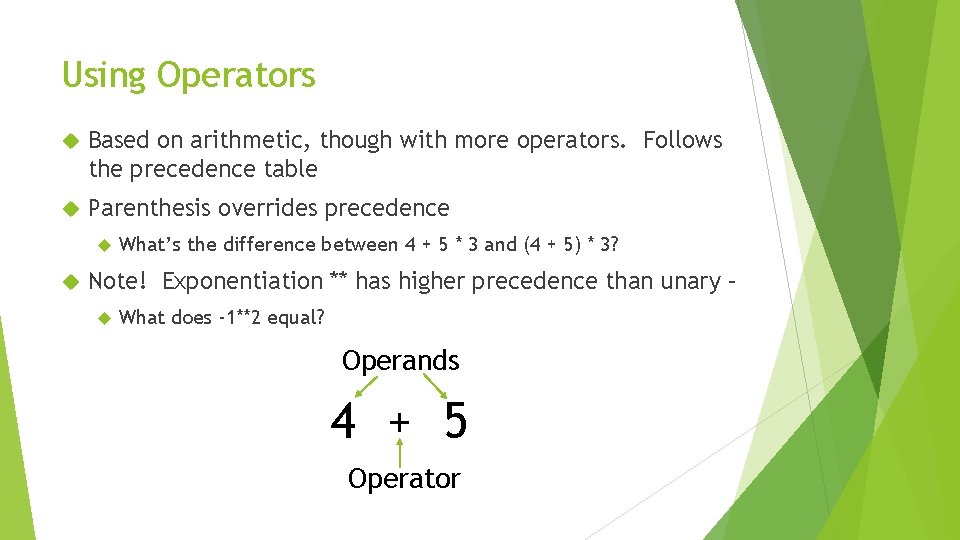
Using Operators Based on arithmetic, though with more operators. Follows the precedence table Parenthesis overrides precedence What’s the difference between 4 + 5 * 3 and (4 + 5) * 3? Note! Exponentiation ** has higher precedence than unary – What does -1**2 equal? Operands 4 + 5 Operator
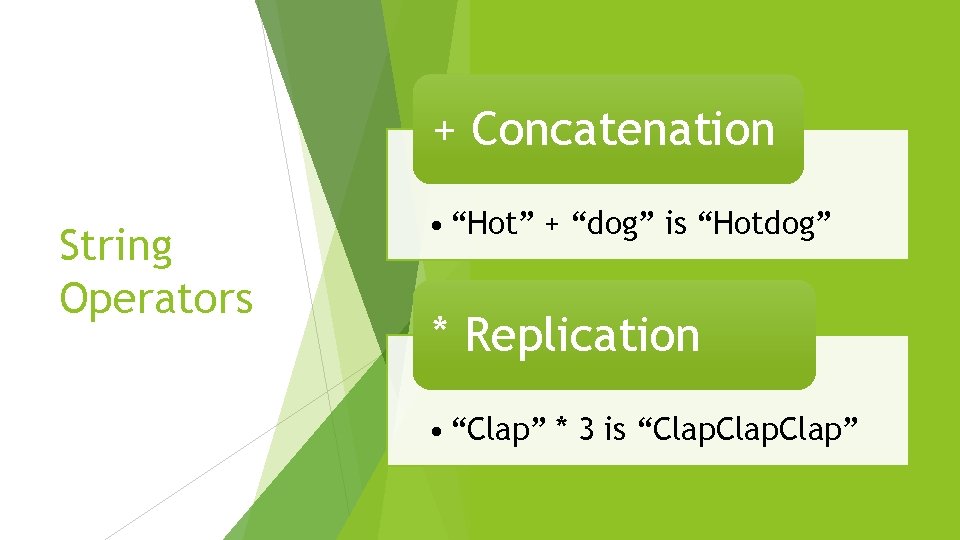
+ Concatenation String Operators • “Hot” + “dog” is “Hotdog” * Replication • “Clap” * 3 is “Clap”
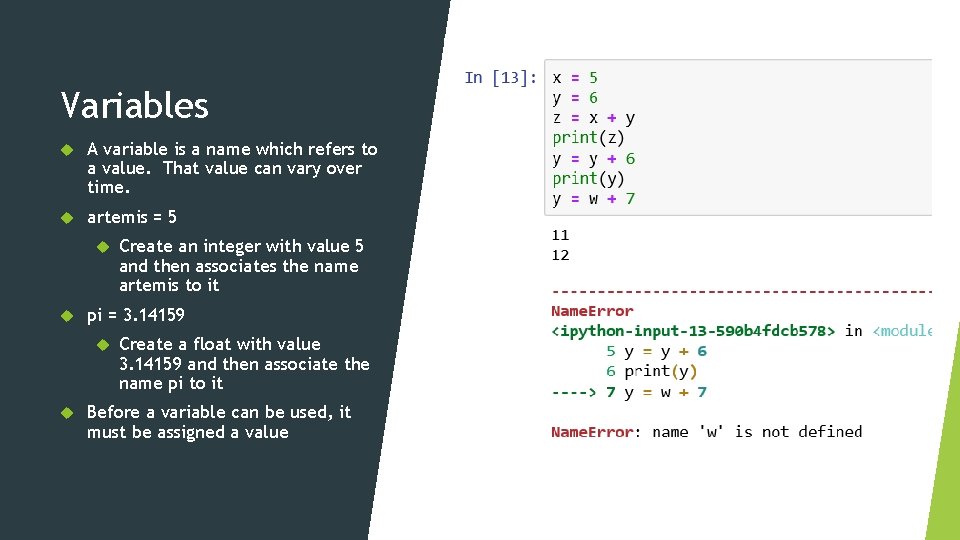
Variables A variable is a name which refers to a value. That value can vary over time. artemis = 5 pi = 3. 14159 Create an integer with value 5 and then associates the name artemis to it Create a float with value 3. 14159 and then associate the name pi to it Before a variable can be used, it must be assigned a value
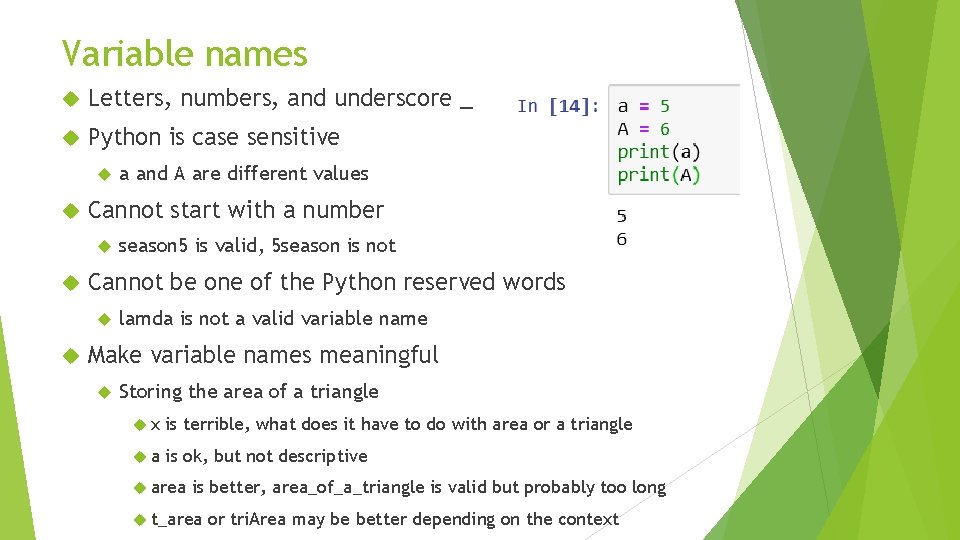
Variable names Letters, numbers, and underscore _ Python is case sensitive Cannot start with a number season 5 is valid, 5 season is not Cannot be one of the Python reserved words a and A are different values lamda is not a valid variable name Make variable names meaningful Storing the area of a triangle x is terrible, what does it have to do with area or a triangle a is ok, but not descriptive area is better, area_of_a_triangle is valid but probably too long t_area or tri. Area may be better depending on the context
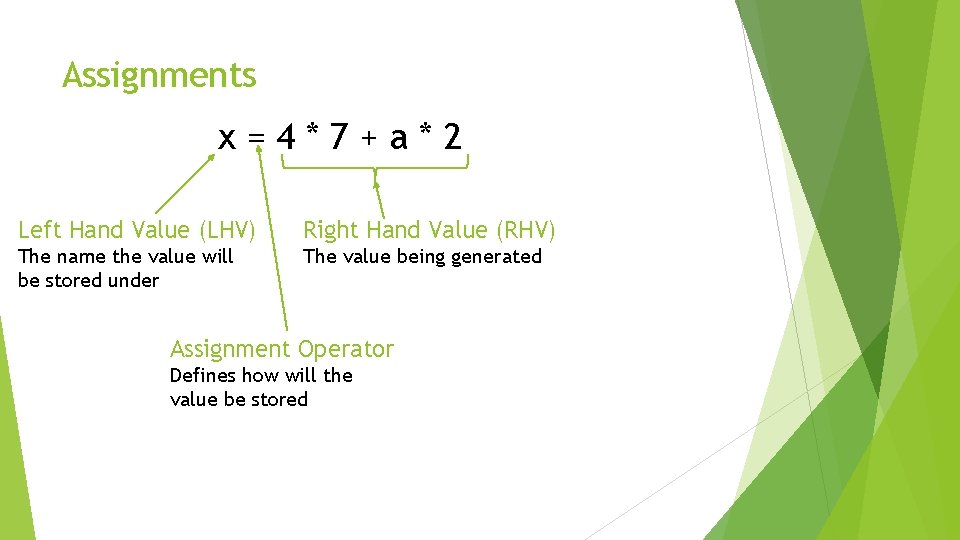
Assignments x=4*7+a*2 Left Hand Value (LHV) Right Hand Value (RHV) The name the value will be stored under The value being generated Assignment Operator Defines how will the value be stored
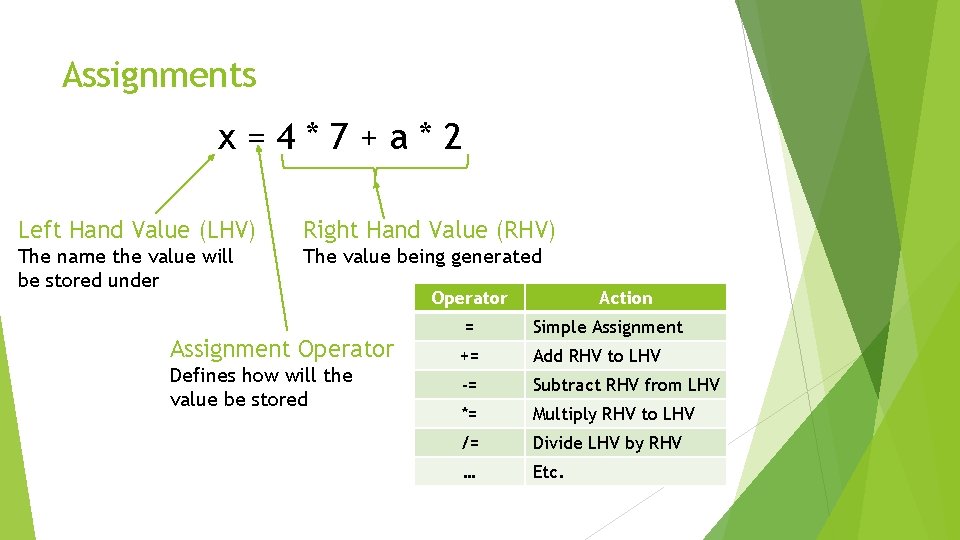
Assignments x=4*7+a*2 Left Hand Value (LHV) Right Hand Value (RHV) The name the value will be stored under The value being generated Assignment Operator Defines how will the value be stored Operator Action = Simple Assignment += Add RHV to LHV -= Subtract RHV from LHV *= Multiply RHV to LHV /= Divide LHV by RHV … Etc.
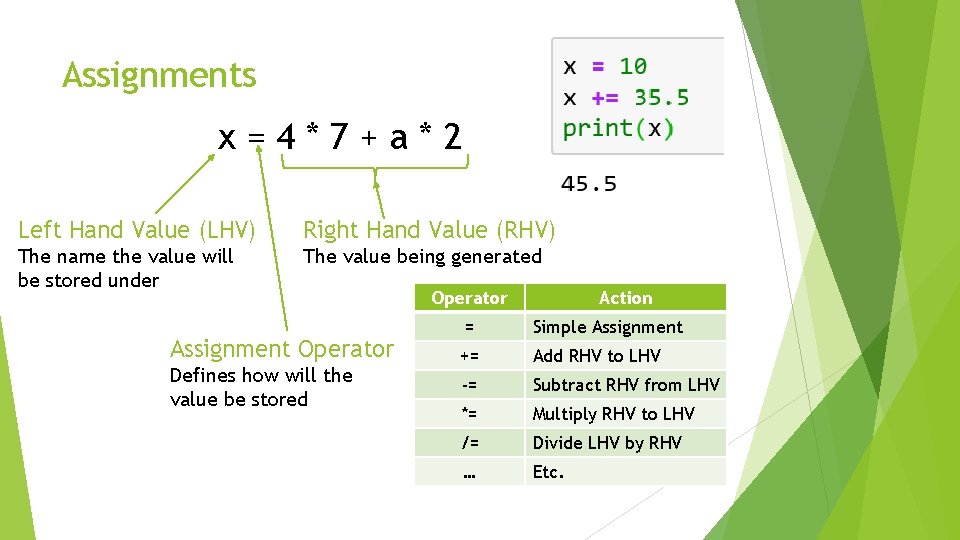
Assignments x=4*7+a*2 Left Hand Value (LHV) Right Hand Value (RHV) The name the value will be stored under The value being generated Assignment Operator Defines how will the value be stored Operator Action = Simple Assignment += Add RHV to LHV -= Subtract RHV from LHV *= Multiply RHV to LHV /= Divide LHV by RHV … Etc.
Variable Type Unlike C, C++, or many other languages, Python is dynamically typed If a variable comes into existence by assigning it a value, how does Python know what data type it is?
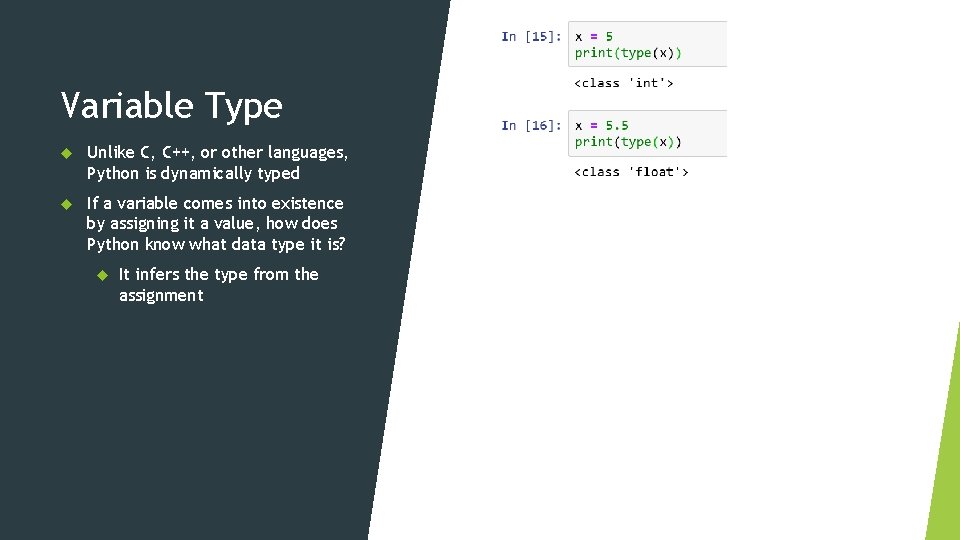
Variable Type Unlike C, C++, or other languages, Python is dynamically typed If a variable comes into existence by assigning it a value, how does Python know what data type it is? It infers the type from the assignment
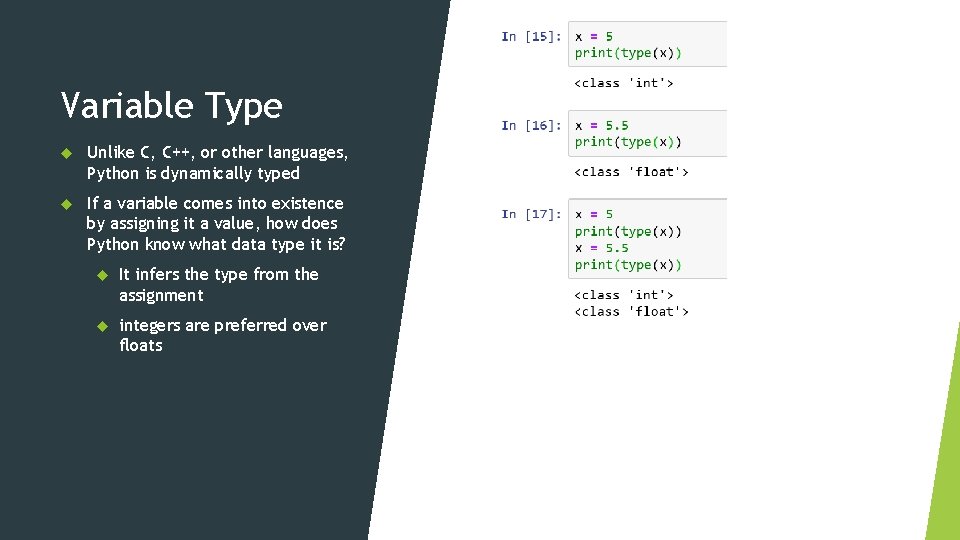
Variable Type Unlike C, C++, or other languages, Python is dynamically typed If a variable comes into existence by assigning it a value, how does Python know what data type it is? It infers the type from the assignment integers are preferred over floats
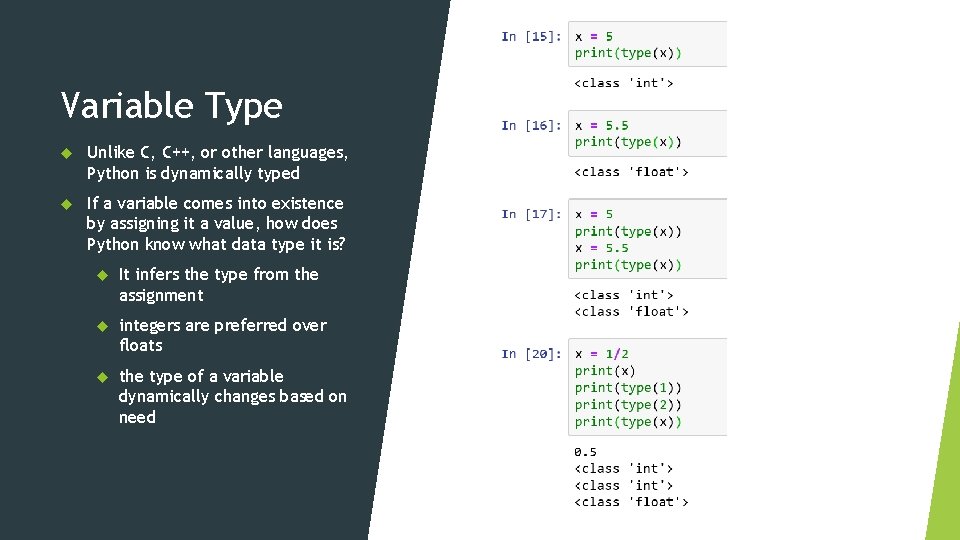
Variable Type Unlike C, C++, or other languages, Python is dynamically typed If a variable comes into existence by assigning it a value, how does Python know what data type it is? It infers the type from the assignment integers are preferred over floats the type of a variable dynamically changes based on need
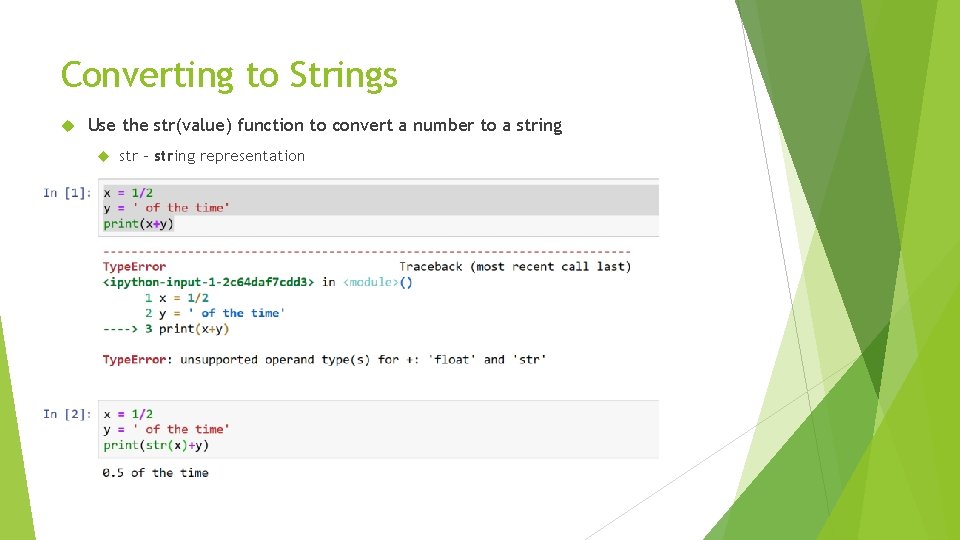
Converting to Strings Use the str(value) function to convert a number to a string str – string representation
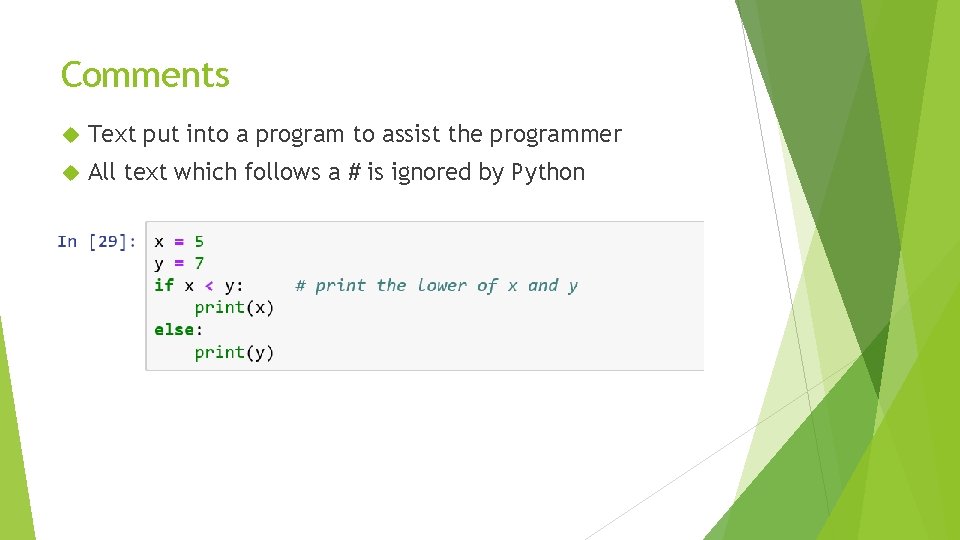
Comments Text put into a program to assist the programmer All text which follows a # is ignored by Python
Bugs Bug An error in a program Types of bugs Syntax errors Problems with the syntax of the source code which stops the parser from being able to understand the program Run-time errors Errors which occur while the program is running. Semantic (Logic) errors Programs which parse and run fine, but do not do what is intended Debugging The process of removing bugs
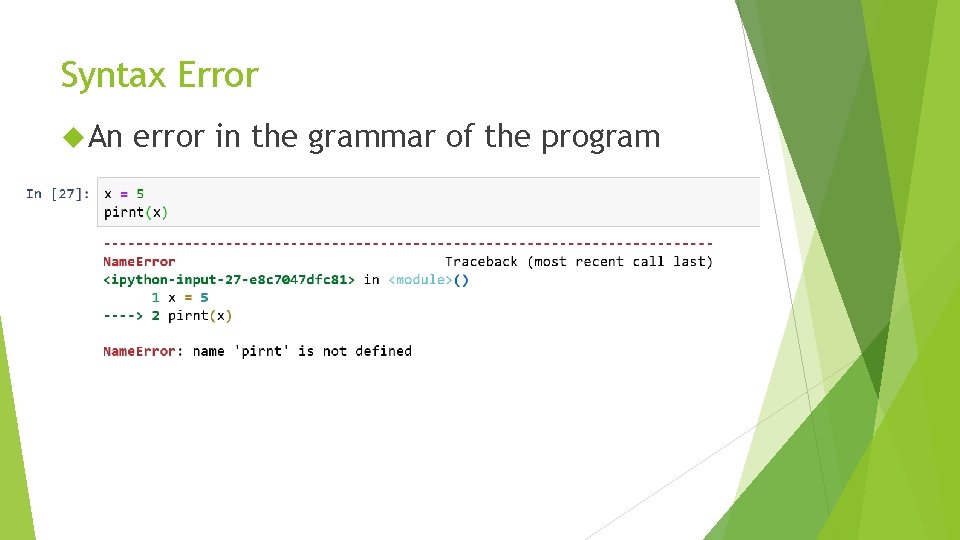
Syntax Error An error in the grammar of the program
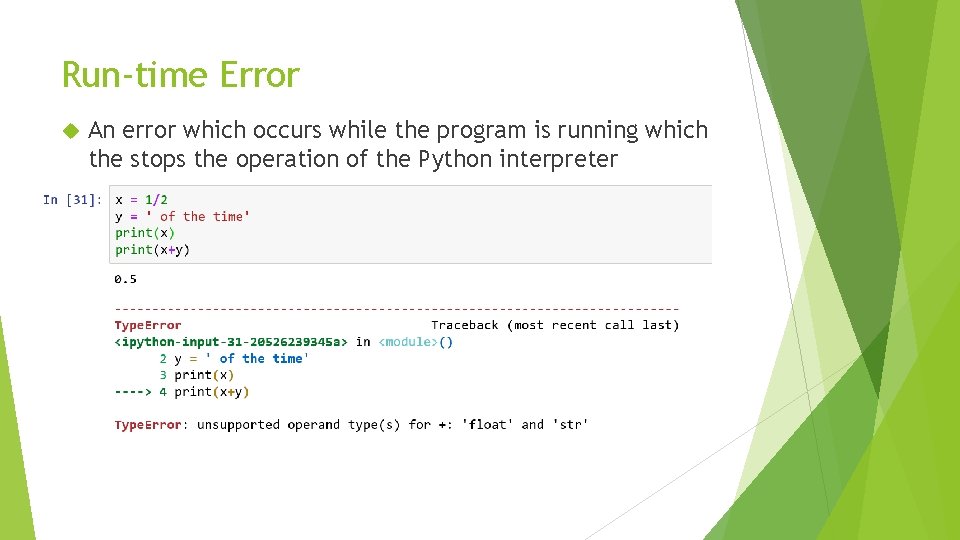
Run-time Error An error which occurs while the program is running which the stops the operation of the Python interpreter
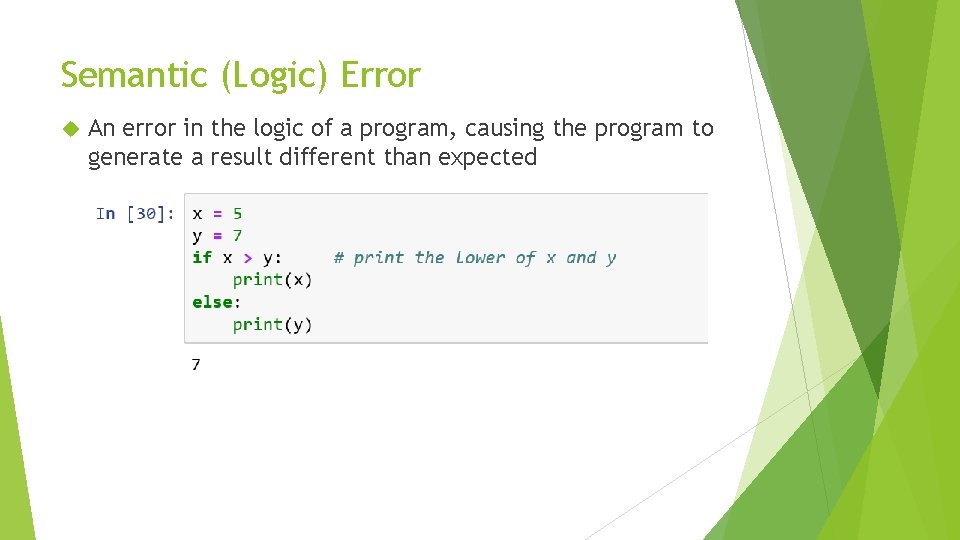
Semantic (Logic) Error An error in the logic of a program, causing the program to generate a result different than expected
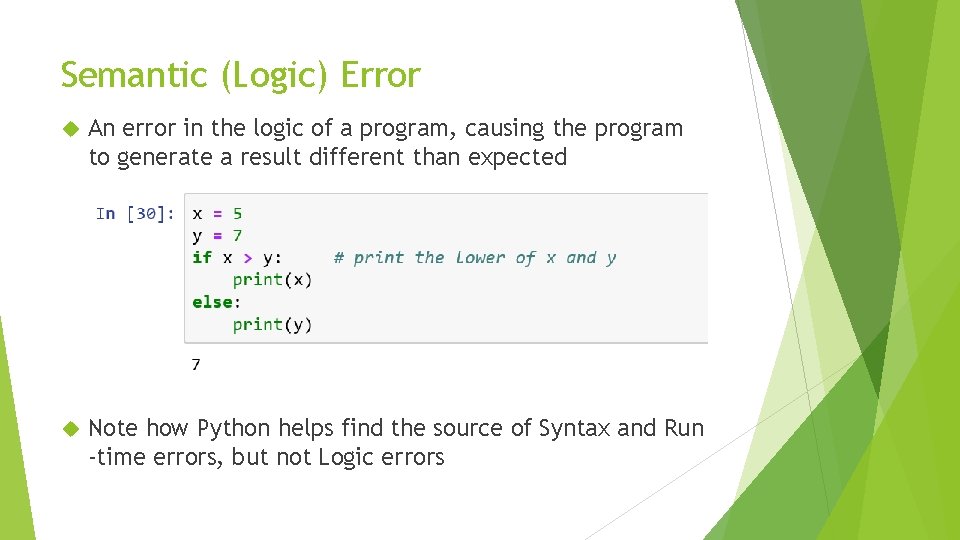
Semantic (Logic) Error An error in the logic of a program, causing the program to generate a result different than expected Note how Python helps find the source of Syntax and Run -time errors, but not Logic errors
Resources Downey, A. (2016) Think Python, Second Edition Sebastopol, CA: O’Reilly Media
- Slides: 30