
Lecture 2 Proteins In Detail The Native State


![Michaelis-Menten Kinetics So what happens if you monitor d[P]/dt at different [S]… Vmax Km](https://slidetodoc.com/presentation_image/2651e28f3324b81c8e73df2e5878740c/image-35.jpg "Michaelis-Menten Kinetics So what happens if you monitor d[P]/dt at different [S]… Vmax Km")
- Slides: 39
Lecture 2: Proteins In Detail The ‘Native State’ structures look like this: But how did they get there (Kinetics) and why do they stay that way (Thermodynamics)? We’ll start at the very beginning: Primary structure
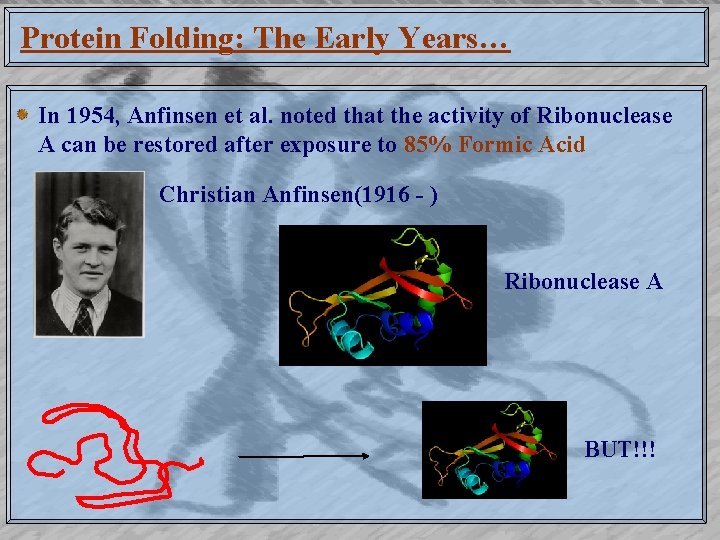
Protein Folding: The Early Years… In 1954, Anfinsen et al. noted that the activity of Ribonuclease A can be restored after exposure to 85% Formic Acid Christian Anfinsen(1916 - ) Ribonuclease A BUT!!!
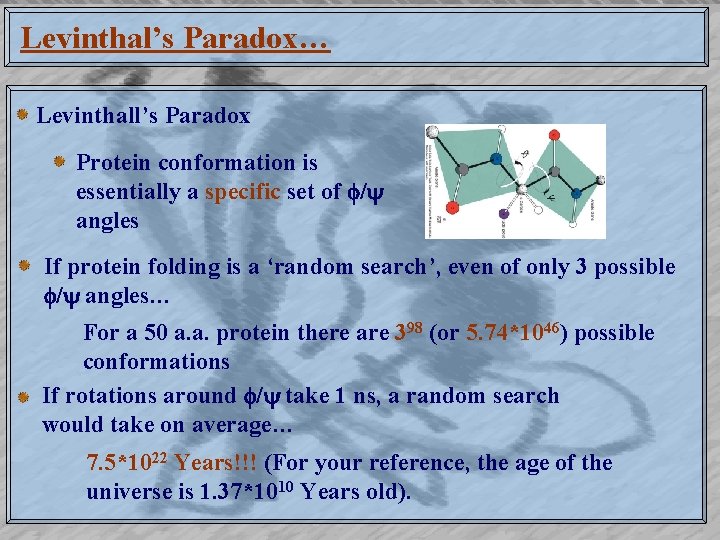
Levinthal’s Paradox… Levinthall’s Paradox Protein conformation is essentially a specific set of / angles If protein folding is a ‘random search’, even of only 3 possible / angles… For a 50 a. a. protein there are 398 (or 5. 74*1046) possible conformations If rotations around / take 1 ns, a random search would take on average… 7. 5*1022 Years!!! (For your reference, the age of the universe is 1. 37*1010 Years old).
Folding Funnels… Protein Folding Can be visualized by ‘folding funnels’, Ken Dill style. The funnel that best describes the Levinthal Paradox is the ‘golf hole’ funel… Ken Dill, UCSF The simplest ‘way out’ is the biased search ‘grand canyon’ funnel…
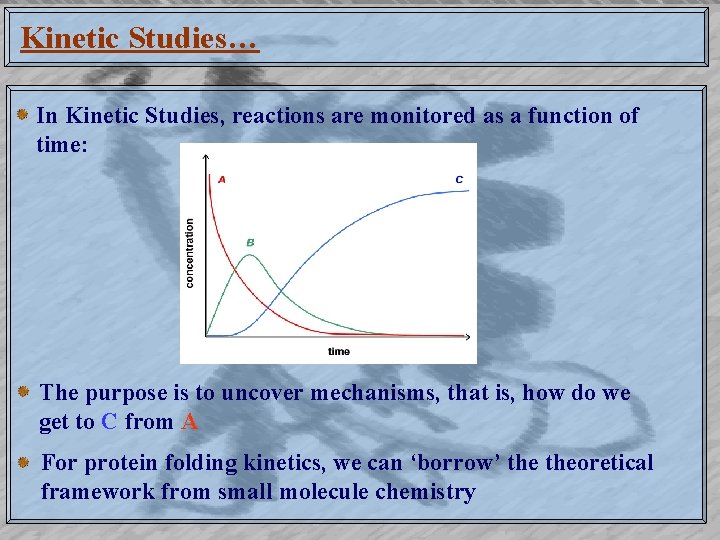
Kinetic Studies… In Kinetic Studies, reactions are monitored as a function of time: The purpose is to uncover mechanisms, that is, how do we get to C from A For protein folding kinetics, we can ‘borrow’ theoretical framework from small molecule chemistry
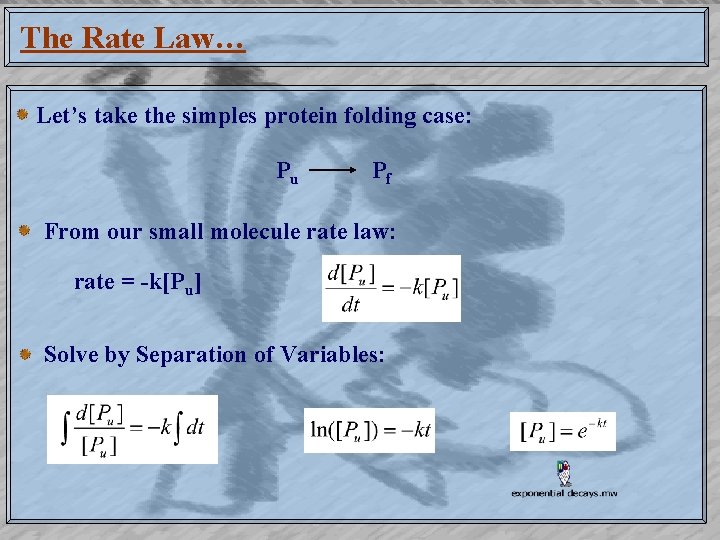
The Rate Law… Let’s take the simples protein folding case: Pu Pf From our small molecule rate law: rate = -k[Pu] Solve by Separation of Variables:
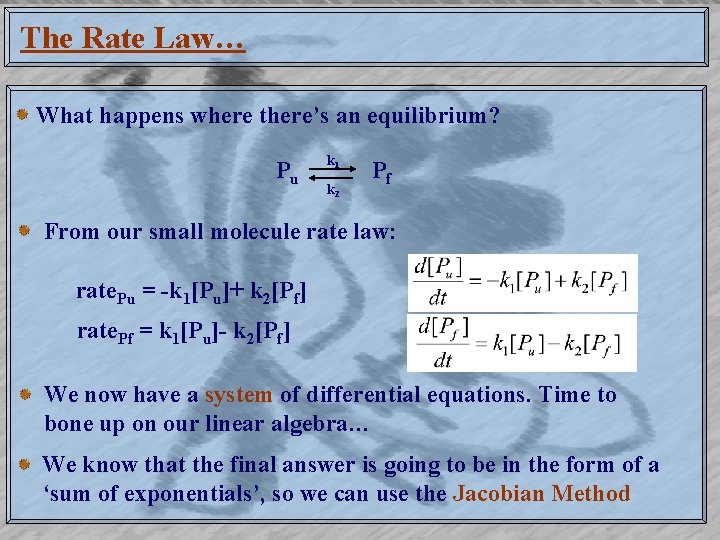
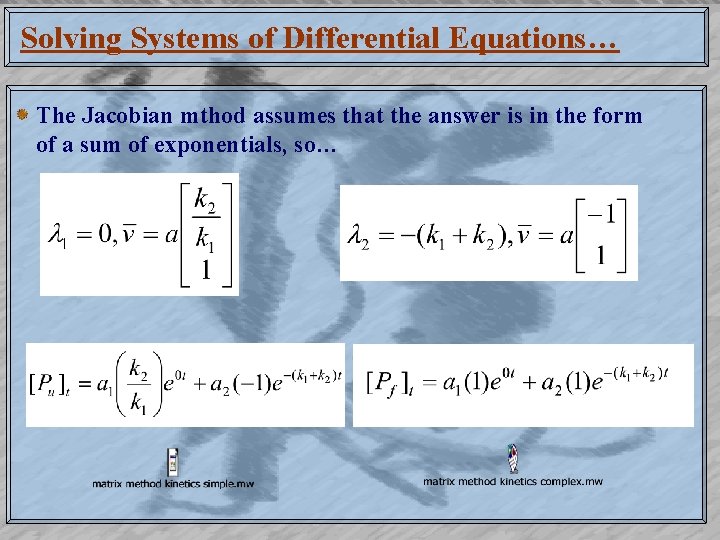
The Rate Law… What happens where there’s an equilibrium? Pu k 1 k 2 Pf From our small molecule rate law: rate. Pu = -k 1[Pu]+ k 2[Pf] rate. Pf = k 1[Pu]- k 2[Pf] We now have a system of differential equations. Time to bone up on our linear algebra… We know that the final answer is going to be in the form of a ‘sum of exponentials’, so we can use the Jacobian Method
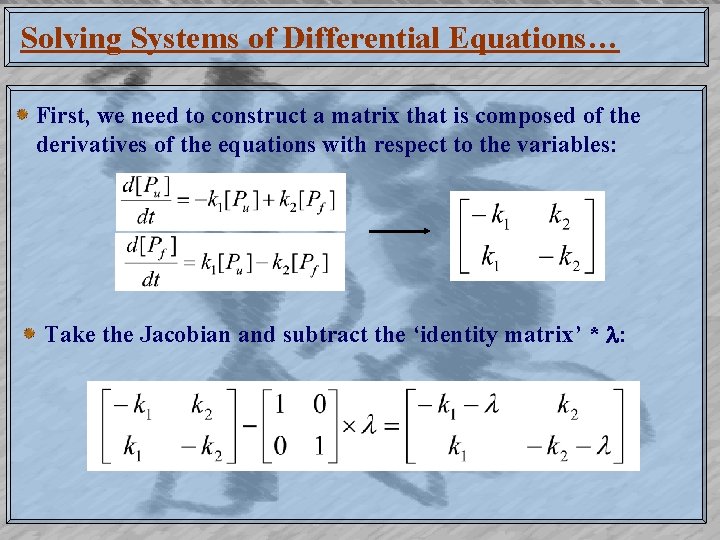
Solving Systems of Differential Equations… First, we need to construct a matrix that is composed of the derivatives of the equations with respect to the variables: Take the Jacobian and subtract the ‘identity matrix’ * :
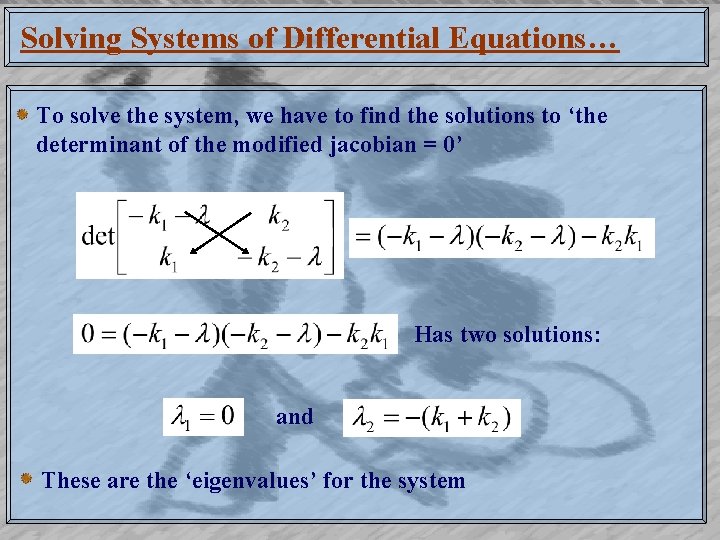
Solving Systems of Differential Equations… To solve the system, we have to find the solutions to ‘the determinant of the modified jacobian = 0’ Has two solutions: and These are the ‘eigenvalues’ for the system
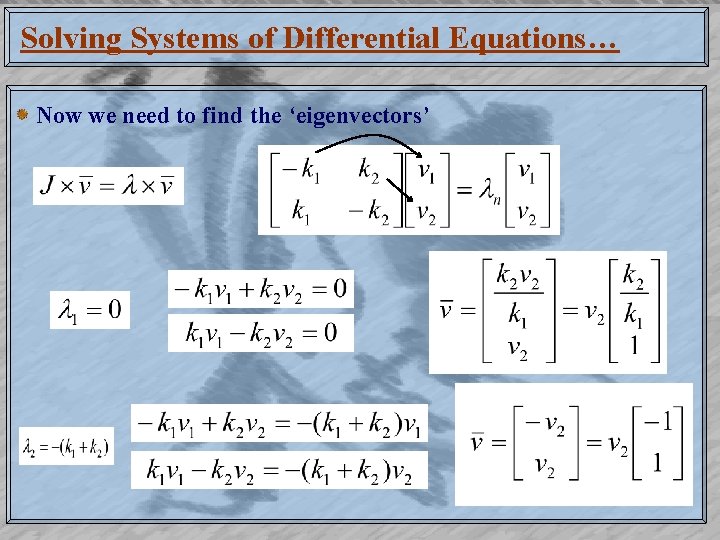
Solving Systems of Differential Equations… Now we need to find the ‘eigenvectors’
Solving Systems of Differential Equations… The Jacobian mthod assumes that the answer is in the form of a sum of exponentials, so…
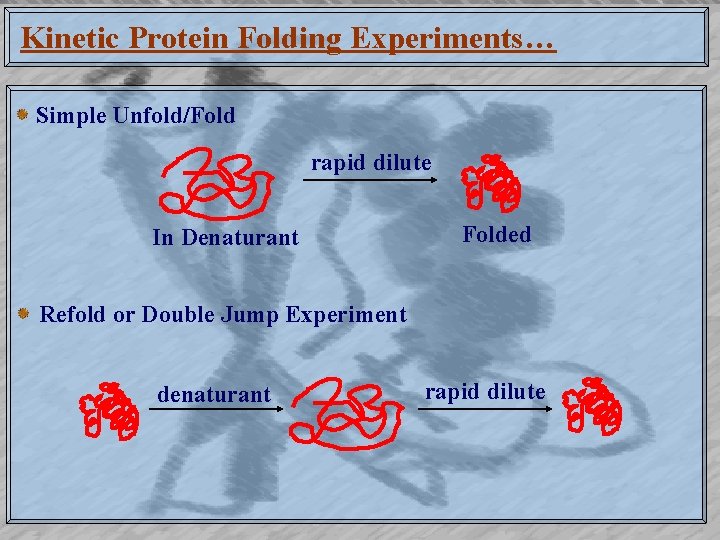
Kinetic Protein Folding Experiments… Simple Unfold/Fold rapid dilute In Denaturant Folded Refold or Double Jump Experiment denaturant rapid dilute
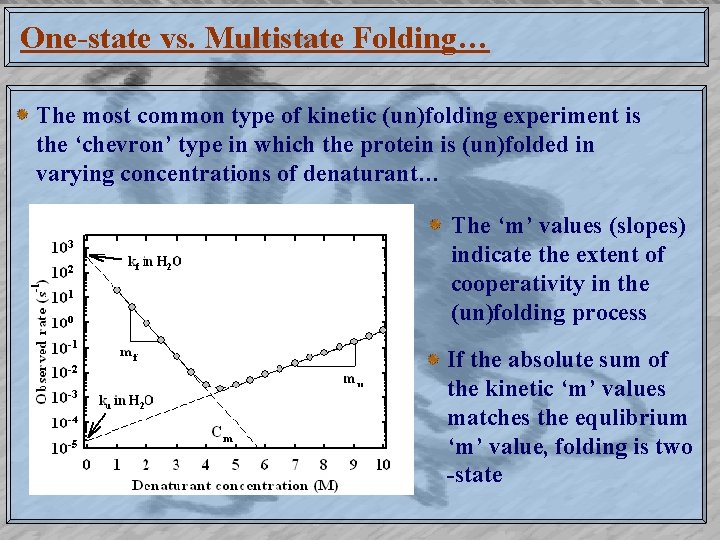
One-state vs. Multistate Folding… The most common type of kinetic (un)folding experiment is the ‘chevron’ type in which the protein is (un)folded in varying concentrations of denaturant… The ‘m’ values (slopes) indicate the extent of cooperativity in the (un)folding process If the absolute sum of the kinetic ‘m’ values matches the equlibrium ‘m’ value, folding is two -state
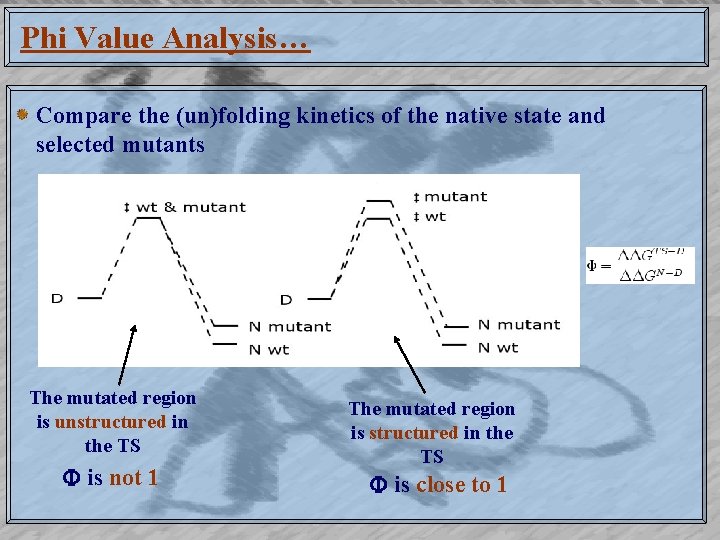
Phi Value Analysis… Compare the (un)folding kinetics of the native state and selected mutants The mutated region is unstructured in the TS is not 1 The mutated region is structured in the TS is close to 1
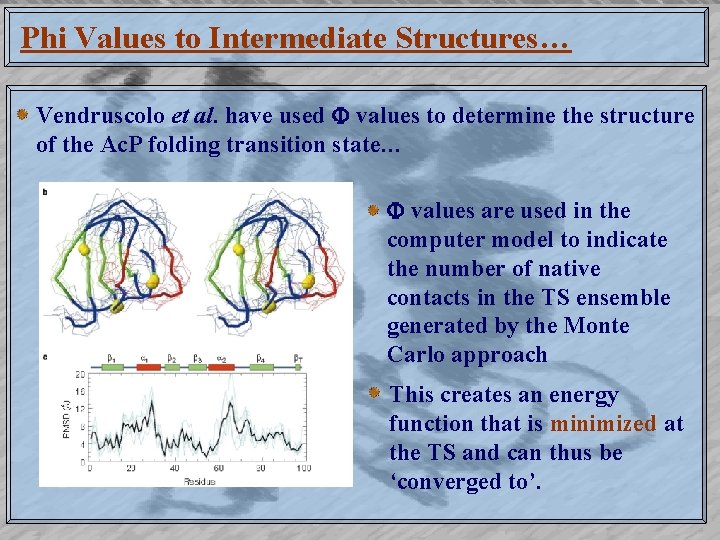
Phi Values to Intermediate Structures… Vendruscolo et al. have used values to determine the structure of the Ac. P folding transition state… values are used in the computer model to indicate the number of native contacts in the TS ensemble generated by the Monte Carlo approach This creates an energy function that is minimized at the TS and can thus be ‘converged to’.
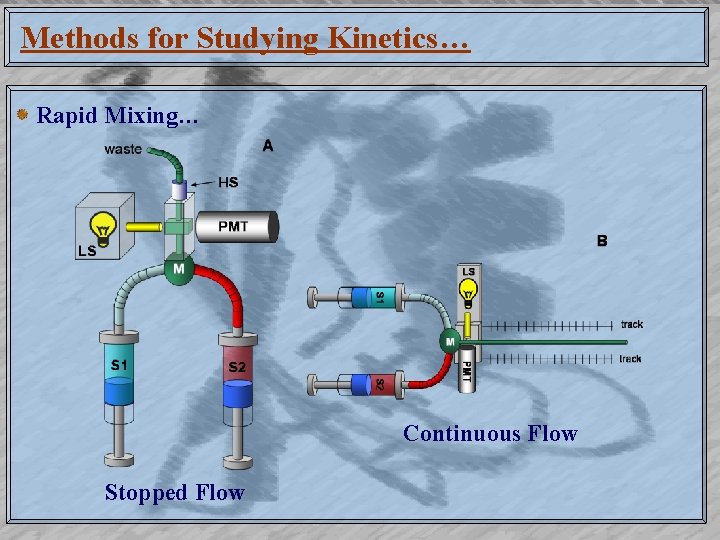
Methods for Studying Kinetics… Rapid Mixing… Continuous Flow Stopped Flow
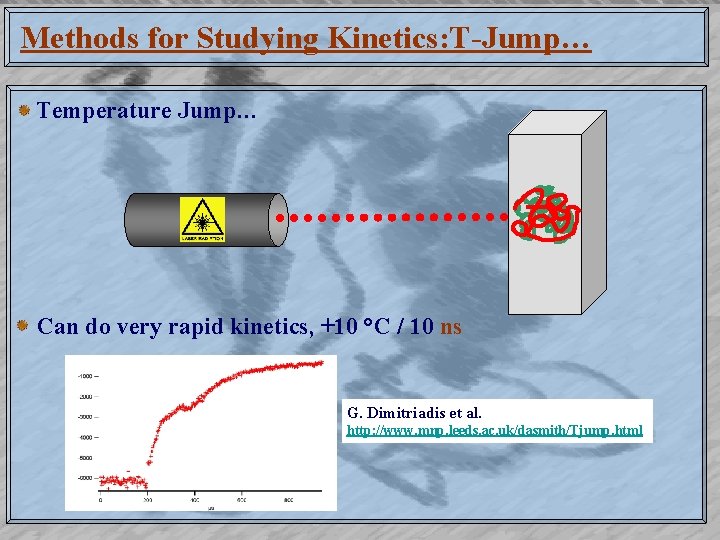
Methods for Studying Kinetics: T-Jump… Temperature Jump… Can do very rapid kinetics, +10 °C / 10 ns G. Dimitriadis et al. http: //www. mnp. leeds. ac. uk/dasmith/Tjump. html
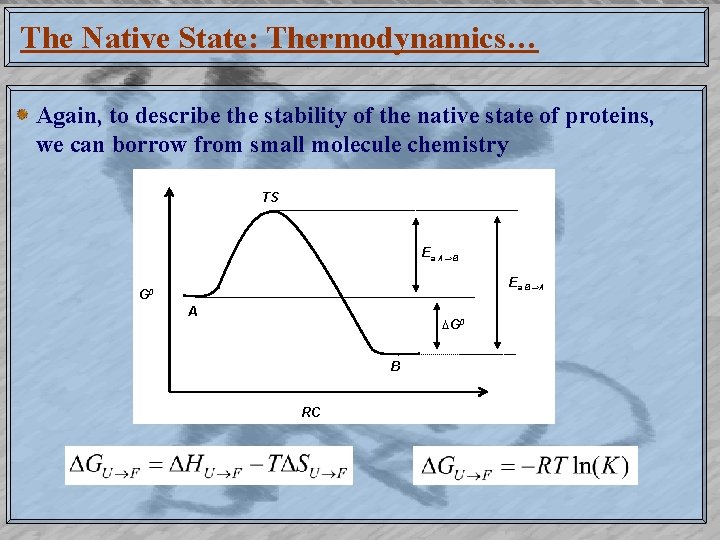
The Native State: Thermodynamics… Again, to describe the stability of the native state of proteins, we can borrow from small molecule chemistry TS Ea A→B Ea B→A G 0 A G 0 B RC
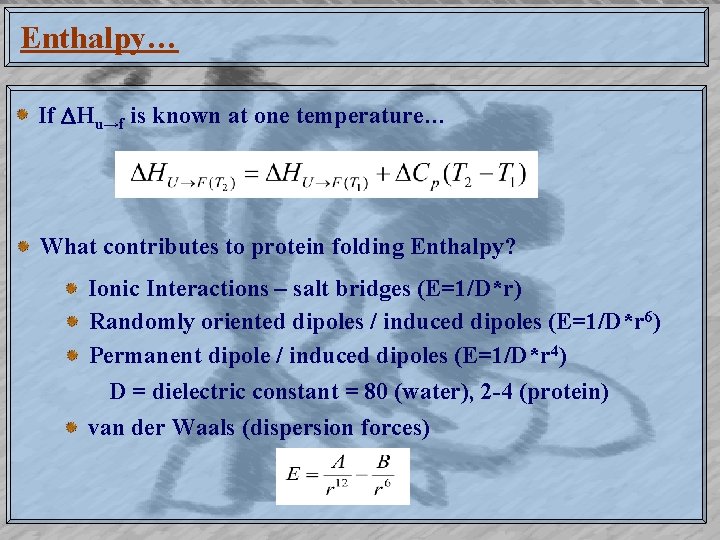
Enthalpy… If Hu→f is known at one temperature… What contributes to protein folding Enthalpy? Ionic Interactions – salt bridges (E=1/D*r) Randomly oriented dipoles / induced dipoles (E=1/D*r 6) Permanent dipole / induced dipoles (E=1/D*r 4) D = dielectric constant = 80 (water), 2 -4 (protein) van der Waals (dispersion forces)
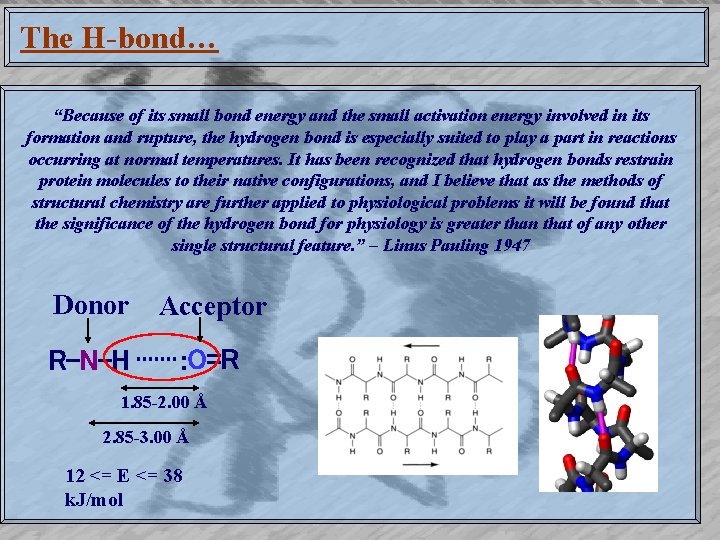
The H-bond… “Because of its small bond energy and the small activation energy involved in its formation and rupture, the hydrogen bond is especially suited to play a part in reactions occurring at normal temperatures. It has been recognized that hydrogen bonds restrain protein molecules to their native configurations, and I believe that as the methods of structural chemistry are further applied to physiological problems it will be found that the significance of the hydrogen bond for physiology is greater than that of any other single structural feature. ” – Linus Pauling 1947 Donor Acceptor R-N-H : O=R 1. 85 -2. 00 Å 2. 85 -3. 00 Å 12 <= E <= 38 k. J/mol
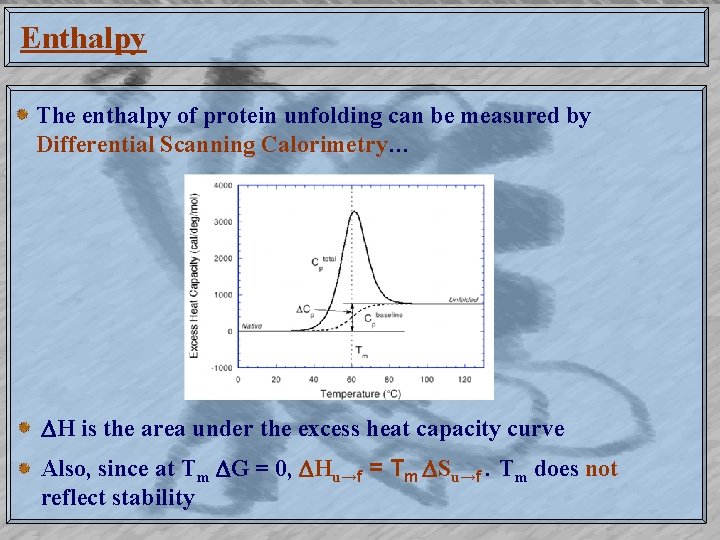
Enthalpy The enthalpy of protein unfolding can be measured by Differential Scanning Calorimetry… H is the area under the excess heat capacity curve Also, since at Tm G = 0, Hu→f = Tm Su→f. Tm does not reflect stability
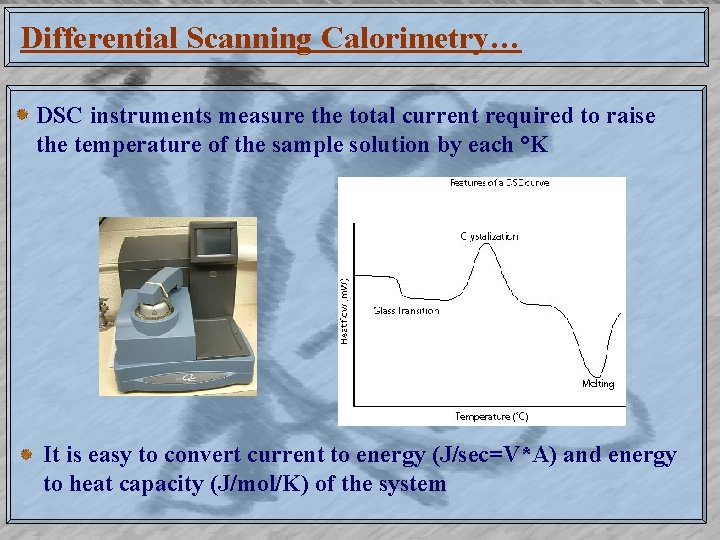
Differential Scanning Calorimetry… DSC instruments measure the total current required to raise the temperature of the sample solution by each °K It is easy to convert current to energy (J/sec=V*A) and energy to heat capacity (J/mol/K) of the system
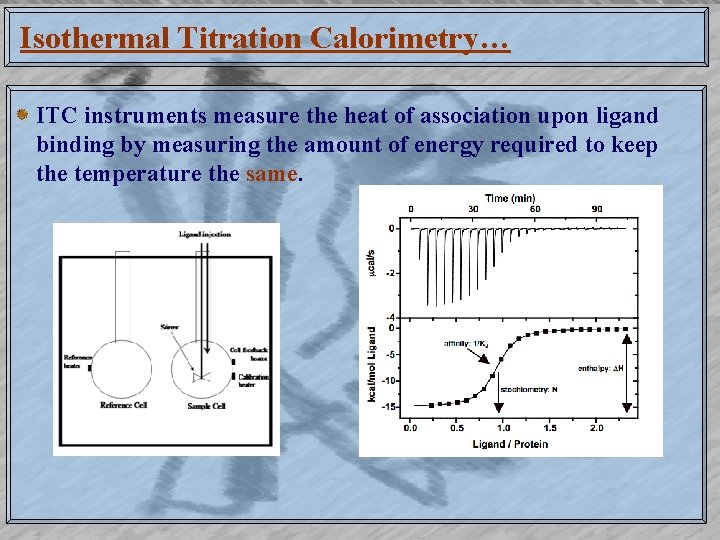
Isothermal Titration Calorimetry… ITC instruments measure the heat of association upon ligand binding by measuring the amount of energy required to keep the temperature the same.
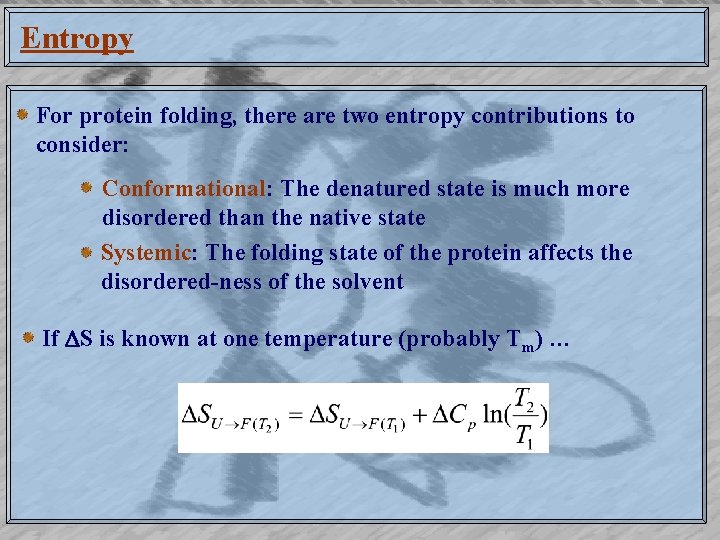
Entropy For protein folding, there are two entropy contributions to consider: Conformational: The denatured state is much more disordered than the native state Systemic: The folding state of the protein affects the disordered-ness of the solvent If S is known at one temperature (probably Tm) …
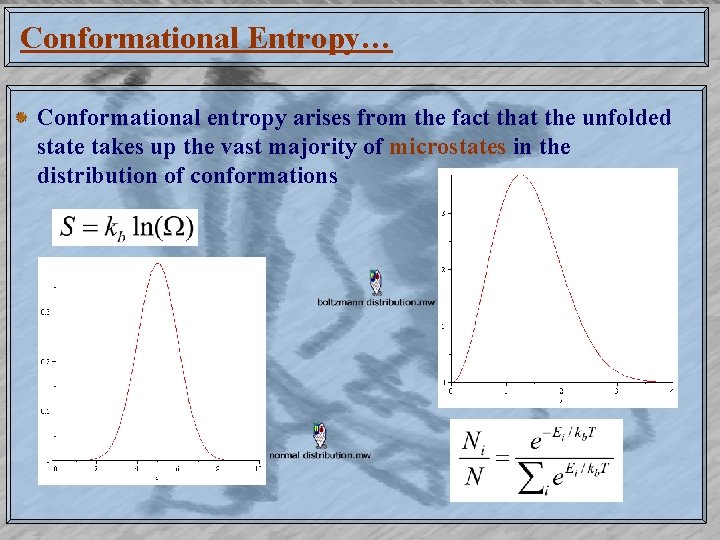
Conformational Entropy… Conformational entropy arises from the fact that the unfolded state takes up the vast majority of microstates in the distribution of conformations
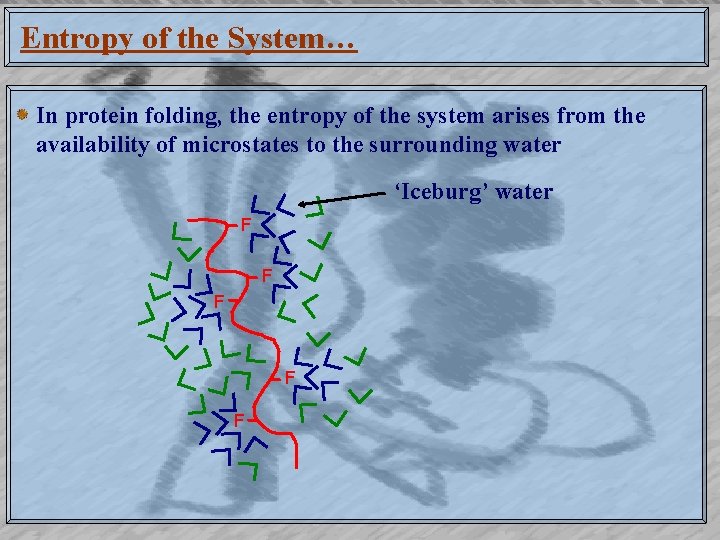
Entropy of the System… In protein folding, the entropy of the system arises from the availability of microstates to the surrounding water ‘Iceburg’ water F F F
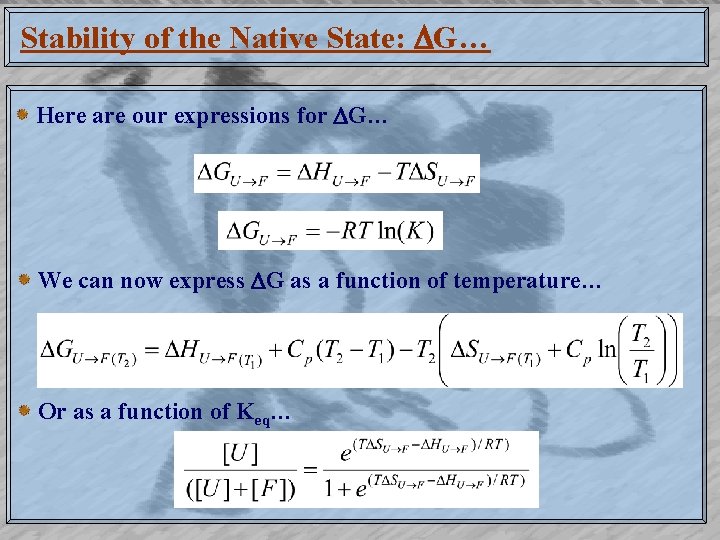
Stability of the Native State: G… Here are our expressions for G… We can now express G as a function of temperature… Or as a function of Keq…
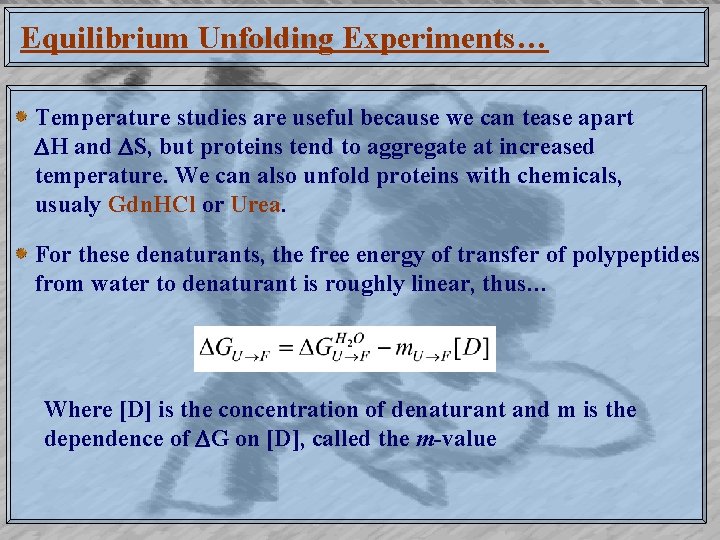
Equilibrium Unfolding Experiments… Temperature studies are useful because we can tease apart H and S, but proteins tend to aggregate at increased temperature. We can also unfold proteins with chemicals, usualy Gdn. HCl or Urea. For these denaturants, the free energy of transfer of polypeptides from water to denaturant is roughly linear, thus… Where [D] is the concentration of denaturant and m is the dependence of G on [D], called the m-value
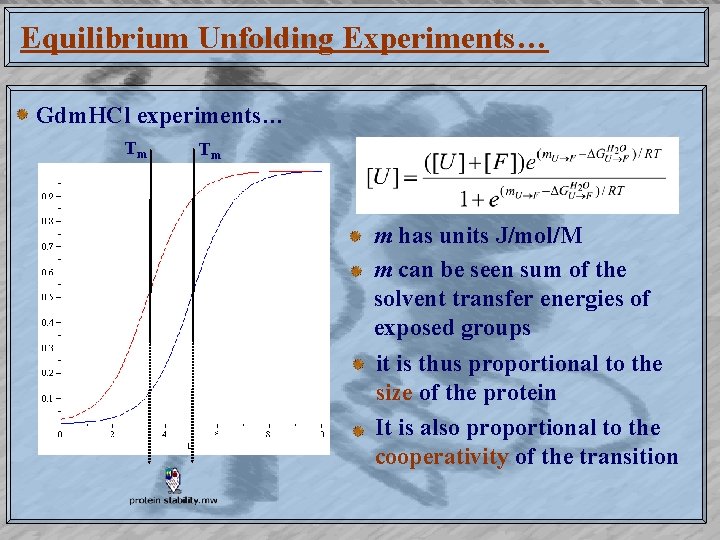
Equilibrium Unfolding Experiments… Gdm. HCl experiments… Tm Tm m has units J/mol/M m can be seen sum of the solvent transfer energies of exposed groups it is thus proportional to the size of the protein It is also proportional to the cooperativity of the transition
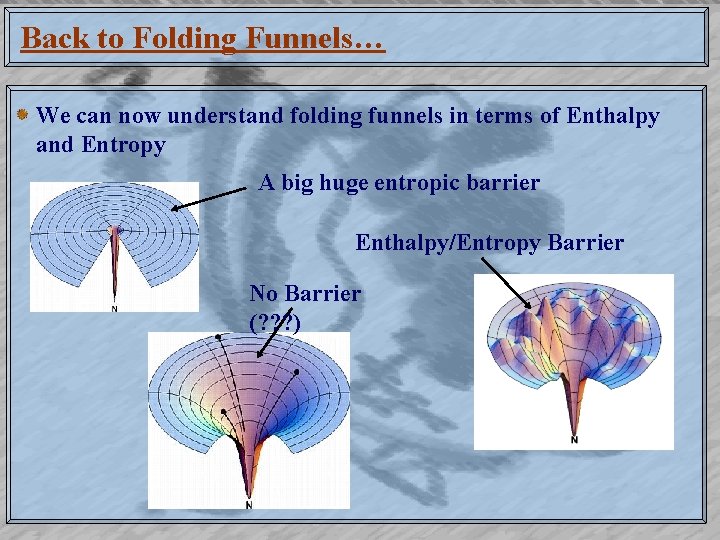
Back to Folding Funnels… We can now understand folding funnels in terms of Enthalpy and Entropy A big huge entropic barrier Enthalpy/Entropy Barrier No Barrier (? ? ? )
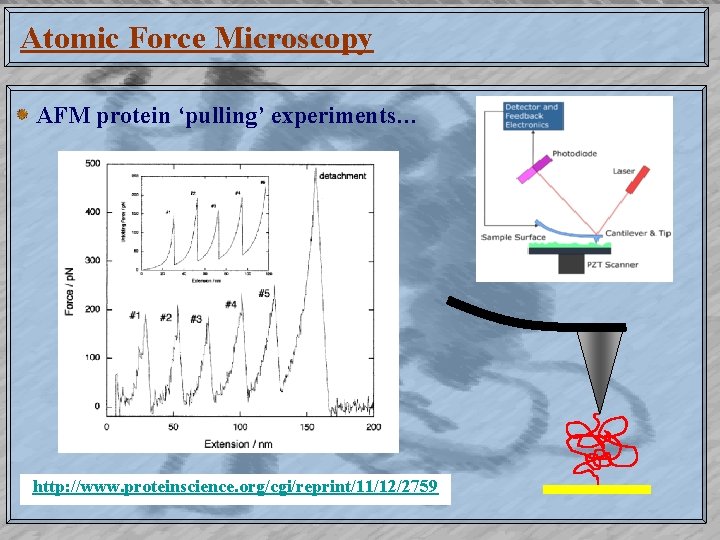
Atomic Force Microscopy AFM protein ‘pulling’ experiments… http: //www. proteinscience. org/cgi/reprint/11/12/2759
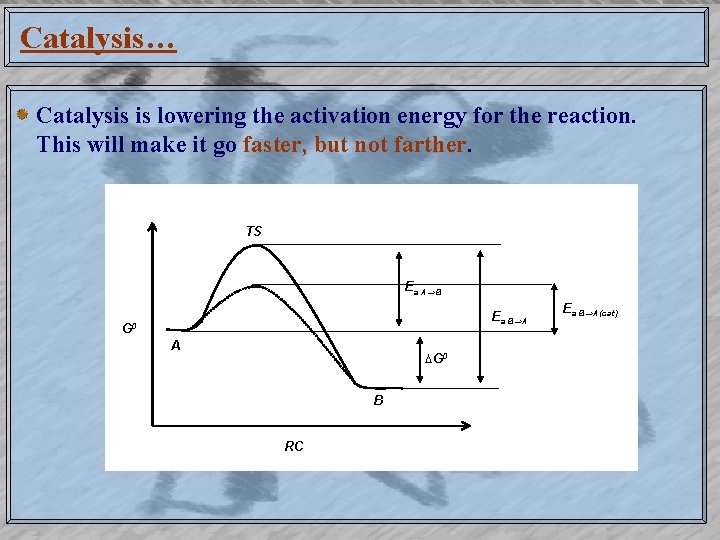
Catalysis… Catalysis is lowering the activation energy for the reaction. This will make it go faster, but not farther. TS Ea A→B Ea B→A G 0 A G 0 B RC Ea B→A(cat)
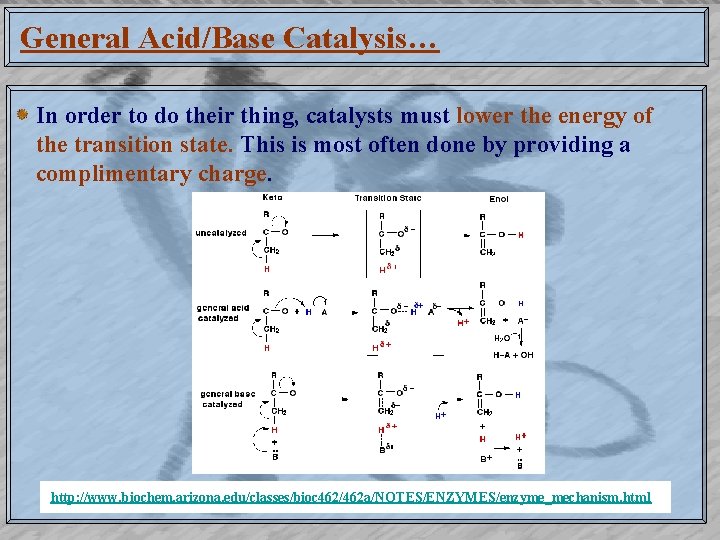
General Acid/Base Catalysis… In order to do their thing, catalysts must lower the energy of the transition state. This is most often done by providing a complimentary charge. http: //www. biochem. arizona. edu/classes/bioc 462/462 a/NOTES/ENZYMES/enzyme_mechanism. html
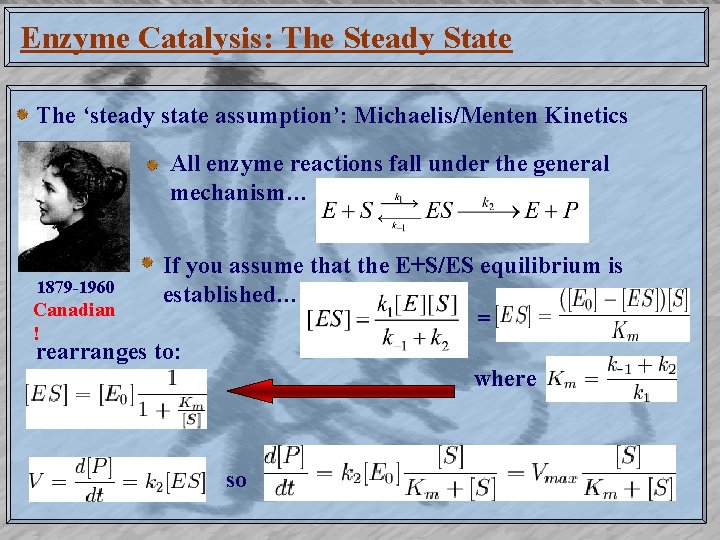
Enzyme Catalysis: The Steady State The ‘steady state assumption’: Michaelis/Menten Kinetics All enzyme reactions fall under the general mechanism… If you assume that the E+S/ES equilibrium is 1879 -1960 established… Canadian = ! rearranges to: where so
Michaelis-Menten Kinetics So what happens if you monitor d[P]/dt at different [S]… Vmax Km Km = the [S] at Vmax/2. It also =[E]+[S]/∑[ES]. k 2 = number of turnovers/sec. It cannot be greater than any forward microscopic rate.
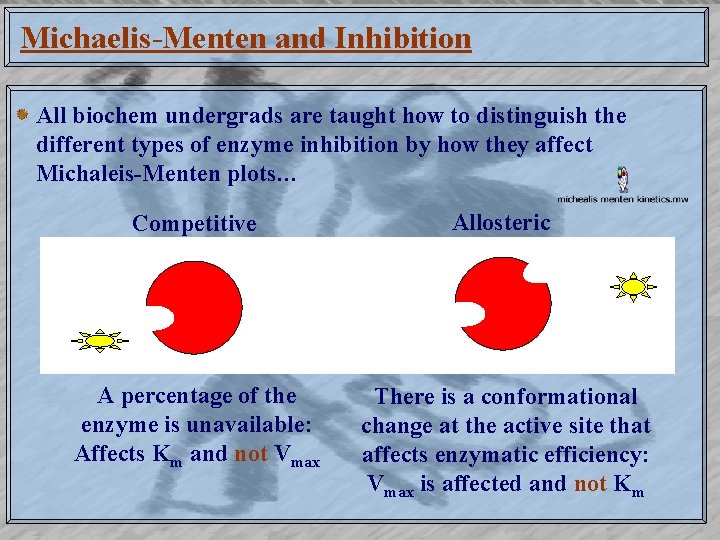
Michaelis-Menten and Inhibition All biochem undergrads are taught how to distinguish the different types of enzyme inhibition by how they affect Michaleis-Menten plots… Competitive Allosteric A percentage of the enzyme is unavailable: Affects Km and not Vmax There is a conformational change at the active site that affects enzymatic efficiency: Vmax is affected and not Km
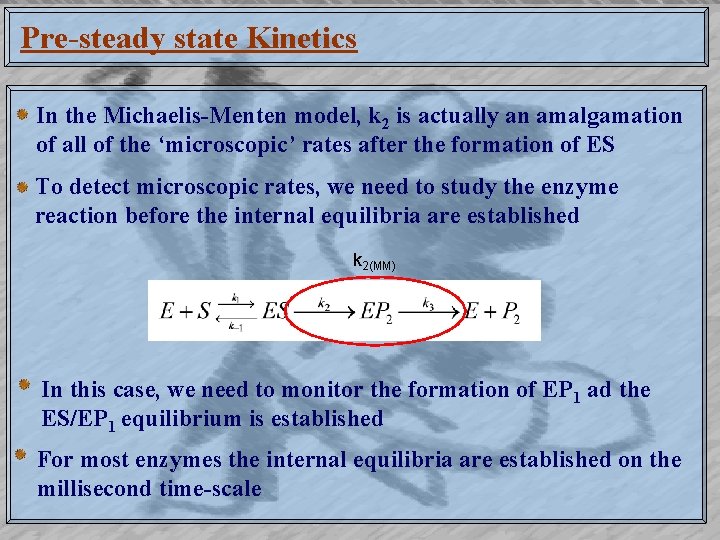
Pre-steady state Kinetics In the Michaelis-Menten model, k 2 is actually an amalgamation of all of the ‘microscopic’ rates after the formation of ES To detect microscopic rates, we need to study the enzyme reaction before the internal equilibria are established k 2(MM) In this case, we need to monitor the formation of EP 1 ad the ES/EP 1 equilibrium is established For most enzymes the internal equilibria are established on the millisecond time-scale
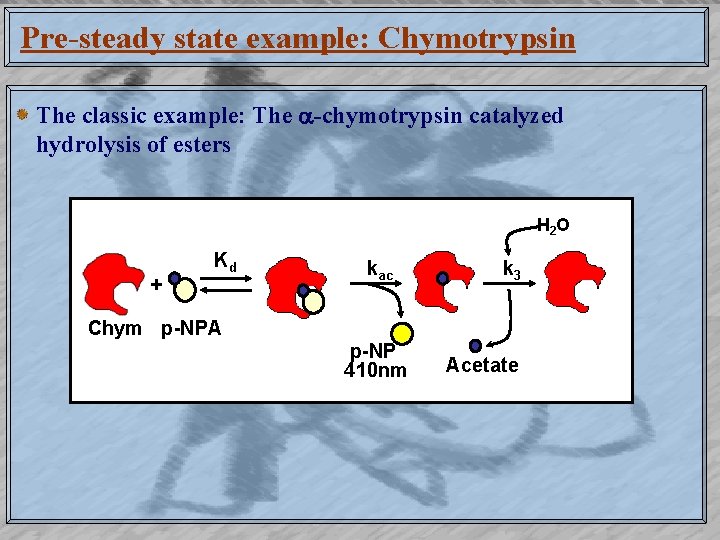
Pre-steady state example: Chymotrypsin The classic example: The -chymotrypsin catalyzed hydrolysis of esters H 2 O + Kd kac k 3 Chym p-NPA p-NP 410 nm Acetate
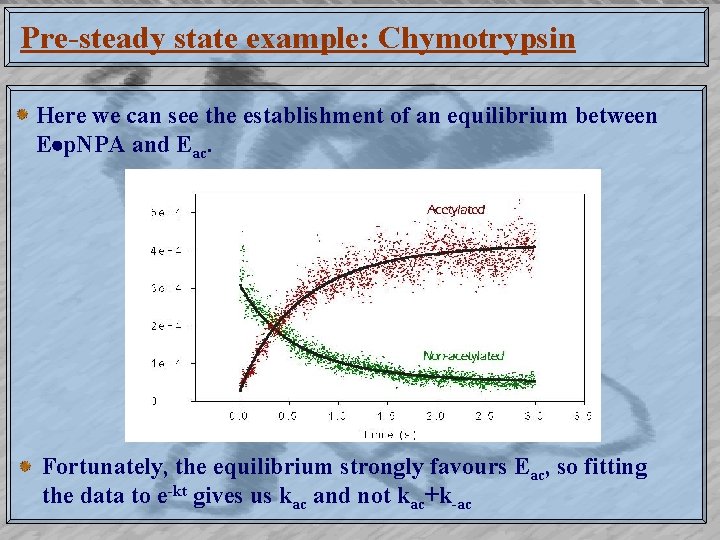
Pre-steady state example: Chymotrypsin Here we can see the establishment of an equilibrium between E p. NPA and Eac. Fortunately, the equilibrium strongly favours Eac, so fitting the data to e-kt gives us kac and not kac+k-ac