
Lecture 2 Placing electrons in orbitals Approximate order
Lecture 2
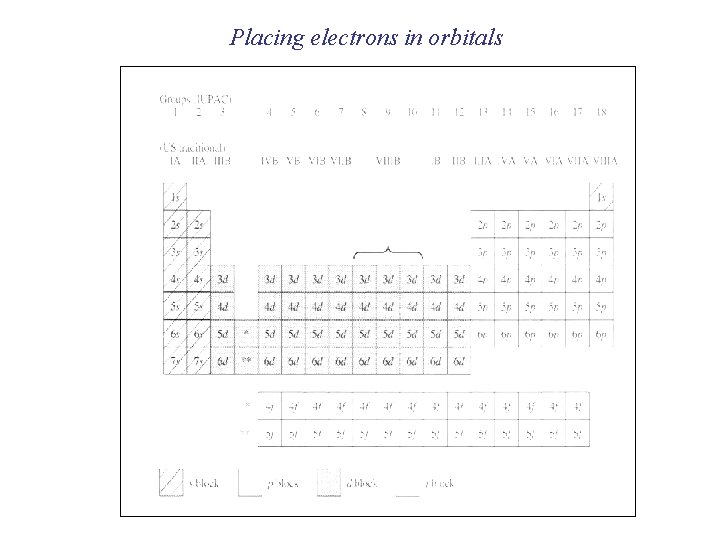
Placing electrons in orbitals
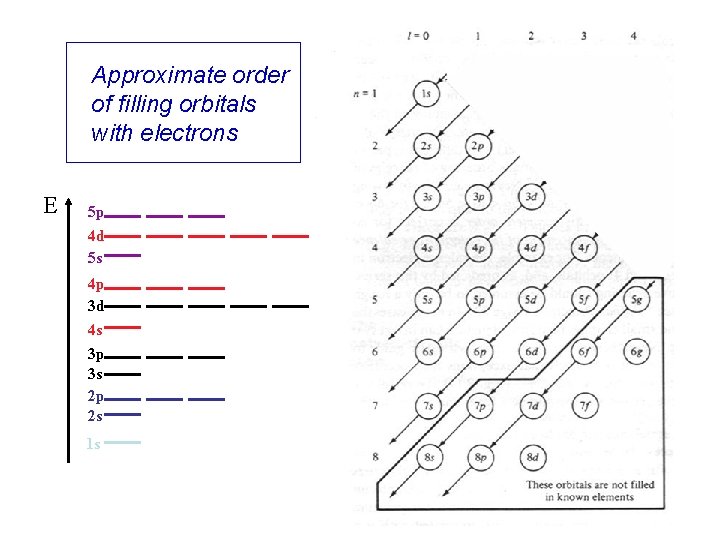
Approximate order of filling orbitals with electrons E 5 p 4 d 5 s 4 p 3 d 4 s 3 p 3 s 2 p 2 s 1 s
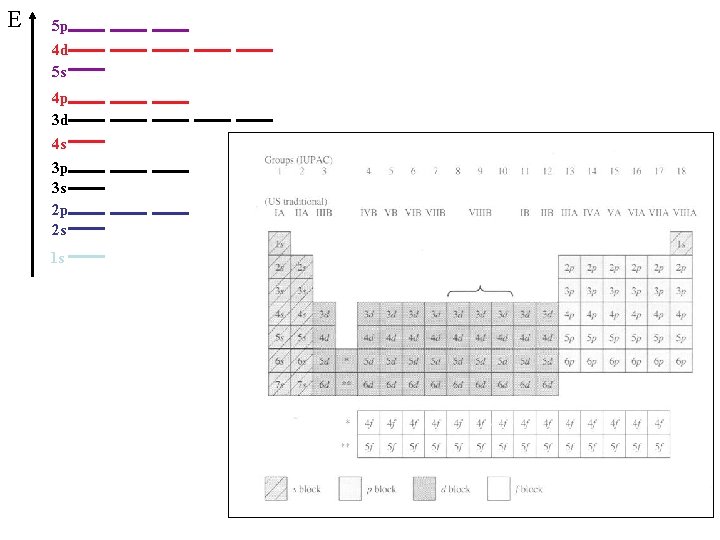
E 5 p 4 d 5 s 4 p 3 d 4 s 3 p 3 s 2 p 2 s 1 s
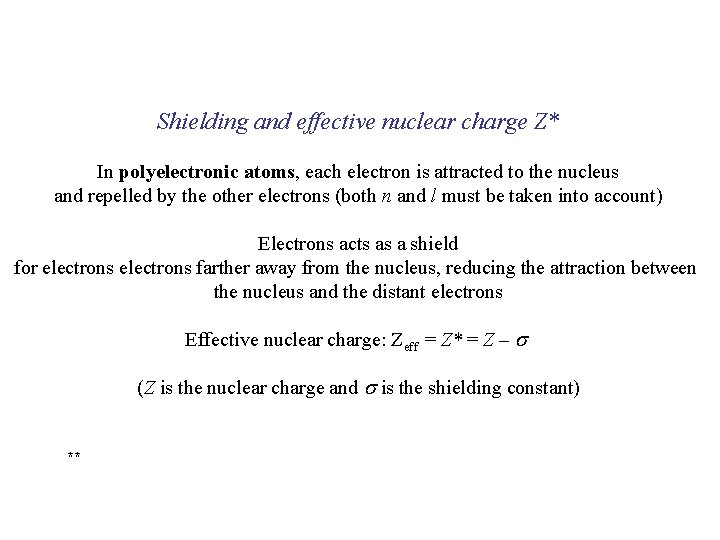
Shielding and effective nuclear charge Z* In polyelectronic atoms, each electron is attracted to the nucleus and repelled by the other electrons (both n and l must be taken into account) Electrons acts as a shield for electrons farther away from the nucleus, reducing the attraction between the nucleus and the distant electrons Effective nuclear charge: Zeff = Z* = Z – s (Z is the nuclear charge and s is the shielding constant) **
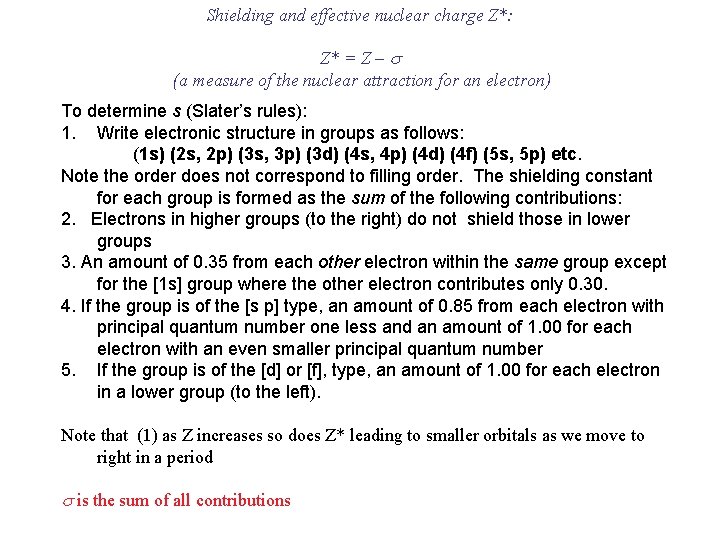
Shielding and effective nuclear charge Z*: Z* = Z – s (a measure of the nuclear attraction for an electron) To determine s (Slater’s rules): 1. Write electronic structure in groups as follows: (1 s) (2 s, 2 p) (3 s, 3 p) (3 d) (4 s, 4 p) (4 d) (4 f) (5 s, 5 p) etc. Note the order does not correspond to filling order. The shielding constant for each group is formed as the sum of the following contributions: 2. Electrons in higher groups (to the right) do not shield those in lower groups 3. An amount of 0. 35 from each other electron within the same group except for the [1 s] group where the other electron contributes only 0. 30. 4. If the group is of the [s p] type, an amount of 0. 85 from each electron with principal quantum number one less and an amount of 1. 00 for each electron with an even smaller principal quantum number 5. If the group is of the [d] or [f], type, an amount of 1. 00 for each electron in a lower group (to the left). Note that (1) as Z increases so does Z* leading to smaller orbitals as we move to right in a period s is the sum of all contributions
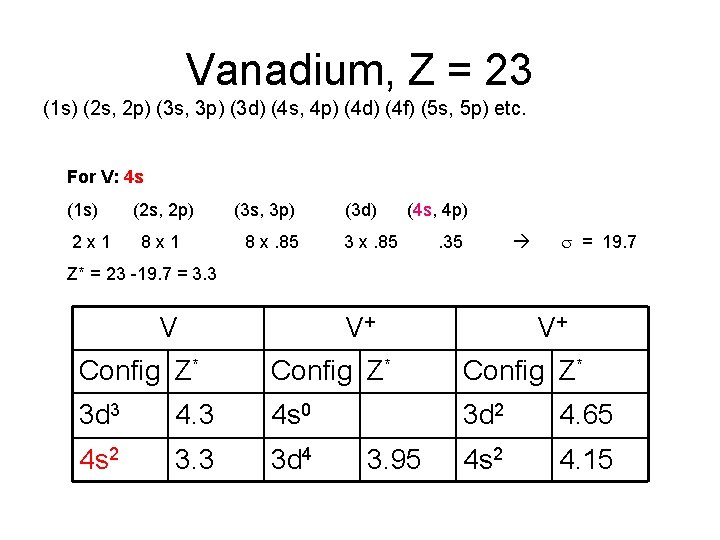
Vanadium, Z = 23 (1 s) (2 s, 2 p) (3 s, 3 p) (3 d) (4 s, 4 p) (4 d) (4 f) (5 s, 5 p) etc. For V: 4 s (1 s) 2 x 1 (2 s, 2 p) 8 x 1 (3 s, 3 p) 8 x. 85 (3 d) (4 s, 4 p) 3 x. 85 . 35 = 19. 7 Z* = 23 -19. 7 = 3. 3 V V+ V+ Config Z* 3 d 3 4 s 0 3 d 2 4. 65 4 s 2 3. 3 3 d 4 4 s 2 4. 15 3. 95
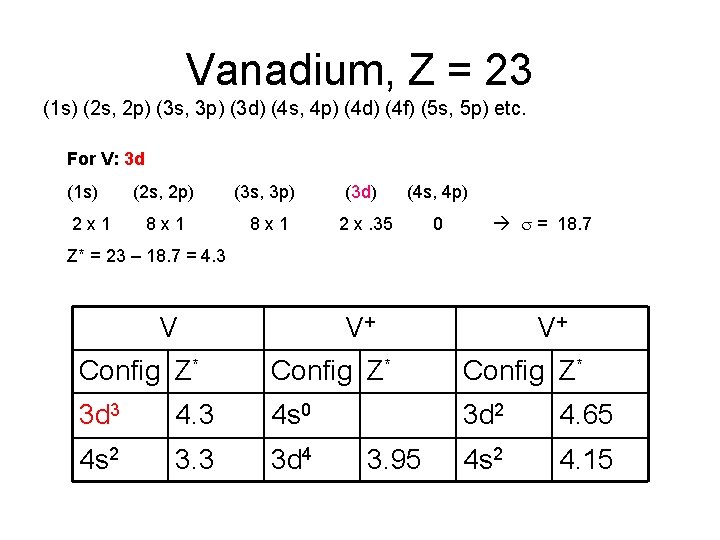
Vanadium, Z = 23 (1 s) (2 s, 2 p) (3 s, 3 p) (3 d) (4 s, 4 p) (4 d) (4 f) (5 s, 5 p) etc. For V: 3 d (1 s) 2 x 1 (2 s, 2 p) (3 s, 3 p) (3 d) (4 s, 4 p) 8 x 1 2 x. 35 0 = 18. 7 Z* = 23 – 18. 7 = 4. 3 V V+ V+ Config Z* 3 d 3 4 s 0 3 d 2 4. 65 4 s 2 3. 3 3 d 4 4 s 2 4. 15 3. 95
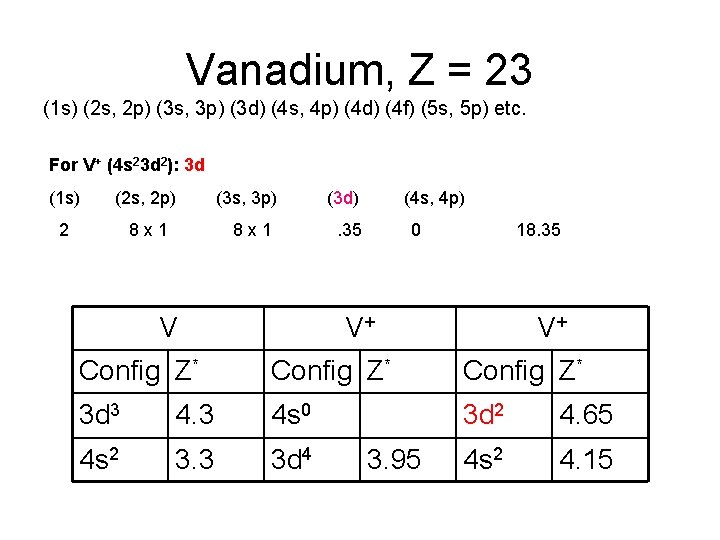
Vanadium, Z = 23 (1 s) (2 s, 2 p) (3 s, 3 p) (3 d) (4 s, 4 p) (4 d) (4 f) (5 s, 5 p) etc. For V+ (4 s 23 d 2): 3 d (1 s) (2 s, 2 p) 2 8 x 1 (3 s, 3 p) (3 d) 8 x 1 . 35 V (4 s, 4 p) 0 18. 35 V+ V+ Config Z* 3 d 3 4 s 0 3 d 2 4. 65 4 s 2 3. 3 3 d 4 4 s 2 4. 15 3. 95
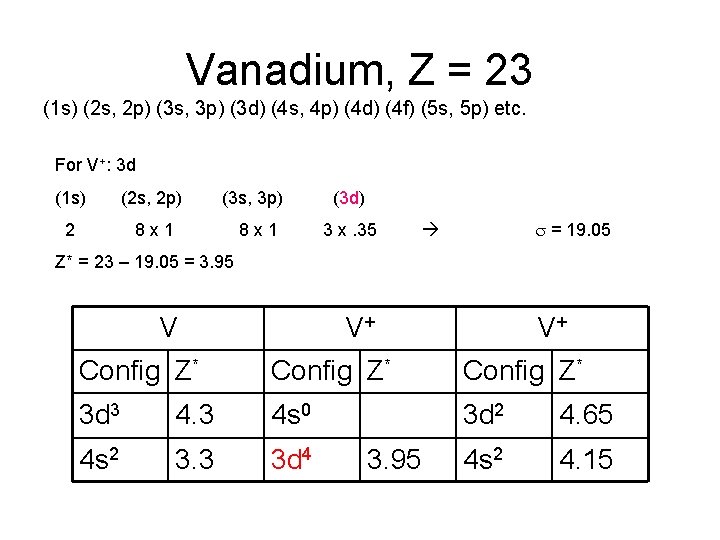
Vanadium, Z = 23 (1 s) (2 s, 2 p) (3 s, 3 p) (3 d) (4 s, 4 p) (4 d) (4 f) (5 s, 5 p) etc. For V+: 3 d (1 s) (2 s, 2 p) 2 8 x 1 (3 s, 3 p) 8 x 1 (3 d) 3 x. 35 = 19. 05 Z* = 23 – 19. 05 = 3. 95 V V+ V+ Config Z* 3 d 3 4 s 0 3 d 2 4. 65 4 s 2 3. 3 3 d 4 4 s 2 4. 15 3. 95
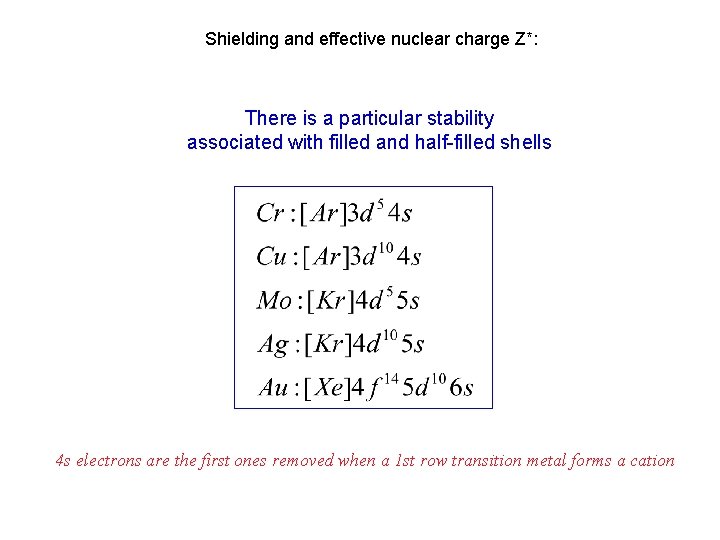
Shielding and effective nuclear charge Z*: There is a particular stability associated with filled and half-filled shells 4 s electrons are the first ones removed when a 1 st row transition metal forms a cation
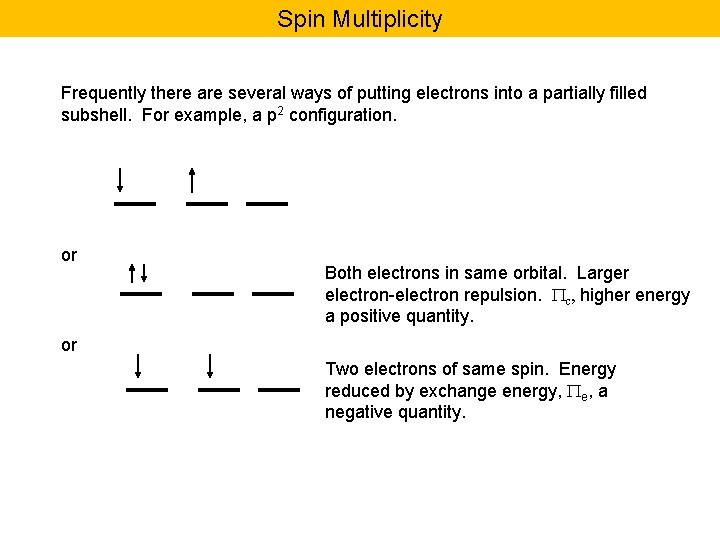
Spin Multiplicity Frequently there are several ways of putting electrons into a partially filled subshell. For example, a p 2 configuration. or Both electrons in same orbital. Larger electron-electron repulsion. Pc, higher energy a positive quantity. or Two electrons of same spin. Energy reduced by exchange energy, Pe, a negative quantity.
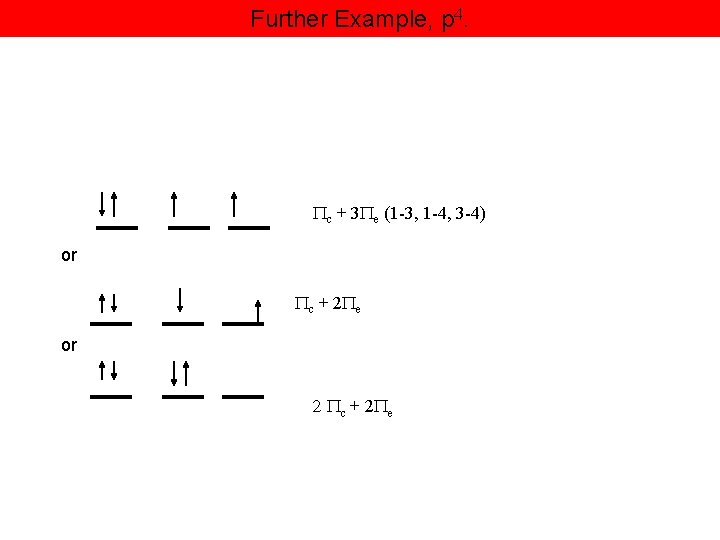
Further Example, p 4. Pc + 3 Pe (1 -3, 1 -4, 3 -4) or Pc + 2 Pe or 2 Pc + 2 Pe
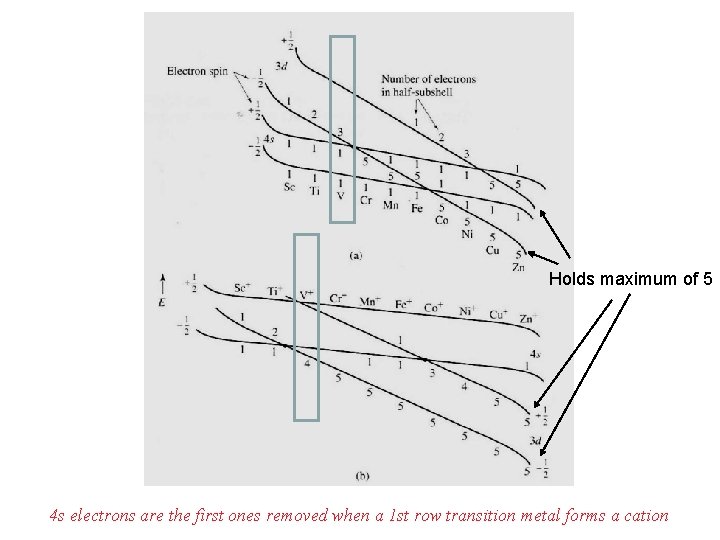
Holds maximum of 5 4 s electrons are the first ones removed when a 1 st row transition metal forms a cation
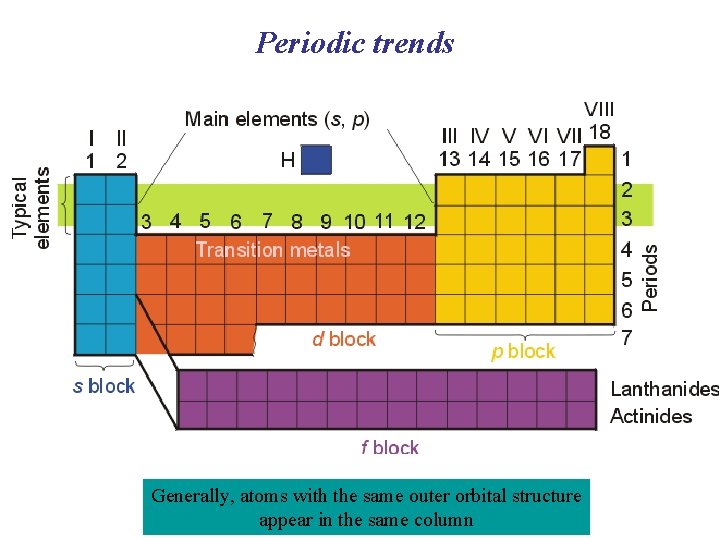
Periodic trends Generally, atoms with the same outer orbital structure appear in the same column
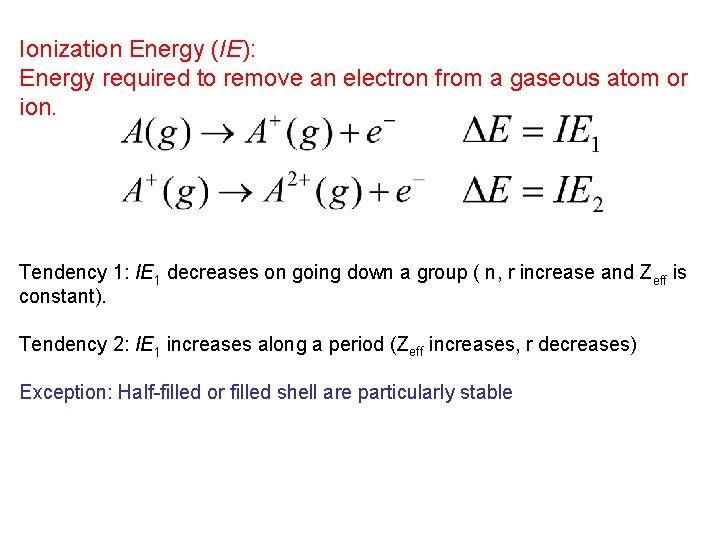
Ionization Energy (IE): Energy required to remove an electron from a gaseous atom or ion. Tendency 1: IE 1 decreases on going down a group ( n, r increase and Zeff is constant). Tendency 2: IE 1 increases along a period (Zeff increases, r decreases) Exception: Half-filled or filled shell are particularly stable
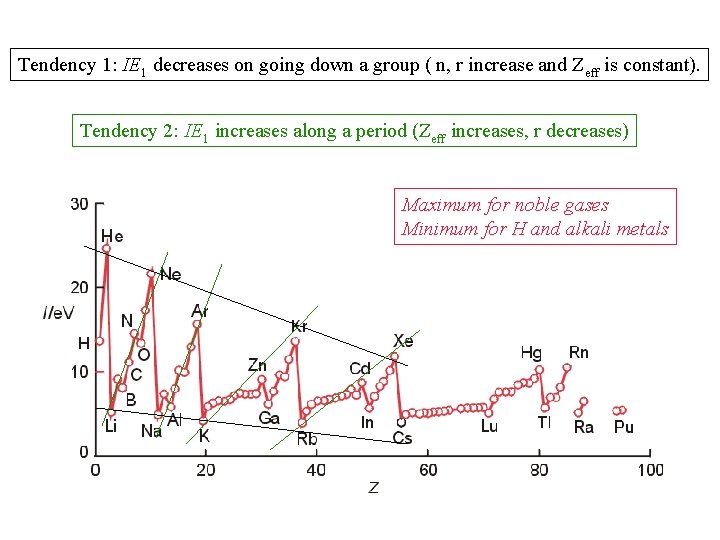
Tendency 1: IE 1 decreases on going down a group ( n, r increase and Zeff is constant). Tendency 2: IE 1 increases along a period (Zeff increases, r decreases) Maximum for noble gases Minimum for H and alkali metals
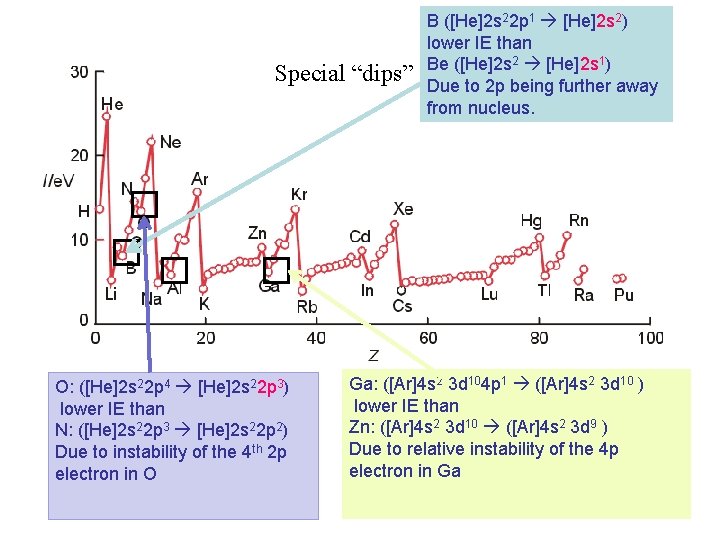
Special “dips” O: ([He]2 s 22 p 4 [He]2 s 22 p 3) lower IE than N: ([He]2 s 22 p 3 [He]2 s 22 p 2) Due to instability of the 4 th 2 p electron in O B ([He]2 s 22 p 1 [He]2 s 2) lower IE than Be ([He]2 s 2 [He]2 s 1) Due to 2 p being further away from nucleus. Ga: ([Ar]4 s 2 3 d 104 p 1 ([Ar]4 s 2 3 d 10 ) lower IE than Zn: ([Ar]4 s 2 3 d 10 ([Ar]4 s 2 3 d 9 ) Due to relative instability of the 4 p electron in Ga
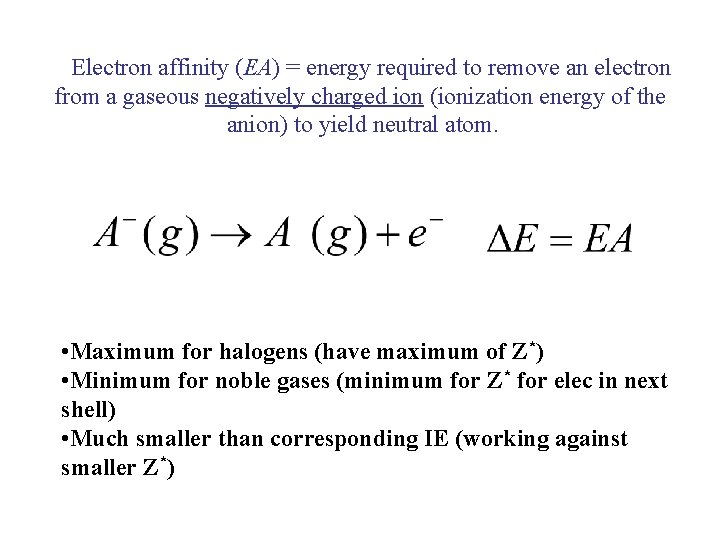
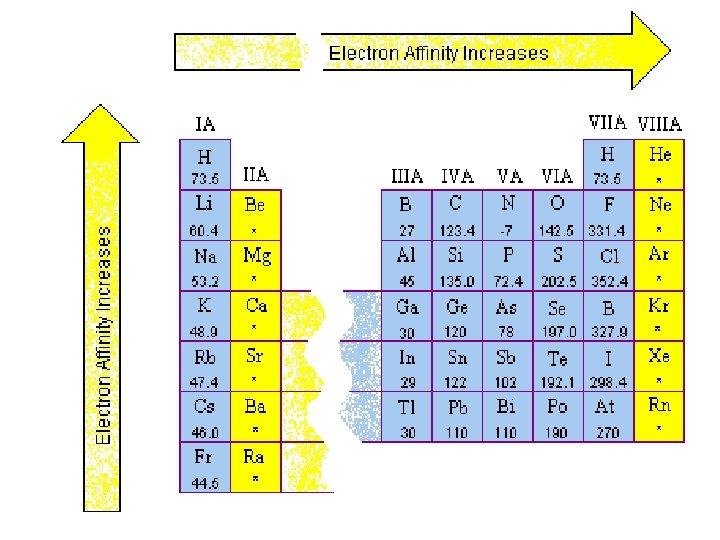
Electron affinity (EA) = energy required to remove an electron from a gaseous negatively charged ion (ionization energy of the anion) to yield neutral atom. • Maximum for halogens (have maximum of Z*) • Minimum for noble gases (minimum for Z* for elec in next shell) • Much smaller than corresponding IE (working against smaller Z*)
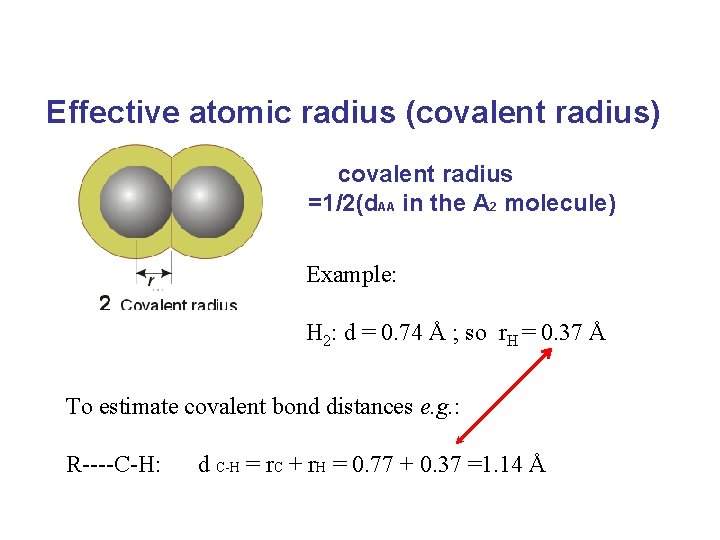
Effective atomic radius (covalent radius) covalent radius =1/2(d. AA in the A 2 molecule) Example: H 2: d = 0. 74 Å ; so r. H = 0. 37 Å To estimate covalent bond distances e. g. : R----C-H: d C-H = r. C + r. H = 0. 77 + 0. 37 =1. 14 Å
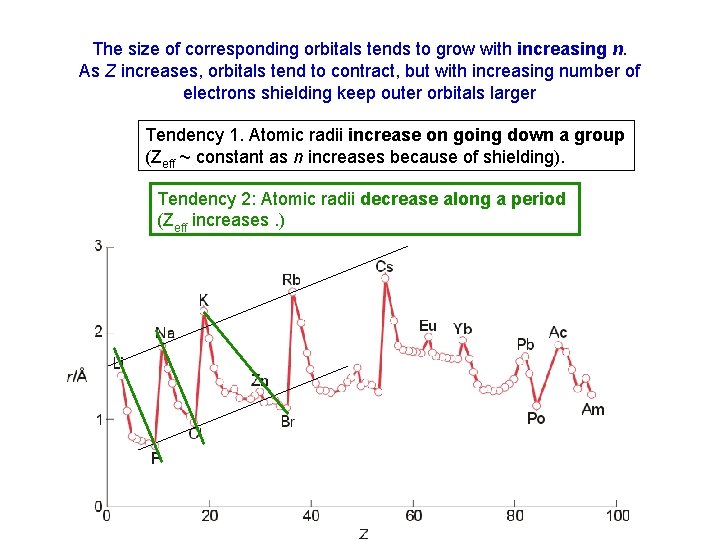
The size of corresponding orbitals tends to grow with increasing n. As Z increases, orbitals tend to contract, but with increasing number of electrons shielding keep outer orbitals larger Tendency 1. Atomic radii increase on going down a group (Zeff ~ constant as n increases because of shielding). Tendency 2: Atomic radii decrease along a period (Zeff increases. )
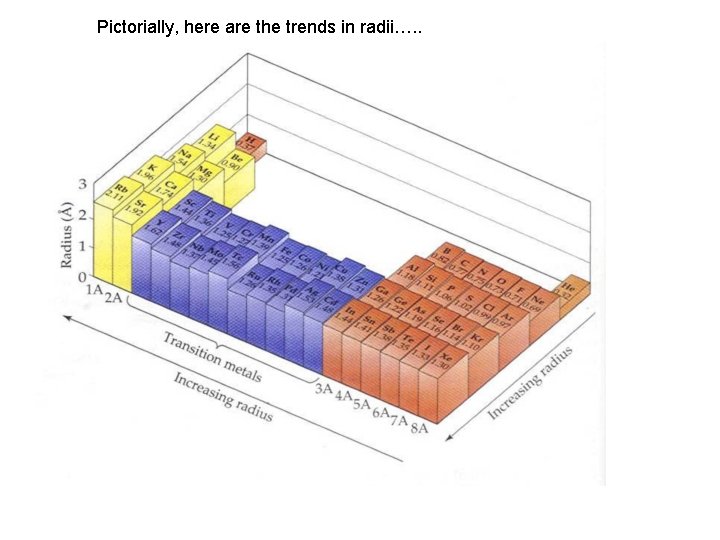
Pictorially, here are the trends in radii…. .
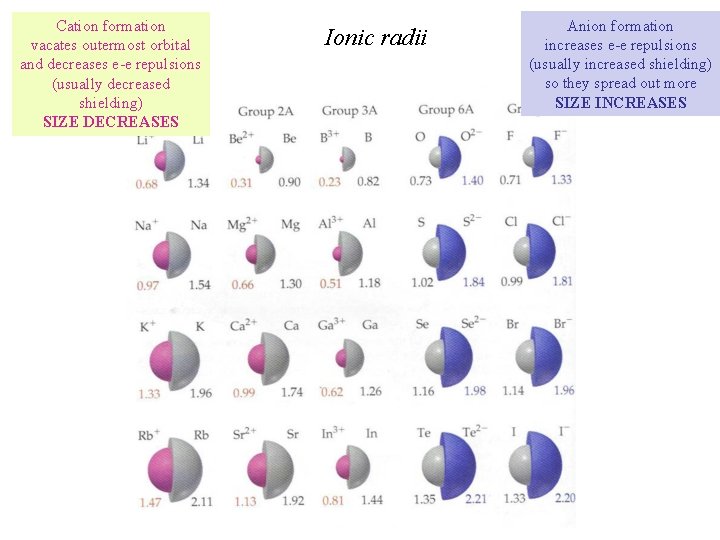
Cation formation vacates outermost orbital and decreases e-e repulsions (usually decreased shielding) SIZE DECREASES Ionic radii Anion formation increases e-e repulsions (usually increased shielding) so they spread out more SIZE INCREASES
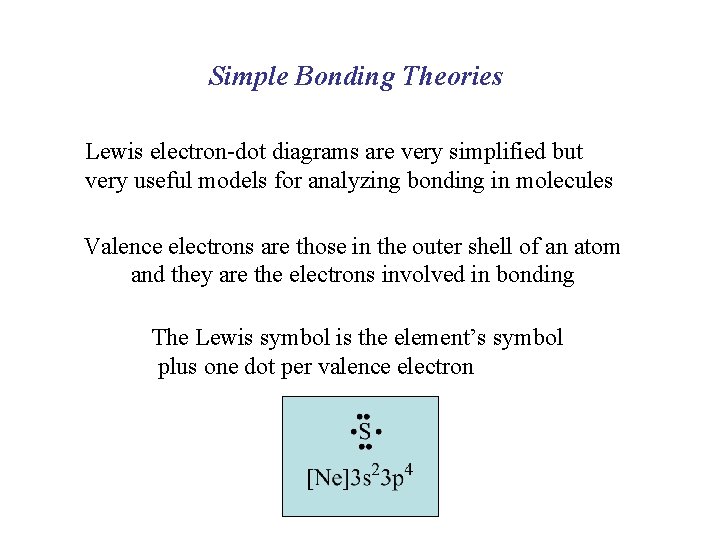
Simple Bonding Theories Lewis electron-dot diagrams are very simplified but very useful models for analyzing bonding in molecules Valence electrons are those in the outer shell of an atom and they are the electrons involved in bonding The Lewis symbol is the element’s symbol plus one dot per valence electron
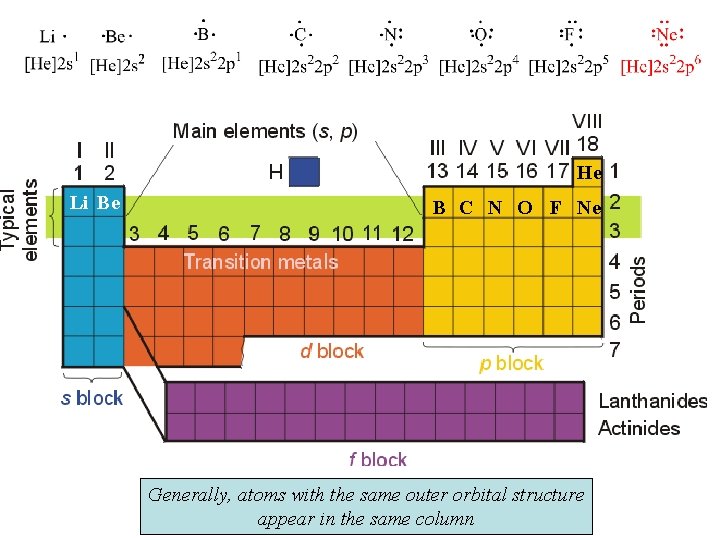
He Li Be B C N O F Ne Generally, atoms with the same outer orbital structure appear in the same column
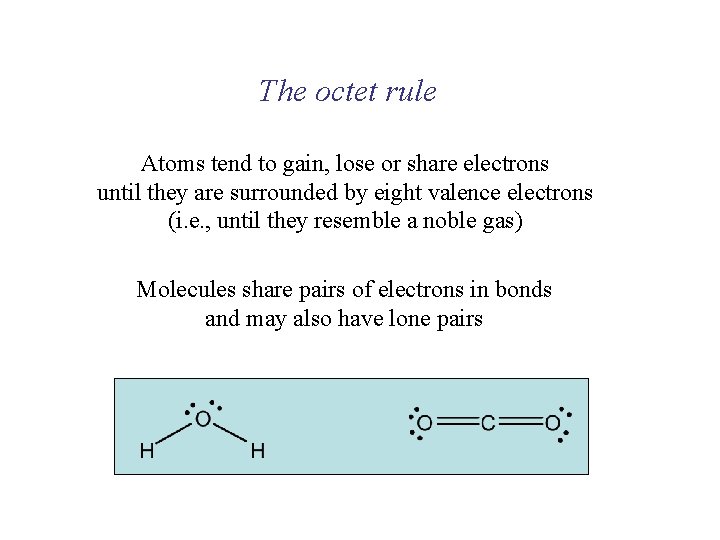
The octet rule Atoms tend to gain, lose or share electrons until they are surrounded by eight valence electrons (i. e. , until they resemble a noble gas) Molecules share pairs of electrons in bonds and may also have lone pairs
Octet Rule, Lewis Structures Electrons can be stabilized by bond formation. H atom can stabilize two electrons in the valence shell. C F can stabilize 8 electrons in the valence shell. Two electrons around H; Eight electrons complete the octet of C F.
Completing the Octet Ionic Bonding: Electrons can be transferred to an atom to produce an anion and complete the octet. Covalent Bonding: Electrons can be shared between atoms providing additional stabilization.
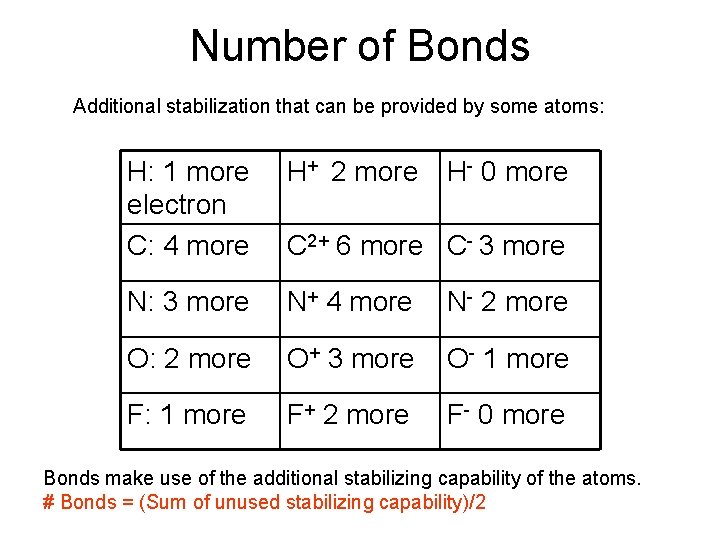
Number of Bonds Additional stabilization that can be provided by some atoms: H: 1 more electron C: 4 more H+ 2 more H- 0 more N: 3 more N+ 4 more N- 2 more O: 2 more O+ 3 more O- 1 more F: 1 more F+ 2 more F- 0 more C 2+ 6 more C- 3 more Bonds make use of the additional stabilizing capability of the atoms. # Bonds = (Sum of unused stabilizing capability)/2
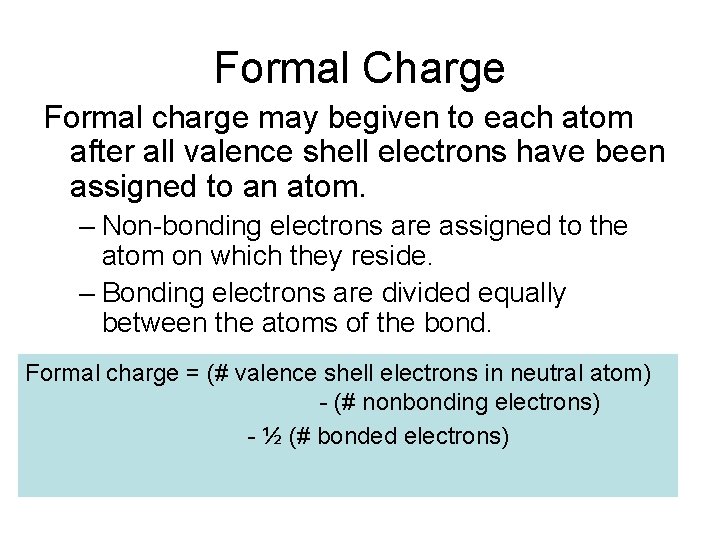
Formal Charge Formal charge may begiven to each atom after all valence shell electrons have been assigned to an atom. – Non-bonding electrons are assigned to the atom on which they reside. – Bonding electrons are divided equally between the atoms of the bond. Formal charge = (# valence shell electrons in neutral atom) - (# nonbonding electrons) - ½ (# bonded electrons)
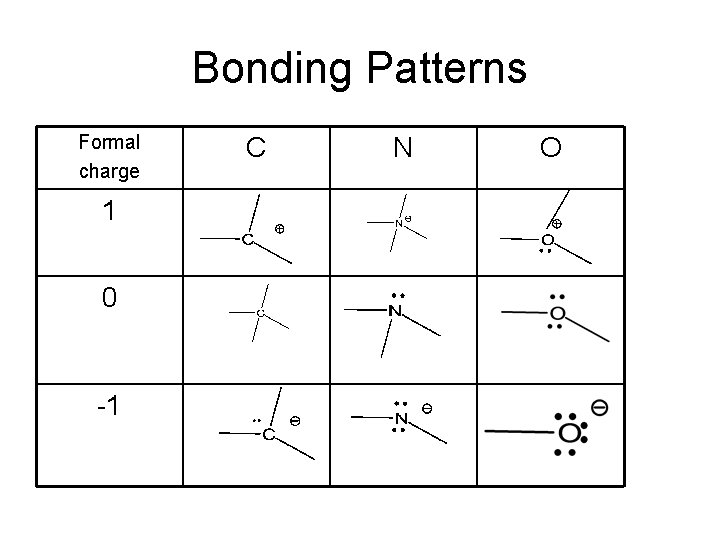
Bonding Patterns Formal charge 1 0 -1 C N O
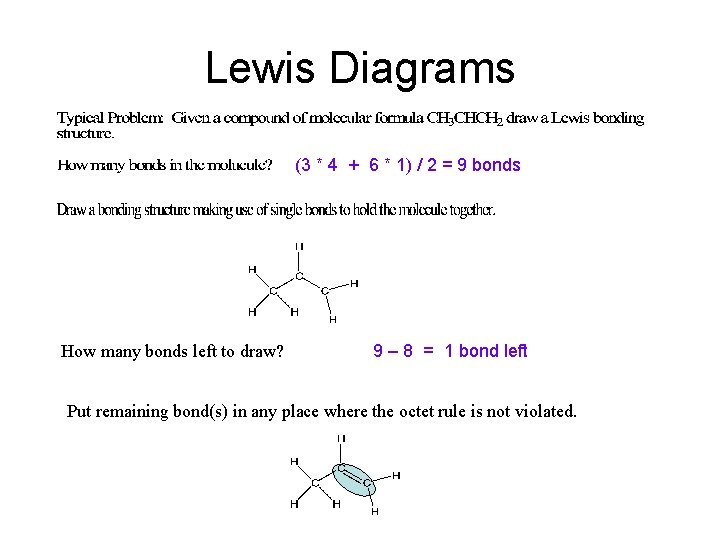
Lewis Diagrams (3 * 4 + 6 * 1) / 2 = 9 bonds How many bonds left to draw? 9 – 8 = 1 bond left Put remaining bond(s) in any place where the octet rule is not violated.
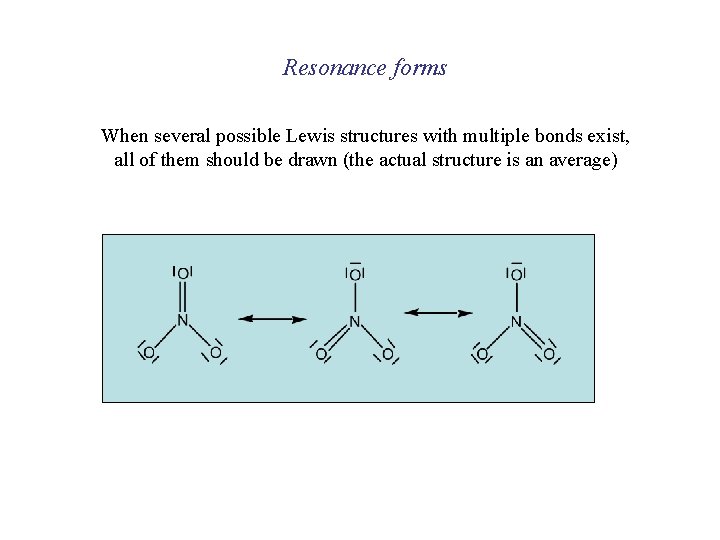
Resonance forms When several possible Lewis structures with multiple bonds exist, all of them should be drawn (the actual structure is an average)
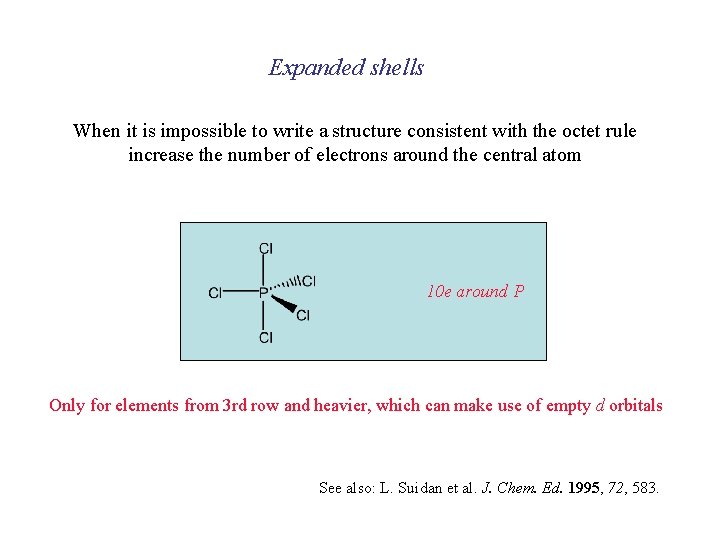
Expanded shells When it is impossible to write a structure consistent with the octet rule increase the number of electrons around the central atom 10 e around P Only for elements from 3 rd row and heavier, which can make use of empty d orbitals See also: L. Suidan et al. J. Chem. Ed. 1995, 72, 583.
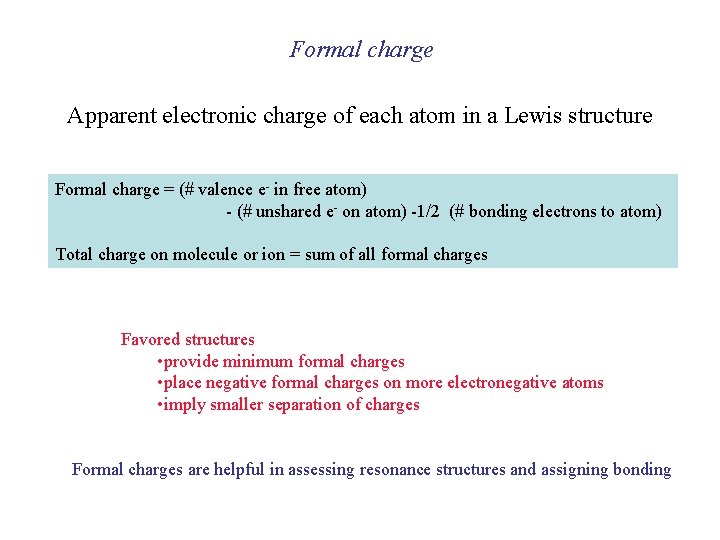
Formal charge Apparent electronic charge of each atom in a Lewis structure Formal charge = (# valence e- in free atom) - (# unshared e- on atom) -1/2 (# bonding electrons to atom) Total charge on molecule or ion = sum of all formal charges Favored structures • provide minimum formal charges • place negative formal charges on more electronegative atoms • imply smaller separation of charges Formal charges are helpful in assessing resonance structures and assigning bonding
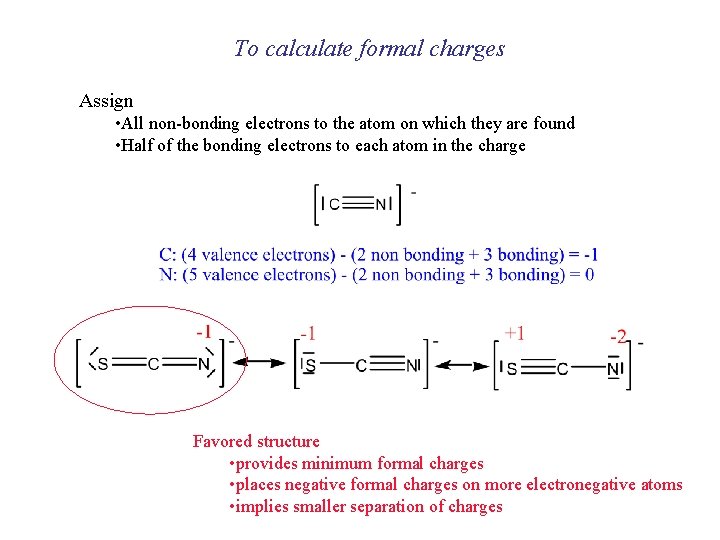
To calculate formal charges Assign • All non-bonding electrons to the atom on which they are found • Half of the bonding electrons to each atom in the charge Favored structure • provides minimum formal charges • places negative formal charges on more electronegative atoms • implies smaller separation of charges
Problem cases - expanded shells - generating charge to satisfy octets
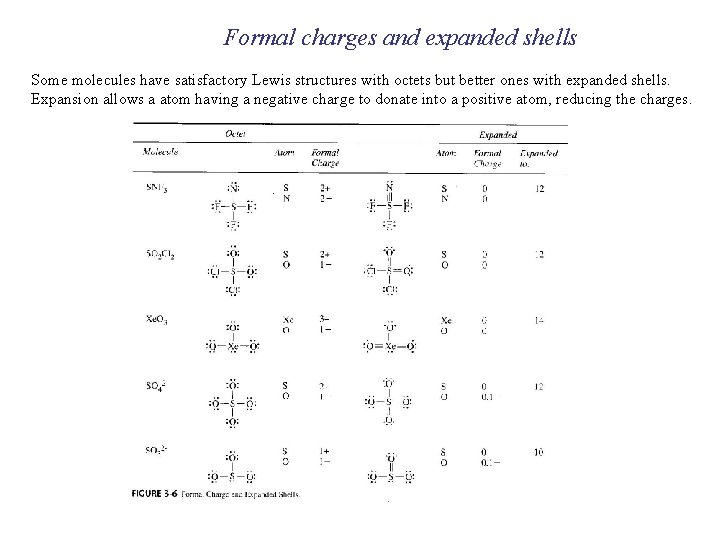
Formal charges and expanded shells Some molecules have satisfactory Lewis structures with octets but better ones with expanded shells. Expansion allows a atom having a negative charge to donate into a positive atom, reducing the charges.
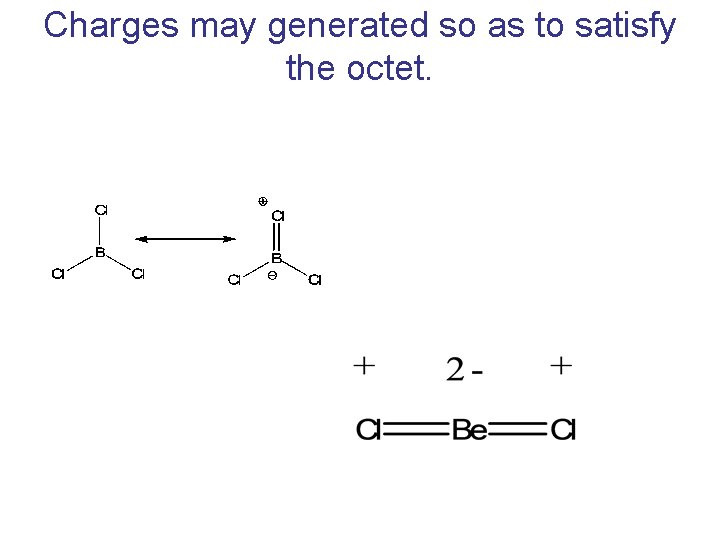
Charges may generated so as to satisfy the octet.
Valence shell electron pair repulsion (VSEPR) theory (a very approximate but very useful way of predicting molecular shapes) • Electrons in molecules appear in bonding pairs or lone pairs • Each pair of electrons repels all other pairs • Molecules adopt geometries with electron pairs as far from each other as possible Electron pairs define regions of space where they are likely to be: • Between nuclei for bonding pairs • Close to one nucleus for lone pairs those regions are called electron domains the steric number is the sum of electron domains
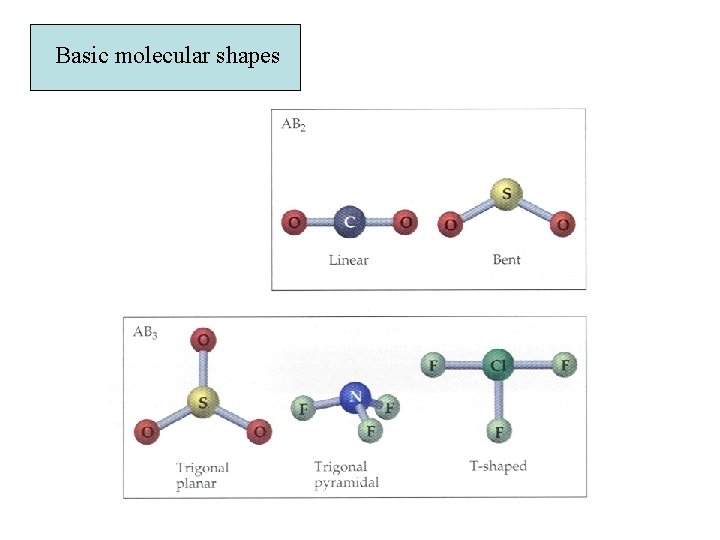
Basic molecular shapes
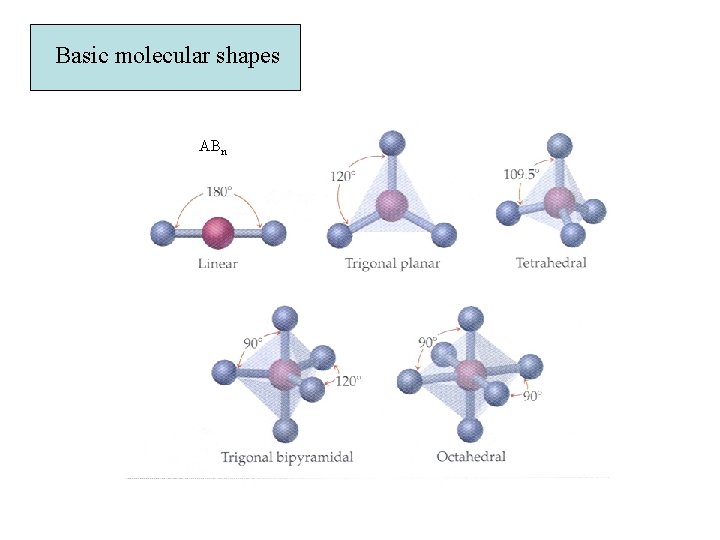
Basic molecular shapes ABn
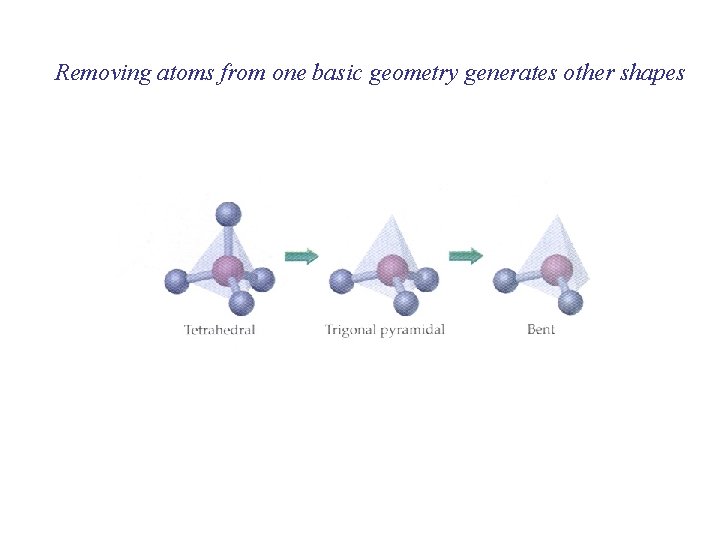
Removing atoms from one basic geometry generates other shapes
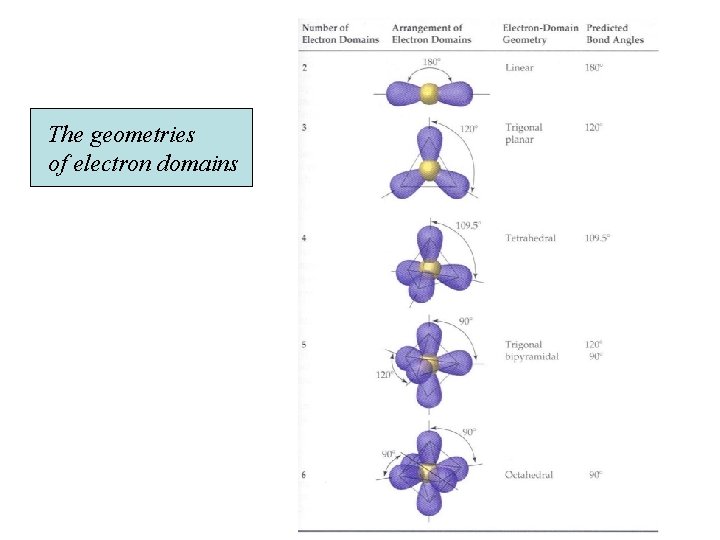
The geometries of electron domains
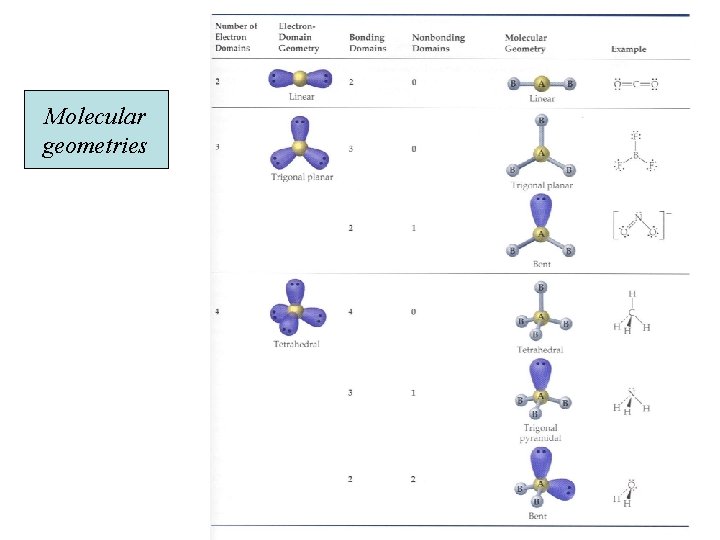
Molecular geometries
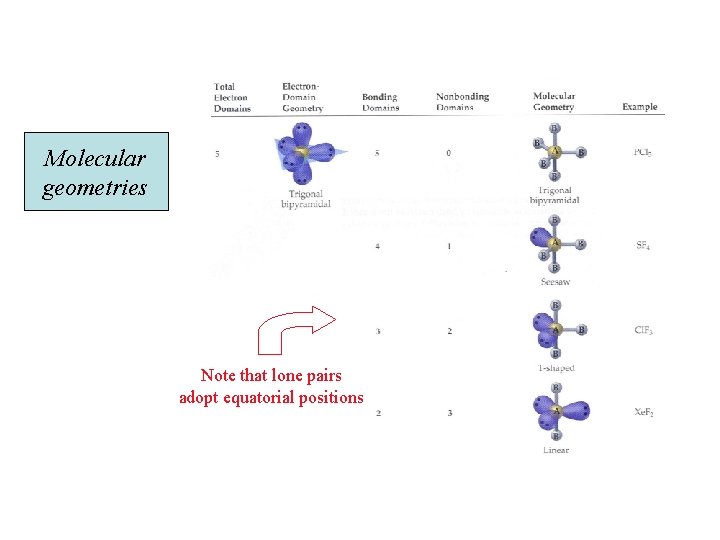
Molecular geometries Note that lone pairs adopt equatorial positions
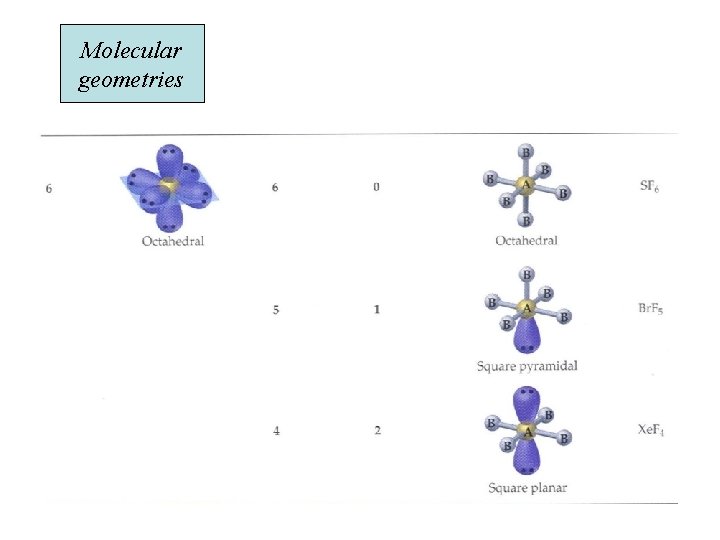
Molecular geometries
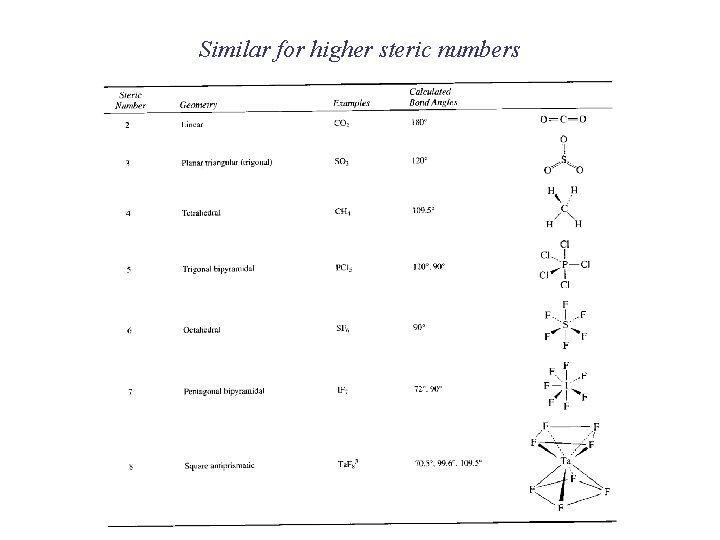
Similar for higher steric numbers
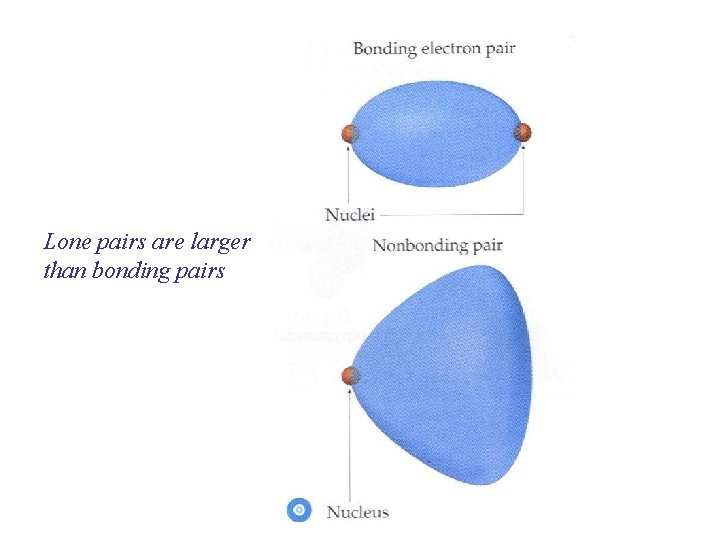
Lone pairs are larger than bonding pairs
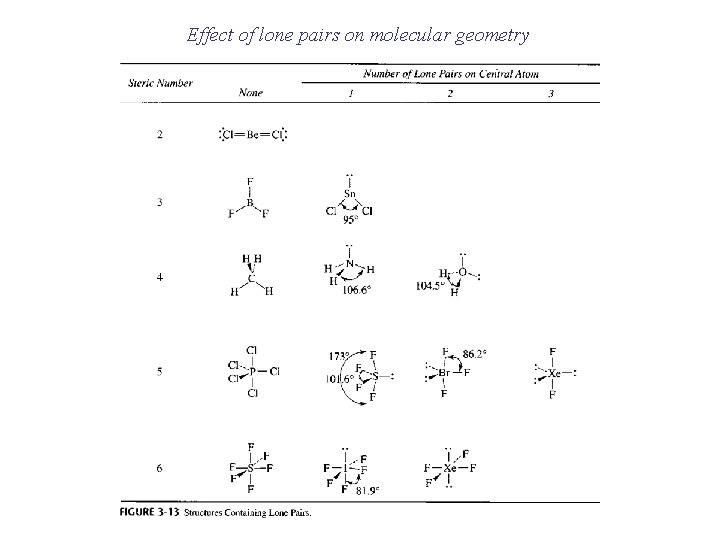
Effect of lone pairs on molecular geometry
Electronegativity Scales • The ability to attract electrons within a chemical, covalent bond Pauling: polar bonds have higher bond strengths. Electronegativity assigned to each element such that the difference of electronegativities of the atoms in a bond can predict the bond strength.
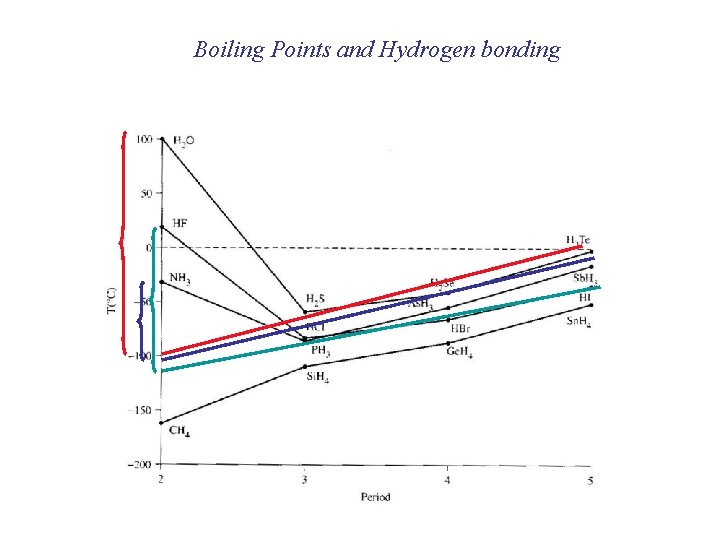
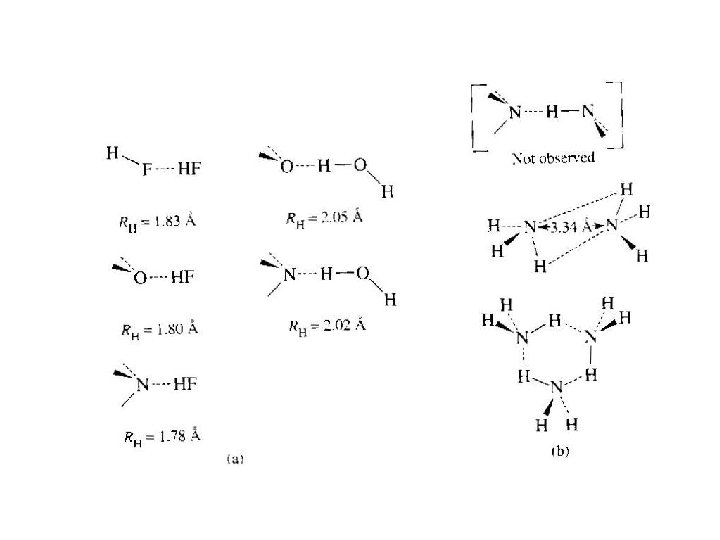
Boiling Points and Hydrogen bonding
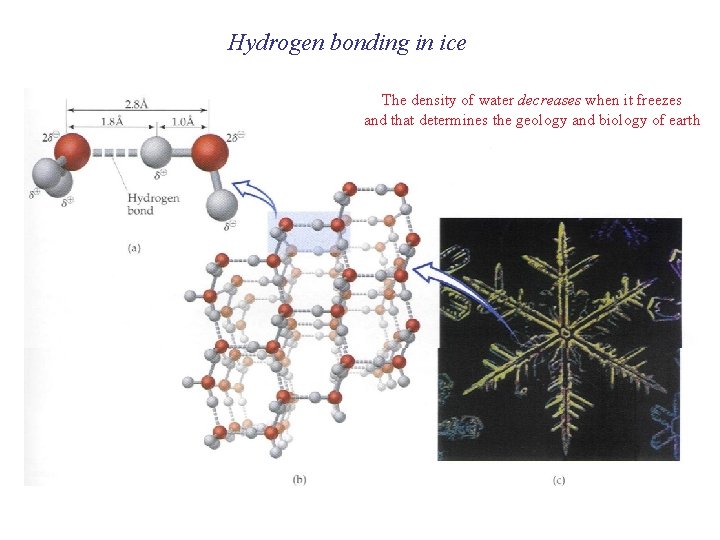
Hydrogen bonding in ice The density of water decreases when it freezes and that determines the geology and biology of earth
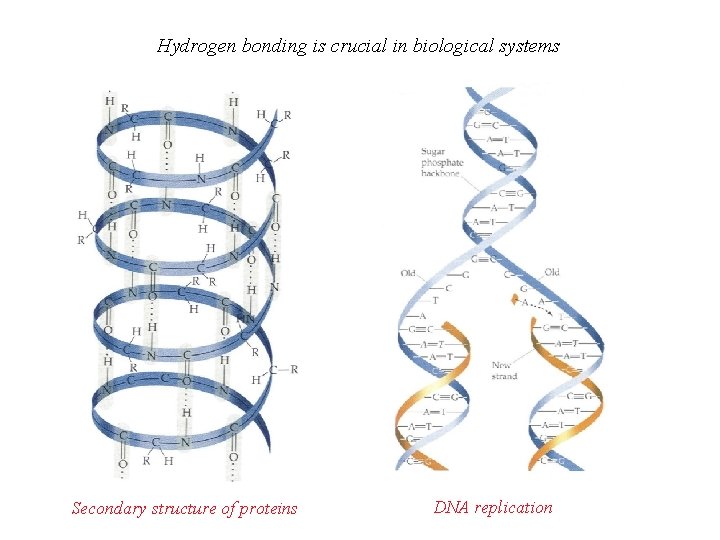
Hydrogen bonding is crucial in biological systems Secondary structure of proteins DNA replication
Symmetry and group theory
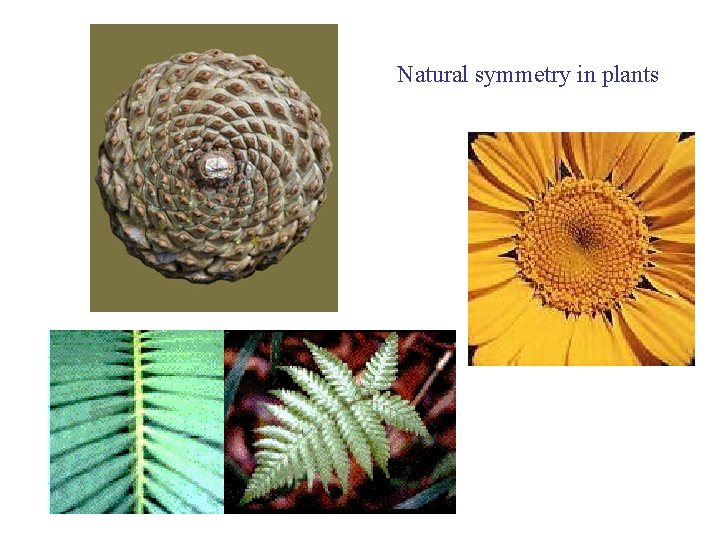
Natural symmetry in plants
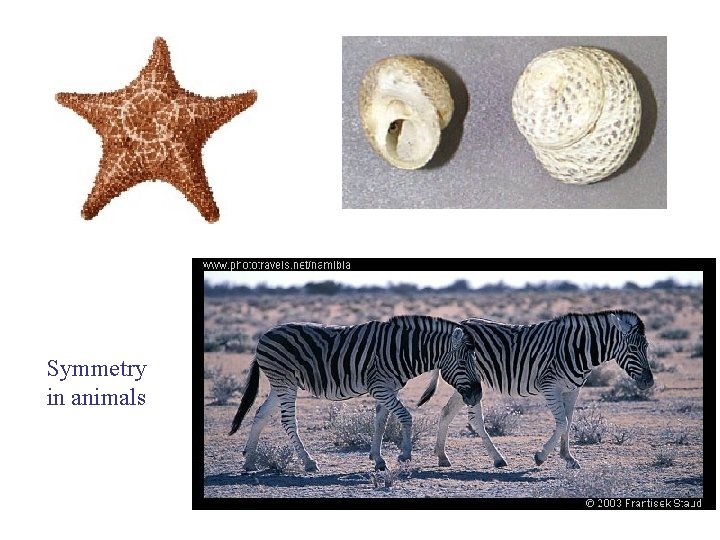
Symmetry in animals
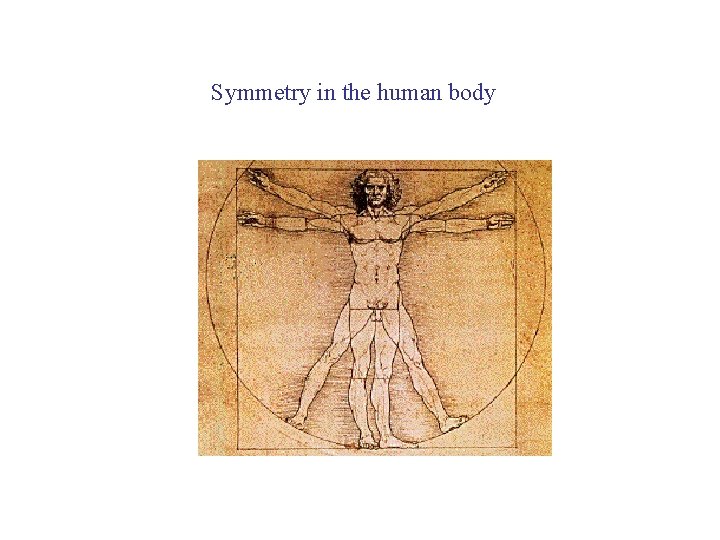
Symmetry in the human body
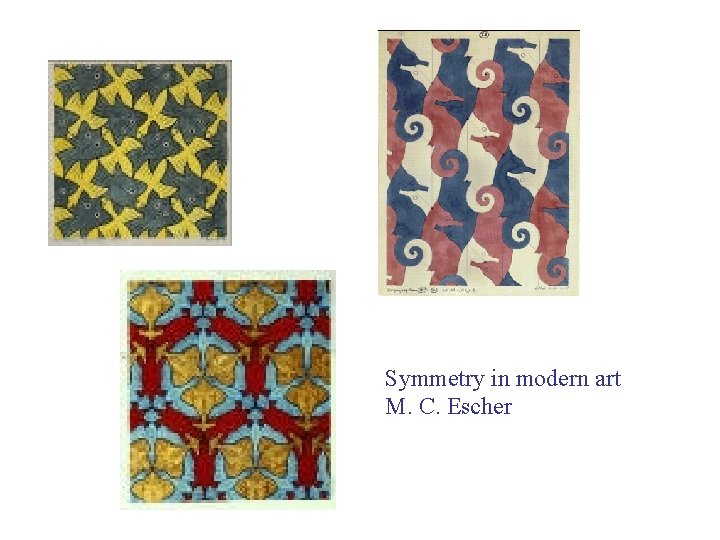
Symmetry in modern art M. C. Escher
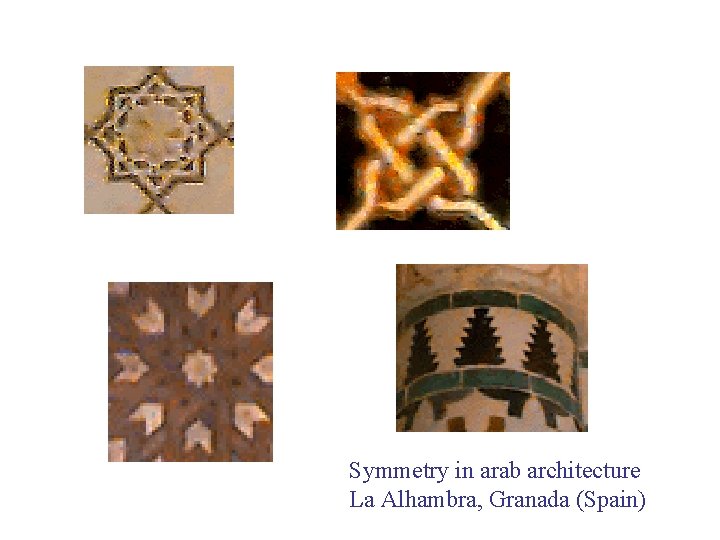
Symmetry in arab architecture La Alhambra, Granada (Spain)
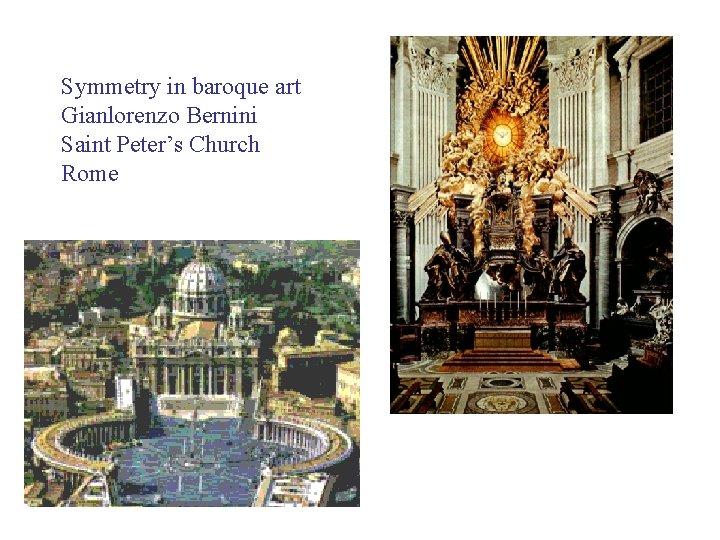
Symmetry in baroque art Gianlorenzo Bernini Saint Peter’s Church Rome

Symmetry in Native American crafts

7 th grade art project Silver Star School Vernon, Canada
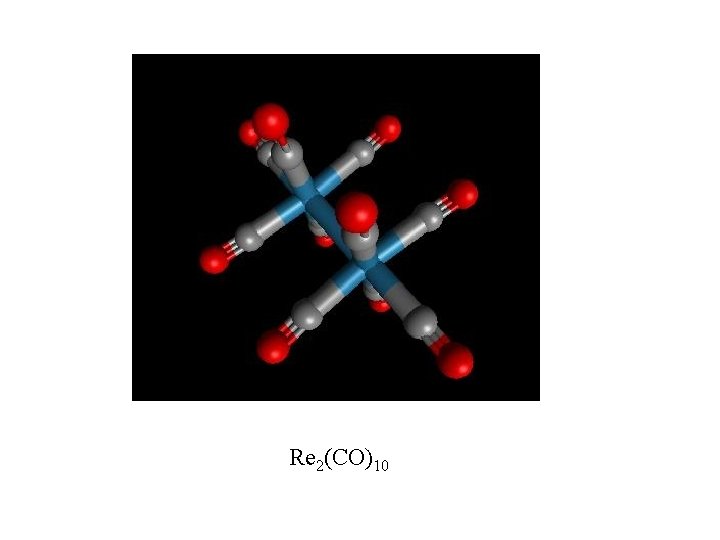
Re 2(CO)10
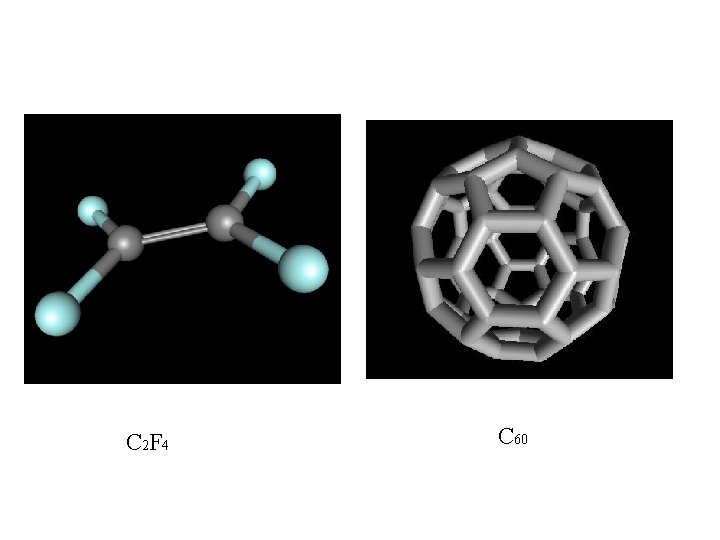
C 2 F 4 C 60
Symmetry in chemistry • Molecular structures • Wave functions • Description of orbitals and bonds • Reaction pathways • Optical activity • Spectral interpretation (electronic, IR, NMR). . .
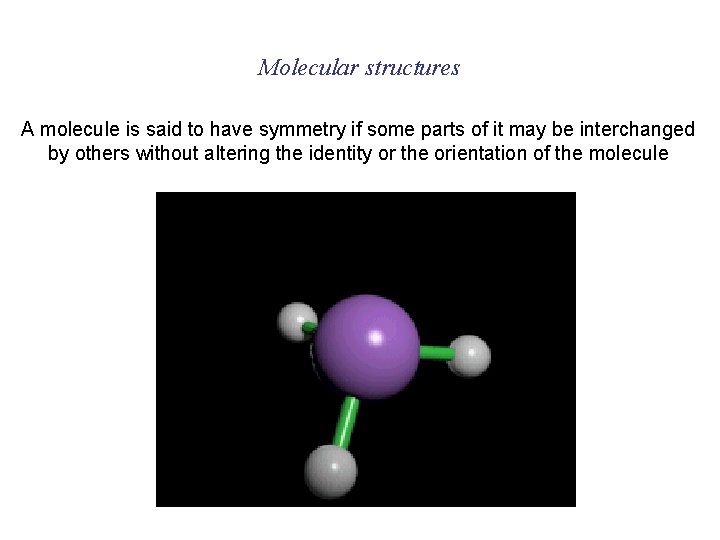
Molecular structures A molecule is said to have symmetry if some parts of it may be interchanged by others without altering the identity or the orientation of the molecule
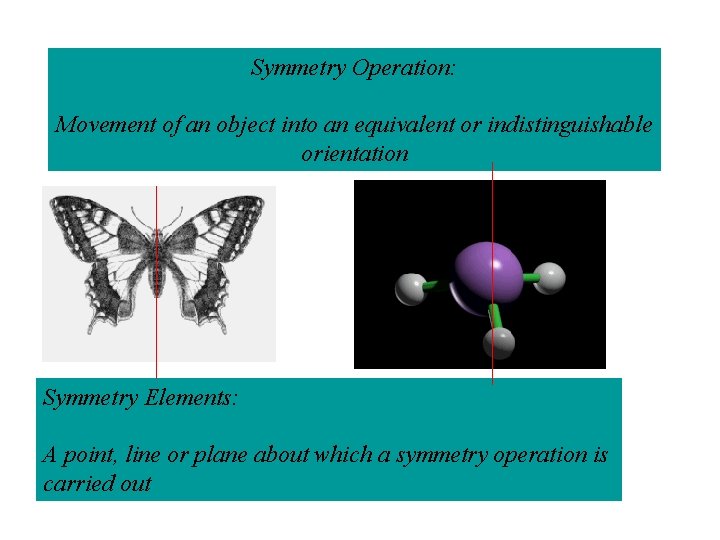
Symmetry Operation: Movement of an object into an equivalent or indistinguishable orientation Symmetry Elements: A point, line or plane about which a symmetry operation is carried out
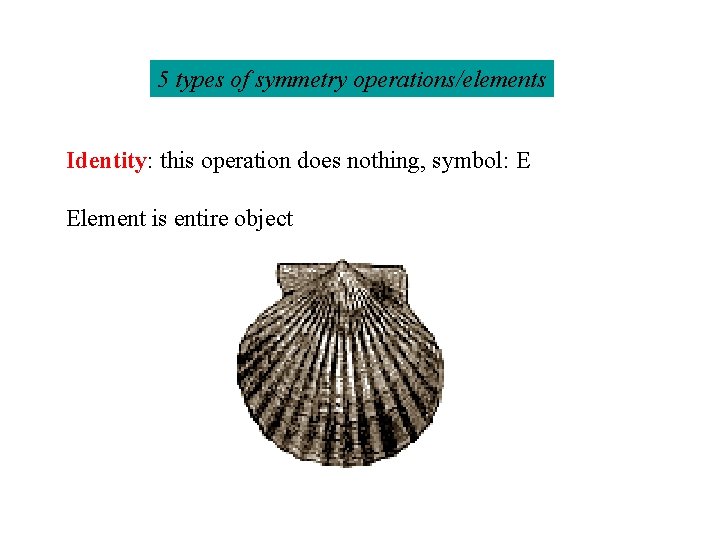
5 types of symmetry operations/elements Identity: this operation does nothing, symbol: E Element is entire object
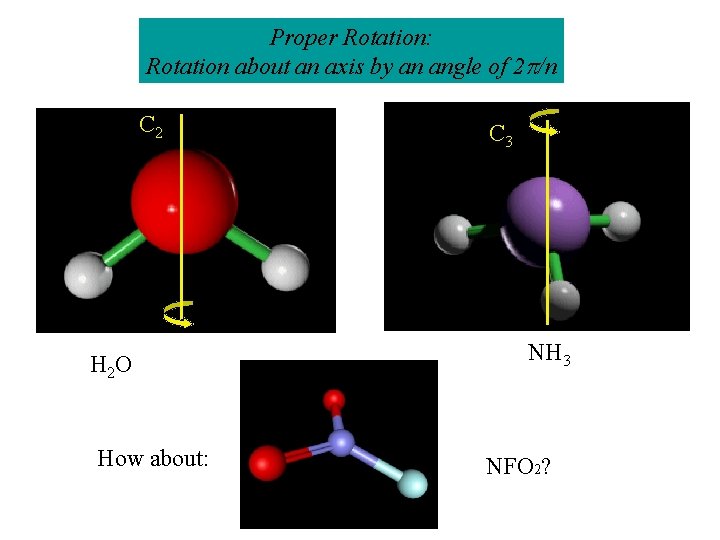
Proper Rotation: Rotation about an axis by an angle of 2 /n C 2 H 2 O How about: C 3 NH 3 NFO 2?
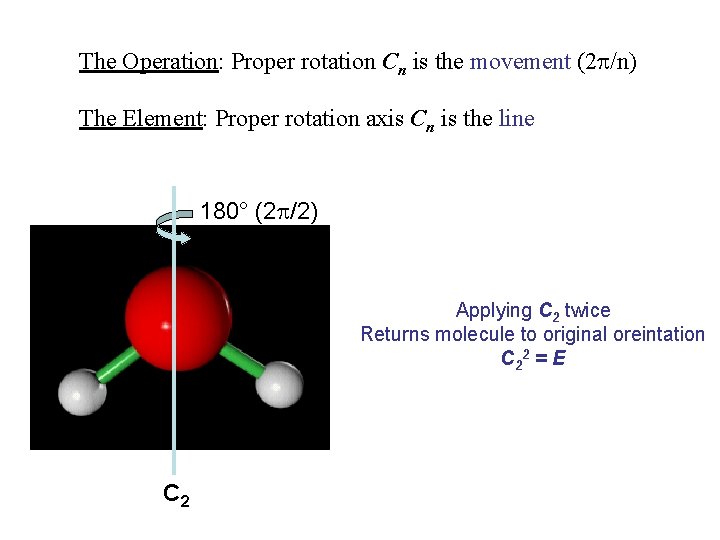
The Operation: Proper rotation Cn is the movement (2 /n) The Element: Proper rotation axis Cn is the line 180° (2 /2) Applying C 2 twice Returns molecule to original oreintation C 2 2 = E C 2
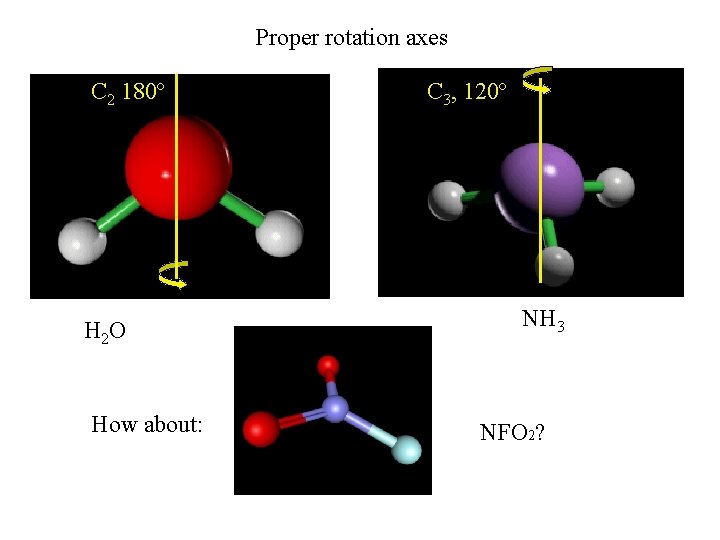
Proper rotation axes C 2 180º H 2 O How about: C 3, 120º NH 3 NFO 2?
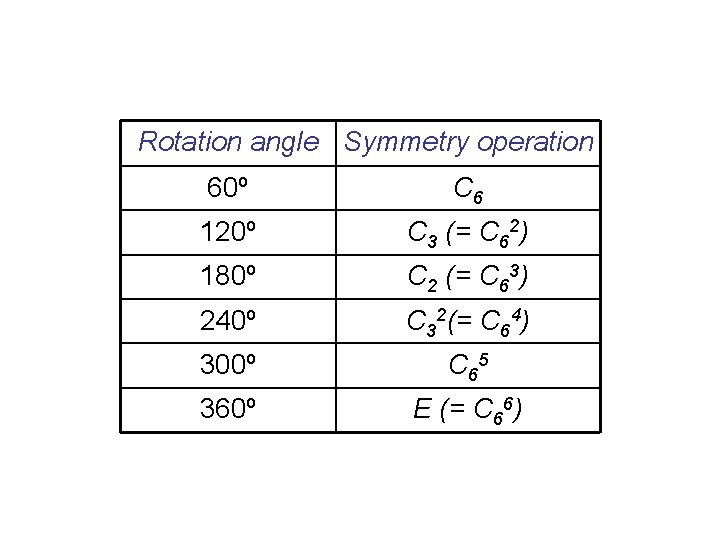
Rotation angle Symmetry operation 60º C 6 120º C 3 (= C 62) 180º C 2 (= C 63) 240º C 32(= C 64) 300º C 65 360º E (= C 66)
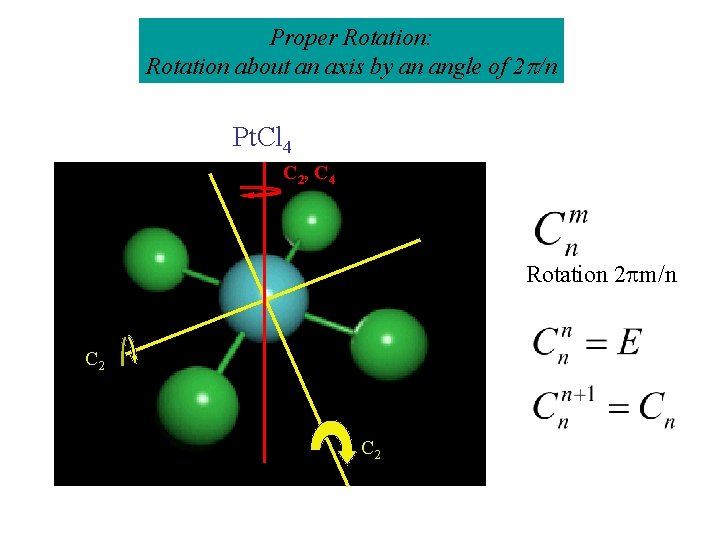
Proper Rotation: Rotation about an axis by an angle of 2 /n Pt. Cl 4 C 2, C 4 Rotation 2 m/n C 2
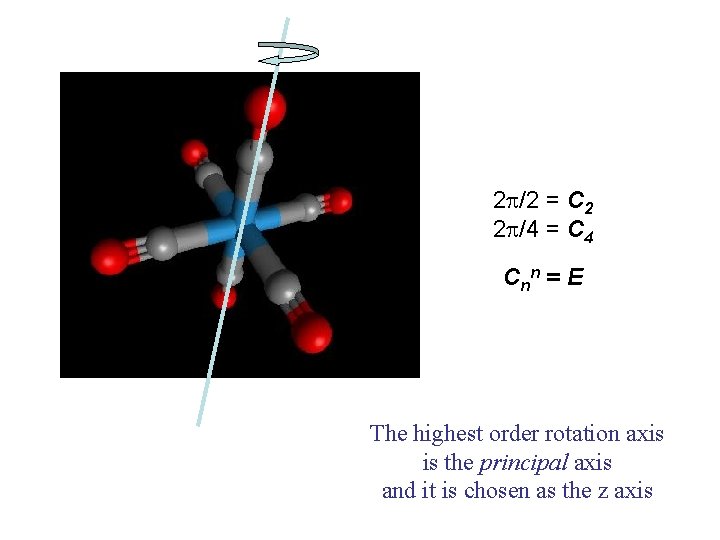
2 /2 = C 2 2 /4 = C 4 Cn n = E The highest order rotation axis is the principal axis and it is chosen as the z axis
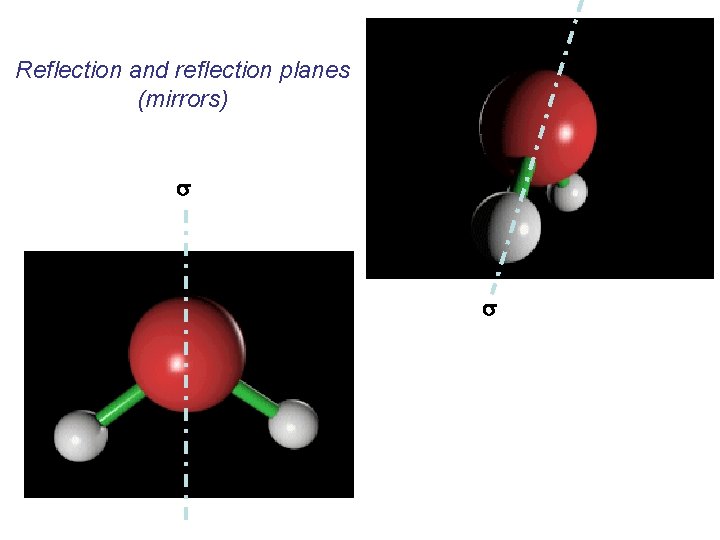
Reflection and reflection planes (mirrors) s s
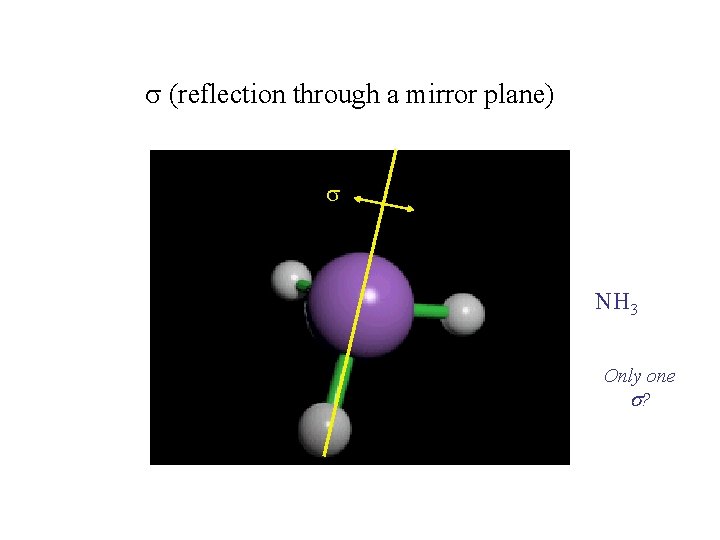
(reflection through a mirror plane) NH 3 Only one s?
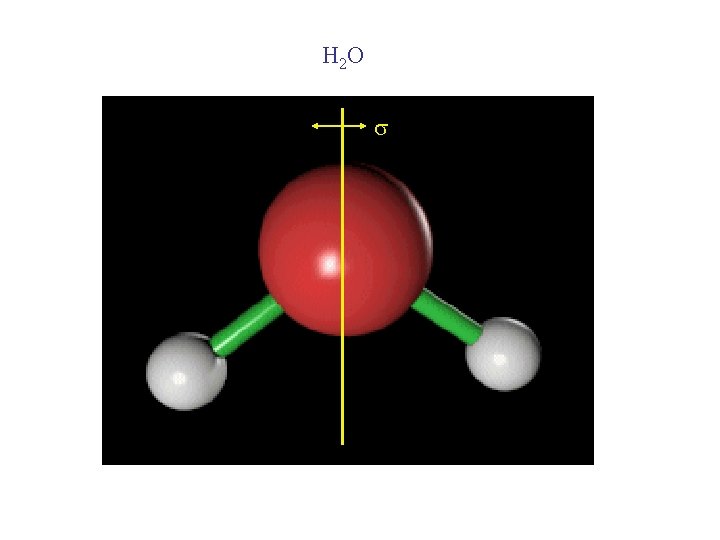
H 2 O
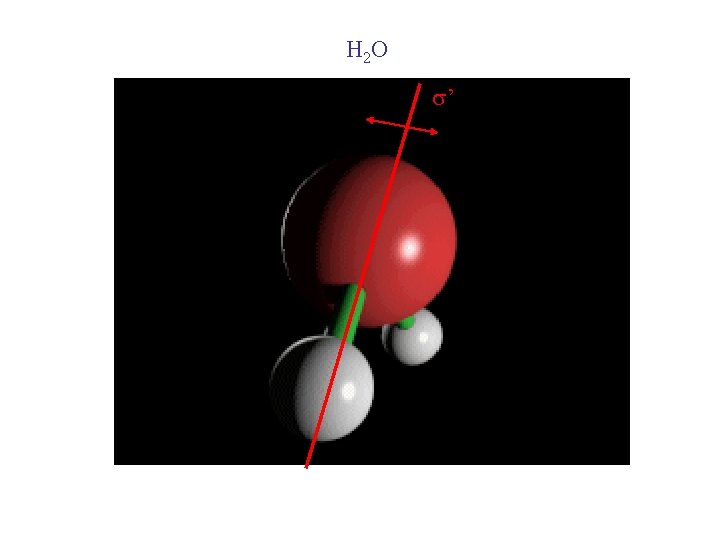
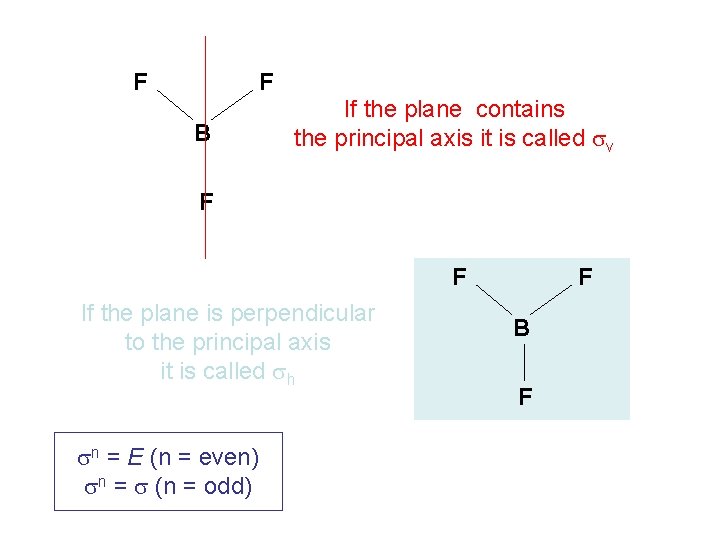
F F B If the plane contains the principal axis it is called v F F If the plane is perpendicular to the principal axis it is called h n = E (n = even) n = (n = odd) F B F
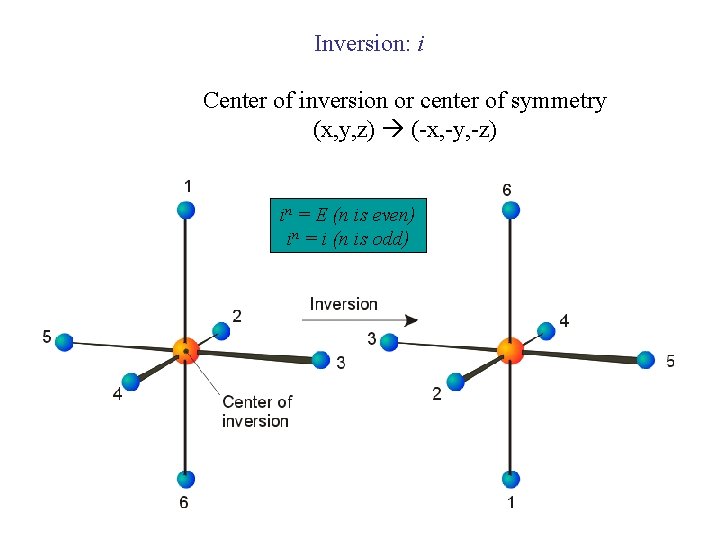
Inversion: i Center of inversion or center of symmetry (x, y, z) (-x, -y, -z) in = E (n is even) in = i (n is odd)
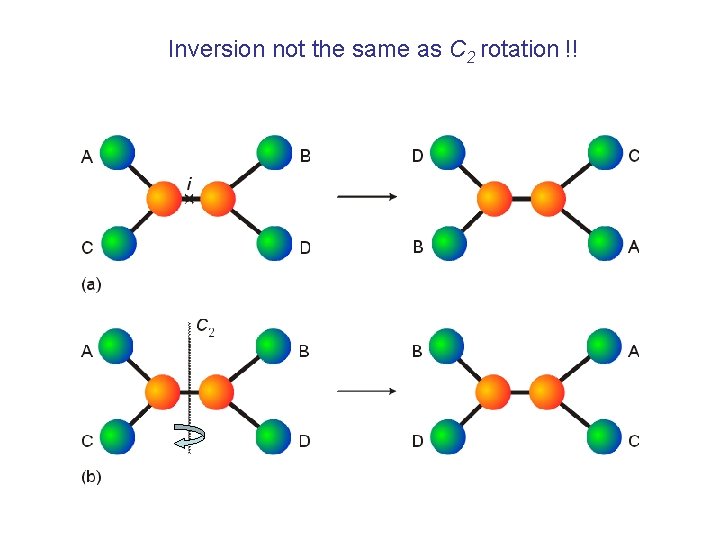
Inversion not the same as C 2 rotation !!
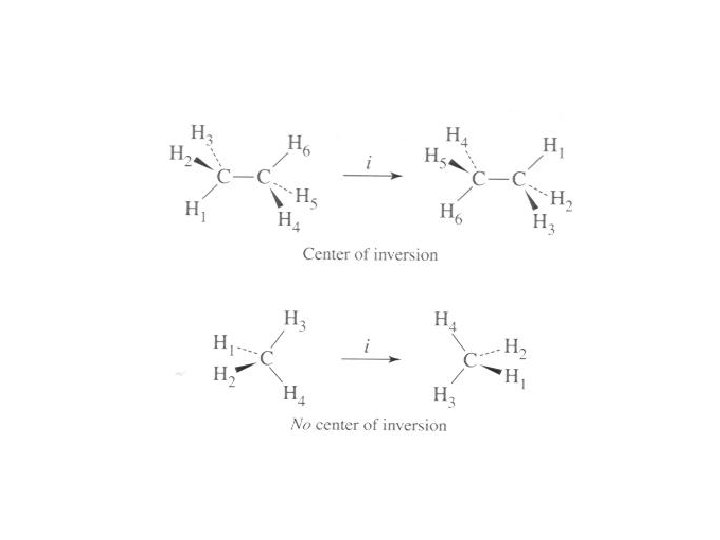
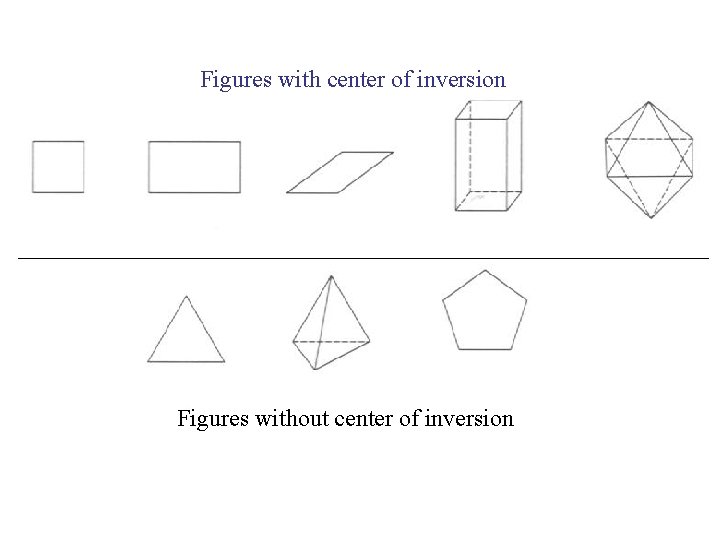
Figures with center of inversion Figures without center of inversion
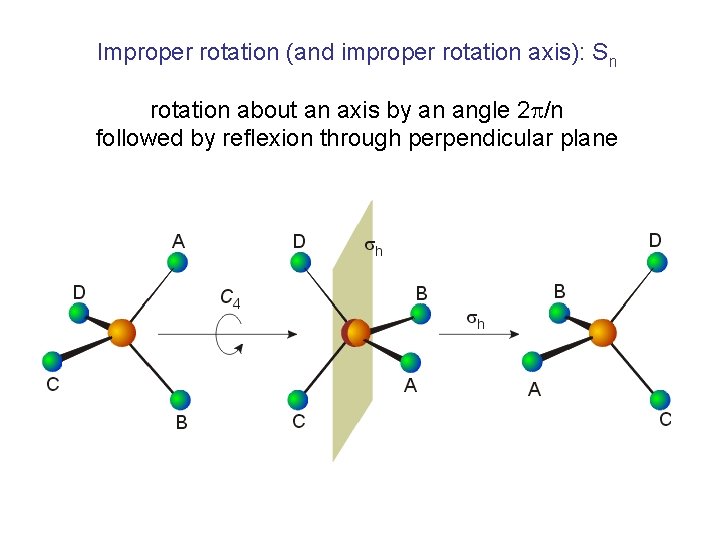
Improper rotation (and improper rotation axis): Sn rotation about an axis by an angle 2 /n followed by reflexion through perpendicular plane
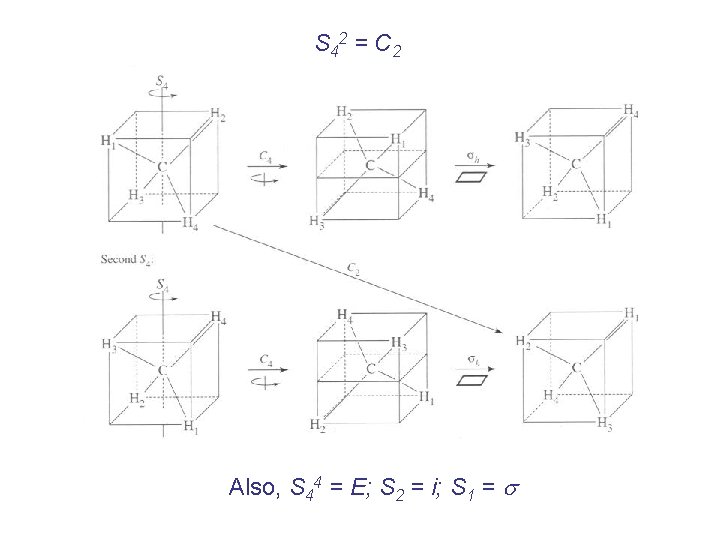
S 42 = C 2 Also, S 44 = E; S 2 = i; S 1 = s
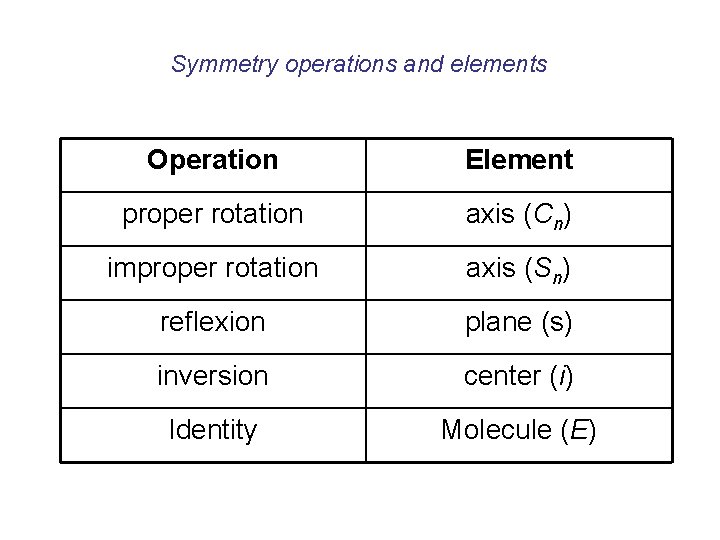
Symmetry operations and elements Operation Element proper rotation axis (Cn) improper rotation axis (Sn) reflexion plane (s) inversion center (i) Identity Molecule (E)
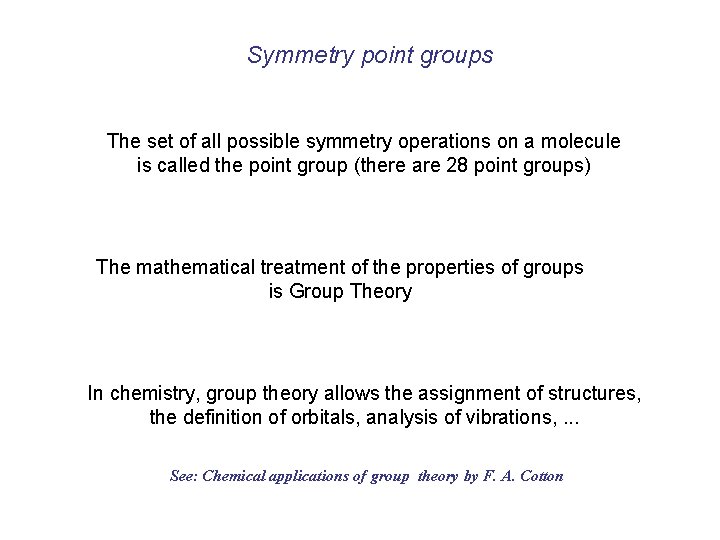
Symmetry point groups The set of all possible symmetry operations on a molecule is called the point group (there are 28 point groups) The mathematical treatment of the properties of groups is Group Theory In chemistry, group theory allows the assignment of structures, the definition of orbitals, analysis of vibrations, . . . See: Chemical applications of group theory by F. A. Cotton
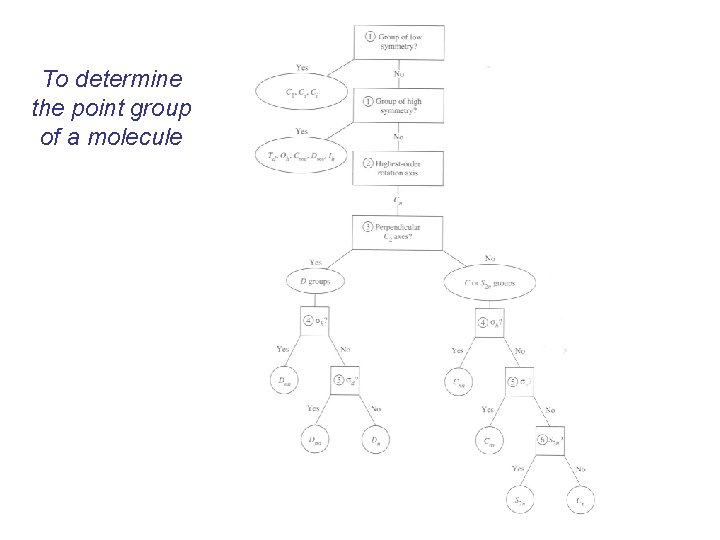
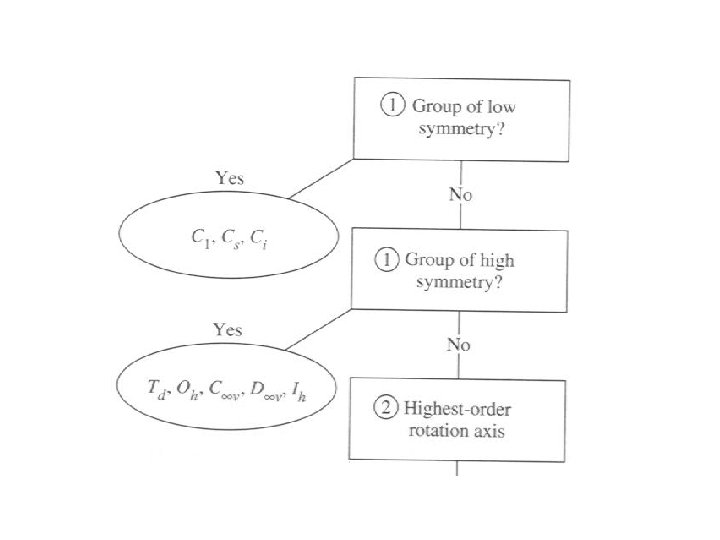
To determine the point group of a molecule
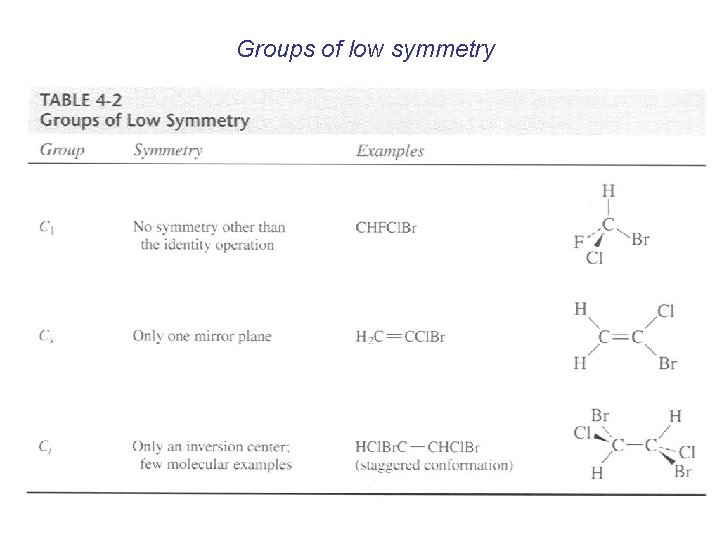
Groups of low symmetry
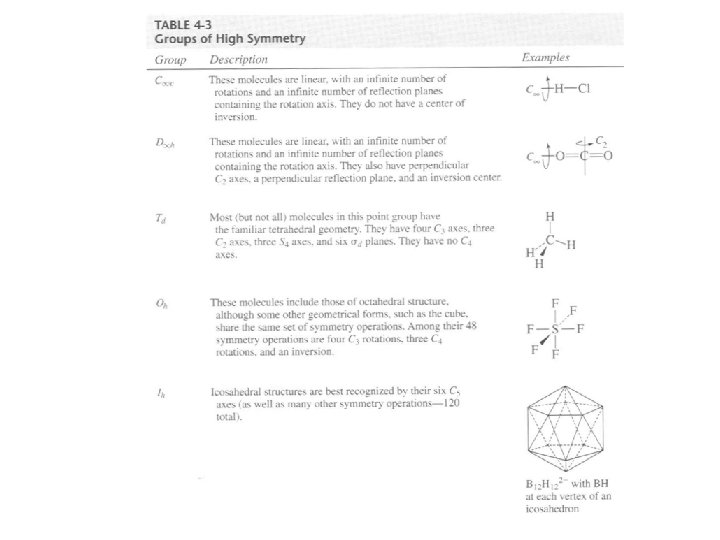
- Slides: 94